
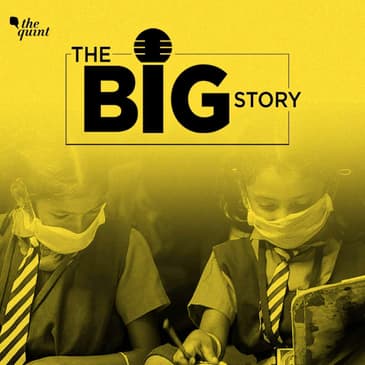
This episode of The Big Story is not going to be about the headline making news, it's going to be about an issue which is very close to us here at The Quint.
Two years since the onset of Covid, India's schools have almost re-opened, but millions of underprivileged students aren't going to be returning to schools anytime soon.
We at The Quint, wanted to look into this long-term impact of Covid on girls' education through our video series — Ladki Hoon Padhna Chahti Hoon – India's Girls Out of School.
If you look at the data, according to UNESCO, almost 1.8 billion students globally have been affected by school closures in the pandemic. Around 320 million of them are in India alone, and out of this at least 158 million are female students.
And it's not just this UNESCO data alone. Ever since India started relying on digital classes for school students from 2020, there have been several parallel surveys and analysis to shed light on who have been impacted the most by the school closures during Covid and how. Most of these surveys and data point to the one fact that girls especially from caste and economic minorities became the bigger casualties of the pandemic.
So we decided to go to the faces behind these numbers and meet the girls whose dreams have been shattered and who childhoods have been lost. Tune in to The Big Story!
Host and Producer: Shorbori Purkayastha Editor: Shelly Walia
Interviews: Sadhika Tiwari and Mythreyee Ramesh
Music: Big Bang Fuzz
Listen to The Big Story podcast on:
Apple: https://apple.co/2AYdLIl Saavn: http://bit.ly/2oix78C Google Podcasts: http://bit.ly/2ntMV7S Spotify: https://spoti.fi/2IyLAUQ Deezer: http://bit.ly/2Vrf5Ng Castbox: http://bit.ly/2VqZ9ur
Learn more about your ad choices. Visit megaphone.fm/adchoices
[00:00:00] You are listening to The Quint's podcast. This time around marks a year to the deadly second wave of Covid. While 5.2 lakh people lost their lives to the virus in India since 2020, there have been many repercussions of this pandemic. And this episode of The Big
[00:00:25] Story is not going to be about the headline making news. It's going to be about an issue which is very close to us here at The Quint. Two years since the onset of Covid, India schools have almost completely reopened but millions of underprivileged students aren't
[00:00:40] going to be returning to schools anytime soon. The voices that you just heard belong to Kajal, Zainab, Natasha, Rinky and her younger sister Pinky. All school-aged girls were forced to drop out of the studies because of the pandemic
[00:01:38] and poverty. And we at The Quint wanted to look into this long-term impact of Covid on girls' education through our video series, Larki Hu Parnachati Hu, India's Girls Out of School. If you look at the data, according to UNESCO, almost 1.8 billion students globally
[00:01:54] have been affected by school closures in the pandemic. Around 320 million of them are in India alone and out of this, at least 158 million are female students. And it's not just this UNESCO data. Ever since India started relying on digital classes for school
[00:02:10] students from 2020 onwards, there have been several parallel surveys and analyses to shed light on who have been impacted the most by the school closures during Covid and how. And most of these surveys and data point to the one fact that girls, especially
[00:02:24] from caste and economic minorities, became the bigger casualties of this pandemic. So we decided to go to the faces behind these numbers and meet the girls whose dreams have been shattered, whose lives have been altered and whose childhoods have been lost. You won't
[00:02:39] find their stories in the mainstream media, so we wanted to bring up this issue into the limelight. Your tune-ring to the big story and in this episode will bring before you the stories of some of these girls. I'm your host, Shorburi. All the
[00:02:57] education is a fundamental right of every child in India. More often than not, it becomes a privilege for girls. Even before the pandemic, the school dropout rate and enrollment rate for girls was a big area of concern in India. Sometimes it's poverty,
[00:03:12] other times it's puberty or gender norms or caste, but the problem has been a constant. Let me paint you a picture with some stark data on girls' education before the onset of the pandemic. According to a World Bank report from 2018, globally nine
[00:03:25] out of 10 girls complete their primary education, but only three out of four complete their lower secondary education. In India, the highest dropout rates were seen in classes eight and nine, which is roughly the age when a girl hits puberty.
[00:03:37] A report by the National Commission for Protection of Child Rights from the same year stated that 39.4% girls aged between 15 to 18 years dropped out of schools and colleges and of the girls who dropped out, 64.8% were pushed out
[00:03:52] of education because they were forced to take on household chores or engaged in begging. The annual survey of Education Report from 2017 also found out that 32% of girls were not enrolled in schools compared to 28% boys. The report
[00:04:06] also said that there were measures to bridge that gap in primary level education, but it was largely lacking in secondary level education, which meant that once a girl dropped out, she was likely to find it difficult
[00:04:17] to re-enter school. And this was the situation before the pandemic goes without saying that the existing factors only exacerbated further in the past two years. Kajal, who is an 18-year-old girl, had to drop out of class 10 to
[00:04:29] pursue a job. My colleague Sadhika Tiwari met her in a home in Delhi's Madanpur, Khadir. Her mother works as a house help. Her father, who worked in a courier company, lost his job after the pandemic struck and Kajal,
[00:04:40] who is the eldest among her four siblings, had to quit her education two years back in 2020 to support her family. Unfortunately, a few weeks after the quints spoke to her, Kajal also lost the job that she had gotten after
[00:04:52] quitting school. Now, school and education are just stories of the past that she reminisces on. My school was full of great teachers. I could help others by becoming a nurse. I wake up in the morning, do some work, take a bath, get ready for the
[00:05:34] house and go back to my office. You go home and do other work? Yes, I do the dishes. I cook when my mother makes food. She works at home and we get up late. We don't have fun anymore. What can we do?
[00:05:54] When I used to go to school, I would talk to my family about what had happened in school today, what had happened to my mother, what had happened. I would tell them everything. And nothing else. Nothing to tell them about.
[00:06:06] I don't like to read. I don't like to joke around. I don't like to talk to anyone. I like to study. When I used to go to school, when I used to do something, my mother would proud of me. That's why I used to like it.
[00:06:28] I didn't like listening to her. I liked it a lot. Now I don't say anything. I go to work, go to my house in the morning. I don't like going to my house. My mother goes to the court.
[00:06:45] That's why I feel bad that she goes to the court or I don't want to go home. That my mother works at the court. I feel that it is important for me to work at the court like my mother does.
[00:06:59] My mother studies, and then we don't get to be at this age. Ma'am taught me not to be weak. If you concentrate on your studies, you can stand up and stand on your feet. You can move ahead. You won't need anyone else.
[00:07:18] If you study, you won't be able to do anything. Studies are everything. First of all, studies. As unemployment levels rose, pushing close to 75 million Indians into poverty, no money in the house meant no money for school fees,
[00:07:36] no money for phones or computers or internet to keep up with online classes. And this economic impact of COVID was felt disproportionately in the education sector. For instance, more rural children were likely to drop out of schools than urban children.
[00:07:51] More socially underprivileged children were likely to drop out than those who are not. And more girls ended up dropping out than boys. And like Kajal, there are at least 10 million girls in India who could drop out of secondary education due to COVID according to data
[00:08:06] provided by the Right to Education Forum. And 1.6 million girls in India aged between 11 to 14 years are already currently out of school. This means that it's not just education that they're being deprived of, rather they're at the risk of repercussions of losing out on education,
[00:08:21] be it early marriage, early pregnancy and economic instability. Now listen to Natasha and Zeynab's stories. Both are 18-year-old girls who dropped out of school in 2020 when money got tied in their family. I used to make breakfast, pack my tiffin, go to school,
[00:08:57] play some games, study, and then come back home. I used to have a good time the whole day. Now I'm going home from job to job. Is there any friend who is going to school? No. Everyone has gotten married. She was a friend of a classmate.
[00:09:23] So she must have had a few things to do at home. So she got married at the age of 15. No. Because we get married at a young age. So you're afraid that if you don't study, you'll get married if you don't go to school?
[00:09:38] Because my mother used to say that she wouldn't let you get married. So you don't want to get married? Because if anyone is doing a job or studying, they think that they don't want to do anything. They just want to stay at home. They think so much.
[00:10:10] Zainab's father, who is a rack picker, also told the quinn that even though her teachers would say that his daughter needs to continue their education, he didn't have the money to buy a smartphone for online classes. Her parents say that there was no other option but for Zainab
[00:10:24] to drop out of school. Now she is worried that she will be married off. Tabasam Sheikh from Mumbai's Govandi area also shared the same fate as the other girls. She and her siblings dropped out of school soon after their mother
[00:10:34] lost her job as a security guard in a mall after the lockdown. Tabasam recounted to the quinn's gender reporter, Maitreer Amesh what how carefree she was in school, how she danced at school events and how she was preparing to give her class 10 exams
[00:10:48] and how she wanted to be a police officer. Instead of living that life, Tabasam had to become a COVID caretaker in a hospital where she cleaned toilets, took care of patients infected with the virus in order to support her family. She says that it's not her mother's fault,
[00:11:03] it's the pandemic that shattered her dreams. Sir, madam, whatever I used to teach, all that was done with good care. Learning everything and when I came to school, I remember a lot. And then coming home, studying again, going to class, it felt really good.
[00:11:44] The situation is dire but not irreparable. I invited my colleague Maitreer Amesh who shot the video from Govandi and covers girls and women for quint to join me in the podcast today. Maitreer, I'll get straight to the point here.
[00:11:57] Can you tell us what is to be done at this point to get girls back to school at a policy level? Yeah, thank you, Shorburi, for having me. So I think one of the first things that policymakers and the government needs to realize
[00:12:10] is to first recognize the problem. I think that's where the fault lies. We have been as a government, both at the center and the state level, have not recognized that girls are not returning back to school at par with the pre-pandemic levels.
[00:12:26] But that said, we should also not see these girls not returning to school as an isolated issue. They are not returning due to various reasons. Even if you make education free, we have to recognize that girls are not being sent back to schools
[00:12:46] because they are engaged in employment now because someone who was an earning member in the family has passed away due to COVID. Girls are also not returning to schools because they are being married off because in India it is perceived so-called perception is there
[00:13:03] that the girls' children are like burdened to their parents. So these are related issues that should be recognized in order to also make sure that girls are returning back to school. But that said, one of the points that came up in our conversation earlier
[00:13:23] was also how there are lack of bridge courses when it comes to secondary education. After food standard, when students are returning back to school after a gap of two years of digital education, what is being done at the school level,
[00:13:39] what is being done at a very decentralized level to make sure that the students have caught up with what has been going on and what has been taught for the last two years. So one example that I would like to take here
[00:13:53] is the case of the Tamil Nadu government which had volunteers in every area, in every colony they had invited. They had called for volunteers who can actually gather six, seven students and teach them. It's sort of like a tutorial if I can say so.
[00:14:12] So this was done beyond school hours to also ensure that students from a particular colony who are studying in the same class are also caught up with what is going on elsewhere. So that I think is a model that is also easy to replicate
[00:14:32] at a very decentralized level. So recently, the Kendra Vidyalaya had announced that across India, they will open up schools which are completely free for COVID offence. Such policies can also be thought of for girls who are not returning to school not just at a center level
[00:14:52] but at every state government level. So I think these are some of the things that can be brought into our policymaking and should very seriously be thought about to bring girls back to school. Maitreya, can you share with us how the process was to finding these girls
[00:15:09] who had dropped out of school? Where did you go? What did you have to do to gain that trust to get them to tell their stories to us? Yeah, so it was a very, very long process to even find students and girls who have dropped out of school
[00:15:24] not because they are rare in numbers but because of the main fact that often, very often parents and even the girls themselves they internalize that it is their fault that they have not returned to school after the pandemic. They do not realize that
[00:15:42] it is because of the government, it is because of lack of policies that are inclusive to bring these children back to school that they have not returned. So personally I had to visit at least two-three areas in and around Pune and Mumbai
[00:16:00] did a day-long recce, spent a lot of time with girls who have dropped out of school during the pandemic and have not returned but the biggest concern and the biggest obstacle that I had in convincing them to speak was because a lot of them thought
[00:16:18] it was their fault it was their financial situation that was not letting them go back to schools. So I had to spend a lot of time also explaining to them that they are not going to school not because it is their fault
[00:16:34] the parents are not sending them to school not because their parents have an internal motivation. In fact, most of the parents I met really, really wanted to send their girls to school. So that was the biggest part to sort of convince all the stakeholders that they have to
[00:16:56] talk about it. The second thing which I again found a little difficult was to gain their trust now most of the children are between 10-14 years of age so how do I gain their trust? How do I tell them that it is okay
[00:17:16] for them to tell their stories and that was something that I had to work on we had to frame questions in certain way and we had to get to know the girls well in advance before we even approached them we do not practice
[00:17:31] the sort of journalism where we just go and put mics in front of their faces so we really worked on getting to know these girls then coming up with a detailed shoot plan and to make them most comfortable in telling their story. And one instance
[00:17:48] that I want to talk about again about Falak Shah who is an 8 year old child from Govandi in Mumbai from where my story is based out of when I went to meet her there was a tuition class that was happening right next door to her house
[00:18:06] so there was this teacher sitting with like a bunch of girls and boys her age and you know the teacher was just having like a regular tuition class and then I entered like her building the first thing I saw standing outside and just peeping into the class saying
[00:18:22] hi, hello to like you know the kids who were coming for the tuition class but it was such a stark image that she could not enter such a space and she could not be a part of the children who were learning so how do you convince
[00:18:38] a 10 year old how do you make a 10 year old trust you to tell her story and everything that is going on inside her mind another thing that I found very interesting and also sad when I met these girls were that you know going to school
[00:18:56] is more than just education it is more than just sitting in a classroom and learning for a lot of girls it's about the freedom to just go out you know the freedom to be with their friends yeah exactly the freedom to be themselves they are in a space
[00:19:14] where they are not anybody's sister they are not anybody's daughter or granddaughter so I think more than that the older girls that I spoke to for example Tabasum was a class 10 pass out but she could not join the 11th class because
[00:19:30] she had to drop out during the pandemic and she actually also worked as a COVID caretaker in hospital in Mumbai so you know she said that all I wanted to do was to laugh with my friends but you know I was taking care of COVID patients
[00:19:48] I was cleaning the toilet this is not the life that I not the childhood that she you know should get exactly so she kind of lost out on you know two precious years which she could have spent with her friends just getting to
[00:20:04] you know just growing up among like minded people so yeah so for a lot of them it was also more than just losing out on education so yeah that was one of the aspects another story that we have a story that is
[00:20:20] just going to come out on the quaint is a story from Jaipur now here it's a very unique story where our reporter Tabina Anjum has looked at girls who were married off during the pandemic now again she has met this really moving case study of a minor girl
[00:20:42] who was married off during the pandemic and who also gave birth to her child during the same period and she has spoken to us about how she was not able to feed the baby because she did not have enough to eat herself so you know
[00:21:00] as I had also mentioned before we should not see these stories and this entire series as just girls losing out on education it is just much more than that it is the loss of freedom for so many it is the loss of childhood
[00:21:16] and it is the loss of dreams and you know nutrition as you mentioned in the story nutrition and malnourishment exactly also yeah you are absolutely right because girls who are also going to government schools will you know also be enrolled in the midday program so yeah they have
[00:21:36] lost out on just so much and also like you know there was when I went to shoot in Govandi with the team I had zeroed in on two case studies and you know I was going with a plan that I will get
[00:21:50] these two girls to speak to us but when I went there I also want to give our listeners of you what kind of area Govandi is it is one of the lesser privileged areas in Mumbai so you know I also got to realize when we were shooting
[00:22:08] there was so many people who were coming and telling us that our child is also you know not gone to school after the pandemic is there anything you can do to help us you know there were girls who were almost you know going to pass out of 12
[00:22:22] standard and then had to sort of back out due to financial situation and that's how I came across Mariam whose story again is very moving because her father became bedridden during the pandemic and the mother at the age of 55 had to take on the burden of
[00:22:38] the household she was working as a domestic worker and Mariam was you know helping her mother in various you know opportunities that the mother got and had to completely drop out of school and the teacher apparently asked her that why do you not have the means to get
[00:22:56] smart phones so you know these are very like it might seem like a very small thing but these are things that change people's life so in an area like Govandi which is right here in Mumbai which is the financial capital of India
[00:23:10] so there were so many more stories you know that were there in that area beyond the stories that we have told so also look at if we look at India on hold sometimes I wonder like you know how many girls are there like that if we can find
[00:23:24] so many stories in Mumbai what about the areas that are not so interesting Absolutely indolent How do we tell those stories because and we really want to reach out to those areas and we really want to tell stories of girls from there as well
[00:23:42] And we have also just gotten word that one of the girls that you had interviewed 8 year old Falak Shah from Mumbai is going back to school So Maitreya would you like to share this quint impact story with our listeners Yes of course so we are very very happy
[00:23:56] to inform that Falak Shah who was actually in class 2 when the pandemic started she was forced to drop out of school because her dad lost his job and he had to you know taken other forms of employment and he could not sustain the family
[00:24:14] enough to send Falak to school So you know this was a family that was struggling to have 3 meals a day during the pandemic and sending their daughter to school was really not on their priority list So it was you know when I met her
[00:24:30] she told me this one line that I think has really stuck with me you know she said that all my friends have moved on to class 4 but I am still in class 2 so I think it was so heart breaking but yeah so after the video was out
[00:24:46] the India Cares foundation came forward and they said that I would like to sponsor Falak Shah's education and right now she has been enrolled in another school and she will be starting her 4th standard like you know she wanted to be in this June
[00:25:06] That's great but finally also let's talk about what we can do you know how can us citizens or the Queen's listeners aid these girls to get back to school So there are two things that our listeners can do one is to support us to tell such stories
[00:25:24] so you know telling these stories finding these case studies convincing them to trust us and tell us their stories involves a lot of time it involves a lot of effort and also much post production expenses So you know one way that the listeners can support us is by
[00:25:44] supporting the Queen to tell more such stories and if you want to directly support the girls and help them return to schools you can write to us at hopeatthequint.com and we will get back to you with the details of the girls so that you can
[00:25:58] support them to return back to schools Okay thank you Maitri Thank you thank you Let me also tell you that we are doing many more stories around this issue from Rajasthan from West Bengal from the northeast and we need your support if you want to
[00:26:12] help us tell these stories so if you are interested in the stories of the girls please visit our website and click on support special projects and you will find all the details there and as I wrap up this episode today let me also tell you that we are
[00:26:28] planning something newer, bigger and better for the big story podcast we will share the details with you soon so watch out for this space If you like listening to this episode please subscribe to the big story playlist for episodic updates
[00:26:42] and for podcasts please log on to the Quint website and check out the podcast section for any feedback shoot an email to podcast at thequint.com Thanks for listening Log on to the Quint's website and check out our other podcasts