
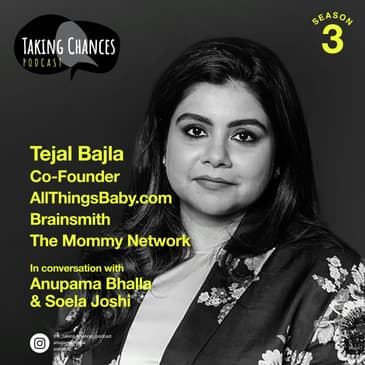

Tejal Bajla is a visionary leader committed to simplifying the lives of new parents in India. Through her ventures, AllThingsBaby.com, Brainsmith, and The Mommy Network, she provides high-quality products, genuine advice, and robust support systems to families.
Renowned for her expertise in consumer marketing and brand management, Tejal has successfully built brands that stand out in today’s competitive market. Her commitment to excellence and innovation makes her a prominent figure in the Mother & Baby sector.
This episode is truly a master class on building brands with many how to and what to insights. Do listen up as she shares the unique needs for women in the industry, and how we need to be more open about our experiences and share with other women who are coming down the pipeline.
This is Taking Chances.
[00:00:00] Hello and welcome to our podcast Taking Chances with me, Soela Joshi and my co-host Anupama Bhalla. Yesterday is Tejal Bajla, a visionary leader committed to simplifying the lives of new parents in India. Through her ventures, AllThingsBaby.com, Brainsmith and the Mommy Network,
[00:00:19] she provides high quality products, genuine advice and robust support systems to families. Renan for her expertise in consumer marketing and brand management, Tejal has successfully built brands that stand out in today's competitive market. Her commitment to excellence and innovation
[00:00:36] makes her a prominent figure in the mother and baby sector. This episode is truly a masterclass for building brands with many how-to's and what-to insights. Do listen up when she shares the
[00:00:47] unique needs for women in the industry and how we need to talk about this and be more open about our experiences and share with other women who are coming down the pipeline. Welcome Tejal, so happy to have you on our podcast Taking Chances.
[00:01:02] Tejal, so we finally meet and we are finally doing this podcast. It's been a long, long wait but we are just so happy to have you on Taking Chances. You know it's honestly my
[00:01:12] pleasure Soela and Anupama and thank you very much for this. I am fairly shy and reticent here so this is my first but very excited and thank you for the opportunity. Okay great,
[00:01:22] so let's get into it immediately. So the first thing that we want to know is about your growing years. So let's start from there also from your growing years to becoming an entrepreneur,
[00:01:32] what is the journey that you've taken? Yeah, so I think I'll start a little bit about the childhood and the early influences in terms of work and things like that because I feel
[00:01:42] like my story is that of like everyone else's, some of all the experiences I've had which have culminated into me becoming an entrepreneur. So I was raised in a typical Gujarati business household where business was always dinner table conversation but we also had a very mixed sort
[00:02:01] of upbringing where it was not just all about education, academics, commerce, but it was a lot of culture, the arts, grew up with lots of writers. My dad was heavily into music and
[00:02:13] philosophy and all of that so abundantly rich in terms of the cultural heritage. So that was the landscape and the environment that I grew up in and in all of this my mother has really been
[00:02:24] what I would call as the sutradha, the enabler. She's actually a very, very smart woman who gave up her career to raise three really bright children as I'd like to believe. So that
[00:02:35] was really the early influence. She was a tiger mom in many ways. We were always made to excel and given lots and lots of opportunities and platforms to display our skills, our talents and so on and so forth. So very rich emotionally, culturally, academically sort of
[00:02:51] an environment that I was brought up in. So very happy memories of my childhood and things like that. And I think all of this kind of led me to becoming fairly ambitious. So excellence was
[00:03:02] always valued in the home and you could do anything but you had to be really good at it and it could be any one thing that you chose to do. But excellence is something we were always
[00:03:13] asked to chase and I think that stayed on right? So through the formative years that was life and then you know you move on to university and college and things like that. And for me, I was
[00:03:23] always, always very curious to understand the world of business, how large organizations work. No one had ever had a corporate job in my home or in my distant family for that matter. And at college, everyone seemed to want the McKinsey's of the world or the Unilever's of the
[00:03:41] world and that all was very exciting that chatter around business school and things like that. And so I decided that I'll be the first. So I decided to apply for a summer internship to Unilever. I almost drove the HR manager mad saying you know they never actually
[00:03:56] recruited from the non-IAMs and I went to a regular business school in the UK. So I almost drove her mad to say you know give me a job and I just want to have an internship.
[00:04:06] I want to get a taste of the corporate life. So Leavers happened to me at age 19, the first summer internship in the haircare team and I was extremely enthralled with this whole world of you know large corporations, brand building, excellent minds, perhaps the best I have ever
[00:04:24] yet worked with because they truly truly poached and bring the best and pulled them all together. And then I went back every summer and those are the years where I was this young girl
[00:04:33] who was willing to do it all right? So I was the one who would even stay even after the ACs were switched off and at that time they for the work-life balance they would switch off
[00:04:42] the electricity at 7 p.m. and that was a Unilever thing but I'd stay on till like 8 30 carrying passers down for launch and things like that. So you know early years were at Unilever that
[00:04:52] landed me a pre-placement offer when I first graduated and I came back into the brand assistant team in the oral care department. So that was the first and I think perhaps the best university I have ever been you know too and that's where I learned everything about product
[00:05:09] development, branding, consumer insights, working in large teams, market research all of that. But you know those were early days. I wasn't ready to settle. I was very you know excited to kind of find out and discover more about myself. So within two and a half years of
[00:05:25] the whole full-time stint I decided to try my hands at something new. Along came a company called Backer Roads where I spent time working with a brand called Shiseido and that gave me an experience into the brand management of premium products. So they basically brought
[00:05:41] premium products and fragrances into India. I loved what I did there because I had done mass market or FMCG products at Unilever and then I transitioned to premium products at Backer Roads. I had that stint for another two years and that's when I realized that
[00:05:55] I resonate deeply with the premium audience and that's truly where the whole theory of I understand premium much better than I understand consumer goods really happened. So that was Backer Roads. After that I kind of wanted to have a very near entrepreneurial experience
[00:06:13] because the end game was always that you know I do want to do something of my own but I'm not sure if I'm equipped yet and these are all the you know the formative years.
[00:06:20] And so I joined a company called ASK Wealth Advisory and Morgan Stanley which happened in you know one after another but both where I used to be in private banking. Now the exciting part
[00:06:30] about private banking was A. you got to run it like your own business because you manage your own book of clients and things like that but more importantly while giving investment advice to you know Aljo high net worth individuals the interactions with the entrepreneurs and
[00:06:44] the stories that they had to tell and the businesses that they built that is really what captivated my interest right and I think that's what saw the seeds saying I really want to
[00:06:54] be on the other side of the table and yeah so I think that's that journey was so incredibly powerful and I think that was truly the birth of me wanting to be an entrepreneur. So I took a break
[00:07:05] after Morgan Stanley because I was going to give birth to my first born and then stayed at home for three years because that's what I saw my mom do best only to realize that I found so many
[00:07:15] gaps in the baby space and that's how you know it led to building out the ventures one after another but the birth of the entrepreneurship came from my private banking experience. Right let's talk
[00:07:26] about these three ventures you know and I was reading up you know all of them and you've got like three ongoing businesses if I may say so so you have Brain Smith you have the mommy network
[00:07:36] is where actually at first you know came to know about you I'll be very honest and then there was all things baby.com so tell us about each of their genesis and most importantly
[00:07:47] how do they integrate in the vision in your overall vision? All of this Soela and Anfama was very very organic right the way we kind of built it out so I was ready to kind of you know
[00:07:58] dive back in and at the time you know it's as a mom as a new mom the most natural thing especially when you've kind of looked after a new baby is to find all the gaps and products that you
[00:08:08] didn't find you know easily available so the first thing that I kind of ventured out was with Brain Smith and I wasn't very ready at that time to really build out a business on my own because
[00:08:19] my baby was really little and I needed a co-founder and it was honestly with my husband's push at the time who I'm very grateful to that we managed to find a co-founder for myself
[00:08:29] and decided to launch Brain Smith. So Brain Smith is our brand of early learning tools, toys and nursery furniture where we actually you know provide parents you know and equip them to
[00:08:40] make learning and play time a lot more fun. Now the landscape at the time was that you know we were really dependent on imports for anything to do with early learning material so it was
[00:08:52] a really small project really we didn't have a vision and I want to be very candid here right it all started with a very small idea that I wanted to inspire parents to really see
[00:09:01] you know what their little one is capable of doing and provide them that stimulus material to say hey you know you can make that time that you spend with your child very meaningful and I think that's
[00:09:11] where it is right the idea that we kind of built around and then there was a company born which is Brain Smith. Things were great because you know we really believed we had built a great
[00:09:21] brand we had backed it with good products the initial excitement around consumption was very good we got a lot of good feedback along the way I you know I was also a new mother right
[00:09:32] struggling on many aspects as many nuclear parents were so where do you find help or do I do with my baby if they have fever in the night and we're all living in nuclear setups you know for the
[00:09:43] first time and that kind of you know gave birth to the mommy network which I created with two other friends who were also new mums and we said hey why not build a community
[00:09:54] where we add like-minded parents to you know share advice and give recommendations and help one another and make it really judgment free etc so that was the birth of the mommy network and we created a
[00:10:05] Facebook group it was really as simple as that and we just added friends and friends of friends that moved today it's 15,000 mums only in Mumbai. The reason we actually only added friends and
[00:10:15] friends of friends is not to really isolate anyone but to kind of ensure that all the advice that came out of that community resonated with the other right because sometimes a monk who comes from a very different mindset will give advice which doesn't resonate with somebody who perhaps
[00:10:32] lives in a much smaller town right because her exposure is very different so we decided to create a like-minded community so the community was purely organic and the premise was judgment free sharing for new mums and that was a read back then we created this many many
[00:10:47] years ago so that was the mommy network and of course we do a lot more with the mommy network which I will share shortly but I must tell you about the pivot so what happened along the way is
[00:10:57] so mommy network is something we built with two other partners Brainsmith is me and my co-founder and we realized and we were bootstrapped and we realized that you know sometimes it's not just
[00:11:07] about an idea how large can that idea scale is what really matters and I think that's when you enter the industry and you discover that okay I mean I'm very passionate I've got to solve
[00:11:17] we've got great products but how large a business can we build out of this and what is it going to take to build that sort of a business and we realized that you know it's the ceiling is very
[00:11:28] low for the toy space especially the premium category that we were looking at we desperately needed to pivot otherwise we would have to shut shop and that's when we you know kind of built all
[00:11:38] things baby so the genesis of all things baby really came out of saying you know we don't have money to support Brainsmith because building a brand is extremely expensive and you need to
[00:11:49] really really scale it up with a lot of money and marketing and things like that which we didn't have we were also not very very confident of our product market fit and the fact that
[00:11:59] Brainsmith alone would take us to build a scalable business and we said okay let's look at it more from a consumer basket right and again this is where my husband who's always
[00:12:07] been my advisor stepped in and he said look if you all don't kind of look at it as a consumer in totality you might actually not land up having a business so we looked at it more from the you
[00:12:19] know aspect of what is it that this mother that we're talking to because we already got a lot of traction etc need besides you know wooden toys and flashcards and nursery furniture and we realized that the solve is far larger than just you know toys and educational material
[00:12:36] so we basically landed up bringing in a distribution so we set up a distribution company first which is at all things baby we have two parts which is the dot com and the distribution and we kind of solved
[00:12:48] for bringing in multiple brands and products from international players into India and this actually inside also came and was vetted by the community at the moment network right for us it became a very interesting way to create focus groups understand that consumer really
[00:13:03] well so we set up a whole distribution company now the landscape then in India was that if you needed anything international in the baby space you would either have to request friends and family to carry
[00:13:14] it back or you would have to kind of get it from the green market supply and we said hey I think here's where we can solve for bringing it in authentically so we kind of first created
[00:13:23] a distribution company where we brought in premium baby brands into India and then backed it up with a dot com which is a whole curated platform which not just has our products which we
[00:13:35] bring into India but also other products from across the country and the world which we make available for the Indian audience so it's a one-stop shop for anyone seeking a high quality premium product in India and as state has it we eventually kind of built all these businesses
[00:13:50] parallely and house them under one umbrella which is all things baby so today all things baby has the mommy network which is the community it has brainsmith which is our own brand of toys and you know flashcards etc a supply chain where we represent over 35 international baby brands
[00:14:08] exclusively in India and the dot com which is a one-stop curated platform and that's how really all of this comes together and ties in with our longer term mission of simplifying the journey for Indian parents really where it's not just about products but it's about advice and
[00:14:24] hand-holding and all of that and we do this through the four verticals. So I think that's great advice whoever gave it to you and I think great thinking and great work so that's pretty 360 degree
[00:14:35] patient. You know I honestly want to say that here I wouldn't take credit for it because it wasn't really advice it wasn't really 360 thinking it was so organic that we just chose an industry we dived right in we kept discovering gaps and we decided to fill it in
[00:14:54] which then all became into this beautiful umbrella which we are now very proud of right so I wouldn't want to take all the credit for the thinking but I definitely want to say that
[00:15:03] you know being really agile and thinking on the ground not having to give up and staying resilient really holding it on helped. So you know my next question is coming from exactly
[00:15:14] what you're saying filling the gaps and looking at the baby market so you know there was somewhere in the mid 70s decades ago mother care came to India and then there were many years past nothing
[00:15:25] possibly J&J came in next and stuff like that so it really wasn't much happening for babies and if you look at it today it's like a multi-layered market right age wise sex wise and you know
[00:15:35] you can just get anything for kids and all brands are getting into it as well. So obviously you are in it as well so you obviously assess the market so what do you see
[00:15:44] as the opportunity in the baby market in India what is it all about what is the net worth of this market and you know so one bet on it and how much are you betting on it.
[00:15:53] To talk about the market as a whole of course it's a very very large market and as you rightly pointed out right consumer India is many indias and there's something in it for everyone of course
[00:16:04] you know the baby market has suffered immensely because we've not earned a very good reputation you know there has been a lot of money chasing it briefly and then again not and only because
[00:16:14] you know we see that people think you know babies grow up and then what's going to happen but you know there are also lots of new babies being created so I have multiple takes on this
[00:16:22] but I feel like the key growth drivers you know for the baby industry and we talked to a very very small niche and I think we've intentionally chosen that niche right. So for us we talked to 5% of Indian parents and that you know in India even a small
[00:16:38] percentage is a very large percentage it's a very large number and I want to give you that example right because iPhone is perhaps the closest parallel I can draw it has a small share of 5% in India
[00:16:47] but globally that contributes to 4%. So you know we've obviously received a lot of flags saying hey you're too premium and you're only talking to a small audience but that's where the consumption is. Of course they have consumption at many other layers as well but small in India
[00:17:01] is large enough to talk to so we've chosen that niche because we've understood that niche really well and then we wanted to kind of solve only for that niche and stick to that proposition.
[00:17:11] Now in this particular niche that we talked to of Indian parents we see certain trends that are just you know amazing and that's why we're so buoyant in kind of building this out and one of the things is if you see increasingly affluent Indian exposed parents are having
[00:17:26] lesser children and that kind of increases the amount of money that they spend per child that is you know one and this is all driven by the sentiment of I want the best for my child.
[00:17:36] So that's one driver the other time is that you know in India we're actually living at a time where we are the most photographed nation right and everyone is increasingly making aspirational choices driven by a deep desire to really create picture-perfect memories so that's
[00:17:52] really leading to consumer choices which they wouldn't have earlier exercised just so that they could show things to the world and create those picture-perfect moments so I think that's another driver where increasingly affluent parents are making aspirational choices.
[00:18:06] The third is you know peer group and community back in the day you know all the advice that came to parents was from their own parents so the grandmama and the nani would be telling the
[00:18:15] mother what to do today and nobody is listening to their parents because they think they're outdated that advice doesn't cut it from there and all the advice is coming from the peer group and community and that is again leading to this large consumption that has been
[00:18:28] driven because you're always wanting to make the same choices as your peers. The nuclear family set up right and I have some crazy examples to give you there but the nuclear family set up you know most of them are double income households or you know the parents are
[00:18:42] living alone where they can make and exercise those choices for their little one. I mean so much so that you know back in the day when we used to go and set up these boots for all
[00:18:51] things baby in multiple cities we would see you know this crazy interaction between a mother-in-law and daughter-in-law. The you know the daughter-in-law has kind of made that choice to buy a very expensive stroller that she really aspires to have for a little one and then the minute she
[00:19:06] hears the price she kind of says okay because the mother-in-law is watching to say okay I'll come back for it and kind of walks away but you know the back consumers come back and
[00:19:15] made that purchase on her card when no one's watching so I think that's another one right so I think we're only getting started and then you know how can we forget that you know the
[00:19:25] aspirational milk class everyone's being driven by how do I climb that ladder to get to the next level of what I can afford or what I should be affording so and again children in India is extremely
[00:19:35] emotional right I'll cut out something for myself but I want the best for my child. So I think all of these aspects put together we're perhaps looking at a very very good time in
[00:19:44] India for the industry and certain things and gaps that it really exists right while India has the ability to consume in terms of Indian businesses in the baby sector we see very little innovation so you'll seldom see a really nicely innovated highly researched baby stroller brand that's come
[00:20:02] out of India. So on the gear space the stroller space we still have a long way to kind of cover on that side of things but of course we've got lots of brands from Indian companies which make
[00:20:12] beautiful diapers personal care so in certain categories we've got great products but in certain categories which are high on R&D we have we have long room to cover. Yeah I guess you rightly
[00:20:23] pointed out the aspirational milk class is massive in terms of numbers in India so Tegel going back to something that you briefly touched upon in the beginning which was the Mami network right now the communities are obviously exceptionally important in today's
[00:20:35] world of marketing and word of mouth is also really really important and influential but you're obviously also dealing with the target audience which is what should I say protective and if I may go ahead and say picky and paranoid as well so you're dealing with motherless.
[00:20:48] So what did it take to build this community of 15,000 moms and what does it take to keep them there as well so what do you do to make the community be continuous and active?
[00:20:58] You know so a lot of and I think community is now the buzzword especially with anyone having a consumer brand right. One of the things we did non-intentionally is built the community first
[00:21:09] because it was built true to its own core right so I think the first thing that we did is we were very authentic we built it around a cause of shared experiences we wanted an open platform for like-minded moms to come together and share advice recommendations without creating
[00:21:24] any judgment so we are very very stringent rules there so one is this whole you know safe place that we provided and Facebook at the time was perhaps the best platform to be on.
[00:21:34] Of course we had to transition over the years and so we also had an Instagram version where we would pull out the best learnings from our Facebook group to make it available to a wider audience
[00:21:44] the Instagram obviously subscribed by anyone across India so one is you know the whole authenticity with which the community was created and then the whole driven engagement how do you drive engagement how do you create trust how do you get people to really share and
[00:22:00] that is something that also happened very organically but we also drove it in the early days through a large offline presence and we kind of built out the offline properties not just the online
[00:22:11] property and I think that is one thing that really worked very well for us today if you look at communities everyone's trying to build a community every brand says oh I'm trying to
[00:22:19] create a community oh you know but what is a community at the end of the day yes of course shared experiences but how do people really get close we can't forget it is human beings and you
[00:22:30] know with especially with everyone becoming so digitally occupied in their lives what really worked for us is the offline aspect so we started creating smaller IPs at the mummy network which would provide opportunities for these mums to come out and interact with each other so one of the
[00:22:47] most popular things and you know you'll laugh if you discovered but our highest subscribed events at the mummy network used to be the mummy network drinks night and you know mums
[00:22:57] really wanted to go out and let their head out and have a go yeah and they used to be highly subscribed you know first access to a new restaurant and things like that and we never
[00:23:07] thought like that because we always thought that you know and we also hosted something called is the mummy network expert series if you saw the difference in sort of conversions it was quite mind-boggling so you know I think one of the learnings mums really want to have
[00:23:21] a good time because they are actually in the toughest phase of their lives especially in the early years right nobody tells you what to expect and then when they come out together
[00:23:29] and just have fun that is magic so we hosted a lot of the mummy network drinks nights and they were extremely popular the second thing we did was the expert series where we had access to you know sleep consultants nutritionists early learning specialists etc
[00:23:46] when mums could actually come together learn share have a good time to go back home so that was another IP then we also had play dates right where we could bring the children so access to perhaps
[00:23:58] the play areas or you know Christmas wonderland things like that where the mother and child could actually bond and I think one of the things that has been most instrumental in building the mummy network and I think perhaps that's why soela knows because the brand is so large
[00:24:13] in that sense is we really decided to be true to the cause of our mothers and as a mother who was in business I realized that the playbook that you need to launch after being a new parent is
[00:24:25] very different the support that you need the access that you need is very different from that of just a normal person entering business only because the early years can be extremely critical and we also realized in that community that increasingly a lot of mothers were very
[00:24:41] very aspirational in wanting to create their own little brands their own products because they would have discovered gaps and what we created was the mummy network pop up where essentially it was mums from within the community who had their own small businesses and they would get a platform
[00:24:55] to kind of open it up and then we opened it up for a shopping experience right so our first pop up we had only 25 brands created by mums from within the community and attended and
[00:25:06] shopped for by the other mums of the community and that project actually has become so large we've you know hosted over eight editions and now from 25 brands each year from within the community we actually have over 150 participating brands and it's attended by over 6000 folks every year
[00:25:23] only in Mumbai and that gave us you know immense immense satisfaction and popularity both and I think that has led to the success of the mummy network we actually provided mums a platform
[00:25:35] in the early stages to launch their small businesses and you know so many good big brands were built out of this platform ours included so that's the mummy network that's fantastic and now we're going to move forward into a conversation where we really pick insights from
[00:25:50] all this experience that you've gathered and I think that's going to be really helpful to our listeners so the first thing is that you know we've been seeing and we've been looking at Shark Tank and how successful that show has happened dinner table conversations today
[00:26:04] all about you know having your own business and having a side hustle in fact with the Gen Z is you know coming into you know when you talk to them you see how important for them a side hustle
[00:26:14] is and how they are looking at you know entering this area of entrepreneurship so I want to know you know from you which are the learning skills that you recommend for all new young
[00:26:26] entrepreneurs you know for becoming a successful one at that super I think you know one is as an entrepreneur you're ever evolving right so I think even I'm work in progress for that
[00:26:36] matter and we always are and if we're not perhaps we're doing a big disservice so I'll start with that but I think couple of things that are not negotiable or at least will hold
[00:26:47] you in good stead the first thing is sales and negotiating skills right I feel you're always selling as an entrepreneur whether you're selling it to your customers whether you're selling your vision to your employees whether it's about you know sharing or selling
[00:27:01] your story to your investors sales is really at the forefront of any entrepreneur's journey and so you have to be able to develop the ability to sell sell your vision sell your
[00:27:13] seller sell your brand sell all of that so that's one thing you know even at all things baby I think we've actually incorporated this very well where everyone irrespective of the function you're hired in has to do sales and and I fundamentally believe in that right sales
[00:27:27] teaches you about your customer if you don't know who is your customer and if you don't really know them well then you will never be able to do your job well irrespective of you
[00:27:37] being in the financial function or the marketing function or the production function so I feel sales is central to any entrepreneur's life that's one the second thing is I think agility right that's a skill that everyone needs to develop because it's no longer about your ability it's
[00:27:54] only about how agile you are in today's ever-evolving complex market so I feel like if you are ready to change pivot and frequently be able to adapt then you've got something going for yourself
[00:28:08] the third is the willingness to learn right again what you know does not matter how quickly and efficiently you're willing to learn is what is game changing because we are living in an ever-evolving
[00:28:20] consumer market so that's third one and I think my fourth and favorite one is empathy right hugely underrated because media only talks about successful people who have power attitudes strengths just exactly contrary or converse to what I believe I feel like empathy kindness being able
[00:28:40] to be vulnerable those are very very powerful for an entrepreneur because at the end of the day no matter what business you do you are dealing with human beings whether it's your teams
[00:28:50] stakeholders customers all of that and so if you can bring out your human side very authentically and and have that empathy I think it makes you a much better leader and entrepreneur you know
[00:29:00] in the largest team of things and one other thing is you know the ability to be able to see from another one's less and I think that kind of also falls into the whole empathy realm
[00:29:10] because if you're very stuck up about your own myopic vision you'll never be able to see it from another lens and I think that can be hugely crippling so yeah these are few skills
[00:29:19] that I think people can develop no I think that's that's a good number of stuff that you've spoken about and that really is important but they certainly so you know there's so much going
[00:29:30] on in your professional world online and offline but obviously it couldn't all have been smooth sailing as they say so what about the hard lessons that taught you a lot of stuff that's brought you to
[00:29:41] where you are today what are some mistakes that you made and you know things that taught you that this is not the right way but the other way but it became the best way
[00:29:49] so I think along the way we've made lots and lots of mistakes right but I think I talk about a couple and things that I've learned perhaps the hard way I think one is you take
[00:30:00] nothing personally if you want to be an entrepreneur you've got to develop a very very thick skin because in today's world where everyone is successful or popular for 30 seconds your ability to take nothing personally helps you stay rational and I think that's something
[00:30:18] I have evolved into over the years initially one bad review one bad customer you know sort of call which would just result in a big heartbreak has now taught me how to you know sort of develop
[00:30:30] a very thick skin and take things in my stride so that you can create more rational solutions so I think just across the board right the first thing I've learned is take nothing personally it's never personal and that allows you to stay rational this second is cut your
[00:30:44] losses like no when to cut your losses it is very very easy for an entrepreneur to become very emotionally attached to their idea and I think that is really the slippery slope knowing when to
[00:30:56] change knowing when to cut your loss and knowing when to pivot and I think for me that was the pivot from Grain Smith right had we continued on that path of just trying to build Grain
[00:31:05] Smith and saying hey I love my idea it's so amazing my product is so good I have to build a big business with it we would perhaps not be existing today as this group right and
[00:31:14] and it took it took my husband to really you know sort of sit me down and say hi you know you're going to burn all the cash and you're not going to have a business to really you
[00:31:23] know shift that focus so I feel like that's another skill that I've learned the hard way and I had somebody to tell me but you know not necessarily that everyone will have that so that's another important one that I've learned you know knowing when to stop is
[00:31:37] equally important as knowing when to go all out and the third one I think that I've learned is you know Suno Sab Ki Karo Apni I feel because advice is you know free flowing especially in
[00:31:50] the early years when you're building it out if you're a first time entrepreneur everyone's telling you what to do but I've learned that ultimately the risk the reward and the consequences
[00:32:01] are yours and only yours and so if you have to make a hard decision it is you who has to make it right so you have to go with your gut because nobody understands your business better than you
[00:32:10] so I think these are the three things I've learned along the way this is good advice seriously coming from all the mistakes that you've made and you know I mean to learn from that and then to stick
[00:32:21] with it I think it's fantastic I want to talk a little bit about you know finances because when you start out and you know when you want to sustain and you want your business to survive
[00:32:31] and thrive finance becomes a huge barrier and this is a cross jamming for anybody who's starting out so is finance still a barrier for women who you know have an idea and they want to build on
[00:32:43] so I have a perspective on you know whether finance is a barrier for women or not I think a woman's career really is a very long end game right it's got lots of pauses and lots of shifts
[00:32:54] it takes a very different type of investor with a very very long-term horizon to be able to take a bet on a women entrepreneur simply because if you look at all the success stories
[00:33:04] across the world you will see women peeking out in their 50s it's just the life cycles that we perhaps have to go through which kind of you know takes a little longer than perhaps the others
[00:33:14] that being said I think the current landscape which attracts institutional money was made keeping men at the helm of the business and I don't blame you know the VCs or any of that because I feel like of course they've got to have an exit within a stipulated time
[00:33:29] because they have investors in their fund that they have to give a return through is it really possible to build a business in seven years and create an exit of course it is
[00:33:36] we've seen so many stories of that but the playbook for women needs to change right and I think that is fast changing because now you will see a whole new rung of entrepreneurs who have
[00:33:46] built large businesses exited them who are now becoming investors etc and they're willing to take that's what we call the patient capital the family offices and all of that which are willing to take
[00:33:57] slightly longer term bets there are also lots of funds which are now funding just women centric businesses or with you know women entrepreneurs etc so I think the industry needs a new playbook
[00:34:09] because the challenges of a woman are very different and it is about a slightly longer term game now I won't lie because and I might be you know really trolled about this but I want to
[00:34:17] share an experience right I've met lots and lots of investors and I have a co-founder in the business and you know true to our philosophy we play to our strengths so you know sometimes if only I'm
[00:34:29] required I will go and do the pitch and sometimes if you know he has to go he'll go and do the pitch and then whenever we need to convene we will convene together so along the way as we
[00:34:37] met investors you know if I was in that meeting and it's going really well right we build a good business I'm you know sharing our story we're sharing our business it's it's a lovely interaction I'm getting all the right affirmations in that meeting or at that table
[00:34:52] and suddenly of course you know when I kind of pop in and say hey I also have a co-founder in the business and then I say the name and he's a man you know the investor space almost
[00:35:02] lights up right it's almost like the business has suddenly become more attractive we are more backable we are more investable and and I can see the shift in the energy right it's all going
[00:35:14] amazing it's the same business it's the same story it's just that now I'm telling you about a male co-founder and that's the harsh reality I mean no one's to blame but again I say that you
[00:35:23] know it's going to need a different playbook you're right the playbook needs to be different and you give an example and we hope you're not true for it coming from that do you feel
[00:35:36] that women entrepreneurs tend to wind up the businesses for lack of x y and z that could be means, motive etc and if they do what is it that you think you could tell them with your experience
[00:35:48] to you know keep on going is it a part that they should take or was advised to wind up and despite the difficulties there is you know as they say the sun shining ahead on the park
[00:35:59] yeah I think again right at the end of the day only you know your business really well so very hard to tell or generalize whether women roll up much quicker than the rest but yes we have seen
[00:36:10] that happen a lot more and I think there are various aspects to this because one is really you know the lack of groundwork before venturing out right and this brings me back to saying it's
[00:36:22] not just about a good idea that you're passionate about because you're seeing it with your lens you know business is not about emotions it's really about saying are you solving for a real
[00:36:30] gap that exists in the market you might have experienced that gap but how many such are there right so I think women tend not to do a lot of the groundwork and just tend to start on women
[00:36:40] saying you know it worked for me it's going to work for everyone else so that could be one of the reasons why we see a lot of them folding up at the early stages because the idea could
[00:36:48] only scale that much and then there is no market for it right so it's very small that could be one of the reasons the second reason could also be lack of funding or you know mentorship
[00:36:57] because we don't actually have many very examples to really draw inspiration out of who have really gone through all the curves and emerged very successful I think that's going to change very fast but we need lots more examples or parallels to draw out of because the struggles
[00:37:16] that you know a woman faces in her life journey are very different from that of any entrepreneur so that could be another one I think the social fabric or the conditioning right where you you almost are not always challenged if you gave up on your business it's acceptable
[00:37:33] socially and I think that it's a mix of the imposter syndrome your social mental cultural fabric around you which allows for you to you know say okay I'll let it pass so that could be
[00:37:44] you know one thing so I feel like for any woman who wants to be an entrepreneur I think it's a lifestyle you choose it you know entrepreneurship to me is a lifestyle it's
[00:37:52] a way of life it's not for the faint hearted and I think one of the things that I would really say is that you know just the way you would never abandon your child right no matter how many tantrums
[00:38:02] what we did at school all of that you'll always find ways to ensure you're protecting them caring for them helping them grow up etc if you just applied some of the same principles to
[00:38:14] your business maybe you would try a little hard you know that's and I feel like all the barriers that we place are the ones we place on ourselves right and if you build a strong support
[00:38:26] system seek out mentors you're you know willing to pivot where necessary then I think you can make it and and I think your best friends in this journey are going to be your own perseverance
[00:38:37] and your adaptability so while there are reasons I feel like women create their own mental barriers and I feel like there's equal opportunity available for both men and women and if you choose it as a lifestyle then there's nothing stopping you so you know Tejha you've given us
[00:38:51] a lot of valuable advice with regards to business and you know to close all of this what would be your top three pieces of advice to anybody who wants to grow a company I might give you four
[00:39:03] you can take three but I think to grow your company the most important thing and and I think it's as cliched as it sounds is really you are as good as your team so invest in a very very
[00:39:15] good team and let the best person do their job as opposed to you know entrepreneurs especially in the early days would believe that they can do it all while you can at a certain scale I think you
[00:39:24] know those to be frugal etc you will do it all but as soon as you can afford it the first thing you should be doing is investing in a good team and letting the best person do the job that
[00:39:33] they are meant to do that's the first one again another cliched one but keeping customers at the epicenter of everything because you've got one bad customer and you've got no business and you've got one good customer and you've got a whole business right so every customer matters
[00:39:49] the third one is really stay frugal you know optimize everything get a deal negotiate you know especially in the growth journey because when you start seeing growths and you start seeing monies it's only natural as human beings as an entrepreneur to kind of say that it's all one
[00:40:05] way up and maybe now I can start you know sort of enlarging my wallet spend and that's when sometimes the cash runs out right so keeping a very close eye on optimizing every last bit of
[00:40:18] costs is something that I highly recommend for anyone wanting to grow their company and the fourth one and I think this is truly out of personal experience is be compliant day one because in a
[00:40:29] growing company the whole hustle juggad culture that is you know there and it's natural right we did that as well kind of just allows for you to take you know decisions or make rash
[00:40:40] decisions you know with with missing steps saying that oh when I grow I'll kind of backward I'll go back and change it and you're non-compliant on many aspects of the business saying I'll figure
[00:40:49] it out you know at a later stage right now let me just focus on growth what typically tends to happen is when you've reached a stage of growth then you've got this mammoth task and you're
[00:40:59] spending crazy money on just trying to rectify what you could have actually built bit by bit compliant so I think compliance is the fourth one for anyone who's growing a company
[00:41:09] stay you know make sure your systems processes finances are you know up to date day one you do a lot honestly Tejal we've seen with you know all your three companies and the kind of vision
[00:41:22] that you have but what's coming up for you next what is it that you want to achieve going forward so I think two things right and I think for me my achievements are not just I think now
[00:41:32] just not just business or actually they've never just been only business right so what next on the business side is that we really want to bring to India an experiential retail space for parents
[00:41:44] right in the category that we operate and we've realized that a lot of education touch and seal is required and we want to create a retail space and back the whole commerce the digital commerce
[00:41:57] with our own experience store and and we get available for parents to try and interact with before they actually make a purchase so that's what's next on our plate at all things baby and
[00:42:09] on the personal side I genuinely want to make more time for my music right because I always you know feel like my 2.0 it's going to be music so while I've chosen entrepreneurship as a lifestyle
[00:42:20] music is really the passion so I hope that in my 2.0 I'm able to marry the Duke wow I wouldn't I was never it was not expecting this for sure that music was going to be your next music for baby
[00:42:38] maybe not I think you know after this whole journey I would have had enough of babies so now that you tell us that you know music is your next 2.0 I mean with your permission
[00:42:50] sing something for us oh wow okay maybe a little bit about you know this is a tough one but I can I can sing a few lines which kind of encapsulates me as my lifestyle of an entrepreneur and and the
[00:43:04] musical side and I feel like that's perhaps the song that governs my life at least at the moment but I'll sing you two lines the excellent this movie had great songs and great movies as well it is such a I love this this song
[00:44:00] it gives me like goosebumps it's just beautiful and yeah you got a voice and entrepreneur with a voice and entrepreneur with a voice I'm going to torture the boy with my voice as for sure no no so this brings us to the end of the first part of
[00:44:19] our conversation so here at agile like we were saying we're going to be doing quick takes and few questions will you know come your way and we're looking for you know some really fun
[00:44:29] spontaneous responses from you so I'm going to be starting so the first one is a quote that inspires you to the pessimist complains about the wind the optimist expects it to change the leader adjusts
[00:44:43] the sales brilliant you know you've spoken about your music so I'm sure that's top of your bucket list but then what's number two on your bucket list as far as your hobbies go
[00:44:53] I'm actually very very passionate about yoga I don't look it but yeah I think I'm a born yogi right in that sense so it's just one of those mind-boding connections that I feel is
[00:45:06] very very powerful so I think apart from just music I'm definitely turning to yoga for me next coming your ways the last app that you downloaded it's called day one and what does it do
[00:45:20] so day one is a you know everyone's talking about journaling and I find this extremely powerful because day one is an app where you can journal things on a daily basis but you can use a hashtag
[00:45:32] strategy so that when you want to reflect back on your notes you just kind of you know put that hashtag that you've used or the tag that you've used and all the notes pertaining to that
[00:45:43] will kind of pop up right so it's a great way to journal put in your thoughts and organize them as opposed to really handwriting though I'm a big fan of writing also in the handwritten form
[00:45:54] but I find this app particularly useful because when you want to retrieve information especially if you journal for like 365 days doing it through a notebook is absolutely impossible so I'm slow graduating to this one. Excellent so Pethi we've spoken so much about moms right
[00:46:11] mommy network and what you've been doing for single mothers or you know working mothers and so on and they've taught you a lot of stuff but what is the one thing that babies have taught you
[00:46:21] which has helped you in your business. So the one thing that babies have taught me is really to express their needs so simply and as it is right there is absolutely no layers in expressing their
[00:46:33] needs or desires and I think if we can just continue to be like them life would be so simple. Fantastic and the last quick take from you what is a big no-no for you at workplace?
[00:46:45] Politicking it's an absolute no-no right for us at all things baby we really thrive on the culture that we've built so we have a zero tolerance actually for any office politics because we operate
[00:46:59] like a family and that has been the base of the success of the organization so you know beyond a point if there is any of those you know manipulative politicking signals we just have
[00:47:12] a zero tolerance. Fantastic so we've done a quick take and everything was really refreshing and we've learned about this app and we're all going to both know and I definitely will be telling. Very interesting. I do send you right. You do right you write out your thoughts yeah.
[00:47:31] Yeah I mean too. So with this thank you Tejal so much for coming on our podcast what a conversation we've enjoyed every minute and we hope you've enjoyed yourself to grow. Thank you thank you Anpama and Soil I think this has been wonderful I did have the nerves
[00:47:47] and I won't lie when I first kind of came on because I've never actually had an interaction like this before but I think you'll have just put me at ease it's been so free flowing I've
[00:47:55] loved sharing all the learnings I'm looking forward to many more but this was fantastic thank you for having me. Thank you so much thank you thanks Tejal take care. We hope this podcast encourages you to follow your dreams listeners.
[00:48:09] We will be back very soon with more chance takers till then have a good day and do like and share this podcast.