
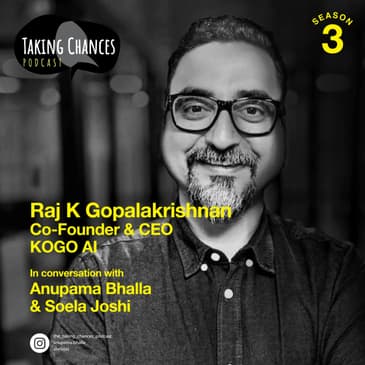


There are no short cuts in life says our guest - Raj Gopalakrishnan the Co-founder and Chief Executive Officer (CEO) at KOGO Tech Labs - India’s only AI travel expert app.
Raj is a professional with more than three decades of rich experience in media, entertainment, design, content, video technologies and AI under his belt.
Adept at building businesses from the ground up he has founded and transformed six start-ups into successful corporate brands.
An avid biker and traveling enthusiast, his passion for travel and culture became a huge part of his professional journey with KOGO.
In this episode he talks about his life’s pursuits, motivations, leadership mantras and of course KOGO.
This is Taking Chances.
[00:00:00] Hello and a very warm welcome to our podcast Taking Chances with me Anupama Bhalla and my co-host Soheela Joshi.
[00:00:08] There are no shortcuts in life says our guest on today's podcast. Meet Raj Gopala Krishnan, co-founder and CEO at Kogo Tech Labs, India's only AI travel expert app.
[00:00:20] Raj is a professional with more than three decades of rich experience in media and entertainment, design and content, video technologies, AI and more under his belt.
[00:00:29] Adept at building businesses from the ground up, he has founded six startups and made them successful corporate brands.
[00:00:36] An avid biker and traveling enthusiast, his passion for travel became a huge part of his journey with Kogo.
[00:00:44] In this episode, he talks about his life's pursuits, motivations, leadership mantras and of course Kogo.
[00:00:51] I have a great day every day he says so welcome Raj and thank you for having this chat with us on Taking Chances.
[00:00:58] I know it's been a long pending conversation but finally here we are and as we kickstart season three it's great to have you on board.
[00:01:06] It's a great pleasure for me to be on season three of Taking Chances. Thank you Soheela. Thank you Anu.
[00:01:12] So getting right to the questions I want to begin by asking who is Raj Gopala Krishnan?
[00:01:17] You're a serial start-up with six startups under your belt. You're into content, technology, AI and a lot else.
[00:01:24] So what does it say about you? Your mindset, your motivational triggers, your goals. Who is Raj Gopala Krishnan and what really makes him tick?
[00:01:33] So let's jump right into it. So what makes me tick? What really sort of got me where I am today in terms of six startups?
[00:01:41] I guess I started early enough there was always an entrepreneurial bug. I started in advertising and at that time I realized that it's a very strange thing.
[00:01:50] When you're younger you think you're far more invincible, you're of course far more motivated and driven but it was a different world.
[00:01:58] I started my career in 94. So in 94 there weren't so many opportunities, there wasn't so much to do but I always had this drive to actually try something different.
[00:02:12] And events and event-based communication for corporates was something that was just about coming up at that time.
[00:02:19] And I thought it was a great opportunity, a great medium to actually communicate and do stuff.
[00:02:24] So I had a short stint in advertising and advertising was stagnant because this is pre-OTT time, there was just run-of-the-mill stuff happening.
[00:02:33] So that's how my entrepreneurial journey started and I think inherently whether you work in an organization or you have your own company,
[00:02:44] you are entrepreneurial in nature and I have to give it to my initial mentors and bosses.
[00:02:52] They sort of just let me have the run-of-the-place, even when I was in Mudra or in this draft,
[00:02:58] I actually more or less operated like an entrepreneur within the confines of the organization.
[00:03:05] And then I said okay, let me build an organization and that's where it began.
[00:03:10] And then I built one and then I built another and then I went bankrupt, learned a lot.
[00:03:15] Probably the best thing that happened in my life.
[00:03:18] Like I said, when you're young, you're cocky or you think you're invincible and you make mistake which sometimes, you know,
[00:03:26] turn out to be the best lessons.
[00:03:27] And after that, I decided that I would work till I was 40, retired 20 days before I turned 40 and moved to the hills,
[00:03:35] then traveled a lot, rode around my motorcycle across the world, did carpentry and then it was time again to hit the road from a business point of view and back here.
[00:03:48] Now when it comes to the different things that I have done, events which is essentially entertainment, films, content,
[00:03:57] I was always inclined towards doing stuff in the media space, but I was a computer science student.
[00:04:06] And it all came to fruition when one of the ventures that I had launched was called Yell Out which was pre-TikTok days,
[00:04:14] but it was exactly like TikTok, had a great exit and that really brought about my love for technology and content and travel altogether.
[00:04:23] And seven years later, that same potent mix of travel and lifestyle with content and technology presented itself in the form of Kogo.
[00:04:34] And that's where we are five years after I started Kogo.
[00:04:39] And yeah.
[00:04:40] All right. So that's basically doing one thing after the other after the other and that's a great way to be because Sohila and I keep discussing like a million ideas
[00:04:49] and hopefully some of them will see fruition someday.
[00:04:52] So you know, you briefly said something a while back Raju, you choose but you started, you saw success and some things didn't happen.
[00:05:00] You saw failure and so on and so forth.
[00:05:02] So in your mind is starting early part way to success because you have the time to fail and learn and then get better and better.
[00:05:09] Or one as an entrepreneur, one can start at any time and make something work.
[00:05:13] What is your personal view on that?
[00:05:15] I think one can.
[00:05:17] I mean, see age does reduce your risk taking ability.
[00:05:21] But having said that people who have become entrepreneurs later.
[00:05:25] So there are some realities in life.
[00:05:28] You got to be financially independent.
[00:05:31] When you're younger, it is easier to take a risk and be bootstrapped because you don't have so many other things to consider.
[00:05:41] When you're older, you have many other things in life, responsibilities, you know, things happen.
[00:05:47] You get used to a certain level of luxury and so on.
[00:05:50] So I guess it is as easy or difficult if you have the resources at hand.
[00:05:56] So if you have enough financial backing starting late also is as good as long as you are ready to give up the privilege.
[00:06:06] And I say privilege, the privilege to complain.
[00:06:09] The biggest privilege that you have as an employee is the privilege to complain.
[00:06:15] But as an employer or a business owner, you do not have that privilege.
[00:06:19] Who do you go complaining to if something is wrong? It's your fault.
[00:06:22] If something's not working well, it is your fault.
[00:06:25] If you've not delegated right, it is your fault.
[00:06:27] If your people are not doing a good job, you're probably guiding them wrong.
[00:06:31] If they don't understand what to do, you're probably communicating incorrectly.
[00:06:35] So you have to be ready to give up the privilege of complaining and just get on with it.
[00:06:40] And one of the other things that you need to have as a mindset for an entrepreneur, right?
[00:06:48] Regardless of age. This is very interesting.
[00:06:50] I was watching this podcast in which Sir Michael Cain said something about him, you know,
[00:06:56] being told something by his theater coach early in his career.
[00:07:00] He was trying to enter the stage and a chair was blocking the door
[00:07:04] because the people who were on stage actually got sort of involved in the scene and chucked the chair.
[00:07:09] And his mentor told him, use the difficulty.
[00:07:13] So, you know, if the chair is blocking the door, if it's comedy,
[00:07:17] then trip over the chair and get on to stage.
[00:07:20] If it's drama, then pick up the chair and smash it on the floor.
[00:07:23] But use the difficulty.
[00:07:25] And I thought that was a beautiful piece of advice.
[00:07:29] Use the difficulty and see how you can take an obstacle and make it into a stepping stone.
[00:07:34] Even if you can, you know, convert it to an advantage by 0.05%, it's an advantage.
[00:07:41] It's not an obstacle.
[00:07:42] So as long as you have that mindset that no matter what comes your way,
[00:07:47] try and see how you can use it to your advantage or learn from it.
[00:07:50] I mean, I definitely learned from my failures.
[00:07:53] Like I said, I went bankrupt when I was 30,
[00:07:56] but I was able to retire by the time I was 40 because I learned, OK,
[00:08:00] you know, these are the things that you don't take for granted.
[00:08:04] I mean, there was a great lesson given in business school about Pan Am, right?
[00:08:11] And they said, anytime you get into business and you're at the top of the food chain,
[00:08:17] make sure you say Pan Am, Pan Am, Pan Am,
[00:08:19] because Pan Am was the largest airline in the world
[00:08:22] and in a span of eight years it just shut down.
[00:08:25] And something in contemporary times, a very similar example was Nokia.
[00:08:31] Nokia shut down in two and a half years, right?
[00:08:35] They went from, I think it was, if my memory serves me right,
[00:08:40] it was 72% market share globally to nothing.
[00:08:44] There is no Nokia phone anymore, right?
[00:08:47] So you have to definitely learn from your mistakes
[00:08:51] and make sure that these obstacles that you have are turned into advantages.
[00:08:56] So age doesn't really matter if you're comfortable
[00:09:00] and if you know that this mindset for three things,
[00:09:03] give up your privilege of complaining, be able to turn, you know,
[00:09:06] use the difficulty to your advantage.
[00:09:08] And of course, learn from your mistakes.
[00:09:10] Everybody says that, but I mean, I've actually been there done that.
[00:09:15] So yeah, expensive mistake, but nevertheless.
[00:09:18] In fact, all successful entrepreneurs and even on our show, you know,
[00:09:22] when we've spoken to them, they talk a lot about failures.
[00:09:25] I mean, right down to, you know, a lot of some of them have, you know,
[00:09:28] also faced bankruptcy and losses, but they've always been able to,
[00:09:32] you know, talk about how they've used that to reach the next goal.
[00:09:36] And I think I agree with you.
[00:09:38] I want to talk a little bit more about entrepreneurship because, you know,
[00:09:42] India is a young country and we're seeing a lot of entrepreneurship being spoken
[00:09:47] about not only with metro, you know, younger kids, but even, you know,
[00:09:51] in smaller towns and tier one, tier two cities, with Shark Tank coming up.
[00:09:55] If you see a lot of young India is participating in entrepreneurship.
[00:09:59] So I want to know considering that you had so many startups,
[00:10:03] tell us a little bit about funding because I think that's really a piece
[00:10:08] which really is so important to know is should one get funding?
[00:10:12] How to get funding?
[00:10:13] What are the challenges that, you know, an entrepreneur will face
[00:10:16] when it just comes to, you know, starting out and making sure that they are there for a,
[00:10:20] you know, long haul and are able to fund themselves correctly so that they can survive?
[00:10:26] You know, this is, there is, this is a question everybody asks.
[00:10:30] Everybody wants this question answered.
[00:10:32] It's agonizingly difficult question to answer.
[00:10:35] So let me try and make some very simple points.
[00:10:38] Firstly, there is no art or science of raising funds, right?
[00:10:43] You go to different VCs or different strategic investors.
[00:10:47] Everybody says there is, there is a template, you know, problem statement.
[00:10:52] What is the solution?
[00:10:54] What is the TAM?
[00:10:55] What is the SOM?
[00:10:56] What is your pricing?
[00:10:58] What kind of penetration?
[00:10:59] You know, there's a template that you follow because people like to put things,
[00:11:03] you know, and understand that okay, you have 10 minutes to tell us this.
[00:11:07] But the problem largely is that funding is difficult, right?
[00:11:12] Because at the end of the day, you are as objective as a fund manager or anybody might be.
[00:11:19] You are talking to someone who is human and a lot of funding depends on how his previous day went
[00:11:26] or on what side of the bed he or she got off on that day or how much they like you as a person.
[00:11:33] And in most cases, while the idea may be maybe about say, I would say the idea is about 35%
[00:11:41] but it's the ability of the that they're really betting on.
[00:11:45] I think 65% is okay, you're saying that you will move mountains.
[00:11:52] Does he have the ability to move mountains?
[00:11:54] Is it a great idea to move mountains?
[00:11:56] Maybe, maybe not.
[00:11:57] But if anybody can do it, then this guy can do it.
[00:12:01] So that's really, I think where the trick is in being able to obviously having said that
[00:12:07] if the idea is no good, the idea per se has to have some merit.
[00:12:13] If the idea does not have merit, you can be the absolute go get a trailblazer, whatever,
[00:12:21] but you will not get funded.
[00:12:23] There are exceptions, but eventually they fail, right?
[00:12:27] So there has to be some inherent merit in the idea and the ability of the entrepreneur
[00:12:32] to actually go and execute on that idea.
[00:12:36] Now, if people who are at the other end who are funding feel that the person has the ability to do it,
[00:12:42] then you will definitely be able to raise money.
[00:12:45] Like I'll tell you a funny anecdote about how we actually raised our first check for Kogo.
[00:12:51] So we got funded back of napkin before we actually even formed the company, right?
[00:12:56] So my co-founder and me went to one of our first angel investors and said,
[00:13:02] you know, this Japanese American collaboration called Kogo because it sounded Japanese, right?
[00:13:07] And they want to do some work in AI in India and this is the concept and blah, blah, blah.
[00:13:12] And we showed one JPEG that we made and we said, you know, we want you to invest.
[00:13:17] Now look at the perception, right?
[00:13:19] My apologies if that investor ever hears this.
[00:13:22] He turned around and said, yeah, yeah, gore bina kya kya suchte ya amazing ya these guys know
[00:13:28] and the valley and these jabs.
[00:13:30] I mean, it's amazing what they think of and we got his commitment and when he said yes,
[00:13:35] I'm interested.
[00:13:36] I would like to invest.
[00:13:37] We said, well, Kogo stands for Koucher Gopala Krishnan because my co-founder is Pravir Koucher
[00:13:43] and I'm Raj Gopala Krishnan.
[00:13:44] And this is our idea.
[00:13:46] And he said, no, but but but that's the whole thing.
[00:13:50] So there is perception, there is ability.
[00:13:52] And of course he believed in our ability, but it's also where the idea is coming from.
[00:13:57] You will find a lot of great ideas, young guys in India with great ideas, great ability to execute,
[00:14:06] but they don't get the funds because of perception of where we are.
[00:14:12] Another interesting thing happened a few years ago before we were raising a large round.
[00:14:18] We were talking to another VC and the VC said, you know, but how did you guys manage to do this?
[00:14:25] We said, I mean, we've done it.
[00:14:27] No, but how?
[00:14:29] It's not like you're from Harvard or Stanford.
[00:14:32] So and it's not like your engineer from MIT or Brown or any of these places.
[00:14:37] And we just started laughing and we said, you know what, our engineers are from Ballyya,
[00:14:43] from Muzaffarpur, from Ranchi, from, you know, some remote corner of Kerala.
[00:14:50] They went to government schools wearing chappals and went to a polytechnic and didn't go to IIT,
[00:14:55] but they are hungry as hell.
[00:14:57] And because we come from a point of being deprived in the most basic of needs,
[00:15:04] we can think more innovatively.
[00:15:07] Yes, there is something to be said about ability.
[00:15:10] These boys and girls are very clever.
[00:15:12] They may not speak great English, but boy, can they speak any other computer programming language
[00:15:19] that exists right now.
[00:15:21] And, you know, we've got a great team.
[00:15:23] So funding is tricky.
[00:15:25] Funding is tricky.
[00:15:27] You may be very lucky.
[00:15:28] We've been lucky all the way, right?
[00:15:30] Because we had experience.
[00:15:32] We were able to express ourselves.
[00:15:34] You know, you tell a good story.
[00:15:36] Everybody loves a good story.
[00:15:37] And of course, your track record and ability speaks for itself.
[00:15:41] But when you're younger, if you're able to show the zeal and the zest that you have
[00:15:47] for actually delivering on the idea that you have presented,
[00:15:52] yeah, the chances of getting funding are definitely higher.
[00:15:56] But like I said, no art of science to it.
[00:15:58] Okay.
[00:15:59] So that's interesting.
[00:16:00] I mean, because you said luck couple of times, you know,
[00:16:02] you know this, so I guess you believe that there has some little element of luck does play
[00:16:07] along with all the other...
[00:16:09] Not a little element.
[00:16:10] I would say luck has a major role to play.
[00:16:13] Okay, right.
[00:16:14] I would say luck has a major role to play because all things being equal.
[00:16:19] If you have shit luck, you're not getting any money.
[00:16:23] True.
[00:16:24] As simple as that.
[00:16:26] Okay.
[00:16:27] Don't talk a little bit about Kogo.
[00:16:30] You know, help us understand what gap did you see in the market?
[00:16:34] How did it come about?
[00:16:36] And what are your ambitions for Kogo?
[00:16:38] So we've had a very interesting journey, right?
[00:16:40] So Praveer and my co-founder and me,
[00:16:42] we were actually, we've known each other for years.
[00:16:45] Between us, we've done almost about 350 or 400,000 kilometers on our motorcycles
[00:16:51] traveling around the place.
[00:16:53] And we were actually coming back from Spiti and we were trying to look for this place.
[00:16:57] And I've been going for the last 22 years to Spiti.
[00:17:01] We set up a primary school there.
[00:17:04] We've done a lot of...
[00:17:05] We set up a community radio project there, a YAKONSEVANCE project and stuff like that.
[00:17:10] So I know that place like the back of my hand.
[00:17:13] And we were coming back and we were looking for this one particular MAGGI guy.
[00:17:17] This is pre-Utteretunnel days, okay?
[00:17:19] One MAGGI guy.
[00:17:21] And for some reason, we just couldn't find the chap.
[00:17:25] And Praveer made an agist remark about me not being able to find stuff
[00:17:31] with any of us about it anymore.
[00:17:35] Not being able to find stuff anymore, absolutely.
[00:17:38] And so it started over in altercation and that night, we were discussing
[00:17:43] what if there was an invisible companion who could automatically start writing our stories every time we travelled.
[00:17:52] Because people would call us all the time,
[00:17:53] yar vaha pe kaisa hai hai, how is this place?
[00:17:56] What kind of roads are there?
[00:17:57] Is there a nice place to stay?
[00:17:58] And we said okay, let's build an AI companion for travel.
[00:18:03] And that AI companion for travel will automatically start writing your story every time you travel.
[00:18:08] And that really began our journey with Kogo.
[00:18:12] Now, you have to understand we started and we actually espoused this concept called narrative intelligence.
[00:18:19] Narrative intelligence is the precursor to generative AI.
[00:18:23] So it would actually take your root live and actually keep writing the story which is, you know,
[00:18:29] pre-generative AI but we used to call it narrative intelligence.
[00:18:33] And that's what we really started with.
[00:18:35] And then we said okay, now that people know where to go because stories are being told by the community,
[00:18:42] we should now also complete the loop and make everything bookable and create the ultimate AI expert.
[00:18:50] As we started creating the ultimate AI expert, we created the entire ecosystem,
[00:18:55] put a million hotels on it.
[00:18:57] Today, you can book a million hotels, you know, global flights, blah, blah, blah, blah, blah.
[00:19:02] The entire travel ecosystem built on top of an AI storytelling platform.
[00:19:09] So people could actually sort of see what people where people were traveling,
[00:19:13] inspire people to get onto the road and so on and so on.
[00:19:15] And we said there should be now a companion which is the ultimate AI expert.
[00:19:20] As we were building the ultimate AI expert, we realized that the base tools or what you call as an AI operating system did not exist.
[00:19:32] So in order to make the car, we had to first invent the wheel.
[00:19:37] Right?
[00:19:38] So we went ahead and created an AI operating system and that AI operating system created the AI travel expert.
[00:19:47] And today, we're at the cusp of launching our AI operating system.
[00:19:52] Travel has become a very small part of our business and we're actually our technology can create an expert of almost any kind.
[00:20:01] You want a legal expert, you want a sales expert, a customer service expert.
[00:20:07] So we are able to create autonomous AI agents that can understand human intent.
[00:20:14] So that's the big change.
[00:20:16] Right?
[00:20:17] What's the difference between what a chat GPT does or anybody else does and what we do, right?
[00:20:22] Chat GPT is an LLM.
[00:20:24] It's a large language model.
[00:20:26] It's Generative AI, but Generative AI cannot perform tasks.
[00:20:30] The next evolution of AI from LLM is LAM, which is a large action model.
[00:20:37] What LAM basically means that the operating system can understand what you mean,
[00:20:43] can understand your intent and get the job done.
[00:20:47] So it can actually complete tasks.
[00:20:49] So you can now talk to the Kogo AI expert and say, hey, I want to book a hotel in Bombay
[00:20:56] and they'll say, okay, when you're going to Mumbai, I'm going to Mumbai morning.
[00:20:59] Great.
[00:21:00] Where do you want it?
[00:21:01] I want it near the airport.
[00:21:03] Conversationally, you can book flights.
[00:21:06] You can book hotels.
[00:21:07] You can book a test ride.
[00:21:10] You can do research.
[00:21:12] In fact, one of the recent deployments that are happening with...
[00:21:16] By the way, I don't know when you'll be releasing this podcast.
[00:21:19] I think we will be out of stealth mode on the OS front by that time, which is early April.
[00:21:25] But one of the...
[00:21:27] So we also have AI paralegal, right?
[00:21:30] And this big law firm came to us and said, okay, let's test out what the skills
[00:21:35] of this AI paralegal are.
[00:21:37] I put two interns and one junior lawyer to do deep research and give me case precedence
[00:21:43] and all of that on the trend of the Supreme Court of India in awarding custody
[00:21:50] of a 15-year-old child to the father.
[00:21:52] It took them four days.
[00:21:54] The Kogo AI paralegal answered it in seven seconds
[00:21:57] and gave a detailed report with markup, with cases, with everything.
[00:22:02] So our platform today is a completely sourced...
[00:22:07] Obviously, it doesn't hallucinate because it's not Generative AI.
[00:22:11] It has guardrails.
[00:22:13] It is a trusted, reliable AI expert in any field.
[00:22:18] And today enterprises can deploy an AI expert to do any kind of mundane task,
[00:22:26] any kind of complex workflow and our governing philosophy
[00:22:31] while we are deploying all of this is unlocking human potential.
[00:22:35] In fact, Praveen was speaking at a business world event the other day
[00:22:39] and there was a lot of talk about it.
[00:22:41] We truly believe that AI and Kogo's platform can help restore work-life balance.
[00:22:47] I mean, it's been a topic for 30 years.
[00:22:49] People are slaving away.
[00:22:51] If you can have an autonomous AI assistant that would be able to take 60-70%
[00:22:57] of your mundane repetitive task workload
[00:23:01] so that you're left to do more strategic, more creative thinking
[00:23:05] and better decision-making and then go home to your family.
[00:23:08] So it is our mission to make sure that people earn double the amount of money
[00:23:14] in half the amount of time and who knows maybe we will be the people
[00:23:18] who help usher in the three and a half or four day week.
[00:23:21] So that's where Kogo is today.
[00:23:23] So it's been an interesting journey.
[00:23:25] We started with narrative intelligence and we continue to build tools
[00:23:30] to take that narrative intelligence and make it into an expert
[00:23:34] that can now autonomously do any task.
[00:23:37] Raj, we've spoken about all the stuff that you've done
[00:23:40] and we've spoken about funding and you also spoke about something
[00:23:43] that you started which ran its course
[00:23:45] and how something didn't work out for you
[00:23:47] and you were bankrupt and 30 and so on.
[00:23:50] So when you start something or take on something new
[00:23:53] what tells you that it's time to let it go?
[00:23:55] You may be letting it go because it's not working
[00:23:58] or you may be letting it go because it's not doing well.
[00:24:01] So is there a time where you start something and say,
[00:24:04] okay this is not working or it's not going where I want it to go
[00:24:07] so just go away.
[00:24:09] What makes you think that and what makes you take that action?
[00:24:12] Okay.
[00:24:13] So the time, I can only draw from my personal experience, right?
[00:24:18] The time that I went bankrupt, right?
[00:24:20] I took a decision at that time and my business partner
[00:24:23] at that time was very keen that,
[00:24:25] yeah we have a great reputation in the market,
[00:24:28] things didn't work out, something has happened.
[00:24:31] There was a certain inflection point which caused us,
[00:24:36] we'd spread ourselves to him,
[00:24:38] we'd grown very big, very fast, costs were high
[00:24:42] and at that time he did say that,
[00:24:45] we have a good thing going,
[00:24:46] we have great equity in the market,
[00:24:48] we built such a great brand, we should continue.
[00:24:51] Let's pick up debt and let's continue, right?
[00:24:55] And at that time I said,
[00:24:56] no dude, I think it's time to let go, okay?
[00:24:59] So you have to go with your gut, it's time to let go
[00:25:03] and we actually as heartbreaking as it was,
[00:25:08] we let it go.
[00:25:09] At the same time, there are too many good
[00:25:13] entrepreneurs and good ventures which did not succeed
[00:25:18] because the entrepreneur gave up too early,
[00:25:22] or didn't have, whatever, there are just,
[00:25:25] I mean as entrepreneurs there's just so many
[00:25:28] rations that we don't even realize.
[00:25:30] I mean, I am thinking of them as I'm talking to you right now,
[00:25:33] that we don't even realize, they're just internalized,
[00:25:36] there's family, there's food, there's financial security,
[00:25:39] there's mobility, there's, there is this,
[00:25:42] but at least for both Ravi and me, my previous partners,
[00:25:45] an overwhelming sense of moral responsibility, right?
[00:25:50] Because like for example, we have about what?
[00:25:54] 60, 70 people who work in Google, right?
[00:25:57] Average family size is three.
[00:26:00] So if I screw up, I jeopardize putting food
[00:26:03] on the table for 180 people.
[00:26:05] That is a great responsibility that you need to fulfill, right?
[00:26:10] So there are multiple things that go on in an entrepreneur's mind
[00:26:14] that you need to pay people on time, you need to do this,
[00:26:17] you need to do that.
[00:26:18] So it's very difficult to take that call here.
[00:26:22] And the most tricky of them all is attachment.
[00:26:26] It's my baby, I have put in blood, sweat and tears
[00:26:30] little bit more.
[00:26:31] So that can take you over the brink or also there are many people
[00:26:36] who sort of crossed over and said, okay, I will go forward,
[00:26:40] I will persevere and then have become big successes.
[00:26:43] It's very tricky here.
[00:26:45] It's each one's personal ability to deal with the pressure,
[00:26:48] environmental factors in terms of, of course, everything's a function of money, right?
[00:26:52] There has to be money in the system.
[00:26:54] Forget for personal fulfillment, but there has to be money in the system.
[00:26:58] It's a business after all for people, for resources to run it, etc.
[00:27:03] So yeah, each one has to figure out on their own.
[00:27:07] Yeah, I guess it's such a personal journey that you, I mean,
[00:27:11] you never know how it will pan out.
[00:27:13] You never know.
[00:27:14] Yeah.
[00:27:15] So Raj, moving forward, a couple of things that we want to chat with you is on leadership.
[00:27:21] And I think as more and more we've seen the young force entering into the workplace,
[00:27:27] the way we were led, you know, Anu and I is very different from now how we are leading.
[00:27:32] So what your certain thoughts on how do you motivate, you know,
[00:27:36] the new generation which comes into the organization,
[00:27:39] and especially you are in the tech business where it's literally,
[00:27:43] I mean, it's run by the young in that sense.
[00:27:46] So how do you motivate them?
[00:27:48] And how do you ensure that they really buy into what your organization
[00:27:52] and business stands for?
[00:27:53] It boils down to leading from the front, right?
[00:27:58] Praveel me.
[00:27:59] We finish work.
[00:28:00] We go back to our respective homes, spend some time with the family.
[00:28:04] And before we go to sleep, we study every night for about two hours.
[00:28:10] And then before calling it a night, we exchange notes for about 10 to 15 minutes.
[00:28:15] And next day in the morning, we are in office before everybody else.
[00:28:21] Chalk out what they need to do.
[00:28:23] Tell them about new stuff that's happening in the world.
[00:28:26] Encourage them to read, to study, to learn more.
[00:28:30] And at the same time, we also very clearly have communicated
[00:28:35] what our vision and mission for the company is.
[00:28:39] Everybody says, you know, we want to be a unicorn.
[00:28:44] We don't say we want to be a unicorn.
[00:28:46] We say hell yes, we want to be a unicorn.
[00:28:49] And hell yes, we are going to be a unicorn.
[00:28:52] Why?
[00:28:53] And what is the path to it?
[00:28:55] It's all very well to say that I'll be the greatest thing in the world
[00:28:59] and I'll do all of this.
[00:29:00] But you've got to show them the path to it.
[00:29:03] You've got to show them that this is how we will get there.
[00:29:06] You do thin slicing of goals.
[00:29:08] You say this is various things that you need to achieve at this time
[00:29:12] at all points in time.
[00:29:14] And I speak, I think I speak for Praveel also.
[00:29:17] The entire concept of leadership is not to say that
[00:29:21] Achha ye ye kaam hai karo.
[00:29:22] Our concept of leadership is to, if somebody starts turning up at 8 o'clock in the morning,
[00:29:27] then we will start turning up at 7.
[00:29:29] If they start turning up at 7, then we will turn up at 6.
[00:29:32] But at all points in time, we've got to do more.
[00:29:36] We've got to show more.
[00:29:38] We've got to exhibit and lead and say that this is how you build
[00:29:44] a global fricking business.
[00:29:47] There is no shortcut.
[00:29:49] And on the other hand, we're extremely fun workplace.
[00:29:53] In fact, one of our investors came to our office
[00:29:56] and as soon as he entered, he was like, oh wow.
[00:30:00] We're not like a corporate workplace where we'll put a pool table
[00:30:05] and a foothold table.
[00:30:06] Guys are playing cricket in office while music is playing
[00:30:09] and they're coding and guys are writing on the wall
[00:30:12] and there's all sorts of shit happening.
[00:30:14] It's mayhem, but there's a method in the madness.
[00:30:18] People have to have a lot of fun.
[00:30:21] We don't do, you know, like all companies do off-sites.
[00:30:25] We do off-sites too.
[00:30:26] But we don't take people to an off-site
[00:30:29] and force them to play team building games.
[00:30:33] We let people do their own thing.
[00:30:35] There's enough time that they spend together.
[00:30:37] And that by itself, when you don't force things down people's throat,
[00:30:41] that by itself motivates and builds the team.
[00:30:43] And yes, there are 60 people.
[00:30:46] All 60 cannot wipe together.
[00:30:48] There'll be eight people who are one group, another seven.
[00:30:51] Let them be and let them have a great time here.
[00:30:53] So yes, groups get formed.
[00:30:55] They have a good time.
[00:30:56] One thing we do not tolerate absolutely intolerant about
[00:31:00] is any kind of politicking in office
[00:31:04] and I'm very proud to say that we've really kept a lid on that.
[00:31:09] And I think another very, I don't want to jinx it, Dutchwood.
[00:31:14] Since 2018 to now, including people who have left
[00:31:18] and who we have let go, 10 people.
[00:31:21] That is how low our attrition is.
[00:31:25] People have been with us from the beginning.
[00:31:28] They continue to be there.
[00:31:30] They're highly motivated.
[00:31:32] And finally, we're anal about some things, right?
[00:31:36] There has to be discipline for work.
[00:31:38] But not discipline at work.
[00:31:41] Not that it's straight jacketed and do your own thing.
[00:31:44] Like our office in Bangalore is in a rework facility.
[00:31:50] Somebody wants to sit by the poolside and work.
[00:31:52] I mean, we have this large office
[00:31:54] and it's generally only me and one other person sitting there
[00:31:57] because somebody is next to the coffee shop.
[00:31:59] Somebody is sitting in the stairs.
[00:32:01] We don't care.
[00:32:02] The work has to get done.
[00:32:04] Everybody has things that they have to deliver.
[00:32:06] We give them that freedom.
[00:32:08] We also have a very flexible leave system, right?
[00:32:12] We've never refused anybody leave.
[00:32:14] Sometimes they overshoot it
[00:32:16] and they're responsible enough to be working on Sundays
[00:32:19] and holidays.
[00:32:20] I mean, they really work hard.
[00:32:22] I am so proud of my team.
[00:32:24] They're all rock stars
[00:32:26] and we have a great time working with them.
[00:32:28] The common thing,
[00:32:30] common motivator for all of us in our organization is food.
[00:32:34] We all love food.
[00:32:37] So there are always tons of stuff ordered.
[00:32:40] Sometimes we get kebab, sometimes samosas.
[00:32:43] So something else and something else.
[00:32:45] Food, music and the passion for technology
[00:32:49] is keeping all of us together.
[00:32:51] That sounds like a real cool vibe.
[00:32:53] I also want to talk a little bit more about leadership
[00:32:57] because it's so important for leaders to display
[00:33:00] like you're saying certain skills and empathy.
[00:33:03] So what is it that leaders of today need to upskill?
[00:33:07] Because we usually talk about upskilling and reskilling
[00:33:10] and it's always spoken about at skip levels,
[00:33:13] you know, at levels which are not necessarily the top ones.
[00:33:16] So I want to just understand from you
[00:33:18] what are the skills that leaders,
[00:33:21] you know, head functions,
[00:33:23] head businesses, CEO level,
[00:33:25] what are some of the skills
[00:33:27] that they need to upskill themselves on?
[00:33:29] Different people have different styles of leadership.
[00:33:34] I believe that upskilling
[00:33:37] and knowing what each person does,
[00:33:40] especially when you're in an executive role
[00:33:43] or as the CEO of a company,
[00:33:45] I can perform the function of my CFO.
[00:33:48] I can perform and understand
[00:33:51] the function of my engineering head.
[00:33:53] I can perform the function of my logistics head.
[00:33:57] I can do all those things if they are not there.
[00:34:00] Right?
[00:34:01] What I'm trying to say is that I make it my business
[00:34:04] to learn every skill that needs to be there in my company
[00:34:09] so that when I ask somebody to do something,
[00:34:13] they cannot turn around and say
[00:34:15] that this is not possible.
[00:34:17] I would be able to turn around and say this is the way.
[00:34:19] So if I'm getting bullshitted,
[00:34:21] then I would be able to tell them don't bullshit me,
[00:34:24] do it and if they do not know how to do it,
[00:34:26] I can say these are the possible ways that you can do it.
[00:34:29] So I think till recently, till Jenae, I came around,
[00:34:33] I think it was for a tech business,
[00:34:36] it is important to understand how code works.
[00:34:39] It's important to understand technology.
[00:34:42] It is important to understand finance.
[00:34:45] It is important to understand derivatives.
[00:34:48] It's important to understand investment instruments.
[00:34:52] It is important to understand that HR is something
[00:34:56] that you learn as you go by,
[00:34:58] but it's also important to understand HR best practices
[00:35:01] and so on and so forth.
[00:35:03] So I think you have to upskill in,
[00:35:05] as a CEO, you have to upskill in every department.
[00:35:09] Yes, you are better at certain things.
[00:35:11] It's not Jack of all trades master of none.
[00:35:14] It's actually Jack of all trades and master of some.
[00:35:17] So you have to be very good at at least two or three
[00:35:21] things and definitely know everything about every function.
[00:35:26] So just taking off from what you said Raj,
[00:35:29] we've got a lot of insight into how you see
[00:35:32] and do things professionally.
[00:35:34] So if you were to write a book,
[00:35:36] what would be your success habits?
[00:35:38] What would be the top five things that you personally as Raj,
[00:35:41] implement and think about and follow to be successful?
[00:35:45] I would think the first thing that comes to my mind is
[00:35:49] obsession. You have to be obsessive about whatever that you do,
[00:35:54] whether it is running the company,
[00:35:56] leading your team, learning new things.
[00:35:59] So you have to be obsessive one.
[00:36:01] Second is you have to be so curious about everything.
[00:36:07] You have to be so curious.
[00:36:09] I mean there is so much to learn.
[00:36:12] There is so much to do.
[00:36:13] It's amazing.
[00:36:14] I mean and today especially right when we were growing up,
[00:36:17] we didn't have so much access to information.
[00:36:19] Now there is so much information and I really revel in being a sponge
[00:36:25] in terms of reading stuff and I'm not a person who's active on social media.
[00:36:31] I mean, I don't know if you've seen my profile.
[00:36:33] I don't post personal stuff.
[00:36:35] I don't do anything on social media but everything that is fun
[00:36:40] and everything that is learning,
[00:36:42] I absorb and I really, really I would say being a sponge,
[00:36:46] being obsessive and having a lot of fun.
[00:36:50] There has to be a lot of play along with work.
[00:36:54] These three things, if I didn't enjoy what I was doing,
[00:36:57] I would not do it.
[00:36:59] You have to make sure that you really enjoy what you're doing
[00:37:03] because otherwise then it's just another job.
[00:37:06] So I have a blast doing what I'm doing.
[00:37:09] I'm challenged every day.
[00:37:11] I learn new stuff every day and then I go and read a book where
[00:37:17] the mailman in rural Wisconsin is saving the world from weapons of mass destruction
[00:37:23] by a terrorist based out of a hole somewhere in Guatemala.
[00:37:28] So you have to have space in your head for all of that.
[00:37:32] So I would say yes, obsessive, be a sponge and have tons of fun.
[00:37:37] These three things.
[00:37:38] And what about missed opportunities, Raj?
[00:37:40] You've done so much but something you felt that you could have done better
[00:37:44] or something you felt, oops, I didn't pick up that opportunity when it came about.
[00:37:48] Do you have such regrets?
[00:37:50] I have a small personal regret, no professional regrets.
[00:37:54] That personal regret is I didn't get enough time for music.
[00:37:59] So I used to play and I well, you know,
[00:38:03] but yeah, I still managed to sing in the shower and play an instrument when I'm, you know,
[00:38:09] had a tipple or two.
[00:38:11] But that's that apart professionally.
[00:38:14] I think everything, yeah, you do, you do feel that, you know,
[00:38:18] you could have done something a little differently and it would have been a little better.
[00:38:25] But I have absolutely, I mean out of six companies, one bankruptcy,
[00:38:31] four successful exits, one running well.
[00:38:34] I have nothing to complain about.
[00:38:36] It's a good life.
[00:38:37] It's a great life in fact.
[00:38:39] That's the other thing.
[00:38:40] I mean, yeah, I have a great day every day.
[00:38:43] So and then I meet people like you and, you know, we have a good chat
[00:38:46] and I'm also reminiscing my last 27, 28 years of my career and, you know, it's good.
[00:38:55] Life is great.
[00:38:56] So no regrets.
[00:38:58] Oh yeah.
[00:38:59] So Rajya, this is a question that we ask almost.
[00:39:01] I mean, we've asked all our guests and it's all about, you know, having a template in life.
[00:39:07] You know, when you look, you know, I mean just forward, what is it that you see that you want in your life?
[00:39:14] How would it look?
[00:39:15] I mean, the best of your life, just if you can tell us what you see.
[00:39:20] At the cost of sounding, I wanted to retire at 40.
[00:39:24] I retired.
[00:39:25] I wanted to live in the hills.
[00:39:26] I live in the hills.
[00:39:27] I wanted to ride around.
[00:39:31] I ride around.
[00:39:32] I wanted to do carpentry.
[00:39:34] I started doing carpentry.
[00:39:36] I've run successful businesses.
[00:39:39] I have run them well.
[00:39:40] I'm running one now.
[00:39:41] I have a great life partner.
[00:39:45] I have a great business partner.
[00:39:48] I have such good health and I mean, I've got everything that dreams are made of.
[00:39:55] So I really don't, I don't have any dreams except that no matter what I do, I should excel at it.
[00:40:04] I should do it well.
[00:40:06] And when people talk about any of the stuff, any of the companies that I founded or I've done, they say,
[00:40:13] this man did it.
[00:40:15] So definitely there is always greed for legacy in what you do.
[00:40:22] On personal front, I just wish that everybody in my friends, family and my colleagues have great health.
[00:40:31] Money will always follow.
[00:40:33] Money comes.
[00:40:34] You have great health.
[00:40:35] You have a good work ethic.
[00:40:37] Everything is good.
[00:40:38] So I'm living the dream life though.
[00:40:40] I don't have a problem.
[00:40:42] My wife looks the same for the next 30 years.
[00:40:45] I'll still be sitting here in in Lovedale in my estate enjoying the views, working on technology, writing my motorcycle.
[00:40:53] I think you're the first speaker who said, hey, I'm living my dream life.
[00:40:57] There's nothing to complain about.
[00:41:00] I mean, there's it's all good.
[00:41:02] It's great.
[00:41:04] But there is one thing.
[00:41:07] There's always one.
[00:41:10] There is one thing that I would love to do.
[00:41:14] But it's just something that today, Kogo is at a stage where we've created something very unique that about say 14, 15 or 20 companies globally have done so.
[00:41:25] And we actually are, you know, the nerdy Star Trek star wars Marvel fans, you know, the one thing that I would really love is actually to be in robotics.
[00:41:39] To actually have a fully to have something to do with a fully functional humanoid robot that could actually make people's lives easier.
[00:41:50] That is something that I would love to do.
[00:41:53] There are things cooking somewhere in the background, and I think the one goal or the one streak that defines my partner and me is that we're audacious.
[00:42:06] We love being audacious.
[00:42:08] People tell us, what the hell are you talking about?
[00:42:11] I mean, when you're not here to do easy things and nobody created great legacy by not being audacious in thought.
[00:42:19] So that's that's the that's the one thing that well, given time, I think we'll achieve that as well.
[00:42:26] But yeah, otherwise, personally, everything is great.
[00:42:30] That's what blah blah blah.
[00:42:31] So what brings us to the end of our main questions, Raj?
[00:42:35] We have a quick rapid fire. So we, you know, we need your quick picks on just anything that we asked you about.
[00:42:41] So we'll start off with the fact that obviously we are talking AI here and you've spoken at length about it as well.
[00:42:47] And you talk about robotics, that's something in the back of your mind.
[00:42:50] So do you see AI as something that will ever have common sense?
[00:42:54] Yes.
[00:42:55] And what makes you say that?
[00:42:57] Well, common sense is different from general intelligence, you know, common sense is is is uncommon because
[00:43:05] it requires you to be logical.
[00:43:08] That's what common sense is, right?
[00:43:10] Which is which is what most people aren't.
[00:43:13] So common sense is something that would definitely be there in AI.
[00:43:17] Will it have EQ?
[00:43:19] Will it be?
[00:43:20] Will it have emotional intelligence?
[00:43:22] Difficult to say.
[00:43:24] Will it have will we achieve AGI very quickly?
[00:43:28] Not so quickly, but common sense.
[00:43:31] Yes.
[00:43:32] Absolutely.
[00:43:33] Your quick take on self-help books.
[00:43:36] Yaar naa mai likhunga, naa mai padunga.
[00:43:39] Oh no.
[00:43:41] It's just as simple as that.
[00:43:43] I do believe that, no, sometimes you do need to reach out for help and I think self-help,
[00:43:52] no, I don't believe in self-help books.
[00:43:55] I think they are multiple templates.
[00:43:59] You're better off just talking to somebody.
[00:44:02] Self-help books are just templates that make authors rich, very clever books.
[00:44:07] In fact, I do think that beyond the point, I mean, my wife is a counsellor and mental health therapist, right?
[00:44:15] But I still believe that people should reach out to people for help, right?
[00:44:22] Self-help books are, oh God, I should say this on record.
[00:44:26] I think self-help books pretty on the weak and the vulnerable.
[00:44:31] Yaar, they do.
[00:44:32] I mean, I can write, I genuinely can go today and write five self-help books on different topics.
[00:44:41] You're intelligent enough.
[00:44:42] You can figure out that this is what people are looking for.
[00:44:48] This is what they need and you can write stuff and if you promote it well and you do a proper marketing exercise
[00:44:55] and you do some influencer marketing and you put two faces to it, you'll have people buying it.
[00:45:00] Because this is the reality that people want to succeed.
[00:45:06] So one fine morning when you wake up Raj, I know you said life's going great.
[00:45:11] If you would hop onto your bike, where would you want to go and why?
[00:45:15] I've not gone down South America.
[00:45:20] I would love to do that.
[00:45:21] Just new cultures, new places.
[00:45:23] I always try and not go back.
[00:45:27] I mean, Spiti is a different issue that's more a spiritual connection for us.
[00:45:31] We try and not go back to the same place or places again because just too much to see
[00:45:37] and there's just too many people to meet and there's just too many cultures to absorb
[00:45:42] and there's just too much food to eat.
[00:45:45] So I've not been down the South American coast and that's what I would do.
[00:45:50] What does authenticity mean to you?
[00:45:53] Oh God, I think authenticity is to have a moral compass and as long as you have a moral compass,
[00:46:01] as long as you believe that everything is an equation, right?
[00:46:05] Don't shaft your people.
[00:46:07] Don't shaft your clients.
[00:46:08] Don't shaft your customers.
[00:46:09] Don't shaft your friends.
[00:46:10] I think that's what being authentic is.
[00:46:13] Have a high moral compass.
[00:46:14] Good things happen to good people.
[00:46:16] That's what I believe in.
[00:46:18] And you spoke about Marvel movies and other science fiction stuff.
[00:46:23] So which is your best science fiction movie and why?
[00:46:26] There are too many.
[00:46:27] You're asking me to, this is a very unfair question.
[00:46:30] You don't want to be unfair.
[00:46:33] I love each one for its own merit, starting from the original Star Trek series
[00:46:39] and what, you know, I mean it's sci-fi and fantasy.
[00:46:43] I love the fact that creators are able to think of concepts where,
[00:46:48] whether it's Lord of the Rings, whether it's Star Trek, whether it is,
[00:46:52] of course, Lee Pace's badly cast in it but I love foundations.
[00:46:57] I love the book series.
[00:46:59] Okay, you look at all of these, the fact that they wrote the entire grammar and culture
[00:47:05] and all of that of the Klingons and they, of the Romulans
[00:47:11] and they wrote and created the lexicology of high Valerian in Game of Thrones
[00:47:18] or they did the entire Tolkien, wrote the entire script from Middle Earth
[00:47:25] and all of that.
[00:47:26] So it's just, they're all good.
[00:47:29] They're all good.
[00:47:30] It's amazing.
[00:47:31] It takes you into such an imaginative world.
[00:47:35] It's fantasy and it's all of it.
[00:47:37] I mean, you think of Star Trek, right?
[00:47:39] I was in my teens when we first saw the series.
[00:47:41] You look at Star Trek, it's amazing.
[00:47:43] Everything that was in Star Trek, everything that Asimov has written about
[00:47:48] is true today and we would have never thought we would have seen it in our lifetimes, right?
[00:47:53] But everything is true.
[00:47:55] It all exists except meeting extraterrestrial life forms
[00:47:59] which I think in our life will happen.
[00:48:02] Have you seen that recent series on Netflix, Three Body Problem?
[00:48:08] I just started watching it.
[00:48:10] It's brilliant, I finished it yesterday.
[00:48:12] So you just talked about aliens so that's what it's about.
[00:48:15] Yeah, yeah, I know.
[00:48:16] Time should also be there.
[00:48:19] From studies...
[00:48:20] You and I are addicted to Netflix.
[00:48:23] Yeah, yeah, we watch too much.
[00:48:25] Yeah, we watch too much.
[00:48:26] This tells us.
[00:48:28] Our screen time is horrid.
[00:48:30] Anyway, House of Dragon is 21st of June or 17th of June, something like that.
[00:48:35] Yeah, that's right.
[00:48:36] So great Raj, thank you so much.
[00:48:38] That was really interesting and a lot of very good insights.
[00:48:41] Thank you for making time as well.
[00:48:44] My pleasure.
[00:48:45] I just thought I was having a good chat.
[00:48:47] It was a very good chat.
[00:48:49] Thank you.
[00:48:50] Take care.
[00:48:51] Bye-bye Raj.
[00:48:52] Thank you.
[00:48:53] Bye.
[00:48:55] We hope this podcast encourages you to follow your dreams.
[00:48:58] We will be back soon with more chance takers.
[00:49:01] Till then have a good time and like and share this podcast.
[00:49:06] Thank you.