
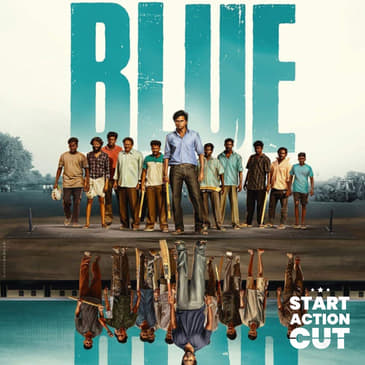
In this episode of Start Action Cut, Swathi, Aswin and Padmakumar are analysing the Tamil movie 'Blue Star' directed by S. Jayakumar and starring Ashok Selvan, Shantanu Bhagyaraj and Keerthi Pandian in the lead.
See omnystudio.com/listener for privacy information.
[00:00:00] A bunch of cricket crazy youngsters in a village is completely swayed by the sports that their
[00:00:19] ultimate aim every day in their lives is playing in a field sprawling in the heart of rustic
[00:00:25] hamlet in the outskirts of Chennai. The underdog street players have to rise to the occasion
[00:00:32] whenever their honour is at stake. That's the premise of the Tamil movie Blue Star.
[00:00:39] Hi, welcome to Onmanorama Movie Podcast, Start, Action, Cut and today Swati and Ashwin are
[00:00:47] here to discuss the film directed by S Jayakumar and starring Ashok Selvan, Shantanu Bagraj
[00:00:53] and Kirti Pandyan in the lead. Now coming to the subject of the movie, it's cricket and
[00:01:00] we have seen a number of movies with cricket as the backdrop and most often they have worked
[00:01:06] here too. It's the game that consumes most part of the movie and how do you view cricket
[00:01:12] in this movie? Ashwin. Well Patmukumar, thanks for having
[00:01:16] me. I thought this was a well-meaning film but for me it fails to connect at
[00:01:22] certain levels because we have had so many movies using sports as a central theme trying
[00:01:27] to tell the story of this underdogs, how they achieve the glory in the end and how we pitch
[00:01:32] for them. But in this film somehow it doesn't work. We have a mix of cricket, cast differences,
[00:01:40] social inequalities, there is an infatuated romance and of course the inevitable final
[00:01:46] heart-swelling moment of glory of the underprivileged. But I wish the film was shorter
[00:01:51] and we always have this applauding feeling about the film. And for me it was mainly because
[00:01:58] of the narrative technique. In many scenes involving two or more characters, we see lengthy
[00:02:04] expositions of past incidents more like a voiceover in a radio play when a more engaging
[00:02:10] visualization or choice of storytelling would have helped those scenes leave a deeper
[00:02:15] impact. I can give an example, there is this scene between Dhanjitha and Anandhi where he
[00:02:21] tells about the rivalry between two clubs and what happened on a cricket ground six years ago.
[00:02:25] We get the gravity of what he says but the connection I'm not sure. Also the characters
[00:02:32] were more like caricatures especially the coach of the elite club, the players. All they do
[00:02:37] is talk, walk and behave with us all purpose of being hated. They could have been more human
[00:02:43] with shades. And the final scenes where the players are presented like animated figures
[00:02:48] kind of completes the mess. It looks so out of place. And I was also surprised to see
[00:02:54] the reaction of Anandhi when she's watching a cricket match because we are told she has been
[00:02:59] watching crickets in childhood and she knows Chris Keynes because she loves all around us.
[00:03:04] But the one visual we see is of an Indian player getting bowled and from what we see
[00:03:11] on her face it is pure joy. I mean in a film with cricket as a central theme, I wonder how
[00:03:17] you can be so casual about such scenes. And S J Kumar this is his debut film, he has written
[00:03:23] this film even in that final game. They kind of discuss about the strategy minutes away
[00:03:31] from the start of the game. How often you do that especially when you say that
[00:03:35] this cricket and victory is a matropoeur prestige. But having said that, I love the setting where
[00:03:43] the story takes place. Even the choice of names of those clubs, I found it very interesting.
[00:03:48] Blue Star and Alpha Boys. We always know that the blue stars are considered to be
[00:03:57] hotter than red stars. And this club includes a set of hot headed youths bristling with
[00:04:02] frustration of being mistreated all through their lives. And Alpha Boys obviously the dominant
[00:04:08] richer fragment of the society within the same village. So those are some aspects I loved
[00:04:14] about the film. Yeah, in fact, I could well connect with the movie, especially the cricket
[00:04:20] theme, just because at the moments, the exciting moments were far removed far away from those
[00:04:30] in other films on the same team. So what was that for you? How did you enjoy the movie?
[00:04:36] Swati? Well, Patma Kumar for me, I felt like even though the movie is based on cricket and
[00:04:44] the sort of cast politics that it talks about, cricket is a theme that was sort of like in
[00:04:49] the backdrop of the movie because there is a sort of rush or adrenaline rush that you'd
[00:04:54] feel while you watch sports movies. But that was completely absent from the movie, I feel,
[00:04:59] because you don't really root for anybody in this movie. Of course, there are two teams and
[00:05:04] these teams, both the teams come together and they have and they fight against all the oddities.
[00:05:10] But I never felt like, okay, this is a team that I have to be with or I should cheer for
[00:05:15] this team because I couldn't feel any sportsmanship entirely in this movie. Of course,
[00:05:20] since it's a bar and production, I think most of the focus was on the class or cast politics
[00:05:26] that the movie talks about. But even that, I feel like there was nothing to feel closely
[00:05:32] or feel that we could relate to on a deeper level. Of course, the theme that they're talking
[00:05:36] about is very important. But at the same time, I feel like they couldn't really get into it,
[00:05:41] like the detailing of it, that wasn't much to capture our attention. And I think that
[00:05:46] was not enough for us to keep hooked to the movie. Yeah, I'm not sure. As you said, there is cast
[00:05:52] politics, but it's actually what we see is a team led by the protagonist that's Rangit.
[00:05:58] He's at war with the rival group in the same village, which is placed slightly above the
[00:06:05] social strata. And what happens when they join hands in a face of with the professionally
[00:06:11] trained giants of a cricket team in the town? And there, I think the disgraceful absence of equity
[00:06:19] just makes a presence in the movie. I don't think it's a dominant factor. There is a presence that
[00:06:25] that's what I feel. So what do you say, Sati? That is true, Patmoham, because like I said
[00:06:30] before, if you look at it, the movie doesn't really go into the details. Like when these
[00:06:35] two teams come together and they play against the other team, both the teams are at receiving
[00:06:40] end of the discrimination. That is clear. And of course, Shantanu's character, while he understands
[00:06:46] that, okay, even though he's, he's steam and himself are just showing discrimination towards
[00:06:52] Ranjit and his team, there's a whole world out there or people out there who are going to
[00:06:57] show the same kind of discrimination against them. And that changes his sort of outlook
[00:07:02] towards everything. And he changes, but, but do they really go get into it and
[00:07:08] talk about the real politics or the real discrimination that everybody is facing? No.
[00:07:12] For them, it's like if they win this match or if they go against that team, that is,
[00:07:17] that for them is the winning element. Probably I think the director might have
[00:07:21] meant it that way. But like the, like you said, it's just a press, it's just a factor there.
[00:07:25] It's not like a complete full-fledged, it's not like a complete full-fledged research thing
[00:07:30] that went behind everything, all the scenes that are happening. So it's just present in the
[00:07:35] background, I'd say. Every, every factor that the movie is talking about is just present in the
[00:07:39] background. Yeah. I think rather than exploring the casteism or, or the class divide, I think
[00:07:47] it's the social exclusion that, that's being portrayed. What do you think, Ashwin?
[00:07:52] Yeah, I totally agree with Swati when she said that there is a sense of shallowness about
[00:07:57] the way the film is treated. I mean, often it is said that you can say more with less.
[00:08:03] But in this film, I think Jay Kumar has a problem of plenty, but he's unable to focus. I mean,
[00:08:10] there is too much of cricket, but whether we are getting that excitement out of that game,
[00:08:16] we are not so sure. But again, if are we going deeper into these characters? For example,
[00:08:21] we have this mother, we have this father who kind of dreams that his son will have a bright
[00:08:28] future playing this game. And there is a changing shades of bond between Renjit and Rajesh.
[00:08:34] But to what extent it takes root? And I don't know, I mean, we kind of yearn for a much deeper
[00:08:41] treatment of each character and the issues that plague their lives, which is solely missing
[00:08:45] in this film. And that also affects the performance. Because when we, when we talk
[00:08:51] about performances, it depends heavily on, on emotional depth of a character and the arc
[00:08:56] they assume. In this film, there is a lack of totality, a sense of incompleteness about the
[00:09:03] characters and of course the theme. I was reading in an interview when Jay Kumar says that
[00:09:09] this is very much drawn from his personal experiences at Harakonam. To an extent, it is
[00:09:14] true because there is a true rawness about the characters. But even for the leads,
[00:09:18] except for the fact that their faces are sun beaten, you don't actually establish a growing
[00:09:23] bond with the characters so that you can feel for them or pitch for them. And that's what Swati
[00:09:28] was also saying. Yeah, I think performance wise, almost all of them say true to their character.
[00:09:34] Like, I mean, if you pick each one of them, they actually went deeper into the skin of the
[00:09:42] characters. What do you say? That's where I beg to differ. See, in this kind of underdog
[00:09:47] story, you know, progressing towards that ultimate moment of success because of a game or because of
[00:09:53] some other ability they have. We always have this central character who acts as the guiding force,
[00:09:58] as the shining light of wisdom. We have this character played by Bhagavati Perumali Manuel.
[00:10:03] I mean, right from the first scene when he's shown, he guides a young boy who has been
[00:10:10] scolded by his coach and he passes on some words of wisdom and suddenly there is magic.
[00:10:17] And this happens throughout the film. And that unidimensional factor or aspect about this character,
[00:10:24] it kind of sticks out. Even when he was hacked in his foot and he comes out of hospital to
[00:10:31] seek revenge and then he sees the man who has attacked him is having a family. He has his
[00:10:37] second thoughts about seeking revenge on him. All these kind of give him a godly sense of
[00:10:44] hallow. I mean, that's where I thought the characters were more or less unidimensional.
[00:10:49] Even for the lead characters, Anandhi suddenly goes missing from the entire narrative. Rajesh,
[00:10:55] played by Shantanu, suddenly establishes a friendship with him. But to what extent,
[00:11:00] we never know. I mean, there are moments I wish there were scenes which dealt more closely,
[00:11:06] more intimately into the inner workings of these characters, the beat, the mother,
[00:11:11] beat the father, beat even the brother. So that's what I felt.
[00:11:14] True. But I think when you talk about the character of Anandhi, I think that romance part,
[00:11:21] that was how that character, Anandhi's character has been sculpted and her innocent affection
[00:11:27] and love has been portrayed was I think a magnificent. What do you say, Swati?
[00:11:33] What about the characters and their performance?
[00:11:36] So Patmukh Kumar, about the characters, I think the actors, let me talk about the actors first.
[00:11:41] So we all know Ashok Selvam, Shantanu Phagiraj and of course,
[00:11:45] Kibli Pandeya, I think all of them are really good performers. But when it comes to the
[00:11:50] characters, Anandhi was really good. I think she was a breath of fresh air and she brings
[00:11:55] a sort of freshness to the movie. She's very bubbly and she's kind of a support source
[00:12:01] for Ranjit. But when it comes to, and also Shantanu's character, I think after your
[00:12:07] self-struggle, Shantanu has finally got a decent character that could perform well because
[00:12:12] his character, I think, was the most complicated and maybe they could have done
[00:12:16] something better with the character. But whatever that was given in the movie,
[00:12:20] Shantanu's character goes through a lot of ups and downs. And I think he was able to pull
[00:12:25] it off to an extent too because his character has a certain inhibition towards the team blue star.
[00:12:32] But then he goes through this whole revelation process where he understands that,
[00:12:38] like a lot of people are discriminated not just in sports but in a lot of other fields as well.
[00:12:43] But then the one thing that was not really convincing was that so after he understands
[00:12:47] that they're also at the receiving end of the discrimination, his character completely
[00:12:52] changes. And we are not shown much details of what happens because he's shown coming to
[00:12:58] Ranjit's house and talking to them and acting like a brother. But that kind of the shift
[00:13:04] between his character before and whatever that is happening later, I felt like there is no
[00:13:10] connection. They did not show any connection. And when it comes to Ashok Selvin, I think
[00:13:16] he did a very decent okay performance. There was nothing really great about it. It was not bad
[00:13:22] also. And I can't comment on the cricket aspects of the movie because I'm not really well
[00:13:29] voiced with cricket. But one thing I did not like and I was talking to you about this before
[00:13:34] was the fact that they're all really not really fair, but they're fairly fair.
[00:13:39] But for this movie, they were all made darker. And I don't know why. What is it with people
[00:13:44] casting fair actors and making them dark so that they look like people from the lower stata?
[00:13:50] They could have just casted some people who have a darker skin tone. They did not do that.
[00:13:55] And I think we've seen this for so many other movies as well where the villains,
[00:13:59] the people from backward community are all made black or their skin is made darker.
[00:14:05] I don't understand why they do that. For Anand, they had not feel like they did much
[00:14:09] changes. But for Ashok Selvin and Shantanu, I did not like the whole dynamics because it was
[00:14:14] just very off putting and because we've seen them in there like we've seen them in other movies,
[00:14:19] it just did not feel very real or genuine. It did not feel like okay, they've gotten darker
[00:14:24] because of all this force. It was just very unpleasant to look at.
[00:14:30] Swathi was making a very relevant observation regarding the skin tone of these characters.
[00:14:34] But as I said earlier, I was reading an interview in which Jay Kumar was specifically asked this
[00:14:40] question. Why the stark tone? Why the stereotyping? And one probable explanation he gave was that
[00:14:46] this film is set in Arakonam, which is one of the hottest places in Tamil Nadu.
[00:14:49] And he also comes from the very same place. So this film is heavily drawn on his personal
[00:14:55] experiences. In fact, he was saying that this character played by Ashok Selvin is based
[00:15:02] on his elder brother, his own elder brother. So what he says is that when people spend so
[00:15:10] much time playing in under the sun on those grounds, naturally they assume the stand.
[00:15:16] That's the explanation he gave. He was saying that he wasn't going for the stereotyping, but
[00:15:21] it just happened. I don't know. But again, Ashok Selvin, maybe because we are used to
[00:15:26] seeing him in all those urban roles, I think he did a good performance, but it didn't register for me.
[00:15:34] But I think Ashok Selvin, maybe because we haven't seen him in that avatar that,
[00:15:40] but I think he did well in this film. It kind of felt like Ashok Selvin could actually see
[00:15:45] Ashok Selvin not Ranjith. Very true.
[00:15:49] It was like Selvin playing a character. You could actually feel that.
[00:15:52] That was very true. I think the stream of raw and beautiful romance that runs side by side along
[00:15:59] the main plot was a bit of a breather, I think in this film. How do you say?
[00:16:05] Yeah. The romance was well told, especially the way it was told. We have these beautiful cross-cuts
[00:16:11] of these two characters talking to each other, getting to know each other
[00:16:15] in railway stations on Overbridge. All that looked very nice. But again,
[00:16:20] you are left wondering with too many questions. I mean, the director has quoted a famous Hong Kong
[00:16:26] screenwriter and director, Wong Kar-Wai to say that the job of a screenwriter is to ask questions
[00:16:32] and not leave answers. It is up to the audience to find answers. But I beg to differ. When you
[00:16:39] choose to tell a story with so many characters, it is only natural that their appearances
[00:16:44] and disappearances are properly answered. But having said that, there were some scenes which stood
[00:16:50] out like Ranjith taking her to a playground when she tells him that she wants to hold a bath
[00:16:56] and play. It was a beautiful scene. And there was another scene. Two brothers
[00:17:01] both head over heels in love in their own romances. They are shown lost in a world of
[00:17:08] their own. One stalking his cheek where his girl planted a kiss in haste. And another
[00:17:14] brother, pressuring a currency knot and dotting over her with a corny poem.
[00:17:18] It was a nice cute scene in that film. Patukumar, yes. I'd like to add to what Ashwin said. The
[00:17:24] chemistry between Ashok Selvon and Kirti Pandian was really palpable. I think the fact that
[00:17:30] they were in their courtship period while the movie's shooting was going on and they got
[00:17:35] married soon after. I think that also the fact that you know that and then you were watching it,
[00:17:39] I think it's fresh or like it's actually seeing them being in love and things like that was really
[00:17:45] nice to see. But the thing is that like I said, Anandhi was really bringing a sort of
[00:17:49] bubbliness to the whole narrative but she was like written off. She was like her character
[00:17:53] was just killed off. Like for a person to be, she's shown us different, she's somebody with
[00:17:58] a different character. She's not like the regular girl. She likes to play sports and she
[00:18:02] observes sports and she even tells Ashok Selvon's character that she doesn't have much interest in
[00:18:08] jewelry and stuff like that. And she wants to go to the playground and hold a bat and do batting.
[00:18:12] But then again, after some time there is no news of her. She's also telling Ashok Selvon's character
[00:18:17] that she is not going to get married, that she'll try to resist it. But then the next
[00:18:22] scene is of her you know just being there and not even responding. And I think that was
[00:18:26] a little bit odd. I think the filmmakers could have done something you know to complete the
[00:18:31] circle. So that kind of was a little bit disappointing.
[00:18:36] And as regards on the backdrop, I think the locale like the whole bustle of the Rastik
[00:18:43] area and the passing of trains which add life to the whole ambience. The trains were making,
[00:18:51] I mean their presence at intervals like a leitmotif in a beautiful song. So all those things
[00:18:57] made the ambience very rich. Do you have anything to say about this Ashwin?
[00:19:02] Yeah, I love the way they made use of these trains. Train is more than a backdrop in this film.
[00:19:09] I don't know whether it was deliberate or not but we see whenever Renjith is stuck or
[00:19:15] burdened with some emotions, you see him talking to Ananthi on an over bridge sitting or standing
[00:19:21] and there is complete lack of motion you know just like the character is stuck.
[00:19:24] And when he talks about his dream, his romance or something that drives him ahead,
[00:19:30] we see them talking in a moving train. It is as though the characters draw some momentum from
[00:19:35] the train. The film does that in a beautiful way. So what do you say about the music by Govind
[00:19:40] Vasundha and the camera by Tamil Yagam? Yeah, talking about the cinematography,
[00:19:45] I thought it was mostly handheld. It gives that unpolished no-frill kind of texture which
[00:19:51] is so crucial to this entire film given the settings in which the narrative is told.
[00:19:56] Even the romantic scenes are short and edited in cross cuts which in a way signify the uncertainty
[00:20:02] and the unpredictability about the romance they have. The high angle shots of the patched ground,
[00:20:08] the sun-dried grass with train chugging along in the background from a distance,
[00:20:13] it kind of captured the mood of the film. Then as for music, it was by Govind Vasundha
[00:20:19] right from the opening song sequence that it has a kind of a raokish high energy
[00:20:26] number. Then we move on to have this more slow-paced melodious, romantic songs. I think
[00:20:33] music was really good in this film. So I think Swathi can tell us more about it.
[00:20:38] Nothing really important to say but I really like the song Rail in Olegal. I think that
[00:20:44] really gave the whole movie a different vibe and a very peaceful vibe. Otherwise intense or at least
[00:20:51] a little bit intense movie. So what I feel is the movie Blue Star is a less intense film but
[00:20:59] it engages you throughout. So that brings us to the end of this episode. Thanks for listening
[00:21:05] to Star Action Cut produced and hosted by me Patmugmar with technical production by
[00:21:09] Aedia Brew Studios. Follow www.onmanurama.com for more podcasts and movies
[00:21:15] and be sure to come back for the next episode of Star Action Cut that will be out on Monday. Thank you.