
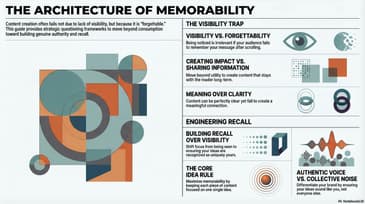

In today’s fast-moving digital world, content visibility is no longer the real challenge—memorability is. You may be posting consistently, gaining impressions, and even receiving engagement, yet something feels missing. People see your content… but they don’t remember you. This is the content recall gap, and it silently limits your growth, authority, and opportunities.
Many professionals, especially mid-career experts, fall into the trap of believing that consistent posting equals impact. But visibility without recall creates noise, not influence. The truth is, your audience is exposed to thousands of posts daily. If your content does not create an emotional connection, a clear narrative, or a distinctive identity, it gets lost in the scroll.
So why does this happen?
The biggest reason is lack of structured expression. Deep thinkers often overanalyze and overload their content with ideas, making it difficult for the audience to retain the core message. Instead of simplifying insights, they complicate them. Instead of telling stories, they share information. As a result, the content may be intelligent—but not memorable.
Another key issue is the absence of a signature style. If your content sounds like everyone else, it becomes interchangeable. Memorability is built when your audience can instantly recognize your voice, your patterns, and your perspective. This requires intentional content positioning, not just random posting.
Additionally, many creators underestimate the power of emotional connection and narrative building. People don’t remember facts—they remember stories, feelings, and moments that resonate. If your content does not make your audience feel something, it will not stay with them.
So how do you fix this?
First, shift your mindset from “I need to post” to “I need to be remembered.” This single change transforms your entire content strategy.
Second, focus on simplification and clarity. Break down complex ideas into structured insights that are easy to understand and recall. Use frameworks, analogies, and clear takeaways.
Third, build a signature content framework. This could include consistent hooks, storytelling patterns, and a recognizable way of delivering insights. Over time, this becomes your identity.
Fourth, prioritize narrative-driven content. Start with a strong hook, build a relatable story, and end with a powerful insight or question that triggers reflection.
Finally, design your content for recall, not just reach. Ask yourself: What will my audience remember after this? If the answer isn’t clear, refine your message.
Because in the end, authority is not built by being seen—it is built by being remembered.