
Learn more about your ad choices. Visit megaphone.fm/adchoices
[00:00:00] Parikshit called one day and said, can you write the forward to this book that I am writing
[00:00:19] on Varadji and I readily agreed.
[00:00:20] I thought I would just read it out because anything else that I say today would not be
[00:00:25] able to go beyond what I have already expressed.
[00:00:29] I profess to be an actor by profession and some of my work related observations guide us in our careers.
[00:00:36] When I saw Balrajdi on the screen, it was not the character he was portraying I saw but only the purity of his heart.
[00:00:44] The way he moved, the way he spoke and the way he expressed himself were unique and straight from the heart.
[00:00:52] When he spoke, it seemed that this is what he was saying.
[00:00:57] He commented on the person when I asked him what he thought about Balrajdi as an actor.
[00:01:03] There was a refined smoothness about him in all his performances.
[00:01:09] If I could have run up to him on the screen, touched his feet and embraced him.
[00:01:14] His cultured and literary background was evident as I perceived during his meetings and reflective moments
[00:01:21] with my father.
[00:01:23] He always came across as one who lived life on his own terms,
[00:01:28] never derogatory about others and their beliefs yet respectful to his own.
[00:01:34] There was a simplicity in his being, in entertaining you with a cup of tea in his home,
[00:01:40] inviting you to play a game of table tennis in the patio in his home.
[00:01:45] The gentle wave of his hand as he passed by you on his horse,
[00:01:49] written without any frills in Kashmir, quietly without the kuchimans climbing up to Gulmarg.
[00:01:56] I know for I was a party to all and every time I drive past his home in Juhu,
[00:02:02] I recall with great affection the man who mementes grace and nobility Baratsani.
[00:02:10] Hello everyone, I'm Supranath Omre and you're listening to Real Deal
[00:02:16] where we talk all things cinema.
[00:02:19] So that voice belongs of course to Amitabh Bachchan
[00:02:23] that is him talking about Baratsani at the launch of his son Parikshasani's book,
[00:02:30] a biography on his father a few days ago.
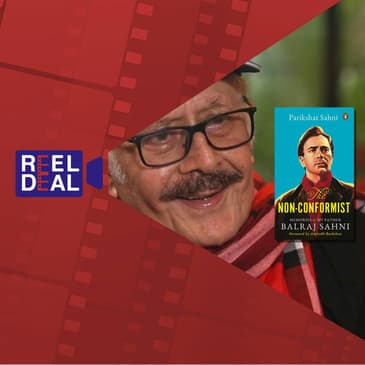
[00:02:33] This book is titled The Non-Conformist Memories of My Father, Baratsani.
[00:02:41] So in today's episode I'm going to talk to actor Parikshasani
[00:02:45] who has starred in hit films like Anokhi Raat, Dhusra Admi, Pavitra Papi
[00:02:51] in the late 60s and 70s and later in films like Laghe Raho Munna Bhai,
[00:02:56] Three Idiots, PK, all these Rajkumar Hinaani films
[00:03:00] and he is going to talk to us today about his father Baratsani
[00:03:04] relive some old memories about him.
[00:03:07] Baratsani of course needs no introduction.
[00:03:10] Apart from being a prolific writer he's made an indelible mark on Indian cinema
[00:03:16] with films like Kabuli Wala, Garam Hava and of course Bimal Roy's Dobhi Ghazameen
[00:03:22] and then many many other films.
[00:03:24] But before we begin I'm going to let you know that you can tune in
[00:03:28] to listen to me every Friday on the Queens channel.
[00:03:31] So watch out for this space and if you like this podcast
[00:03:34] and want to hear more like it you can head over to the Queens podcast section
[00:03:38] or subscribe to the Queens channel on Apple, Google Podcasts and Spotify.
[00:04:04] Have you seen him being this non-conformist?
[00:04:07] Well he felt that conformity is mediocrity and he didn't conform to any of the social norms.
[00:04:17] He lived the way he liked to live life.
[00:04:22] He didn't conform to the film norms to the dorms of society
[00:04:29] and he lived in his own way. He didn't care a damn although he was criticized very often for it
[00:04:34] and sometimes he even made fun of.
[00:04:37] But right from the beginning of his life he was something of a non-conformist.
[00:04:42] When his father wanted him to do business in Rawalpindi he went off to live with Tagore.
[00:04:50] After that his father wanted him back and he went to live with Gandhi ji in Sevagram
[00:04:58] when the war started in 1939.
[00:05:04] In 1939 itself when the seas were being, were infested with the U-Boats, German U-Boats
[00:05:11] and British ships were being bombed and torpedoed.
[00:05:15] He went off to England for four years, five years, worked in the BBC
[00:05:19] for Indian soldiers fighting in the Second World War.
[00:05:22] He became a Marxist there and he remained a Marxist all his life.
[00:05:27] He did what he pleased, he didn't think that he should let society oppress him
[00:05:32] which is what we let society do. This is not the done thing so don't do it.
[00:05:37] You have actually spoken a lot about your personal relationship.
[00:05:42] A lot of biographies it's sometimes when you, I mean obviously it's written by somebody close to the person
[00:05:48] a lot of your personal things have to be poured out and which you have
[00:05:52] was that difficult for you to really bring, put your relationship with your father out there?
[00:05:58] It was difficult and it was painful also because I miss him very much
[00:06:04] and some of the memories were pleasant and some were unpleasant
[00:06:10] and some proved me to be not a very good son.
[00:06:16] So I wanted to be honest to him. So it was difficult but once the memories collected
[00:06:24] I really didn't have to write the book, it wrote itself.
[00:06:29] They just poured out and I just edited it once.
[00:06:34] The rest was done by the Penguin people.
[00:06:36] It was yes a cathartic experience because I think nobody knew him as a man.
[00:06:41] People knew him as an actor.
[00:06:45] So I felt that they should know him as a human being, as a person
[00:06:50] with all his foibles, with all his plus points and minus points
[00:06:55] and his personal idiosyncrasies, his ways, his philosophy of life.
[00:07:02] So that's why I wrote all these. These are only my association with him.
[00:07:07] I haven't written about the movies or it is my experiences with him as a man, as a father
[00:07:14] and as a husband and in a way my mother as a brother in connection with his brother Bheeshamsani.
[00:07:23] So these are all my recollections.
[00:07:25] You have written about your experiences working with him in films
[00:07:31] and the kind of lessons or the kind of things you learnt from him, the things that he used to do as an actor.
[00:07:38] Superb. Very frank I didn't ever want to be an actor.
[00:07:44] I was not trained as an actor. I didn't want to be an actor.
[00:07:48] People took me as an actor because I was his son and they felt ok, he looks alright,
[00:07:54] maybe he has learnt something from his dad.
[00:07:56] But I didn't take acting as seriously as he did.
[00:08:01] Of course I learnt a lot from him by watching the way he worked.
[00:08:05] But I didn't take it as seriously and I didn't do my homework as much detail as he did.
[00:08:13] My first love has always been, I've studied this in Russia for six years, film direction, writing and editing.
[00:08:22] I am happiest when I'm writing, especially when I'm writing a script.
[00:08:27] And I have about five or six or seven, eight, nine, ten scripts lined up.
[00:08:32] When I take it to someone they say, you are acting.
[00:08:38] But I enjoy writing a hell of a lot. Acting is something I... it's fun.
[00:08:44] I like it. I like the Bon Homi, I like the units, I like to be with other people.
[00:08:51] And of course this above all to thine own self be true said Polonius to his son in Hamlet.
[00:09:00] It must... you know about this above all to the own self be true.
[00:09:05] It must follow as a light the day, you cannot be false to any man.
[00:09:09] So you have to be true to yourself. I cannot do anything that will sully his name.
[00:09:15] Somebody says, yaar baap kya tha beta bhi kachara kar raha hai? That wouldn't be right.
[00:09:21] So in that context I try to give my best. But then it's not the... be all in the end all for me.
[00:09:27] To be frank, you have to have some kind of a passion, a madness.
[00:09:33] That's what Amitabh has for instance. I mean he is really passionate about his work.
[00:09:38] Dad had that. I see that Amir has that. Although Amir is I think a good writer himself and a good director.
[00:09:47] So dad had that passion for acting since a long, long time.
[00:09:52] I didn't have it ever. I just happened to do a film, it was a hit.
[00:09:57] I did a second film, it was a hit. I did a third film, it was a bigger hit.
[00:10:01] And there it was that the staff was laid. You're an actor, forget about everything else.
[00:10:06] I in the middle I made a banner called Balraj Sani Productions.
[00:10:11] I wrote a few serials because films is a big thing. They were very big. They did very well.
[00:10:17] And I was... gave me a lot of joy. But the joy was in writing them.
[00:10:23] Not in producing them or I asked somebody else to produce it.
[00:10:27] So I'd say writing is my first love. Then comes acting and direction and the rest of it.
[00:10:33] You have really in detail spoken about how he worked on his craft after his first film became a hit, I think.
[00:10:42] He actually, Hamlog, and he actually went... you've said he used to go swimming.
[00:10:49] He used to... really he worked on his craft. Can you tell our viewers also a little bit about his process as an actor?
[00:10:58] It's a book that's variable on the internet. You must read his autobiography.
[00:11:04] I was not in Bombay when he struggled. I was in boarding schools all over India.
[00:11:12] First Pune then I was in Salah, Lawrence School, Salah, near Sibla, Kasauly.
[00:11:19] Then I was in Delhi College, in St Stephen's College. Then six years in Moscow.
[00:11:26] So in those initial years I did not see that how he struggled.
[00:11:32] All that is borrowed from his autobiography. Very frankly narrates how difficult it was for him to face the camera.
[00:11:40] He had to learn it from scratch because he was a theatre actor.
[00:11:44] But you see here this tenacity which people from... which his brother has also.
[00:11:50] Once these two brothers made up their mind to do something, I mean they didn't give up till they mastered their craft.
[00:11:57] So he just kept on and on and on and he read a lot of books. He read Stanislavski.
[00:12:03] I think that's the system he followed most.
[00:12:06] And he watched other films. I remember once I've written about it in the book.
[00:12:12] He went to see a film called Bridge of the River Kauai. We saw the 330 show.
[00:12:18] He came out and said let's have a cup of tea somewhere.
[00:12:21] It was an Eros. We heard that. I had come on my holidays from Sanaa.
[00:12:26] We had a cup of tea and he said, you have 630 shows.
[00:12:31] I said sure. He said, so the 630 show he came out.
[00:12:37] He said let's have dinner somewhere.
[00:12:40] So there used to be a place called Bertorelli or something. We had some light snacks then.
[00:12:45] He said now let's go and see the 930 show. I said dad what's wrong with you? What's the problem?
[00:12:50] He said then you are that guy. There's two big actors in that film.
[00:12:54] One is Alec Guinness. The other is William Holden.
[00:12:58] And William Holden is outstripped. Alec Guinness. I want to see it again.
[00:13:03] In those days there was no internet or CDs and things you had to see.
[00:13:08] He saw movies again and again. I asked Dilip Saab once where did you learn your acting?
[00:13:14] He said I learned it from the character of Darcy in a movie in which...
[00:13:20] Pride and Prejudice.
[00:13:22] In which Sir Lawrence Olivier played that role.
[00:13:26] So I saw it again and again and again and again and I tried to understand how he works.
[00:13:30] So that's what dad did among other things.
[00:13:33] And then he made his own theatre unit called Juvaar Theatre.
[00:13:37] And you always felt that theatre is the best thing for an actor.
[00:13:41] He said you keep your acting muscles toned up if you are on the theatre.
[00:13:46] And he did theatre all his life every evening.
[00:13:48] After shooting he would go for a rehearsal. He was a member of the IPTA.
[00:13:52] So all these things helped him.
[00:13:56] He was always known as a very natural actor.
[00:13:59] He came across as a very organic on screen.
[00:14:03] So it was interesting to read that he actually had a method how he went to the stage of the character.
[00:14:09] There are two things I noticed about him.
[00:14:11] Firstly, whatever character he played he found a model for it.
[00:14:16] When he played the army officer in Hakikat, he spent a month or two in Kalina army camp
[00:14:23] learning how to crawl, learning how to salute, learning how to walk,
[00:14:29] their haircuts, the way they spoke.
[00:14:31] He homed it on one guy I think and then did that.
[00:14:35] Secondly, the same thing with Kabaliwala, the same thing with Dubhika Zameen.
[00:14:41] He studied, he went and sat with peasants.
[00:14:44] He learned their way of walking, talking, their psychology, what they thought.
[00:14:49] So he got into that character that way. He liked to better mofoze himself.
[00:14:54] Secondly, he depended on what Stanislavskiy called emotional memory.
[00:15:01] I mean Stanislavskiy says that in order to enact a particular scene
[00:15:05] you have to remember if you've been in a situation like this in your own life
[00:15:10] and then be as natural as possible.
[00:15:12] You'll do that scene.
[00:15:14] So for instance, the scene he did in, which is one of my favourite films,
[00:15:19] Garmawa where his daughter dies, he had to go back to relive his own daughter's death
[00:15:27] and that was very painful for him but he did compromise.
[00:15:31] I've just narrated a subject, something to somebody about a film called Alad
[00:15:35] which he did a brilliant scene in the last scene of the day, 6.30.
[00:15:40] People clapped, it was so well done and he came back and he dragged up the director
[00:15:46] and said, Mounji, open the set again. I'm coming to redo the scene.
[00:15:50] He said it was brilliant. No, no, I must do it again.
[00:15:53] And I was with him in the car, he went back and this time people did clap.
[00:15:57] After the scene they wept.
[00:15:59] I asked him what was the reason for going back.
[00:16:01] Dad, you opened the key, you opened the set all again
[00:16:04] and the lights had to be put on and the cameraman had to become
[00:16:07] 50% had a couple of drinks. He said, I did the shot mechanically.
[00:16:15] It was good because I know my technique of acting but it was a shot when my wife dies.
[00:16:21] Then I looked at you and I remembered what happened, what I felt like when your mother died.
[00:16:25] So it was the second time I was being true to my role. That's when people wept.
[00:16:30] So that was his secret. He said acting is believing, it is not acting.
[00:16:34] If you can see through a person's acting, for him it was not acting.
[00:16:40] It was believing in that moment, in who you were, where you were, with whom you were,
[00:16:45] what time you were, what situation you were in. So he believed and he said it's not acting.
[00:16:52] Acting becomes by itself. Be sincere. That thing called the lens used to tell me
[00:16:57] that's a monster. It catches every nuance of your mood
[00:17:01] because it's a large thousand times on the big screen. So if you're being insincere
[00:17:06] that damn lens will catch it. So be completely sincere to what you're doing.
[00:17:11] Live that role.
[00:17:32] You know your own condition.
[00:17:34] Every day I'm worried about earning and food.
[00:17:38] Why worry? Until you get sick, your food will be on me.
[00:17:42] You give me the rickshaw. I'll also drive it.
[00:17:44] It's a very important job.
[00:17:46] Let it be. If you can't earn Rs. 235 in two and a half months,
[00:17:50] then my land will be taken away from the house.
[00:17:52] Lala, there will be no other job with you.
[00:17:56] Why don't you be the head of the company?
[00:17:59] You were all thieves. What can't a person do if he works hard?
[00:18:03] Not in luck but in the human's arms.
[00:18:07] A person can make his own destiny.
[00:18:09] He can make his own destiny as well.
[00:18:15] Who has his actors that he revered as first?
[00:18:19] He didn't talk about it. But I think he revered Motilal Ji a lot.
[00:18:25] He revered your Marathi actors a lot. Stage actors.
[00:18:29] In fact, every week he went to see a Marathi play.
[00:18:32] He revered Bengali actors a lot.
[00:18:34] He felt that they were really good, especially the people on the stage.
[00:18:38] But I think among Indian actors, maybe he admired Dadamuni a lot.
[00:18:43] Ashok Kumar Sahab. But it was mutual.
[00:18:45] Dadamuni admired him in return.
[00:18:48] But he was the only one he felt he was acting very well.
[00:18:51] You have mentioned about Ashok Kumar actually saying that one role that he said,
[00:18:58] this doh bhi gha zameen, that I wouldn't have been able to do.
[00:19:01] You see, he was chosen for that role by Bimal Roy.
[00:19:04] And then Rishita, Rishikesh Mukherjee, he suggested Dad.
[00:19:09] And Dad went to meet him in a suit and all that.
[00:19:13] He just came back from England. He looked fair.
[00:19:15] That's a powdery and all that.
[00:19:18] And Bimal Roy told this guy, who the hell have you called here for this role?
[00:19:23] And they said no, no, give him a chance.
[00:19:26] And he replaced Dadamuni with Dad.
[00:19:29] And that hurt Dadamuni. He told me this once, later on after Dad died,
[00:19:34] I was shooting with Dadamuni and he called me home.
[00:19:37] He said let's have lunch together. I'll give you some Bengali food.
[00:19:40] And he said there's always when I see a film,
[00:19:44] I feel I could have done this role better than this guy.
[00:19:47] Always, 100%. But there's only one instance when I saw a film,
[00:19:52] and I said no, this only but Raj could have done. I couldn't have done it.
[00:19:56] Bimal Roy made the right choice, which was, I think, fantastic coming from Dadamuni.
[00:20:01] What was the significance of Mr. Hamidah Bachchan launching this book for you?
[00:20:06] Your families have been closed for a long time.
[00:20:09] And Harwancharai Bachchan was a person that Dad looked up to a lot as a literary man.
[00:20:15] I mean, he used to read out his poems to us, his works to us after dinner at the dinner table.
[00:20:23] And I think Amitabh was asked by Harwancharaiji,
[00:20:28] that you go and meet Raj first. And he met Dad.
[00:20:32] And Harwancharai told him that if you become an actor, be like Baraj.
[00:20:37] So he has got a very soft spot for Dad. He just didn't come for the launch, he wrote the foreword,
[00:20:43] which is I think one of the best chapters in the book.
[00:20:46] So he was very fond of him and he knew how fond we were all as children
[00:20:52] and my family of him and of his dad. I really revered his dad.
[00:20:57] I read his books and he was a master.
[00:21:01] I think reciprocally he probably agreed to come.
[00:21:05] And that was the high point of the launch of the book because people didn't come for the book.
[00:21:11] They either came for Baraj Sanisabh or for Amitabh and not for me.
[00:21:16] Did you get to know about Bimal Roy and his working equation, the creative equation that they had?
[00:21:25] Yeah, he just told me once one thing. He said, yeah, Bimal Roy has to come on the set,
[00:21:28] he has to stand up and Bimal Roy has to go up and down the set for half an hour, 45 minutes.
[00:21:33] Looking out at the next shot we were all standing waiting for him till he had worked out a shot.
[00:21:38] Then when he placed the camera he told us what to do then we sat down and did what he said.
[00:21:43] So I think he had a tremendous regard for Bimal Roy. The entire cast did.
[00:21:47] If you had to say your favourite work of his, you know.
[00:21:52] I have answered this question again and again and again and I repeat there are three films
[00:21:57] which I consider his best films. Dhobe Ghazamid, Kaabali Wala and Garmawa.
[00:22:03] Seema is excellent, it's a great film. Amiya Chakravarti. In Vakti was fantastic.
[00:22:09] But then in every film he was fantastic. I mean that way he was in Egg Pooz, Dho Mali.
[00:22:16] He was remembered in Talash. But these three I think were the roles in which he excelled absolutely.
[00:22:23] The peak of his career.
[00:22:27] One thing that's a rarity probably today is that the way he used to welcome people
[00:22:34] and work that he used to do which you've written about in the book
[00:22:38] and never share the good work that he has done.
[00:22:41] And he would always be with the people, with the masses.
[00:22:44] You spoke and about how he would probably travel in a third class because the whole team is travelling.
[00:22:49] I'd like to quote someone if you allow me.
[00:22:52] Someone has said that the only measure of your work and your deeds is the love you leave behind after you are gone.
[00:23:00] And he was love personified. He just loved everybody.
[00:23:05] The leaps up said about him when he died.
[00:23:08] Here was a man who hated, hatred. He had no hate in him.
[00:23:12] So he, without this empathy, Amitabh has that.
[00:23:17] Without this empathy, without this love for people.
[00:23:21] One of his favourites saying was that the greatest aim in life is to love humanity.
[00:23:28] So he was so full of love all the time.
[00:23:31] He empathised with people who were poor, helped them in whatever way he could.
[00:23:36] I came to Bombay from Moscow. I went to the southern sands and the waiters refused to take money from me.
[00:23:45] I said, what is that?
[00:23:48] Then one of the waiters said, sir, we'll be having strikes here in front of the hotel.
[00:23:53] The hotel authorities refused to budge and even in bad shape, our children were starving.
[00:24:00] Dad, his father used to go for a swim every morning to the sea.
[00:24:03] He used to hand us over a packet every day. This is for your children.
[00:24:07] He didn't tell anyone about it. I've written that in my book where I did this role called Shivaji.
[00:24:12] He had done something so huge, so colossal and not said a word about it to anyone.
[00:24:18] He was like that. That is what made him great. It is love. The operative.
[00:24:23] God is love. He that dwelleth in love, dwelleth in God and God in him.
[00:24:29] He was an atheist. He didn't believe in any religion. He had never read a religious book.
[00:24:34] But he lived those things naturally. He was full of love.
[00:24:38] Thank you so much Parikshit Ji for talking to us.
[00:24:41] Salute to everybody on Quint. Big hello to all of you.
[00:24:44] So that was Parikshit Zani at his candid best.
[00:24:47] And really what an insightful conversation for me.
[00:24:51] At a note for young listeners, please go back and explore the work of Balraj Zani
[00:24:56] because he's one of our first Indian stars, actors, brilliant actors
[00:25:01] who believed in the new realistic cinema of the time.
[00:25:04] A textbook if you can say on acting.
[00:25:07] And those who have known Balraj Zani and watched his work as an actor
[00:25:11] must definitely read this book because there's a lot more to learn
[00:25:15] about the man behind the camera.