
Learn more about your ad choices. Visit megaphone.fm/adchoices
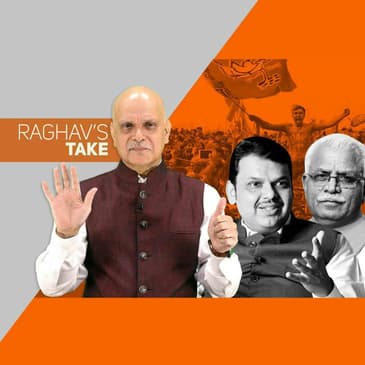
[00:00:00] Rise Above The Din Unbox the News with me, Raghav Behal. You know now I know that adjectives like milestone, like game changer, like watershed, you know these are very frequently used after polls that throw up somewhat contrarian, somewhat unexpected results.
[00:00:36] But even after adjusting for this caveat I would call the October 2019 mini national elections a juggernaut stopper. Now here are my 6 takeaways on those elections. One, the Modi Delta, you know that Modi Delta, the change that Prime Minister Modi commands
[00:00:56] in votes because of himself, it's almost a fantastic 12, perhaps even 15 percentage points. Now we all know that the BJP scores a considerably higher vote share when Prime Minister Modi is on the ballot, that is when the voter is seeking to give him a direct mandate.
[00:01:16] And that sort of falls away dramatically when he is canvassing for votes for his party in state elections. Now collating the differential between the past two Lok Sabha elections and 14 assembly elections and these 14 include Maharashtra and Haryana in 2014 as well as in the week gone by.
[00:01:38] I estimate that the Modi Delta is closer to 12 perhaps even 15 percentage points, that is if the BJP gets 35% in a state election it could score close to 47 to 50% in that state in a national or the Lok Sabha election where Prime Minister Modi is on the ballot.
[00:01:58] Now this almost predictable dichotomy is quite unprecedented in any electoral democracy. Two, Congress's defeatism is actually misplaced. You know the surprise bounce by the Congress plus its allies across the country must convince the grand old party that its post 2019 defeatism is utterly quite unwarranted.
[00:02:26] You know it's 20% national vote share is quite a healthy minimum, it's quite a healthy minima on which it can build a strategy of political revival. You know it does enjoy a fairly natural resonance with an electorate which is looking for
[00:02:44] an alternative and this is especially among the poor, among the disenfranchised in vast spaces of Northwest and Central India. Of course this also means that regional strong leaders, regional titans whether it's Anamrindar Singh in Punjab or Ashok Geyalot in Rajasthan or Kamal Naath in Madhya Pradesh or Bhupinder
[00:03:08] Kerala or of course Alai Sharad Pawarin Maharaj Shah. These should be empowered without being feted by what's called the Delhi leadership. Now the third takeaway, the changing political impact of the MLA's count.
[00:03:29] We look at a party's count in the Lok Sabha to measure its strength but a far more central metric is the number of MLA's in the kitty of that party. Remember an MP at an average represents over 2 million, about 20 lakh citizens while an
[00:03:48] MLA is accountable to about a 10th, you know to about 2 lakh or 200,000 people. Therefore an MLA's clout with his constituents is far more intimate and forceful. Now the UPA plus opposition parties have been consistently adding to their arsenal of MLA's
[00:04:10] with pretty strong ever increasing velocity over the last 12 months especially after the Punjab, Gujarat, Madhya Pradesh, Rajasthan, Shatisgarh, Maharashtra, Haryana and other by elections. Now at a rough count I reckon that this could be, they could have added
[00:04:28] about 200 plus MLA's. Now that's an accretion of over 25%, 25% to their earlier numerical strength. Now this gives the non-NDA parties a rather solid base on which to reconstruct their political fortunes. Takeaway number four, you know cultural nationalism, jingoism is now somewhat dwindling
[00:04:58] across the political space. Clearly neither the Balakot strikes nor the jingoistic appeal of you know we've killed Article 370 or indeed the graphic threat of Wilchak illegal immigrants into the Bay of Bengal. Now none of this seemed to move the needle with an electorate
[00:05:19] which now appears quite obsessed with unemployment and dwindling economic prospects. So any narrative that's based on these divisive political issues is a lose-lose proposition in these non-national elections. Now if the ruling party harps on these themes those leaders they start looking
[00:05:42] remote and dodgy to the electorate. And if of course the opposition tries to counter this kind of narrative forcefully, the opposition risks sort of ratcheting up emotions and thereby distracting from bread and butter issues. Takeaway number five, turncotes they
[00:06:02] can't fool all the voters all the time. Now guess who were the real political mascots of last week of October's polls? No it wasn't Devendra Fadnovis, it wasn't Manohar Lal Khattar but three relatively non-descript local politicians called Udyan Rajay Bhosle.
[00:06:26] He's an ex-member of parliament of NCP Sharad Pawar's NCP, Alpesh Thakur, he's an ex-MLA of the Gujarat Congress, Dhaval Singh Zala, he's also an ex-MLA of the Gujarat Congress and of course a clutch of other political turncotes who jumped ship to either the
[00:06:45] BJP or the Shiv Sena, they were quite obviously hoping to ride the curry train, the gravy train. But a wise electorate stopped them dead in their tracks. Finally the sort of sixth take away, jail, jail means instant political stardom. You know Prime Minister Modi and his government
[00:07:09] must recall the folly of the Shah commission in 1977 and 78, which almost single-handedly resurrected a hopelessly defeated Indira Gandhi's political career. Now right or wrong, I'm not saying it's right, I'm not saying it's wrong, right or wrong our electorate is quite feudal and quite sentimental
[00:07:30] about the strong or the son of the soil kind of politician. And if the electorate senses that they are being hounded unfairly or they are being punished selectively, you know their sympathy,
[00:07:45] hormones, they begin to work overtime. Now just see what happened to Sharad Pawar after he was booked by the enforcement directorate days before the Marathas voted. Pawar's political stature just seemed to swell in might. In Haryana, the dogged Bhupinder Hooda, you know who was seen
[00:08:03] fending off a concerted attack from several central agencies, he acquired the halo of a true jart, you know one who fearlessly takes on his tormentors. So therefore the lesson is quite clear and overuse of the agencies is a double-edged, you know often losing endeavor. The government must
[00:08:26] rein them in. Thanks for listening. Tune in next week for another episode of Raghav's Take.