
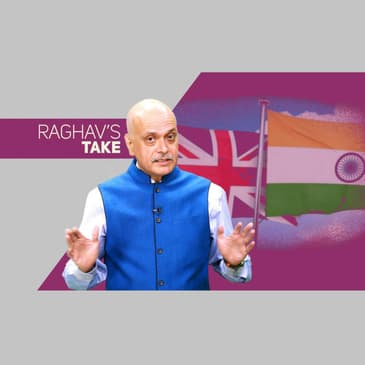
As a nation, our feelings toward our former colonisers are complicated at best. For better and worse, the British profoundly shaped modern India, breeding insecurity and sectarianism while imparting some of their most enlightened institutions: Parliamentary democracy, an independent judiciary, rule of law, the English language (and accent), the university system, a robust free press, the civil bureaucracy and military architecture. Because of the British, we play cricket, drink tea and drive on the left side of the road.
Despite Delhi’s efforts to change colonial place names, we still visit McCluskiegunj in Jharkhand, for example, which was once home to a large Anglo-Indian community, and fly into Jolly Grant Airport in Dehradun. We couldn’t erase the impact of British colonialism even if we wanted to!
Listen to the podcast for the rest of the story!
Learn more about your ad choices. Visit megaphone.fm/adchoices
[00:00:00] Rise Above The Din, Unbox The News With Me, Raghav Behal As tensions mount in what Indians love to call Sada or Aapro or Amchi London. That's three ways of saying our London in what the Brits would have once called three dialects of the natives.
[00:00:18] Now what's happening in London about will Britain do it? Will Britain won't do it? Will it get out of EU? Will Brexit happen? Now in all of this, how does India react to all that's going on? Not a good start, Boris. Order. The eyes to the right, 328.
[00:00:40] The nose to the left, 301. So the eyes have it. The eyes have it. I don't want an election but if MPs vote tomorrow to stop negotiations and to compel another pointless delay to Brexit potentially for years then that would be the only way to resolve this.
[00:01:01] He wants the table of motion for a general election. Fine, get the bill through first in order to prevent, in order to take no deal off the table. Now first things first, we are now the bigger brother of our erstwhile colonial rulers where
[00:01:30] Britain is losing ground, India is gaining. While the UK's population is aging, India's youth bulge will help make it the world's most populous country by 2024, 25, 26, somewhere around that time. And while the UK's economy in 2017 it was the world's ninth biggest and that's measured at purchasing power parity PPP.
[00:01:53] Now that will fall to the 10th place by 2050, India is expected to climb from third to second and that's all according to IMF. No wonder London sees India as a key part of the post-Brexit solution to its looming demographic and economic troubles.
[00:02:14] One Commonwealth report found that Brexit would provide a fresh opportunity for India-UK trade, giving the UK more flexibility in negotiating a free trade agreement once its formal departure from the EU is complete. Ah, here comes in the Commonwealth.
[00:02:34] Has it now become a potential opportunity from once being a pariah? Now remember, even Nehru who was instrumental in securing independent India's membership in the association of these former British protectorates in 1949, he, remember vehemently opposed it at first.
[00:02:54] Under no conceivable circumstances is India going to remain in the British Commonwealth. Nehru had said that in April 1947 with the Raj at that time refusing to grant India even a Dominion status. Of course by the time independence was won and that was fully and swiftly about 2 years
[00:03:14] later Nehru had changed his mind. He believed the ready-made network of kindred nations would boost India's security and economic prospects though of course he remained adamant that Indians would never answer to the monar. Now since the demise of the British Empire, the Commonwealth has managed to persist despite
[00:03:41] its waning usefulness. With 53 members it remains the world's third largest international association after the United Nations and the organization of Islamic cooperation. Yet many and this includes several Brits consider this very far flung group you know almost
[00:04:01] an arcane artifact a sort of obsolete collection from the Empire days devoid of any real economic or strategic benefit. The Guardian called the biannual meeting of member nations the you know they called it the zombie summit.
[00:04:20] You know it was a gathering of whimsy that refuses to die so that's the language they used. Others of course refer to it simply as the British Empire 2.0. Indians who you know never really bought into the concept despite Nehru's enthusiasm have been especially indifferent.
[00:04:42] Remember between 2010 and 2018 no Indian Prime Minister bothered to attend a Commonwealth meeting until of course Prime Minister Modi acquiesced to London's insistent overtures which of course included a letter from Queen Elizabeth and a personal visit from Prince Charles.
[00:05:03] You know I think India has nothing to lose by stepping up its engagement in the Commonwealth of course it affords Delhi diplomatic contact with smaller nations it might not otherwise connect with and is one of the few places where Beijing can't interfere.
[00:05:24] The Commonwealth actually gives us a chance to talk to fellow Asian countries without China being in the room and this is a fairly famous quote. At the very least it provides another global forum for showcasing our strengths.
[00:05:39] Already Indians comprise more than half the Commonwealth, more than half the total population of Commonwealth is 2.4 and we are more than half. The 2018 report credited India with driving increased intra Commonwealth trade and investment which is predicted would exceed 700 billion dollars by 2020.
[00:06:02] And with calls mounting for Britain to appoint an outsider to succeed Prince Charles as head of the Commonwealth in 2020, India is an obvious choice to fill that role. Now to move ahead India can encourage, entice, deliberate and be patient with the UK but it mustn't back down.
[00:06:26] There should be no trade deal without visa liberalisation that should be our demand. India of course should be happy to lend Britain a hand just as long as they do the same for us. Thanks for listening tune in next week for another episode of Raghav's Take.