
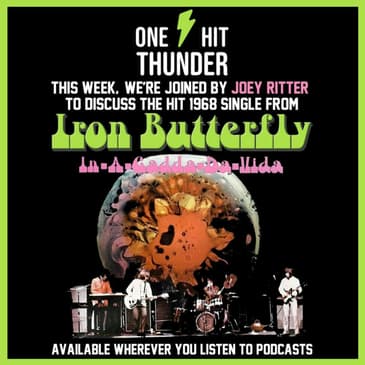
Whether it was from an 80s horror movie, a Simpsons joke, or your dad’s record collection, you have undoubtedly heard the psychedelic sounds of Iron Butterfly’s 17-minute-long opus “In-A-Gadda-Da-Vida”. This week, we’re joined by Joey Ritter to discuss extended drum solos, wild conspiracies, and the bizarre career of these hard rock pioneers that sold over 30 million copies of their landmark album.
If you like the show, be sure to rate, review, and subscribe. Email us at
onehitthunderpodcast@gmail.com. Also, follow us on our social media: Twitter: @1hitthunderpod Instagram: onehitthunderpodcast Wanna create your own podcast? Contact us at We Know Podcasting for more information. Visit Punchline: A Band Called Punchline | Pittsburgh, PA for Punchline tour dates, news, and merch. Sign up for more One Hit Thunder on our Patreon One Hit Thunder | Patreon
Learn more about your ad choices. Visit megaphone.fm/adchoices
[00:00:00] Hey everybody, it's Chris. If you're a sports fan like me, or you're just a fan of a great story,
[00:00:05] you gotta check out Press Box Access, a sports history podcast hosted by Todd Jones.
[00:00:11] Todd sits down with fellow sports writers who experienced firsthand some of the biggest sports moments of the past 50 years,
[00:00:16] and they share some of the stories behind the stories, some of which they've only told to each other.
[00:00:22] What I personally love are the wild stories that you might not hear so much about on SportsCenter over the years.
[00:01:25] all the places you get your pods and you can also find Pressbox Access on YouTube. Go check it out.
[00:03:04] Whether it's from an 80s horror movie, Night of the Living Dead premieres in Pittsburgh. The Beatles music videos for Hey Jude and Revolution debut on the Smothers Brothers Comedy Hour. The Motion Pictures Association of America adopts the film rating system. American I think this will be the first podcast that my parents ever listened to. So my dad was huge into this song and the 60s are really out of my wheelhouse. So all the stuff you mentioned at the top, what was going on at
[00:04:24] the time, there's a couple more things to add look at the CDs. And I swear every single human being that my parents were friends with had this LP, had the Iron Butterfly album in the Gotta Divida
[00:05:41] that had like three songs on side A
[00:05:44] and then all of side B was collapses onto the organ and falls over. But as a kid, I didn't get, I was like, why was this song 17 minutes long? And there's jokes that completely went over my head.
[00:07:00] And now I'm like, oh my God, that joke just gets funnier
[00:07:04] the more you know about the real song and this band 17 minutes long, they're at the recording studio. This song was a sound check. So the engineer is in the room, the producer hadn't even gotten there yet. And the engineers, they're just checking mics, they hit record, and they just, it's basically like a jam session of the song. They never intended it to be 17 minutes.
[00:08:20] Wow. I didn't know that. I mean, that's on. There's a two and a half minute long drum solo. That's a not impressive solo. It's a great drum solo though. You think it's great? I was so unimpressed by his drum solo. Come on, you gotta remember, it's 1968. They don't have Metallica CDs to be inspired by.
[00:09:40] They're the first to do what they're doing.
[00:09:42] True.
[00:09:42] I don't think that this was the intention, right?
[00:09:45] But I think the was thinking of like, obviously, there's this band was somewhat influential. Like Chris said, they're considered one of the first heavy metal bands. Yeah. And all that. But I think as I was listening to this, the band that I think probably is the biggest iron butterfly fan in the world
[00:11:01] was probably like typo negative, right?
[00:11:04] Like you've got that deep bassi vocalist and you've got the like
[00:12:02] And that was shortly after this was released. I mean, this band was influencing the Beatles, let alone all the hard rock and metal that was to come, regardless of my thoughts on the song.
[00:12:10] It was definitely influential. And yes, it only the song went to number 30, any reason, like had a surgery and was on painkillers, I'd probably, on the list of like, okay, I'm high for the only time possibly in my life. What are some things I want to do? Listen to In the God of Devita might be somewhere on that list. Like just take it in. I guess that does make sense.
[00:13:41] I mean, a lot of people were tripping at this time.
[00:13:44] I wouldn't think so many people were tripping that it would stay on the charts for 140 weeks
[00:13:48] in a row. Cosby, late 60s, full Cosby, he's like, what was the name of that song? In the God of the Vita? In the God of the What? You know, just in. Just drugging all the women. Right, he had two pockets full of drugs ready to go. Yeah, so it's, that, I guess it makes sense that you match the drugs of the time
[00:15:01] with the fact that this is probably
[00:15:06] the heaviest shit out there.
[00:15:08] Yeah. for whatever you're watching. I think that that's one of the things that I like about the song, and I already thought this before I ever saw this movie, but there's like an element of this movie or this song that feels kind of scary and unsettling because it's so long as well. And then there's the movie Manhunter, which is the first ever Hannibal Lecter movie.
[00:16:22] It was from 1968, directed by Michael Mann. that I found in my research was that they were supposed to play Woodstock, right? They were supposed to play the first Woodstock and they got stuck at LaGuardia Airport. They explained the situation to the concert performer and asked for patience. But then their manager sent a telegram demanding that Iron Butterfly be flown in by a helicopter whereupon they will immediately take the stage
[00:17:41] and then after their set will be paid and put back into the helicopter
[00:17:47] to be flown back to the LaGuardia Airport.
[00:18:46] Awesome big what if there I mean what if they played Woodstock and their set was legendary more You know legendary than Jimi Hendrix playing the Star Spangled Banner
[00:18:49] I mean what if they did a 17-minute version of the Star Spangled Banner in the middle of in the Gotta Dabita
[00:18:55] Never will never know ever universe it could have changed the course of history
[00:18:59] I want to talk to you guys a little bit about Doug Ingle the guy who wrote the song yeah the kind of the
[00:20:03] both considered the earliest versions of heavy metal. Like Iron Butterfly, a metal thing that flies,
[00:20:06] Led Zeppelin, also a metal thing that flies.
[00:20:10] So Doug wrote this song, I'm sure you guys saw this,
[00:20:14] and Ron Bushe, the drummer, was kind of like writing it down.
[00:20:19] OK, here's what the song is.
[00:20:21] But at the time, the dude was a Vita band. I got to check out the new album Yeah, yeah, they were doing it and by 1971 They broke up and they eventually got back together
[00:21:41] Without Doug and recorded two more alms in 1975. I first gave AG1 a try because I'm always trying to balance a ton of podcasts and music projects and I need energy. I saw an AG1 bottle sitting out of my buddy Mike's counter and I asked him about it. After hearing him rave about how much he prefers it over taking a bunch of supplements, I was
[00:23:02] in.
[00:23:03] Since drinking AG1 daily, I your first purchase at www.drinkag1.com slash one hit. That's www.drinkag1.com slash one hit. Check it out. I'm not gonna lie here. I've become a factor fanatic lately. I'm a busy guy and getting to eat restaurant quality meals that are ready to heat
[00:24:22] and eat in two entity has been growing. And then... Dan, please take my hand. But what's the bass part during the drum solo? Just... What did those guys do during the drum solo? That's a great... I wondered the same thing. They're just smoking cigarettes or what... Lots of drugs. That makes sense.
[00:27:02] Can we also, real quick, before we jump into more about Iron Butterfly
[00:27:05] and we're talking about the structure of this song, This leads very nicely into what I'm so excited to talk to you guys about. The Inagata-Davida bassist is, I think, different than the guy that you're about to talk about. Really? Chris, I'm not sure if you looked at the Wikipedia page for Iron Butterfly and their past members. It is like 40 names deep on the past members list.
[00:28:20] Lee Dorman was the bassist on Inagata-Davida, and then they broke up for a couple years,
[00:28:24] got back together, and then that bass, I'm gonna talk about this anyway. There's this guy, Philip Taylor Kramer, known as Taylor by his bandmates. He played in the band, I guess, starting in 1974, bassist, they really seemed to like him. I watched them talking about him. But after the band was finished, this bassist, Taylor,
[00:29:44] got his degree in aerospace engineering
[00:29:46] and he worked on the LA International Airport to pick up a business associate and the associate's wife. On the way and the DEA had on the OJ Simpson murder trial. And then he was never heard from again, and they never found his vehicle, and they never found his remains for Robert Tepper. Oh, wow. That makes sense. That's great. That does make sense. I was like, as you were talking about how many band members there were, I was like,
[00:33:43] wait a second.
[00:33:44] We've talked about someone being an Iron Butterfly in center city Philly. He was doing well, bought himself a black Pontiac Trans Am. So in like 85, 86, a car thief takes his black Trans Am, proceeds to drive around City Hall in Philadelphia in the opposite direction. The cops are chasing him.
[00:35:00] He ends up crashing into a bus.
[00:35:03] And in the midst of all this chasing by the cops,
[00:35:06] he proceeds to throw all And my dad just ten floors up.
[00:36:20] 17 minutes and five seconds.
[00:36:23] Wow.
[00:36:23] And he said the DJ looked up at the time that this song peaked at number 30 on October 26th of 1968, the number one song of the time was Hey Jude. And also on the charts at that time,
[00:37:40] at number two was Little Green Apples by O.C. Smith,
[00:37:42] if you guys know that song.
[00:37:44] Number 12 was Susie Q. from Creed and Clearwater Revival. DVD of this thing and we just we knelt motionless for the entire length of magic carpet ride well well the guy running the thing is like are you guys gonna do something and we just like we just like set their motionless and then took our DVD and walked away I eventually put it on YouTube but that's what that song always reminds me of I gotta say yeah it's
[00:39:02] good it's gonna take a Texas toast episode at Scott Stapp, but that whole like marble mouth sort of delivery that we all like to make fun of, this might be the first one of those. So you know, aside from inspiring all this hard rock and metal, it may have also inspired all the marble mouth goobly goo of the 90s and 2000s and even into now.
[00:40:25] So yes, I would have to give on and be like, sorry, dad, blunder, but no way. The more I looked into it, the more I researched, I'll give them points off because maybe the other songs that are catalog,
[00:41:42] I'm not going back and listening to,
[00:41:44] but they keep playing,
[00:41:47] they inspired the Beatles as you said, members even though the main songwriter is still alive painting houses in Oregon. Like it's just it's a really weird band and a really weird story. I think this episode was Thunder, but I think the band Iron Butterfly is a bit of a blender. Oh, boy, you guys both made great cases. If I'm the deciding factor here, I was look.
[00:43:04] I do not like this song. I'm not going to beat it on the butcher.
[00:43:05] I don't ever want played the same song. Like at what point are you like, I'm going home. I'm gonna go to a different bar and hear a different band play. That would be rough. They did influence everybody. I mean, I thought it was especially interesting. They influenced in some small part the Beatles.
[00:44:20] Like that's a big deal, you know,
[00:44:24] and influenced like generations of like heavy music that this happened. I don't even know we realized how big we were or whatever. They seem like good guys. I love what a mountain man Doug seems to be. I love that he's like, well, had this giant hit sold 30 million copies. I'm going to go manage an RV park and paint a few houses. I think that's pretty cool. I probably didn't have to do that. I don't know. I'm on the fence, but I'm going to fall over to one side and say thunder. All right.
[00:45:44] Nice. I didn't expect it. I did not anticipate guest. Regardless of the song, it's always Thunder when Joey Ritter stops by. Love having you, man. I'm getting it right now Time flies, no luck with the bugs and clock eyes Make you say things have been so old So your rage has bringing you down And how?
[00:48:21] If there's no sentry the peril
[00:48:24] Well then I guess we didn't make it
[00:48:26] But I bet we didn't miss by much