
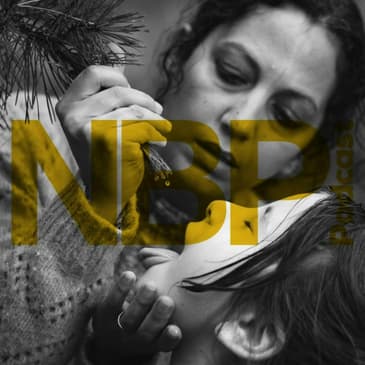
"Green Border" had its world premiere at the 2023 Venice International Film Festival, where it received critical acclaim for Director/Co-Writer Agnieszka Holland's harrowing depiction of the refugee crisis sweeping its way through the Belarus–European Union border. With stark black and white photography, intense performances and a vast but intimate scope that looks at how the crisis has impacted the lives of so many, the film stands out as one of the most controversial but important films of the year. Holland was kind enough to spend some time talking with us about her work on the film, which you can listen to below. Please be sure to check out the film, which is now playing in theaters from Kino Lorber. Thank you, and enjoy!
Check out more on NextBestPicture.com
Please subscribe on...
SoundCloud - https://soundcloud.com/nextbestpicturepodcast
Apple Podcasts - https://itunes.apple.com/us/podcast/negs-best-film-podcast/id1087678387?mt=2
Spotify - https://open.spotify.com/show/7IMIzpYehTqeUa1d9EC4jT
YouTube - https://www.youtube.com/channel/UCWA7KiotcWmHiYYy6wJqwOw
And be sure to help support us on Patreon for as little as $1 a month at https://www.patreon.com/NextBestPicture
Learn more about your ad choices. Visit megaphone.fm/adchoices
[00:00:00] Shopify grows your business no matter how far or big you grow. Shopify is the global commerce platform that helps you sell at every stage of your business. Whether you're selling your fans' next favorite shirt or an exclusive piece of podcast merch, Shopify helps you
[00:00:19] sell everywhere. Shopify powers 10% of all e-commerce in the US. Allbirds, Rothies, Brooklinen, and millions of other entrepreneurs of every size across 175 countries. Plus, Shopify's award-winning help is there to support your success every step of the way. Because businesses
[00:00:43] that grow, grow with Shopify. Sign up for a $1 per month trial period at shopify.com slash income, all lowercase. Go to shopify.com slash income now to grow your business no matter what stage you're in.
[00:01:39] Welcome everyone to the Next Best Picture Podcast, where we are talking with Agnieszka Holland, the director and co-writer of Green Border. Agnieszka, thank you so much for joining us today. My pleasure. Thank you. Hello, everybody.
[00:02:20] You've worked as a director for a few years now, and some of your screenplays you've written, some of your screenplays have been written by others, some you've co-authored with other people. What attracts you to writing a project versus directing something that someone else has written?
[00:02:43] That film is different from others somehow. It means I always decide to tell the story or to make the film about some situation or some people or to adapt the book because I feel that it's relevant somehow to my own situation and to the situation around me.
[00:03:04] But with Green Border, it was much more than that. It means for some time, I think and I believe that the world is going in a very dangerous direction and that the experience of the Second World War and the Holocaust have been
[00:03:21] forgotten and that the vaccination which was made by those events evaporated. Maybe around September 11th. And the issue of migration, it will shape Europe and probably all world in next years and decennies. And that no one is really dealing with that issue in an honest way.
[00:03:49] But the politicians are spreading the fears and hate and using the migrants and refugees as a political weapon and political gold. And it's right at least since 2015, since the Syrian war. But it became in my country also in Poland on Polish borders.
[00:04:18] It became the real moral issue which I couldn't just to watch and observe. I feel that I have to tell something about it and tell the story in all possible complexity
[00:04:39] to let people somehow to feel and wake up and to give the voices and faces to the people, especially refugees, but also activists who are helping them and to give them real identity because they've been dehumanized by the regime.
[00:04:59] So I felt that it's my duty as a filmmaker, as an artist, as a citizen of the world and as somebody who made three movies about the Holocaust and one film about Stalin's crimes.
[00:05:16] So I know very well how that egg of serpent is born and how easy it is to change people's mind and to infuse them with the hate of others. So, you know, so that it was the main reason why I decided to make the film.
[00:05:36] And if some similar kind of the reasons have been behind my films, Europa, Europa or In Darkness, that will have been historical films about the past, the past which was resolved and
[00:05:52] which we know we have the distance to, we have the overview, but to the reality, to the actuality, we don't. So it is very challenging to tell the story which is going on in front of our eyes and we don't know the ending.
[00:06:10] But I feel that the ending cannot be good if we will not change the attitude. Absolutely. And in working with your co-authors on this, what made you reach out to them to create this piece with you? It was a great collaboration.
[00:06:27] I had only not co-screenwriter, but I also invited two young women directors to join me and co-direct some scenes. We've been shooting very quickly in 24 days. So we divided some days on the parallel units and they've been shooting one unit and I was
[00:06:48] shooting the other. And also my daughter, who is a director, was helping me on the most complicated and complex and massive scenes. So, you know, it went, we've been all on the same page.
[00:07:00] You know, it was somehow, you know, the movie was hard to shoot and it is also the movie which costed the documentation, the research for that film and talking to the people who went through that. It was quite heavy. It means it engaged me emotionally a lot.
[00:07:20] But in the same time, the collaboration with my crew and actors have been very, you know, very harmonious somehow. You know, it was we made that film very, very fast and in some state of grace, I will tell.
[00:07:37] And imagine 24 days is not a lot of time at all to shoot something this sprawling in terms of location and characters. There's a lot happening. Did you shoot on location? Yeah, everything was on locations. How did you find places in this forest, this ancient, dangerous forest?
[00:08:00] We didn't shoot in the real forest. It was impossible. It means that the forest were on the border, which is a very big and vast and ancient forest. But there is also state forest. So we never had the permit to shoot that. And it's highly militarized.
[00:08:19] It's full of, you know, of soldiers and police and border guards and blinded vehicles. And so we found very similar places, of course, of a little different scale. But you don't see it in the film close to Warsaw in private forests.
[00:08:40] We found the swamps and we found the fallen trees and all that stuff which is characteristic for the forest on Białowieża. So it was easier, of course, and we can shoot it to some point very discreetly.
[00:08:58] So we've been not deranged by the, you know, by the police or by the passersby. Only by the end we've been recognized and that created a bit of problems. But it was very close to the end of our shoot, so we escaped the real problems.
[00:09:18] This is Krista Makes, guitarist and vocalist for Less Than Jake and host of Krista Makes a podcast, a songwriting podcast where every week I'm joined by an amazing guest to break down the writing, recording and release of one iconic song from their career.
[00:09:35] In our giant evergreen back catalog of episodes, we've had rock legends such as Dee Snider and Huey Lewis, punk rock favorites like Mark Hoppus, Fat Mike and Brett Gurowitz, and up and coming artists of today, such as Liz Stokes of The Beths and Genesis Owusu.
[00:09:50] We've had guests from all genres and styles of music, and I guarantee that if you peruse our back catalog, you'll see several episodes that will make you say, man, I got to hear that.
[00:10:01] Whether you're a fan of music or a creator of music yourself, you'll take away a whole new appreciation for the songs you know and love. Krista Makes a podcast is available for free on all the places you could possibly
[00:10:14] listen to podcasts and new episodes come out every Monday. Good, I can imagine it was shooting, you know, in these forest locations. And shooting on black and white film, which is a very striking choice that brings
[00:10:32] you know, like what you were talking about, the connection to the past and subjects that you've made other films on before. But shooting on black and white, how did you solve for like making things look
[00:10:48] though, the level of black or white or gray that you wanted when you're shooting in the natural world, as opposed to an environment you can more closely control? But you know, you can control black and white easier somehow. No, because to control, yeah.
[00:11:07] Because you can correct a lot of things, you know, after with the contrast or with the, you know, with the shade. And I have great cinematographer who I worked for some last work with. And and he's very flexible and he's also operating.
[00:11:25] So somehow he's like my eyes and my hands. And it was again, it was it was very harmonious. We found the concept very quickly and after we've been following it as much as possible and it worked.
[00:11:40] Sometimes you have the concept, you imagine to shoot the film in some way. But the first, second day of the shooting, you see that it's not relevant with the story and that somehow, you know, the story and the situation is defending itself
[00:11:54] from your concept. But that time our concept happened to be to be totally right. Yeah, I can imagine. The film, you divided the film into four chapters that are each defined by a character or group of characters point of view.
[00:12:13] You have first the family, then the border guard, then the activists and then Julia, the woman who joins the activist group. How did you come to this order? On the beginning, I think the order was slightly different. The activists come in the second group, I think.
[00:12:35] And after we and we we made it a little less linear. But after we found out in the editing that that we have simplified it a bit and that also emotionally that order, which is final, will be more efficient.
[00:12:50] So so that is, you know, when you are doing the film like that, it's totally independent and you don't have, you know, the founds or studio or television or platform telling you what to do, that you have to go to
[00:13:05] color, that it cannot be longer than two hours and that you have to take that those and those actors somehow, you know, is somehow it's for me much more difficult because the freedom makes me inspired and the freedom gives me also the courage to be bold.
[00:13:26] And even duty to be bold. So so we've been we've been like reacting to the needs of the material through the shooting and after after doing the editing and taking the advice from the people who know screening. And I'm editing in my country house in Britain, in France
[00:13:50] and then it came and now we have little studio, you know, to edit and screening. And so it was extremely intense. But we had the friends coming and my producer came and we've been screening it to them and they gave a lot of notes.
[00:14:08] And after I asked some friends, other editors in Belgium and Poland to see the watching and give the notes and like that, we it was all together. It was nine months to make that film, to finish the film.
[00:14:23] And nine months for the woman director is, I think, the good period because it's exactly when your baby is born. That sounds perfect to me. It's nice, nice symmetry. I know we're coming up on the end of our time together, but I had to ask
[00:14:41] because I read that when this film was shown in Poland, the Polish government forced a film of their own about the crisis at the border to be screened before this. I was wondering if you have seen that film. Actually, no, it was the two minutes propaganda clip.
[00:15:08] Yeah, which was totally non-efficient. And the most of the cinemas were not dependent on the government being not run by the local government or something. They refused to screen it. So it was screened, I don't know, in 10 cinemas among 200. So it was not successful action.
[00:15:28] And thank God for that. Well, anyway, it will be not efficient. The people, you know, if somebody came to the cinema to see my film and watching two hours, 40 of the movie, it will be not convinced or impressed by that pretty primitive propaganda clip. One would hope so.
[00:15:49] The movie is incredibly powerful and leaves you with a lot of big emotions and things to think about at the end. As we have to wrap up, what do you want people to be left with as something they can do going forward
[00:16:08] after they've been moved by this film? Don't forget that we are all humans and we have only one life and the choices we are making about ourselves and others can have incredible consequences. So we have not to forget our humanity. It's a very important thing to remember.
[00:16:31] Thank you so much, Agnieszka. Thank you. Hey, everyone. Thank you so much for listening to Dan Baer's interview with the director for Green Border, Agnieszka Holland, here on the Next Best Picture podcast. Green Border is now currently playing in limited release from Kino Lorboer.
[00:16:47] You have been listening to the Next Best Picture podcast. We are proud to be part of the Evergreen Podcast Network, and you can subscribe to us anywhere where you subscribe to podcasts. Be sure to leave us a review on Apple Podcasts
[00:16:57] to let us know what you think of the show. We really appreciate your feedback and your support, which you can also lend on over at Patreon for one dollar minimum a month. You'll get some exclusive podcast content from us. Thank you all so much for listening, as always.
[00:17:10] And we will see you all next time. Hey there. I'm Hannah. And I'm Audrey. We are a sister filmmaking duo and co-hosts of Sleepover Cinema, our show where we analyze the films that created the collective unconscious
[00:18:06] of the girls, gays and they's of the late 90s and early 2000s. Princess Diaries, The Cheetah Girls, Aquamarine, Cinderella, the one starring Brandy. We haven't stopped thinking about these movies since we first saw them, and we want you to rewatch them and review them with us.
[00:18:23] Are these movies as bad as critics would have us believe? Do we even care if they are? We are always unpacking that very question on Sleepover Cinema. Check out Sleepover Cinema wherever you get your podcasts or at evergreenpodcasts.com. See you soon.