
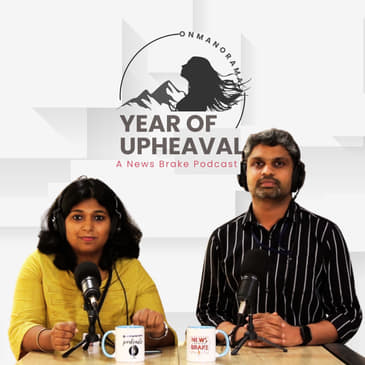

2024 was a year of upheaval—marked by tragedies, political surprises, and elections that reshaped Kerala’s social and political landscape. In this special year-ender series on News Brake, Onmanorama revisits the defining moments that captivated the state. In this episode, hosts Haritha Benjamin and Aswin J Kumar delve into the Wayanad landslides, examining how they exposed Kerala’s vulnerability to extreme weather and the ongoing rehabilitation efforts.
See omnystudio.com/listener for privacy information.
[00:00:00] While Kerala has faced its share of tragedies, political twists and turns this year, these events have shaped the way we think and live. So at Onmanorama, we are calling 2024 a year of upheaval.
[00:00:33] Through a special year-ender series, News Brake podcast will be looking at the key events that Kerala faced this year.
[00:00:41] I am Harita Benjamin and joining me today is Ashwin J. Kumar. So today we will be discussing about one of the devastating tragedies that struck the state in July this year, the Wayanad landslides which claimed over 400 lives in the state.
[00:00:57] So Ashwin, so basically extreme rainfall events and extreme weather events are becoming extremely common in Kerala now.
[00:01:06] So from my understanding, we have more than 3100 millimeters of rainfall which is being received in the state now.
[00:01:14] So it is common that you know we would have floods and landslides and it is bound to affect us.
[00:01:22] But the worrying fact according to experts is that there is high intensity rainfall which is being reported across the state right now.
[00:01:31] So we have events like cloudbursts which are being recorded right now.
[00:01:35] So was the Wayanad landslide triggered by an extreme weather event like this?
[00:01:41] Right.
[00:01:42] Could you probably bring us on board with that?
[00:01:45] Right. If you look at the rainfall pattern in Kerala in the last 10 years or so, there has been a considerable increase in frequency of extremely high rainfall events, especially after 2018.
[00:01:58] It was the cause of floods in 2018. Then we had landslides in 2019. If you look at the pattern, in all these cases there was sporadic extreme precipitation preceding the event.
[00:02:10] The same thing also happened here. If you look at the data, the closest rainfall recording station is at Kerala, which is around 5 kilometers north of the crown of the landslides, the place where the landslides occurred.
[00:02:23] And this station recorded over like nearly 580 mm rainfall in last 48 hours, which was, you know, on July 30 itself, it was twice the average rainfall recorded for the entire district.
[00:02:37] So you can imagine the scale of rainfall the place received.
[00:02:41] The first information report filed by the Geological Society of India clearly stated that extreme rainfall was the triggering factor which led to the landslide. I think we can talk to George who did…
[00:02:55] He was a reporter who covered the Wayanad landslide.
[00:02:58] Right.
[00:02:59] So we need to talk to George on how things transpired there.
[00:03:02] Okay. So let's look at what George has to say and then come right back.
[00:03:07] Thank you. Thank you, Harida and Ashwin.
[00:03:11] When I went to Vaina to cover the landslides, the staff at Dr. Mupin's Medical College at Maypadi, they shared with me a few voice messages of their colleague, Neetu Jojo from Churilmala High School Road.
[00:03:25] I can never unhear her voice again. Her desperate SOS calls to her colleagues to come and rescue her family from the flash floods, not just described what was happening around her.
[00:03:41] She even told the world about the sound and smell of those dark, deathly hours. That was the last anyone heard from Neetu.
[00:03:51] The remnants of her house and also of her neighbours still stand on Churilmala High School Road.
[00:03:59] People have moved to safer places. Unlike Churilmala, Mundakai and Punjiri Mattam, Attamala on the downstream was not affected.
[00:04:11] But the government has relocated the people even from Attamala to safer places. But their lives have not moved on.
[00:04:22] Their livelihoods are not yet restored. They say the government promised around Rs. 300 per day for two persons in a family for two months to compensate for their loss of job.
[00:04:35] So, on the first month, that is in September, they got the money on time. But for the second month, they had to protest.
[00:04:45] Several survivors told me that they got the second month's compensation only ten days ago. Many others are yet to get that money.
[00:04:53] Women who work in tea estates, they told me that they travel nearly two hours to reach their workplaces in Churilmala from places far away.
[00:05:06] Diary farmers told me that the cattle they lost in the landslides have not yet been compensated.
[00:05:14] Women working in tea estates told me that they have to travel nearly two hours from places such as Kalpita and beyond to reach their workplace at Churilmala.
[00:05:28] And they start their day as early as 5.30 in the morning for a meager wage of Rs. 480 per day.
[00:05:38] But many men are struggling to find jobs and the food kits which were being distributed by charitable and community-based organizations, they have stopped.
[00:05:54] And the going is getting tougher by the day. However, the government has not stopped the rent which it promised to give to the survivors.
[00:06:06] The government is crediting Rs. 6000 every month to their bank account. But the survivors are not sure how long it will go on.
[00:06:16] But they are preparing for a longer stay in rented house because the government has not yet initiated the process to find land, acquire land to rehabilitate them.
[00:06:29] So, thanks George. I think now it is essential that we talk about the warning systems which are there in place.
[00:06:37] And we all know for a fact because On Manorama also covered it. The Hume Institute had actually warned that there is a probability of landslides which is likely to occur in Churilmala region, Churilmala Mundakai regions.
[00:06:55] And it is also known for the fact that there is no evacuation.
[00:07:01] So, I think there is no evacuation which happened. So, I think there is a primary factor that the warning systems which are there in place is not adequate.
[00:07:10] Especially when we have extreme rainfall events like these being recorded. So, what do you have to say on that Ashwini?
[00:07:16] See, after the 2018 floods Kerala took significant steps in increasing the number of automatic weather stations.
[00:07:22] We had around 30 weather stations in 2018 which we increased to over 100. Nearly 130 weather stations were installed.
[00:07:32] But what happens in North Kerala is a matter of concern. Because advanced weather warning system is given by Doppler weather radar system.
[00:07:40] Right. Which functions, we have got one in Trivandrum vs. SSE and we have got one in Kochi.
[00:07:46] So, Kerala has been repeatedly demanding for this Doppler weather radar system somewhere in North End Kerala.
[00:07:52] And the place is yet to be identified. Right.
[00:07:54] So, we have identified locations in Kodikod and Vyanat. But as per the latest reply received from the centre,
[00:08:01] one station will be installed in Vyanat and in 2026 another will be installed in Mangalore. Which will also be beneficial to Northern Kerala.
[00:08:12] Right. But having said that, it is not just about early warning systems. We need to have a proper disaster resilient mechanism to deal with such disasters.
[00:08:20] Which is not happening in Kerala at present. And I think there should be a region specific disaster alert which should be in place. Right. Right. Right. Right.
[00:08:28] Because regions like Vyanat and Iduki which are more susceptible to landslides and natural disasters like this.
[00:08:36] There should be something which is based on the orography. Right.
[00:08:38] Because I think the Western Ghats areas receive more rainfall, almost double the rainfall compared to the rest of Kerala.
[00:08:46] So, I think they should have more of a mechanism to look at that. So, moving on. Now, we were talking about the topography.
[00:08:54] So, which also brings us to the land use patterns. There is always a question on whether it is a band made disaster or is it a natural disaster.
[00:09:04] Debate always happens. Yeah. There is always a debate which is there. And I think in the case of Vyanat, where Churalmala and Mundakai was clearly said that it is an extreme rainfall event which triggered the landslide.
[00:09:15] However, in the case of Kavlapara, we have seen that there was, you know, a land use pattern was blamed for the instability of the slope and that's what triggered.
[00:09:25] Right. So, there was also a warning in Putumala saying that, you know, this area is not suitable for living or inhabitation. Right.
[00:09:35] So, when you are looking at these scenarios, why do you think these places are still being inhabited? You know, what is it that leads people stay there or government authorities to permit people stay in these extremely vulnerable regions?
[00:09:52] It's a very tricky question as far as the state government is concerned. Because over 15% of Kerala's total landscape is susceptible to landslates. And if we redraw this map, officials pretty much are certain that this 15% will touch almost 50%.
[00:10:10] Okay. So, that leaves us barely any of any, any space for any land. Right.
[00:10:15] For any person to set up his house.
[00:10:16] Considering that we are a very highly, densely populated state.
[00:10:20] Yeah. True. True. And it's very hard to convince local residents also. Right.
[00:10:24] Because when we were talking to these people after this incident happened, they were telling us that we have been living here for a very long time.
[00:10:31] So, whenever a disaster happens or a monsoon arrives, it is natural of them to shift to a safer location and then come back. This time they couldn't do that. This time at 1.15, everything was done with.
[00:10:45] Yeah.
[00:10:46] Like they lost their house, they lost their village, everything was over. So, this is a very crucial question. In fact, I remember one of our reporters, Swati, doing an elaborate article on the scope of rehabilitation based on this burden person.
[00:10:57] Where do people leave from now on? It's not just about why not. We have got our coastal areas. Right.
[00:11:03] Erosion has completely devoured our coast. The Punar Geham rehabilitation scheme has been dragging on for a while. So, this is a very policy decision which government needs to take.
[00:11:14] Yeah. So, now talking about rehabilitation, that is another aspect which is being criticized and which we all are curious to know about.
[00:11:24] Because there is a constant debate amongst the centre and the state on where are the funds and the centre is like what are you doing with the funds. Right. Right. Right.
[00:11:34] Now, we just heard Amit Shah's reply to Priyanka Gandhi wherein he said that it is the state government's fault and they haven't submitted the reports they are supposed to.
[00:11:45] And the centre has claimed that they have already released the funds which was essential at that point of time and it is because of this report that they haven't given more. Right.
[00:11:55] So, what is the status of that? Could you elaborate? See, at present, the government of Kerala needs funds to, if at all, this rehabilitation project has to be realized.
[00:12:07] Yeah. Because we have raised a fund demand of over 2000 crores. But given the existing norms, this fund is hardly to be met from the centre.
[00:12:16] Okay. So, that's what centre has been saying. But that's a totally political debate which is happening. But our concern is that how soon can we rehabilitate these people?
[00:12:24] An expert panel appointed by the state government has already demarcated places suitable for living. They are saying that despite the landslates, many places in Churalmala are still suitable for habitation. Right.
[00:12:38] But as far as rehabilitation, they are envisaging a kind of an elaborate township kind of thing which needs funds.
[00:12:44] Where is this township located? Is it actually?
[00:12:46] Actually, they have identified two plantation lands. Right. And again, it has got stuck in legal tangles. Both these plantation companies have approached the High Court demanding a stay on the government decision to earmark this plantation land for rehabilitation of wine and land slate survivors.
[00:13:01] Okay. So, that is another concern. So, that is also a stance to it.
[00:13:03] Basically, government is dealing with two things like dearth of funds and legal tangles. Legal tangles. Right. Now, I think to wind up, we could talk about the way forward. And I think that is what is essential here. So, when we are talking about
[00:13:16] any type of disaster, there are three things which comes into mind. One is mitigation on how this can be prevented. The second is adaptation on how the people can adapt to a tragedy when it happens. And the third is rehabilitation. Now, rehabilitation we have already spoken about. But what about the mitigation and the adaptation part? How are we going to tackle such disasters? Not specifically about wine art, but overall, when you are looking at it, how would the state tackle such disasters in future?
[00:13:45] Given Kerala's growing susceptibility to this extreme weather events, there is no escape from this. That is an accepted fact. Right. So, if you look at Odisha for example, once the first wave of cyclone hit completed, decimated that state, they put in place a proper disaster management system regarding evacuation, local level planning system. They set up multi-purpose, multi-hazard resistant cyclone shelters. Everything actually helped.
[00:14:13] In Kerala also, local level planning is already underway. But even in Mepadi Panchayat or even in Vainat, Panchayat in Vainat or in Nidiki, these local level plannings have been incorporated in the working groups, annual plans of the Panchayat.
[00:14:32] But when it comes to implementation of the ground level, these schemes hardly work. So, that is one concern we need to address.
[00:14:39] Do you think on paper there is a lot which is happening? Yes. So many plans on paper, nothing is getting converted somehow.
[00:14:43] Correct. Correct. So, in terms of if we are to implement this model, because Odisha went on with this, with the motto that zero human casualty. Because the first priority is immediate evacuation of people.
[00:14:57] Right. Yes. But in case of Vainat, around 50 people were evacuated. There was huge debate regarding whether proper evacuation happened or not.
[00:15:06] I think a lot were evacuated to the school, which was completely…
[00:15:09] Yes. Which again was damaged in the landslide. Yes. Damaged. Yes. Damaged.
[00:15:14] So, that is one thing. As regarding the adaptation thing, as we said, we as a local population, we as an administrative machinery, the government have to work together.
[00:15:25] And when we were discussing, Haritha, you pointed out about the need for departments to integrate. Yes. Yes. Yes.
[00:15:31] If one department introduces a regulation policy, others will also have to support it. It is not like one department goes against the other in terms of implementation of policies.
[00:15:39] That is true. I mean, you cannot work in silos. Correct.
[00:15:41] You cannot have the forest department doing one thing and the other ministry doing something else. So, I think that is what is fundamental here. So, I think on that note, we can wind up today's episode. Ashwin, thank you so much.
[00:15:54] Thank you so much, audience for joining us today. We will be back next week on Newsbreak again for another series, for another episode in this year-ender series on the year of upheaval. Thank you so much. This is Ashwin and Haritha signing off. Thanks.