
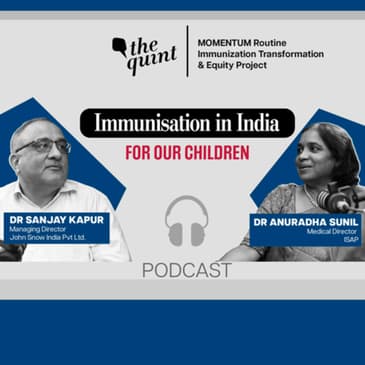
Partner | The COVID-19 vaccination drive in India exemplified as a model for routine immunization, achieved over 97% population coverage. It also amplified the need for timely immunization to prevent a global pandemic. In this podcast, Dr. Sanjay Kapur, from John Snow India (JSI) sheds his expert insights from the MOMENTUM Routine Immunization Transformation & Equity project supported by USAID. We are also joined by Dr. Anuradha Sunil from the Indian Society of Agribusiness Professionals (ISAP) who emphasized the challenges of vaccine hesitancy, combated through community involvement and awareness.
Learn more about your ad choices. Visit megaphone.fm/adchoices
[00:00:00] Hello and welcome to today's podcast, I am your host Prathik Lidhu.
[00:00:05] It's a special session we have today dedicated to India's youngest citizens on children's day.
[00:00:11] We'll be talking about the critical role of immunization or in simpler words, the importance
[00:00:16] of vaccinating your young ones.
[00:00:19] Getting the right vaccine that the right age is pivotal to protect a child's life and
[00:00:24] future.
[00:00:25] It is in fact the most effective and affordable way to ensure a healthy future for our kids.
[00:00:30] It is key to a child's survival and missing it or the lack of awareness around it can be
[00:00:35] life threatening.
[00:00:37] You'd be shocked to learn that the world's most vulnerable children miss out on immunization
[00:00:42] and as a result of it, a healthy life.
[00:00:44] In India at the same time there are multiple efforts that are being taken on this front to ensure
[00:00:50] accessible immunization to create awareness, reduce vaccine hesitancy and more importantly
[00:00:56] to strengthen India's health care system.
[00:00:59] I'm joined by pioneers in this field to tell you more about the immunization efforts in
[00:01:04] India.
[00:01:05] We have experts joining from John Snow India private limited leading public health organization
[00:01:10] and from the ISAP India Foundation which is an organization that works closely with the Indian
[00:01:15] government in managing large and complex projects in routine immunization.
[00:01:20] They have been at the forefront for over 30 years helping create a stronger health care
[00:01:25] system in many parts of the country.
[00:01:28] We have Dr. Sanjay Kapoor managing director at John Snow India private limited.
[00:01:33] Under his leadership, JSI has developed a strong portfolio by raising over $100 million
[00:01:38] in new funding from bilateral multilateral donors and CSR.
[00:01:42] He has successfully established several new partnerships and alliances with public and private
[00:01:47] sector organizations.
[00:01:49] Under his leadership and guidance, JSI has witnessed the five-fold expansion of programs
[00:01:54] and size of the organization.
[00:01:57] He has had several organizational systems developed, garnered membership of key policy
[00:02:01] and technical committees of the government of India in overall leadership role.
[00:02:07] Dr. Kapoor has also been a recipient of several national and international awards for
[00:02:11] his exemplary work in the public health sphere.
[00:02:14] Along with him, we have Dr. Anurada Sunil, the medical director at ISAP India Foundation.
[00:02:19] Anurada's areas of interest include development of technology-driven solutions in healthcare
[00:02:25] and designing an implementation of innovative healthcare models.
[00:02:29] She worked with the National Health Services in the UK in primary care and acute hospital
[00:02:35] trusts for more than 10 years.
[00:02:36] Hello, Dr. Sanjay.
[00:02:37] Hello, Dr. Anurada.
[00:02:38] Thanks for speaking with me.
[00:02:40] My first question is to you, Dr. Sanjay.
[00:02:42] The most recent and the biggest immunization drives we saw was of course the COVID-19 vaccination
[00:02:49] drive.
[00:02:50] So, let's start with that as an example of giving a short introduction to how the immunization
[00:02:56] program actually works in India to give our listeners a little insight.
[00:03:01] So India has the world's largest immunization program.
[00:03:05] We have a system of vaccinators.
[00:03:07] We have about 250,000 vaccinators across the country who gave vaccination to about 27 million
[00:03:13] children who are born every year as well as 30 million pregnant women who get pregnant
[00:03:18] every year.
[00:03:19] So, we have a system of coaching where the vaccine just stood at a particular temperature,
[00:03:25] starting from the manufacturer up to the last mild connectivity.
[00:03:29] There are medical officers who plan the immunization program.
[00:03:33] The COVID-19 vaccination was laid on the existing universal immunization program of India.
[00:03:39] Same vaccinators were used, same cold change space was used.
[00:03:43] But the vaccines were developed in India in a very quick short period of time.
[00:03:47] They were basically COVID shield and the COVID vaccine and there were few others also.
[00:03:51] So, the entire COVID vaccination vaccine approval was done in a very short period of
[00:03:56] time because of the emergency nature.
[00:03:58] The government of India took a lot of steps to quickly get the approval.
[00:04:02] The manufacturers, they increased their capacity over time and the entire sort of 95% of
[00:04:08] India's eligible population was vaccinated in a very short period of time.
[00:04:12] And that is a very commendable work which the government of India has done.
[00:04:15] Of course, it was partnership there were other donors, other partners, private sector also
[00:04:19] played in and use also played a very important role which I can explain to you later on.
[00:04:23] And what is the role of the momentum routine immunization transformation and equity project?
[00:04:29] So, this project is supported by USIT and the project was given to JSI in August 2021
[00:04:38] to actively help government of India to rapidly scale up COVID vaccination across the country.
[00:04:43] So, based on the data, government of India elotted 18 states to JSI to help government
[00:04:50] of India and the 18 state governments to ramp up COVID vaccination in the country.
[00:04:55] We identified 26 NGOs who were part of this whole initiative.
[00:05:00] We worked at the grassroots level to make sure that there is information about COVID vaccination.
[00:05:05] There is clear answer for any missing patients which the local population may have.
[00:05:12] And it was very focused on vulnerable and marginalized populations because usually the government
[00:05:17] of India's programs reach to all populations but some at the margins are sometimes left out
[00:05:22] like truck drivers, like disabled people, like blind people, like transgenders, like migrants
[00:05:27] who were far away or people who would be usually left out of the healthcare delivery systems.
[00:05:32] So, what according to you are the few learnings that this project has gathered from the COVID-19
[00:05:38] vaccination drive that now can be used in routine immunization for kids especially.
[00:05:43] It's a good question and there were several learnings which were sort of generated when the
[00:05:48] COVID vaccination drive was sort of implemented led by government of India.
[00:05:52] So, in a nutshell the first lesson learned is that we should do an evidence generation
[00:05:58] of the communities and target our strategies according to the needs of those particular
[00:06:02] communities which basically means one size will not fit all and was it something that wasn't
[00:06:07] happening earlier? It was being done but not at that level and because there was some hesitancy
[00:06:13] in the COVID vaccination and we were in an emergency situation. It was all the more important
[00:06:18] that we had to convert the nasirs into a serious and there was a lot of time because it was
[00:06:23] an emergency situation. routine immunization has been going for decades but this was an emergency
[00:06:29] situation and we had to somehow get into the communities understand them and devise quickly
[00:06:33] device strategies to address those issues and then get the vaccines to them and it worked very well
[00:06:39] and that's a very good lesson which we have learned. The second important lesson is that
[00:06:43] you know there should be a lot of data collection and strategies should be devised on data
[00:06:48] and because the government of India developed the COVID app through which people were able to
[00:06:55] get their vaccines you know defined where they can get the vaccine when it will be available
[00:06:59] that was a very good denot technology which really acted as a game changer in India.
[00:07:04] Had that not been there it would have been very difficult for us to reach so many millions of
[00:07:09] population in such a period short period of time. Now based on that learning the whole
[00:07:15] program now is for the universal immunization the larger immunization program they are developing
[00:07:20] what is called a human. It is based on the COVID model module but it is much more expanded now
[00:07:28] and it will be useful for all routine immunization for pregnant women as well as for
[00:07:33] and it will include different kinds of it will include all kinds of vaccines which are available
[00:07:37] in the immunization program of the country. The third lesson is that engagement of local
[00:07:42] NGOs, local influencers as well as community leaders whatever are the local influencers
[00:07:48] and they may be different in different communities some places religious leaders are more important
[00:07:52] some places youth clubs are more important some places feed based organizations are there so
[00:07:58] whatever are sometimes the panchaya is a very strong so whichever are the local influencers
[00:08:03] they we should leverage their presence and use them for reaching out to the communities
[00:08:07] and convincing them for the need for vaccination that is another lesson which we have learned
[00:08:13] the fourth lesson is that you know there should be a tab on misconceptions and especially on
[00:08:18] the social media that never used to happen before COVID vaccination there was lot of misconceptions
[00:08:25] lot of wrong ideas were being you know that vaccination we should not take it will do this it will
[00:08:30] do that but keeping a tab on that and doing something to negate those misconceptions was a very
[00:08:36] important lesson learnt which will help now in routine immunization and therefore going forward
[00:08:41] government of India has decided that it will keep a tab on it through various means mechanisms
[00:08:46] partners on its own to make sure that if there are some negative messages going into the community
[00:08:51] vaccination they should be addressed so that you know more and more people children can get
[00:08:56] vaccinated so that's another role of media was also very very important in COVID vaccination
[00:09:02] media can play a very important positive role if it wants to by creating good positive stories
[00:09:07] you know about people who have gotten vaccinated people who have gotten other people more vaccinated
[00:09:13] so that you know they are acting as you know changes into the communities so these are the
[00:09:18] in a nutshell few sort of lessons which we have learnt which can be used for routine immunization now
[00:09:23] and Dr. Anuradha would you have something to add to this yes we are all aware that COVID-19
[00:09:30] vaccination was one is the biggest vaccination drive in the history of humankind
[00:09:36] and there are very valuable lessons that have emerged through this vaccination drive that have
[00:09:41] the potential to be replicated into the Rotany immunization as well I will talk about a couple of
[00:09:47] points or the lessons that we have learnt firstly the role of local NGOs local NGOs have played
[00:09:54] a very very significant role in vaccination drive during the COVID-19 vaccination
[00:10:00] there being engaged in the community they are understanding of the complex on-ground situations
[00:10:06] and the local nuances played a very critical role in the success of the COVID-19 vaccination
[00:10:12] coming to the next point public private partnerships they also played a very big role in
[00:10:17] vaccine distribution we all must have seen that the vaccines are being delivered using boards,
[00:10:25] the camels and you know all sorts of modes of transport so that was one of the biggest
[00:10:32] achievement during this COVID-19 vaccination in vaccine distribution I think the same success can be
[00:10:38] replicated into Rotany immunization as well and as NGOs you know we at ISAP we established
[00:10:46] intersectoral relationships and a great coordination between various government departments as
[00:10:51] well like we worked with the Women and Child Department, Education, Skill Development Department,
[00:10:55] Social welfare and obviously the health department as well so there was a very big coordination
[00:11:01] that was happening during the COVID-19 vaccination I think these lessons or leverage
[00:11:08] these groups can also be utilized in the Rotany immunization as well. Next I'll talk about the
[00:11:15] building public trust we are all aware that during the initial phase of vaccination there was
[00:11:21] lot of myths and rumors going around about the vaccination but eventually all this was overcome
[00:11:27] by using effective communication and community engagement strategies and finally reaching out to
[00:11:33] the unreach you know there was a lot of remote areas in our country which is very difficult to reach
[00:11:39] out to but during this COVID-19 vaccination there was special vaccination drives and community
[00:11:45] engagement activities that were deployed to reach out to these communities and we were able to see
[00:11:50] great success in COVID-19 vaccination I think these are some of the strategies like enriching out
[00:11:57] special people like coal mine workers, PVTG populations, tribal populations, disabled people
[00:12:04] so there was I could list out the entire list of entire spectrum of people who normally would have
[00:12:11] been unreach but COVID-19 vaccination we were able to reach out to all of them so in the same way
[00:12:16] I think the same lessons can be replicated in Rotany immunization as well to reach out to those children
[00:12:22] who normally would be unreachable to the regular programs. One last point I wanted to mention
[00:12:30] which COVID vaccination has given a lesson is that leave no one behind. Everybody's equally
[00:12:36] important, the peripheries have to be taken as important as the center of the population and that's
[00:12:43] actually like something you know which can be used for a general vaccination as well okay so before we
[00:12:50] get into more details I want to get some context on where we currently stand as a country in our
[00:12:57] immunization coverage and how many people have been reached and what should we be doing? What
[00:13:01] are some of those gaps that you can still identify right now. So if we are talking about routine
[00:13:07] immunization coverage India is doing fairly well in this sphere overall we have about 76 or 77
[00:13:15] national immunization coverage. If we talk about individual vaccines like TPD1 our coverage is
[00:13:22] over 95% similarly DPD3 coverage is about 95% our measles coverage for the first doses also 95%.
[00:13:31] So generally speaking India is doing very well yes during the COVID pandemic there was some
[00:13:39] slow down of the routine immunization because the same health workers were providing
[00:13:43] vaccine COVID vaccination and there was lack of movement of there were lockdowns and therefore
[00:13:47] there was some slowing down of routine immunization to the extent of about 6% but after the COVID
[00:13:53] pandemic sort of reduced India has been able to catch up and now we are now we have caught up on
[00:14:00] the last ground which we did. We think the pre-COVID numbers we have already achieved pre-COVID
[00:14:06] demand fact now we are improving upon the pre-COVID numbers also as I mentioned to you India's
[00:14:12] Re-mination program is largest in the world we have about 27 million new bonds every year who are
[00:14:16] vaccinated and 30 million pregnant women who get vaccinated every year. In terms of COVID vaccination
[00:14:24] coverage first dose coverage we were able to achieve 97% coverage of the eligible population which is huge
[00:14:31] considering that you know we have a 1.4 billion total population and even the second
[00:14:35] of second dose coverage was also 90% for India which was unthinkable there were lot of
[00:14:40] skeptics who felt that India will not be able to do it in a very short period of time but you know
[00:14:45] here we are we did an excellent job of sort of ramping up the COVID vaccination in a very short period
[00:14:50] of time. So generally speaking India is doing fairly well and it is making a lot of continued
[00:14:56] and rapid progress we are adding new vaccines every year now we added rotavirus few years back
[00:15:01] we added the PCV company for five years back we are also thinking about adding new more vaccines also
[00:15:07] and the equitable coverage is also improving now so people who were marginalized or vulnerable
[00:15:12] they are being specially taken care of there are specific campaigns which the government
[00:15:18] of India called IMI's or intensified mission in the Tanish. We have done three rounds which are
[00:15:24] basically meant for tracking children who are either dropout or leftouts so those have also given
[00:15:30] us very encouraging numbers and how is JSI a part of this whole initiative and what role does JSI
[00:15:36] play in the larger Indian health care sector. So JSI is a not for profit organization and we
[00:15:44] were we are a key partner of government of India and state governments in helping them to ramp up
[00:15:50] COVID vaccination and routine immunization also the COVID vaccination grant was provided by USA
[00:15:55] and the momentum routine immunization but for other routine immunization activities we have
[00:16:00] several donors which provide us funds and we in turn are a member of all technical committees
[00:16:05] of government of India on immunization. For example, we also anchor the immunization technical support
[00:16:11] unit for government of India which actually acts as the nerve center for helping the government
[00:16:17] of India to plan policies get data and you know defined strategies on what should be done
[00:16:22] for ramping up the routine immunization. We help the government of India in introducing new
[00:16:29] vaccines rollout for example we were the partner for rolling out rotavirus vaccine across the
[00:16:34] country. We were the partner to government of Indian rolling out the new local vaccine for pneumonia.
[00:16:39] So JSI anchors the AFI setup for government of India. AFI is called adverse events following
[00:16:47] immunization it's a very important component of any immunization program in the world and we provide
[00:16:52] them with all the information on what AFI is happening and you know we do case studies.
[00:16:57] If there are any issues with vaccination we sort of do scientific analysis of that and provide
[00:17:02] information to the government to take actual and accordingly the action which they have to take.
[00:17:07] Now Dr Anuradha one of the biggest challenges faced even during the COVID-19 vaccination
[00:17:12] drives was vaccine hesitancy right? How rampant is it when it comes to children's vaccination
[00:17:18] and how do you usually fight it? Vaccine hesitancy among parents still a challenge in several
[00:17:24] pockets of our country. It's a very complex issue you know driven by various factors like misinformation,
[00:17:30] fear of side effects and cultural beliefs. We have seen several incidentals during the COVID
[00:17:36] vaccination itself that parents were fearful that child will become important and men will
[00:17:42] become infertile or they will become disabled or the death of some of the celebrities due to various
[00:17:50] other reasons where all are attributed to COVID vaccination and this is more pronounced in
[00:17:56] undeserved areas due to you know lack of access, lack of information and also disparities between
[00:18:03] urban and rural areas. So how do we overcome these kind of misinformation and misbeliefs?
[00:18:11] We basically I like I talked about earlier a deep dive into the community and engage the communities
[00:18:17] you know we have to work with the communities involving them in conducting workshops one to one
[00:18:23] or group workshops wherein we talk about their various concerns and addressing those particular
[00:18:29] concerns to mitigate this vaccine hesitancy. We also have to build awareness amongst the community
[00:18:35] about the benefits of vaccination. We also have to talk about mitigating the misbeliefs and also
[00:18:41] build the trust and the awareness amongst the community and thirdly we have to also improve
[00:18:47] the public private partnerships to strengthen the vaccination programs amongst the
[00:18:51] unreached areas to improve the coverage and also combatting the hesitancy. Do you think post COVID
[00:18:56] there has been like a decline in vaccine hesitancy generally amongst people? I would think so because
[00:19:02] the government has put in a lot of efforts in reaching to various pockets of population and various
[00:19:09] stakeholders like me talked about earlier NGOs and community organizations we all have worked together
[00:19:15] to reach out to these communities and the trust that has been built through these previous initiatives
[00:19:20] are really helping to achieve this childhood vaccination as well. And you had earlier mentioned that
[00:19:27] immunization among children has increased right and the coverage is also increased. So I want
[00:19:32] to go behind the scenes of this increased coverage. How does it look like? So the main reasons for
[00:19:38] this improved coverage is that we have much more data now, specific data related to the communities
[00:19:45] and there is much more data being used for defining strategies which are relevant to those particular
[00:19:51] communities. Wherever we find that there is less immunization coverage, more resources are being
[00:19:58] directed towards those geographies or those communities where the immunization coverage is less.
[00:20:04] Because the immunization coverage is not homogeneous across the country, some states are doing better
[00:20:08] than the others. So a lot of focus is also going on and the areas which are not doing very well,
[00:20:14] more resources in terms of human resources, financial resources, more vaccines are being sort of
[00:20:18] transported to those areas. So there's a lot of extra efforts which are going, it is a working
[00:20:23] progress. There is still areas of communities, specific geographies where the immunization
[00:20:29] coverage is increasing but not as good as we would like to. So we are continuing to make sure that
[00:20:35] those areas are focused and you know lot more work is happening there. Lot more work is now
[00:20:40] being done on social media. Lot more campaigns are being rolled out more, or step information
[00:20:46] is being rolled out. Efforts are being made to reduce misinformation on an ongoing basis.
[00:20:51] Lot of specific days are celebrated where there are like children's day and other women's day,
[00:20:57] where there are specific push being made on immunization. So doctor Anurada all the points that
[00:21:04] Dr Kapoor just mentioned. What do you think will be the positive impacts of these points
[00:21:10] on the health and well-being of children in our country? The Rotain Humanization helps protect
[00:21:16] the children from various life-threatening diseases like polio, measles, diphtheria,
[00:21:21] petuses, tetanus, et cetera, et cetera. Obviously this will achieving success in
[00:21:28] Rotain Humanization will reduce the child's mortality and mortality rates. And also high
[00:21:33] immunization coverage will lead to herd immunity which means the children who are unvaccinated
[00:21:39] as well can be protected from the vaccine preventable diseases. And also there is a lot of
[00:21:46] economic burden on families and the community and the government if we get vaccine preventable diseases.
[00:21:53] So by achieving higher vaccination rates will also help us save money in terms of preventing
[00:22:03] in terms of cost involved in the treatments. And India has made a very significant progress in achieving
[00:22:09] success in eradicating polio, and I'm sure in the coming years we will also be able to see
[00:22:14] significant success in eliminating diseases like measles and rubella through our concerted immunization
[00:22:21] effect. And what are your plans to further strengthen this immunization program?
[00:22:27] We will continue to work with the government of India as new technologies are emerging.
[00:22:32] We will be helping the government of India to leverage the technologies,
[00:22:36] get that new information, global best practices we like to bring from different parts of the
[00:22:41] world on what others have done. You would also like to showcase India's experiences also.
[00:22:46] That also we are doing very actively, GSI is doing very actively to show India as a world leader in
[00:22:52] ramping up good routine immunization program as well as COVID vaccination lessons. So
[00:22:56] India for the world we are trying to follow and making sure that the lessons which are learnt in
[00:23:01] India are sort of shared across the world. And if there are any good things happening across the
[00:23:04] world they could also come to India. Okay so we are about to close in a bit and the final question
[00:23:11] for the both of you. If you would have one parting message to parents, caregivers and community
[00:23:17] and the community about the importance of increasing the immunization coverage what would it be.
[00:23:22] Basically why is it important for kids to get vaccinated? My message to parents is that
[00:23:30] all parents want to give the best to their children right from the time of pregnancy.
[00:23:35] And timely vaccination is one such gift that you must all give your children without fail.
[00:23:41] This simple but profoundly impactful step will safeguard your children from potentially life-threatening
[00:23:46] illnesses. And my message to the community is timely vaccination is a shared responsibility
[00:23:54] and we as a community must you know collectively participate in this moment and play our respective roles
[00:24:00] to build a resilient and diseased free community. What about yourself? And my message to the
[00:24:07] parents is that the comment of India has a very strong program. It is available right next to
[00:24:12] wherever you are living. Immunization is free of course just you know take your child there whenever
[00:24:17] it is due to the local health worker and you know it will save your children give him or her a
[00:24:22] very healthy future. So you don't have to pay anything you just have to make sure that you
[00:24:26] know children are vaccinated at the right time. Thank you Dr. Anurada and Dr. Sanjif having this chat with me.
[00:24:33] I think through this chat we have established that India and many other countries
[00:24:37] showed with commitment and efforts that progress can actually be restored to the pre-indemic levels.
[00:24:44] Countries and global partners must work in collaboration with local communities,
[00:24:48] health forces and leaders to strengthen services and build trust within communities prior to outbreaks
[00:24:54] beginning. India has come a long way in its immunization coverage but like we spoke earlier there
[00:25:00] are still gaps that need to be filled and efforts are being taken on that front. Meanwhile it
[00:25:05] is conversations like these which help amplify the cause. I hope this discussion help you
[00:25:11] understand the immunization efforts in India and why we need to spread the message for our children.
[00:25:19] Thanks a lot for listening to this podcast and I'll see you in the next one.