
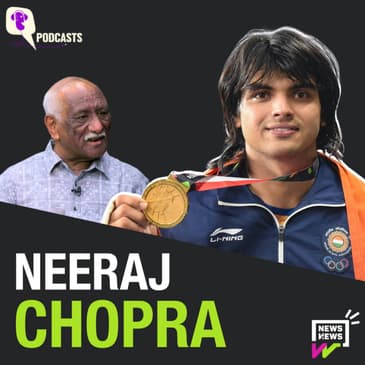
In this podcast, we spoke to Norris Pritam, a veteran sports journalist, about his new book, 'The Man Who Made History: The Neeraj Chopra Story', a biography of Olympic gold medalist Neeraj Chopra. The book chronicles his early life, exposure to athletics, and his eventual moment of glory when he won the Gold Medal at the 2020 Tokyo Olympics.
In addition to talking about the athlete, Pritam also sheds light on some systemic issues plaguing Indian athletics, his resentment for cricket, and some anecdotes from his vast career as a sports journalist.
Watch till the end for some untold stories about Indian sports.
Learn more about your ad choices. Visit megaphone.fm/adchoices
[00:00:00] Hello and welcome to this podcast with the Quint. My name is Pratik and today I have a fellow journalist with me
[00:00:07] By the way, when people call you like a veteran journalist or an experienced journalist does that make you feel untypical?
[00:00:13] Yes, but men say it's okay, women say it's a veteran I feel.
[00:00:16] Actually I feel bad.
[00:00:18] So I can call you a veteran journalist. Sometimes they call you an uncle which is worse.
[00:00:24] But in terms of numbers here, yes. So we have a journalist with so many years of experience on his side
[00:00:31] He has written this book about Nira Chopra, the man who made history.
[00:00:36] It's written by our guest today in our history term and we're going to have some really interesting conversations about Indian sports about Nira Chopra of course.
[00:00:46] But as his book is, we're going to have a conversation about the deeper issues and bottlenecks with the Indian athletics.
[00:00:55] So why Nira Chopra? He wasn't just the Olympic glory. Did you feel like, okay I'll be part of this glorious moment or what was the first thing I did?
[00:01:04] As I told you earlier, I didn't go to Tokyo and I was watching the television and some people said, oh, this time I didn't go on and he said, well I was also feeling bad.
[00:01:13] And then I happened to meet a friend, a fellow journalist and then he said why don't you write a book on, I can't write.
[00:01:20] I mean I can write a 1000 word article in maybe half an hour flat or maybe 2000 for a certain magazine cover story which I've written.
[00:01:29] But this I think it's not my cup of tea. You know, not try and just think about 50 stories. It's only 50,000 words.
[00:01:36] So until publisher came and we had a meeting and lunch, all lunch and he said how soon?
[00:01:43] Maybe in a month's time. So what? So I thought that he thought that one month was a very long period.
[00:01:50] Finally this after-dation game, this was the only time when he is going back to Europe to train for Paris Olympic Games.
[00:01:57] So it was a window where he was not going to win anything. And that's how the book came now.
[00:02:04] So when you're observing a personality so closely as a writer and as like just a general observer do you feel like you somehow know him?
[00:02:15] Like if I want to ask a question because obviously we can't ask Nira right now, you are the closest person to Nira's that we can get hold of.
[00:02:23] If I ask a question address to Nira's, do you think he'll be able to justify an answer from his side?
[00:02:29] Okay, so Nira's. Why Javalin? Why and how Javalin?
[00:02:34] How Javalin because it wasn't Javalin. It wasn't even athletics as people know I've also written and he was very fat.
[00:02:43] And in fact I wanted to thank his grandmother for feeding him onto Malay and Dhu and Kriim.
[00:02:51] So we came in fact that's why he had a reason to go to his dad even to his dad.
[00:02:55] If his grandmother had not fed him on this maybe he would have been a farming educate after some doing some fieldwork.
[00:03:05] So because to shed, we wouldn't have had a...
[00:03:08] We wouldn't have had an Indian, wouldn't have had a medal.
[00:03:10] So he went to Pani Parth and to practice, not to practice him to do some exercises.
[00:03:16] And there he saw when somebody throwing a Javalin and he said, what is this?
[00:03:20] Somebody said it's real. He didn't know that there's a sport in there.
[00:03:23] No, never been to a sports field. In his village there are only fields.
[00:03:27] There are no sports. Unfortunately not even now when it's become an Olympic champion, there is no sport facility there.
[00:03:33] In his village. Absolutely, mill. Ministers have gone there.
[00:03:37] Everybody has gone to congratulate him. Pictures with him, photo up and everything.
[00:03:41] But nobody had cared about to have at least a playing field.
[00:03:44] So there the children who are inspired by him can also play something.
[00:03:48] So any sort of Javalin, I see ask what is this? Somebody said Javalin.
[00:03:51] So let me try. They gave it to him and because he was already fed on milk and all day through farther than many youngsters who were training for Javalin.
[00:04:00] And that's how he caught onto Javalin.
[00:04:03] And he didn't have money to buy his own Javalin.
[00:04:07] So once all his chacha and family members, they were all pulled in to buy a Javalin for him.
[00:04:13] And for that he and his friend they went to merit with the sports industry.
[00:04:17] They brought one Javalin from there. They went to the morning, came back at evening.
[00:04:23] By the time they came it was already dark. We kept the Javalin at home and he slapped next to him.
[00:04:28] He didn't even sleep. He was lying down waiting for the sunrise so that he could go to the morning.
[00:04:34] And the next morning when he and his friend went and I think till afternoon they kept throwing the Javalin.
[00:04:39] And as a result they were massive pain in their animals.
[00:04:43] It was a childhood lesson.
[00:04:44] The technique can all nothing just...
[00:04:46] No, no, no, no, no, no, no, no. I'm just throwing like that.
[00:04:48] Just watching people.
[00:04:49] I think while he was a national player he was still learning techniques from YouTube right?
[00:04:55] Yes.
[00:04:56] Because Javalin, let me tell you because I'm involved in athletics for about 45 years.
[00:05:02] Javalin is not now, it was the weakest event in athletics in India.
[00:05:08] The weakest event.
[00:05:09] And we say that swimming and athletics, there are the mothers sports.
[00:05:13] Exactly. But in India we are the weakest in those two sports.
[00:05:16] We call it a nation of water but as many as we have of a few, we don't have.
[00:05:22] And athletics also, first of all it's a very demanding sport.
[00:05:27] It's about 80 to 85% physical effort will power and the rest is technique.
[00:05:32] Unlike in cricket for example even if somebody was very fat...
[00:05:36] We have seen...
[00:05:37] We have seen, I don't know what you think.
[00:05:40] I don't know either.
[00:05:41] We have seen.
[00:05:42] They are unfit to play any sport but they can play cricket because 90% skill.
[00:05:47] If you know standing there, if you know how to hold the bat and you face the baller,
[00:05:51] you can do without even being fit.
[00:05:53] So there are players who can't feel, they find a place to hide themselves in the field
[00:05:58] but yet they are great cricketers.
[00:06:00] But it can't happen in athletics.
[00:06:01] It's not a make-up break factor.
[00:06:03] It can't happen in athletics.
[00:06:04] Behind needed success there were sponsors, government, the prime minister, everyone.
[00:06:11] And this is your saying even before the gold.
[00:06:14] Even before the gold.
[00:06:15] That resulted in gold.
[00:06:16] That resulted in gold.
[00:06:17] I mean I know some very good players.
[00:06:20] Whenever they had problems they used to go to Turkwan, Gait and Pa.
[00:06:23] Yes.
[00:06:24] Delhi and get some money.
[00:06:25] Mahaleshwale Gapaz.
[00:06:26] There were no physiotherapists or a few to somebody who knew sport.
[00:06:31] But in this case when his elbow was hurt...
[00:06:35] He had a surgery as well.
[00:06:37] And one of the best leading doctors in Indian partywala...
[00:06:41] He really picked up the pieces, broken pieces of elbow and pasted them back.
[00:06:46] All the time he was in South Africa, Turkey, either competing or training.
[00:06:50] So Pani Pati last four or five years I think he hardly stayed in Pani Pati.
[00:06:54] And is that rare for Indian athletes to train?
[00:06:56] Oh yes, no.
[00:06:57] Not like him.
[00:06:58] Siddharth Singh who came seventh in Olympic Games in Asian, double Asian Games.
[00:07:03] He went to Montal Games three days before his event when he did not have seen
[00:07:09] even the artificial survival of the tartan track which was used in 1976.
[00:07:13] He was training in Delhi on grass.
[00:07:16] So I think he had never seen it?
[00:07:17] No, there wasn't any.
[00:07:19] There was no exposure.
[00:07:21] At least in that aspect him and I are the same.
[00:07:24] He had never seen it.
[00:07:27] But he had to run on that.
[00:07:30] So even there the first time when he ran the first round of the race
[00:07:33] he had stepped on a tartan synthetic track.
[00:07:36] Wow.
[00:07:37] And after first round and semi-final he created a ration record
[00:07:41] and his legs were full, so tired and there was no physio.
[00:07:45] So these people went in those circumstances.
[00:07:48] Even Ptu Ushar, she went to take part in hurdles.
[00:07:50] She was not a hurdle.
[00:07:51] She was a good sprinter.
[00:07:52] She didn't know how to hurt her.
[00:07:54] And that's why she came forth.
[00:07:56] Only if she had a couple of hurdle races she would have been a medal in 1984.
[00:08:01] So in that respect Niraaj was very lucky.
[00:08:06] The games got postponed.
[00:08:10] In 20, the games were taken place.
[00:08:12] He was injured.
[00:08:13] Forget about the gold.
[00:08:14] He would not have been able to take part.
[00:08:16] So games got postponed and this is something that even he admits.
[00:08:20] Yes.
[00:08:21] It's not like a thing for him.
[00:08:24] He gets my Kabiliyat pick it out.
[00:08:26] No, of course he trains very hard and very sincere.
[00:08:30] I mean whenever he's taking only last month he has eaten some paratha
[00:08:34] or something which he likes.
[00:08:35] At the age of three years he didn't touch.
[00:08:38] So he went to Paneepa to what?
[00:08:40] To have parathas and Churma which is mother makes.
[00:08:44] Otherwise the rest of the time when he's European that boiled food
[00:08:48] and he was vegetarian.
[00:08:50] And then he started taking some, somebody said no, no you must take protein
[00:08:53] you must take chicken and mutton started eating mutton, that too boiled.
[00:08:57] No oil, nothing.
[00:08:59] So it's a hard sacrifice, it's a hard work but notwithstanding
[00:09:03] the kind of luck that he had.
[00:09:05] First of all does that sort of generate some sort of resentment in the older athletes
[00:09:12] towards the end of the time.
[00:09:14] Well, even if they resent they can't do much.
[00:09:16] There is a lot of frustration and which I have written.
[00:09:20] I've quoted Siddharth saying Ashwani Natchapah, Harkamalji saying all contemporaries
[00:09:26] of those I have written all that.
[00:09:29] And unanimously they all said yes no doubt he's a great athlete, very good performance
[00:09:35] India, the Olympic champion.
[00:09:36] But in our days if we had got such facilities if not gold maybe we would have won a bronze medal
[00:09:42] which is true I agree with that because I've seen it myself.
[00:09:45] People are somebody you ask how did you get into sport?
[00:09:49] My father's sold a band, my father sold a bell even with Neeran.
[00:09:54] Even with Neeran.
[00:09:55] All is fortunately he had four chacha's.
[00:09:58] They all pulled in 200 rupees, 200 rupees that's how they're supporting him.
[00:10:03] Initially of course now he has got the biggest house, it's kind of big Havali, three four
[00:10:07] story Havali in Neerapani.
[00:10:09] And credit to him I asked him why not in some bigger town you can afford certain Sharmaya
[00:10:14] Gautam and I also may be in Garbanaunga.
[00:10:16] So then how is he as a person?
[00:10:18] Fantastic, brilliant person.
[00:10:20] By the way while reading this book I realize that he's younger than me.
[00:10:23] And I have so many Sharamahayi who studies what we are doing or what we are doing.
[00:10:28] No I'm not like that.
[00:10:30] I mean basically again divine intervention stars where you're born, what is your lineage and what kind of support you get.
[00:10:37] So everything in this case everything was put in place.
[00:10:40] Since when have you been observing Neerapani?
[00:10:43] I had seen him, I had read about him so one day two friends of mine have decided let's go to the village
[00:10:52] and hoping we will get to see him.
[00:10:55] And that time the book was something in my mind so I essentially I went to see him and to get something on the book.
[00:11:03] The book told is not there.
[00:11:05] And since he has been winning his chacha's and his father and all they are also kind of stars in their village.
[00:11:13] So they are like a Pradhan.
[00:11:15] Neerachka chacha.
[00:11:17] Everything is this Neerachka Papa.
[00:11:19] He is related to Neerachka's house.
[00:11:21] This is Neerachka's car. Everything is a Neerach brand.
[00:11:24] My Papa has not shown this episode yet.
[00:11:26] He will be like that, look at the younger boy.
[00:11:29] He will be in his village and he will be in the name of the village.
[00:11:31] So when we went his uncle, chacha's and father everyone sitting and so I ran out of questions to them.
[00:11:39] Because how long can you order us to people?
[00:11:42] And I said how to spend some more time hoping Neerachka would appear.
[00:11:46] And you know in village they have a big hookah with one tube that he smells like passes on.
[00:11:52] So I said let me also try.
[00:11:54] I started listening to him sometimes and I had never smoked and did like this.
[00:11:59] I started listening to him.
[00:12:00] This is also typical journalist behavior.
[00:12:02] Smoking to get in the circle.
[00:12:04] I wanted to go past time.
[00:12:06] At some talking point I wanted and when I was so angry, I was like a small bird.
[00:12:12] La Pani came and took some 15 minutes.
[00:12:14] There was a chai figure.
[00:12:15] And we were about to get up and a huge car came and I saw the car.
[00:12:20] So I told his chacha, where is my kitchen?
[00:12:22] And he was in Patiala so he had come.
[00:12:26] And the first thing he does is touches my feet.
[00:12:29] And he said, you are my name, I am from the village.
[00:12:31] I said, come here, sit here and order.
[00:12:33] So I asked some questions and all.
[00:12:35] I was emotional myself because I have seen some of the very great things
[00:12:41] and they were also legend at least.
[00:12:44] And they were also very polite but he took the cake.
[00:12:48] I think he was much more than them.
[00:12:50] That is a rarity when it comes to superstar athletes.
[00:12:53] Not tracking field stars.
[00:12:55] Cricketers, I hate.
[00:12:58] That is the thumbnail opening title, everything on this episode.
[00:13:04] The Paris Freedom says I hate cricketers.
[00:13:08] And I hate cricketers for some reasons.
[00:13:11] Like any other Indian, I have also played a lot of cricket.
[00:13:15] I tried the house and I discovered that he used to be the king.
[00:13:19] Rajavi, so we played cricket.
[00:13:23] But what happened?
[00:13:25] I was in school and we heard that from Ranjitwafi match was on in Kota.
[00:13:30] And Navapatodi, they used to play from Real Madrid, Budi Kundaran.
[00:13:34] They were batting.
[00:13:35] So we went to school, we went there.
[00:13:38] Kota, lunch break when he was coming back towards the pavilion.
[00:13:41] I opened my bag, school bag and took out a copy which was absolutely untattered
[00:13:46] because I was not a good student.
[00:13:48] And I took out a, I was looking for a clean pay.
[00:13:50] All the pages crossed word and knocked and coughs.
[00:13:53] So one page was Kali and I showed it to him as an autograph.
[00:13:58] He took my copy and he threw it through it like this.
[00:14:02] I was furious and the guy next to me was a kind of a street dara.
[00:14:08] And he abused him and he wanted to charge me.
[00:14:11] No, don't do that.
[00:14:12] Budi Kundaran saw that, he picked up the notebook and said to me he said wait,
[00:14:17] he went to him, said Tiger, sign it.
[00:14:19] And he signed it and he gave it to me.
[00:14:21] I threw the book.
[00:14:22] I said I don't want to sign it.
[00:14:24] He's not my kind of man.
[00:14:25] Anyway, we went from the service.
[00:14:27] So that was the hatred towards cricket.
[00:14:31] The second point was when we used to run, I would run a Delhi championship or something.
[00:14:36] No mention in the newspaper.
[00:14:38] No mention.
[00:14:39] Somebody will score ten runs and one photo.
[00:14:42] I mean no fault of theirs.
[00:14:44] It was us journalists who were making them gods.
[00:14:46] And not covering the athletics.
[00:14:48] Half the athletics championships I have covered my own money.
[00:14:51] In Express, I was an Indian Express newspaper.
[00:14:53] They won't stand because they thought only cricket sells.
[00:14:56] Now only because of me, people have started trending and all.
[00:15:00] So do you think because of all of these experiences that you had,
[00:15:03] you sort of made it a point to bring light on to all of these other sports as a journalist as well?
[00:15:10] Not that a mission.
[00:15:11] Not at this book but yes.
[00:15:12] No, but in general.
[00:15:13] Oh yes.
[00:15:14] Yes.
[00:15:15] I've written and not only written, I've made it a point to help people in whatever way we could do.
[00:15:22] There was a wrestler called Malwa.
[00:15:24] In 1962, one the Asian Games Gold Medal.
[00:15:28] He was in a very poor condition and he was selling alukitiki and someone who is a Jhanger Puri colony and all.
[00:15:34] So one day, Milka Singh was passing by Indian Express at that time.
[00:15:37] I was an Indian Express.
[00:15:38] He stopped the car and Milka was a very dear friend so he came inside and he said,
[00:15:43] you are Jhanger Puri in Chase Punjabi.
[00:15:45] He said, you are Jhanger Puri Ketay.
[00:15:47] I said, why?
[00:15:48] You said Malwa is a great wrestler.
[00:15:50] I want to give him some money.
[00:15:52] So I said, okay.
[00:15:53] So I went and took my photographer.
[00:15:55] We went to Jhanger Puri.
[00:15:56] And it was two hours located in wherever in Jhom Puri he was.
[00:16:00] And he was actually selling alukitiki outside.
[00:16:03] Asian Games Gold Medalist and many time national champions and Arjuna ward winners.
[00:16:08] So we took pictures and all and we went to his hut and there was something shining like a light coming.
[00:16:14] So I said, Malwa, what is this?
[00:16:15] Are you going to give me the money?
[00:16:17] There are two things.
[00:16:19] It was the broken piece of the Arjuna ward.
[00:16:21] It was shining and reflecting.
[00:16:23] We took the pictures of that.
[00:16:25] Milka gave the money and we came back and I did the story.
[00:16:28] That time Indian Express had 26 editions of Indian Express all over India.
[00:16:32] And all editions on page 1, column 12345 and pictures and it appeared.
[00:16:38] And the country wide response to that.
[00:16:41] Next week the parliament was the non-market tell-wow sports minister.
[00:16:45] The entire opposition was throwing copies of my story in parliament in the next press.
[00:16:50] So these are the things that you know, you live when you feel good that you did a sport and you did writing.
[00:16:57] But not for cricket.
[00:17:02] But now you would have had a change of opinion for cricket.
[00:17:06] Because players have gotten a fit all out of the pressure.
[00:17:08] No, not for me.
[00:17:09] My opinion is change.
[00:17:11] That sport has become an interest for you now and not anymore sport especially cricket.
[00:17:16] So we are going to close in some time.
[00:17:19] And as we close I want to address this one issue.
[00:17:22] Every Olympic season there is a conversation that literally template conversation.
[00:17:29] India is a population of X billion but our medal style is solo.
[00:17:34] And as you said, all experts give their own.
[00:17:38] They should do this, they should do it.
[00:17:40] They should not do it.
[00:17:42] They should not play in stadiums.
[00:17:44] They should not play in government.
[00:17:46] Where do you think in all of this whole debate?
[00:17:50] Who needs to take that first step?
[00:17:53] Because everyone is speaking on the other side.
[00:17:56] Now I tell you, when we talk about the population.
[00:17:59] Population is just a number.
[00:18:02] Now let me ask you one thing.
[00:18:04] Out of that population of billion every time we say no gold medal winner.
[00:18:09] Why don't we ask how many noble audits?
[00:18:12] We have one that population has won.
[00:18:14] How many good writers of Rabindranath go and all very much less population.
[00:18:18] How many good doctors we don't ask that.
[00:18:21] Only sports person, why not?
[00:18:23] Out of that 1 billion tell me how many people play?
[00:18:27] If we will have to wider the pool of active players.
[00:18:31] And where do you play?
[00:18:34] That is the second thing.
[00:18:36] If 10,000 people do say around 100 meters.
[00:18:39] Out of 10,000 will be discarded.
[00:18:42] The next 5,000 will be go to state level or school level.
[00:18:46] And then 2,500 will become a kind of a national level.
[00:18:49] Out of those 2,500 or maybe 100.
[00:18:51] Finally there will be two or three champions.
[00:18:54] I mean it will pick up the top few results.
[00:18:57] Indian at least.
[00:18:58] You will find that most of them are from villages.
[00:19:00] Poor background.
[00:19:01] Somebody is a son and daughter of a carpenters.
[00:19:04] There is nothing wrong with that profession.
[00:19:07] In fact, we salute to them that even at that they have sacrificed their and to bring up their children
[00:19:14] and see that they produce medalists.
[00:19:17] Whereas the only exception of a rich person I think was having.
[00:19:21] I mean I've been a runner.
[00:19:22] Shooting range, better shooting range than any shooting range at home.
[00:19:28] So either you have like a very passionate father or a father figure or a coach.
[00:19:35] Or you are extremely rich that you essentially make a whole setup for yourself.
[00:19:41] But again I would say it's not only money.
[00:19:44] Money was I think maybe Ratan Tata would have been a World Champion.
[00:19:47] Money would have been a World Champion.
[00:19:50] But we have to support these people.
[00:19:53] And it's not only money at times I think media has to back them up.
[00:19:58] And we kind of nice to them at least.
[00:20:00] And do you think now that the market has come into all of these sports?
[00:20:04] Even you see a badminton league, you see all of these leagues and all of these.
[00:20:08] So do you think that will help kickstart that whole chain of engagement?
[00:20:13] I think so.
[00:20:14] I think so.
[00:20:15] There has to be.
[00:20:16] And what are some of the things that we need to stay clear of as you said that market has become a circus because of this.
[00:20:22] There are some negative points.
[00:20:24] But there is a positive side on money has to come and why will somebody give you the money if he's not getting anything in return like JW.
[00:20:32] Exactly.
[00:20:33] I mean before near edge came or somebody came no but not many people knew.
[00:20:37] I'm sure people don't even know what they as the stands for.
[00:20:41] But they know JW.
[00:20:42] Because all the time they go on the street shirts.
[00:20:45] But at least so the JW owner generals know that you know we get something out of it.
[00:20:50] The patronage has to come from somewhere.
[00:20:52] I mean otherwise they remain in the corporate page news.
[00:20:57] But by doing this, they come to the first page of the news papers.
[00:21:01] And actually in the cultural conversations right?
[00:21:05] Like the term money doing all of these things becomes every time near it goes to Prime Minister or President to meet JW.
[00:21:13] And then JW has to wait for one year to get a appointment.
[00:21:18] So these are the subtle advantages or the subtle benefits which are absolutely fine if they are giving money in crores.
[00:21:25] Why not?
[00:21:26] Yeah.
[00:21:27] They are institutes in Beliari and Bengal.
[00:21:31] The fantastic place with the trained people and keep people in the office.
[00:21:35] Are there any talks happening to make some sort of a league out of track and field events?
[00:21:40] It tried earlier also but like IPL or you know so many kind of things.
[00:21:46] And we don't have numbers.
[00:21:47] I mean if I ask you give me two names, the three names of Gavrinth and Indian.
[00:21:52] Most people will get stuck at Nairach even I would.
[00:21:57] Unless you have a pool.
[00:21:59] Earlier we had tried, I was one of them, we have promoted and we organized.
[00:22:03] Maybe a day is event in which we will have only one sprint 100 meters, one middle descent 800 or one through.
[00:22:10] Like a triangular, we tried but it wasn't a great success because we don't have numbers.
[00:22:16] Maybe you can have a South Asian maybe you can have two again the moment you say Pakistan.
[00:22:21] Pakistan is the only one who has a full German role.
[00:22:24] The event is on.
[00:22:25] The event is on.
[00:22:26] The event is on Pakistan as I said in the event.
[00:22:29] No I wanted a video clip from the league.
[00:22:35] Only this one is a government.
[00:22:38] It's a tradition.
[00:22:40] I don't want to talk to you.
[00:22:42] You see it in real life.
[00:22:44] Near as a Nadeem are such good friends.
[00:22:47] Very good friends.
[00:22:48] In fact if you have time permits I can show you one story which I have written in this.
[00:22:53] Which has not appeared in any newspaper.
[00:22:56] There was at least 20-25 journalists covering the Tokyo Olympics.
[00:23:01] Nadeem happened to touch the Javlin Nairaj.
[00:23:06] People started to say it was a temple area.
[00:23:10] First of all they have no clue what a Javlin looks like.
[00:23:14] The only thing, even if you want to temple the only thing that you can do is the grip.
[00:23:23] The moment the grip is in the flight changes.
[00:23:27] The weight distribution is the same.
[00:23:29] The weight distribution is the same.
[00:23:30] Now that will take 5 hours.
[00:23:32] The thread is pasted and they don't realize that each event has 7-8 cameras.
[00:23:40] We all are camera persons.
[00:23:41] They know it cannot be covered with one camera.
[00:23:43] At least 10 cameras on the screen.
[00:23:45] And 100 cameras around the security.
[00:23:48] The police officers sitting in the basement and watching everything.
[00:23:52] Even a Ropey game, even you scratch head like this.
[00:23:55] And you do this immediately.
[00:23:56] The next man sitting with youthful is a spectator.
[00:23:58] He will be a cop.
[00:23:59] He will catch hold of the man.
[00:24:00] He will think that he was throwing something.
[00:24:02] So they are monitoring each and every second.
[00:24:04] So there was no chance.
[00:24:05] And why he touched that?
[00:24:07] He wanted to throw with that.
[00:24:09] Because the rule is that when you take your own equipment,
[00:24:14] you have to deposit with the organizer.
[00:24:16] 24 hours before the event.
[00:24:18] They check that it is to the measurement and specification.
[00:24:22] And then because it's the property of the organizing committee.
[00:24:26] Anybody can use it.
[00:24:28] And that Javelin happens to be the one with which he had won the South Asian Federation game.
[00:24:35] Because when we came for the South Asian Federation games,
[00:24:38] his Javelin was misplaced from Karachi, or wherever.
[00:24:42] So Shippal Singh, who was an Indian Javelin,
[00:24:45] threw her there, he asked him, Mirko Javelin,
[00:24:48] and with that, he won the gold medal.
[00:24:50] And when Shippal got out in Tokyo,
[00:24:53] he left that Javelin for Nadim with Neeraj.
[00:24:56] So Neeraj took it there, Neeraj kept it.
[00:24:58] And that's why Nadim wanted to throw where they didn't know this story.
[00:25:02] Not even the result.
[00:25:03] Nadim had tampering with it.
[00:25:05] Where?
[00:25:06] How the tampering is happening?
[00:25:12] So Shippal told me this story.
[00:25:13] And the results were written.
[00:25:14] I was reading that.
[00:25:20] He became an Indo-Pac thing.
[00:25:22] Of course it did.
[00:25:23] And Javelin threw his 19 year old,
[00:25:28] when he was coming to Hangzhou, he got selected.
[00:25:31] You know the first gold complementary message from Keen from where?
[00:25:34] From Neeraj from Neeraj.
[00:25:35] He called him up and said,
[00:25:37] Javelin, why did you come here today?
[00:25:39] And Javelin sent me a picture from Hangzhou.
[00:25:42] He and Neeraj standing together.
[00:25:44] So he wrote this picture.
[00:25:45] Sir, you have seen Neeraj.
[00:25:48] You know why?
[00:25:49] Sir, we are the same people.
[00:25:51] We are the same people.
[00:25:53] I can't speak English.
[00:25:54] I can't speak English.
[00:25:56] Who else will I come to?
[00:25:58] I know it's barrier.
[00:25:59] Who will I speak to?
[00:26:00] We talk about Indian music and films.
[00:26:04] And then culture is the same.
[00:26:06] He says when I am standing at there,
[00:26:08] even if I had some problem,
[00:26:10] I would have to see how much the wind is going.
[00:26:12] Who will I ask?
[00:26:13] The only person who has asked me,
[00:26:15] I don't know how much the wind is going.
[00:26:17] I don't know what people will say.
[00:26:19] So this was a good bonding.
[00:26:21] But Javelin's make it a big story,
[00:26:23] Indo-Pac story, Indo-Pac story,
[00:26:25] no Indo-Pac story.
[00:26:26] Nice.
[00:26:27] I think we can go on for so long,
[00:26:30] but our cameras will soon be going very longer.
[00:26:34] Five days and all.
[00:26:39] Thanks a lot for having this chat with me.
[00:26:42] It was so great.
[00:26:43] I think the way you contextualize
[00:26:47] the whole state of Indian athletics,
[00:26:49] because this book is about Neeraj.
[00:26:52] Neeraj is on the cover and all of that.
[00:26:55] But I would say that even more than that,
[00:26:57] it's a book about Indian athletics.
[00:26:59] You share it.
[00:27:00] Yeah.
[00:27:01] So it's great that we can be as objective about...
[00:27:04] He was a talking one.
[00:27:06] So you played smartly.
[00:27:08] If you only click on the book about athletics,
[00:27:11] you'll get a lot of attention.
[00:27:13] So he's like,
[00:27:14] no, another reason is that he started with that.
[00:27:17] Because when he said book on Neeraj,
[00:27:19] I was struggling what to write.
[00:27:21] He was only one.
[00:27:23] He wanted that time.
[00:27:25] How much can you...
[00:27:27] That's the problem of writing about active players.
[00:27:29] You want to write 50,000 world Neeraj in a gold medal.
[00:27:32] And he said he thought that he was like,
[00:27:34] after a point,
[00:27:36] that's why I said let me speak to all that stakeholders.
[00:27:38] And that's how it came to that.
[00:27:40] You could definitely give it a zine.
[00:27:42] This was Mr. Naris Patitham,
[00:27:44] this was Patik and as even...
[00:27:46] Thank you.
[00:27:47] Thank you. Thank you so much for having me.
[00:27:49] It was interesting.
[00:27:52] You were listening to the Quinn's podcast.