
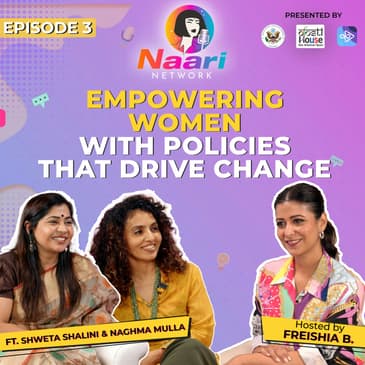

In this enlightening episode of The Naari Network, host Freishia B. sits down with two influential women leaders, Naghma Mulla, CEO of Edelgive Foundation, and Shweta Shalini, a BJP leader and advisor, to discuss how innovative policies are revolutionizing women’s economic participation in India. The discussion delves into the impact of government and corporate initiatives on women's empowerment across rural and urban settings. They share insights on breaking barriers, fostering men’s allyship, and the importance of representation. The episode also highlights the significance of implementing supportive measures like maternity leave, flexible work hours, and training programs while navigating inherent biases in workplaces. Join the conversation and be inspired to advocate for policies that drive change and create equitable opportunities for all women.
[00:00:00] People who sit in AC rooms and make policies do not understand the challenges that women at grassroot level face.
[00:00:10] The wishful scenario is it cannot be an us versus them story.
[00:00:15] Men and women, so if we have a women's day, we'll have a men's day.
[00:00:19] And if we have a women's day, we want all men to wear pink.
[00:00:22] The dream that we are seeing of India becoming the next superpower cannot happen without women.
[00:00:27] Women actually open doors for other women.
[00:00:30] So most women will also not even realize that they're being cut to size. It's that bad.
[00:00:35] So I feel humor is such a cruel, such a poisonous tool and we have to stop laughing at these jokes.
[00:00:44] I'm Frishia. I'm an award-winning master of ceremonies, a TEDx speaker, a content creator
[00:01:07] and I'm also the founder of Kata Cleanup, a beach cleanup movement.
[00:01:11] And in this episode, we're going to sit down and explore the innovative policies that are transforming women's economic participation.
[00:01:21] Discover how government and corporate initiatives are breaking barriers and of course, supporting women in the workforce,
[00:01:29] paving the way for greater empowerment in the professional realm.
[00:01:33] Our first guest today is Nagma Mulla, CEO and board member of Edelgiv Foundation.
[00:01:39] She has successfully built promoted collaborations in key development areas such as education, women's empowerment, as well as livelihood.
[00:01:50] Over the last decade of her association with Edelgiv, she's driven the vision of this foundation, transforming it from a grant making foundation to a philanthropic asset management platform today.
[00:02:01] Our next guest is Shweta Shalini, a BJP leader, advisory to Deputy Chief Minister of Maharashtra.
[00:02:08] She's also the State Secretary spokesperson for BJP Maharashtra.
[00:02:12] She's also advisor to Neeti Aayog, the think tank of the government of India.
[00:02:18] Nagma and Shweta, both of you, thank you so much for being here at the Nari Network.
[00:02:23] And I think what's wonderful is that we have two women, strong leaders, both leading in two very different sectors coming together on the couch over here.
[00:02:36] And we're going to explore how we can allow other younger women to also get onto their journeys.
[00:02:43] Let's also talk a little bit about maybe some of the difficulties we've encountered, maybe some of the mistakes that we have made.
[00:02:50] And I hope by the end of this conversation, we inspire more young women to go down this road.
[00:02:56] So before I do begin, I'm also thinking, could you introduce yourselves in 30 seconds with something that no Google search will tell me about you?
[00:03:12] So Shweta, since you smiled on that one, we'll go with you.
[00:03:18] I'm a politician. My life is an open book. So everything that I'm going to say right now is going to be found on Google.
[00:03:26] But yet, if I have to introduce myself, I'm going to say that I'm a mother, extremely proud Indian, extremely strong woman who stands with all other strong women.
[00:03:43] And women generally are strong. So, you know, and when you were introducing you, you know, you said a few things where I want to add.
[00:03:55] When a network is called Nari Network, nobody can say no.
[00:04:00] So thank you for having us here. It's so fantastic. And thank you for doing what you're doing.
[00:04:06] Thank you. Thank you. What about you?
[00:04:09] So three things that you can't find on Google.
[00:04:12] Okay.
[00:04:13] Okay. I love to eat. I am extremely ambitious. And I'm extremely naughty.
[00:04:21] Ah, that's going to be an interesting side, which I wonder how we will explore, but we will find out as the conversation unfolds over here.
[00:04:31] I know that a lot of the work, Shweta, that you are doing, and I loved your website.
[00:04:37] I really was very inspired when I went through it.
[00:04:41] And I was especially looking at the core with the kind of work that you are doing around our country and more so, especially in Maharashtra.
[00:04:50] And one of the things, of course, we know that you're focused a lot on creating policies for women's empowerment, especially when it comes to the rural areas.
[00:05:00] And that's not a very easy space to explore, to navigate. And how are their challenges so different from what urban women do?
[00:05:15] So let me reframe this question a little bit. Okay. Because I don't think that their challenges are different from ours.
[00:05:24] The problem is that the people who sit in AC rooms and make policies do not understand the challenges that women at grassroot level face.
[00:05:37] Now, if you actually look at a rural household, the most difficult jobs across India, the most backbreaking jobs, whether it is in agriculture or it's in household or in caretaking or in livelihood care.
[00:05:57] So when women, if you actually look at women in Haryana, when they look after their livestock, most of the backbreaking jobs are done by women.
[00:06:09] So, as we call it Perni, which means that when you're sowing, women are sowing.
[00:06:15] And that's when the entire day you have to bend down and sow.
[00:06:21] And that's when we call it. Cooking. There was a time when, you know, entire household, women in rural areas were cooking on, not on a gas stove, but on chulhas.
[00:06:36] Of course, we've been able to change quite a bit of this picture now.
[00:06:41] But this woman needed a different kind of an approach. Yeah. And that's when we realized that future is feminine.
[00:06:52] 50% of women, 50% of India's population is women.
[00:06:57] And the dream that we are seeing of India becoming the next superpower, of India ruling the world cannot happen without women.
[00:07:09] And these women at the rural areas, they were empowered. What you needed to give them were the right opportunities.
[00:07:17] And hence, we realized that with this fire in the belly, for them to change the scenario for their own families, for their own villages and for their own areas.
[00:07:32] These women were absolutely perfect to sow the seeds of entrepreneurship.
[00:07:39] So if you actually look at the self-help group movement, the entire microfinance movement and the self-help group movements have happened across the rural areas of India.
[00:07:51] Yeah. And in Maharashtra, because your question was specifically on Maharashtra, 4.5 lakh women's self-help groups were made.
[00:07:59] Wow. In these women's self-help groups, federations of these women were made.
[00:08:05] Yeah. Apart from these, CBOs were made, which were actual business units, business organizations.
[00:08:12] FPOs were made. And these farmer producer organizations had women who actually had agricultural land.
[00:08:21] And these women not only held those land, but they also had this dream of changing their own lives and the lives of their families.
[00:08:31] And that's why when they started taking control and when the government started giving them interest-free loans through banks,
[00:08:38] when they started giving them priority on various schemes, if you are a registered self-help group,
[00:08:46] if you're a registered CBO or a registered FPO.
[00:08:49] And when these schemes started flowing into actual needy, that's when change happened.
[00:08:57] So today, a woman based out of Nagpur is equally empowered as a woman based out of Gadchi Roli and Vardha,
[00:09:09] who's equally empowered as a woman based out of Pune or Lona Vla.
[00:09:16] What they still lack, perhaps, is opportunities, linkages, markets, large corporates, exposure, upskilling.
[00:09:28] We are giving them skilling, but upskilling. So yes, there is still lots to do and many more miles to cover.
[00:09:36] You know, when I was looking at the male-female ratio of the workforce of our country,
[00:09:42] and when I was looking not just urban or rural, there was no division.
[00:09:46] There was a chart that I happened to chance upon.
[00:09:49] And absolutely in places like Haryana, Ladakh, it showed that the female ratio was much higher than the male ratio.
[00:09:59] And now, you know, you've answered that for us.
[00:10:04] And I want to now flip it to you, Nagma, because when we look at the corporate work structure,
[00:10:11] and over there, when we take a look at the male and female ratio, it's the absolute opposite.
[00:10:17] There are definitely more men than women in the corporate space.
[00:10:22] And what do you think we can do to kind of now slowly make a shift take place?
[00:10:30] Have more women come into the corporate space?
[00:10:35] So, see, more women are coming into the corporate space.
[00:10:38] So at entry level, you will find that there is almost an equal entry point.
[00:10:43] Absolutely.
[00:10:44] The world has opened up, the corporate world has opened up.
[00:10:47] However, the design of all systems has been built in the time when men built for men.
[00:10:55] Because women were just not there.
[00:10:57] So we basically, we've opened our doors to women.
[00:10:59] But our mindsets, our policies, our structures are still not keeping up with the inflow of women.
[00:11:07] And that is why at strategic points, you see them drop off the workforce.
[00:11:11] So the fact is that women at entry point are almost equal to men at entry point.
[00:11:15] But at every, you know, life milestone, you will see the shedding happen.
[00:11:20] Yeah.
[00:11:21] And that is why, you know, by the time women are menopausal, for example, they're so exhausted.
[00:11:27] You know, the demands of corporate work, physically it's working against them.
[00:11:32] Families are, you know, children are in, you know, India is the only place I think in the world where women have to take pressure of children being in 10th standard.
[00:11:39] You know, and then college admission.
[00:11:42] So these strategic or these life milestones add so much pressure.
[00:11:47] And when the work environment is not geared to accommodate that, and the home environment is not geared to accommodate the pressures at work,
[00:11:54] is when women struggle and that's how they drop off.
[00:11:58] So I think the simple answer, there is no simple answer.
[00:12:01] No, the way to even look at this problem is that what are we doing for the woman in our workplace?
[00:12:09] Yeah.
[00:12:10] What are we doing for the woman at home?
[00:12:12] You know, and I really believe a lot of what we see workplace is secondary.
[00:12:17] Our lives are, you know, we are representatives of, you know, of what we have, what's happening at home.
[00:12:22] What is the mindset of the family at home?
[00:12:25] And what is the mindset of the family in work is what determines the experience for the woman.
[00:12:30] If we can alter that for her, we have so many more in here.
[00:12:34] So that's interesting because you just spoke about what can we offer the woman.
[00:12:39] So other than just the family support that can come in, let's talk about both the fields and the kind of support that can come in.
[00:12:48] So Shweta, have you seen any examples of successful government policies that have come in, that have enabled women and that have allowed them to change their lives?
[00:13:01] And of course, to make their work life so much easier.
[00:13:04] See, it's, see, policies can be extremely simple and these simple policies work.
[00:13:11] For example, if you actually saw about 10 years ago, what used to primarily happen is when a woman was preparing or a girl child was preparing for a government examination.
[00:13:24] And the parents would ask her if she are, she is fully prepared and she's going to crack it.
[00:13:28] She would say, yes, I'm kind of prepared.
[00:13:32] So the household would not pay for her government exam fee.
[00:13:37] But on the other hand, if the boy was not sure, they would still say, appear, maybe it'll be like a practice test for you.
[00:13:46] Yeah.
[00:13:46] So, you know, the government realized these simple things.
[00:13:49] And as a policy, what they've done is they have waived off the exam fee.
[00:13:55] If you're sitting for a government exam for women.
[00:13:58] Now, it's a very simple thing to do.
[00:14:01] Yet it has now a lot of people turn around and ask what happened to beti bachau beti padhao.
[00:14:07] Right.
[00:14:08] We have issues.
[00:14:09] We have safety, security issues in the country and across the world.
[00:14:14] But what actually has happened is, see, earlier we were, our gender ratio was 800 to 1000.
[00:14:21] Yeah.
[00:14:22] 800 women to about 1000 men.
[00:14:25] Today we are 1082 women to 1000 men.
[00:14:29] So, as Nagma ji was rightly saying, a lot of these are societal, psychological changes.
[00:14:36] Government policy needs to facilitate this transformative change.
[00:14:42] Because in gender policies, it is not about gender equality only.
[00:14:47] It is also about gender sensitization.
[00:14:50] It is also about gender transformation.
[00:14:54] It is also about gender negativity.
[00:14:57] So, you need to basically tackle all these things as far as policy is concerned.
[00:15:03] Now, for example, in workplace, the maternity leave in India is about 26 weeks.
[00:15:10] Yeah.
[00:15:10] Right.
[00:15:11] Because we realize that across the globe, the unpaid care work, UCW as the UN calls it,
[00:15:20] unpaid care work, women do three times more than men.
[00:15:26] And in some places, eight times more than men.
[00:15:29] Now somebody has to cater to this.
[00:15:32] And hence, a lot of governments, what they do is they have government or they sponsor childcare services and so on and so forth.
[00:15:43] Right.
[00:15:44] In India, we realize that, you know, societally, the mother needs to be at home with the child.
[00:15:51] And hence, we extended the maternity leave.
[00:15:55] We also have parental leave.
[00:15:57] Now, you know, both the spouses are given leave.
[00:16:01] Having said that, we have seen, you know, women or corporates dropping off women, especially for this reason, because you will have to give paid 26 weeks of leave.
[00:16:16] Now, this is where we need to understand.
[00:16:19] As policy, we can talk about best policies, you know, anti-dowry.
[00:16:24] Yeah.
[00:16:25] So, 498A was a brilliant policy.
[00:16:28] It was a brilliant policy.
[00:16:29] Because we know that world over, you know, three out of human trafficking, 71% of human trafficking is just women.
[00:16:41] Yeah.
[00:16:41] And three out of four people, women there are sexually abused.
[00:16:47] One out of three women have been abused in their life somewhere or the other across the world.
[00:16:54] In India, we realize that dowry is one of the main causes.
[00:17:00] And hence, 498A came as a policy.
[00:17:04] Do we also see that in the corporate space as well?
[00:17:08] With your experience with corporate policies as well.
[00:17:11] Maybe an example of a simple little change that was made that had a larger ripple effect.
[00:17:18] Or just a successful corporate policy that you have seen that supplemented women in their journey.
[00:17:23] So, I think that ICICI Bank is one of the, you know, my favorite examples that had almost 33 decades worth of focused policy on, focused attention on ensuring women reach leadership positions.
[00:17:39] I think that's a stellar example.
[00:17:41] Like standing way above the others.
[00:17:43] Yeah.
[00:17:43] We also know that, you know, Accenture has this very good global gender equity strategy.
[00:17:48] Okay.
[00:17:49] Which focuses on leadership nurturing.
[00:17:52] Yeah.
[00:17:52] Ensuring that women are promoted, talent is nurtured.
[00:17:55] Deloitte, I think, has a leadership program.
[00:17:57] So, corporates have these leadership programs and policies.
[00:18:01] I think, you know, there's one thing which is policy and the other is what is the impact of it.
[00:18:07] And I think what we need to do is make this not something that we follow by letter, but followed by, you know.
[00:18:16] Spirit.
[00:18:16] Spirit.
[00:18:16] Spirit.
[00:18:17] And that happens when there is a, there is a, almost like a camera dre, a partnership between people who are working in that ecosystem.
[00:18:25] Yeah.
[00:18:25] So, it's, I think policies are great beacons to begin with.
[00:18:30] And definitely they are important.
[00:18:32] Because when it's not a policy, you know, you're, you know, you're like fighting in the dark.
[00:18:36] So, policy kind of sets the bar high.
[00:18:39] That this is what we would like to do.
[00:18:41] And this is what we're instructing that everyone will do.
[00:18:43] But how to follow it.
[00:18:44] It's everything comes, you know, everything kind of comes down to the how.
[00:18:49] It's like what Shweta said right in the beginning, right?
[00:18:52] We can't be sitting and making corporate policies sitting in our AC offices.
[00:18:58] And I mean, it's the same, right?
[00:19:00] Absolutely.
[00:19:00] Whether we're talking about a woman in a rural environment or someone in an urban space.
[00:19:05] Yeah.
[00:19:06] And I think there also needs to be equal representation of women when those policies are being made.
[00:19:11] If they're for women.
[00:19:13] It's ideal that when our policies are made to ensure women are retained, progressed, nurtured,
[00:19:20] they have to be equal representation of women's voices in the making of the policy.
[00:19:24] But is it even practical to expect that?
[00:19:27] Because today, you know, women don't even represent 20% of India's workforce.
[00:19:32] Women are contributing 18% of the GDP.
[00:19:35] You have top 2,000 companies out of which only 100 women are, you know, 100 CEOs are women.
[00:19:40] So what are we talking about?
[00:19:42] We have a board mandate or we have a mandate by the Companies Act that there has to be a woman on every board.
[00:19:48] Thank God for it.
[00:19:49] Yes.
[00:19:49] It came 10 years ago.
[00:19:50] So at least we have a representation that is going on.
[00:19:54] You know, at least that has started happening.
[00:19:56] And that's an example of a stellar policy.
[00:19:58] I think it was very needed.
[00:20:01] Yeah.
[00:20:01] And hats off to all the women who were those firsts who entered those boardrooms and really navigated it.
[00:20:06] Because whatever progress we will make in boardrooms, we stand on the backs of those brave women really.
[00:20:12] Yeah.
[00:20:13] So it's ideal that women are equally voicing their perspectives when these policies are made.
[00:20:19] But it's not practical in today's time.
[00:20:21] So what do we need then?
[00:20:22] We need to co-opt men.
[00:20:24] Men allyship is what will begin this journey for us.
[00:20:29] What will accelerate this for us in the absence of enough women there.
[00:20:32] So then what do you think we can do to also help and support women?
[00:20:37] Because we're right now talking about women being in the boardroom, being in leadership positions.
[00:20:42] Yeah.
[00:20:42] What more can we do or what changes can we make where we can support them in those leadership roles even more?
[00:20:50] See, I think the investment to ensure that a women leader thrives is very low, monetarily or otherwise.
[00:20:58] You know, trainings for board representation, trainings for leadership positions, networks of women and men CEOs who come together.
[00:21:09] And there are now because of social media and because of multiple networks, they're coming together.
[00:21:13] But we need more support structures for women who reach the top or who are on their way to the top.
[00:21:20] See, a lot of times these are women, you know, doing their firsts.
[00:21:24] Yes.
[00:21:24] And they are.
[00:21:26] And we've also seen a trend that wherever the company's in crisis, there's a tendency to put the woman on the top, you know.
[00:21:33] I just heard that phrase today, the glass cliff.
[00:21:36] Yes, the glass cliff.
[00:21:37] The glass cliff is a real thing.
[00:21:39] And I know enough women myself who are navigating extremely tough conditions and winning at it.
[00:21:45] But, you know, they're poised there to take the fall if the fall should happen.
[00:21:50] And they do it.
[00:21:52] And they're incredibly brave.
[00:21:54] Yeah.
[00:21:54] And if they should not fail, then we have these, you know, I knew it would be this way.
[00:22:00] Many, many, many prophets who will say their prophecies came true.
[00:22:04] Yeah.
[00:22:05] So what we need are support structures.
[00:22:07] We need investment in their trainings.
[00:22:08] We need them to be exposed to, you know, different kinds of, you know, leadership opportunities.
[00:22:15] That is what we need.
[00:22:16] We need to nurture that.
[00:22:18] And then we also need to ensure that all of women who have reached that top are opening doors for other women.
[00:22:24] That's how the pipeline builds.
[00:22:26] As women, we wear crowns.
[00:22:28] But once in a while, we adjust each other's crowns as well.
[00:22:31] Yes, absolutely.
[00:22:32] We should.
[00:22:33] Yeah.
[00:22:33] And then Shweta, what do you also think then at, you know, a rural level also, how are we uplifting women in leadership positions and letting them lead in their environment, their neighborhood, their work, more importantly?
[00:22:47] So I'll tell you one of the things that I wanted to add in Nagma's list was, and one of the most important things is actually having an idol.
[00:23:01] Okay.
[00:23:01] Please understand that as women, we look up to idols who are primarily men.
[00:23:08] And that's why most of our efforts is towards being like them.
[00:23:15] So it is important for us to, one, share success stories.
[00:23:22] Second, it's extremely important for women to open doors for other women.
[00:23:28] And this sisterhood is in real.
[00:23:31] Women actually open doors for other women.
[00:23:34] What we need to do is to actually create a whole story out of it.
[00:23:38] We need to create PR around it.
[00:23:41] We need to create heroes of these women.
[00:23:44] And that's exactly what is required at the rural level as well.
[00:23:48] See, when this policy of 50% reservation for women in panchayat elections and corporation elections, municipal elections was declared.
[00:24:01] In the very beginning, men opposed this law because women were not ready.
[00:24:09] Yeah.
[00:24:10] And in the first lot, you only saw…
[00:24:13] Do you think they thought women were not ready?
[00:24:15] No.
[00:24:16] I practically know that women were not ready.
[00:24:19] Okay.
[00:24:19] And hence in the first lot, what you saw were only wives, sisters, daughters of politicians come in.
[00:24:29] But now that I see these women, there are about 1.4 million women at this level in the panchayat system, in the counselling, as counsellors, as corporators in India today.
[00:24:42] So 14 lakh women, if you actually see them, nearly 60% of these women repeat their terms.
[00:24:50] They are extremely confident, they know their subject, they learnt around in the way.
[00:24:55] So policies matter, but as rightly said, it needs to be implemented well.
[00:25:02] And as I always say it, I'll repeat it, behind every successful man there could be a woman.
[00:25:07] But behind every successful woman, there needs to be a complete ecosystem.
[00:25:11] And this ecosystem we need to build as a society, whether it is at the rural level or at an urban level or at a corporate level.
[00:25:20] We just need to create a large group of cheerleaders that will always hold you physically, mentally, psychologically and mentor you to not only counter the ceiling but also the cliff.
[00:25:38] It's the age of collaborations also. I think what we're all beginning to realise is that we can't work in silo.
[00:25:46] You know, there was a time when it was all about keeping it to yourself, gatekeeping, safeguarding.
[00:25:53] I won't tell you how I got here, you know, I don't need to give you that information.
[00:25:57] And that has completely changed now.
[00:26:00] We're all realising that we need to come together as one bigger community and feed off each other.
[00:26:05] But at the same time, I also want to ask both of you, what are some of the biggest challenges that, you know, we have also faced when it comes to implementing policies?
[00:26:16] I can actually use the example, you know, she gave on the maternity leave, the 26 weeks, which is, I think, very progressive.
[00:26:25] But it has had a huge negative impact on the hiring of women as well.
[00:26:32] A lot of her, and because it's also not politically correct to ask a woman whether she will get married or whether she will have a family.
[00:26:39] It's not politically correct.
[00:26:40] So, they're eliminated before even being given a choice and nobody will ever talk or say about it.
[00:26:47] So, we've kind of, you know, like leaned out the funnel right before any choice was made itself.
[00:26:54] So, I think that's had a huge negative impact.
[00:26:56] Yeah.
[00:26:57] Second impact, and I'm saying this in spite of the positives.
[00:27:01] Second impact is the whole point of a lot of women don't want to be home for 26 weeks.
[00:27:06] Okay.
[00:27:06] They would rather have a caring and sharing partner.
[00:27:10] Yeah.
[00:27:11] You know, someone to help with caregiving at home and a support system so that they are also out because it is tough.
[00:27:18] You know, a lot of women are, you know, battling depression, battling struggles of, you know, first time motherhood.
[00:27:25] Yeah.
[00:27:25] And are also very, very petrified that they're away from work for long enough to have an impact on their career.
[00:27:32] You know, the world is running faster than their break.
[00:27:34] Yeah.
[00:27:34] So, that has again had, if you see one of the reasons why progress kind of gets, it's a big, big kind of break in the middle of a speeding train.
[00:27:44] And a lot of women actually don't, I don't speak for all women, but there are women who would rather have the man, you know, help and him taking part of the leave and them being able to go.
[00:27:56] So, paternity leave is very important, but it's not always taken.
[00:27:59] Right.
[00:27:59] It's not always given.
[00:28:01] And if it's taken, it's not like the woman is being relieved of her duties.
[00:28:04] Yeah.
[00:28:05] So, I feel that this is a very, very important policy that needs to be supported by a good ecosystem for it to work well.
[00:28:13] And Shweta, on your experience, have you had an instance?
[00:28:17] If you actually ask me for examples, I can give you multiple examples of how, you know, policies have been made but have not been accepted.
[00:28:29] For example, let me give you a very global example.
[00:28:32] Now, for the first time when G20, when India did the presidency of G20, we came up with this idea where Shri Narendra Modi ji said that, yes, women need development.
[00:28:45] But why cannot we have women-led development?
[00:28:51] Why should we always look at women as emancipated and consider them at the end of the tool?
[00:28:57] We need to talk about models, economies where women can lead the change.
[00:29:03] So, we actually did a complete W20, women 20 on the side with world-ovaled policymakers to ensure that development can be women-led.
[00:29:17] But unfortunately, including the United Nations, nobody has really accepted this in letter and spirit because they still feel that the gap is so large that women can't lead it.
[00:29:31] Whereas in India, now that we are creating models like this, it is, if nothing else, it is changing the entire social platform and changing the mindset of the women.
[00:29:43] For example, I think Sanex schools were never open for women, never open for girls.
[00:29:50] And in a very simple policy, Sanex schools were opened for girls.
[00:29:54] Okay.
[00:29:56] In the same letter in spirit, permanent commissions were given to women in the army.
[00:30:05] And hence now women feel that we have equal opportunity to fight for our nation.
[00:30:12] Now consider this as a policy and look at the after effect that it has on other girls.
[00:30:18] Now, I see a lot of girls from Punjab, I see a lot of girls from Bihar, I see a lot of girls from Satara district in Maharashtra, who stand up when I meet them and say that I'm going to be in the army.
[00:30:31] I'm going to join the Sanex school.
[00:30:32] Now that is the spirit that will change the country, but it needs to be implemented right.
[00:30:39] And hence for it to reach the last mile, I think we need a lot of stakeholders and most of them in the system are men.
[00:30:49] So then what role can men play? And, you know, let's also look at it from like the positive point of view that what role can these men play so that we can have successful women centric policies?
[00:31:03] And this could be in the corporate section or we're looking at it from the government implemented section.
[00:31:10] What do you think would be that wishful scenario?
[00:31:13] The wishful scenario is it cannot be an us versus them story.
[00:31:18] Which it becomes like, you know, men and women.
[00:31:22] So if you have a woman's day, we'll have a men's day.
[00:31:24] And if you have a women's day, we'll have we want all men to wear pink.
[00:31:28] I mean, these these very, very visual, you know, more of an advertisement oriented gestures, we have to also, you know, calm down a little bit on them.
[00:31:39] We get a little super excited. And by we, I mean both men and women.
[00:31:43] Yeah. It encourages tokenism where one needs to sit down and really think about what needs to happen.
[00:31:50] Second is I feel we need to all be a little calm.
[00:31:55] A lot of men would be our allies if they weren't so fearful of saying the wrong things and doing the wrong things.
[00:32:03] I think women should not be the owners of responsibility of any mind change.
[00:32:11] I think the responsibility doesn't rest only on a woman.
[00:32:13] But for the men around us, I think it's important that we keep talking and keep repeating some messages so that they hear.
[00:32:23] Because otherwise this will never happen. You know, it's like a pendulum when something has been, you know, fixed at one point for so long.
[00:32:32] Yeah. When you're releasing it, it's going to swing the other side. So there will be noise.
[00:32:36] There will be destruction. There will be hurt feelings and exaggerated response.
[00:32:41] Pushback will happen.
[00:32:42] What we have to do is through all of this, ensure that we communicate to the men around us.
[00:32:47] And hear their communication as well. For example, you know, all these movies that were for Gangubai, for example.
[00:32:54] I went with my family. I'm sure I'm surely going to watch some of these films with the boys.
[00:32:58] I have two boys. I will watch Animal with the boys.
[00:33:03] Because it's important to watch that film with the boys. It's important to hear how they interpret what we are interpreting differently.
[00:33:11] What I am very angry with. Why is he amused by it?
[00:33:14] And then to not tell him that how dare you be amused by it.
[00:33:18] But to understand what is the cause? What is it happening?
[00:33:20] If we don't understand men, how will we help them help us?
[00:33:25] So that I think we need to make a little easier.
[00:33:28] We're too judgmental right now. And we need to just allow for some mistakes to happen.
[00:33:34] I'd love to hear what you have to say, Shrata.
[00:33:36] They are inherent biases. And these biases, for example, I was teaching, like Nagma, I have two boys.
[00:33:46] I was teaching one of the boys that,
[00:33:49] that the man who was a good man who was a good man.
[00:33:52] And then while I was teaching them this, and they were young boys, I realized, why did he say that man?
[00:33:59] So now these are inherent biases.
[00:34:01] And these biases are part of our society. It's part of our culture.
[00:34:07] Now, I have to make an effort to tell my two sons that you need to be aware of these biases.
[00:34:16] Now, having said that, this is a very, very thin line.
[00:34:22] So I again feel that the responsibility and the onus lies on mothers to teach their boys.
[00:34:31] And, you know, a lot of people talk about stricter rape laws, fast track courses.
[00:34:37] I agree to all of that. Policy needs to change.
[00:34:41] But more importantly, society needs to change.
[00:34:44] And we as women are also responsible for changing this society because we bring up our boys.
[00:34:51] Absolutely.
[00:34:52] And somewhere we need to teach them.
[00:34:54] I was using some meta AI or some AI in which a picture of a person working in a kitchen was identified as a woman.
[00:35:09] If an AI engine can have a bias, trust me, humans are humans.
[00:35:16] Because AI engines are also being made by humans.
[00:35:19] Yeah.
[00:35:19] And that's why it is important that these inherent biases, I just want men to recognize these inherent societal biases.
[00:35:30] Yeah.
[00:35:30] And be aware of them because once they are aware, I'm sure every mother teaches the right things.
[00:35:37] You know, you gave such a lovely example right now because the bias that you spoke about, there are some which are very in our face, right?
[00:35:45] The ones that we see, the glass cliff, the glass ceiling, you know, the way women dress, all of those obvious ones.
[00:35:53] This example of how AI will recognize the person who works in the kitchen, woman, has to be a woman.
[00:36:01] In the corporate world, is there any uncommon bias that you have seen in your years of experience?
[00:36:09] Uncommon or unseen bias. A bias that is there, but it's rampant, it's everywhere.
[00:36:15] Sure.
[00:36:16] But it's not talked or spoken about. I think humor.
[00:36:20] I think humor is a tool for bias. And it is a very beautiful tool. It is lethal.
[00:36:27] Right. Cuts like a sword.
[00:36:28] Cuts like a sword. You can't protest. You have to grin and bear it.
[00:36:33] But humor has been one of the most, most sharpest tools by which a woman has been cut to size.
[00:36:39] In every way. Whether it's asking for coffee from an executive who is equally as important as me, the man.
[00:36:48] Whether it is about, you know, making sexist comments when a woman who is entering a boardroom,
[00:36:54] you know, just to throw her off her game. There are small and very small slides that are given,
[00:37:02] which women also then get conditioned to bear with a smile.
[00:37:07] So most women will also not even realize that they're being cut to size. It's that bad.
[00:37:13] So I feel humor is such a cruel, such a poisonous tool. And we have to stop laughing at these jokes.
[00:37:21] It is exactly the same with abuses.
[00:37:24] And I know equal number of women who use the same abuse, which is primarily focused on one or the other organ of a woman.
[00:37:35] Now, it's so pathetic.
[00:37:38] You can feel very cool about it. You can feel very empowered about it.
[00:37:43] But real empowerment is standing up and telling that man there, you can't use it.
[00:37:51] Not at least in front of me.
[00:37:53] No, but I mean, this is something that I used to have a big problem with while growing up.
[00:37:57] You know, where is that one gali I can give back?
[00:38:00] Yeah.
[00:38:00] Which is, you know, your father, your brother, your something and there's no vocabulary for it.
[00:38:05] And you realize the worst insult a man can give to anyone is a gendered insult.
[00:38:12] And now it's cool. Like how can you not swear?
[00:38:17] But my problem is women who are swearing with the same swears.
[00:38:22] It's cool to be swearing, right?
[00:38:24] Yeah.
[00:38:24] Just because I'm empowered, I can give back to the man in the same language.
[00:38:29] Yeah.
[00:38:29] But I hope that a lot of, you know, young women that are watching right now, like I love the resort, the retrot that you just gave, which was blank expression.
[00:38:39] I didn't really get it. What were you talking about?
[00:38:42] Yeah.
[00:38:43] Those things, you know, when somebody is trying to cut you like a sword, what they think are doing.
[00:38:47] You should try that one. I've tried it.
[00:38:49] And the satisfaction.
[00:38:51] It's lethal.
[00:38:52] It's lethal.
[00:38:53] When I joined, you know, before I was a politician, I was one of the first people to join this multinational company and I was on the sales team.
[00:39:03] So occasionally I would be the only woman in a 40 people team.
[00:39:07] And I would look at them plainly, simply and say, was the joke meant on a woman?
[00:39:16] And trust me, all you can see is silence.
[00:39:20] But you need that one person to stand up and say, stop it.
[00:39:24] And I'm sure the men realize, the only thing is, the ecosystem is so set with men, along with other men, that and in a societal way, we are so trained.
[00:39:36] Yeah.
[00:39:37] That is just cool and happening.
[00:39:39] Yeah.
[00:39:40] It's better to just brush it under the carpet, pretend like it never happened.
[00:39:43] And then I can just move on.
[00:39:45] How many fights will you fight?
[00:39:46] Right?
[00:39:47] Yeah.
[00:39:47] There are so many things.
[00:39:50] And then finally, are we going to fight on, you know, how did you give me that gully?
[00:39:53] Exactly.
[00:39:54] So you choose to bypass it.
[00:39:55] But look at what happens when you do.
[00:39:57] Yeah.
[00:39:59] So then let's dream a little, you know, and let's also now say that what's one policy that I wish would just become a norm?
[00:40:10] In both your sectors.
[00:40:12] You know, freehand and I want this to become a norm.
[00:40:16] Precious.
[00:40:19] Precious.
[00:40:20] Most important.
[00:40:21] Most important.
[00:40:21] Yeah.
[00:40:22] Because how.
[00:40:23] Any mother.
[00:40:24] Right.
[00:40:24] Any mother, whether she has a support system at home or not.
[00:40:28] The liberty with which a woman can work knowing her child is all right.
[00:40:33] And accessible if something happens.
[00:40:36] Yeah.
[00:40:36] It's priceless.
[00:40:38] And companies will see the monetary benefit of this.
[00:40:41] This is a benefit that, I mean, it's just so sad to see women, you know, double shoot on so many things,
[00:40:48] having to rush back home, needing hybrid structures.
[00:40:53] Yes.
[00:40:53] But the struggle of a woman whose child is young, even if there is a parent at home, even if there's a, because the child is young and there are struggles.
[00:41:03] And in our country, we are caregivers to the older generation as well as our children.
[00:41:08] Yeah.
[00:41:08] So there is a lot.
[00:41:10] Just having a crush in your company can change the game of output and career, you know, the output that a woman can deliver at work.
[00:41:20] Absolutely.
[00:41:21] And what about you, Shweta?
[00:41:22] So just to add to what Nagma was saying, when the 26 week maternity policy was made, this policy was also made that if you have a certain number of like the posh law that you need to have a Vishaka committee.
[00:41:36] If you have a certain number of women in your workforce, then you need to have a crush.
[00:41:42] But again, as an example, where is it?
[00:41:44] Where is it?
[00:41:45] Where is it?
[00:41:45] We're not there only.
[00:41:46] Exactly.
[00:41:46] That's what I'm saying that if you really look at it, the policies have been put in place.
[00:41:51] Yeah.
[00:41:52] Actually, there are many, many progressive laws and policies that are there in this country.
[00:41:56] But the problem is one, we're not even aware they've made.
[00:41:59] Yes.
[00:41:59] Okay.
[00:41:59] The implementation is weak because stakeholders don't know.
[00:42:02] The beneficiary doesn't know that it's for her.
[00:42:04] Like women don't know so much is available for them.
[00:42:07] Right.
[00:42:07] Today, if something happens in this room, I wouldn't know how to go and file an FIR.
[00:42:11] Hmm.
[00:42:12] You know?
[00:42:13] Whereas women can actually file an FIR from WhatsApp.
[00:42:17] From WhatsApp.
[00:42:17] It's a zero FIR.
[00:42:19] Do you know I don't need a lawyer if I want to, you know, access the court?
[00:42:23] I had no idea.
[00:42:25] Exactly.
[00:42:26] It is.
[00:42:26] So that is how ill-informed we are.
[00:42:28] I think as citizens, and now I don't speak as women or men.
[00:42:33] As citizens, I think our one duty is to know our citizenship.
[00:42:38] And to contribute positively to it.
[00:42:41] Yeah.
[00:42:41] So one dream policy for me then would be that as women, we need to definitely make sure we're more aware.
[00:42:47] We have to.
[00:42:47] We have to be.
[00:42:48] The level of unawareness in our gender is abysmal.
[00:42:55] Because see the way, and I do blame this a lot on how we are raised.
[00:42:59] Yeah.
[00:43:00] Because we are protected.
[00:43:02] We are discouraged.
[00:43:03] Like, finance is a problem with women even now.
[00:43:05] Because all their childhood they've been told, Papa will take care of it and Baia will take care of it.
[00:43:09] Yeah.
[00:43:10] So you're not tuned to thinking.
[00:43:11] Are you not capable of?
[00:43:12] No.
[00:43:13] I'm a chartered accountant.
[00:43:14] The amount of jokes that people have made on numbers with me without knowing this degree that I have is funny.
[00:43:20] The way men explain numbers to me is ridiculous.
[00:43:24] Okay.
[00:43:24] Because they don't know that I am a chartered accountant.
[00:43:27] And I will be spelt out.
[00:43:28] It's almost like I am deaf and they're explaining, or I know Chinese and they're explaining something in English.
[00:43:33] It is that silly.
[00:43:34] So, because we have an entire generation and generations before them who have been raised being told that some things are not meant for them.
[00:43:45] So we typically tend to just be relaxed about it.
[00:43:49] The one thing women have to do for themselves is just get awareness of your rights, of the laws that are made for you, of the policies your companies have for you.
[00:43:57] Yeah.
[00:43:57] You know?
[00:43:58] There is a lot out there.
[00:44:00] We don't have to fight for everything actually.
[00:44:02] A lot of fight has gone.
[00:44:03] Generations before us have done that for us.
[00:44:06] I still want to answer that question.
[00:44:08] My wish list.
[00:44:10] I think the dream that every woman politician has seen in the country, the wish is definitely going to come true.
[00:44:18] We have been talking about a reservation of women in the parliament.
[00:44:24] I'm not a very keen supporter of reservation.
[00:44:27] But having said that, we still have 11% representation of women in the parliament today.
[00:44:35] Yeah.
[00:44:35] And these are the women who are involved in making policy for women.
[00:44:40] So with 50% population, we need more representation of women.
[00:44:45] So ideally, either there needs to be a reservation for representation of women in the parliament or more and more political parties need to stand up and say, I will give more opportunities to women.
[00:44:58] Yeah.
[00:44:59] And that's where the entire table is going to turn for policies.
[00:45:04] Yeah.
[00:45:04] Hasn't representation for women in parliament come through?
[00:45:08] Yeah, the law has actually come through.
[00:45:10] But the implementation is going to happen in 2029.
[00:45:13] That's what I said.
[00:45:15] That deferred implementation.
[00:45:16] Yeah.
[00:45:17] Well, we hope that it could happen earlier.
[00:45:20] This is a question that we're asking all our guests.
[00:45:24] What is one major change that you would like to see that gets implemented across all sectors that then allows women to have equitable opportunities in their career?
[00:45:36] I would love if selection for posts happens without reference to gender.
[00:45:41] That part of the selection actually is when selectors don't know whether they're talking to a woman or a man.
[00:45:49] Because talent-based selection will change the game.
[00:45:52] There are too many talented women waiting in the rings.
[00:45:56] So across sectors, if we have a talent-based entry point that is gender neutral, that would be fantastic.
[00:46:04] And what do you think?
[00:46:05] I think access to finance and access to technology.
[00:46:09] These are two things which are extremely important.
[00:46:11] During COVID times, my eyes opened up when I saw that in certain areas when the education went digital and there was just one mobile phone in the household.
[00:46:28] Only the boy child was studying because as simultaneous classes, the girl child was kept at home because the preference and the priority was given to the boy child.
[00:46:38] So I firmly believe this, that the only minority in the world is woman and child.
[00:46:45] So we need to tackle this.
[00:46:48] So we need to tackle this.
[00:46:48] Access to technology and access to finance can bridge a lot of gaps.
[00:46:52] Obviously, that will bring in skill.
[00:46:55] That will bring in upskilling.
[00:46:58] That will bring in talent.
[00:46:59] That will bring in opportunity.
[00:47:01] And that's exactly what women across the world need.
[00:47:06] So I'm going to play a quick game with you all.
[00:47:08] And this one is called complete the sentence.
[00:47:12] It's a little like policy women based that we have over here.
[00:47:17] And it's for both of you.
[00:47:18] Do we have a hamper?
[00:47:21] Unfortunately, no.
[00:47:21] Do we have Karan Johar?
[00:47:26] Are my producers listening?
[00:47:28] There is a demand for a hamper.
[00:47:30] Well, yeah, we're almost here.
[00:47:32] It's four sentences.
[00:47:34] Every company should implement a flexible start time policy because?
[00:47:42] Because women are primary caretakers for the children and the elderly.
[00:47:48] Because it's more important that people do their jobs and not important when they start.
[00:47:54] Absolutely.
[00:47:55] As long as the job gets done.
[00:47:57] To support women from returning to work after a career break, we should introduce?
[00:48:04] Upskilling?
[00:48:05] Crescent.
[00:48:06] Yeah, let's talk about it.
[00:48:09] Every organization should provide a monthly wellness day for women because?
[00:48:16] Because they need it.
[00:48:17] And this wellness day should be mental and physical wellness.
[00:48:23] Because they will see a remarkable change in the productivity of the woman.
[00:48:28] To promote women in leadership, a company should start a mentorship program
[00:48:32] that?
[00:48:35] That allows women to access senior leadership and ask candid questions without being penalized
[00:48:41] for them.
[00:48:42] That involves men.
[00:48:47] An ideal policy for women in tech would include?
[00:48:52] Good question.
[00:48:54] STEM, I'll take a slightly longer.
[00:48:56] STEM, if you actually look at it, the tertiary population of women in STEM is a whole lot of a lot.
[00:49:04] If you actually turn around the papers and see the 10th class results and 12th class results,
[00:49:10] mostly toppers today in India are women.
[00:49:12] But then they drop out.
[00:49:14] And hence it is important for us to include STEM in various ministries.
[00:49:21] So when we are talking about climate, we need to have STEM included in it.
[00:49:26] And that's when coupled with all the other things that we've talked about, policies for women,
[00:49:31] I personally feel that women will get included more in STEM and will get included in the final
[00:49:39] use case of that ministry.
[00:49:41] If it is climate, agriculture, why not use STEM in agriculture?
[00:49:45] And I think women can be extremely good with that.
[00:49:47] Why not include women in water security?
[00:49:50] Because most women use water across the world.
[00:49:54] And this is exactly where we need to talk about women-led development and women-led STEM programs.
[00:50:01] Very interesting.
[00:50:03] Can you repeat the question?
[00:50:04] Yes.
[00:50:05] An ideal policy for women in tech would include?
[00:50:09] Cyber security and cyber crime.
[00:50:12] Definitely the need of the day as well.
[00:50:15] Yeah.
[00:50:15] To ensure equal opportunities, the government should introduce a mandatory diversity training.
[00:50:23] That would?
[00:50:27] That would include men, women and children.
[00:50:34] So this diversity training should start young.
[00:50:38] Catch them young.
[00:50:40] I think it should not be about men and women.
[00:50:43] It should be about all kinds of diversity.
[00:50:46] Cast, religion, gender, social class.
[00:50:50] Because most of our issues are extremely interconnected.
[00:50:55] All right.
[00:50:56] Thank you both so, so much.
[00:50:59] I think our viewers are definitely going to walk away with so many new perspectives, so many new approaches.
[00:51:08] And at the end of the day, you know, whether we come from a rural India, an urban India, yes, the problems are of course.
[00:51:16] We've talked about that.
[00:51:18] We've talked about that.
[00:51:18] But there are also many common things that we just as women within our workspaces are also struggling with.
[00:51:25] And I wish both of you the absolute best, especially when it comes to the kind of policies that you all are advocating in both your respective spaces.
[00:51:33] Thank you, Freishya.
[00:51:34] Thank you.
[00:51:34] We loved it.
[00:51:35] Thank you for having us here.
[00:51:36] Thank you.
[00:51:37] Thank you for tuning into this episode of the Nari Network.
[00:51:41] And we have uncovered, I think, some very groundbreaking policies as well as initiatives that are transforming women's economic participation.
[00:51:50] A very big thank you to both my guests for coming, sharing their invaluable insights on how government as well as corporate efforts are shaping a more equitable and inclusive future.
[00:52:04] Share this inspiring discussion and don't forget to catch us on YouTube as well as Spotify or your favorite podcast platform.
[00:52:13] Keep advocating for policies that empower women.
[00:52:16] Together, I definitely think we can drive change and we can create opportunities for all women in our country.
[00:52:24] Until next time.
[00:52:25] Ciao.