
---
Send in a voice message: https://anchor.fm/ranjit-pawar6/message
[00:00:06] Hello and welcome back to the Long History Short. I am Ranjit and you are listening to another carefully researched and curated story from the pages of history.
[00:00:17] With this episode, we enter a new series that will give you a closer look at the events and personalities who made the 18th and 19th centuries the busiest and darkest periods of India's story.
[00:00:30] You will also see why I call it dark as each episode demonstrates how the fall of the Mughal Empire led to the enslavement of India by foreign powers.
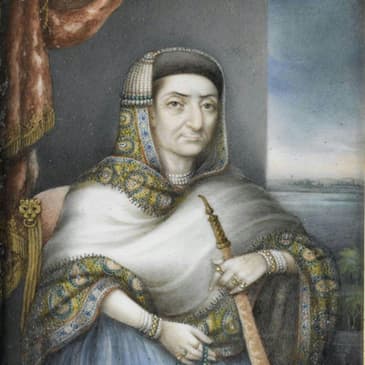
[00:00:41] We start with the story of a female figure whose memory has all but vanished from common history.
[00:00:48] Had it not been for the effort made by the late Julia Key, wife to the noted history author John Key,
[00:00:55] we would have remained unaware of this lady's role in the politics of late Mughal India.
[00:01:01] After Noor Jaha and Razia Sultana, she is probably the only other woman who played a decisive role in the affairs of northern India or Hindustan.
[00:01:11] Although I chose her more so for her qualities as a survivor, a generous benefactor to her people
[00:01:17] and also a die-hard romantic who thought nothing of the patriarchal views of her society when it came to matters of the heart.
[00:01:27] It is probably her survivor's grit that also blessed her with a lifespan that was unusual for her times.
[00:01:34] The Begum lived a full life of 86 years, outliving all her peers, her lovers, her enemies and the Mughal Emperor himself,
[00:01:45] whose life she saved more than once during her long reign.
[00:01:49] She even outlasted the Mughal Empire itself, which was lost decisively to the British in 1803,
[00:01:56] more than 30 years before her own demise in 1836.
[00:02:01] One wonders that had she been born a bit later and lived through the uprising of 1857,
[00:02:08] could the outcome for the War of Independence have been any different?
[00:02:12] I'm sure by now you're curious to find out all about this fascinating woman.
[00:02:17] So let's start our journey with the Begum's arrival into this world sometime around 1750.
[00:02:24] From the historical material available to us, we unfortunately do not know what the Begum was named at birth or what she was called by her parents.
[00:02:34] The few memoirs that have survived remain mostly silent on her childhood,
[00:02:40] except for telling us that she was born in the family of one Luthfad Khan
[00:02:45] and her mother was a Tavaif or a courtesan who had followed the Khan from her house of entertainment in Delhi
[00:02:51] to his home in Kutana, a village less than 100 km away from the capital.
[00:02:58] Her childhood was short-lived as the Khan passed away when she was just about 6 years old.
[00:03:04] There couldn't have been a worse time for a girl child to be without a father
[00:03:09] in the war-torn country of Hindustan or northern India.
[00:03:13] The country had suffered for decades under the repeated assaults by foreign raiders from Afghanistan and Iran
[00:03:21] as well as the emboldened native forces like the Marathas, Sikhs, Jats and Rajputs.
[00:03:28] A long line of weak, disinterested and short-sighted successors who came after Aurangzeb
[00:03:34] had reduced the once glorious Mughal Empire to a crumbling establishment that had nothing to its credit
[00:03:41] other than the nominal recognition of still being the central authority.
[00:03:46] Gone were the standing armies of the once invincible empire and the coffers too were empty.
[00:03:52] Whatever little came by means of revenue from the northern and northwestern provinces also had to be shared with the Marathas
[00:03:59] who otherwise threatened to remove the emperor himself from the throne.
[00:04:04] Shah Jahanabad, today's old Delhi, had been laid waste by the raiders
[00:04:09] and its once prosperous inhabitants, flourishing trade and artisans had all left this city
[00:04:17] whose beauty had once been described by not one but eight celebrated poets.
[00:04:23] All that now remained of the city were its deserted streets and the ruins of burned downhouses.
[00:04:30] The few shadows that scurried about the streets only remained in the city for they had probably nowhere else to go.
[00:04:37] In such a tumultuous environment the little girl and her mother Zelda made their way into Delhi
[00:04:45] back to the Kotha or evening quarters where the rich and the intoxicated spent lavishly on the dance performances
[00:04:53] and other pleasures that were on offer.
[00:04:56] The girl still does not have a name in history as little is known of her days spent in the Chauri Bazaar neighborhood of Delhi.
[00:05:03] We hear about her next only when something completely unexpected happens.
[00:05:09] An event that would help her not only escape a lonely disease death in the darkness of Chauri Bazaar
[00:05:16] but make her the ruler of a flourishing estate and the proud owner of a residence in nowhere less than the emperor's palace itself.
[00:05:26] Before we jump to that big turn in her story it might help you to know a little more
[00:05:31] about European military adventurers who were making a beeline to the Indian shores.
[00:05:37] While the Mughal capital reeled under invasions and extortions, the empires governors in Bengal, Hyderabad and Awadh
[00:05:46] used the king's name generously to collect taxes from these fertile regions.
[00:05:52] They also negotiated favorable terms with the new merchants in town the Europeans.
[00:05:58] The Nawabs used the imperial decree to extract commercial taxes from the East India trading companies of the Dutch, French and British
[00:06:09] who had set up their factories in Calcutta, Chandarnagar and Madras on the east coast of India.
[00:06:16] The west coast was not hospitable to these late comers as the Portuguese had arrived there more than a century before them
[00:06:23] and fiercely guarded their ports on the Arabian Sea while the Marathas ruled the mainland from Karnataka to Gujarat
[00:06:32] making it impossible for anyone to establish a base over there.
[00:06:36] Therefore these trading companies chose to pay their taxes to the Nawabs in the east while silently continuing to fortify
[00:06:45] and arm their benign looking factories.
[00:06:47] This created opportunities for young men in the west to come to India as soldiers, officers or clerks.
[00:06:56] These men brought with them the latest military techniques, skills and discipline which helped the white man to colonize country after country across the world.
[00:07:07] But even the British themselves could not have predicted in 1756 that they would become the masters of the richest Mughal province in less than a year.
[00:07:19] How did this happen?
[00:07:21] Well for centuries the strength of Indian armies had been their large numbers, the charging cavalry's, the much feared war elephants
[00:07:30] and their soldiers' skill with the sword and the lance.
[00:07:34] Even early European invaders like the Portuguese had found it wiser to remain on the seas and control the ports
[00:07:42] than venture into the mainland where they could have been cut down by the fast cavalry's and superior steel of the Indian rulers.
[00:07:51] Unfortunately for the Indians all of this changed as science developed faster in the west
[00:07:57] and superior guns, artillery and above all the power of tighter and organized troops made it possible for a swifter smaller European regiment to knock out a slower bulkier Indian force.
[00:08:13] As part of their politics and means of earning wealth the French were the first to offer their services to Indian princes who were at war with their local rivals.
[00:08:23] Quite soon European mercenaries became a valued asset in every Indian province.
[00:08:30] French, English and Italian military men found employment as brigadiers with many Indian princes who most certainly included the Marathas, Jarts, Rajputs and also the Mughal Nawabs.
[00:08:45] One such mercenary was Walter Reinhardt who hailed from the French Alsace region which alternated between French and German control.
[00:08:54] As the times demanded Walter switched employers in India faster than today's software developer in Bangalore.
[00:09:02] He had the luxury of choice as his CV boasted of skill sets that were in great demand
[00:09:07] and there was no dearth of opportunity as Indians and Europeans clashed against each other with increasing frequency.
[00:09:15] The private soldier conscious that his last name may not help warm up to his British masters swiftly changed it to a more acceptable last name of Somers.
[00:09:26] He would not refrain from making this change once again as he walked over to the French side.
[00:09:31] This time he chose Sommer in the hope that the French would find it less offending than an English sounding Somers.
[00:09:40] It was this name that would stick with him though his loyalty to the French stuck much lesser.
[00:09:47] As Sommer gathered European and Indian soldiers to form his own brigade, his name gained a more native flavour as his brown subordinates came to call him Samru.
[00:09:58] This would be the name that would transfer to his would-be partner as well.
[00:10:03] After leaving the French, Samru had taken employment with the Nawab of Bengal, Mir Qasim.
[00:10:10] The Nawab was growing impatient and disillusioned with the treatment meted out to him by the British who were now the practical masters of Bengal.
[00:10:20] An impulsive and hot tempered man by nature he made no secret of his feelings for the British.
[00:10:27] So there was the strong, if only false belief that his people would never allow a white virangi to rule their country and would stand behind him if the occasion arose.
[00:10:39] After all, Mir Qasim came from a line of Nawabs who had ruled the Bengal province for a good two centuries.
[00:10:45] However, his predecessor Mir Jafar had thrown away his legacy quite easily when it came to betraying his master Sirajuddala and sold the Mughal honour at the Battle of Plasi in exchange for the promise of being made the next Nawab.
[00:11:03] Heading with the historical influence of Mughals over India, Mir Qasim did not think much when he ordered Samru to murder a large number of British officers in Patna by treachery.
[00:11:15] The British's Bloody Act put a reward on the heads of both Mir Qasim and his Alsatian Brigadier, both of whom became enemies number one and two on the British Blacklist.
[00:11:27] Conscious that he would be horribly tortured and then murdered if caught alive, Samru abandoned Mir Qasim and turned west where he found refuge and employment with the powerful Jhat King Jawaharmal.
[00:11:40] The British would not dare to come anywhere near the Jhat's, thought Samru and he did prove to be somewhat lucky with this decision.
[00:11:49] Earning the favour of the Jhat's and proving to be a crucial member of their campaign against the Mughals, Samru became the trusted aide of Jawaharmal.
[00:11:58] It was a successful raid on Delhi that brought Samru in contact with the young and beautiful daughter of Zelda who came as part of his spoils of war.
[00:12:07] Not much is known of this episode except for the fact that Jawaharmal gave her to Walter Reinhardt amongst other rewards for supporting his march on Delhi that left the Jhat ruler far richer but also fulfilled the long held Jhat dream of getting even with the Mughals, even if it was late by a few centuries.
[00:12:29] Happy with this outcome compared to what he would have suffered at the hands of the British, Samru settled in the Jhat territory of Digh and Bharatpur with his newfound consort.
[00:12:40] Reinhardt or Samru's Brigade as we saw earlier was made up of Indians, Europeans and Indo-Europeans.
[00:12:48] The Europeans came from a number of nationalities and like Reinhardt they too had left their world and come to the east in search of a fortune that could change their life once they returned to Europe.
[00:13:02] The early settlers amongst them had married native women and from this temporary union had come a generation of Indo-Europeans who for many practical reasons were as Indian as their Sipoi brethren.
[00:13:17] The Sipois were pure natives who had been handpicked from Hindustani armies or recruited from villages but they were trained in the more sophisticated European military drill and weaponry.
[00:13:31] In order to manage this mixed bag of hired gunmen Walter had to make sure he had their respect and trust for he knew that the slightest discontentment could end with him taking a bullet or a bayonet in his back from this motley crew.
[00:13:47] His new companion from Delhi helped him bridge the gap with her charm and intelligence.
[00:13:53] Also the novelty of a woman being so fearless in engaging with soldiers who were so easily given to violence and aggression made her somewhat an object of curiosity for Samru's troops who affectionately started calling her Samru ki Begum or Begum Samru.
[00:14:11] Despite having no formal marriage ties between them the dancing girl from Chauri Bazaar unknowingly earned herself the respect and the status of a Begum from Reinhardt's men.
[00:14:25] This title would stay with her even though it would not be the last one that she earned in her lifetime.
[00:14:32] In keeping with his past record Reinhardt once again shifted camps and this time he was on the Mughal side, the same Mughals with whom he had crossed swords in Delhi.
[00:14:43] This made him a sworn enemy of the Jhards who had given him asylum when he was on the run but the bigger reason for their anger was that Samru knew their forts intimately as a result of having stayed there for so long.
[00:14:57] It was this knowledge of the design of the Jhat fortifications that helped the Mughals defeat their enemy and as a reward Samru earned his first Jagir in India.
[00:15:09] The Mughal Emperor granted him the revenue rights to Sardana, a district that was part of the Doab or the rich alluvial delta formed by the Ganga and the Yamuna rivers.
[00:15:21] Situated on the eastern side of the Yamuna, Sardana was naturally protected from the Sikh and Afghan threats of the west.
[00:15:29] The Begum and Reinhardt turned this estate quite soon into a profitable venture which made the Samru couple one of the richest Jagir owners and made Reinhardt richer than most Europeans who had tested their luck in India.
[00:15:44] As per author Julia Key, the annual net income for the Samru couple from this estate was nearly 3 million British pounds in today's terms.
[00:15:54] This was the ultimate dream of every European adventurer in medieval India.
[00:16:00] The envy of all Europeans serving in different armies across the country and still uncomfortable about the British reward hanging above his head, Reinhardt continued to win battles for the Mughal side until he received an even larger reward, something that no European could have imagined even a hundred years ago.
[00:16:20] Pleased with his support in annihilating the Jart threat to the capital, the Mughal Emperor granted the governorship of Agra, once the capital of the Mughal Empire, to the French-German military commander.
[00:16:33] However, Samru could barely enjoy this coveted position as the long years spent fighting and being on the run took a toll on the health of this 50-something soldier and the butcher of Patna, as he would be remembered by the British, breathed his last in 1778.
[00:16:52] He left behind an official wife, referred to as Bada Bibi and a son Louis Baltazar Reinhardt.
[00:17:01] Yes, this was Samru's official family before he met the Bell of Delhi. Much to the begum's discomfort, the Mughal administration was bound by rules of hierarchy and was therefore inclined to confer the titles of Walter Reinhardt onto his son Louis Reinhardt.
[00:17:21] Where would this leave the begum, who now appeared to remain a queen only in name? Was this the end of Begum Samru's story? Well, she did not go down on the pages of history for giving in to her challengers, did she?
[00:17:36] To know how this lady went on to retain her title and her beloved estate of Sardana, stay hooked on and watch out for the forthcoming episode on the Long History Shot with me, Ranjit.
[00:17:48] Meanwhile, if you have any questions or comments, please feel free to write to me at LHSwithranjit at gmail.com.
[00:17:58] Also, do visit my brand new site www.ranjitcobar.com which has other exciting content like blogs, videos, news articles and reviews of books and movies that make history serious fun.
[00:18:14] Look forward to hearing from you and until then, good night. Keep listening, keep exploring.