
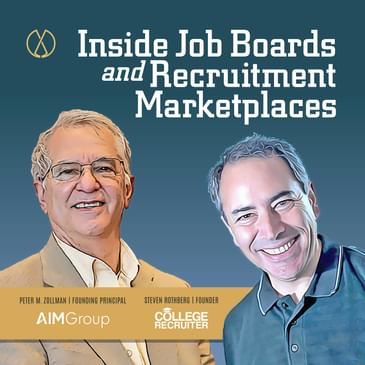

Joe Stubblebine is the Chief Revenue Officer of Lensa, a fast growing aggregator whose founder and most of its staff are located in Hungary but whose employer and candidate users are mostly in the United States.
In today's episode, Joe discusses some of the innovations coming out of Lensa, including its FastTalent Direct product as well as his vision for how buyers and sellers of candidate traffic can better work together. Hint: he strongly advocates a far more collaborative and transparent relationship than most are currently comfortable with.
Learn more about your ad choices. Visit megaphone.fm/adchoices
[00:00:09] Welcome to the Inside Job Boards and Recruitment Marketplaces podcast. I'm Stephen Rothberg, the founder of College of Crudder Jobs Search Site. At College of Crudder we believe that every student and recent grad deserves a great career.
[00:00:23] And I'm Peter Zolman, founding principal of the aim group, the leading global business intelligence service for marketplaces and classified advertising companies. We consult with recruitment marketplaces companies and publish aim group recruitment intelligence and a free weekly digest. We also host the annual global recbos conference.
[00:00:44] This is the podcast for you to learn more about how to create, manage and work with general, niche and aggregator job boards and recruitment marketplaces.
[00:00:53] Well if it's a Thursday and it looks like it is, I must be back with my friend Peter Zolman, Peter. Good to be with you today.
[00:01:03] It's good to be with you, but the secret is that we're really recording this on a Tuesday. So it's airing on Thursday, but today's Tuesday. Although I've been so confused for the past five weeks, I have no idea what day it is. It's terrible.
[00:01:20] Well I think our sense of timelines vanished either because of COVID or old age or a combination of the two. Yes. What were you saying again? I'm sorry. Who is this? Who am I? Old jokes are not, are not particularly appropriate, but I'm allowed to make them.
[00:01:42] Everyone's in a while. I'll be on stage at a conference and I'll say the federal white guys and people all go, and I go, I'm allowed to make that remark because I am one. This is true. This is true.
[00:01:55] Although I've lost 15 pounds so I'm still a fat ol' white guy, but a little less fat. Well, somebody who maybe he thinks of himself as an old white guy, but he's not a fat ol' white guy is is a are good friend and today's guest Joe Stouble-Bine.
[00:02:13] I met Joe. I think something like a dozen years ago. I was at a TA tech conference and at the time he was running human capital solutions, which I knew then that I think most people know as job circle.
[00:02:29] He turned around and he sold that to job search site network that became known as next. And his chat and she would say that's next with the two exes, not the three exes.
[00:02:43] And I think he led media sales there before he left and put it last four years. I can't believe it's been that long. He's been the chief revenue officer of Lensa.
[00:02:55] One of the really interesting things about Lensa, and we're going to dig into it in the interview is that it's founder, the engineer, the operations team, they're all in Hungary. But Joe and the headquarters, and I'm assuming a bunch of other staff too, are in the Philadelphia metro.
[00:03:14] So we'll get into that. But Joe, in the meantime, welcome to the inside job boards and recruitment marketplace as podcast. Hi guys, it's really great to be here. Peter Steven Big fans of you both and happy to be on the show. Very excited.
[00:03:31] Well, we're happy to have you. It's been a long while. I think I've known you even longer than Steven because when I knew you it was IAEWS.
[00:03:42] And I think it was before you were at beyond. In fact, I know it was before you at beyond. So it's been a long time. The recruitment world is changing and all of the recruitment marketplaces are changing.
[00:03:58] The latest shift, although it's not latest anymore but the latest shift is indeed is going in all in on pay per application. It seems like an interesting choice, if not a difficult choice. Talk about that and insights into performance advertising in general.
[00:04:20] Yeah, I think that this is probably one of the most interesting topics in our space. I know Ed Lens have one of our big moves that we've been working on over the last year is doing server-to-server integration and Steven obviously you run a job board see if that.
[00:04:37] I think CPA is fantastic for the space and I think that over the next 12 to 18 months. Most job boards will be selling to other job boards that way as well as a lot of employers will be buying that way.
[00:04:50] The challenge is being able to get the data back to be able to get the feedback to be able to convert those clicks into applications. That raises a question which is how do you attribute a job application to a recruitment site?
[00:05:06] Obviously if it comes straight through indeed, indeed can say okay they apply it on our site. But what about and then the employer can say but that was a bogus application. That was a meaningless application.
[00:05:21] What about attribution and I mean the ultimate is paper higher but that's just really complicated. How do you attribute a paper apply?
[00:05:32] Well, it's a pretty simple way right so most job boards have a unique click ID that's dependent to every single click that is sent from the job board to the applicant site or to the ATS.
[00:05:44] Typically the ATS or wherever that job secret is landing is going to provide some kind of feedback either in the form of a pixel fire or a server to server integration.
[00:05:55] Usually be a web hook that takes that ID after it converts and sends it back to the job board so that the job board then knows we sent 12 clicks to the job.
[00:06:05] Three of them converted into applications and then from there you can derive your cost for application, your conversion ratios and all of the interesting data around that.
[00:06:13] So what about paper higher really that's kind of like what contingency staff and companies do right or placement for once you get to that point it's definitely much trickier.
[00:06:22] The problem is if you're looking at CPA versus CPA start we can send the job secret to the corporate site but perhaps the ATS processes long and cumbersome.
[00:06:33] Now, in general, to generate a completed apply based on how that employer has set up their landing pages or their application process so.
[00:06:43] I think that there are many applicant tracking systems and many job boards that still don't have the capability to report back to the source of the click which I think is one of the challenges that our space needs to overcome in terms of the procurement advertising publisher platforms.
[00:07:00] So question for you on on the paper apply the candidate goes over to the employer site in the US and some other markets that's typically the ATS and other markets might not be but they go to the ATS they apply there's some kind of a.
[00:07:20] And then you know, you're tracking your URL or some other mechanism that the job board is is using so that the ATS should automatically identify it report back.
[00:07:30] And the employers paying on a per application basis one of the things that I have heard very, very little about but within deeds changes I think we're about to hear a lot about it.
[00:07:41] Is I think there's going to be a big move to job boards firing their customers or saying hey you know your XYZ pizza chain but you've got a 4,000 question application process and so it takes people an hour and a half to get through.
[00:07:58] If you're going to pay us on a per application basis, you're going to have to pay 300 dollars.
[00:08:02] Your competitors only going to have to pay 30 dollars. I'm kind of anxiously awaiting the day for indeed or some of the other paper application sites to come back and say no we won't work with you or we're going to have to charge you such an exorbitant amount of money because your application process is so horrifyingly bad that almost nobody's getting through.
[00:08:22] Is that something that you guys at Lensa are talking about or are you not even looking at the paper application model yet?
[00:08:29] We have a couple of clients that we are charging on a CPA basis. I think in that particular case most of the job boards are moving to native apply so indeed has.
[00:08:38] The job seekers that are sitting on its site and when do you push that little apply within deed button on indeed they're going to count that as an apply so they're not necessarily concerned about moving candidates off of indeed to the ATS they want everything inside indeed.
[00:08:55] Obviously there are sites like phenom people that create landing pages to sort of compensate for the fact that many applicant tracking systems still use a self-select dropdown, you know where did you hear of us.
[00:09:07] So I still think in the traditional ATS world you've got the landing page type software out there that people use but indeed is really trying to encapsulate that entire job seeker experience within its own platform obviously even with the interview questions.
[00:09:24] So if you're indeed or if you're another site that's charging per application and you're going to send a candidate over to the ATS what you're actually going to charge for is a click.
[00:09:39] You're not actually going to charge for a completed application on the ATS. If the employer insists on if the employer insists on the candidate coming to the ATS to apply, no problem then we're just going to charge you per click and I think indeed calls that an apply start.
[00:09:54] We'll be back right after this break.
[00:10:30] Let's talk about pay transparency. The New York law, the California law, Denver all of those places. Do you require pay transparency? What do you think about it? How's it going to work in Europe?
[00:10:50] How is it going to work everywhere? I saw an article that said everybody who now sees pay transparency in the job ads is going to be asking their bosses for raises. How's this going to all work?
[00:11:05] Well, I come from a recruitment advertising perspective so I think it's interesting we obviously don't require. We work publisher to publisher as well as with our direct clients and we don't make any requirements at this point with regard to publishing salary or publishing a range.
[00:11:22] I think we're just kind of sitting back and waiting to see what happens. I'm just going to give you a little bit more information on the subject.
[00:11:29] I want to ask people to tell me what you're currently struggling with the concept of forcing private companies to disclose their pay. I tend to be a capitalist from that perspective and I understand there is obviously disparagement from different groups.
[00:11:44] for publishers like us because what is our responsibility with regards to publishing these jobs? And if we don't have that information, is there any liability for us? We only actually sell traffic and job-seeker acquisition in the United States. I can't really speak about the rest of Europe.
[00:12:03] But I'm not sure sometimes we can over regulate. I think some regulation is good, but we'll have to see how this plays out. I think there's a handful of states now that are requiring it. And there hasn't been specific guidelines on what the responsibility of the job board
[00:12:18] or the publisher is in all of this. So I think we're going to evolve with the industry on this one. Yeah, I could definitely see the regulations evolving to where the, it's not just the employer that has to publish that data. It's also their agents.
[00:12:35] And if it's their agents, it's the job board. So we've mentioned Europe a couple of times. And let's dig into that a little bit with respect to lensic because I kind of find it really fascinating.
[00:12:46] The owner, I don't know if he's at the 100% owner or just the primary in Hungary. If I understand correctly, that's where your engineers are. Most are all of your operations folks. When I was getting ready for the interview today, I saw that your global headquarters is,
[00:13:05] I think it might be a room in your home or down the street, whatever. But in Philadelphia, where in Philadelphia, where you are and then that's that's no coincidence. So talk with us about lenses model because it seems really unusual to me
[00:13:22] to have this significant presence in Hungary. But all the operations, if you will, you know, postings, the customers, the candidates in the US. You know, how did that happen? Why does that happen? Or are you looking to expand outside the US?
[00:13:38] What's your social security number or all those? All that good information. Yeah, it's actually an interesting story. So our CEO is a Garigo body and Hungary they do last name first. So it would be a body, a Gadigal.
[00:13:51] And Garigal built the largest job board in Hungary called profession.HU and he sold the steps on back in 2012. And he got some nice change for that. And like most people, they want to make it big in America. And he went to high school year for three years.
[00:14:07] He lived in California for 10 years. He has Canadian citizenship as well. Went to school in Canada. So he's always been attracted to the United States from a business perspective and just from a cultural perspective. So what he did was he set up a US-based company.
[00:14:23] And we are headquartered in right outside of Philadelphia. And we actually have very beautiful offices in Westchester, Pennsylvania. And so we've got about 12 US folks and the remainder of our team is in Budapest. The S has pronounced as sh. So it's Budapest.
[00:14:39] And you have about 120 folks in Hungary. The model is actually quite brilliant because we only sell traffic and job-seeker services in the United States. So we make our revenue and dollars. But yet we have extremely capable engineering team in Hungary, and we pay our Hungarian teams in France.
[00:14:59] So we have a fully own Hungarian subsidiary of the US company. And the economy, as scale, especially as the dollar starts to fluctuate in a positive direction against the currency of other countries. We just have a natural advantage of really being able to capitalize
[00:15:18] the salary disparities in terms of Hungary versus the United States. We have some excellent engineers. Most of our team has master's degrees at least we have PhDs in AI, mathematics. We have a really, really smart Hungarian team with an American front end.
[00:15:35] All of our client relations, customer service, sales, all of that type of stuff is run in the US. So it's an incredible blend between two cultures because these guys are really smart, really analytical. And then of course we know the space.
[00:15:49] We've got some people on the team that have been in the space since forever, and in the space since 1998. So it's a really great marriage between the two. And Gargoyle kind of helps bridge the gap between the two cultures. Everybody in our company speaks women English.
[00:16:04] All of our meetings are conducted in English. And we have beautiful offices in Budapest as a matter of fact we're adding to the same thing. I think 10,000 square feet because we are aggressively hiring. About 10 to 12 people in Mouth were onboarding right now just because there's so many
[00:16:19] complex things for trying to solve. And obviously having that intellectual capital is really the core. That's one of the main reasons why I left. You know, some of the US companies I work for and went to Lensit because when you're on the
[00:16:34] revenue side to have the power of intelligent people behind you, a massive amount of development and project managers and AI folks and SEO folks, it really creates a distinct advantage in the space.
[00:16:46] And I think Lensit has proven that we've grown very, very, very quickly in the last four years. So first of all, the kind of goes to Gargoyle quite frankly, very, very smart guy.
[00:16:56] So you said, you know, you're on the revenue side, but you've been in the field a long time and you worked as an application engineer way back when are you really a geek at heart? And then how does that affect your, you know, CRO chief revenue officer approach.
[00:17:15] Are you a geek at heart or no, not anymore? I wouldn't say I'm a geek at heart. I'm actually capitalist but I like taking technology and making money. And I think it's a lot of fun to just write some code put some stuff together, see if
[00:17:29] people buy it, replicate that process, scale it. So from that perspective, it's fun to be able to craft something with your hands and put it out there and people purchase it. So I wouldn't necessarily say I'm a geek or a nerd but I really enjoy taking technology
[00:17:46] and converting that into revenue. And I think in our space we actually get to help people find jobs. If we do our job well, there's somebody somewhere that's feeding their family as a result of the work we did.
[00:17:57] And so you have this extra layer of just sort of being satisfied in this particular space more so than just a straight, you know, fin tech or other sort of generic tech space.
[00:18:07] So but I used to be a coder back in the day and I wasn't very good at it. My team always said, you know, make what we make it better. So I would try and code stuff and then I think it's just fixed it make it more efficient.
[00:18:17] But I did start out as an IT contractor for many years. Well, there aren't too many things in this world that are more honorable than helping somebody find a great new job. And I think one of the things that we've become good at at college or
[00:18:33] career is continually reminding ourselves internally. This is what we are doing. So you can talk about a click being 50 cents or an employer signing up for a thousand postings or whatever. But at the end of the day when we're helping people find jobs, that is transformative.
[00:18:50] For them, their family members, their friends, their community, it's really honorable and we all need to keep an eye on that. You talked about revenue and one of the things that I recently learned about was lenses new product and I think it's called fast direct.
[00:19:07] What's different about fast direct than the previous products, or the products that you were offering previously? So it's actually called fast talent and fast talent is it's a performance based product.
[00:19:22] And I think one of the things that's interesting about it is a lot of employers don't add the capability or the desire to figure out Should I be beating 52 cents for my job at the developer job and fill it off you?
[00:19:34] Or what are these nursing jobs worth? What they want is they want applications to fill the open jobs as fast as possible. So fast talent's very simple. We just simply grab the jobs from the site. So we have something called smart bid that evaluates about 60 million job postings.
[00:19:52] And we look at what everybody in the market is pricing that particular click or view. And we can automatically price those jobs put those into our auction based ecosystem. And we can then drive eyeballs to your jobs and some percent of those eyeballs hopefully will convert into applications.
[00:20:14] I think it's not dissimilar to many of the performance based products out there, but we do have really great data as you know Steven we work together on the business as well. So we can show customers at the job level clicks, conversions to applys.
[00:20:29] We have the ability to obviously distribute those jobs to 70 plus partners. We also have a very strong Google for jobs presence. We have 26% of our traffic as SEO. We get over 100,000 registrations a month just from organic traffic.
[00:20:45] We get about 25,000 sticker registrations a day but of course, a month over 100,000 come from organic. So we learn through years of selling in the quote unquote wholesale space how to really drive efficient performance.
[00:21:00] And we've now taken that kind of package that into a very simple performance based product that customers can be sure that they're only paying for obviously clicks on jobs and eventually applications on jobs. So that's really what fast-down it is.
[00:21:17] We could go on for another half hour mocking each other and making fun of each other and talking about how we're all old and gray, which is not good for podcasts because the audiences are much younger than we are, but that's okay.
[00:21:33] But I think that's a good place to wrap up. Any last points you want to make and the other question we always ask is if people want to find you how do they find you? I would just like to say thanks to you guys.
[00:21:47] I think having these podcasts and obviously I'm a big fan of both of you and the work you've done over the years, I think it's important to document these things and have a chat about them and I love listening to your podcasts.
[00:22:00] So at it terms of me, Joe at Lenset.com, feel free to reach out at any time or fast-down.com. Happy to help anyone that might be listening in anyway I can. Sounds good.
[00:22:12] Let's just spell Lenset so people know it's L-E-N-S-A.com, just like you have to spell next and a few others. Indeed, you don't have to spell but on that note, sir, thank you very much for joining us. It's been enough quick 20 minutes.
[00:22:30] Thank you both for having me. I appreciate it. Thanks, Joe. Inside job boards and recruitment marketplaces is a co-production of Evergreen podcast, College Recruiter and the Amru. Please subscribe for free on your favorite app. Review it, five stars are always nice.
[00:22:50] And recommend it to a couple of people you know who want to learn more about job boards and recruitment marketplaces. Special thanks to our producer and engineer Ian Douglas. I'm your host, Peter's Olman of the Amrup, the leading global consultancy in the field of marketplaces and classified advertising.
[00:23:08] Find out more about our reports on recruitment marketplaces, job boards and class divides, including our new recruitment marketplaces annual at amrup.com slash reports. I'm your host, Stephen Rothberg of Job Search Site College Recruiter. Each year we help more than 12 million candidates find great new jobs.
[00:23:30] Our customers are primarily Fortune 1000 companies, government agencies, and other employers who hire at scale and advertise their jobs with us. You can reach me at StephenAtCollege Recruiter.com. Hi there, I'm Heather Drego and I'm Sarah Saunders.
[00:24:03] We host the podcast that's a hard known about saying no and setting boundaries, so you can be calm that true and empowered you that this world needs. They know is in Justin K. It's the key to living in authentic fulfilling life.
[00:24:20] I'm a licensed professional clinical counselor, so while this podcast is in no way or a placement for one on one therapy, I suppose I know what I'm talking about. I'd say so. We talk about learning to say no and set healthy boundaries and how it impacts mental health,
[00:24:37] physical health, relationships, parenthood and more. Subscribe wherever you get your podcast and visit our website, HardNovePodcast.com. We're here to help you find your know and say it on apologetically. That's a hard known.