
Seeing India Through New Eyes
They say you can’t truly appreciate something when you’re too close to it—sometimes, the clearest perspective comes from the outside. India: A Story in the Making has given me that fresh lens, making me look at India—and its spiritual depth—not just as someone born into it, but through the eyes of those who found their way to it.
Why Would Someone Leave Everything Behind for a Vedic Life?
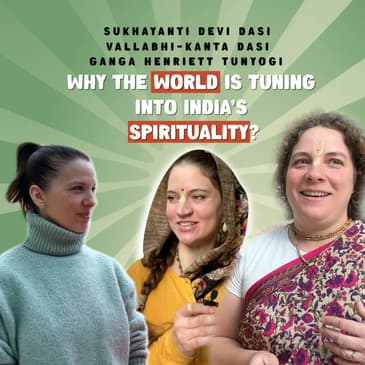
What makes a Canadian-Israeli woman transform into Sukhyanti—embracing a life so deeply rooted in Vedic tradition that she wakes at 4 AM, sends her children to a Gurukul, and lives without modern comforts—yet calls it comforting?
How does someone like Vallabhi, who lost her husband young and raised a child alone, find unshakable solace in Krishna—believing that all she must do is keep doing her duty because Krishna still means well?
And what led Henriett, a ballerina, filmmaker, and teacher from an aristocratic Hungarian family to India? A simple stone from the Himalayas sparked something in her—drawing her first to yoga, then to the Kumbh, where she was given the name Ganga.
- Why is the World Turning to Indian Spirituality?
- What Makes Kumbh More Than Just a Dip in the Ganges?
- But is this just belief? Or is there an ancient science behind it?
- Is There a Science Behind Kumbh’s Spiritual Power?
- What does Kumbh symbolise?
What Does This Mean for the World?
At its core, Indian spirituality isn’t about geography—it’s about connection.
I found mine through Sukhyanti, Vallabhi, and Ganga’s unique journeys, offering me a new way of looking at Kumbh—a festival I grew up with in Ujjain but never saw through this lens.
It was clear: whether through mass rituals like Kumbh or solitude in places like Krishna Valley, people are seeking the same thing—a deeper, more meaningful way to exist.
The common thread? Hindu spirituality.
🔴 A FASCINATING EPISODE: STORIES OF SUKHYANTI, VALLABHI, AND GANGA HELPING ME UNDERSTAND: Why the World is Tuning into Indian Spirituality
Live NOW.
Here’s a sneak peek at what’s in store...
FULL VIDEO
https://www.youtube.com/@loveenatandonproductions
PODCAST SMART LINK
https://bingepods.com/podcast/podcast-rn7moe
Loveena Tandon: HOST: SOCIAL MEDIA HANDLES
https://www.linkedin.com/in/loveenatandon/
Twitter/X
https://twitter.com/loveenatandon
https://www.instagram.com/loveenatandonofficial/?igshid=OGQ5ZDc2ODk2ZA%3D%3D
https://www.instagram.com/tandonloveena/?igsh=MW5tOHdlc3cyMGJrOA%3D%3D&utm_source=qr
Tik Tok
https://www.tiktok.com/@loveenatandon
Learn more about your ad choices. Visit megaphone.fm/adchoices
[00:00:00] When I went to India, I sought divine protection. This is the music of my soul. I didn't grow up being religious at all. I grew up in communist Hungary where religion was forbidden and then suddenly I was, oh my god, I'm home. How is it possible I wasn't born here?
[00:00:16] That is actually a Vedic lifestyle. We try to live it here. Started reading the Bhagavad Gita, all answers were there. I had no more question left. Whatever questions I had were answered in the Bhagavad Gita and I was immediately hooked. I said that's it, I found it. This is India, a story in the making and I'm your host Loveena Tandon.
[00:00:38] Hello and welcome to India, a story in the making. Today I'm out and about and yes, there's a reason for it. I want to find out what draws people born outside of the culture to the Indian spiritual tradition. Now that the Kumbh is still going on and we are told that about 30 lakh or 3 million people who are foreigners not born in India are going to be visiting the Kumbh.
[00:01:05] I want to know what makes people go there and also what makes people connect to the spirituality of India or the philosophy of India and Hinduism if you can say for some people.
[00:01:17] And so to explore that, I'm here in the Krishna Valley. This is the biggest or one of the largest of its kind, an ecosystem I can say that is spread across 300 hectare and I'm told this is completely self-sufficient. Though I'm going to be speaking to two wonderful ladies in regards to this.
[00:01:42] And this is where I am, beautiful Krishna Valley. But to tell me more about the valley, I'm going to be joined by Sukhyanti. And Sukhyanti, I have a lot of questions with as well. Sukhyanti, this is you. Thank you very much for talking to us. My pleasure. And what a beautiful place. Yes. I feel so calm. Normally I don't feel so calm. That's what you feel when you come here.
[00:02:08] I know. It's become closer. We are in one of these beautiful corridors. I thought, where should I shoot? Where should I shoot? And I thought, perfect, perfect place to shoot here. Sukhyanti, first tell me about the Krishna Valley. So Krishna Valley is a Hungarian farm community. Yes. It belongs to ISKCON, the International Society for Krishna Consciousness. It was established 30 years ago by Shiva Ram Swami and the Hungarian Hare Krishnas.
[00:02:38] And basically here we try to live the model of the life that is actually a Vedic lifestyle. We try to live it here in Krishna Valley. So very simple life. We're striving for self-sufficiency. We're not connected to electricity. So we don't have any government provided electricity. Oh.
[00:03:03] Whatever electricity you might see here is either from solar panels or in worst case scenario, we might have to use the generator. Oh. But otherwise we're trying to be completely self-sufficient. So even our water is brought up. We have a well, a community well, which is very, very deep. So we have our own water. We have our own sewage system. We grow our own food. But that's just the self-sufficient side.
[00:03:32] What we really try to do is follow the Vedic scriptures as it was presented to us by the Acharya of ISKCON, AC Bhaktivedanta Swami Prabhupada. And we try to live the lifestyle which he taught us, which helps people to actually achieve spiritual realizations. So self-sufficiency is what it is, isn't it? So self-sufficiency is the materials aspect. That's the material side of things, right?
[00:03:59] Because if you live in a very peaceful environment, not supported by the materialistic way of life, then you're able to concentrate on the spiritual aspect. Yes. So that is actually our goal, to reach love of God, to reach Krishna. And in order to do that, we're trying to create a society, a community where it's easier to focus. Making it congenial to do that. Exactly.
[00:04:24] Before I go to my next questions, I was passing through these beautiful murals and we have Vallabhi who is really helping us shoot here. She is beautiful. She's left her son at home to do this for us. So I have to thank her for this. Vallabhi, please show what are these murals and tell me a little bit about this before I go forward to talk.
[00:04:48] So when you enter the temple building, you want to really enter into the spiritual world. You really want to absorb the spiritual world. So we have different 3D images here of the different pastimes of Lord Krishna.
[00:05:02] For example, this is when Vasudev carried Krishna from the prison in Mantara to Vrindavan to his foster father, Nandamaraj. And here we can see the pastime of Krishna being carried away by Trinavarta, the wheel ringed. I'm saying it bad, but wheel ringed. Do you know? I understand. Yes. Yes. The various attempts to kill Krishna. One of them.
[00:05:29] None of them were successful. And so you see the perfect example. And that's Yashoda, of course. Yes. Trying to find that probably butter in his mouth. Actually, actually the coward boys, if you see Balaraman, the coward boys are behind Krishna and they told him Krishna that he ate dirt. So now Yashoda is trying to see, because Krishna is saying he didn't eat dirt. So now Yashoda is trying to see if he really ate dirt. And as she looks inside his mouth, she sees the whole universe.
[00:05:57] The whole universe. And that's what it is. Yes. Yes. Yes. Yes. And then she sees herself and Krishna also in that. If you see on the top there. Yes. So now you see that little bubble. Yes. Yes. Yes. And she sees the universe. Yes. Yes. Yes. Yes. And her and Krishna inside her mouth.
[00:06:23] Because he was poisoning the Amuna river. Yes. Yes. And so Krishna is dancing, chastising him by dancing on his foods and eventually he chases him away from Vindavan and the Amuna river. Yes. So how beautiful, see, Yamuna being made dirty now. Yes. Yes. So these whole concepts are there, isn't it, of what you talk about, of climate change. So how beautiful these whole concepts of climate change and stuff are there, drawn into the philosophy.
[00:06:52] What, I am going to speak to Sukhyanti specially as a separate episode, but this is just the teaser of Sukhyanti here. Sukhyanti, what do you look after here? Personally, what do I do here? I'm manager of the guest houses. So I make sure that the guests that come to visit Krishna and the Holy Dham are happy and are well accommodated. Like to make us happy. I'm hopeful. I hope so.
[00:07:19] I have a lot of food. I have a lot of prasandam, I have to say. So what made you come here? Do you really want to go? It's a long story. It's a long story. We have to discover that long story in another episode, which is going to be there. But tell me a bit more about this valley. The question that I was asking, why are people who are not born in the Indian culture, are so attracted to this place and what it gives them? Well, it's actually Krishna consciousness which attracts people.
[00:07:48] Because, you know, in modern day society, modern day life, many people feel the emptiness, that something is missing. And these questions of who am I and why am I here and why am I going through this motion of life, the answers are not being answered. And so personally I was also feeling like that and searching, not knowing that I'm searching.
[00:08:11] And then Krishna consciousness gives the answers. It tells you who is God. It tells you who you are. It tells you what is this material world around us. And it tells you how you can reach love of God. So it's the perfect remedy for anything in this world. What is the one thing that found you? The one thing that found me, I think it was the first of all, it was the devotees.
[00:08:37] When I first saw those brahmacharis that were European, German brahmacharis, when I saw them, they were shining. And I felt like, wow, they must have something. They must have some secret. And then when they started telling me about the philosophy and they actually gave me a Bhagavad Gita and I started reading the Bhagavad Gita, all answers were there. I had no more question left.
[00:09:03] Whatever questions I had were answered in the Bhagavad Gita and I was immediately hooked. I said, that's it. I found it. I didn't even know I was searching for it. And I found it. How beautiful is that. So for all that you have to watch the next episode. But and how, what she found and what is it that found her as well and how she landed where she landed. But how many foreigners come here?
[00:09:30] As visitors. So in the actual living here, we don't have that many foreigners. The language is difficult and therefore it can be difficult to get accustomed to living in Hungary as a foreigner. We have more and more people, foreigners becoming introduced to Krishna Valley. It's not so known outside of Hungary. In Hungary we're really, really famous. Everybody in Hungary knows. And they just come here. Now, so Hungarians come here, they heard about Krishna Valley, they're curious, they want to see what it is.
[00:09:59] And now slowly, slowly it's becoming more open to the wider crowd. Many Indians started finding out about us and coming here and taking Darshan of the Deities and seeing this Holy Dham. And most of them are, they didn't know. They're like, oh my God, I didn't know we have the same thing. But also non-Indians, it's starting to get more and more open for foreigners as well. Tell me what all are there? So you have your cows, they had the beautiful cow milk.
[00:10:28] So tell me what all do you have? How have you made yourself self-sufficient? How did you make yourself self-sufficient? It wasn't easy. So when the devotees first came here, everything was empty. It was just fields. And they had to, from scratch, start building the whole place. They actually excavated the river, which is the Uuna River. Maybe we can talk about it later, that actually all the holy places of Vrindavan have manifested here, about the meditation and prayers of the devotees.
[00:10:56] But they really had nothing. They lived very, very simple. And slowly, slowly they started building up the whole community, started bringing the cows here, started working the land with the oxen. We're talking about 30 years, so a lot has been accomplished throughout these years. So tell me what all? So first of all we have the beautiful temple building and temple room, the beautiful Deities of Radish Yam, which is the center of our lives.
[00:11:26] We have a beautiful Deity worship, which is very opulent, five offerings a day. I don't know how many of our artis actually, like also five artis a day. It's very opulent. That's the center. And then on top of that we have the Goshana, cow barn. We have 75 cows and oxen, and we get the milk from our cows. Only Ahimsa milk, we don't get milk from anywhere else. And the cows are treated with respect and love until the end of their natural lives,
[00:11:55] which is very important. So none of them are killed under no conditions, the oxen, the calves, everybody. On top of that we have a meal, a vegetable garden where we grow vegetables. We have orchards where we grow on fruits. We have fields where we grow hay for the cows as well as wheat for us, such as the puris that you ate today was from our own wheat, from our own flour.
[00:12:23] We have a milling station. We have a power ox, a mill station which is powered by oxen. So the oxen walk around and it actually powers the engine, which mills the flour, creates oil as well. We create our own oil and other things as well. What else? Own electricity, own water, own sewer system. We have our school, of course. We have our guru pool.
[00:12:51] From kindergarten until all the way up to high school, our children actually are educated here now. In the guru pool. In the guru pool where we have, okay, it's a government established, so we have to of course teach what the Hungarian government has dictated for any school operating in Hungary. But we also have spiritual topics that children learn shlokas. They celebrate special holidays, Vaishnava holidays.
[00:13:22] They learn about sattva and etiquette and all of these. And they get degree as well, which is recognized by the government. Yeah, definitely. Honeybees we have, we generate, we create, no, we don't create the bees. Some things we still have to buy from the outside. We're not completely self-sufficient yet, even though that's the goal. That's the goal. So your children study in the guru pool? Yes. Oh, how wonderful. And how many people live here who work and do seva?
[00:13:52] So inside Krishna Valley, inside the farm itself, we're about 130 people, including the children. But we also have devotees living in the village here, which is just one kilometer outside. Yeah. The road that goes out to the valley, it's just one kilometer and they're living in the Shomodjvamash village about 150, 160 as well, including children. And so the children from the village and from here, inside the farm, they go to the guru pool.
[00:14:21] Inside the farm, you have the devotees that live in the farm, they serve, they dedicate their whole lives for the project. And the devotees that live outside in the village can choose. Some of them also work here inside the farm itself. Some work outside. It's more of their choice. It depends. Really how amazing is that? And you do your seva, so you have your grihast life and then you have your seva here as well.
[00:14:48] And you have a whole dincharaya or the daily routine. Yeah. So I guess you're referring to the morning program in the temple. So every day at 4.30 in the morning, we come to the temple room. We have Mangalarti where we sing different prayers in front of the dailies. Then we have two hours of japa meditation, personal meditation time. We continue with some more prayers. We have a morning class about, we read from the Srimad Bhagavatam.
[00:15:19] And then that's from 4.30 until 8.30. After that, everybody goes and has breakfast. And then at 9.30, we start our daily service. It usually lasts until 5.30. But ladies with children, they do only half day. So until your child is 10 years old, we acknowledge that the mother should be with the child. So the ladies only half day service. And only from the age of 2.30.
[00:15:49] So when the child is 2.30 and 2.30, then they go to kindergarten. And then only then the mother will start doing service. So you don't have any option, child care problems? No, we don't. No, no fighting for child care. No fighting for child care. No, no. So all this corridor will lead us to the darshan, the temple and the darshan. How wonderful. So how did this woman, who is from? Israel. Israel. And born in Canada? I was born in Canada.
[00:16:18] I was two years old when I moved to Israel with my family. My father is Israeli, my mother is Canadian. And how did that work to Budapest? That's the story for next time. But I also want to connect with someone who has gone to the Khumbh. And she, you will see her. Gru, gru, gru, gru, gru, gru. Come on then. This is the beautiful lady. So Ganga is, come, come Ganga closer. So she's actually, what's her actual name?
[00:16:47] Henrietta Tsunyogi. Yeah, Henrietta Tsunyogi. And she's now become Ganga. And that happened in one of the Khumbhs. Yes, that happened in 2010 in Haridwar Khumbh. During my 40 days silence. I was roaming around and there was a Raja Babaji who was sitting there. And I went to sit with him. I could not talk. So he asked me questions. Why was only writing? And he asked me, why are you here?
[00:17:17] And then I said, because I want to know the real me. And I kept going back to Raja Babaji. And then he looked at me one day and he said, from now on, you are Ganga. Oh, and this is Ganga. And she is so, she's the one who drove me all the way here. An unbelievable, amazing woman. Again, another episode which is going to come because this story you want to know. She actually is a ballerina. She's an actor. She's a filmmaker.
[00:17:46] She's won loads of awards. And she is practicing Hindu. From someone who didn't even, was not, didn't grow up in religion. I didn't grow up being religious at all. I grew up in a communist Hungary where religion was forbidden. But when I went to India and we did the morning prayers and the shlokas, I felt I'm home. And I also felt that. I thought this mostly. I was like, you know, this is the music of my soul.
[00:18:16] So that's the essence of who I am. Even though I never heard anything about Hinduism. I just, I went there because I wanted to study yoga, make my life a bit easier as a ballerina. And then suddenly I was, oh my God, I'm home. How is it possible? I wasn't born here. Oh, why am I not here all the time? How wonderful.
[00:18:40] And this is a story we will come to in another episode, but I wanted today just explore Kumbh with you. Tell me, you went to three Kumbhs. Yes. And why would you go to Kumbh? Kumbh is, can I just quickly say for people who, I know it's the biggest religious festival, the biggest coming together, the spiritual gathering of the world. But there is, there's a story behind it very quickly.
[00:19:06] If I can, in a very bird's eye view say it was the demons and the devas who are the gods were having this, had to take a nectar out of the ocean and both efforts, so you can say the positive and the negative in the world, were churning, had to come together to churn out the nectar, the nectar of immortality.
[00:19:30] And the demons got their hands on it first and they, the gods traveled behind them and were trying to chase them. And four drops fell in four places. So there was Nasik, Ujain, Allahabad, which is now Prayag Raj and Haridwar. And this is where the Kumbh happen every four years. But after 12 Kumbhs, the stars align in a way and it comes only in 144 years.
[00:20:00] And that's what is happening in Prayag Raj now, which is Mahakumbh where 30 lakh or 3 million foreigners are expected. Ganga is not able to go there this time because she has a four year old son, but she's gone to three other Kumbhs. And one of the Kumbhs as we heard, got her the name Ganga. So tell me why would you go to Kumbh? Because a lot of people feel that this is more a spectacle. It's more of, than spiritualism. It is more ritualistic than spiritualism.
[00:20:30] What would draw you to Kumbh? I think I was drawn to Kumbh by the Divine or by destiny because I had no idea Kumbh existed. I was in Rishikesh, I was doing my 40 days silent practice and studying yoga and Haridwar is very close to Rishikesh. So one of the teachers took me there and then I was amazed at the devotees and the devotion and the spirituality there.
[00:20:56] And slowly I was more interested, oh I also would like to take the bathing and experience what it is. So that was the first one in Haridwar. And then I also went to Prayag Raj, that I did the full Kumbh. But it's also by kind of, I was guided there because I spent time with my Guruji and it happened to be Kumbh is coming. Can you stay longer in India? So I changed my flight three times.
[00:21:25] So I did the full Kumbh experience, the bathing even in January. You bathed? I did the bathing. Ganga did the Ganga dip. I did, I did. Every single day when it was you know spiritually the right day, I went even though it was freezing cold and I had no idea what will happen, what I have to do. I just went because I thought this is the right thing for me.
[00:21:49] But what did it do to you? I mean what was the experience of taking that dip, living uncomfortably you said, sleeping just on the floor. You know it was comfortable in the uncomfortable because somehow millions of people were there for the same reason. I really felt that I wanted to be part of this energy. But people are here for good, for better things.
[00:22:19] And I felt protected. Once I got lost because the crowd I went with, they just run because they were so excited and as a foreigner, completely by myself. And suddenly I was just very close to the river and I looked around and everywhere only men devotees. And I know in India you have to be separate from the ladies, from the men. And I said, oh my God, how am I going to get out of here, going to the right place to bathe with the ladies?
[00:22:46] And I just spotted one of the men and I said, oh you look like Shiva, please protect me. Because I just don't know how to get out of this, you know, I was like squashed. And then they were absolutely lovely and I said, no worries, we're going to protect you, you can do the bathing here. And that's how it was. So whenever I went to India, I felt divine protection.
[00:23:09] And I travelled by myself, I stayed and meditated in caves and I never, never, ever had a problem. I always had food, I always had shelter and I just feel like where I'm from. Even though I am. That's where soul comes in and that's where we are, where we are. Your soul belongs to India. Yes. It travelled to Hungary but it belongs to India, yeah. How wonderful, how beautiful is that.
[00:23:39] So we will explore Ganga's story of how she became Ganga. She told you a sneak peek but there is a lot of it. So stay tuned on India's story in the making. But before we now walk down, and I think I want to just take and take Valabi's story who's been shooting it with us as well. Valabi will you speak to us? Yes. Three days here with us. She's saying something in Hungary which I don't understand. I'm sorry.
[00:24:08] No, that's absolutely fine. We end up speaking in Hindi all the time. So everyone wear sari here, Valabi? Yes, usually yes. This is our normal cloak. Did you have to learn a lot to see how you wear sari and how did you do all that? Actually my mother was a photographer in magazine. And when I was four years old, she met devotees and we went to the Hare Krishna temple. And I fell in love with sari and everything.
[00:24:38] I felt myself at home similar like Ganga. And my mother didn't join Hare Krishna Mukma but we became vegetarians. And then in the kindergarten, how to say Falsang? We have a festival in Hungary where everyone wears some costumes.
[00:25:07] They dress up, kids dress up. They wear fun costumes they wear. It's Falsang. Yeah, because my mother was a photographer in a huge magazine, in a famous magazine. He got many PR presents like sari also and I wear sari in the Kilda Garden. Oh, how wonderful. Everyone wears sari. Can you tell you I have never worn sari properly ever. Four or five times maximum? You guys are doing this.
[00:25:34] People showed how to wear and my mother knew. So my mother showed me how to wear the sari and I went to the kindergarten in the sari and I said I'm a Mataji. You should call me like Mataji, I'm a Mataji. And I put a big sticker here, but like this bigger. And I said you should sing Hare Krishna and I showed what to do like this Hare Krishna. Because that was what I saw in the Hare Krishna temple.
[00:26:03] And I said you should don't eat meat because this is so... You tell off everyone? And I began to preach very straightly. So the teachers and everyone was very freaked out. I was a little bit too, how to say face to face preacher. That's right when I was born. And later my mother went to another topic. But she was vegetarian.
[00:26:29] And then my parents divorced and I had very terrible periods in my life. And when I was 16 I was studying in an artist school. And we had a task. I had to write some kind of thesis about an interesting topic.
[00:26:54] And my topic that I chose was, how to say, the way, the path. Path of, philosophical path in our life and the material path also. So I was thinking about what is the real way of life and what is the goal of our way and where should I go. And I was reading many different books about many different philosophy.
[00:27:20] And that time I met again a Hare Krishna devotee in a big square. And I said, Hari Bol! Because I knew they say like this, Hari Krishna, Hari Bol. And I said, I'm vegetarian. And this Mataji told me that I could go again to the temple. Not to the temple. First she invited me to visit their Govindas restaurant.
[00:27:47] And I went to the Govindas restaurant and there was a very kind monk there. He was reading up from Bhagavad Gita. And I said, oh, this is so good because we had a Bhagavad Gita at home but it was so big. And my mother told me this is a basic book. You should read this. And I said, oh my God, this is so big. How can I read this? So I was a little bit lazy. So I went to this Bhagavad Gita event and finally I could know what is inside in this big book.
[00:28:16] And I was very happy because I had so many, many questions. And I got answered. Yeah, but the first good experience was this time I met first time in my life. And when I could speak people who could understand my question. Because usually if I had a question, not the answer was not the problem. The problem was they even didn't understand what is my question. And what was your question?
[00:28:45] I had many questions about life and God. Okay, I'll ask you a question then. Wallaby was shooting for us and now I have to shoot Wallaby. And can you tell me the significance of this Tilak? What is the significance? This is a symbol, this Tilak. All the different Sampradayas have similar but a little bit different Tilaks. This is made by Mother Ganga's mud.
[00:29:15] And these two lines symbols Krishna's lotus feet and this little petal or leaf symbol the soul. And that means we belong to Krishna forever. We are spirits so as we are not this body. And our Sampradaya is the evolution of Sampradaya. And this is the Gaudiya of Aishnavatilak. What is their actual name actually Wallaby? What was it?
[00:29:45] Virag. Virag is flower. Flower. Oh, and you are from Hungary. So you are Hungarian. Okay. Okay. So what is life for you? What do you understand of life now? The real life means we can live our life for Krishna. So the real life is when we really love Krishna, Dad and we can offer everything for him because he is our everything.
[00:30:15] And what has it given to you in your life? Oh, so deep questions. He is my inner guidance. Inner guide. I could feel this from my first moment when I was very small. And he arranged everything in my life and he protected me always when I had this terrible period after my parents divorce.
[00:30:43] And now I am not in a... how to say... So now I have a very, very miserable period again because I lost my husband two years ago because of a brain tumor. But still I could feel that Krishna is with me.
[00:31:12] And he was talking to me so we could prepare for this. So you can deal with it better? Yes. It's not easy but I have no doubt about Krishna's plan. This is also the part of Krishna's plan. Thank you. Thank you. Thank you for sharing your story with me. And on that note, I think should we all do the Darshan?
[00:31:37] Thank you. It is so calm here. It really is. I just want to sit down and pray. And while I do that, I thank you very much for watching this episode.
[00:32:05] The next two episodes will be about and will be from actually Budapest where I will be exploring the why people are so connected with the spiritual Indian traditions. And speaking to people like Sukhyanti, Ganga and Adam who is a Hungarian born person but is a brilliant astrologer, Ayurveda expert as well as Vastu Shastra expert as well.
[00:32:35] So a lot coming in this spiritual series. Thank you. Take care and God bless. Thank you for watching India Astoria.