
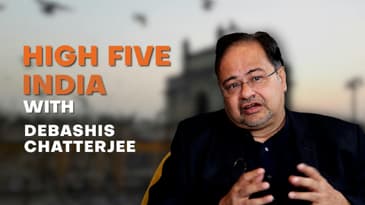
In this special High Five India section, we feature Professor Debashis Chatterjee, the longest-serving director of IIM Kozhikode and a leading voice in India's education and leadership landscape. In this sneak peek, he shares powerful insights on India's future, leadership, and the unique aspects of Indian thought. Whether you're a leader, educator, or thinker, this episode is packed with wisdom you won’t want to miss. For the full experience and deeper insights, watch the full episode of India: A Story in the Making – "Is It India’s Century and Why?" (Full episode link below).
Once again, thank you for being a part of India: A Story in the Making!
FULL VIDEO You Tube
https://youtu.be/bL8j8x5igS4?si=dCNueHOGDNdJJKo7
PODCAST SMART LINK
https://bingepods.com/podcast/podcast-rn7moe
Professor Debashish Chatterjee LinkedIn
linkedin.com/in/debashischatterjee1
Loveena Tandon:
HOST: SOCIAL MEDIA HANDLES
https://www.linkedin.com/in/loveenatandon/
Twitter/X
https://twitter.com/loveenatandon
https://www.instagram.com/loveenatandonofficial/?igshid=OGQ5ZDc2ODk2ZA%3D%3D
https://www.instagram.com/tandonloveena/?igsh=MW5tOHdlc3cyMGJrOA%3D%3D&utm_source=qr
A HUGE THANK YOU TO OUR #hospitality #partner THE CINNAMON CLUB
https://cinnamonclub.com/
#IndiaStoryInTheMaking #IndianThought #TimeIsRelative #LassiAndWashingMachines
#FunFacts #global #foryou #didyouknow
Learn more about your ad choices. Visit megaphone.fm/adchoices
[00:00:00] Hello and welcome to India a story in the making. My guest today is a man who harped various professions, ultimately to realize that his true calling is thought leadership. Professor Devashis Chatterjee, the first generation longest serving director of IIM.
[00:00:22] Professor Chatterjee was in London for a conference on globalizing the Indian thought. That's when we on India a story in the making caught up with him. He even brought me beautiful spices from the very land of spices in India, Kerala, Cozy Cold. And what a coincidence the interview was held in the Cinnamon Club in London.
[00:00:45] I spoke to him about, is it India's century and why? And from that fascinating interview, I bring to you High Five India, a rapid fire section.
[00:01:02] We have a high five section, Professor, where I will ask you five rapid fire questions. You end up with a high five with me.
[00:01:11] High five, like this?
[00:01:11] Like this, like.
[00:01:13] Okay, all right.
[00:01:13] India for you in one word?
[00:01:16] Invincible.
[00:01:18] Explain, please.
[00:01:20] How can you defeat something that is not fighting you, that's always embracing you?
[00:01:28] How can you beat somebody who is not opposing you, who is taking you in?
[00:01:32] This country has assimilated everything and yet remained resilient as one nation.
[00:01:37] United Europe is not a reality. United India is.
[00:01:41] What is the one thing about India that the world doesn't get?
[00:01:46] It's idiosyncrasies.
[00:01:49] There's a method in our madness.
[00:01:52] And that method one doesn't get.
[00:01:54] One only gets the CNN version of the madness.
[00:01:58] The method is that when a democracy of 1.4 people, billion people are jostling to arrive at a certain consensus, there will be noise.
[00:02:09] There will be fire.
[00:02:13] But we are doing it together.
[00:02:15] And so value for many and value for money are two different things.
[00:02:20] We are trying to build a consensus around so many different kinds of degrees of aspiration.
[00:02:27] And we are doing it for years and years.
[00:02:31] What is the one thing that India is doing right?
[00:02:33] And what is the one thing that it needs to still get?
[00:02:38] To be sensitive to its ecocentric view of life.
[00:02:43] None of the egocentric view of life.
[00:02:45] We are not a nation built on arms and power and economies.
[00:02:52] We are a nation built on relationships.
[00:02:56] And we believe that this is one thing that the world has to learn from us.
[00:03:01] The multi-alignment of India's geopolitical with every power that there is.
[00:03:07] The ability to get along with everyone, including China.
[00:03:12] And Russia.
[00:03:13] And Russia.
[00:03:14] And America.
[00:03:15] At the same time.
[00:03:16] It's an incredible power.
[00:03:18] I think India is doing it right.
[00:03:20] Our foreign policy is incredibly ecocentric.
[00:03:26] Okay.
[00:03:27] You're a big exponent of thought leadership.
[00:03:33] From Gita, or from all that you have read,
[00:03:36] what is it that the Indian ethos provides in terms of leadership thought to the world,
[00:03:43] which we don't have in the Western concept?
[00:03:48] When the work is done,
[00:03:53] the followers say that we have achieved it.
[00:03:58] And the leader remains invisible.
[00:04:02] A leader is like an ice cube.
[00:04:04] You put in a glass of water.
[00:04:08] It cools the water, but it vanishes itself.
[00:04:10] The Rishis of India were the real leaders.
[00:04:14] That's why the biggest leaders of India are called Rajashis.
[00:04:18] Raja is the executive.
[00:04:19] Rishi is the reflecting entity.
[00:04:23] Raja is hard power.
[00:04:25] Rishi is soft power.
[00:04:26] When they come together,
[00:04:29] that model of leadership is what the world needs.
[00:04:32] It needs reflective action people.
[00:04:36] Behind every Alexander, there must be an Aristotle.
[00:04:41] Behind every Chandri Gupta, there has to be a Chanakya.
[00:04:44] Behind every Arjun, there has to be a Krishna.
[00:04:46] Without that, you can't have leadership.
[00:04:49] It's reflection plus action.
[00:04:51] That is Indian model.
[00:04:55] What is the one thing that you have learned,
[00:05:01] which you have imbibed in your life,
[00:05:04] that has been your productive driving force?
[00:05:10] Small work with great love.
[00:05:13] One sentence.
[00:05:15] I learned it from an unlikely person, Mother Teresa,
[00:05:19] who embraced Vivekananda.
[00:05:21] And I asked her,
[00:05:22] what does small work in great love?
[00:05:23] With great love, I couldn't get it.
[00:05:25] She was trying to explain to me.
[00:05:28] So I was out in the street.
[00:05:29] I wanted to meet her along with an American friend.
[00:05:32] And she was a Nobel laureate.
[00:05:34] Thousands of people working for her.
[00:05:37] And she got all of these ideas from the Vedantic tradition, by the way.
[00:05:40] She's Mother Teresa,
[00:05:42] the prime name in Christianity,
[00:05:44] but ethos is Indian.
[00:05:47] So I asked her,
[00:05:48] what does small work great love mean?
[00:05:50] She was trying to explain,
[00:05:51] but I couldn't get this.
[00:05:52] So I'm out in the street.
[00:05:54] I'd forgotten my bag
[00:05:55] in the place where she was talking to me
[00:05:57] and my friend.
[00:06:00] What she does is,
[00:06:01] she carries the bag in her hand
[00:06:02] and runs halfway across the street
[00:06:03] and Nobel laureate with a pacemaker in her heart
[00:06:05] just to return the bag to me.
[00:06:07] And I recognized that was small work.
[00:06:10] And that was great love.
[00:06:12] And then she explained again.
[00:06:14] She said,
[00:06:15] your work is local,
[00:06:16] but love is universal.
[00:06:20] It expands.
[00:06:21] Any work that you do,
[00:06:23] the love will expand the work.
[00:06:24] So if you put your,
[00:06:26] what does love mean in this context?
[00:06:28] If you put the entirety of your energy,
[00:06:31] your attention,
[00:06:34] in whatever you're doing,
[00:06:36] that work will expand.
[00:06:38] It will transcend national geographical boundaries.
[00:06:41] I put that into practice
[00:06:43] because I've seen a lot of people
[00:06:45] and they bring that intensity
[00:06:46] to whatever they do.
[00:06:48] That intensity is what
[00:06:51] takes them to huge spaces
[00:06:53] that they never imagined they would reach.
[00:06:55] How wonderful.
[00:06:56] But I do want to ask you one more.
[00:06:58] Yeah.
[00:06:58] If you could go back in history
[00:07:02] or if you were standing
[00:07:03] on the field of Mahabharata,
[00:07:05] who would you want to be
[00:07:06] and what would you want to ask?
[00:07:08] Who would I want to be?
[00:07:11] Depends on which part of life
[00:07:13] I want to be Arjun.
[00:07:16] I want to be Krishna.
[00:07:19] And for me,
[00:07:20] these two are not two different people.
[00:07:22] Like I said,
[00:07:22] one is Raja,
[00:07:23] the other is Rishi.
[00:07:24] One is the hardware,
[00:07:25] the other is software.
[00:07:26] I think one is incomplete
[00:07:28] without the other.
[00:07:29] So you want me to be Arjun,
[00:07:31] yes,
[00:07:31] when action is required,
[00:07:32] I want to be that.
[00:07:34] I want to be brave.
[00:07:35] I want to be courageous.
[00:07:36] I want to be emphatic.
[00:07:38] I want to be a sharpshooter.
[00:07:40] I want to be aggressive,
[00:07:41] necessarily.
[00:07:43] But I would
[00:07:45] also like to be playful,
[00:07:48] compassionate.
[00:07:50] I would like to be reflective.
[00:07:54] And that's where Krishna comes.
[00:07:56] So for me,
[00:07:58] these two sums up
[00:07:59] pretty much
[00:08:01] what I would choose
[00:08:02] from that battlefield.
[00:08:04] Okay.
[00:08:05] All right.
[00:08:07] Thank you.
[00:08:07] Thank you so very much.
[00:08:09] I got so impressed
[00:08:11] in this whole...
[00:08:12] Thanks for this great question,
[00:08:13] otherwise there's no conversation.
[00:08:16] No, no.
[00:08:17] Thank you so very much,
[00:08:18] Professor Devashish.
[00:08:19] Chachiji.
[00:08:20] The link to the full episode,
[00:08:22] Is It India's Century and Why?
[00:08:24] is available below.
[00:08:25] Please consider subscribing
[00:08:27] to the show's audio
[00:08:28] on Apple, Spotify
[00:08:29] or your preferred podcast platform.
[00:08:32] And the video of the show
[00:08:34] is available on my YouTube channel,
[00:08:36] Lavina Tandon Official.
[00:08:38] Thank you for being a part of
[00:08:39] India,
[00:08:39] a story in the making.