
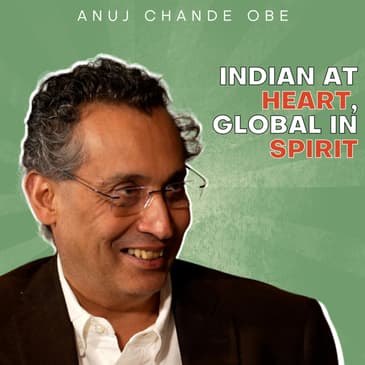

How crucial is the significance of your place or country of origin, even if you weren't born and raised there? Discovering your roots or establishing a connection with it is a compelling urge that can shape people's lives. While the answers may vary, it held profound meaning for Anuj Chande OBE.
Anuj Chande, OBE, born in Tanzania and primarily raised in the UK, has woven a substantial part of his professional life with India. As the founder of Grant Thornton's South Asia Group since 1991, established when he became a partner, he has been instrumental in providing a comprehensive range of services to South Asian companies entering the UK market and assisting UK companies venturing into South Asia. His notable contribution, along with his team, includes the widely acclaimed Indo-UK Business Tracker report. Moreover, he has played a pivotal role in crafting the report titled "India in the UK: The Diaspora Effect" that celebrates generations of diaspora success.
With over 30 years of experience in the sector, Anuj Chande brings forth intriguing insights into the nuanced business habits of each country. Whether you're navigating business in these nations or seeking wisdom from those who've mastered the art of doing business, tune in to listen and learn.
FULL VIDEO EPISODE
via @YouTube
PODCAST : India a Story in the Making
Learn more about your ad choices. Visit megaphone.fm/adchoices
[00:00:00] India had heart global in spirit. That's what typifies me. What is India in heart? What
[00:00:16] is it that you? It's in my blood, right? My ancestry is from India. It's true, but still
[00:00:21] what is it? My grandfather was from there, right? So my roots are India, right? The fact
[00:00:26] that I haven't lived in India, it should really matter. In a cricket match which you
[00:00:29] love. Who do you support? Oh India very much. So I fail what is called the heavy test. You did.
[00:00:36] This is India, a story in the making. And I'm your host, Lavina Tandon.
[00:00:44] Hello and welcome to India, a story in the making. My guest today is a man who could have become an
[00:00:53] actor but has become an accountant and then much more. And thankfully that because the world is
[00:01:00] business in India and the UK is doing much better because of him. With me Anu Chanday,
[00:01:07] who is his partner and is heading the South Asia Business Center in Grant Thornton.
[00:01:13] You wanted to be an actor? I wanted to be when I was young, yes.
[00:01:19] Either an actor or a pilot. Really? Two choices, yes. As you said, I ended up being an accountant.
[00:01:25] And what was the inspiration? What made you at what points did you think?
[00:01:29] I don't know what it was that inspired me. Later on in life, my maternal uncle did marry an Indian
[00:01:36] actress. So Mumtaz. Oh, I don't know that. So she's my mommy G. But that was later on.
[00:01:46] I think I wanted to be an actor before that. Did you tell your mommy G? Mumtaz?
[00:01:50] I'm sure I have done. She didn't facilitate that. No, she didn't facilitate that.
[00:01:56] But you did. I think my ambition had probably died by the way.
[00:01:59] Dwindled out. Yeah, dwindled out, yes. Was it because there's typical Indian parents telling you,
[00:02:05] no, no, no, no. My parents never dictated what I should do in life. But being an accountant was
[00:02:13] something quite early on in my life. I wanted to be an accountant. Maybe from the age of about 14,
[00:02:19] I wanted to be an accountant. So you ended up being one. So it's quite intriguing for me
[00:02:27] that please give your background. You have Ugandan and Tanzania, origin, Indian descent.
[00:02:39] So I was born in what was at that time Tanganyika, which has now become Tanzania. So I was born in
[00:02:44] a British colony. I did my early schooling in Tanganyika. But I was very fortunate that my maternal
[00:02:54] grandfather, who was in Uganda, had set up a educational trust to educate all his grandchildren
[00:03:00] overseas. So very far cited off him to think of that. And so we all, all of the grandchildren,
[00:03:07] benefited from being able to be sent to boarding school in the UK. And we all went
[00:03:13] to the same school. All the cousins went to the same school. So it's very fortunate to do my
[00:03:18] education in the UK. Having been, and I think being in the UK was something which I actually
[00:03:27] wanted to do. I pleaded to my parents that I would like to go to boarding school, to go to
[00:03:32] school in the UK. But I hated it. As soon as I got there, there was a bit of bullying involved
[00:03:38] there as well. I used to, in those days, there was no phones and stuff like that. It was,
[00:03:43] you have to write letters to, you know, so I would write letters to my parents with me
[00:03:48] behind, showing behind bars. So I used to get chill blains and it was, you know, it was a horrible
[00:03:56] time. But I see my parents once a year, you know. And how old were you? You said? I was
[00:04:03] eight. That is my hard bleeds for you, I know. Yes. But I think it hasn't, hasn't done me any
[00:04:11] harm. I probably didn't know anything else. No. I think it's given me the independence that,
[00:04:17] you know, I think it's important for people to have some independence. So chill blains. What,
[00:04:23] what were you bullied for? I think it was my, if I remember correctly, it was my ears,
[00:04:29] I think correctly. Oh, yeah. Not for your color. No, it couldn't have been a little bit of color.
[00:04:38] I don't know. It could have been a bit of both. Yeah. Okay. So you've forgotten it. So that's long
[00:04:43] gone. Yes. So yeah, it's not easy. For garden and forgive it. I've forgotten and forgiven for sure.
[00:04:49] How did you deal with it? For all those children who still deal with just being strong and, you know,
[00:04:54] making sure that you don't, you know, it doesn't, doesn't actually harm you in any way from a mental
[00:05:01] point of view. Because bullying is, it's a mental thing, right? It's about, yes. And it's about
[00:05:06] dealing it with it. But how to an eight year old boy being bullied? How do you deal with that
[00:05:12] internally and still continue to live there? Yeah. Well, I had no choice, right? I mean, there was
[00:05:18] no escaping. I basically, I had made my bed is expression has made my bed and I had sleep in it.
[00:05:23] So also because you had had expressed the desire to go, so they wouldn't take you back. No, and
[00:05:29] they wouldn't take me back. So I think at one time they sent one of my uncles just to make sure I was
[00:05:36] okay. And I remember him coming with a box of quality, quality street chocolates, you know, did
[00:05:42] it help? Well, I wasn't, actually, the school wouldn't allow me to eat it. So it gets worse.
[00:05:48] Okay, I don't want to go in self-pity mode, but I'm feeling bad for you.
[00:05:53] Yeah, no, I'm not dead, feel bad. Okay, I'll get over it then. Like you have, like I have, like I
[00:06:00] have after I qualified as a child of the country, I wanted to go back and work in Tanzania to be
[00:06:07] near in my parents, because I'd been away for such a long time. Unfortunately, fate prevented me from
[00:06:14] going to the, and I've tried three times in my life to go back to Tanzania to be with my parents,
[00:06:19] and each time it's failed for one reason. I know why. You know, didn't take you back.
[00:06:24] - This is the most. - This is the most.
[00:06:26] - Are they so happy to take me back?
[00:06:27] And then they were very happy. So now that they decided, no, now you're staying in the UK. Yes, no, I stay in the UK. Okay, it's, I guess, then then you'll get into being an accountant and then you're qualified as a charter to come to here with a big big accounting firm.
[00:06:45] I then went to work in industry in the US in a place called Data No IO where everything, the towns are built around the corporation.
[00:06:57] Yes. I worked for a big multinational US company. And then you ended up working and starting in 1991 for Grand Thornton, the India South Asia Centre, primarily with India Focus.
[00:07:11] Yes. Is that right? Yes, that's right. So my first question usually with guests is because we have a lot of guests who are not of Indian origin, is what is your India Connect?
[00:07:22] But I think I want to ask you that question as well because you never lived in India. You are the, like I'm the living bridge, you are the living bridge for India as well, but you never really lived.
[00:07:33] But yet you gravitated to doing something that was India Connected. What is that in India or Indian in you, having born in Africa and brought up in UK?
[00:07:49] Yes. I think I'm very much Indian at heart. You know, there's an expression when you go, when you land it, I think it's daily or wherever at the airport, Indian at heart, global in spirit. That's what typifies me.
[00:08:00] What is India in heart? What is it that you? It's in my blood, right? My ancestry is from India. It's true, but still, what is it? My grandfather was from there, right? So my roots are India, right?
[00:08:11] The fact that I haven't lived in India shouldn't really matter. No, that is true. At heart is I'm an Indian. Cup completely. Is there something Indian, Indianness? Let us call it.
[00:08:22] I think it's the values, perhaps the values, right? The values of respect for elders, you know, the values in terms of traditions, the values in return to religion.
[00:08:33] Yeah, I think. I mean, it's quite intriguing for me, and I often delve on it and think about it, that what is that Indianness, even though people haven't lived there, but yet they feel like one.
[00:08:51] And in a cricket match, which you love, who do you support? Oh, India very much. Oh, God. So I failed what is called the David Test.
[00:08:59] You did. All the way. And you love tennis as well. Yeah, I love tennis as well. It's not just India. I think it's South Asian. So if Pakistan is playing, it's a support Pakistan.
[00:09:12] Seriously. Yeah, the Bangladesh is playing as would Bangladesh. If India and Pakistan are playing, then I support India. I'm sure your English friends are absolutely not.
[00:09:21] No, I think they're used to it. They've resigned to the fact that... Is it big because of the bullying that happened? I'm going to try and connect to something. No, no, definitely not.
[00:09:33] Oh, right. Why is that? Why is what? Sorry. Why would you support? Because I'm in India as we discussed.
[00:09:41] From here, born in Tanzania, brought up in the UK all the way through working in the UK, and you're still fine. This is what living bridge is.
[00:09:51] Anuj, along with his team, comes out with these two reports. I want to show you which talks about the Indo-UK business world and the DASpora and how much business exists between the two countries and all of that. It's very interesting.
[00:10:08] Well, I started the report in 2013. That's the interesting thing is that how did I get to this report? Is it basically '91 is when I started doing business within the India-UK corridor?
[00:10:20] For many years, people used to say anecdotally that there's a lot of Indian investment in the UK, but nobody could ever quantify it. Nobody ever had any idea of the size of it.
[00:10:30] So that's when I decided that I should do some research and do a report. And this is the genesis of that report, which we now produce in collaboration with CII.
[00:10:41] And we do a similar report the other way around, which Grandforton Bharat does. Britain meets India.
[00:10:48] I mean, you told us quite interesting about why you set up the centre to cater to the Indian businesses.
[00:10:57] Then I spoke to you about the reason for you to set up a South Asia centre or group. I keep calling it centre, but the reason for setting the South Asia group for you.
[00:11:10] It was really four or five reasons why I set up the group. And in terms of the services we provide, it's the same services we provide to all our clients at Grandforton.
[00:11:21] I think it's the way the service is delivered and what I'd identified, and it was through talking to potential clients and clients and intermediaries.
[00:11:30] Number one, the Indians, whether this Indian diaspora or the Indian businessman from India, was they wanted prompt personal attention.
[00:11:40] They wanted a 24/7 service seven days a week, which is something which British entrepreneurs don't necessarily always want.
[00:11:49] Where is an Indian entrepreneur? It doesn't matter if it's a Saturday or Sunday.
[00:11:55] They call you eight o'clock at night, nine o'clock at night, hello. And you have been picking up phones.
[00:12:00] Yeah, absolutely. You have to. You have to.
[00:12:03] And I think secondly is that they needed confidentiality. Obviously all our clients expect confidentiality, but I think, again, there's so many interconnections in the Indian community.
[00:12:15] I'm an Indian family. People know each other. You know, it's like instead of six degrees of separation, it's one degree of separation, right?
[00:12:22] If you and I talk, then we would find somebody in common, right, very early on.
[00:12:26] So they wanted an organizational firm that would respect the confidentiality, which was key.
[00:12:34] I think the third thing was value for money.
[00:12:38] And how was it received? Because it was, yes, there were lots of Indians, but it was quite different environment at that time.
[00:12:48] It very much was. And I was a bit of a lone voice in '91 in terms of looking at the potential of India.
[00:12:55] - Extremely learned voice. I remember acting for some Indian technology companies that wanted to tie up with UK software houses just to form a strategic partnership. I could not even get those UK companies to meet my Indian technology clients. They would say Indian companies are poor quality work, poorly times unreliable. I mean those same companies then went to countries like Germany in the US and now some of the world's most successful companies. So I think it's a very good thing.
[00:13:24] So it was very disappointing from that point of view. So that was one big resistance I faced was the lack of interest or interest in India. Of course the world is changing now in India is at the forefront of people's minds.
[00:13:41] I think the second thing was that in terms of me looking to do this business, I was very fortunate that my CEO at that time was very much fully behind me in terms of saying well if this is what you want to do I understand please go and do it, go and travel that.
[00:14:01] At that time Grant Thornton Barat was very small, one location, 50 people and I just basically as they say traded the leather and went to particularly places like Bombay which I still call Bombay and developed my own network.
[00:14:19] So it was my vision that I knew that India at one day would be where it is today. I'm very proud that it's something that as an Indian as I said before that I'm very proud that India has developed to what it is today and the potential it has for the future.
[00:14:40] So we will come to India today but as of India yesterday, for someone who again I come back to not live there but you felt strongly in the potential of India, what was it and what were the challenges that you faced in Britain then?
[00:15:00] Yes, well I talked about the British challenges of getting to, not even getting a meeting with, in terms of India, I didn't get any challenges in terms of from Indian corporates that I approached etc but I think as people know that you require a little patience to do business in India.
[00:15:26] And which I have, is one of my natural skills, I have a skill but it's a trait of patience which is what is very much required but I really, really get excited when I'm dealing with Indian corporates or individuals, it gives me a buzz and it's, you know, I haven't actually had any sort of issues or challenges, yes there are always challenges in terms of particular individuals or whatever
[00:15:55] but I think one of the great things I have found in my 32 years of doing business with India is that very rarely have I come across bad management teams for example.
[00:16:05] So 32 years of doing business with India, we started in 91, describe India then and India now?
[00:16:14] Well India then, I mean as you know 91 is when economic liberalisation started under Mahal Mahal Singh, the finance minister at that time. So India was a very exciting place because you know suddenly it had been unleashed from that, from all the ties of being in a national situation.
[00:16:32] It was a very exciting time because the things were people were excited.
[00:16:36] Well there was a buzz in 2000s as well about India and then it sort of fizzled out and there is a buzz now and this question I ask everyone, is there a difference?
[00:16:49] Do you think this will not fizzle out and now we are here to stay to make our place in the world order?
[00:16:55] Yeah, I think we've got to a stage where the engine has left the station, it's going at full speed. I think the world can't afford for India not to succeed. India is too important now in the world economic order.
[00:17:10] You know we are now the fifth largest economy in the world, soon to be the third largest in maybe less than four years time.
[00:17:17] So I think the train is gone, or the horse is bolted, so I don't think there is any stopping India now.
[00:17:25] Right, what are the pluses?
[00:17:27] I think because of the sheer size of what we are talking about.
[00:17:30] So I wanted to come to reasons plus and the challenges in this journey that India has undertaken or is on.
[00:17:42] I think there are challenges and I think we shouldn't be complacent and think that everything is going to be fine.
[00:17:47] I think there are challenges in terms of the infrastructure, making sure that keeps pace with the growth.
[00:17:56] I think another challenge, people talk about the demographic dividend and the fact that 50% are under 30 etc.
[00:18:04] I think it's important from the point of view that we don't make it a demographic bomb so that there is enough work, labor and opportunities for young people to take jobs.
[00:18:17] And I think India is very top class in terms of technology.
[00:18:23] Technology I think will also help with the growth.
[00:18:26] At the same time we need to think about whether technology and talking particularly about AI, whether that's going to potentially replace some of the jobs that would have been available for some of these young people in say 10, 15, 20 years time.
[00:18:42] You've led me to that question anyway which I was to ask. How is the world of AI? How will AI change the world of business and where are the opportunities or opportunities that lie now?
[00:18:56] Which area are the opportunities more in?
[00:18:59] I think with AI, and again AI is here to stay, I think with AI it's all about what you use it for and to use it in the proper way where it benefits the business.
[00:19:12] Equally I can see that AI could potentially be damaging as well.
[00:19:16] I see AI can be involved in any business or activity.
[00:19:21] It can appear.
[00:19:22] to try to whether you're eating in a restaurant like we have a lovely restaurant like here, or it could apply to the manufacturing shop floor as well. So I think AI is going to affect all of us in one way or the other. Even as individuals at home, it will affect us. We've got to embrace it. From 91 to now, what is the difference that you see in how the world is engaging or engaging with you? Because you said people won't even give you a meeting.
[00:19:52] When you talk about Indian businesses, what is it like now?
[00:19:58] Now everybody is wanting to do business in India. Even in the other way, Indian companies are increasingly coming into making investments in the UK.
[00:20:11] Last year, India was the second largest investor in the UK, behind the United States, and that's been consistent, and I don't see that changing.
[00:20:21] In our per hour report in 2023, we had 954 Indian companies in the UK with a combined turnover of just over 50 billion, employing over 110,000 people.
[00:20:34] And I see that increasing year by year. So if you were to ask me next year or year after or five years' time, I can see it potentially being significantly higher than what it is today.
[00:20:47] There is a lot of interest in the UK. That's despite Brexit. There was a little concern that Brexit would mean that Indian companies would not look at the UK, but that's not being the case.
[00:20:58] So has it not changed at all? Or has it really changed at all?
[00:21:01] Really?
[00:21:01] Yeah, it hasn't changed at all. Which is surprising. Which is interesting.
[00:21:07] And why is that? Tell me...
[00:21:09] I think because Britain still has lots of attractions to Indian companies. First of all, language is the biggest one.
[00:21:15] It's a common language. Secondly, I think, as you say, it's about the diaspora, the living bridge, as you say.
[00:21:22] I think they feel very comfortable that there is a significant diaspora community here. Lots of Indian restaurants, lots of Indian vegetables and spices and all of that.
[00:21:33] Secondly, I think it's the education system. The UK education system. So a lot of Indians are coming here or sending their children for schooling because of the UK education system.
[00:21:46] One more thing in the report which I quite struck my mind was that London is seen as the startup capital, if you like, but that's what India is emerging quite brilliantly.
[00:21:59] How would you compare and where do you think? Don't compare, but tell me, is it where who should we give the capital crown to?
[00:22:08] I would say India. Purely, I think, eight because of the size, the sheer size, but secondly, probably because of the government incentives that exist in India, there's a big push by the Indian government in terms of the startup community.
[00:22:27] And I think you've also got a much more entrepreneurial spirit with Indians, so there are many, many more startups than you have here. Forget the relative size.
[00:22:38] I think just in terms of looking at a popular person basis.
[00:22:43] Now let's talk about the Britain in India aspect. How strong is that? What is the India interest in Britain?
[00:22:52] What have you been the British Indian Indian Indian? That is also strong, but it tends to be dominated by some of the larger British companies.
[00:23:03] One thing about the India UK and the per hour report is a lot of small, medium-sized Indian companies that are coming to the UK, whereas that's not the case for the British companies.
[00:23:13] If you look at our report, the Britain meets India report that Granfaunton Barra produced. It's dominated by some very large companies, the likes of Tesco, Marx and Spencer's, or other people like that, JCB, for example.
[00:23:27] So what you're saying is that in India looking towards Britain, it is more medium and SME and medium-sized businesses, small and medium businesses that are looking at Britain.
[00:23:37] And for Britain in India, it is more big companies and corporations. Why is that interesting?
[00:23:43] I think that's slowly changing. Now that Britain is becoming much more aware of the India opportunity, the British companies are more aware, it's slowly changing.
[00:23:53] You're getting a lot more mid-corporates and British SMEs looking at India.
[00:24:00] Is it to do with that 1991 syndrome that you came across that India is not a sure place to be kept?
[00:24:06] Yes, I think absolutely. The perception is gone. That perception of poor quality, unreliable lead time, that's all gone, right?
[00:24:14] It's gone.
[00:24:15] So people are now accepted that actually India is just as good in terms of quality, if not better.
[00:24:21] So that perception is gone and secondly, people are much more aware, whether it's individuals or corporations, they're much more aware.
[00:24:29] Of Indians being full class. I mean, I don't like to take names, but you take the large Indian conglomerate that bought JLR, which we all know.
[00:24:43] That is become the taxi driver in London knows that JLR is owned by Tata's.
[00:24:50] Yeah, exactly. You said it.
[00:24:52] Yeah, that's fine. Am I right to say that Tata's are the biggest employers in Britain?
[00:24:59] So it's an Indian company that employs the largest number of people in Britain, of course British as well.
[00:25:06] All right, so I think it employs something like over 35,000 people.
[00:25:11] Wow. So something has flipped. I just keep trying to understand what is it that flipped?
[00:25:19] It's flipped because it's reality, right?
[00:25:21] Okay.
[00:25:22] People can no longer pretend it doesn't, you know, India doesn't exist.
[00:25:27] People can't pretend that India doesn't have quality people or quality products or quality services.
[00:25:33] You have worked in the whole mix of understanding businesses and how they work in India and in Britain.
[00:25:41] Please tell me toolkit if you were to give three things to people who want to establish their business in Britain.
[00:25:50] in Britain. What is it that they should think about and keep in mind? I think firstly they should understand that UK has a different business culture to India. So I think it's important to understand some of the cultural differences between India and the UK. That's in terms of an understanding of some of the mindsets that the British people have and British business people have.
[00:26:19] It's making sure you understand and have empathy with that culture. I think secondly is to respect, have respect for some of the rules and regulations that exist in the UK.
[00:26:36] But I think thirdly is to make sure that you take good advice from your advisors in terms of whether you set up, whether you open a greenfield operation or you buy a business or where do you set up.
[00:26:49] Do you set up in London? Do you set up in Manchester? Do you set up in Birmingham? Wherever?
[00:26:55] You need to think carefully about where you want to set up and what sector as well, of course that's important.
[00:27:02] So which are the lucrative places and sectors? I think sector wise I would say that UK is renowned for engineering.
[00:27:14] Engineering is an important area sector to look at investing. Britain is also well known for its media expertise.
[00:27:25] So media is another area. Education is another area. I think health but health in terms of digital health, medical devices, that sort of thing.
[00:27:40] That's another area. Those will be some of the areas. I'm just not giving an exhaustive list of some of those areas.
[00:27:48] Okay, now let's flip it and for businesses to go to India. What are the three things that they should keep in mind?
[00:27:55] I think in a way a bit similar. India is a very hierarchical society and has always been and I think will remain so.
[00:28:07] So I think it's important for people to understand that doing business in India, there's a lot of hierarchy and stuff to deal with.
[00:28:15] So I think that patience is something else you needed in India. Whilst it's improved bureaucracy is still there. So you need to be aware of the bureaucracy that there is in the country.
[00:28:26] But I think you need to be aware of the patience in terms of it's a very relationship driven society.
[00:28:31] I mean all businesses are about relationships but I think in India it's more it's relationships are very important.
[00:28:38] And once you develop that trust and confidence in somebody then that relationship is there for the rest of your life because there is a lot of loyalty.
[00:28:47] So I think it's thinking about that there's some of those cultural aspects and the hierarchy in nature and looking at it's a great opportunity to do enormous.
[00:29:00] How does an Indian do differently the business to a British? What's the cultural nuances?
[00:29:07] Well I think Indians are generally and I think I mentioned earlier they're much more entrepreneurial. It's in the blood.
[00:29:14] The trading instinct is very much there. So that's one aspect in terms of the mindset of the Indian mindset.
[00:29:25] And that applies to whether it's a living bridge Indian, Indian diaspora or whether it's an Indian businessman doing business in India.
[00:29:32] Agility. It's about agility and being able to think on your feet.
[00:29:37] Jugar.
[00:29:39] Jugar.
[00:29:40] Jugar.
[00:29:41] Exactly.
[00:29:42] And what is it about the British one?
[00:29:47] So British I think the strength of the British is that they're quite strategic in their thinking.
[00:29:56] They are quite disciplined in the whole approach. They don't get sidetracked and go off the thing.
[00:30:06] And then don't get me wrong there is an entrepreneurial spirit in Britain as well but I think you will find there's much much stronger entrepreneurial spirit.
[00:30:14] Do you really think so? But one would think that Britain has a very strong, you think Indians have more?
[00:30:19] Yeah.
[00:30:20] I'm saying UK does have an entrepreneurial spirit for sure. And then it's developed over the years post Monday Thatcher.
[00:30:28] So we think it's developed a lot where it was incentivization was brought in to make people take a think about risk and reward.
[00:30:37] Right. Brilliant. Tell me an anecdote of dealing with an Indian business that you remember.
[00:30:43] Which will be inspired you to start or when you were starting.
[00:30:46] No, I'll give you an anecdote of where one of this points about cultural understanding is important right in empathy.
[00:30:52] So I was very early on back in the 90s. I was one of my clients, early clients was a Bangladeshi business that owned a newspaper, a well-known newspaper that exists today.
[00:31:07] And they called me for a meeting at six o'clock in I don't know where.
[00:31:12] In East London somewhere. I arrived there at six o'clock. There was nobody in the reception.
[00:31:17] I was waiting, waiting, six, thirty came and still waiting.
[00:31:21] Now somebody who was not aware that they actually was Ramadan and they were breaking their fast would have thought these people are very rude.
[00:31:27] I'm going to leave. Right. So that was an example. An anecdote of where.
[00:31:32] You waited. I waited because you knew.
[00:31:35] You knew that. Yeah.
[00:31:36] They missed time the breaking of the fast. That was all.
[00:31:39] That was all.
[00:31:40] Brilliant. Thank you very much.
[00:31:41] Thank you very much.
[00:31:42] And we have a section called High Five India in which I'm going to ask you rapid fire five questions and you reward us that I'll give you a high five.
[00:31:53] Okay. I see.
[00:31:54] Okay.
[00:31:55] I'm not very good at doing high five, but let's try.
[00:31:58] You will try. You will learn today.
[00:32:01] We'll try.
[00:32:02] Okay. So we're going to do the high five sections.
[00:32:04] So.
[00:32:10] What is India for you in one word?
[00:32:13] Opportunity.
[00:32:14] If your life.
[00:32:17] was to be made in what would be the name of the film.
[00:32:21] That's in Rajeshkana.
[00:32:23] What is the one thing that Britain could adopt from India
[00:32:29] and one thing that India could adopt from Britain?
[00:32:32] I think Britain could adopt the food, Indian food a lot more.
[00:32:36] And I think India could adopt probably some of the brands that we have in the UK.
[00:32:45] One thing about India that people of UK get wrong, or don't get it.
[00:32:52] I think they fail to understand that India is quite a large country and a complex country.
[00:32:59] I think this complexity of India, they do not understand that there are so many different languages, so many different dialects.
[00:33:07] Each state is very different. Each region is very different.
[00:33:11] I think it's the complexity.
[00:33:12] I think it's the enormity and the complexity of India.
[00:33:15] I don't think Britain's have any, British have any idea.
[00:33:19] Right, still.
[00:33:21] Still, those who visit or regularly visit now do.
[00:33:27] If you could go back in history and you had the chance to ask any historical personality of India a question,
[00:33:38] what would that be or would have one to have dinner with?
[00:33:42] Well, I'd like to have dinner with lots of Indian personalities.
[00:33:46] Mahamma Gandhi would be one, obviously.
[00:33:48] Jauru Nehru would be another one.
[00:33:50] I think those are the two people that I would love to have dinner with.
[00:33:55] And what would you like to ask?
[00:33:58] I'd just like to listen to them, actually, rather than ask.
[00:34:02] But you'll have to ask something to listen.
[00:34:05] I'd probably ask the same questions you're asking me.
[00:34:09] Okay, so if you could change one thing about your life, what would that be?
[00:34:20] I think probably I wish that in '91, when I saw the potential of India,
[00:34:24] I'd actually invested in property in India.
[00:34:27] I probably wouldn't be sitting here with you today.
[00:34:30] You know, I'd be quite a rich person.
[00:34:33] You're still a rich person.
[00:34:34] No, I'm not a rich person.
[00:34:36] All right, I think we have managed five.
[00:34:40] Yes.
[00:34:41] So let's try and do this.
[00:34:43] That was quite well.
[00:34:45] It did.
[00:34:47] So thank you so very much, Anuj.
[00:34:49] Thank you.
[00:34:49] And we are sitting in the house of Mink as we saw.
[00:34:52] And actually, I must ask you the India-China question, which is always the case.
[00:34:59] India-China, anything that you want to say?
[00:35:02] No, I think, and I would say this, but long-term, I think India is in a better place.
[00:35:06] And will be in a better place than China.
[00:35:08] Geopolitically, India is benefiting from the geopolitical tensions that you have.
[00:35:14] So for me, India is still number one, and will be the top destination top country.
[00:35:22] For a man who has relatives in India, but never went to India till 1991,
[00:35:28] has now travelled 350 times.
[00:35:31] Yes.
[00:35:32] You chose, even if you were not there to be.
[00:35:36] One, this is what an example of living bridge is.
[00:35:40] And since we are in a Chinese restaurant, and it's the ear of the dragon, the house of Mink in touch,
[00:35:46] I have to thank them for this hospitality.
[00:35:49] There's this fortune cookie.
[00:35:51] Okay, we've got to open this fortune cookie.
[00:35:54] Now the point is, how do I read it?
[00:35:57] Okay, no, I can read it.
[00:35:59] A journey of 1000 miles begins with a single step.
[00:36:05] So I have to take the single step in which direction it doesn't tell me.
[00:36:09] Well, obviously the direction of India.
[00:36:12] Okay.
[00:36:13] And mine says, "Seek adventure, explore the world, like the general of the Mink dynasty."
[00:36:21] Of the Mink dynasty.
[00:36:22] Oh, that's why the Shezma and the Cantonese food.
[00:36:27] This is what the house of Mink gives you.
[00:36:30] And this is what they are asking you to do.
[00:36:33] Yes.
[00:36:34] So adventure.
[00:36:35] What is the next?
[00:36:36] It's all the world.
[00:36:37] I have to single step.
[00:36:39] Thank you.
[00:36:40] So, so very much Anuj for your time.
[00:36:44] Thank you.
[00:36:45] And I hope you go on your adventure.
[00:36:47] Where would you like to go?
[00:36:48] It says explore the world.
[00:36:50] So where is the first place?
[00:36:51] I think one thing is for sure is that travelling the world is important.
[00:36:56] It's the best form of education.
[00:36:58] Yes.
[00:36:59] And maybe now you can fulfil your actor.
[00:37:03] Yes.
[00:37:04] You can't be a pilot, please.
[00:37:05] I can't sit the plane that you drive.
[00:37:07] Right.
[00:37:08] Sorry.
[00:37:09] I said ride, drive.
[00:37:11] No fly.
[00:37:12] But I can see the film that you.
[00:37:15] And you did work in a film.
[00:37:16] Yes, I did.
[00:37:17] Very, very small, three, five, I must be for ten seconds slot.
[00:37:22] But I did, yes.
[00:37:23] In the.
[00:37:24] Well known.
[00:37:25] I'm not so well known, but.
[00:37:26] Ashwarya Arathil.
[00:37:27] Ashwarya Arathil.
[00:37:28] You're a well known actress.
[00:37:29] Ashwarya Arathil.
[00:37:30] Tell me which one.
[00:37:31] It was called Mistress of Spices.
[00:37:32] Mistress of Spices.
[00:37:33] So now you can explore and venture out.
[00:37:35] Yes.
[00:37:36] With your acting.
[00:37:37] Okay.
[00:37:38] Are there?
[00:37:39] Fulfill my ambition.
[00:37:40] So the ear of dragon will fulfil that for you.
[00:37:43] Yes.
[00:37:44] Thank you so very much.
[00:37:46] So thank you very much Anuj.
[00:37:48] Fascinating story of Anuj.
[00:37:49] And many such people that we want to bring on this living bridge series on India.
[00:37:55] A story in the making.
[00:37:57] And thank you to the house of Mink.
[00:38:01] Beautiful place indeed.
[00:38:03] The ceilings are hand painted.
[00:38:05] The food is Cantonese as well as Shezma.
[00:38:08] From inspired by the house of Mink.
[00:38:12] So and you can please tell me what are, who are the other people?
[00:38:16] What is your story?
[00:38:17] Please, I'm happy to share your story here as a part of the living bridge on India.
[00:38:23] A story in the making.
[00:38:25] Thank you.
[00:38:26] Take care and God bless.
[00:38:27] Listen to my podcast audio on Apple.
[00:38:30] Spotify.
[00:38:31] BingePods.
[00:38:32] Or wherever.
[00:38:33] You get your podcast from.
[00:38:35] And watch the video of the podcast on my YouTube channel.
[00:38:39] Lavina Tandon.
[00:38:41] New episodes are out every Sunday.