
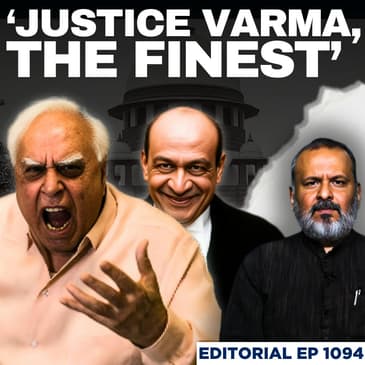

In this episode of Editorial, Mr. Sujit Nair discusses the arguments put forth in defense of Justice Yashwant Varma in the cash case. Justice Varma has also refused to resign in connection with the controversy.
Learn more about your ad choices. Visit megaphone.fm/adchoices
[00:00:00] Namaskar, welcome to another episode of editorial. You see I had spoken to you about the Brahmanical society, the contemporary Brahmanical society that is being created in this country.
[00:00:16] I told you that the constitutional authorities, judges, these are the Brahmans, the top caste, the top society, the golden batch in our society. You can't question them. You can't question them and if you question them then the whole gang comes and tries to support.
[00:00:41] Let's talk about, again let's talk about Yashwant Varma, let's talk about the cash that was allegedly found in his house and let us talk about how people are now trying to defend this entire story. Let's get right into the show.
[00:01:01] So Kapil Sibal is a very eminent lawyer in this country, an intelligent man who is now defending, defending not in court but defending in public. He is defending Yashwant Varma, saying that Yashwant Varma possibly is one of the best judge he has argued in front of. He says he likes Yashwant Varma, he says ask anybody Yashwant Varma is good.
[00:01:30] So India has to believe that Yashwant Varma is good. Why? Because he is possibly the best judge that Kapil Sibal argued in front of. This is what Kapil Sibal talks about. So I am going to take Kapil Sibal's arguments and let's kind of debate it a little. Now Kapil Sibal, I understand is not the advocate on record for Mr. Yashwant Varma.
[00:01:52] He says that he is not going to be his advocate because otherwise he has all the constitutional right and responsibility to defend his client. But otherwise too, of course he is a citizen of this country and he is defending a judge. And my argument today is that when a judge is on the docks, when the judge is allegedly, I am using the word allegedly very clearly,
[00:02:14] allegedly caught with money in the outhouse, you have a lot of judges, you have a lot of advocates, you have a lot of senior advocates, celebrated advocates coming and defending him. Why? Because possibly they are defending that community. They are defending a community which the same privilege wouldn't, a common man wouldn't have got the same privilege.
[00:02:39] Had this been a common man, nobody would have come to his aid. He would have been in some jail, languishing in some jail. This is the point I wanted to make and let's talk about the first argument that Mr. Kapil Sibal makes. Mr. Kapil Sibal says,
[00:03:23] Mr. Kapil Sibal says that, It could be monopoly money, for all you know, you could say that also. The committee didn't say that. Yeah, there is money in your house. There is money in your house. Now I will come to that outhouse part of it. There is money in your house and it is photographed, burnt money. And this senior advocate says that,
[00:03:50] What did you say? But how can you say that money belongs to the owner of the house? How can you say that? Did the committee say that? Do you have any proof? I mean this is absolutely fabulous. It is that the money comes out of my residence and I go to the court and say, I don't know how the money came.
[00:04:15] You see, hundreds of cases like this were caught by ED. Hundreds of cases were trialled by ED. People went behind bars. Hundreds of cases like this was tried by CBI courts and people went behind bars. They were common people. Possibly the money recovered was lesser than this. But they were common people. Nobody spoke about them. Nobody even knew.
[00:04:42] Nobody even knew when they were caught, they were arrested and they were put behind bars. Nobody even knew. But when a judge, this kind of money is caught, the question that lawyer asks and the community asks in form of Kapil Sibbal, who is part of the community, is asking, Baba, where is, which committee told you? Which committee told you that this money, money pipe, okay. But which committee told you that the money is this? Question one. Let's go to his next point. The next point he says,
[00:05:12] The in-house inquiry didn't know why Delhi police went there. Why did Delhi police didn't do the FIR? Did someone inform the people of the family and told that there is cash? No one thing. The in-house inquiry did not find why Delhi police left and did not file the FIR. You see, to the best of our understanding. And you can go through the editorals I have done previously.
[00:05:40] To the best of our understanding, Delhi police was asked by his assistant, by Mr. Yeshwant Verma's assistant to go back and come tomorrow. Delhi police went back. Was it wrong? Of course it was wrong. All of us raised questions on that. But the fact is, you see, he's a judge. Our entire constitutional bodies work this way. When a judge says,
[00:06:10] End of story. That is exactly the point. When a judge loses a dog, when a judge's dog runs away, he puts, he talks to the Joint Commissioner of Police that my dog is missing. You please put a team and ensure I have more security so that my dog doesn't go out. This also happens in this country. This is reality. And I'm sure Sibble is aware of that. I'm sure Mr. Sibble is aware of that. Whether he wants to accept it or not is a different issue. When a judge wants something, he gets it.
[00:06:41] When a judge asks the police to go and come back later on, that's it. Or judge what? Is assisted. That's what happened here. Huh? Whether there has to be an affair? Of course there has to be an affair. According to Mr. Sibble, a fire has to be on everybody. A fire has to be on the police. A fire has to be on the fire extinguishers, whatever. The fire brigade. A fire on the neighbour. A fire on the onlooker. A fire on press, which what about the story? They also should get a fire, Baba. According to Mr. Sibble,
[00:07:10] everybody should be getting a fire. Everybody should be behind bars. But the judge, no judge. Good man. Very good man. Because Mr. Sibble likes him. Very good man. So nothing, no fire against him. Nothing should happen to him. He is an honest man. He is a noble man. I'm not saying he's not. I have no proof to say whether he is or not. That is not my job. But the fact remains that, I am going by my judicial committee.
[00:07:40] The judicial committee of my country had said that there was cash and that cash was genuine. There was cash in that, in that premises. That is what my, my judicial committee has said. Which is what I understood. I am based on, I am basing my premises on that. And I have all the right to base my premises on that. Ha, but you know, Kapil Sibble likes him. So a fire should be on everybody except for the judge. And mind you even today with so much money, I ask my audience,
[00:08:11] look at the privileges that these people get. With all this, not a single ED raid, not a single CBI raid, not a single police raid on this, this, this judge. They are contemplating whether to impeach him or not. Please impeach, please resign, please. This is what we are doing. We are begging of him, resign. And he today made a claim saying that I am not going to resign. Under pressure,
[00:08:41] I will not resign. This is what the story is. Let's go further. Why the fire services ensure that some notes were seized, which had serial numbers? So that we could have known what the source of that notice, which bank it comes from. Now again, the blame, not on your son for my, but on the police first. Now the fire services, why didn't the fire services seize? Why didn't they take a serial number?
[00:09:09] Are you fire services job is to extinguish fire? Oh, they are not an investigative body. Whether they say, what is the note? What is the serial number? What is the name? What is the name? That is not their job. They are not detectives. They went, they saw fire extinguished, it went back home and by and when they were extinguished in fire, they saw notes burning, currency is burning. They told their boss, Baba currency is burning here. It's a common reaction. Wouldn't you react that way?
[00:09:39] So if you react that way, you are expected to go and investigate. It is like, you see a murder happening and then a lawyer like Mr. Kapil Sibbal says, when you are seeing that murder, no, why didn't you see which, whether the murder was on from right hand and whether it was in 45 degrees angle or whether it was caught in 90 degrees angle and whether it, hello, common man, saw murder, reported to the cops, end of story. That's all he can do, he or she can do.
[00:10:10] Fire extinguisher, saw fire, extinguished it, while extinguishing the fire, saw money, reported to his boss saying, that's why you are making money. Now, serial number note, their fault. Their fault. Okay, let's go, let's go further. This is funny. This is really funny. Prima facie evidence is that, is what he has to say. And everybody knows, and that's even the, that's even the, the, the, the, the prima facie findings in the report,
[00:10:40] that the keys of the outhouse, were, were with other people, not with the, not with the family. Anybody could open the outhouse. They were not under the control. And I've been a minister also. We've had outhouses. I never went there. My family never went there. This is near the, where the, where the, where the, where the, those helpers live. Each of them had access. So, piles of cash could be lying there.
[00:11:09] But the owner doesn't need to know that it is piles of cash. He may not know. Somebody else must have kept. Are you, He outhouse. He is. Sula, what do you think it is? Public law? That anybody can come, do anything and go back. Is that how it works? It's a judge's house. The high court judges house. Government house. CRPF standing there. Police standing there. Why to guard the house?
[00:11:38] And you are saying anybody, anybody from the road can say, come down and say, I have both. Let's go to the house. Is it even possible? I mean, think about it. If it, is it even possible? And, I don't know, some of you all who owns outhouse, in your farmhouse or wherever, you think, you have no idea what is lying in your outhouse. You think that it's just lying there
[00:12:07] and anybody can walk in, stay there for six days, six nights, seven days and go back the eighth day and you will not even know about it. Or there's somebody comes and put their gold, their money and all that and you will not come to know about it. Is that even real? I'm talking about normal people. Forget about a judge whose house is guarded with our tax money. With our tax money and all those CRPF and all that, like I told you are guarding it. and a judge and a, and a advocate to, to protect or possibly whatever. The reason? He says that,
[00:12:37] hey, what's the deal about it? What else can anyone keep the money there? It is okay. Poor man, he doesn't know what is happening. He was told, there are so many crores of rupees burnt. He said, so many crores of rupees burnt. That's it. Do you think this is how the picture is? Do you think this is how, it's, it's all, it's all, it's all happened. You see, the point that I'm trying to say is again, again, I am not trying to say,
[00:13:06] and I have nobody to say whether he is guilty. He is not guilty. He had the cash. He had, he didn't have the cash. He kept it. But look at the evidence and look at, as from a layman's perspective. And look at how his colleagues, his fellow judiciaries are trying to support him. What logic are you producing in front of the people? What logic? The committee didn't say that there was money and the money was his.
[00:13:37] You have those fake monies. You know, they have those reverse bank of India monies. You think, you know, that also could have happened. Is that, what kind of argument are we making? What kind of argument are we making here? You know, he says, like I told you, he says he's one of the finest judges. And now they want to destroy a judge. And I can say, with the utmost of responsibility, that he is one of the finest judges that I have argued before.
[00:14:07] You ask any lawyer, any lawyer in the high court, any lawyer in the Supreme Court. Good for you. You find him finest. Excellent. Good for you. Good for you. A lot of people found, used to believe that, Arvind Kezival is the finest CM. But he was put behind bars. No. A lot of people felt that, Karniwani was a fantastic minister. She was put behind bars. No.
[00:14:37] A lot of people felt, A. Rajah was a fine minister. He was put behind bars. No. So, if you find somebody, a fine person, why? There are, there are, there are, there are devotees of that Ram Rahim fellow, that rapist. There are devotees even today. That other man, that Asana Mbappu. There are devotees, devotees who consider him to be God even today. Wasn't he put behind bars? Asana Mbappu is out and it is not fair.
[00:15:05] Ram Rahim gets furlogged every second day. That is also not fair. But they were put behind bars. Who cares if anybody likes him or not? Law is law. And if you are guilty, you are put behind bars. Are you here? At least, let's have a fair trial. Let's have an investigation. Why is that judge not investigated like a normal person? Where he is called to the CBI office or called to the economic office, wing office or, and, or,
[00:15:33] and a call to the ED office like it would happen to any common man. Imagine my God. Imagine if there was 15 crores found in, first of all, outhouse is a big thing, but I am saying any house. Imagine 15 crores found in my house. What would have happened to me? Can you imagine for 15 crores, 5 crores, 2 crores, whatever money is cash like this found in my house. What would have happened to me as a common man? Can you think about it? Think about it for a minute and nothing happened to this gentleman till now. That's the question I ask.
[00:16:03] And that's why I say we are creating a Brahminical society again. These people are beyond law. Then if the law that applies to us doesn't apply to them, there are debates whether they should be impeached or not. Are you paying cash? Are you paying cash? Are you paying cash? What are you talking about? What impeachment are you talking about? What are you debating about impeachment? Why is he not investigated like a common, whatever accused?
[00:16:33] And, you know, we have debates where Mr. Sipal says, the CJI shouldn't have sent the report to the president. The CJI shouldn't have made the report open. Why? Why should everything be kept silent? He says he is going to file suit against those media who spoke about Verma. Why? Because they showed cash.
[00:17:01] Because they said that probably this cash belongs to Verma. So you sue the media? You sue the media? You sue the police? You sue the fire brigade? You sue the passerbys? You sue the onlookers? You sue everybody? But nothing should happen to the judge. Nothing should happen to the judge. This is what Mr. Sipal says. Or possibly that is what he intend to say. I got out of what he said. That is what I derived of what he said. I find this very strange.
[00:17:31] Like I said, If he was his advocate, fair enough, I understand. He is doing his constitutional responsibility of defending his client. But if he is not, then just because he is part of the judiciary, and just because the judiciary should not get into this kind of trouble, you should be protected or judiciary be above law. And above everything, nobody questions them. Nobody talks about them. Nobody writes about them. Nobody does any reports on them.
[00:18:00] Nobody does an editorial on them. I don't know whether I will be sued because I am doing this editorial. I mean how fair is this? Where are we taking our country to the reason I wanted to do this editorial and the reason I am doing this editorial, I mean I have done this subject at least three times, is because listen, judiciary is our last frontier. I have nothing against Kapil Sibola or anybody for that matter of fact. Neither do I have anything against Heshwant Varumar. But judiciary is our last frontier.
[00:18:29] Everything of us is almost corrupt and degrading. I am not saying judiciary is not, but at least let's guard judiciary. Let's ensure that we take extra care to ensure that the corruption which is already spread, doesn't spread more in our judiciary. That's all I am asking you. For the sake of our country, for the sake of our democracy,
[00:18:58] for the sake of our being, let us please guard our judiciary. Let us not protect people who possibly, I am not saying Heshwant Varumar is accused or he is convicted, he is accused, but let him at least be investigated without pressures and biasness and counter pressures and all of that. Let him be investigated. That's all I ask. And let him be investigated like a common man. Because he is a judge.
[00:19:27] That's his job. He is an Indian first. That is what his status is. And to me, being an Indian is equal. Every other Indian is equal. My job doesn't design, define my status in this country. Unfortunately today, the job is defining status. The job is defining status. The sheer constitution that was built to ensure that everybody is equal. That constitutional, the constitutional authorities are ensuring that
[00:19:56] they alleviate themselves from the common man of this country. And I think people like Mr. Kapil Sipal selectively help this cause. That's the reason why I want to do this editorial. And till I see you next time, that's tomorrow at 10. Namaskar.