
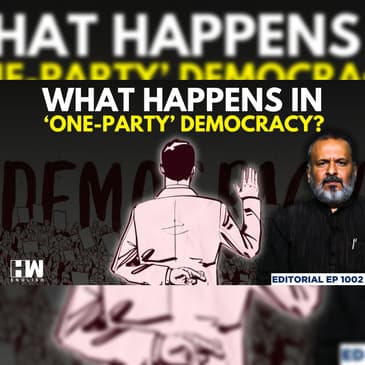
In this episode of Editorial, Mr. Sujit Nair explores a hypothetical scenario: what if India becomes a single-party democracy? Mr. Nair delves into what India might look like under such a system and explains, in detail, the many ways our ‘right to choose’ could be curtailed.
Learn more about your ad choices. Visit megaphone.fm/adchoices
[00:00:00] Namaskar! Welcome to another episode of Editorial. What happens if we become a single-party democracy? What happens to India? What happens to your life and mine? Is there a possibility of us being a single-party democracy? Let's discuss all of this. Let's get right into the show.
[00:00:28] So what happens if India becomes a single-party democracy? Now the first question a lot of you may ask me is why? Why are we talking about it? It's a hypothetical situation. Why are we talking about it?
[00:00:48] The reason I am talking about on this subject is because as citizens, as people who have tried or who takes pride on being the world's largest democracy, we should know what happens if our democracy takes a turn.
[00:01:11] If our democracy mutates, if our democracy changes from its current form, we should know what happens. Whether that will happen or not is a different story and that is something that we can talk and see and hope later on. But what happens if our democracy takes a turn?
[00:01:35] Now that's the reason why I am discussing this topic today. Believe me, it's interesting. You see, the concept of democracy is rule by the people. That's what the definition of democracy is. Rule by the people.
[00:01:52] Now in India, this rule by the people is done how? By 545 elected members. This 545 elected members comes from various political parties. Some are independent too, but bulk of them comes from various political parties.
[00:02:14] Now if you go to see, interestingly, the definition of political parties is a group of persons organized to acquire and exercise political power. They are there to exercise political powers. So you have democracy, rule of the people.
[00:02:32] And this rule of the people, to enforce this rule of the people, you have political parties. And these political parties are an organized group of people who are there to acquire political power. Political power means the power to govern you.
[00:02:47] While one says it's rule of the people, while the other says political party are a group of people who are there to gain political power. Let's keep that aside.
[00:03:00] Now let's go to our question.
[00:03:03] What happens if there is only one political party and there are no other political parties to compete with the political parties? We are sentient beings. You know what sentient beings means? Sentient beings means we feel. We feel, we understand our environment. That is what makes us different to a rock, possibly.
[00:03:27] As on now, under the scientific current understanding, rock is not a sentient beings. So we are.
[00:03:35] So therefore, we as a human being, we choose. We can choose to sleep, we can choose to stay awake. We can choose to walk, we can choose to sit. We can choose to drink, we can choose to eat.
[00:03:47] We can choose to do something, we can choose not to do something. That is the right of choice.
[00:03:54] Even a dog has a right to choose. The dog can choose to eat, the dog can choose to sleep, the dog can choose to run, the dog can choose to bark.
[00:04:03] So it is very imperative that we have a right to choose. The moment that right to choose is taken away, we turn more into a rock.
[00:04:21] Because our fundamental way, the way we know life changes. Let me try and explain this to you.
[00:04:32] You see, today, you have the right to choose a political party. That political party wants you to choose them.
[00:04:46] They know that they can only be acquiring power, like what the political party's definition is, if you choose them.
[00:04:56] So they come to you, they plead for your vote. They want your vote. And once they get your vote, then they acquire the power that they want to.
[00:05:09] Now, once they are in power, they are still scared of you. Why? Because after five years, you can throw them out.
[00:05:16] Like you threw Congress out, or UPA out. You can throw them out. So the fact remains that, they still will try and look after your interest to the best of their ability,
[00:05:30] or to how much of it they should, they can. They will look after your interest purely because they know that you have to elect them again.
[00:05:39] Otherwise, they will be out of power. Because that is the power of choosing. Your power to choose.
[00:05:48] Now, imagine that goes off. So that political party, that political person, that person who is at the helm of the affair,
[00:05:56] he has no fear because you can't take him away. You can't throw him out.
[00:06:00] You can't uproot him. His power is permanent. He is like God.
[00:06:04] He actually becomes God because his power is permanent. Only death can take away his power.
[00:06:10] He knows. Nothing he or she knows. Nothing else can take away the power.
[00:06:16] That becomes a permanent power.
[00:06:19] For a political party, not even death because that political party will continue to rule that particular country till time immemorial.
[00:06:28] Till some historic change happens.
[00:06:30] So what really happens is, the interest of that person will be higher than your interest.
[00:06:40] You lose the power to choose.
[00:06:44] You, from a human being, turn into a rock, which hardly has any power to choose.
[00:06:54] You see, that political party, that person can decide which television channel you watch.
[00:06:59] That political party, that person can decide which airline you take.
[00:07:03] That political party, that person can decide whether you take an airline.
[00:07:07] That political party, that political person can decide what you eat.
[00:07:10] That political party, that political person can decide what you drink.
[00:07:13] That political party, that political person can decide what you see, what you wear, your hairstyle.
[00:07:20] You saw in North Korea there are one or two prescribed hairstyle which everybody has to follow.
[00:07:25] You cannot do your own hairstyle.
[00:07:27] Everything about you will be decided by that one political master.
[00:07:33] And that one political master will guide your life.
[00:07:38] That one political master will decide which mobile phone you use.
[00:07:42] That one political master will decide what kind of traditional attire you wear or what tradition you follow.
[00:07:50] That political master will decide whether you watch a dance or whether you watch a play.
[00:07:55] That political master will decide.
[00:07:57] That political master will decide whether you breathe next day or you don't.
[00:08:03] That too will be decided by that political master.
[00:08:08] Now a lot of you may already have started writing that I am exaggerating.
[00:08:13] The fact is I am not.
[00:08:16] The fact is I am not.
[00:08:20] We have seen countries like North Korea.
[00:08:23] We have seen countries like North Korea where even a tourist forget about the local.
[00:08:30] Even a tourist cannot be moving around in that country unescorted.
[00:08:37] If you ever get a visa to North Korea which you get it only through China.
[00:08:43] If you ever get a visa to North Korea and you want to go there as a tourist.
[00:08:47] There will be two guides waiting for you in the airport.
[00:08:50] And those two guides will be taking you through the entire of North Korea.
[00:08:54] You cannot move out.
[00:08:57] You cannot move out of your hotel room without those guides escorting you.
[00:09:02] You cannot go to a place alone without those guides escorting you.
[00:09:06] Why?
[00:09:06] Because one leader, one party decided so.
[00:09:12] One party decided so.
[00:09:15] One leader decided so.
[00:09:16] One party democracy.
[00:09:17] They too do not call themselves as a dictatorship.
[00:09:22] In their own form they also call themselves as a democracy.
[00:09:27] In their own form.
[00:09:31] Now this is normally what happens when there is one party.
[00:09:38] There is hardly any difference then between a monarchy, a dictatorship and a democracy.
[00:09:47] Who becomes rich?
[00:09:49] Who becomes poor?
[00:09:50] How much percentage of the total population becomes rich?
[00:09:53] How much percentage of the total population will remain poor?
[00:09:56] Would we decided that one political party or one person?
[00:09:59] We have seen it.
[00:10:00] We have seen crony capitalism even in a democracy like ours.
[00:10:06] We have seen crony capitalism.
[00:10:07] We have seen how the rich grows and the poor remains or degenerates.
[00:10:15] We have seen that.
[00:10:16] So it is not very unique.
[00:10:21] The reason I am talking to you now.
[00:10:25] You see, a politician currently joins a political party for power.
[00:10:33] Let us be very clear about it.
[00:10:34] He or she joins a political party for acquiring power.
[00:10:40] Ideology, which used to be the forerunner for a political person to join a political party or to join a movement.
[00:10:51] That ideology part is not even in the top 10 list today when a person chooses his career, her career as a politician.
[00:11:01] That ideology part was important when we were fighting for our freedom.
[00:11:06] Because then people believed in ideology and stuck to their political parties.
[00:11:10] Stuck to the political parties where their ideology was preached, practiced and prevailed.
[00:11:18] But after that, ideology just got lost.
[00:11:20] So what really happened?
[00:11:21] What was left was people who wants power.
[00:11:25] Now what is that getting us to?
[00:11:28] No particular political party or no particular bill is going to be passed saying that we will be a one political party democracy.
[00:11:36] But what is happening is a politician today, if you see, especially states like Maharashtra, where one political party has sweeped the election,
[00:11:46] you see that the opposition leaders are now wanting to jump to this one political party that swept the election.
[00:11:55] If the representative you chose, you chose because they were standing against one ideology and that particular party,
[00:12:04] after you chose him or her, once the government is formed, once the assembly is set,
[00:12:09] if he or she wants to jump to the political party, which he or she opposed while asking for votes,
[00:12:18] what is going to happen is you are going to see a larger, larger and larger treasury bench
[00:12:23] and you are going to see a smaller and smaller and smaller opposition.
[00:12:30] The smaller the opposition, the lesser your right to choose.
[00:12:36] Because a small opposition is compromising on your right to choose.
[00:12:41] Because then there is nobody to question.
[00:12:45] Then there is nobody to ask,
[00:12:50] Why like this? Why not like this?
[00:12:53] That's your right to choose.
[00:12:55] That is why you send that political person into that assembly stroke parliament.
[00:13:00] When people jump and jump for power,
[00:13:06] remember,
[00:13:08] they have taken something from you
[00:13:12] and they are using it for something else.
[00:13:16] Which means,
[00:13:18] they have asked you for your votes,
[00:13:20] saying that I belong to this ideology,
[00:13:23] I support this ideology,
[00:13:25] I support this movement,
[00:13:26] they have taken your votes
[00:13:28] and they are using it to gain political power
[00:13:32] by giving that vote of yours
[00:13:34] to another ideology,
[00:13:35] to another movement,
[00:13:36] to another set of political parties.
[00:13:41] So,
[00:13:42] they are taking it based on one promise
[00:13:46] and they are handing it over
[00:13:47] to the other.
[00:13:52] Technically speaking,
[00:13:54] shouldn't that be crime?
[00:13:56] Shouldn't that be crime?
[00:13:57] Because,
[00:13:58] if you go to a bank
[00:14:00] and you say that
[00:14:02] I want to take loan for my housing
[00:14:05] and you take loan for your housing
[00:14:07] but you use that to buy a car,
[00:14:10] it is fraud.
[00:14:12] You have defrauded that bank.
[00:14:16] So,
[00:14:17] that's money.
[00:14:18] So,
[00:14:18] there you may be jailed.
[00:14:19] But here,
[00:14:20] you have defrauded faith.
[00:14:23] Faith of thousands
[00:14:24] and lakhs of voters
[00:14:26] who has given
[00:14:27] this particular political person
[00:14:29] their votes
[00:14:30] and he takes the votes
[00:14:32] and jumps to another party.
[00:14:38] How fair would that be?
[00:14:40] The reason I talk to you today
[00:14:43] about one political party,
[00:14:45] one nation,
[00:14:45] one party
[00:14:46] or possibly
[00:14:47] one party democracy
[00:14:50] is because
[00:14:51] the more
[00:14:52] a party
[00:14:53] gets powerful,
[00:14:56] the more
[00:14:57] we see
[00:14:58] the opposition
[00:14:59] trying to jump
[00:15:00] to the powerful party.
[00:15:03] It is not that
[00:15:04] you see
[00:15:05] a party
[00:15:06] becoming powerful
[00:15:07] and it's not like
[00:15:08] we saw
[00:15:08] during Indira Gandhi
[00:15:10] where there was
[00:15:10] emergency
[00:15:11] but then there was
[00:15:12] a JP movement,
[00:15:13] there was a Jai Prakash Narayan movement
[00:15:15] where there was
[00:15:15] Atal Bihari Vajpayee,
[00:15:16] LK Advani
[00:15:17] and all coming together
[00:15:18] to fight
[00:15:19] that
[00:15:21] political party.
[00:15:22] They ensured
[00:15:24] the JP movement,
[00:15:25] the Atal Bihari Vajpayee
[00:15:26] and the
[00:15:27] Charant Singhs
[00:15:28] ensured
[00:15:29] that you got
[00:15:30] a choice.
[00:15:30] The Muradji Deshai
[00:15:31] ensured
[00:15:32] that you got a choice.
[00:15:34] Country had a choice.
[00:15:36] There was a
[00:15:37] regime
[00:15:37] that was trying
[00:15:39] to take away
[00:15:39] your choice
[00:15:40] and there was
[00:15:41] a group of
[00:15:41] political parties
[00:15:43] that fought against it.
[00:15:45] that's
[00:15:46] what is missing
[00:15:47] in our current
[00:15:48] political scenario
[00:15:50] and that is why
[00:15:51] the worry
[00:15:52] that
[00:15:52] there is a
[00:15:53] very evident
[00:15:54] possibility
[00:15:55] that
[00:15:56] we could turn
[00:15:57] into a single
[00:15:58] party democracy
[00:16:00] because
[00:16:01] that resistance
[00:16:02] or that
[00:16:05] creating choice
[00:16:06] for people
[00:16:07] that
[00:16:08] seems
[00:16:09] to be missing.
[00:16:10] I hope
[00:16:11] I made
[00:16:12] my point
[00:16:13] clear.
[00:16:13] Till I see you
[00:16:14] next time
[00:16:15] that's tomorrow
[00:16:15] at 10.
[00:16:16] Namaskar.
[00:16:18] Stay ahead
[00:16:19] with our
[00:16:20] cutting-edge
[00:16:20] news app.
[00:16:22] Instantly
[00:16:22] access the
[00:16:23] latest shots
[00:16:23] in just
[00:16:24] one minute
[00:16:24] and breaking
[00:16:25] news
[00:16:25] in just
[00:16:26] 50 words.
[00:16:27] Download
[00:16:27] now for
[00:16:28] a smarter
[00:16:28] faster
[00:16:29] news
[00:16:29] experience.