

Help us cover Maharashtra elections: https://pages.razorpay.com/hw-maha-elections-2024#
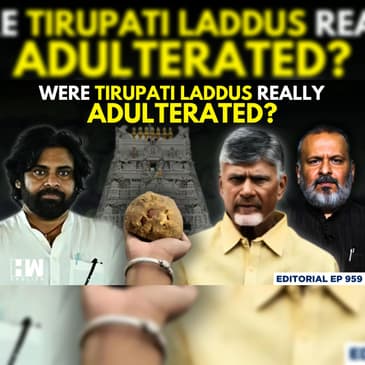
In this episode of Editorial, Mr. Sujit Nair delves into the revelations surrounding the Tirupati Laddus. He discusses how the executive officer of TTD revealed that out of 10 tankers of ghee, 4 were found to be adulterated. These 4 tankers were sent back to the supplier after testing. Mr. Nair also explores the heated debate on whether the temple should remain under state control. Additionally, he sheds light on the issue of corruption at religious sites.
Learn more about your ad choices. Visit megaphone.fm/adchoices
[00:00:00] Namaskar! Welcome to another episode of Editorial.
[00:00:06] The question that we asked tonight was the adulterated ghee.
[00:00:11] Ghee adulterated with beef fat, pork fat, fish oil used to make the laddus which were distributed in Tirupati Balaji.
[00:00:22] This is the question we asked tonight. Let us try and do a little bit of investigation.
[00:00:27] Let us come out with an answer. Let us get right to the show.
[00:00:36] Now, like I said, let us deep dive into this entire issue.
[00:00:41] Has the oil, has the ghee being used to make laddus?
[00:00:48] Now there is an article in print, a very interesting article in print where the print reporter asks the executive officer,
[00:00:55] Shamala Rao whether the contaminated ghee, contaminated ghee which had pork fat, beef fat,
[00:01:05] fish oil was that contaminated ghee used to make those laddus.
[00:01:11] And the executive officer, Shamala Rao categorically said no. He said nothing doing, it was not.
[00:01:20] Now, according to Shamala, he took over as executive officer of the trust right after the Chandra Babu Nairu formed their government on the 12th of June.
[00:01:32] He took over right after that.
[00:01:35] He says the ghee that is said to be contaminated with fish oil, laddus, pork fat and beef tallow besides other elements of vegetable oils were supplied in July.
[00:01:47] Now, he says this ghee came to us in July after he took over and after Chandra Babu Nairu had formed the government, this is when they received the order.
[00:02:00] Now mind you also to get to your notice this entire tendering process of getting this company who provided this particular order,
[00:02:10] the tender was made available in March.
[00:02:14] The tender under which this company called Aya Dairi from Tamil Nadu applied in March.
[00:02:21] March when Vyasadairi from Tamil Nadu was finalized, their tender was found good and they were finalized and was asked to henceforth deliver ghee.
[00:02:36] Now, on the 15th of May, 8th of May they were finalized, 15th of May the order was placed.
[00:02:44] This is the chronology and this order that was placed on 15th of May, the order was delivered in July according to the current executive officer.
[00:02:55] Yata Thik? Okay, let's go further.
[00:02:59] Now, according to the executive officer of the 10 tankers supplied by Tamil Nadu Aya Dairi Kaugi in four tankers they found that it was inferior in quality based on human sensory perception of TDD expert.
[00:03:19] They smelled and they could sense it with the smell.
[00:03:25] 10 tankers were bought, 10 tankers were supplied, out of 10 tankers 4 tankers through human sensory perception they realized that there is something wrong with this.
[00:03:37] Something is not right here.
[00:03:39] Chicken, smell and samples from these four tanker analysis and learning in livestock and food in Anand for adulteration test.
[00:03:51] Now, out of the 10 that arrived, 4 of this 4 tankers where there were smell problems was sent for testing.
[00:04:00] The others were not sent for testing.
[00:04:01] Now, the ghee was never used 100%. Shamala told the print.
[00:04:09] The 4 tankers were kept aside and sent back to Aya Dairi after NDDB, Kalf Report reflected animal and vegetable fat contamination.
[00:04:19] Shamala said that 5 agencies supplied ghee to TDD.
[00:04:24] Now, I am assuming two things.
[00:04:27] One is where my human sensory perception, that is my sense of smell, where my sense of smell told me that there is a problem.
[00:04:37] Those were the ones that were checked.
[00:04:39] Where my sense of smell told me that there was no problem, I didn't check it, I used it.
[00:04:44] I presume that is used because he only sent back 4 which means 6 were kept back from Aya Dairi.
[00:04:51] Now, you tell me a dairy that sends you ghee that to a temple laced with beef, with pork, with fish oil.
[00:05:02] Are you going to trust that dairy?
[00:05:05] Are you going to say that only 4 may they did, 6 may know the balance 6?
[00:05:10] Nothing, that's all good.
[00:05:12] Is that how we would look at?
[00:05:14] If you were the quality control manager, would you throw out all those 10?
[00:05:19] What would you say that this may, I don't know, smell says, so this 3, 4 you go back, 6 I will keep.
[00:05:25] What would you do?
[00:05:27] That's my question number 1.
[00:05:30] My question number 2 is, percent to external labs for testing for the first time on the history of TDD.
[00:05:37] The thing is, Tirupati Balaji distributes 3.5 lakh laddus every day to different devotees.
[00:05:47] People who come with utmost devotion, 3.5 lakh laddus and we are leaving it to our sensory perception,
[00:05:56] our sense of smell to figure out this is 100% vegetarian and this could be adulterated.
[00:06:04] When our sense of smell told us no, this is not right, that is for the first time in the history of TDD was sent for a lab test
[00:06:11] and we are sitting here and assuming that out there, everything is right up above 3.
[00:06:16] There has been no laddus that were laced with any ingredients, any animal fat, it was all right.
[00:06:24] This is what we are assuming.
[00:06:25] I mean, is there a logic to what we are saying?
[00:06:28] I am asking you purely from a logical perspective.
[00:06:31] Now the thing is, why was AR dairy, why was AR dairy hired in the first place in the tender process,
[00:06:39] March tender process?
[00:06:40] AR dairy was hired, according to Shyamala, AR dairy was hired because they were supplying ghee at 320 rupees per kg.
[00:06:51] The least price amongst all the five suppliers.
[00:06:55] Market price today is 500 upwards.
[00:06:58] AR dairy was providing it at 320 rupees at the least price.
[00:07:03] Why were they providing and how could they provide?
[00:07:06] Could they get their ghee from Mars?
[00:07:10] Could they get their cows from some other planet?
[00:07:14] So how did they knew of close to 5200 crores of revenue, a temple that was making this kind of revenue?
[00:07:23] Why would they want to compromise on as essentials as ghee that is used for the prasadam of that temple?
[00:07:33] I mean, isn't that a simple logic?
[00:07:35] Who are they saving money for?
[00:07:38] For who are they saving money for?
[00:07:41] That is point number two.
[00:07:45] Point number three, you see Ramana Dixitulu, a former chief priest.
[00:07:51] We call it male Shanti in down south.
[00:07:54] A former chief priest at Tirumala temple claimed that he had complained about deteriorated qualities of laddu
[00:08:03] and other prasadam in the past.
[00:08:06] But instead of rectifying the issue, the then government targeted him.
[00:08:12] The point that I was trying to make is that this can't be the first time is what I believe in.
[00:08:17] Do I have any more proof than this except for logic?
[00:08:20] I don't but then I believe that this is not the first time it is happening.
[00:08:24] That's number one.
[00:08:26] Number two is that all this cover up that you know, okay, we send it back with
[00:08:31] this I think it makes no logic.
[00:08:34] It doesn't stand the test of logic.
[00:08:37] It doesn't.
[00:08:38] It absolutely doesn't point number one, my last point before I end.
[00:08:42] You see, therefore by now a lot of us will write saying that listen, you know,
[00:08:46] government should be moving out of temple,
[00:08:51] temple should not be administered by government's hall and so forth.
[00:08:54] You think these temples that are run privately are run clean?
[00:08:59] You think these temples that are run privately are run with all the reverence
[00:09:06] and devotion that it that requires?
[00:09:10] There's a lot of corruption that goes around in temple.
[00:09:13] In fact, there's a lot of corruption that goes around in every religious place.
[00:09:17] Let's just talk about temple.
[00:09:19] But in this case, let me stick to temples.
[00:09:23] There's a lot of corruption that goes around if there are private players,
[00:09:26] then those private players do corruption the way they want.
[00:09:31] Absolute lack of transparency, absolute opacity and there are a lot of corruption.
[00:09:36] If it is government, then we see what is happening.
[00:09:40] You see, the fact is a lot of us we believe that temples are managed by saints.
[00:09:46] Semples are managed by Bhagats.
[00:09:47] Semples are managed by people who really are worshipping the God
[00:09:52] and they are dedicated their lives to God.
[00:09:54] But temples are not managed by them.
[00:09:57] They are priests, they come and go.
[00:09:59] Temples are managed by local politicians, stroke, local leaders.
[00:10:07] That's the people who manage temple.
[00:10:09] Elections happen for temple management.
[00:10:12] There is money put for that election to be the boss of the temple management.
[00:10:18] So temple management even in private sectors doesn't work that easily.
[00:10:23] You see, there are a lot of examples.
[00:10:25] A lot of examples where the people themselves, Vaishnav Devi, people themselves wanted the government to take over Vaishnav Devi temple.
[00:10:35] Same is the case with a lot of other temples.
[00:10:37] So the point is this argument that government should take over temples or people should be given temples
[00:10:45] or temple management should be given temples or temples should be given freedom.
[00:10:49] That argument is not as open and shut as we seem it to be.
[00:10:54] There's a lot of complication in both the cases.
[00:10:57] That being said, as a person I believe that temple should have their independence.
[00:11:03] As a person I believe that temple should be run by people who pray,
[00:11:10] run by people who worship the idol of the temple.
[00:11:15] Temple should be run by them.
[00:11:16] Not politicians, not government.
[00:11:19] Temple should be run by them and that's the way we need to formulate that policy
[00:11:23] and that policy till now is not clear in India if you know what I'm trying to say.
[00:11:29] Till now that policy is not clear with us and till such time that that policy is not clear
[00:11:33] as to how do we ensure that devotees, hardcore devotees of that deity runs that temple,
[00:11:42] you will find corruption in a temple.
[00:11:45] Hand it over to a devotee who has dedicated his or her life for that deity,
[00:11:50] then you will find that temple to be absolutely clean and run immaculately.
[00:11:55] There has to be a process for this and that process we have still not identified
[00:12:02] and that is what I wanted to tell you through my editorial today.
[00:12:06] So till I see you next time, that's tomorrow at 10. Namaskar.
[00:12:11] The year that changed Maharashtra politics forever. Old alliances were broken.
[00:12:17] I was in the temple of the temple.
[00:12:19] People were saying that I am a Jew and I am a Christian.
[00:12:24] That means if I had kept a formula, I would have kept it for a long time.
[00:12:28] I think it is white that we went to the temple on the morning of the day of the death.
[00:12:34] And new alliances were formed from early morning surprise swearing in.
[00:12:39] I am Devendra Gangadhar Rao Fadnavis.
[00:12:43] I am the witness of the incident.
[00:12:45] I am Ajit Anant Rao Pawar.
[00:12:48] I am the witness of the incident.
[00:12:51] Unlikely coalitions.
[00:12:53] I am the leader of the Buddhist nation.
[00:12:56] I am the witness of the incident.
[00:12:59] An unprecedented splits in two major political parties.
[00:13:14] I am the witness of the incident.
[00:13:19] I am the witness of the incident.
[00:13:21] I am Ajit Anant Rao Pawar.
[00:13:22] I am the witness of the incident.
[00:13:24] The political landscape of Maharashtra saw several twists and turns in the last five years.
[00:13:31] Now as Maharashtra gets set,
[00:13:33] for the 2024 Assembly elections,
[00:13:36] we believe that we have the infrastructure, we have the know-how,
[00:13:40] we have the experience of covering Maharashtra.
[00:13:42] We want to cover the Maharashtra elections.
[00:13:44] What are the issues on the minds of the voter?
[00:13:47] Can sitting Chief Minister Ekna Chinde defend his turf with the BJP and Ajit Pawar by his side?
[00:13:53] Or will the legacies of Thakrez and Pawar prevail?
[00:13:57] What role will Manoj Jalangeh Patil, the face leading the Maratha agitation play?
[00:14:02] Now for us to cover the Maharashtra elections, we need some funds.
[00:14:05] We need money.
[00:14:07] We need around 5-6 lakh rupees.
[00:14:10] I would urge our patrons, I would urge our viewers,
[00:14:14] viewers who appreciate our work, viewers who think we are worth that.
[00:14:21] I would urge you to contribute to this venture.
[00:14:27] Give us that 6 lakhs so that our journalists can go to the look and corner of Maharashtra.
[00:14:33] Find out exactly what the problem of Maharashtra is.
[00:14:57] Maharashtra's experience.