
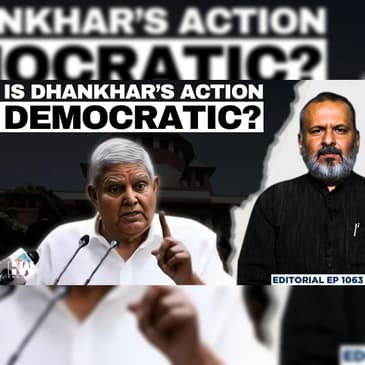
In this episode of Editorial, Mr. Sujit Nair discusses a statement made by the Vice President of India, Jagdeep Dhankhar, regarding the judiciary. Mr. Dhankhar has criticised the Supreme Court for setting a deadline for the President’s assent to state bills. Mr. Nair questions whether the Vice President has the authority to challenge the judiciary.
Learn more about your ad choices. Visit megaphone.fm/adchoices
[00:00:00] Namaskar, welcome to another episode of editorial. Now our Vice President Mr. Jagdeep Dhankhar is very angry. He is angry because he says hello Supreme Court who are you to give deadlines to the to the President of India?
[00:00:22] Who is it? Now let's discuss his speech threat bear, let's discuss his thought threat bear, then we will put our opinion in front of you, then you decide whether he is correct or whether what the Supreme Court did was right.
[00:00:43] So let's get right into the show. Now the thing is the Supreme Court said that listen you know what Governor, President, President cannot take unlimited time to decide on a bill, to give assent on a bill, unlimited time. The court said President take three months, Governor take one month, in one month decide on the bill.
[00:01:11] And possibly the reason they said it is because if the Governor and the President does not decide on a bill, then why is the Assembly there? Why is the Parliament there? They come, they discuss and they debate, they fight and finally they make a bill and they pass the bill and that bill the Governor says no. Unlimited period.
[00:01:34] The court said the President cannot have a pocket veto. You put the bill in abeyance, not ascending on the bill. You can't have a pocket veto. It's a democracy and end of the day it harms the interest of the people.
[00:01:54] Ah, this was what the Supreme Court said. Now let us come to Jagdeep Dhankar. Jagdeep Dhankar, the famous Vice President of India, also the Chairperson of Rajya Sabha. Now before I get into the Law, before I get into all this, this what he said and how he said and all that, let us first understand, does he have the right to say what he said?
[00:02:21] You see, a Vice President, according to our Constitution, is not a member of the Parliament. A Vice President is not a member of the Parliament. In fact, while the Vice President presides over the Rajya Sabha, they are not a member of the House and do not participate in debates or ordinary voting. They don't participate in debates, they don't participate in voting, they are not a member of Rajya Sabha. He presides over Rajya Sabha.
[00:02:50] This is what a Vice President is supposed to do. The Vice President is not part of the legislative process in the same way as elected or nominated members of the Parliament are. So, the Vice President is not the hero who will come and debate and who will say, that is not his job. His job is to preside.
[00:03:17] To conduct the process smoothly and legally and constitutionally. That's what his job is. But then, we saw Jagdeep Denkar as a Governor in West Bengal. A Governor's job is also not interfering in the administration of the state. But Mr. Denkar was very famously known for interfering with the administration of the state.
[00:03:42] So, there too, he, I think, to my mind, this is my opinion, he didn't perform his duty as a Governor, but he performed a duty as a good Bharatiyan Janata Party Party worker. He performed his duty that way. This is what I think, my opinion. Okay? Unfortunately, I think he is doing the same as the Vice President of this country.
[00:04:07] And, somewhere down the line, what he is preaching may harm this country and take this country towards fascism. I'll tell you what I mean by that. You see, Denkar said that Article 142 of the Constitution which gives Supreme Court special powers has become a nuclear missile against democratic forces available in the judiciary 24 by 7.
[00:04:32] He said, yeah, yeah, yeah, yeah. You know, this, this, this, this article 142 which gives judiciary the right to question the legislature and if you see, a lot of questions were, were asked by the judiciary thanks to that, that there is certain amount of democracy still left. He said 142 is very bad. What do you mean judiciary asking questions? He says that, you see, there is a directive to the President by the recent judgment which is what I told you.
[00:05:00] He said, where are we heading? He asks, what is happening in the country? We have to be extremely sensitive. It is not a question of someone filing a review or not. We never bargained for democracy for this day. This I agree. We never bargained for democracy for a day like this. That I agree. 100% agree, 300% agree.
[00:05:22] Okay. Okay. He says, okay. He says, president being called upon to decide a time-bound manner and if not, it becomes law. So, we have the judges who will legislate, who will perform, execute functions, who will act as per parliament and absolutely have no accountability because law of the land does not apply to them.
[00:05:45] He says, who are these judges? They are super legislatures. So, they will today tell president that do this or it will be law. Okay. See, my first problem. My first problem is a constitutional authority is questioning another constitutional authority in an open parliament.
[00:06:09] These are things that should have been discussed in closed doors and anyway, Jagdeep Dankar doesn't have the right to do all this. It is a legislature, elected member of the parliament who should have been discussing all this. Jagdeep Dankar didn't win one vote. He is not sitting there because he won the mandate of the people. He is sitting there because somebody nominated him there and he was favored and he was made to sit there. So, he is sitting there.
[00:06:36] So, his question is that how can you question the president? According to him, the president doesn't want to look at one particular state. I am not saying president doesn't look at one particular state or otherwise. That is not what I am saying. I am just giving an example. I am saying if the president says,
[00:06:56] I don't want to take care of, I don't want to look at this state, I don't want to give assent to this particular state or the governor concerned there doesn't want to do that. That is okay. You can't question. You are super legislator, he asks the judges. Now, pray tell me, a bill is passed by 545 elected members of the parliament
[00:07:26] or whatever the number is, elected member of legislative assembly in that particular state assembly. elected members, your and my representative. These people, they pass the bill. Which means, I have to assume that majority of my country is for the particular bill. Is it fine if I assume that? Because that is what democracy is all about. Correct? Okay. Now, this bill is stopped by a
[00:07:55] non-elected nominated member called the governor who is not elected at all. He or she may not even be in politics. He or she may not even know what administration is. He or she may be some cultural organization and come from some cultural organization before that and sitting in the whatever, governor's chair and he can stop and assent to the bill. That's okay. But the public mandate, legislature, gone down the whatever.
[00:08:25] Correct? He says, 545 MPs who are sitting in the parliament, the president, the president can take innumerable, I mean, whatever time, unlimited time to, to give an assent to the bill. Who are those 545 people? People elected by the, the people of this country. The so-called absolute representation, manifestation of democracy. That's that people. Those people give, pass a bill,
[00:08:56] and want that to be an act and the president can decide and say, ne karta ja. Ne karta ja. I'll take time. And the court says, no. If you want to think on something, think within 3 months. If a governor wants to, wants to reconsider, review, take one month, review for one month. Do it in a time-bound fashion so that the development of the people of that state, stroke the country, doesn't suffer.
[00:09:25] Is that fair? And this man is talking about democracy and he himself says that people who are not elected through democratic process can hold on to a bill unlimited time. He is favoring that and he is questioning a judge who is also not elected, but he is questioning a judge who says that, Baba, at least put some deadline. Put some deadline because it's, it's the growth of a state, stroke the country, which you are putting, unlimited, you are pushing,
[00:09:56] you are, you are delaying. Now, you think about it. You think about it. Who is right and who is wrong? A non-elected member, a nominated member because he did a lot of favors for that particular political party is part of democracy. He can take all decisions. He can delay all decisions. But a chief justice of India who interprets the constitution, he cannot.
[00:10:26] This is democracy. That is not. You see, I have always been somebody who has questioned the judiciary. If people who are, some of you who may be watching us regularly, a lot of questions I have raised against the judiciary. Of course, there should be judicial reforms. Is there a doubt to that? Absolutely. None in my mind. You need judicial reforms. But the point is, as far as constitution is concerned,
[00:10:56] it is not the vice president of the country who should be talking all this and bringing in front of camera and speaking to the people and speaking to the country. It is not his job. Senior ministers from the ruling government, law minister from the ruling government, can speak. Had the law minister said this, it would have been understood. Fair enough, the law minister is replying or reciprocating to what the Supreme Court said. One can understand. It is part of their job.
[00:11:25] He is questioning another nominated person. He himself is nominated and he forgets that. Achha, he went on to say that, you know, an event happened on 14th and 15th of March in New Delhi at the residence of a judge. For seven days, no one knew about it. We have to ask the question to ourselves, is the delay explainable? Condonable? Does it not raise certain fundamental questions? In an ordinary situation, the ordinary situation defines rule of law.
[00:11:55] Things would have been different. It was only on 21st March disclosed by the newspaper that the people of the country were shocked as never before. Thereafter, unfortunately, in public domain, we had inputs from an authoritative source that the Supreme Court of India and the inputs indicated culpability. Inputs did not lead to doubts or something was amiss. Something required to be investigated. The nation is restive because of our institution to which people
[00:12:25] who have looked up always with high respect and defense was put in the dock. Achha, now he talks about that corruption case that justice Verma where the money was found and what happened to that. Fair enough. The question what he asked is very valid. Was he wrong? No, no. He is right in asking all these questions. Perfect. Good questions. The fact again, I say it was not his job to ask these questions. It would have been ideal if a law minister would have asked the question but a law minister will not ask that question.
[00:12:55] You know why a law minister will not ask the question? Because then in this same breath, in this same breath, this vice president should have asked the home ministry saying that what are you doing? Are your inspectors, your Delhi police went there. They were not allowed to do spot panchanama. They were asked to go. Go. Go. This is what happened. The home ministry should have asked the commissioner of police, Delhi, as to why was there no spot panchanama?
[00:13:26] Is law different to a judge and different to a common man? Is police action different to a judge, different to a common man? Who is responsible for this? So as much as he is trying to put the entire blame on judiciary, which he should, but he should also ask his own government, which he will never, that listen, home ministry, hello? What happened? Why is there no investigation? Why are you not investigating? Why is it Delhi police? Can anybody stop Delhi police from investigating? Can anybody stop
[00:13:56] CBI from investigating? Why hasn't that happened? Why hasn't that happened? Isn't that the responsibility of the government? So why is he being one-sided when he is asking questions? So the point is, as always, I believe that more than anybody else, a vice president is a political.
[00:14:26] A vice president is the vice president of the country. He is not the vice president of the parliament. I mentioned to you, he is not a member of the parliament. So he is not a vice president of the parliament. He is the vice president of the country, parliament included. He happens to be the chairperson of Rajya Prasad Sabha. The fact remains that that's something that he should understand. So either he behaves and keeps quiet
[00:14:55] and let the parliament and the legislature do the talking, do the debating and he conducts that debate in an orderly and in a legal and a constitutional fashion which his job is. But that, this job part of it, he always went beyond the brief when it came to governor of West Bengal. Now he is going beyond his brief when it comes to the vice president of India or the chairperson
[00:15:25] of Rajya Sabha. He is not fighting for the democracy. I believe my personal opinion is he is fighting and talking for his political dispensation. This is the point I wanted to make. Till I see you next time. That's tomorrow at 10. Namaskar.