
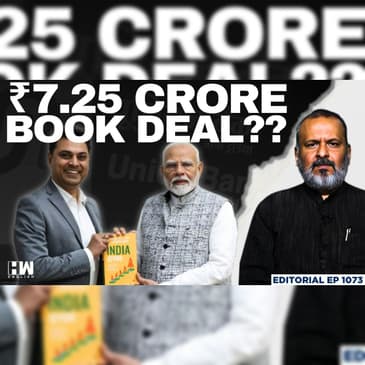
In this episode of Editorial, Mr. Sujit Nair discusses the suspension of India’s Executive Director at the IMF, Krishnamurthy V. Subramanian, amid concerns over alleged impropriety related to the promotion of his book and violations of certain internal IMF protocols. The Union Bank of India purchased 2 lakh copies of Subramanian’s book for ₹7.25 crore for distribution. The bank is now under scrutiny for this purchase, with top leadership claiming they were unaware of the transaction.
Learn more about your ad choices. Visit megaphone.fm/adchoices
[00:00:00] Namaskar, Welcome to another episode of Editorial. Today I have a story about a gentleman called Krishnamurthy Subramanian. Krishnamurthy Subramanian was a former chief economic advisor. Krishnamurthy Subramanian was then appointed as executive director by the appointment committee.
[00:00:27] Guess who are in the appointment committee? The Prime Minister of India Mr. Narendra Modi and of course the Home Minister of India Mr. Amit Shah. He was appointed as the executive director of International Monetary Fund. Then something interesting happened. Let us discuss what happened. Let's get right into the show.
[00:00:49] So let's talk about Krishnamurthy Subramanian. Krishnamurthy Subramanian was a professor in ISB. The appointments committee of the cabinet which includes the Prime Minister and the Home Minister that is Mr. Narendra Modi and Mr. Amit Shah, they thought that Mr. Krishnamurthy would be a very good chief economic advisor. So he was appointed as the chief economic advisor of India.
[00:01:23] Afterwards, they thought that he could do better. So he could do better. So he was elevated from the chief economic advisor of India to executive director in the International Monetary Fund. So India, Silekar, he was sent to IMF. Okay, now Krishnamurthy Subramanian was sitting in IMF as executive director representing India. Story starts from here.
[00:01:53] Krishnamurthy Subramanian decided to write a book. He decided he wants to write a book and he wrote a book. He wrote a book called India at 100. And in this book called India at 100 which was published by Rupa publication which is one of the best in the world, one of the best in the country at least.
[00:02:14] Rupa publication in the book spoke about India, Indian economy touching 55 trillion USDs by 2047. That is what the book was all about. So Krishnamurthy Subramanian wrote a book. Then problem was Karithika Koon. Who is going to read the book?
[00:02:37] So it is said, it is said that Subramanian Krishnamurthy used his chair and called Union Bank and said Union Bank come here. He said listen, I am writing this book. Now somebody has to read? No. So what you do is you buy 7 crore worth of book from us. 7.25 crore to be precise. I will write the book and you ensure that you buy the book and then you distribute it. You distribute it to whoever you want.
[00:03:07] Bank said okay sir, we will do it. Achha, now whose money is this Union Bank using? It is the depositors money, end of the day. It is the money of common Indians which Union Bank is doing. Why? To promote Krishnamurthy's book. Now, technically this entire thing comes under some kind of a promotion, marketing promotion for the bank. That is how it is normally seen.
[00:03:36] So when the bank gives out some free gifts to their customers, to their dealers, to their employees, it is seen as a promotion or a brand enhancement exercise as it is called professionally.
[00:03:52] Now, let me first clear this doubt from your mind. Distributing a book written by some Subramanian Krishnamurthy who once upon a time used to be the chief economic advisor of India and now then, in fact after that he was sacked, I will come to that.
[00:04:12] The executive director of monetary fund calling people, calling retailers or calling their customer base and giving these books will have no brand benefit for Union Bank of India. Absolutely no brand benefit for Union Bank of India. Giving a pack of chocolates to their important customers, to their regular customers, to their loyal customers would have more effect on their brand than giving a book to these customers.
[00:04:40] Let me tell you very frankly. So this is where it is. So the fact remains that this book was purchased for 7.25 crores and doled out by the bank. Now let us come to the bank perspective. The bank decided to purchase nearly 2 lakh copies at the cost of 7.25 crores to distribute among customers, local schools, colleges, library, etc.
[00:05:10] So Union Bank, bank, okay, goes to customers and gives every customer, customer who is whatever walk of life, he calls the bank, gives a book. Book, book, book. This is a gift from us. Goes to school, goes to libraries and just hands over this book. Why? Because they have to purchase 7.25 crore book. Why? Because the former chief economic advisor told them, no? Problem ne mangta hai. So they purchased.
[00:05:40] Okay. Now, interesting factor is that Economic Times had identified two letters. Two letters which was issued on June and July of 2024, a head of book publication in August,
[00:05:56] where the bank's support services department at its central office wrote to its 18 zonal heads informing them of the decision by the top management to procure and distribute hardcover and paperback version of the book among customers. Corporate, Pan India, as well as local schools, colleges, libraries, etc. This is what Economic Times got.
[00:06:20] Economic Times could lay their hands on this particular circular where they stole their 18 regional offices. You could do it. You could do it. College is cool like I told you. Local customer work. Distribute it. But buy it. The letter went on to say the decision to purchase 1,89,450 copies.
[00:06:41] 1,89,450 copies which equals to 10,525 copies each by 18 zonal banks. Now, you know, to make a book bestselling, to make a bestselling book, you need to circulate 10,000 copies. So, 10,000 copies sold, you are the bestseller. So, our man, Mr. Krishnamurthy became bestseller by sitting at home.
[00:07:09] Some bank bought it and called customer and said, 1,89,450 copies of paperback at Rs. 350 and 10,422 copies of hardcover at 597. This is the right math. So, technically, like I told you, 7.25 crores of total books.
[00:07:36] So, books were bought and given away, doled out so that Krishnamurthy gets money and he is seen as a bestseller. So, next time when you talk about Krishnamurthy, you will say, Krishnamurthy, the bestselling author. The bestselling author of India at 100. This is the unfortunate part. You paid for it. You paid for it.
[00:08:03] It was sold under the garb of advertising and marketing, fake advertising and marketing, for the simple reason that this marketing, this advertising will do nothing for the brand. I am telling you, with my 30 years of brand management experience, I tell you, this will do nothing for the brand. All it does is that the Krishnamurthy will earn money and Krishnamurthy, whatever brand famous that person would be,
[00:08:30] even if it is like somebody forces the book on somebody and that somebody who gets the book uses it for having bhelpuri, this Krishnamurthy, whatever, will become famous. People will know his name. The bank gets nothing out of it. But the bank spent your money, which you deposited in the bank, the bank spent 7.25 crores. Now, this is as far as the bank is concerned.
[00:08:53] Now, let me tell you, the bank as always, typical what you see in the government sector. The bank managing director and chief executive, A. Mani Meghalai and chairman Srinivasan Vardarajan, they did not respond to Economic Times, who broke the story. They did not respond to Economic Times. But they said, you know, we don't know. We don't know anything. In fact, Mani Meghalai informed the board, according to people aware of the development,
[00:09:23] some according to sources, Mani Meghalai informed the board that she had asked Mishra to make the purchase. Girija Mishra was the general manager who made the purchase. She asked Mishra to make the purchase, but not break any rules, Baba. Not break any rules. What rules? Why purchase? What was the logic of purchasing some chief economic advisor's book? What was the logic? India had 100. 19, 2047, what India would be?
[00:09:51] This bank is purchasing and giving it to their customers. Why? What was the logic? What was the brand logic? Is there an advertising agency that endorsed it and saying that do this and it will enhance your brand? Is there a brand strategist who said this that it will enhance your brand? No. But the way, I told the general manager, you should not break any rules, but you buy the book. You buy the book. This is what the union bank chief executive and managing director A. Mani Meghalai said.
[00:10:20] I told Mishra, Giriraj Mishra, who finally became the scapegoat because finally he was suspended. Giriraj Mishra was suspended. Why? Why? Why he signed the order? This is exactly typically what happens.
[00:10:38] You know, we spoke about accountability and the reason I want to talk to you not just to show you how your money is being spent by these banks and why is it that, you know, these banks have NPAs and these you see so many frauds in the bank. The reason I am talking to you is I am still on the topic of accountability. Where is Mr. Modi's accountability? He hired, no? He hired this Krishnamurti Subramanian.
[00:11:07] Where is Mr. Amishra's responsibility? They were the one who hired him. They were the one who alleviated him and sent him to represent India in International Monetary Fund. And you know how crucial it was. Subramanian's exit, India pulled him back. India asked him to come back. India told him enough. India's exit comes days before the IMF Executive Board meeting on 9th of May, which will review funding arrangement for Pakistan.
[00:11:37] India is likely to oppose the additional financial assistance to Pakistan in the meeting. Look at the crucial time. The crucial time this man had to be recalled. India appointed the wrong person for the job. The appointments committee of the cabinet, which includes Prime Minister and the Home Minister, appointed wrong person for the job. Where is the accountability? Where is the accountability?
[00:12:06] The chief executive, the managing director and the chairman, that is Mani Mechala and the chairman, Srinivasan Varadarajan. What is the problem? What is the problem? Seven crores of money spent on promotions and the chairman and the managing director doesn't know is almost impossible. Anyone watching me, advertising, marketing people who are watching me, please write down in your comment below.
[00:12:30] Have you ever seen a seven crore spend happening without the chairman and the managing director not kept in the loop? It does not happen in our country. And if it is happening in Union Bank, then it is the biggest fraud then. It is the biggest fraud. Seven crore just goes off and the managing director and the chairman is not kept in the loop. If it was part of a large campaign, it's a different issue here.
[00:12:58] It is you're going out of the way to buy somebody's book and just distribute it, dole it out. And the board is not aware of it. Then why is the board there for? Where is the accountability of Mani Mechala and Srinivasan Varadarajan? Where is where are their accountability? You sack the lowest common denominator in the structure. That is a general manager who happened to sign because you forced him to sign. Where is your responsibility? Why is the chairman not sacked? Why is the managing director not sacked?
[00:13:28] It is time India asked these questions. Otherwise, it is very easy. I mean, just let me represent the situation to you beforehand. A professor who was appointed as the chief economic advisor, who then was elevated as a representative, the executive director representing India to International Monetary Fund, decided to write a book where he said that India after 100 years,
[00:13:58] that is in 2047 will become a 55 trillion economy. That book he wrote. And then one Indian bank with Indian people's money, they decided to buy close to 2 lakh copies of his book, paper bag and hardtop, 2 lakh copies of his book, worth 7.25 crores. Possibly this is the only people who bought his book. 7.25 crores that book was bought. To be doled out to people free of cost.
[00:14:27] Customer, customer, whatever, customer, dealer, whatever, whatever, whatever. And then when this entire thing, this FOPA was bought to people's notice, the chairman manager said, we don't know. I told Papa, but I said you should not break any law. And finally, the person who signed was suspended with immediate effect. And this Krishnamurti is also suspended with immediate effect.
[00:14:57] Matter closed. India should ask the prime minister. India should ask the home minister. If you take up the responsibility of hiring, you should take up the responsibility of justifying why that person committed fraud. That is your responsibility. If you are in corporate India, you would be asked that question. The chairman and the managing director of union bank should be responsible for the 7.25 crores. Sack them first. Then sack Mishra. Or suspend Mishra.
[00:15:26] They should be responsible. 7.25 crore or public money has been spent. Spend on things which were absolutely unnecessary under the name of branding. Sack them first. This would be justice. If India starts asking people for accountability, trust me, we will see justice. We will see growth. If not, all this is hogwash. Till I see you next time. That's tomorrow at 10.
[00:15:56] Namaskar.