
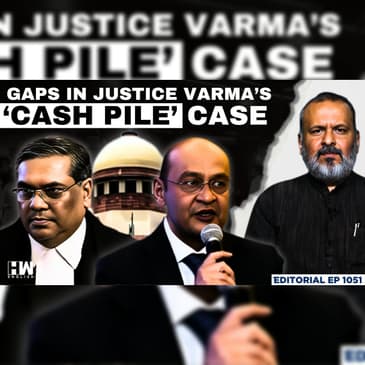
In this episode of Editorial, Mr. Sujit Nair discusses Justice Yashwant Varma’s case, in which ₹15 crore was allegedly found at his home. The Supreme Court has formed a three-member committee to investigate the matter. Through this episode, Mr. Nair raises crucial unanswered questions about the case. He also examines whether politicians are using this case to revive discussions on the NJAC Act, which was previously struck down by the Supreme Court.
Learn more about your ad choices. Visit megaphone.fm/adchoices
[00:00:00] Namaskar, Welcome to another episode of Editorial. Now there are a lot of questions that are still unanswered as far as Justice Yashwant Varma's fire incident is concerned. Remember Justice Varma, fire 15 crore rupees cash at home. Now there are a lot of questions.
[00:00:24] Lot of questions and is there a political angle to all of this? Let's get right into the show and figure out. Fire happened 14th March Holy Day, 14th March 11.30pm. Fire extinguished 12th midnight 15th March.
[00:00:52] So half an hour fire happened, half an hour fire extinguished. And the police personnel who were on the spot during the fire, five police personnel, Justice Varma's secretary came and told them, Police had come to investigate and police, Delhi police were told, Come tomorrow morning, he said.
[00:01:22] Police went. So it is that simple. Come tomorrow morning. Okay. Tomorrow morning, as in the next day morning, police came again. Again, the secretary said, The fact remains that, Why is this important? And why is this issue that has to be taken up? Is A. Why was the secretary not allowing the police to do a spot panchanama?
[00:01:52] And most importantly, Why did Delhi police not insist on a spot panchanama? On a spot panchanama? Because spot panchanama is possibly one of the most important evidence that the police collects. Spot panchanama is when you are on the spot of the crime or whatever, crime, incident, whatever it is, accident, whatever it is, you are on the spot and you record whatever is there on the spot.
[00:02:21] Had that spot panchanama happened, the police would have then possibly recorded that there was X amount of cash that was lying there, either they would have recorded it or they would have not. If the cash was there, they would have recorded it. If the cash was not there, they would have not recorded it. They would have recorded the cash if it is there or not. And then they would have asked five independent witnesses to sign on that spot panchanama. What then could have happened is, nobody could have denied the fact that
[00:02:50] Paisa hai, paisa nahi hai, paisa hai, paisa nahi hai, money was there, money is not there, money is there, money is not there. The fire brigade said, I never said money is there. Then the fire brigade said that I never said that money is not there. So then the justice says that I don't know about the money, my family was never shown the money, my family was never told that there was money, so on and so forth. All this argument and all this is left in open and all this is now a debate is purely because of spot panchanama was not done.
[00:03:20] Why was the spot panchanama not done? Because the five police personnel who came, the secretary of the judge said, no, no, no, in the last time. What is this? Is this how our law enforcement is stricken? Just because he is a judge? And most importantly, is this how Delhi police is? So this is how we have to believe. So had it not been fire, had it been a murder, God forbid, had it been a murder and the judge's secretary would have told Delhi police, abhi ne baat me haotum, abhi ne,
[00:03:50] you come tomorrow morning and investigate, would they have gone back? Without doing a panchanama? Why would police not do their duty? Why did that five people not do their duty? Why is that not questioned? Their duty was to go there and do the panchanama, whether a secretary says it or not, ask the secretary to go take a walk and if he stops them from doing their duty, they could have arrested him. It's well within the rights of the police.
[00:04:19] So that's a very, very major question that needs to be asked. Secondly, the police commissioner informs the high court chief justice, Delhi high court chief justice next day at 4.30. This is what, according to Indian Express, he is informed next day at 4.30. Why so much delay? Even took place 11.30 last night, high court judge informed next day at 4.30.
[00:04:47] And with all this 15 courts, etc. being spoken about, all of this came to limelight on the 21st. Kolojiwa and all were called on the 21st. 21st. 14th? 21st. 7 days? 8 days? 14th was last to last Holy Friday and 21st is last Friday. Friday to Friday, nobody spoke about it. Pandya, Kurud, lying in somebody's house. Nobody spoke about it. Nobody talked about it.
[00:05:16] No, no, no news about it. So, the question is, what exactly is the story? What exactly is the story and why was it taken so lightly? 15 courts was found in a man's house. 15 lakhs if it is found in a man's house, a common man's house, there will be police, ED, IT, everything pouncing on him. 15 courts found in a judge's house, at least,
[00:05:45] allegedly found in the judge's house. Let us use this word, allegedly very clearly. Allegedly found in the judge's house and it is now going to be allegedly for a long time because where is the spark puncha nama? Allegedly going to, found in this judge's house and the fact remains that nobody knows about it. It took seven days for people to even react. Now, that's point number one. Point number two is, there is a three-member committee that Chief Justice of India,
[00:06:14] Sanjeev Khanna, has appointed. So, three-member investigative team and that three-member committee includes Chief Justice of Punjab and Haryana High Court, Justice Sheer Lagu, Chief Justice of Himachal Pradesh High Court, Justice G.S. Sandhya Walia and Justice Anu Shivraman of Karnataka High Court. They are the three-member team that is going to investigate into this matter, into this
[00:06:41] was the money there or not there? This is what the three-member team will be investigating. So, this is where the scene is. This, like I told you, could have been easily sorted out had there been a spot panchirama and the spot panchirama said that we found the money. Anyway, let's go to the next. Now, this is one end of the story. Now, let's look at another aspect of this entire incident. Is this incident
[00:07:10] being used as a tool, as a political tool so that NJAC can be implemented? NJAC is National Judicial Appointments Commission was passed in Loksabha 2014 but Supreme Court did not accept it. Supreme Court shot it down. Supreme Court said nothing to it. NJAC is questions the fact that why should be the appointment of judges especially in higher courts that is high court
[00:07:40] why should the appointment of judges be decided by a collegium? Why is there no published representation there? Judiciary said nothing doing. Nothing doing. There will be no outsiders. The judges will decide who will be apt for which court that let the collegium decide. Now, I will give you a brief of what NJAC is. The act says that now, it is not the collegium
[00:08:10] that is going to be appointing judges. It will be a six-member committee. Six-member committee will consist of one chief justice who will head the committee. The chief justice of India that is will head the committee. Two senior Supreme Court judges. Fourth law minister and two more eminent personalities from the country. Two eminent personalities from the country. So, that is how the six-member team will happen. Now, who will
[00:08:40] decide who is the eminent personality? Prime minister. The prime minister will decide who is the eminent personality. The CGI will decide who is the eminent personality. The leader of the largest opposition party will decide who the two eminent personality is. So, that is how the six-member team will be made. Now, firstly, I want you to think about it. Is Cologium right or is NJAC right? Cologium
[00:09:10] appoints judges at will. It is not that the Cologium has been absolutely crystal clear and, you know, pick and span, squeaky clean when it comes to appointment of judges. We have seen a lot of judges appointed by the Cologium. People who are judges who have been communal, judges who have made communal statements, judges who had prejudice against certain community, you know, these kind of people were appointed
[00:09:41] by this Cologium. So, it is not that the Cologium was doing a fabulous job. So, that is as far as the Cologium appointing the judges are concerned. But in the name of democracy, in the name of democracy, our politicians normally, especially the party in power, will try to appoint people in every constitutional position, people who they want. Then what happens is, what happened
[00:10:11] with the CBI chief? the CBI chief is appointed by the prime minister, the chief justice and the opposition leader. What happened? Even now, the opposition is crying about the election commission. All these are supposed to be appointed by the prime minister and the opposition leader, prime minister and the CGI and the opposition leader. All of these combinations, all these are appointed that way. All these people were appointed that way. What happened?
[00:10:41] Can we boldly say that they are all fair appointments? So, the democratic process of involving public representative has also not worked. So, this is the problem with NJAC. Now, Yulisahed, you think, write down in your comment box below, whether you think NJAC is good or Kolojim is better. Now, the point that I am trying to make is, today, our vice president, Rajasaba chairperson, has gone around, that is, Mr. Dhankar,
[00:11:11] has been now talking about, you know, why don't we reimplement? Why don't we talk NJAC again? He says, see how that judge has taken money, see what has happened? Had we done it through NJAC, nothing of this sort would have happened. This is what he says. He is gathering force, he is gathering opposition parties, he is gathering opposition numbers, putting them together, pulling them together and saying that, listen, let us execute NJAC, let us implement NJAC. Like I told you,
[00:11:41] let me tell you, whatever the political parties, today the opposition or non-opposition, whatever the political parties would say, privately, every political party, every politician wants NJAC to happen, so that, they know today or tomorrow they may come to power and no political party would want an independent appointment, an independent body appointing judges or an independent body appointing CBI chiefs or an independent body appointing CBT chief or an independent body appointing
[00:12:11] election commission, no politician wants that. They want to interfere so that when they are in power, they have absolute control. This is where the stance is. Now, this is what I meant when I said that are we using this incident to direct or to meet this political end of implementing NJAC. think about it, let me know your views, write down in the comment box below and
[00:12:41] till I see you next time, that's tomorrow at 10. Namaskar.