
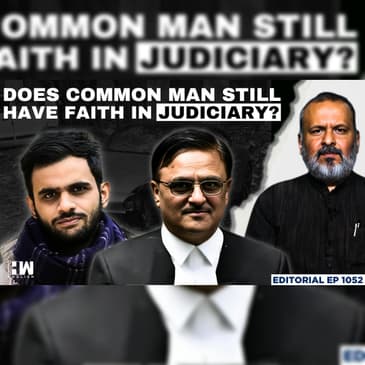
In this episode of Editorial, Mr. Nair discusses a key point raised by Supreme Court Justice AS Oka. Justice Oka has expressed concerns over case pendency and judicial expectations. He also noted that it may not be entirely correct to assume that the common man has full faith in the judiciary.
Learn more about your ad choices. Visit megaphone.fm/adchoices
[00:00:00] Namaskar! Welcome to another episode of Editorial. You know all these years, my effort of actually coming and presenting my Editorial in front of you is to make you aware of what the reality is.
[00:00:24] What the reality about our country, our democracy, our society is and I leave it to your discrete decision as to what you conclude out of what I present to you.
[00:00:39] I don't intend to influence your decision or help you make up your mind but what I want you to do is understand what is happening around you, things which may not be very sensational, things which may not be trending but yet things which are important to a common man. I dedicate my editorial to a common Indian, to a common middle class Indian.
[00:01:06] I am not too bothered about the rich and I am not like I said to bother about bringing about sensational stories or sensational topics and talking in front of you topics that trend so on and so forth. My intention is to bring in front of you topics that concern you. Today there is one such topic that I need to speak to you with.
[00:01:37] Not entirely correct to say a common man has full faith in judiciary. Not entirely correct to say a common man has full faith in judiciary. I don't say this. I don't say this. Supreme Court Judge A.S. Oka says this. Imagine a country which doesn't entirely trust its judiciary. Let's get right into the show. Let's talk about it.
[00:02:09] Actually, imagine a country that doesn't entirely trust its judiciary. Imagine a country that doesn't entirely trust its public representative. That is the legislature. Imagine a country that doesn't entirely trust its executives. That is your babus, your administrators.
[00:02:37] Imagine a country that doesn't entirely trust the media. This is where our democracy is currently placed. If you ask a common man on the street as to whether he or she trusts his ministers, his political whatever, his public representative. Does he trust, he or she trusts the answer could be possibly no.
[00:03:06] From a large section of that audience. If you ask the same audience whether he or she trusts the judiciary, answer could be no. Same thing with executive and same thing with media. If this is where we stand, think about it. Think about it. If this is where we stand today, then what democracy are we talking about? What world's largest democracy are we talking about?
[00:03:35] Are we a democracy in the first place? Then how is the situation different to situation hundred years back, thousand years back when we had rulers and we were slaves. Rulers would rule over us and we would do our work, create money, give taxes and then try to fend our family. How is it different now? Nomenclature and all, it's okay.
[00:04:04] But how is it technically different? This is the question I want you to ponder today. Now I am going to read out statements made by Justice A.S. Oka and very, very interesting statements. And then we will take this forward. He says, we kept patting our backs that citizens trust the court.
[00:04:32] But we have to ask if citizens are saying that. I have been to villages, etc. The statement that common man has full faith in judiciary may not be entirely correct. Out of 4.5 crore pending cases, 10% of the cases are over a decade old.
[00:04:54] Dr. Ambedkar, he said, had warned that in independent India unconstitutional means of protest are prohibited. If today lawyers practicing in the high court takes recourse to something completely unconstitutional, are we not causing big prejudice to litigants? We talk about great penitency in bigger high courts. And who is contributing to it?
[00:05:23] Imagine, there are 1000 bail applications before 5 courts and 100 will be taken up. If the members boycott, then the date will be given when the accused is entitled for a bail. Who is to blame? We have forgotten that brevity is the hallmark for great advocacy. It is our problem also. We write long judgments.
[00:05:51] Judges also have to decide that no lawyer shall be allowed to hijack judicial time. Lawyers have to realize that our time is precious. A couple of very interesting issues that this judge talks about. And one of the most interesting issues that he is talking about is the concept of bail.
[00:06:16] Now, predominantly, predominantly this concept of jail is an exception. Bail is the rule. This concept is spoken up by a lot of judges, especially some former chief justices who only spoke rather, didn't do much but spoke a lot. So, such people have always been advocating this concept of jail is an exception. Bail is the rule.
[00:06:46] But when it actually happens, like this judge says, that if there are 1000 bail cases, bail application spending, only 100 are taken up. And if there is some discrepancy, some protest, some failure, technical failure, whatever that particular day, those 100 people also blocked.
[00:07:06] So, those 100 people or those 1000 people who are languishing in the jail, languishes because the judges don't have time to pick up the application and hear it. So, where is this concept of bail? Where is this concept of bail is the rule and jail is the exception.
[00:07:33] Imagine you pick up a person, put him behind bars. You pick up a human being and put that human being behind bars like a caged animal that to his crime, you put him behind bars, him or her behind bars and he can't exercise his rights. Now, tell me, isn't it dichotomy? Isn't this entire situation a dichotomy or a paradox even?
[00:08:04] Because judges are supposed to provide justice. Courts are supposed to provide justice. The justice that is supposed to be provided to an accused is that his opportunity to be heard, his opportunity to get bail, that is the justice that needs to be provided to an accused, which is not provided because the courts cannot provide it.
[00:08:27] So, the very system that has to provide justice actually destroys the concept of justice. Isn't that a paradox? Isn't that weird?
[00:08:42] The system that needs to ensure that corruption, harassment against women, etc. are eradicated from this society. The system that actually punishes people for harassing a woman or for corruption is the very system that indulges in harassment of a woman,
[00:09:10] sits in the bench to judge himself and judges himself as innocent and walks out. This is the judiciary we are talking about. The system that is supposed to eradicate corruption from this country, which is possibly one of the biggest problems that this country is facing,
[00:09:33] that particular system, the man with that black coat sitting in that chair, they say he has a rate card. He or she has a rate card. That is what the allegation is. He or she has a rate card. So, you pay and you get justice the way you want it to be. Now tell me, what are we creating? And what are we talking about?
[00:10:03] What justice system are we talking about? Like I told you yesterday, the government says I want to get involved in appointment of judges. Justice says the court system, the Indian judicial system says nothing doing. We will appoint the judges. We will create a collageum. We will appoint the judges because if the politician interferes, then you will be interfering or pressurizing the judge tomorrow. You never know.
[00:10:34] You know, it would have been a fair situation if the people of India would have said fine, you know, good. We trust the judges to appoint good judges in higher courts. So keep away the politician. Would have been a fairly okay situation. Or say that, listen, you know, we trust our politician. Let them decide who should be our judges. That is how the system should have actually worked. That is what democracy is all about.
[00:11:02] Public representative actually deciding. But look at the situation that we are facing here. And that's what I want to draw your attention to. We are facing a situation where we can neither trust the judge to appoint a fair, honest, non-corrupt, non-corrupt judge. Neither we can trust a politician to appoint a judge because you know that that politician is going to make use of that opportunity of appointing a judge in a higher court.
[00:11:30] He is going to ensure that the judge does exactly what he wants him to do. Look at the situation we are in. And the irony is our tax money pays that judge with all his 40 security personnel and his entire entourage. We pay for that judge and we elect and pay for our public representatives. For what? For them to rule over us. For what?
[00:12:00] For them to ensure that if we go to them seeking justice, we have to stand with folded hands, beg to them asking them for a tarik, asking them for a date. Or, you know, bail, just avoid it. Bail, not given because the case doesn't come up for hearing unless and until you are a famous person. Now, let me come to the third point.
[00:12:29] You see, I do not, respectfully, I say I do not agree to justice AS Oka. I do not agree to justice AS Oka. Because it is not the way he just said that there are thousand cases and hundred cases are randomly chosen. And then, you know, those hundred cases get bails. Others still wait for their right of getting a bail. They wait, they don't have a choice. Why? Because the system doesn't have that time.
[00:12:58] It doesn't work that way. It doesn't work that way because people who are powerful, people who are rich, people who are connected, politically connected, influential, these people get their time, their cases heard on time and they get whatever the best that the justice is. The justice system can provide them. That is what we normally see. And I don't say this either.
[00:13:26] This also is told by a judge. When a rich and influential comes in, the entire system goes, you see, this is what a judge said. A Supreme Court judge, a very respected Supreme Court judge said. I'm not saying this, which means this too is not correct. That, you know, thousand log, sir, 100 log, ko miltai justice. That statement is not entirely correct.
[00:13:51] Thousand logo me, in thousand people, 100 influential stroke rich gets priority to justice. Gets priority to justice. Now, let me tell you what I mean by what I just said. You see, let's take an example of Lakhimpur Kiri. Do you remember Lakhimpur Kiri case 2021?
[00:14:15] There was this union minister Ajay Mishra, who was a union junior minister for home and his son Ashish Mishra had allegedly crushed eight people to death. Eight anti-farm law protestors to death. Eight of them. 2021. Now, he incidentally was given a bail. He was given a bail by the Supreme Court.
[00:14:41] In fact, the Supreme Court had given him a conditional bail where he couldn't leave Lucknow and Delhi. And it was incidentally in 2025, the Supreme Court has asked the law enforcement department to go and investigate on allegations that he was seen all over the country. He has left the restricted area. This is the status. So, he was given a bail. Eight people were dead. Now, let's look at another case.
[00:15:11] 14 September 2020, a man called Umar Khalid. Umar Khalid was put behind bars under UAPA. That is, Unlawful Activities Prevention Act. UAPA. He was supposed to be the mastermind of violence that left 53 people dead, according to the police. He too was accused. 2020, September 14th, he is still behind bars. 2021, a man is out.
[00:15:42] What kind of law is this? You see, the Puna Porsche case, I am sure all of us are still, all of us still remember it. The couple was smashed, crushed to death again by a drunk driver. This happened May 2024, Bail June 2024. Got away.
[00:16:04] The point that I am trying to say is, justice must not be done, but must also be seen as done. Is what the famous definition of justice, justice system is. This is by Lord Hayward, the Lord Chief Justice of England, 18-1924. This is that one statement that the judicial system across the world follows. You tell me, do you think, you see justice has been done?
[00:16:34] Rules different for one person, rules different for another, and rules completely different for the third person. Is that how justice is supposed to be done? The point is, it is worrying me. It is worrying me. If our society is not very sure about our justice system, then forget about democracy and all. That is a lot of things that are the same. Forget about democracy.
[00:17:03] I am worried about we calling ourselves a society. A regular, civilized society. Because the only thing that distinguishes a civilized society to possibly the animal kingdom is our concept of justice.
[00:17:25] And if that concept is in question, then I don't know what the future holds for us. That's the point I wanted to make till I see you next time. That's tomorrow at 10. Namaskar.