
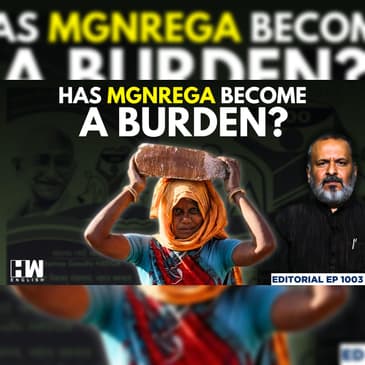

In this episode of Editorial, Mr. Sujit Nair discusses MGNREGA. Mr. Nair questions whether the increase in MGNREGA wages aligns with inflation and why the central government is delaying the release of these wages.
Learn more about your ad choices. Visit megaphone.fm/adchoices
[00:00:00] Namaskar! Welcome to another episode of Editorial. Manarega wages, first of all, why are Manarega wages pending? Secondly, the Manarega wages that are pending, are they in consonance with the rising price? Are they in consonance? Is it enough for our rural labour? Let's get right into the show.
[00:00:27] Mahatma Gandhi National Rural Employment Guarantee
[00:00:32] You see, I speak about Manarega very often. I speak about Manarega very often is because I believe that this is one scheme, this is one government scheme that can change the life of our rural labour.
[00:00:50] This is one government scheme that can actually alleviate our rural poverty and ensure that we have give some relief to the rural distress that currently our farmers and our rural workers are facing.
[00:01:06] Because 100 days of guaranteed work can ensure that they have an alternative to their regular agricultural labouring that they are doing currently, either they are small farmers or agricultural labour. At least there is an alternative.
[00:01:26] There is an alternative. There is an alternative. There is an alternative. There is an alternative. There is an alternative. There is an alternative. There is an alternative.
[00:01:32] So therefore, Manarega becomes the lifeline of the rural poor. And that is why I constantly make it a point whether I get viewers or not to talk about Manarega.
[00:01:44] Manarega. And I am doing the same today. While my topic is about the increment in Manarega wages, is it to the is it in consonance with the rising inflation where that is my topic. But before I get into my topic, I like to ask the government as to why are they keeping Manarega wages pending?
[00:02:09] Why are certain states not offering that 100 days of work?
[00:02:15] 5,000 odd crores. Let me tell you, according to Ministry of Rural Development, 5,553 crores, 5,553 crores still pending to West Bengal, which means the citizens of India, citizens, people staying in West Bengal are deprived of their right.
[00:02:41] It is a rural employment guarantee scheme. That guarantee is being deprived by the people who gave the guarantee. That is us, the government of India.
[00:02:53] What is their fault? The fault is that the West Bengal government is not in compliance with the Manarega rules. Possibly they may not be.
[00:03:04] But the point is, the fault lies with the government. The fault lies with administration, if at all there is. It lies with the government and the administration.
[00:03:16] You punish the government and the administration. Why are you punishing the rural poor?
[00:03:22] Why are you not offering them their money? Isn't it a very simple question?
[00:03:27] Okay, that's point number one. Point number two, and so is the case with a lot of states.
[00:03:33] Manarega is not working like a well-oiled machine where people get work and people get their wages for that.
[00:03:42] So, we will come back to that. The question in hand, the topic that I was going to talk to you about.
[00:03:48] You see, Manarega increments are based on Consumer Price Index for Agricultural Labor.
[00:03:56] That is CPIAL. That is what it is called. Consumer Price Index for Agricultural Labor.
[00:04:03] This is what Manarega increments are based on.
[00:04:07] So, the average increment that people have got as on March 2023 is 2% to 10%.
[00:04:15] This is the average increment. Like I told you, based on Consumer Price Index, Agricultural Labor.
[00:04:24] Now, if you look at it from money terms, the state that pays the highest as far as Manarega is concerned is Haryana, which is 374.
[00:04:33] And the state that pays the lowest is Arunachal Pradesh and Nagaland, which is 234.
[00:04:40] So, technically speaking, what I am trying to say and figuratively if you put it, you see, Haryana pays rural labor around 37,400 rupees per year.
[00:04:56] 37,400 rupees per year. The way I have done it is 374 multiplied by 100 working days.
[00:05:03] And Arunachal Pradesh and Nagaland pays you 23,400 rupees per year.
[00:05:11] Same, 234 multiplied by 100, which is 23,400 rupees.
[00:05:16] First of all, you decide, is that a figure that can feed a family in India under the current circumstances?
[00:05:26] The increment that you are giving is anything between 2% to 10%.
[00:05:30] That is assuming that you are getting a wage.
[00:05:32] Now, the issue is, somewhere down the line, Manarega is being dragged.
[00:05:40] Manarega looks to me, my personal opinion, it looks to me as if the government finds it as a burden.
[00:05:48] Other than as a project which has to be executed first in priority.
[00:05:53] I don't see that happening and that is precisely why I come in front of my audience, I talk about Manarega on a daily basis.
[00:06:01] Literally on a daily basis.
[00:06:02] My last point.
[00:06:04] My point is, why can't Manarega be seen as something that we are doing good for our agricultural labor, for our agriculture, for our rural poor and also doing good for our country?
[00:06:20] The point that I am trying to make is, are we using Manarega laborers for the benefit of our country?
[00:06:27] For the good, for higher production value for our country?
[00:06:31] Are we using it?
[00:06:33] You see, you have a lot of infrastructure development happening across the country.
[00:06:39] Most of them are city centric.
[00:06:41] But there is a lot of infrastructure development that is happening in the rural sector.
[00:06:46] Why are these laborers not involved in this, in this, in this infrastructural development?
[00:06:53] Number two is the first question itself.
[00:06:57] Why are infrastructural development not happening in rural India?
[00:07:03] If you develop infrastructure in rural India, you could productively use these labors for that development, which means the country benefits.
[00:07:11] We pay the laborers, the laborers benefit.
[00:07:13] We are all happy.
[00:07:15] Manarega does not become a burden for the country anymore like the way it seems to be.
[00:07:21] Like the way it seems to be.
[00:07:24] Because there are stories that Manarega people were asked to dig a hole and then fill the hole and then they had to be paid because it was a rural guarantee scheme.
[00:07:36] So, can't we use this more productively?
[00:07:40] Can't we focus on rural infrastructure which helps India, which helps the laborer?
[00:07:46] And can't we use rural labor for building our infrastructure instead of depending on huge companies, huge companies to take the contract and then get machineries and laborers from the city and do infrastructural work.
[00:08:05] Depriving that work opportunity for the poor, for the rural laborer.
[00:08:12] Depriving that work opportunity for the laborer.
[00:08:12] So, the point that I am trying to make here is A. Manarega, to my mind, is being seen as a burden.
[00:08:21] And day in and day out, we are having huge problems with Manarega, both when it comes to pending wages, but when it comes to even increments to the laborers.
[00:08:33] Two, is are we using this entire facility, this entire program for the benefit of both the laborer and the country?
[00:08:42] That's the question I asked tonight.
[00:08:44] Till I see you tomorrow.
[00:08:47] Namaskar.