
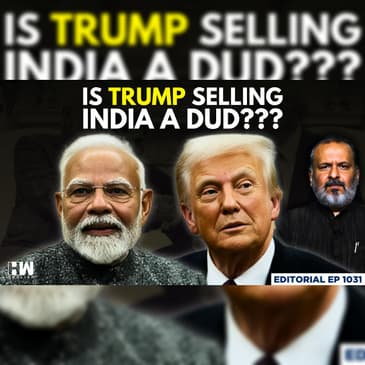
In this episode of 'Editorial', HW News' Managing Editor Mr. Sujit Nair discusses the press conference jointly addressed by US President Donald Trump and Indian Prime Minister Narendra Modi. Mr. Nair in his editorial sheds light on 2 key points mentioned by Prez Trump. First, increasing defence exports to India by selling F-35 stealth fighter jets & how Elon Musk severely criticized them in November previous year and second, reciprocal tariffs.
Learn more about your ad choices. Visit megaphone.fm/adchoices
[00:00:00] Namaskar! Welcome to another episode of Editorial. President Trump in his press conference said that we will be increasing military sales to India by many billion dollars. He said military sales we are going to increase by many million dollars. And he was talking as if he is doing a huge favor to India. And we all should say thank you so much.
[00:00:29] President Trump thank you so much for selling us so many billion dollars worth of military equipment. My topic number two today is how can the President of the United States make a statement like this in a press conference when the leader of the other country is also standing there where he says that listen I am going to sell billions of rupees worth of military equipment.
[00:01:00] I am going to pay pay way for a for a aircraft for a fighter jet. How can a President say that? And why is India listening to all this? You know there is a reason and there is a valid reason. Let's discuss that reason why India may have to listen, may have to concede, may have to succumb to a certain extent to US pressure. There is a reason why. Let's discuss that also. Let's get right into the show.
[00:01:29] You know when I was watching the Trump Modi press conference. I was actually very amazed.
[00:01:47] You see Trump was talking about selling things to India in a manner where it was like my nearest grocer, my nearest retail store taking a mic and announcing this customer can't pay 10 lakhs. So you know customer you should be thankful. I am going to sell 10 lakhs. And I will sell 10 lakhs.
[00:02:12] I am going to sell 10 lakhs. If somebody is selling something to me, what is so much to get excited about? So that's the same feeling I got when Trump spoke about increasing military sales to India by billions of dollars, not increasing military gifts to India. I am going to sell 10 lakhs. And we are supposed to be happy about it. That's okay. That is one way.
[00:02:43] You see, he voluntarily sold us F-35. What I meant by voluntarily sold us F-35 is he made a statement that we will be increasing military sales to India by many billions of dollars. We are also paving the way to ultimately provide India with the F-35 stealth fighter.
[00:03:08] India didn't ask. India didn't ask. He assumed we are going to provide. We are going to give it to you. You will have to pay us. Free Naya. You have to pay us. We will give it to you. So he assumed that the sale is closed. In fact, Indian foreign secretary Vikram Istri, he said, I don't think with regard to the acquisition of an advance
[00:03:29] aviation platform by India, that process has yet started. He said that this is currently something that in the stage of a proposal. Vikram Istri said that, listen, this is like in a stage of proposal. We don't think we have bought it. We don't think we have agreed to buy. We don't think we have agreed to buy F-35.
[00:03:55] Donald Trump in a press conference with the whole world is watching. Our prime minister standing next to him says that we are paving way to give you F-35. Lelo, take it.
[00:04:09] I can understand if F-35 is something which is so unique, so, so, so rare and so brilliant that it is our sheer fate, good luck that, you know, we are getting a chance to acquire F-35 at a huge cost, but all the same.
[00:04:30] Now, let us go to another gentleman. In this entire story, a gentleman called Elon Musk. You see, nowadays, whenever you talk about America, whenever you talk about Donald Trump, you cannot not talk about Elon Musk. It is now almost become synonymous.
[00:04:53] So, it's like, if you talk about Elon Musk. So, it's like, if you talk about Donald Trump, you have to talk about Elon Musk. And so, our prime minister took gifts for Elon Musk's children. Indian prime minister who went for a foreign visit, went and visited Elon Musk and got his children gifts. That is Elon Musk.
[00:05:13] So, how can we end a conversation without Elon Musk? Now, coming back, Mr. Trump wanted to sell us F-35 and this is what Mr. Elon Musk had to talk about F-35. You see, he said, meanwhile, some idiots, I repeat, meanwhile, some idiots are building manned fighter jets like the F-35.
[00:05:40] He says, he says, he says, that F-35 design was broken at the requirement level because it was required to be too many things for too many people. This made it an expensive and complex jack of all trades, master of none. Success was never in the set of possible outcomes. This is what Elon Musk said.
[00:06:07] Elon Musk went on to add that manned fighter jets are obsolete in the age of drones anyway. Will just get pilots killed. This is what he had to say. So, our man, Mr. Donald Trump, the president of the United States, in front of our good prime minister, Mr. Narendra Modi says that, you know, I am paving way to sell you F-35.
[00:06:37] And Elon Musk, which is like I told you, the one of the most influential person in United States, says that, Kaika, F-35, it is a failed platform. It will kill your pilots, failed platform.
[00:06:54] So, what am I supposed to understand? Am I supposed to understand that we have been offered a dud product? A dud product? A product that nobody is going to buy or a product that is not going to work or a product according to Elon Musk? See, why should I believe Elon Musk? I should believe Elon Musk because almost every decision in America seems to be taken by Elon Musk.
[00:07:17] So, if every decision in America is taken by Elon Musk, so I want to believe that what he is talking about, his own aircraft, which is made by his own country, is correct. So, therefore, I should believe Elon Musk. I don't claim Elon Musk to be a major, you know, aeronautical engineer or an expert in fighter jets and all that. I don't claim. But the fact remains that every statement he makes seems to be important for the United States of America. So, I will assume, no, that when he spoke about F-35, that is also fairly true.
[00:07:45] So, I am assuming it. He said it. He said that it is useless. It is not worth flying this aircraft. Okay. Now, like I told you, India again, let me tell you, India has been very clear. Okay, we have not said yes to this aircraft and all that. We have not said yes and all. The president sat there and said here we are paving way to give India F-35 at a price which I will talk to you about. You know, we will give India F-35 and, you know, we will be, you know, but we have, it is in a proposal stage.
[00:08:15] We have, there is no decision taken yet. India said this. Okay. Now, let me talk to you about some figures. Important, no? Figures. Let us talk about figures. You see, F-35 is one of the most expensive fighter jets in the history of fighter jets. It is one of the most expensive fighter jets. With each unit costing anything between 80 million and 110 million depending on variant.
[00:08:45] 80 million to 110 million. You see, aircraft may be jet fighter jet may be variant. This I realized when I was reporting on Rafael. Variant rate. Like in car, LX, VX, DX and all that model, why is variant rate? So, here also there are variants. So, the variant cost starts, the price of the aircraft starts at 80 million, ends at 110 million, which makes it the most expensive jets.
[00:09:12] Let me also tell you, we are also, we are also negotiating for, with Sukhoi, that is a Russian company, for something called as SU-57. Su-57. And, if you see the price, if you compare the price, SU-57 is almost half the price of our F-35. SU-57 is 35 million to 40 million based on the variants.
[00:09:41] 35 million to 40 million based on the variant versus 80 million to 110 million based on the variant, which is F-35. You see the difference. You see the difference. And, there, Donald Trump says, we are paving way to ensure that India gets the F-35. Now, let me also tell you some more facts.
[00:10:07] You see, trade with Russia has, especially when it comes to military equipments, has been very fair. To the best of my understanding. Fair because, Russia not only offers us the aircraft, it offers us technology. So, maintaining that aircraft after it is procured, becomes easier for India.
[00:10:33] Not that, therefore, I am saying that every aircraft that was bought from Russia was the best and there was without flaws. There was a lot of question raised about the MiG that we bought from Russia. Lot of questions raised. So, I am not saying that everything was picture perfect. But, the fact remains that Russia transfers technology to us. Therefore, maintenance becomes an easy way out for India.
[00:11:02] Once the aircrafts are with us, then India can indigenously maintain it. For instance, for the Sukhoi range, Sukhoi is tying up with HAL in Nashik plant to maintain the Sukhoi aircraft. So, maintenance becomes a huge advantage. Now, this is where we stand. Now, you know what Trump says, billions of dollars we are going to sell to India and all that.
[00:11:30] And India has to kind of, we didn't really keep quiet. We said that we have not committed. But, to some extent, we may have to concede. We may have to concede. To some extent. You see, and it is not entirely, you know, weak in India's part or wrong in India's part to concede either. Because, we don't have much of choice. I will try and tell you why.
[00:11:55] You see, our total trade with United States in 2024 was $129.2 billion. $129.2 billion. And, you know, US exports to India out of this $129.2 million was $41.8 billion. And, India's export to United States was $87.4 billion.
[00:12:23] Almost double of US exports to India. So, India is in trade surplus as far as United States is concerned. The trade we do with United States is far, far more. Almost double of the trade they do with us. So, it is important that United States is kept in good humor. Because, they buy our products and services. So, it is not that India can go and say,
[00:12:54] Why is the Prime Minister not saying anything? Why is India, Indian Foreign Ministry not saying anything? It is not. To some extent, we will have to kind of play this very tactfully. For instance, you see, he also spoke about giving us crude oil and LPG, liquid petroleum gas.
[00:13:19] Now, if you were to buy crude oil and liquid petroleum gas from United States of America, which we possibly may have to buy according to a lot of experts, we will end up paying more money for crude oil. We will possibly end up paying more money for crude oil. Forget about the price itself. The transportation of crude oil from America to India will ensure that you end up paying more money. LPG possibly is a different issue.
[00:13:49] So, the point is, even if at all, even we have to pay a little more, the chances are that we may have to buy from United States. Now, another very big issue that he spoke about is reciprocal tariff. Now, let us understand this concept of a reciprocal tariff and why India should be worried about it. You see, after World War, what happened was the world decided that,
[00:14:17] listen, there is a huge gap between the developed countries and the developing countries and the underdeveloped countries. The gap was huge. So, generally, the world said that, listen, you know what? The infrastructure that developed countries has, both in terms of industrial infrastructure, in terms of agricultural infrastructure, the infrastructure that developed countries had was huge. So, they could make everything in abundance. So, agricultural produce was in abundance.
[00:14:47] Industrial produce was in abundance, which a small developing country or an underdeveloped country couldn't. So, now, what happens if the developed country starts dumping their products in underdeveloped, stroke developing countries? What happens? Developing countries, their producers will not be able to sell their products because you have foreign products coming and being dumped in your market at a price that the local manufacturer cannot make.
[00:15:16] So, what happens? The local business flops. The local business shut down. What happens if the local business shuts down? If the local business shuts down, then the local economy goes kaput. Thap. So, the world decided that developing countries, underdeveloped countries, puts a larger tariff on the developed countries for them to export their product to these small countries.
[00:15:47] So, therefore, when they export it to small countries, their product will be dearer. It will be more expensive. So, therefore, the local market, the local manufacturer, the local farmers, the local producers can sustain, can survive. This was what the logic was.
[00:16:06] And when these small countries, they export to large countries, the large countries normally lessens the tariff on these products so that these small countries can export their product to large countries. Large countries can consume it since they need that. They have the money. They have the wherewithal. They can consume it. And these are no competition to the large countries. So, the large countries would allow them to be imported at a lesser tariff price.
[00:16:36] So, ultimately, it would mean the larger good of the globe, the larger good of the world. Because then, underdeveloped countries, developing countries can develop by exporting their products. And developed countries are anyway developed. They are rich. So, they can get products across the globe at their doorstep. Thikka na? Ok. Now, let's go step further. Donald Trump says, nay, ho gaya.
[00:17:06] Yeh sab. Yeh sab not anke ho gaya. Now, nothing. Now, it is reciprocal tariff. He says, it is reciprocal tariff. Tum meru ko tariff dala jada, am tum ko tariff dala jada. That's the name of the game now. If you are going to put more tariff on my cars, I will put more tariff on your cotton. If you put more tariff on my consumer products, I will put more tariff on your wheat. I will put more tariff on your eyes. It is as simple as that.
[00:17:35] If you are going to put tariff me, I will tariff you in reciprocation. That is what you call as reciprocal tariff. Now, this reciprocal tariff is going to affect India the maximum. India estimated reciprocal tariff rates is 29%, which is the largest as far as the trade with America is concerned. Brazil is 28.
[00:18:03] European Union is 25. UK is 24. Mexico 23. And the least is Singapore, which is 9.
[00:18:09] So, India is going to see the largest increase in tariff if we do not succumb or if we do not negotiate well or if we do not work well with the Trump administration and get to some kind of understanding where our exporters can continue to export their products to the United States of America.
[00:18:34] So, to end this editorial, to conclude this editorial while he says that, you know, we are going to sell billions of dollars worth of military equipments to India. And he will say that because we are the largest importers of military equipments in the world. So, he says, listen, I am going to sell you. Now, what is he trying to tell you? He is trying to tell you, you buy from Russia. Now, you buy from US. Trade deficit is going to match.
[00:19:04] So, that's what he is trying to tell you. So, at some level, India will have to succumb to it. At some level, India will have to agree to it. And it's not just about being strong or being, you know, pushing or way to being intelligent. Because end of the day, you have to survive. End of the day, you have to trade. End of the day, you need to have positive trade. And that is only possible if we trade with the United States of America.
[00:19:31] This is the problem that we are facing currently. So, that's my story tonight. And till I see you next time, that's tomorrow at 10. Namaskar.