
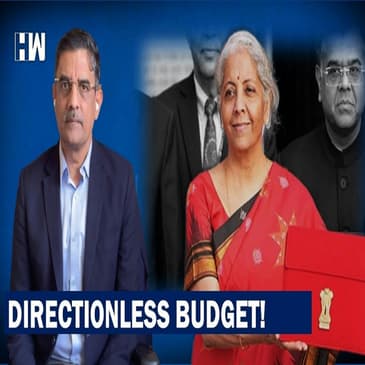
Finance Minister Nirmala Sitharaman in Union Budget 2023 has announced attractive incentives and rebates in the new income tax regime, a steep hike in capital investments and the biggest ever outlay in railways. The rebate limit in the new tax regime is increased from Rs 5 lakh to 7 lakh and there is a corresponding easing of the tax slabs. The new tax regime is the default. Sitharaman has proposed an increase in capex by 33 per cent to Rs 10 lakh crore. States are also being incentivised to spend more on infra. Rs 2.40 lakh crore has been allocated for Indian Railways, which is the highest ever. In this episode of the BUsiness Tit-Bits, our Business Editor Mr Akhilesh Bhargava shares his take on the matter.
Learn more about your ad choices. Visit megaphone.fm/adchoices
[00:00:00] Namaskar, this is Rakhilesh Pargap. Welcome to Tipits on Business and Finance with me. It is budget day today and we will just finish watching the Finance Minister's budget speech.
[00:00:13] It was one of a shorter budget speeches as compared to those in the past.
[00:00:18] 2024 is election year in India and this was the last full budget presentation of the current Modi tenure.
[00:00:28] Being a election year next year, it was expected that this budget would be a populist one with a lot of goodies meant for the common man in order to encourage voting for the ruling party.
[00:00:39] Interestingly, it did not turn out to be one which is loaded with populist measures.
[00:00:46] Coming back to the budget, from a pure academic perspective, a budget is meant to be a financial statement of mere financial statement which contains the estimated receipts and payments of the government for the forthcoming year for which it needs a parliamentary approval.
[00:01:05] In India, budget time is a location for the government to announce its policies, its major reforms, its major initiatives and that makes the budget time in India an interesting one.
[00:01:17] We look out for the budget speech to see what are the major policy initiatives being announced by the government and based on that, one is able to understand in what direction really the government is taking the economy.
[00:01:33] We also look at these proposals of receipts and payments based on the state of the economy thinking and hoping that the budget proposals will ensure that they resolve the current issues related to the economy and put it on the solid footing such that they encourage growth.
[00:01:52] If we talk about the current budget, the state of the economy can be best seen from the four engines that drive growth in any economy.
[00:02:01] The first one exports. Expodes in India may have gone up by about 16% in the current financial year, but the fact is that imports have shot up much more and the year is expected to end with a current account deficit of 4%.
[00:02:16] So the budget would have been expected to be having some measures so as to facilitate exports out of India.
[00:02:24] The second growth engine that we talk about is private investment.
[00:02:29] Private investment in the country has been languishing for many years and one would have expected the budget to have measures to promote private investment.
[00:02:38] The third engine of growth is government capital expenditure.
[00:02:42] Government capital expenditure has been robust, it has been on a high and the government is expected to continue spending on capics because they gone we need it.
[00:02:53] And the fourth engine of growth is private consumption, consumption by the households.
[00:03:00] After the festival spending got over, private consumption has been featuring out.
[00:03:05] If private consumption in the first half of the current financial year went up by about 15.4%, it is expected to contract by 0.2% in the second half of the year.
[00:03:18] In other words, private consumption has been slowing down, it has been dipping.
[00:03:23] It is based on this that one would have expected the government to have formulated its budget proposals.
[00:03:29] Incentives for private investment to kick off and take off in the economy.
[00:03:34] Incentives for the consumer to spend because these two engines have been slowing down.
[00:03:39] Incentives and policy measures to encourage exports and of course maintaining capics by the government.
[00:03:48] The only area where the government has come out with very clear measures is to do with government capics.
[00:03:53] The government capital expenditure in the current budget is expected to shoot up to 10 lakh crores which is a 33% raise as compared to the last year.
[00:04:03] It was about 7.3 lakh crores last year, it is expected to be 10 lakh crores in the coming financial year.
[00:04:10] And that constitutes about 3.3% of India's GDP which is a record of the stocks.
[00:04:16] So as far as capics by the government is concerned, the government lived up to its promise.
[00:04:22] It has come up with a far bigger allocation.
[00:04:25] As far as the other three are concerned, there are most specific measures really by which we can say that there are measures directed to encourage private investment or there are measures directed to encourage consumers spending or that there are measures if we will ensure that India's exports look up.
[00:04:44] While we talk about this, we are also very clear that the global economy has been slowing down.
[00:04:51] The Indian economy too is getting impacted and growth is slowing down.
[00:04:55] So one would have expected these measures related to consumption, private expenditure and exports such as to ensure that India maintains its growth trajectory in a far more robust manner with these measures not being there.
[00:05:09] The fact is that as the global economy slows down, as the Ukraine war continues and perhaps intensifies, as commodity prices remain uncertain, as oil prices may go on the boil all over again, India's growth will be impacted.
[00:05:25] This budget has not come up with measures related to that.
[00:05:29] The other area where measures were expected was to give relief to the middle class.
[00:05:34] The middle class and the MSME sector has been the most burdened segment of Indian society because it was expected that from the election perspective also, the middle class is going to be given a lot of taxation relief measures.
[00:05:47] It has savings, its household savings go up and perhaps it might encourage the middle class to spend.
[00:05:55] The finance minister has come up with cosmetic changes like increasing the threshold of tax exemption from file liquefages to 7 liquefages and the claimers that all that tinkering is resulting in revenue sacrifices about 35,000 crores.
[00:06:10] With this, we think it will not be so. These measures are just cosmetic. The middle class has not got any tangible substantial relief measures such that its present situation of different income, unemployment, different household savings is ameliorated.
[00:06:29] Further if we look at the budget, the budget was supposed to come up with measures to simplify taxation because that's why the government keeps claiming all the time.
[00:06:39] It is supposed to come up with real measures to ease the doing of business in the country and to improve the index of the cost of doing business in the country.
[00:06:50] We really do not see measures related to that.
[00:06:53] So, what is the overall direction of today's budget?
[00:06:57] The first is that it is not really an election budget. It was not an election speech. Populist measures are certainly missing.
[00:07:05] From a fiscal perspective, the government gets marks on it but from a political perspective what we would expect is that the government will be compared to come up with populist measures and the government will choose perhaps November or October as a time to start announcing them.
[00:07:22] Thus, while there may be no such measures now, they will come and they will come later in the year. At the moment it is a budget which has got a certain amount of fiscal balance.
[00:07:34] Why has the budget got a fiscal balance? The fiscal deficit for the current year has been maintained at 6.4% as well budgeted last year.
[00:07:45] In the coming year, the government says that the fiscal deficit will come down to 5.9% and it says that it will live up to its promise of bringing down fiscal deficit to 4.5% by 25-26.
[00:07:59] Going by this trend, it would work out. So, the government has been mindful of its fiscal and it does not end up in any kind of a reckless spending.
[00:08:08] It will certainly get a lot of accolades from international agencies because healthy government finances are always a plus for any government, for any country.
[00:08:19] So, the first direction of today's budget is to do with maintaining a balance in the fiscal.
[00:08:24] The second direction of course is that the government is mindful and recognizes the fact that somebody needs to spend in the economy in order to maintain growth and the government is playing that role.
[00:08:36] Of course, we have not seen the fine print. We still do not know whether how genuine or how bona fide is this figure of 10 lakh roles or is there some kind of manipulation in it.
[00:08:46] We still do not know whether the railway capital of 2.1 lakh roles has been included in order to hide from the figure when you take it at face value at the moment and say that one of the clear thrusts of the budget is to ensure that the government maintains its capital.
[00:09:32] Directive for the middle class. Well, the government has ensured that presumptive taxation rate the thresholds have been increased from 2 lakh roles to 3 lakh roles for small businesses and for professionals from 50 lakhs to 75 lakhs of receipts.
[00:09:47] That would give some relief to a certain segment of the middle class but across the board taxation measures it would have ensued the middle class and resulted in savings such as to have probably put more money in its kitty to spend.
[00:10:01] So, we really don't see that translating. The finance minister's speech was a short one. It was one which did not give more details about taxation measures.
[00:10:12] So, as of now, we still do not know what is the fine print in the budget for direct tax measures and what is the true fine print even for the indirect tax measures.
[00:10:23] She has announced some tinkering in the custom due periods on the indirect tax side and she has announced some measures related to direct taxes would be think that unless the details are not seen, unless we don't see the fine print will not really come to know what the exact measures were.
[00:10:40] Past experience shows that the government has a lot of measures in terms of amendment of the law, in terms of new sections, in terms of amended sections, in terms of tax rates etc which are contained in the budget proposals which do not form a part of the finance minister's speech and we will need to see that and tell you more about it.
[00:10:59] Once I have seen it, we will certainly come up with what do we think are the exact measures in the budget for direct taxation.
[00:11:09] We think that is the overall thrust of the budget, not election oriented, high on capitalist spending, balancing the FIS and ensuring that the government financials remain good and you give that point certainly good marks.
[00:11:23] So, the overall picture is that by last year rather for the current financial year 22-23 the government is expected to spend 41 lakh rows against which its tax receipts, its overall receipts are about $1.
[00:11:38] 24 lakh rows leaving a gap of about 17 lakh rows which it is funding out of the boroughs etc. In the coming year, it expects that its expenditure will go up to 45 lakh rows from 41 lakh rows and that its receipts would be about 27 lakh rows, leaving a gap of 18 lakh rows to be filled in by the way of borrowings, by the way of small savings and by the way of other receipts that the government expects.
[00:12:04] The finance minister's speech said nothing about monetization of government assets, it said nothing about privatization.
[00:12:11] It did not speak about other measures by which the government would propose to increase its receipts that was missing.
[00:12:20] That was the gist of the budget today. It gets marks as far as the health of the government financials are concerned by controlling the fiscal deficit to a certain extent and maintaining a balance there.
[00:12:33] It gets marks for the capics. It also gets marks truly fiasc by not announcing populist measures of freebies which are a drain on the government's revenue and which are not really the benefit of the government, the country's progress and development.
[00:12:48] Where it doesn't get marks is measures for the middle class are truly missing. Measures related to encouraging private investment are missing.
[00:12:58] Measures related to encouraging exports are truly missing and measures which get back confidence of the middle class to spend and ramp up its consumption expenditure, those are missing and we think that they needed support.
[00:13:12] The three engines of economic growth today which are line or which are line wishing which is exports, private investments and private consumption is where the budget needed to have a thrust that has been missing.
[00:13:25] We will come back to you with more details about the budget proposals particularly when we have gone through the taxation measures and then we'll come to know the government has lived up to it, what it says all the time of improving transparency of making its similar, of making compliance easier.
[00:13:41] And improving the use of business in the country. This will take part in signing off till we meet again.
[00:13:49] Namaste.
[00:14:11] Namaste.