
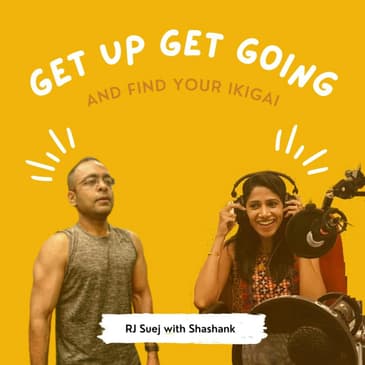

This episode has been particularly interesting to record as Shashank is a person I have been inspired by for a while now, ever since I discovered that there could be a post-meal healthy dessert as well. Clearly, there are no 'zero-calorie' promises, yet you know you aren't consuming processed sugar under other names. Shashank Mehta was over a 100 kgs when he started his fitness journey 15 years ago. In the decade that followed, he taught himself fitness, lost 40kgs, ran several marathons, and helped many friends and colleagues get onto the fitness bandwagon. He has self-experimented with every fitness-fad and quick-fix out there, and now runs a 100 percent clean food brand called The Whole Truth that makes super clean Protein Bars, Energy Bars & Muesli. Go check them out at thewholetruthfoods.com and make sure you enjoy more than just this episode. Cheers to health!
[00:00:00] Okay there, all you lovely people. Well, lockdown may end or not, but May is definitely coming to an end.
[00:00:08] So on this last day of May, if I may, I would love to present the chat with a super inspiring personality on Episode 11 of Get Up, Get Going and Find Your Ikigai.
[00:00:19] His name is Shashank Mehta and he's the founder of a 100 pc clean food brand called The Whole Truth Foods. Some of you may remember it earlier of a thought and nothing else as well.
[00:00:31] The Shashank really inspires me to the story night for you should listen to it too. He started his fitness journey at over 100 kgs 15 years ago.
[00:00:41] In the decade that followed, he taught himself fitness, lost what he kgs, ran several marathons and helped many friends and colleagues get onto the fitness bandwagon. And I am graduate. He has also self experimented with every fitness parent who picks out there.
[00:00:59] And all his learnings by friends have been poured generously into his brand that now makes super clean protein bars, energy bars and musely. You will hear the how, what, why and more in the podcast ahead. So enjoy.
[00:01:15] Well it is with a huge sense of warmth and humility that I welcome fellow entrepreneur and fellow fitness lover Shashank Mehta. On this podcast that has already had ten inspiring guests on air in its short existence. Hey Shashank, how are you doing today and what's on your mind?
[00:01:36] Hey, thank you so much for having me, Shajada. And on my mind just like the rest of the world is, when will this dreaded lockdown open up and when will this virus go away? I guess.
[00:01:48] Absolutely. I completely agree with you and let's start with a bit of positive again. What we can do for people who are, you know, in the lockdown, you know, who can listen to some inspiring stuff and can't wait to get out.
[00:02:01] So we can do that bit from our side. So let's, let's kind of jump into the first question. If you're okay. Yeah, let's go for it.
[00:02:09] Okay. So, you know, childhood and growing up are the best time of our lives, right? And also a period where we are guided or inspired by others most of the time.
[00:02:19] So tell us a bit more about this period in your life and you know who influenced, who inspired you, who guided you. So let me start with a caveat that I am one of those people who's memories are really, really bad.
[00:02:34] So I remember my childhood only in like flashes and few incidents, like I know a lot of people who remember in like deep detail. I'm not one of those people. Right.
[00:02:46] Yeah, having said that. So I was born and brought up in Delhi, spent my first like 20-21 years of life in Delhi And, bond to a very like a proper middle class Indian household dad, the government's government, moms and school teacher.
[00:03:06] So, you know, very, very standard whatever you would imagine, middle class upbringing to be the, you know, including all the cliches of, if I met you, the science fellow and the science fellow, that's true. Obviously, in general, in Karloja, medicine, Karloja.
[00:03:24] Right. In general, in Karloja, the MBA, Karloja. So I did exactly all of that. I did my schooling from actually a brilliant school, and I'm going to talk about that. I think that was the most formative part of my formative years.
[00:03:37] That my mom insisted that my kids will go to a, you know, a convent that was earned dream because she realized very early on that,
[00:03:49] like English-speaking kids will have an H in this world. And she's a maths teacher, very, very brilliant student herself, but couldn't, you know, do the level of studies that she wanted to do purely because of financial pressures in her household.
[00:04:08] Yeah. So she had, she always had these dreams for her kids that my kids should get the best education and nothing will come in the way of their education.
[00:04:19] I will do everything possible from the best school to the best books to the best tutions, whatever they need to get there and, you know,
[00:04:27] the school mountain Mary's in Delhi can was, was step one. And, and I really had to fight to get us both me and my brother, and to brother into it because it was largely only for army kids.
[00:04:40] But yeah, those were the most formative years here. The biggest influence in my life, weren't any role models from family actually they were a few teachers,
[00:04:52] school, especially in this teacher name Mr. Merleoy, who was my fourth standard teacher. She was the first one who pushed me to get onto the stage. Until then I never knew that I had a flare for debates and quizzing and theatre and eventually later on, etc.
[00:05:13] She's the one who pushed me to get on stage and I discovered new side of me and then for the next whatever seven or eight years in school, I used to be the debate champ debating chat with school.
[00:05:26] And then when I went into engineering college, I discovered that I also loved to do theatre.
[00:05:32] And then when I got into MBA, I actually realized that I also kind of like doing a bit of comedy by the side. So I could all start it from Shermila, I'm pushing me out to the stage.
[00:05:44] That's like one of the big events that I remember from my formative years, but if I zoom out a little as I said, very straight old,
[00:05:54] schooling was a science student, got into engineering, right off engineering, got into MBA and right off MBA, got into what at that time was my dream company which is Hindustan year-leivers. So that's a summary.
[00:06:09] Wow Hindustan year-leivers, right? And we all aim for a career where we can be successful to really well, etc. So what were the thoughts in your mind as you entered Hindustan, liver on the first day?
[00:06:27] To be honest, so the other again, when I look back at that time in life, I don't think I was living life making very conscious choices about where life is headed.
[00:06:41] It pretty much seemed like there is a set path and I'm supposed to my job is to just run the first test on this set path.
[00:06:51] I was told that kids who do well in class till 10th standard, and I used to be a topical, largely in the top 23 ranks in my class.
[00:07:03] We ordained part that you have to take science, so I took science and then pre-ordained part, you have to do engineering, so I did engineering.
[00:07:12] And then from there if you really know your stuff then you would get into an IM, so I got into an IM and then after the IM, if you are marketing guy, you do the dream company, you understand in liver, so I should get a good way to get into an instant in liver.
[00:07:28] Either I got there, and once I got there it was just about now, I got an IM, I now need to come first among this group of people. So I don't think I was making very conscious choices up until then.
[00:07:46] Like frankly the only conscious choice that I made up until then was preparing really hard for cat, it's a poor me exam because that was also running away from something, I just do not see myself living like being an engineer as my career.
[00:08:07] And the most accepted escape route was getting MBA.
[00:08:14] So to be honest when I got into, by the time I got into a unit liver I was just trying to be the best in whatever group of people I got thrown in and the definition of best was what I was society decided.
[00:08:27] Society decided that marketing students still have best in the sun and leave it okay, I will go and track in the sun.
[00:08:33] And how long did you work with them Shashaan, as we were speaking earlier, you told me that you moved on to another company and there was a bit of movement there.
[00:08:43] Yeah so in total I worked for eight years out of, you know, my corporate career was ten years out of which eight years was in liver but this was in two parts.
[00:08:56] So in 2009 I joined in the sun and in liver I was there for three years and it was in those three years that for the first time I started thinking independently.
[00:09:06] I moved out of home for the first time in life, like after I moved out of home in MBA but you know this is the first time in life and I felt truly independent my own money in my pocket living in a different city completely by myself etc.
[00:09:23] I think that's when I started realizing that I have some sort of an entrepreneurial pitch because whenever I look back on my life I kind of saw that you know the, and I know we'll talk about you know what gives us happiness also but that's been a constant pursuit in my life.
[00:09:43] I keep looking back and seeing what are the things which are truly giving me happiness and the answer at that time also started becoming clear to me that creation gives me a lot of happiness.
[00:09:53] And that's when I realized there is some sort of an entrepreneurial pitch that I haven't that's why in 2012 which is after three years of being within liver.
[00:10:02] I quit and I was being really, really well at that time so if you're in a shock this guy is quitting the dream company. To go join a really fledgling startup at that time it was called Fossos at that time now it's called rebel foods.
[00:10:19] And it was this is so cut 2012 with that time startups weren't as sexy as they are today. You know, economic times was not doing front page articles about startups and unicorns and billionaires and all of that stuff because it was really really early in India.
[00:10:39] So did that for two years got supremely burnt out and in 2014 came back to my original dream company which is in the study and liver and then spent another five years there. Okay.
[00:10:53] Would book of eight split into three and five and was it in marketing that you were back again at Unilever? Actually the first thing was sales, because which is how Unilever makes you start. Right. So what did you learn at rebel foods that you're using today?
[00:11:14] I mean what skills or what did you learn that you should not do in a startup? Oh we'd have to do a separate podcast.
[00:11:24] I started with everything down but again to be honest at that time as I said the feeling was being overwhelmed, being overwhelmed and like it took me a good three four years after coming back to Unilever to actually synthesize all my learnings from the two years of rebel.
[00:11:47] Like I thought for two years of well were like 10 years of learning crammed into two and hence a lot of pain also right because no learning comes without pain.
[00:11:59] Yeah and it was so painful at least for me that for the next two or three years so I was just you know how you don't want to look back at the painful memory just want to run away from it.
[00:12:14] Yeah painful, purely because like I failed. This was the first time in life and I didn't do well. The work was so overwhelming there was too much to do and that was one of like okay, it's a talk about learnings.
[00:12:28] The first big one is you really understand what infinite work means when you work them up. Yeah, that'd be a good idea. Because the limit to the amount of work is decided by how much you can think up.
[00:12:43] If you're willing to settle for mediocrity, work will cut off at X but if you want to keep creating excellence, work will cut off at 10x, 20x, 100x, 1000x you can't say. You keep coming up with more and more work.
[00:12:57] Second is, you truly understand how extremely variables the world is when you do a startup. When you're in a protected environment like you'll live here, people talk almost with certainty that it's all we're facing. The world doesn't, the novel world doesn't operate like that.
[00:13:25] And a startup makes you realize how there are crows of variables out there from people not turning up to supply chain to this to that that can that can screw up any of your plans. You can't say anything with certainty.
[00:13:42] But what you also realize is that that's the definition of a good entrepreneur. Someone who is able to both predict the future and then create it. That's what I learned, that a good entrepreneur is someone who's able to project into the future.
[00:14:02] And has a vision for a future that a not many other people have because if everyone has that vision then everyone will be as good as the as the function.
[00:14:11] As the founder they have a unique vision for the future and then we have the capability to create that future doesn't exist today. Right? So let's say you take Uber someone like the founder there had a vision that why can't cabs be booked to an offline place.
[00:14:30] Why do we have to stand on the road and heal the on a tax? And every time under a lot of money can't get in. And once he got convinced that he should be created.
[00:14:41] And the third learning was I used to keep saying I keep still keep saying that I am a creator. I'm not a manager. That's didn't taught me that by definition creation is ultra painful. You can think of it in biological terms that giving birth has been fruitful.
[00:15:02] Creating anything means going through a sea of pain for something beautiful to come out at the end of it.
[00:15:11] So these were some of the macro learnings because there were thousands of micro learnings on how to hire how to run a company this and that that I use every day now. Wow, wow, but really really inspiring stuff.
[00:15:24] Now we all you know, I spoken in introduction about your passion towards fitness and health. How do this segue into a hundred percent clean label food brand as you call it? Tell us all about that.
[00:15:38] So ever since I came back from rebel the first one or two years, you know, anyone who asked me, I tell them life may be a start-up to not do that. That's how you know burnt out I was. Thank you.
[00:15:53] And I just do a bit first into my job at Iniliver. I got married at that time. So a lot of stuff was happening in those two years. Just went by without anything else apart from it, you live a work.
[00:16:07] At the same time, I've had a history with obesity and fitness. So fitness was a journey wasn't starting at that time. You could be a hundred and ten kg, nineteen year old.
[00:16:21] And then in the college time, I decided one day I'm going to lose all of this and I went back to crazy and I lost 40 kg in like nine months. Oh my God. That's been painful as you said.
[00:16:40] It was, it was, it was, but it was madness at that time because I had no education around it. I just figured that if I start exercising whatever little I can and starve myself, I will lose weight.
[00:16:54] And that started showing results. So I did that for nine, ten months and I lost 40 kg things. And once you start losing weight, you get people's attulation then it becomes a self-fulfilling cycle also that you didn't. Then then in two three years, then after that I thought,
[00:17:12] I'm going to tell you and I used to think that thin is equal to fit. So I started eating like my thin friends and low and behold in two three years all of it came back. And these two three years were basically the MBA.
[00:17:26] I am like, no, here's been as it is life. We used to sleep like four hours a day and eat shit all day on campus. Right. All of it came back. Then in my univote is I again, I lost 30 kgs again.
[00:17:40] Then I was like, okay now it's done. But then I joined Rebell and Rebell me again, life went for a toss, no sleep, no pattern, no discipline. Trying those two years, I again gained all of it back.
[00:17:52] Then when I came back to Unilever, I was like, okay, now this better go. So in those first two years, I lost all of it again. So I did the plus minus 30 40 kg cycle, thrice in life.
[00:18:03] But what was the process? I'm sorry. What was the process that you the same process? Like just Navi yourself and yeah. No, no, no. So by the third time I started becoming a lot more intelligent about the process.
[00:18:16] Actually the third time which was I had just come back to Unilever and you know, I didn't have any other distraction on my mind. I was like, okay, get near, wait for this. And to ask you, I said, okay, that it doesn't come back.
[00:18:29] So I started doing research and I started teaching myself about health and fitness. Okay. Yes, so I started learning about food and how that impacts the body, how exercise impacts the body, There are a lot of books, met a lot of people, a lot of interviews.
[00:18:45] Like did all the research in the world? And this time when I lost weight, I lost it by changing my lifestyle. Okay. So I started to learn from point by point eliminating stuff from my diet point by point like crafting and exercise regime,
[00:19:01] which is which, you know, I developed my own definition of fitness. Like I never used to have a definition of fitness for my fitness was healthy. Oh, if it was thin, right? So finally I realized actually fitness is equal to a combination of three things.
[00:19:20] It's endurance plus strength plus flexibility. Okay. So I'm going to make a plan which attacks all these three components of fitness. So I first worked on endurance, started learning marathon. Then when you run marathon, your runner, you lose a lot of muscle. Right?
[00:19:38] After that, one side run a fair few half marathon I turned my attention to building muscle. And once I had done that, I obviously lost a lot of flexibility because you become stiff. Yeah. Then I turned to yoga. Okay.
[00:19:54] And it was over three or four years that I was able to, I think balance out these three things. Okay. To truly say that I have become fit but this was the self-teaching that I was doing in those two three years of that third weight loss cycle.
[00:20:12] And at the end of that cycle is when I actually started, I felt that I've learned so much and I've researched so much and self-experimented so much that I can start. I should share this with people. Yeah.
[00:20:25] That's when two years into being back at in Lever around 2016 is when I started writing a blog called FitShit. Okay. Which was my weekend hustle which became my weekend hustle at Lever so every weekend I used to write a blog.
[00:20:39] So I did this for two to a half years at a stretch. Wrote about 100 articles. One article every week I would write and that blog really hit it off.
[00:20:51] I had no marketing money, nothing but people who are reading it in droves and commenting and chatting with me and asking me for help etc. That actually became the genesis of the whole truth which is the hundred percent clean, they will food company that I know right.
[00:21:08] And piece of trivia is the company is called FitShit Health Solutions. I know that. I get those bars too. Yeah. So how it came to the whole truth was, as I was writing the blog and so many people are supporting one
[00:21:28] I felt that telling people what's wrong with the world is a good thing but it's just step one. If you really want to bring change then you've got to do step two which is do something about it. Right.
[00:21:43] And the second was I realized that a major problem in weight loss, you know when people say that weight loss etc is 80 percent diet they're correct. And nowadays half of that 80 percent is packaged food and food that we bring from outside.
[00:21:59] And what I realized was we are packaged food brands are lying to us through their teeth like we've been told something is healthy like you know in my second weight loss cycle. I used to think that I had shifted from drinking coke to drinking real juices.
[00:22:17] So this must be really healthy. Right. Or I used to think that I've shifted from parantas to consulate this must be really healthy. And when I did the researcher realized that oh not really the juice and the coke have the same sugar, you know the parantas,
[00:22:36] that we plant us seem to be healthier than consulate given the amount of sugar. Right. So I figured that why isn't there a food brand which just tells you the truth about what's going on.
[00:22:49] What's going on to the food? Why do you have to bring a magnifying glass turn to the back of back and then find this microscopic font ingredient list,
[00:23:00] which you will not even understand half the ingredients written there because they really chemicals in order to something that you want to farm. There are tens of sugar substitutes,
[00:23:10] maltodextrin malt Nicole, so what we call food? The hell knows these things. Why is all of this in my food?
[00:23:17] So this conviction kept growing and growing that this needs an intervention and from the market here side of me I felt that I have the tools to build a brand like it's not just a pipe dream.
[00:23:32] I know how to do this. And the scope with a lot of seniors that you know, I told them this is the basic concept. I will create a brand which will tell you what's going into your food.
[00:23:46] Do you think it's possible? In every one said yeah we'd love that. If there was a brand just to you know that didn't put any sexy photography on the front of back or in try to entice us with you know dripping chocolate etc.
[00:24:00] That just told us that your food is made of these five things they are Kanai, so how you can't find it. So that was the Genesis and I thought yeah, but this is truly you know a one-sener lifetime opportunity that this is something I'm so passionate about.
[00:24:19] This was something that the world needs and I can create an impact with it. And it is something that I can do like professionally, I have the experience in the skill to be able to do this then what is my reason to not do this?
[00:24:34] Yeah, and that's where your key guy. Yeah, actually as I told you when we were chatting earlier I didn't know it's called leaky guy. I just stumbled upon it. It's amazing. Amazing and tell us how has the journey been shoshank?
[00:24:53] It's rather the journey has been better than what I could have thought of in my while list dream. And to be clear it that doesn't mean it's been easy.
[00:25:06] But it's been so worth it is what I mean that you know I've been ever never did anyone ask me how are you I tell them. Never been busier or happier. Nice. It's a life.
[00:25:21] Right? So we are less than two years old the amount of love that the brands started getting in continuous to get from day one is insane. People like you and so many others tell us that you know the products that we make.
[00:25:38] You will make them happy and they're happy feeding it to their kids, to their parents and they have a like they have zero doubt. They don't have to think about what they're feeding to their loved ones. That's so true.
[00:25:49] The happiness plus you know the the the metathart that I will enjoy creation. So personally the joy of you know it's such a privilege to get this opportunity to be able to create something which is exactly the change you want to bring in the world.
[00:26:12] Is getting so much love and ideation from the world because we are all social animals no matter how much I say I do think so my own self. I love it when people love what I do.
[00:26:24] So that is happening and as a business like if you see it, peorly as a business also in terms of revenues etc. It seems to be doing fairly well so it's not a you know charity project.
[00:26:39] It has all the possibilities of becoming a self sustaining vehicle for good. And that's always been one of my pet peeves that buys wire companies and capitalism seniors.
[00:26:53] You know tours of evil that they eventually you know try and sell you stuff that they shouldn't be selling you but they also know it and you know there's this evil scheme going on.
[00:27:03] Why can't companies be forced the force for good you know capitalism is a great machine to actually bring good stuff into the world also.
[00:27:11] Yeah so when you like I wake up nowadays there are very bad days also obviously in any startups really but every time I feel down also I just think back to this that imagine the immense privilege to be able to do all of this follow your passion build a business.
[00:27:31] Create something which is impactful like how many people get that chance so it's been I couldn't have asked for more. Absolutely and I'm this.
[00:27:44] I'm just mesmerized by this conversation you know really really enjoying talking to you Shashank and there's so much motivation and determination in your voice that I'm sure all our listeners would be equally determined to at least try following their.
[00:28:01] There passions now one last question which is your message for our listeners. You know who want really follow their Ricky guy.
[00:28:10] Sure thank you so much for the kind words and my my messages this that you know many people asked me that how did you plan how did you start when did you know you're going to do this.
[00:28:23] etc and I think those are you know that clarity of should I start up should I go after my dream x-rays what most people who are thinking along these lines struggle with my my one learning I've had throughout life. Is you know.
[00:28:44] I have this analogy that life is like driving a car in a dark tunnel and you can truly only see as far as the head lights go so what the means is you know when I was when I came back from rebel.
[00:28:58] I used to think that I will never start up again and who actually turn my focus from that focus from that I started focusing on my fitness again and this time I said let's read about it.
[00:29:10] I had no instinct that just focus eating anywhere right then I started writing a blog because like hey I read so much let's write a blog.
[00:29:19] and the blogs started doing well I started thinking hmm why shouldn't there be a brand like this right and then after and all of this took like five years at which time for two and a half years I was writing a blog with absolutely knowing cling that this blog will only lead me to starting up again.
[00:29:37] But it eventually did yeah so my my learning from that is I didn't know for four and a half hours of five years that I was heading back again towards starting up but I was if my heart and my passion took me somewhere took me towards fitness.
[00:29:53] I tried to do as much justice to it as I could so I did spend you know hundred weekends on the trot writing. Yes, yes, today and that somehow led somewhere.
[00:30:08] So don't don't pressure yourself to come to a decision of what to do let's say your passion is something in music. Start doing something around it and the path will present itself.
[00:30:24] As you keep going deeper deeper deeper into it clarity will emerge no one has clarity from day one and no one gets clarity if they wanted on day one if just got to lean into it and trust the process.
[00:30:40] Wow trust the process is the statement that I use myself all the time in you know any situation. So I think that's a great end trust the process.
[00:30:49] Thank you so much Shashank one last bit if you want to tell our listeners about your Instagram handle maybe they can go have a look at your products etc.
[00:30:59] Oh, that'll be great. So you can find us on the web at the whole truth foods dot com that's the whole truth foods dot com and on Instagram which is where we share a lot of content that a lot of people love you can find us at whole truth foods.
[00:31:17] Great great and thank you for sharing most of the whole truth I would say because we didn't have as much time I would have loved to you know maybe we'll have another podcast as you were discussing about.
[00:31:28] You know what were your learnings but thank you so much for being on this episode it's been a pleasure.
[00:31:34] The pleasure is being on mine. Thank you so much for allowing me to talk about and reminiscing about the past I just don't get the time to do that nowadays. Great good to look back. Thank you. Thank you. Thank you. Bye bye. Thank you.
[00:31:51] So who all those of you who wonder whiff business and taking care of our well-being can lead it can definitely take us along long week if we choose to make it our true passion and I think I truly enjoy making this episode as always and look forward to your feedback at rjsuj at gmail.com
[00:32:09] Till we meet again here's me saying take care stay safe and keep working on your giga