
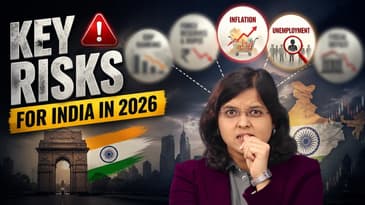

India continues to be one of the fastest growing major economies, but 2026 brings a set of critical challenges that cannot be ignored. In this video, we break down the top 5 economic challenges for India, including GDP ranking shifts, rupee depreciation & forex reserves, inflation pressures, fiscal deficit risks, and rising unemployment. We also explain the real reasons behind these trends, how global factors like crude oil and geopolitics are impacting India, and what this means for the economy going forward. If you want a clear and practical understanding of India’s macro outlook, this video covers everything you need to know.
Learn more about your ad choices. Visit megaphone.fm/adchoices
[00:00:00] Hey folks CA Rachana Ranade here and I welcome you all to a very very informative video wherein we are going to talk about top 5 challenges, top 5 economic challenges that India can face in 2026. Now which 5 economic challenges are we going to talk about? Number 1 we are going to talk about GDP ranking, then we'll talk about Forex reserves, then we'll talk about inflation, then fiscal deficit and ultimately unemployment. Video is going to be extremely informative so keep on watching the video till the end.
[00:00:26] Now if you have been following my live streams, you already know that India has moved to the 4th position in GDP ranking. This is what the IMF outlook mentioned back in April, April 2025 right? But if you know about the latest data point, our GDP ranking has slipped from the 4th position to the 6th position. Where did I see that data? This is on the IMF website and if you see that 1, 2, 3, 4, 5, 6, this is where we are right now at 4.15.
[00:00:57] Trillion dollars. That's our current GDP right now. Now many might be like, okay, we know that India is one of the fastest growing economies. Who says that? This is again a PIB article which mentions at around 7.4%. I read somewhere on trading economics. Yes, here on trading economics it's around 7.8%. All in all we are growing at a good pace. Still, why did our ranking slip from the 4th position to 6th position?
[00:01:22] The reason is very simple because whenever we talk about nominal GDP, it is calculated something like this. Nominal GDP in INR terms divided by the exchange rate. Now, because nominal GDP will be in US dollars. Whatever we calculate is in INR. Now, what is happening right now is that yes, our growth is improving, but growth is improving at what rate? So growth rate is around 7% or let's say 7.8%. We'll take trading economics number. Okay, our growth rate is 7.8%.
[00:01:52] But simultaneously INR depreciation is at 11%. So what is happening? Our denominator is growing faster than the numerator. What will happen to the ultimate number? Is the ultimate number going to come down? Yes, and that is the reason why our GDP ranking has slipped. So I hope you have understood that this is more of a valuation effect, not a production effect.
[00:02:12] So as and how the overall inflation eases out, overall the growth improves, our Indian rupee stabilizes. That is when I believe that our ranking should also improve in GDP terms. Okay, but what about one more parameter GDP based on PPP. If you if you see this, he put P after PPP. PPP is not a bad word, Baba. PPP is purchasing power parity.
[00:02:38] He thought PPP something like that. Okay. So anyways, if I'm talking about GDP based on PPP, we are at number three position. And if you see our difference with us is not that high. So there is a possibility that we may go closer and closer to USA as far as GDP based on PPP is concerned. As of now still, we are at number three. But just in case if you're like, what is purchasing power parity? If you want to know more about that, just comment PPP and I'll be more than happy to make a separate video for you.
[00:03:08] Also, before we move on to the next point, still, if you have not subscribed to our channel and still if you have not hit the bell icon, please consider doing that. It's free for you all, but it makes me feel happy. Now talking about the second point, which is Forex reserves, you can see that we had reached a peak on February 27th, 2026, where our Forex reserves had reached 728k US million dollars.
[00:03:30] And from there, that there has been a slight sell off the lowest point that we saw since then was at 688k US million dollars. And right now we stand at somewhere around 700k million dollars plus. But now first thing we have to understand that why did the reserves drop? Reason is extremely simple. The drop has been primarily seen post February from the end of the February.
[00:03:52] And that is when the geopolitical tension started, the war in the Middle East started. And what happens typically in such cases is that to defend the weakening Indian rupee, RBI typically steps in, sells more and more dollars so that the rupee stabilizes. Okay. And when RBI is going to sell more and more dollars from where is it going to sell? From our reserves, right? So that's how the Indian Forex reserves keep dropping. Okay. Now question is that, okay, to defend the rupee, we had to sell dollars agreed.
[00:04:22] But why did rupee depreciate? Why did rupee weaken? That is a bigger question, right? There could be multiple reasons. I'm talking about the top three reasons right now. The very first one is because the dollar became strong, rupee became weak. Now, why did dollar become strong? One reason could be that US bond yields were rising. See, whenever bond yields rise, typically what bigger institutions do is that they pull out money from capital markets.
[00:04:45] So you can imagine, everyone knows, right, that FIS have been selling a lot in Indian equities. Whenever they want to take back their money home, what will they do? They'll sell equity. They'll take rupees. They will sell rupees, convert into dollars, and then they'll take back the dollar. So what is it going to lead to? It is going to lead to selling of rupee and that is what will weaken the Indian rupee further. So always remember that whenever yields rise, there is going to be money which is going to be pulled out of the capital markets, which will lead to a weaker rupee.
[00:05:15] Second problem will be a trade deficit problem. I will say this at least three, four times in the video today that oil, which has already gone beyond $100 per barrel, that is going to increase our import cost. Gold has increased. That is going to increase our import cost. Electronics is going to increase our import cost. Whenever import cost increases, we need to pay in dollars. And if I want to pay in dollars, we have to sell rupee, buy dollars. And that is the reason why selling pressure on INR, which will further weaken the Indian rupee.
[00:05:42] And ultimately, the third point, which very few people understand, this is a pure economics theory, is inflation differential. Many people feel that this party did bad work, that party did bad work. It's economics. Inflation differential. What do I mean by that? If I were to say that Indian rupee is weaker as compared to US dollar. Why is that so? Because India's inflation is higher than US economy's inflation.
[00:06:09] And is this something bad or is this something like, how did this happen? I don't know. For any developing economy, the inflation is on a higher side. And as we go from a developing economy to a developed economy, our inflation drops. Okay. So higher inflation will lead to a lower or a weaker currency is a better word. Let me rephrase. Higher inflation is equal to a weaker currency. And that is what happens whenever to compare Indian rupee with US dollars.
[00:06:36] Now, let's start with the third point, which is about inflation. Now, when I say inflation, people generally track two indices. One is CPI. One is WPI. CPI is about consumer prices and WPI is about wholesale prices. First things first, let's check the CPI data. And you can see that from October 25, the numbers have started to increase. And currently, it is at 3.4%. This is CPI. What about WPI? WPI has also continuously risen. And currently, it is at 3.88%.
[00:07:05] Now, we need to understand 2-3 very important parameters here. What is RBI's target? RBI's target is 4%. Okay. 4% is the ideal situation for them. Plus 2%, they are saying we are okay with that. So, up to 6%, they are okay with that. And minus 2% also. So, at 2%. So, one more time, let me wrap this up. Ideal, they are saying our target is around 4%. But we are okay if we are within the range of 4% to 6%. Within the range of 2% to 6%. Okay. Now, why CPI? Why WPI? What?
[00:07:34] Which one is more crucial? See, WPI is a leading indicator. What is WPI? It's a wholesale price index related inflation. This is inflation which businesses actually face first at wholesale prices. So, first who is going to buy? It's going to be the wholesalers, right? And then when they sell to the consumers, that is when the inflation will be passed on from the businesses to the consumers.
[00:07:57] So, if WPI is at 3.88 and CPI is at 3.4, there is a chance that CPI may also eventually increase. So, we have to keep a track that how far the inflation grows. Now, inflation can be two types of inflation or two sides of inflation. One, we say it is a demand pull inflation or second could be supply push inflation. When does demand pull inflation occur? It is mainly when demand rises drastically. More demand, more or less similar supply, prices are going to rise.
[00:08:27] That is nothing but inflation. What about supply? Supply is less. Demand is more or less similar. And that is the reason why there will be a rise in prices. That is inflation. Which type of inflation are we facing right now? It's more of a supply side is what my understanding is. Because of one of the key parameters, again the same old story, which is geopolitical tensions, mid-east tensions, because of which supply is less for what? Crude oil. Everyone knows that. And when supply is less, prices are going to shoot up. Have we seen that?
[00:08:56] Yes, crude oil has well gone beyond $100 per barrel. And it is said that for every $10 rise in crude oil prices, headline inflation typically rises by 50 basis points or 0.5%. Now, if that be so, it's very clear that supply side inflation is the main trigger. What could be the worst case scenario for us? It could be stagflation. What is stagflation? We are not seeing any growth in the economy as if I were to compare it with inflation. I'm going to explain that.
[00:09:27] And that is coupled with inflation. So understand this. Stagflation is divided into two parts. Stagnation plus inflation. Okay, inflation is what we have understood. Now, why am I saying stagnant economy? Or why is there a stagnation? Stagnation is basically when we are saying that there is low growth, but low growth in comparison with what? Inflation. I'll give you a simple example. Assume that current growth is 6%. But inflation is 4%. Can I say it is stagnation? No.
[00:09:55] Is our growth higher than inflation? Yes. So current situation is not a problem. What is a problem? Let's say inflation goes to 5%. And our growth slows down below that. Okay. Let's say even 4.9%. In that case, what has happened is that inflation is higher than our growth rate. Now, you might be like, Rachna, why would we have a lower growth rate? This is just a hypothetical assumption that let's say the war in the Middle East continues for a pretty much longer time.
[00:10:25] In that case, what will happen? Industrial gases supply, which is like LNG, commercial, LPG, whatever, that may dry up to a bigger extent, which can lead to forced cut of production, forced cut in production of different organizations, factories, right? And with that, the production cut will happen and that will hamper growth. But the best part is that a lot of analysts, even RBI suggests that the risk of this happening is not high at all. It's like moderate. Okay.
[00:10:52] So, we should just hope that the war scenario eases out and hopefully stagnation does not happen. So, I hope third point is also clear. Let's move on with the fourth point in the next section. Let's move on with the fourth point, which is fiscal deficit. Now, if you have a look at this data, you will see that fiscal deficit has been going down and down. Basically, we say that fiscal deficit is consolidating. If you were to understand in a simple term, always remember lower the better. Okay. Now, fiscal deficit, whenever we express that, we don't express it in direct in rupee terms.
[00:11:22] We always express it as a percentage to GDP. So, if you see here, it was like at maddening number in 2020. Of course, it was an unusual year. It was 9.16% of GDP and slowly and steadily it started to come into control. 2025 projected was 4.3%. Actual number was a shade different. But what is important for us right now is how much is the revised estimate for 2526, which is at 4.4%. And the 2026-27 budgeted estimate is at 4.3%.
[00:11:51] So, as and how this number keeps on reducing, that is always going to be good for our economy. But the problem is that though our budgeted estimate is 4.3%, some real-time data from April 2026 suggests that maybe our fiscal deficit can widen a little bit because of obvious reasons, which is the tensions which are occurring because of geopolitics, especially because of the war situation. Iran, Israel, USA, everyone knows that.
[00:12:17] Now, what happens because of such war-like situations in the Middle East? How does it impact fiscal deficit for a country? Answer is very simple. See, if I'm talking about a case of oil, I've done loads of videos on that, that we import a lot of oil, state of farmers, everyone knows that. But point is that crude oil has again clocked above $100 per barrel. Now, if that be so, our import cost is going to increase. And if our import cost rises, that is going to put pressure on the fiscal deficit.
[00:12:47] And it is expected that this could be one of the key drivers because of which our fiscal deficit could push towards 4.5%. Now, what happens is that government majority of the times takes the hit on itself because it doesn't want to pass a big chunk to the end consumer. What it does is that for the end consumer, it can either give a subsidy or it could cut excise duty. Now, for that, I can give you an example that recently government cut excise duty on petrol and diesel.
[00:13:15] But what happened because of this, it resulted into an approximate dent in revenue of 1.3 trillion rupees. So, I hope you're understanding this so that the pain to the end consumer is less. The government takes the hit on itself by increasing the subsidies or by reducing the duties and taxes. Okay. One more point is that they wanted to ensure that they are shielding the businesses, be it MSMEs or other businesses.
[00:13:41] And for that, what they have done is that they have established a 1 lakh crore rupees fund so that the businesses are shielded from the closure of straight-of-armers. But this again could potentially add a 0.1 percentage of GDP to fiscal expenditure. Okay. But don't believe that all points are on the negative side. Are there also some positive points which say that in spite of all these points, maybe we could achieve fiscal deficit contraction. What could be the point?
[00:14:11] See, government is saying that till date, like I showed you the graph, right? Government has been successfully able to control the fiscal deficit. And government is saying that we should ideally be able to follow and glide through that path that we have given. And we should be able to achieve whatever numbers we have targeted. Second point which is being mentioned is about the tax collections. And it is estimated that next net tax receipts grow by 8% in FY27. So, always remember, see what is fiscal deficit?
[00:14:39] Simple word is fiscal deficit is nothing but whatever is government revenue minus government expenditure. So, if revenue is less, that is going to lead to a fiscal deficit. So, if tax receipts increase to a good extent, my Amdani will increase. And that is how my fiscal deficit may reduce. It's also being estimated that there is a chance that government may also go in with some asset monetization. It can get some continued dividends. So, some public sector enterprises which are listed on the stock exchange,
[00:15:09] they can give more dividends possibly. So, that government also gets a lot of money into its fisc. Fisc is nothing but government treasury, right? All in all, what they are trying to do is number one, they are trying to reduce the fiscal deficit. But they are saying let's not anchor ourselves only to fiscal deficit. Let's also focus to something called as the debt to GDP ratio. Again, for a perspective, the thumb rule is lower the better. In FY26, the estimated debt to GDP ratio is at 56.1%.
[00:15:39] And in FY27, it is estimated to come down to 55.6%. And by financial year 30.31, it is expected to reach to as low as 50%. Now, why is this important? It's extremely important to understand this. See, lower the debt to GDP ratio, better it is for the country. Better it is for the financial strength of the country. And if that be so, if country is financially strong, it can raise debt at lower interest rates.
[00:16:07] Now, why is it extremely important for us to spend lower on interest costs? Because for us, if you have a look at this image, this is the latest budgetary data image. This says that for India, the highest spending is on interest cost. So for us, what is important? Because we run a fiscal deficit, we will need to borrow more money. But if we can borrow that at a lower interest rate, it's going to be beneficial for us. So I hope fiscal deficit plus debt to GDP, all things are absolutely clear.
[00:16:34] All right, with that, let's get started with the fifth and the final point, which is about unemployment. Now, if you have a look at this, I'm on trading economics. You can see that unfortunately, unemployment has been on a rise. The lowest that we could see was in November 2025, which was at 4.7%. And with the steady rise, we can see the latest data, March 2026 data, it is at 5.1. With this, if you feel a little bit disheartened, let's zoom out a little bit. At a three year data, we are still at a pretty low point.
[00:17:04] But if I were to check one year data, yes, the unemployment rates are rising. Okay, so now let's understand that, okay, if unemployment is rising, is there any bifurcation between how much is the rural unemployment? How much is the urban unemployment? Is there any split between males, which are unemployed, females, which are unemployed? Now for that, we'll just check out the data sets one by one. If you see in urban areas, the joblessness or unemployment has increased from 6.6% to 6.8%.
[00:17:32] Rural regions, again, it has increased from 4.2% to 4.3%. But this is just urban versus rural. What about men, women? So for women, if I'm talking about women in the urban areas, it has again increased from 8.7% to 9%. And women in the rural areas, that unemployment has increased from 4% to 4.1%. Now if I'm talking about male unemployment, male unemployment has ticked up from 5.9% to 6.1%
[00:18:02] in urban areas. And in rural areas, it has gone up from 4.2% to 4.4%. All in all, if you understand, in each and every area, be it rural, urban, male, female, all areas, the unemployment has gone up. If I were to understand what could be the causes of unemployment, of course, there could be a lot of factors. But just laying down two out of these, the very first one, needless to say, is about the AI-driven layoffs.
[00:18:28] TCS let go nearly 30,000 employees in just six months. Oracle has cut around 10,000 jobs in India. And these are just examples. I'm sure there'll be way more number of companies who have laid off employees just because of the AI thing. So that is one of the key pointers. And second one, look at this. I don't even feel like reading out the data. This is about high graduate unemployment. Very disheartening. And this is unfortunate truth that if you just become a normal graduate,
[00:18:57] the word unfortunately is just a normal graduate. Because if you were to get actually, if you were to get employed at a proper organization, what is required is the practical skill sets, which a lot of students would actually not have. And that could be one of the key reasons of high graduate unemployment. And that's the reason why whenever I have student indirections, I keep on mentioning that do ensure that you learn some life skills as well. You learn certain skills which are required at the industry level.
[00:19:25] So even though you might not have liked this data, but if you liked the overall video, please don't forget to smash the like button. Please don't forget to share this video with your friends. I'll see you in the next one. Until then, take care. Chai in and bye-bye. You might have come across such advertisements on various social media platforms. Please note, all of these are fraudsters promising unbelievable returns through stock tips. I don't provide any calls or advisory services. I provide only educational content through my social media handles
[00:19:55] and through my website, RachanaRanade.com and RachanaRanade.in.