
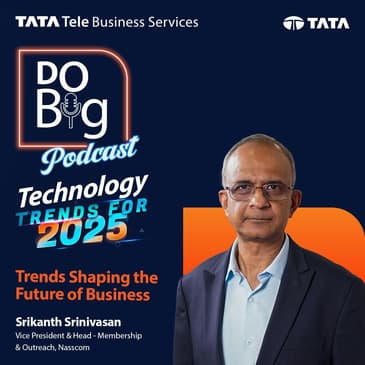

As we wrap up 2024 and gear up for 2025, what key lessons should businesses take forward to stay ahead of the curve? In this episode, we chat with Srikanth Srinivasan, Vice President & Head - Membership & Outreach at Nasscom, about the year’s most impactful tech trends and the innovations set to define the business landscape in 2025.
00:00 Introduction to AI and Personalization
01:20 Meet Srikanth Srinivasan
02:28 Reflecting on 2024: A Roller Coaster Year
03:31 Innovations Beyond Gen AI
05:25 Tech Disruptions and Trends in 2024
07:43 The Rise of Personalization in Technology
08:21 Looking Ahead: AI in 2025
11:27 Blockchain and Trust in Technology
14:18 Consumer Behavior Shifts in 2025
21:00 AI's Impact on SMEs and MSMEs
26:06 Do Big Mantra for SMEs
30:08 Conclusion and Final Thoughts
[00:00:08] Have you found surprising ways in which AI has been used or you think there are new ways that AI will be used in 2025?
[00:00:16] Today, I think it's all about personalization and that's where this whole AI impact is also coming in.
[00:00:24] And if you see this, wherever there is consumerization, you would see the adoption of technology only going up the value chain.
[00:00:32] With all of this which is happening in the world of technology, especially in the social media space,
[00:00:36] lack of trust is becoming one of the key issues amongst consumers and between businesses and consumers.
[00:00:43] In the cycle of transaction, in the web of transaction, in the chain of transaction,
[00:00:48] you don't know where it is going and who all is seeing and whether your identity is completely protected or not protected.
[00:00:56] So that's the trust piece and hence, trust becomes critical more so in technologies like this.
[00:01:02] Whether it's a customer or a B2B or a B2C, you should say, I'll customize it for you.
[00:01:07] In my view, the word customization is over. It's past. I don't think it exists now, at least for this generation.
[00:01:16] Today, it is personalization.
[00:01:19] Welcome to the Tata Tele Business Services Do Big Podcast.
[00:01:23] Today, we're thrilled to have a powerhouse of expertise and insights with us.
[00:01:28] Shrikant Srinivasan, Vice President and Head of Membership and Outreach at NASCOM.
[00:01:33] With over 25 years of proven excellence across IT, telecom, e-commerce and industrial automation,
[00:01:40] Shrikant has mastered the art of driving businesses to new heights.
[00:01:45] From building robust customer relations to steering profitability through innovative strategies,
[00:01:51] his career is a masterclass in making big things happen.
[00:01:56] A specialist in strategic planning, partner management and business fulfillment,
[00:02:02] he's all about turning vision into reality.
[00:02:06] In this episode, we will dive into a wrap-up of 2024, explore game-changing trends for 2025,
[00:02:14] and hear Shrikant's Do Big mantra for businesses aiming to excel.
[00:02:18] Without further ado, let's get started.
[00:02:21] Hi, Shrikant, and welcome to this episode of the Do Big Podcast.
[00:02:25] Thank you.
[00:02:25] It's a pleasure having you here.
[00:02:26] Thank you very much.
[00:02:27] Shrikant, you know, we're coming.
[00:02:28] This is going to be the last episode of the year for us.
[00:02:31] And I thought it would be nice if we could do a quick rewind onto what has happened in 2024.
[00:02:37] And so my question to you is, if one was to describe 2024 from a tech perspective,
[00:02:44] would it be a roller coaster?
[00:02:46] Would it be a rocket launch?
[00:02:47] Or would it be a slow burn?
[00:02:50] Interesting.
[00:02:51] Options are interesting, first of all.
[00:02:53] But I think I would stick to roller coaster.
[00:02:55] And all of us know how the year has been, right?
[00:02:58] I mean, the year started off with certain things that happened during 2023.
[00:03:05] The GNI impact and so on and so forth.
[00:03:08] Industry was trying to kind of, you know, grapple with some of it, trying to embrace some of it.
[00:03:14] Some did, some didn't.
[00:03:16] Some are still trying to.
[00:03:17] The industry and even the overall geopolitical of the world,
[00:03:21] there have been too many changes that we have seen.
[00:03:24] So I would call it a roller coaster, but I would definitely see a lot of light at the end of the tunnel.
[00:03:29] And is GNI that one innovation which tells the world the future is here?
[00:03:35] Or do you think there are other innovations which are happening quietly on the side,
[00:03:39] which are more likely to tell us that the future is here?
[00:03:42] I would believe that there is much more than this one GNI that's happening around us, especially in terms of technology.
[00:03:50] Yes, it's probably caught on because of one reason that it was very easily accessible, more seeable.
[00:03:56] People could see it all over.
[00:03:58] People like you and me could also experiment with it.
[00:04:01] And hence, probably it's caught on more.
[00:04:03] But there are enough and more innovations and newer technologies that are impacting the industry and life around us.
[00:04:11] What kind of innovations and tech are we talking about when you think that they're more futuristic than GNI is?
[00:04:18] See, when I say AI, I would say I would want to call this holistically as AI.
[00:04:24] Gen AI is just a piece of it.
[00:04:26] AI in terms of its own adoption, AI in terms of its own manifestation in various things in industry.
[00:04:33] I think there's a lot more to it than what we all speak about.
[00:04:37] I mean, not just the AI that you and I use on our small handheld devices,
[00:04:43] nor what people are using in their own operations and implementations in the organization.
[00:04:49] It's way beyond that. That's one.
[00:04:51] But again, other technologies today, you are seeing a lot of things like quantum catching up.
[00:04:56] The multifarious uses of quantum that's catching up.
[00:04:59] Even in terms of today, in a world where things are so well connected,
[00:05:04] I would say that from augmented reality today, we are seeing mixed reality and things like that.
[00:05:10] So these are technologies which are really catching up,
[00:05:12] have phenomenally good use cases as we go along for the industry to flourish.
[00:05:18] And, you know, there has always been certain disruptions which come in every year from a tech point of view.
[00:05:25] What are the most unexpected disruptions we've seen in 2024?
[00:05:30] See, in terms of, in 2024, I think a couple of disruptions that we have seen, I think, is a little bit of slowdown overall,
[00:05:38] globally in terms of the market conditions and things like that.
[00:05:41] And we saw all of it, right?
[00:05:42] I mean, I think the results, the industry, globally things did slow down.
[00:05:46] And that could be of various reasons, right?
[00:05:49] I mean, it could be the political or the kind of situation, or it could also be the industry being a little more guarded.
[00:05:58] Because when things around us are not going great, what really happens is people definitely want to protect what's there in front of them,
[00:06:05] rather than running behind something which is non-existent.
[00:06:09] And hence, things became guarded.
[00:06:11] And that's where you saw a little bit of that dip.
[00:06:15] And that's why, to go back to your first question, I said rollercoaster.
[00:06:19] So it's also going up.
[00:06:21] So we are seeing that thing changing there.
[00:06:24] So that's interesting that people became guarded.
[00:06:26] But I also believe that a lot of people have started re-looking the way technology can be used in their business.
[00:06:33] And talk a little more about that.
[00:06:34] Where are those uses that are happening of technology which are going to bring change?
[00:06:42] See, today, I think the adoption of technology was kind of limited to certain areas.
[00:06:47] But today, if you see, it's kind of getting adopted across.
[00:06:50] All of us know, and the most quoted example is of course the financial services space, right?
[00:06:56] Whether it is payments, whether it is accessible banking, digital banking.
[00:07:01] Today, we are talking of frictionless payments, contactless payments, and things like that.
[00:07:05] That's one piece.
[00:07:06] But I think a couple of other areas where we're seeing this catching up a lot is definitely the healthcare space.
[00:07:13] Healthcare is the adoption of technology, the adoption of newer technology is picking up a lot.
[00:07:20] And now in the post-COVID world, I think even areas like hospitality and travel, tourism is picking up.
[00:07:28] I think people call it a revenge tourism or revenge travel today.
[00:07:33] But eventually, I think it's happening.
[00:07:35] And we see it all around us.
[00:07:37] So a lot of technology is going into that space.
[00:07:40] More importantly, and I think this is very important today, I think it's all about personalization.
[00:07:46] And that's where this whole AI impact is also coming in.
[00:07:51] There's a lot of data around this.
[00:07:54] Service providers and products want to be extra nice to that customer or client, and hence personalization matters.
[00:08:03] That's where the technology, and if you see this, wherever there is consumerization, you would see the adoption of technology only going up the value chain.
[00:08:12] So, we spoke about the year that has gone by.
[00:08:17] Let's jump a little bit into the 2025 playbook.
[00:08:21] Just want to get a sense that, you know, we spoke about AI in the previous segment.
[00:08:27] And I just want to get a sense of, have you found surprising ways in which AI has been used?
[00:08:33] Or you think there are new ways that AI will be used in 2025?
[00:08:38] The way I look at it, I don't think I'm surprised by the way it has been used.
[00:08:42] Because I think any, and when I'm speaking from the point of NASCOM and I'm also speaking from the point of tech organizations, right?
[00:08:51] Tech SMEs and tech services and tech product companies.
[00:08:55] I think most of them have taken it like a fish to water in terms of finding ways and means of adopting it whichever way.
[00:09:03] And again, just to go back, it's not that it's completely new, right?
[00:09:08] It has been there in some form or the other all the while.
[00:09:11] But only that, you know, it has probably got re-crisened or it's got a new found importance or seat on the table.
[00:09:19] And that's how it's happening.
[00:09:21] But definitely nothing surprising about it.
[00:09:23] People have started using it in some form or the other, wherever they have to sharpen the skills, sharpen the saw, be more operationally better and so on.
[00:09:34] And as 2025 comes around the corner, it's a couple of weeks away.
[00:09:40] A lot of SMEs are looking to stay ahead of the curve, right?
[00:09:44] It is a constant challenge for them.
[00:09:47] That's right.
[00:09:47] What are the major tech trends that you see coming up in 2025, which will impact SME businesses?
[00:09:55] I mean, undoubtedly, AI is going to be an important piece, especially with both when I say SMEs or MSMEs.
[00:10:03] One is the tech SMEs, which are one using the technology for themselves.
[00:10:08] Second, adopting this technology in whatever they offer to the end user.
[00:10:12] And that could be the MSMEs that we already talked about, which are end user organizations.
[00:10:17] Today, I think technology is no more the primary of one set of companies.
[00:10:21] Everybody's using it.
[00:10:22] All of them are adapting to it, adopting to it, both adapting and adoption.
[00:10:28] Given that, I think definitely AI is going to stand out there.
[00:10:32] But we also see them using a little bit of the other technologies.
[00:10:37] I mean, while we talked a little earlier about quantum catching up or mixed reality and so on,
[00:10:44] definitely things like even blockchain will catch up as we go along.
[00:10:47] Given the reason that it is also a failsafe kind of a platform, right?
[00:10:52] I mean, it's a very meshed architecture.
[00:10:54] It's an architecture where, you know, there's a lot of cross-check built in.
[00:10:58] And today, trust becomes an issue, especially in certain kinds of transactions, financial and so on.
[00:11:04] So these are things that will definitely catch on.
[00:11:07] So the and different organizations, even SMEs are investing time, effort, money in adapting to some of these.
[00:11:15] So it's very interesting because the AI, as I recall, it has been conversation for the last couple of years.
[00:11:20] But it took a Gen AI to create the tipping point on the acceptance of AI.
[00:11:25] Correct.
[00:11:25] Similarly is the case with blockchain, right?
[00:11:28] Everybody's heard of blockchain, kept knowing about it, reading about it, but always in the context of cryptocurrency and not really beyond that.
[00:11:36] Correct.
[00:11:36] Where do you see a tipping point on blockchain coming in for it to become mainstream like AI has?
[00:11:43] Or will it never become mainstream like AI?
[00:11:46] It might.
[00:11:47] Right.
[00:11:47] I mean, I don't know.
[00:11:48] I mean, I don't think I can predict this, but definitely I can tell you that given that as an architecture, it's built in such a way that it can, it's a very connected architecture.
[00:12:00] It's an architecture which can cross-check.
[00:12:02] It can, it's an architecture which can check the past history and so on.
[00:12:08] Definitely.
[00:12:09] It has a long, it has a huge play going forward.
[00:12:12] Yes, you're right.
[00:12:13] It all started with crypto.
[00:12:14] Maybe that's one of the use cases or one of the early use cases of blockchain.
[00:12:18] But going forward, I think, I mean, I have seen in, at least in some hackathons and things like that, please people using blockchain for multiple things.
[00:12:27] I've, I've seen people talking about it in the banking space, you know, where multiple transactions happen.
[00:12:33] I've seen people talking about it in, in the voting piece, right?
[00:12:37] Somebody who's voted.
[00:12:38] It's been, I mean, it, it makes, it also kind of, in a way blockchain also kind of removes this whole locational piece, right?
[00:12:48] You don't have to be located in a particular place at a particular point of time to do something, but can still get cross-checked.
[00:12:54] That, I think, can be multiple use cases as we go along.
[00:12:58] And you rightly said trust, right?
[00:13:01] Because with all of this which is happening in the world of technology, especially in the social media space,
[00:13:06] lack of trust is becoming one of the key issues amongst consumers and between businesses and consumers.
[00:13:13] And I just want to understand, other than blockchain, are there technologies which will help aid this whole building of trust?
[00:13:21] Trust, if you really step back and see any technology needs to be used with trust, right?
[00:13:26] I mean, that's the primary, primary piece.
[00:13:28] See technologies like blockchain and AI, all the more important.
[00:13:32] And I'm using these because, see quantum, et cetera, maybe it's still early days and I'm not commenting about it.
[00:13:38] But these two I'm taking because, one, we are already seeing it be used in certain cases.
[00:13:44] Trust becomes critical because it is also capturing a lot of data knowingly and unknowingly.
[00:13:51] When I'm saying knowingly and unknowingly, you are putting some data there knowingly.
[00:13:56] But in the cycle of transaction, in the web of transaction, in the chain of transaction, you don't know where it is going and who all is seeing.
[00:14:06] And whether your identity is completely protected or not protected.
[00:14:10] So that's the trust piece.
[00:14:12] And hence, trust becomes critical more so in technologies like these.
[00:14:17] Okay, so switching gears from technologies which are used by businesses for themselves to a little bit on the consumer facing side.
[00:14:27] What shifts in consumer behavior are you likely to see?
[00:14:31] Are we likely to see in 2025 and how, you know, there was this whole millennials and the digital natives, et cetera.
[00:14:39] But now we have Gen Z and Gen Alpha.
[00:14:42] Completely different breed.
[00:14:44] Just want to understand how is this whole play going to happen with this shift in the younger ones who are way ahead of the curve when it comes to using technology for their benefit?
[00:14:55] First of all, I think we have to grapple with all of that every day.
[00:14:59] Right?
[00:14:59] Each one of us will have to grapple that with every day in our lives.
[00:15:02] I think what? Gen Z's must be in their 20s, mid to late 20s.
[00:15:07] Yes.
[00:15:07] And the alphas would still be in teens.
[00:15:10] Yes.
[00:15:11] And probably the ones that will, so the Gen Z's are just entering the workforce or already been there for a couple of years.
[00:15:17] And the alphas will come in the next few years, right?
[00:15:20] I mean, they are probably entering college and things like that.
[00:15:23] First and foremost is, I think, a couple of things.
[00:15:27] If you look at the behavior pattern, first is the span of attention is very low.
[00:15:31] Right?
[00:15:32] I mean, the span of attention, if the span of attention for some of us were like one hour, for them it's a few minutes.
[00:15:37] And it's only reducing.
[00:15:38] And this party is going to become bigger with the beta going to join them in another 10 years.
[00:15:43] Correct.
[00:15:43] Right?
[00:15:44] I mean, it's only going to become bigger and probably, I don't know, better or worse, but only time will tell.
[00:15:50] Now, the second is apart from the span of attention, the second piece is because of span of attention and the quick and the need for a quick response, personalization becomes very key.
[00:16:02] I mean, earlier we used to talk of customization, right?
[00:16:06] Whether it's a customer or a B2B or a B2C, we used to say, I'll customize it for you.
[00:16:11] In my view, the word customization is over.
[00:16:16] It's past.
[00:16:17] I don't think it exists now, at least for this generation.
[00:16:20] Today it is personalization.
[00:16:22] Okay.
[00:16:23] Now, in personalization, we talked of things like ultra-personalization.
[00:16:27] We talked of micro-personalization.
[00:16:31] I believe that we have entered the area of nano-personalization, which means that it has to personalize to the extent that, to the point of time, to the point of place, to the point of everything, to them.
[00:16:46] Only then.
[00:16:47] I mean, for example, in a B2C example, which is very easy to give, for them, you need to kind of give them the suggestions what they would need at this point of time, this point of time of the day, and the month of the year.
[00:17:02] To that extent.
[00:17:03] So, I think here data is the key, and data plays a huge role in trying to kind of shape your offering to them.
[00:17:12] So, talking about data, there is so much data, right?
[00:17:16] And there's this whole conversation around data obesity.
[00:17:19] I just want to…
[00:17:20] I like that.
[00:17:22] So, I just want to get a sense of when you have data obesity, how do you get down to nano-personalization, is the question.
[00:17:30] Correct.
[00:17:30] So, I think that's where the…
[00:17:32] How do you manage the data?
[00:17:34] See, today, as we all say, right, more the merrier with data.
[00:17:39] But again, yes, there's a lot of unstructured, unneeded data that comes in there.
[00:17:45] So, how do you clean it up?
[00:17:46] That's where I think the use of technology and tools is about sharpening it.
[00:17:51] How do you sharpen that piece?
[00:17:53] How do you sharpen the saw there?
[00:17:55] In terms of using the data to personalize becomes key.
[00:17:58] And more so in an SME or an MSME context, it becomes that much easier today than earlier.
[00:18:05] Because today, earlier if you had to adopt to a new technology or one of these things, it was a very time-taking, capex kind of a situation.
[00:18:15] Today, thanks to cloud, thanks to everything available on the fly, it is a very opex kind of a model.
[00:18:23] Today is a model where, you know, you can go try it, use the tool, you know, sharpen it, or, you know, just keep moving.
[00:18:31] But eventually, you keep moving, right?
[00:18:33] I mean, you try to move forward.
[00:18:35] So, today in terms of usage of technology, not just data, I would call it like, you know, there are three phases, right?
[00:18:42] The first phase is where you want to kind of try it out.
[00:18:45] You want to deploy it, try it out, right?
[00:18:48] Then you enter a phase where you want to establish it, where you want to pick.
[00:18:53] And then finally, when you sharpen it is when you kind of, you know, go and kind of institutionalize or industrialize it in your operation.
[00:19:00] But today usage of data across all of it becomes very critical to personalize and give very sharp options to your consumer.
[00:19:11] That's really interesting.
[00:19:13] And will all of this data and all of this technology have an impact on certain sectors more than the others or certain markets more than the others in 2025?
[00:19:23] Yes and no.
[00:19:25] It will be more visible in a consumer-driven kind of a situation because you will feel it, right?
[00:19:32] I mean, as the buyer, one will feel it.
[00:19:34] You will resonate with it every day.
[00:19:36] But even in a B2B scenario, I think it will still matter today because when you, even in a B2B scenario, when one is going to a consumer, when a prospective customer, client, as you would call them,
[00:19:49] there's enough evidence of the past to show that more than 55, 60% of the cases, the buyer has already decided what to buy.
[00:19:57] Right?
[00:19:58] I mean, the buyer knows what to buy.
[00:20:00] They know whom to buy it from, what to buy.
[00:20:03] Everything is rather reasonably clear.
[00:20:06] They're only ratifying their decision when you're there in front of them.
[00:20:10] And this happens even in our own personal lives, right?
[00:20:12] I mean, you want to buy a car or a house, you've seen a few first few and then you decide.
[00:20:17] And after that, all the time you spend looking at the rest is only to ratify your decision.
[00:20:22] Okay.
[00:20:23] You are not there to change your decision.
[00:20:26] You're only trying to know, telling yourself that, you know, I'm taking the right decision.
[00:20:30] This is the right one, even if it is costlier.
[00:20:31] Okay.
[00:20:32] And if you really go back to the market and see, if that is not true, then only the cheapest should have been getting sold.
[00:20:40] Correct.
[00:20:41] Only a few should have been getting sold.
[00:20:42] Everybody has a share in the market.
[00:20:44] So in my view, I think this is the way it will go on.
[00:20:48] And there is a play for all of this both in the B2B space and B2C space.
[00:20:53] Okay.
[00:20:54] And, you know, I keep coming back to AI because that seems to be the buzzword today.
[00:20:58] Sorry.
[00:21:00] It's just one of those things.
[00:21:02] But where do you see AI having the biggest impact when it comes to the MSMEs and SMEs in terms of whether it's operations, whether it's consumer experiences, whether it's innovations?
[00:21:17] Where do you see the largest play of AI coming in 2025?
[00:21:22] Actually, all the three.
[00:21:23] And maybe we should, we can deep dive into each of them.
[00:21:26] Sure.
[00:21:27] The first one is operationally, right?
[00:21:29] Operationally because operation, when they use it in operations, it will improve efficiencies.
[00:21:34] It improves scalability.
[00:21:36] It will, it will improve the speed to market as I would call it.
[00:21:40] So definitely there.
[00:21:41] The second one you talked of was customer experience.
[00:21:45] Absolutely.
[00:21:45] Again, all of this when you do, you're collecting a lot of data.
[00:21:49] You're collecting data of the past.
[00:21:52] You're sharpening the data.
[00:21:54] And hence you're giving very pointed suggestions to your consumer or client.
[00:22:00] And hence the probability of winning is higher.
[00:22:03] You're actually increasing your winning probability every time you use this data better.
[00:22:08] It's about, you know, reading up the customer before you go there.
[00:22:10] Right?
[00:22:10] I mean, reading up not when you say the customer, not just the company, but the person who you're meeting and et cetera, et cetera.
[00:22:16] So that's the one.
[00:22:18] The third one I think was product innovation.
[00:22:21] Product innovation.
[00:22:21] Product innovation, undoubtedly, because today with the use of technologies, AI and the ability to kind of try something new and also stop using it both ways.
[00:22:31] Right?
[00:22:32] Earlier, if you got into it, then you know, you have to justify your money.
[00:22:35] You continue to use it irrespective of the need here.
[00:22:39] You can stop and get to the next.
[00:22:41] Keep moving.
[00:22:42] Right?
[00:22:42] I think innovation, it becomes even more critical because one, you can use it to quickly try and fail because quick try and fail is perfectly acceptable.
[00:22:53] And then you can also use it.
[00:22:54] And since you have a backward integration that you're wanting to use it on a customer, you can test it on the customer.
[00:22:58] And again, take that feedback, go back to the innovation stage and redo it again.
[00:23:05] So in my view, all three, the impact is equally there.
[00:23:09] It's only a question of how much more, how much less that the organization uses.
[00:23:12] But eventually all the three will have its own say.
[00:23:16] So SMEs continue to struggle with adoption of technology because of multiple reasons, right?
[00:23:22] There's investments, there is knowledge, all of it.
[00:23:25] Yes.
[00:23:26] This year, there has been some adoption of AI amongst the SMEs or MSMEs.
[00:23:31] Yes.
[00:23:32] Do you see this as becoming bigger or do you think it will still remain a buzzword for a couple of years before SMEs really get into utilizing everything that AI can offer them?
[00:23:42] There are two reasons why the adoption of AI becomes critical in SMEs and the struggle too.
[00:23:49] One, of course, is the investment.
[00:23:50] Second is the skill.
[00:23:52] These are two important things.
[00:23:53] See one, if you don't have the money, then you can't get the tools.
[00:23:58] And obviously you can't hire the right people.
[00:24:00] Assuming that you have the money and if you don't get the people, it's also an equally big problem.
[00:24:05] So in my view, in tech SMEs segment, I think adoption has definitely started.
[00:24:10] The amount, the number of people getting skilled at least in AI is definitely growing up in India.
[00:24:16] So that's definitely adding and hence I see some movement there.
[00:24:20] In the user segment, which is the so-called end user companies, right?
[00:24:25] The MSMEs as we call them.
[00:24:27] There is still, for the slightly evolved ones, the adoption is definitely happening.
[00:24:34] At least they are hearing.
[00:24:36] When you go and talk to them, they say, yes, we need to do.
[00:24:38] Yes, there could be an issue of a little bit of a financial impact,
[00:24:42] but there are people who are willing to put that extra little money on the table to try it out.
[00:24:49] Because they do see it as a potential win in terms of some growth, acquisition of customer and so on.
[00:24:55] Yes, at the bottom of the pyramid, there could be still an impact.
[00:24:59] There could still be a challenge, but that's not just with the money,
[00:25:03] but even their ability to access the skill and so forth.
[00:25:06] So that's an issue.
[00:25:07] But again, as NASCOM, and I can tell you this for sure, that we did talk to a few.
[00:25:11] We did some kind of a sensitization program for tech SMEs a few months back.
[00:25:18] And then out of that, we actually picked a few.
[00:25:20] We're working with about a dozen now and actually trying to help them to scale up in terms of adoption,
[00:25:27] in terms of offering, etc. in the value chain of AI.
[00:25:30] So I think more of this needs to happen.
[00:25:33] Probably this has to happen 100x.
[00:25:36] And if that can happen, and more importantly, if some of these things can also be incentivized by whomever needs to,
[00:25:46] I think that will also help the industry.
[00:25:49] Because today, for a non-tech, I'm saying for an end user organization,
[00:25:54] every tech spend is being viewed as an expense.
[00:25:58] It's not being viewed as an investment.
[00:26:00] So that's a challenge.
[00:26:01] The moment they start viewing it as an investment, I think things will change.
[00:26:06] Shrikant, this is a do big podcast, right?
[00:26:09] And therefore, what we want to understand from you is,
[00:26:13] what's a do big mantra for the tech companies going forward?
[00:26:17] So how do you see the Indian tech landscape evolving in the coming years?
[00:26:22] And any area that you would want tech leaders to solve for?
[00:26:26] A couple of things there.
[00:26:28] I think one thing that, as tech, we need to solve for is the challenges of the future.
[00:26:35] When I'm saying challenges of the future, today we are solving,
[00:26:38] we are working on segments like financial services, we talked of healthcare and so on.
[00:26:43] But I think being environmentally and socially responsible becomes extremely critical.
[00:26:50] All of us are talking this, the world is talking about it.
[00:26:53] How do you kind of leave the planet a better place than what we came into, right?
[00:26:58] How do you make it greener, better and so on?
[00:27:00] I think there's a lot of technology play in this.
[00:27:03] How can we use leverage technology to kind of make it better is one piece that
[00:27:09] I think organizations are working towards it.
[00:27:12] There's more and more usage of technology in this,
[00:27:15] whether it is going green, whether it is, you know, the use of hydrogen,
[00:27:20] whether it is about the use of electric or rather the reduction of fossil fuel,
[00:27:27] geothermal energies, all of this, right?
[00:27:29] I think this is something that organizations have to work on to ensure one,
[00:27:35] they can contribute to the use of technology.
[00:27:37] And secondly, also being more responsible from their side as a corporate.
[00:27:41] And from a skilling, scaling perspective, because that's another challenge that we as a country will definitely have,
[00:27:51] because we're positioning ourselves as one of those countries which solves for tech.
[00:27:55] How do you see that play?
[00:27:58] So there's a lot of skilling already happening in the country.
[00:28:03] Both, I mean, I'm talking this from the point of NASCOM and even otherwise as an organization, as a country.
[00:28:10] But I think there's much more to do here, because there's always this discussion of, you know,
[00:28:17] are all the people employable? Are the industry ready? And so on.
[00:28:20] I think the industry academia connect, the industry academia collaboration or the ecosystem collaboration has to even get better.
[00:28:30] It's definitely moved a few notches from what it was maybe 20 years ago, but this is not enough.
[00:28:37] It has to move much, much, much more ahead.
[00:28:40] And this, but today the good part of the whole thing is we are seeing earlier, it used to see only the large part of the industry,
[00:28:48] the larger organizations kind of, you know, doing all this.
[00:28:51] But today you get to see even the smaller organizations, the SMEs wanting to do this so-called academia collaboration.
[00:28:58] And as NASCOM, we actually do this, right? I mean, we do something called as a C3 program, a corporate campus, corporate connect program,
[00:29:06] where we are, where students do learn in the colleges.
[00:29:11] They go through various online modules. We have our own future skills prime as a platform where students can learn on the move.
[00:29:18] It's also kind of, you know, appended with some kind of classroom training by the industry.
[00:29:24] So the industry leaders go on the weekends, take classes.
[00:29:29] They're not adjunct faculty per se, but they are people who go train the students.
[00:29:34] For example, in the weekdays, if the students learnt Java, right?
[00:29:39] Java, that's the more theoretical form of Java, right? Or web technologies.
[00:29:43] These people go and tell them how to use it in a practical sense, right?
[00:29:47] Give them some use cases, give them some projects.
[00:29:49] So this has started, this has actually been happening the last couple of years.
[00:29:54] And I see more of this happening. And this has to happen.
[00:29:58] Again, as is this probably has to happen 100x of what's happening today or even more.
[00:30:03] That's when I think we'll be able to really get that bigger scale of people in terms of scale.
[00:30:09] And my last question for today's episode is, if you could give one piece of actionable advice to businesses looking to stay ahead in 2025, what would it be?
[00:30:20] How will they thrive?
[00:30:22] I would not want to call it as one single piece of advice.
[00:30:25] I would give three words, which people can probably kind of, you know, relate to in whatever they're doing.
[00:30:32] The first one would be being responsible.
[00:30:36] Because in whatever you do, you're kind of, you know, relating to what's needed around you.
[00:30:40] So that's important. That's one.
[00:30:43] Second one is embrace.
[00:30:46] Embrace technology as it comes.
[00:30:48] Instead of trying to look at it as a threat or an opportunity.
[00:30:51] Obviously, everything that comes will have its own headwind and tailwind.
[00:30:55] But embrace technology and plate your strength.
[00:30:58] You need not, everybody need not use everything, but plate your strength is important.
[00:31:03] So being responsible, definitely embrace.
[00:31:06] And the third one is focus.
[00:31:08] Focus on customer experience.
[00:31:10] That's very, very important.
[00:31:12] If people can kind of, you know, bucketize whatever they do in being responsible, in embracing it and focusing,
[00:31:18] I guess that probably could lead them to a better future.
[00:31:23] Thank you so much for that, Shrikant.
[00:31:25] That was our last episode of the year.
[00:31:29] And we hope you've taken as many insights as I have out of this episode today.
[00:31:34] Thank you very much.
[00:31:36] Thank you.
[00:31:37] Great to be on this platform.
[00:31:38] Thank you.