
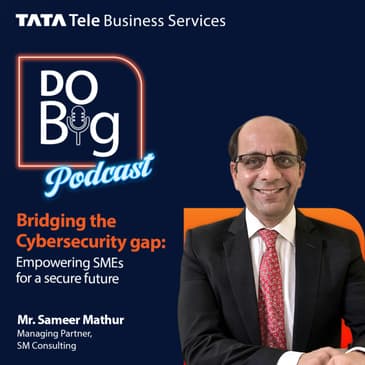
Join us on the latest episode of the Do Big Podcast, where we're delving deep into the world of cybersecurity alongside Sameer Mathur, a seasoned expert with over three decades of experience. In this insightful discussion, Sameer shares invaluable insights aimed at empowering SMEs to navigate the complex landscape of cybersecurity and ensure business continuity. From practical tips to strategic advice, learn how SMEs can make informed decisions and bolster their cybersecurity posture to maintain uninterrupted operations in today's digital era. Tune in to discover how to safeguard your business against cyber threats and ensure a secure and resilient future.
[00:00:00] Prioritising Cybersecurity is imperative for small businesses to safeguard their operations and reputation. A successful ransomware attack can result in significant consequences such as financial losses, service disruptions and harm to the brand image. Rebuilding customer
[00:00:28] trust for security breach is challenging and we result in the loss of potential clients. We have with us Sameer Mathur, Managing Partner SM Consultant. Sameer Mathur has more than three decades of experience in similar work functions. Sameer completed his MBA in 1989, post his
[00:00:50] graduation in Science from Hans Raj College Delhi University. Over the last 34 years, Sameer has worked for organizations like NIIT, Vipro, Tata Unices Limited and Quantum Network Technologies Limited. He is a Certified Data Protection Officer and is also a Certified
[00:01:10] Information Systems Editor. Sameer is a member of the governing board at the Asia Pacific Institute of Management in New Delhi. He has been an entrepreneur for most of his professional life. He is a Level B IPMA, International Project Management Associates,
[00:01:28] Certified Senior Project Director. Welcome to the Do Big Podcast Sameer and I look forward to an interesting conversation with you on cybersecurity. Yeah, Shital thanks for that introduction. Yes, cybersecurity is an area of concern
[00:01:47] amongst all the MSMEs and they understand, especially in the last two, three years when the usage of internet has gone up and the usage of online tools like recording tools and also business applications has gone up. The issue of cybersecurity is a big area
[00:02:04] of concern for most of the MSMEs. The issue today is that the understanding of the threat perception is there but due to various reasons which we will discuss in subsequent, the actual implementation or actionable insights are very few. So I think that's a big challenge
[00:02:26] that SMEs are facing and we as advocacy champions for this, it's our prime job to inform SMEs of the kind of potential threat like you mentioned about ransomware. Ransomware is one of the issues which gets highlighted in the media for people are worried about ransomware
[00:02:44] but there are 10 other issues which could happen. So I think it's a very interesting topic and it is a topic which needs immediate concern of the SME owners but yes, there's a concern area but also quite often ignored area.
[00:02:59] Sameer, typically in your experience and you worked with so many organizations, can you tell us the kind of threats that SMEs have faced? So if you could prioritize the threats, that will be great but if you could at least talk to us about the kind of threats
[00:03:15] they are facing. The kind of threat they are facing are like I said many in number but the issue is that most of the threats that are coming so these are concepts which are not very clear
[00:03:27] to MSMEs. That's why like I mentioned that actionable insights are actionable actions are not there which means that the threat is not clear to them. For example in terms of loss of privacy, in terms of loss of data, in terms of loss of valuable asset, it could
[00:03:46] be a data asset, it could be other assets also. What will a hacker do to us in terms of if the hacker is actually able to get into my network? We've had experience of
[00:03:58] large SME manufacturing company owners telling us that how does it matter if a hacker gets into our network? What can they take? If they can take our data, doesn't matter to us. So I think that's where lies the problem. Actual potential loss of data is something that
[00:04:17] is not clear to most of the SME owners. Now I am mentioning SME owners is that most of the SMEs do not have a very mature IT security teams. So most of the SMEs are still struggling with their ERP implementation or CRM implementation and security kind of
[00:04:36] takes a backseat because it is something that is not visible. It doesn't actually hamper your daily operations and that's why it is often ignored and that is something that we need to work on. Okay, so just out of curiosity, Samir, can you list some of the cybersecurity issues
[00:04:53] that SMEs face? So like we talked about ransomware, what are the others that they fix? So there is hacking going on. There is bot based ransomware where without clicking any link one can get into it. There are user account based hacking happening. There is identity theft
[00:05:15] that's happening. Today users are actually the hackers are gaining entry into your system and sitting in the system for months together just trying to gauge the user behavior and just trying to reach the most potential or the most dangerous victim that they can get
[00:05:36] hold of. It could be the MDs laptop, it could be the CFO's laptop. So all this user analytic behavior is happening today as a result of which many people are not aware of lot of illegal activity happening in their network. Actually, there is a data survey
[00:05:55] conducted by international research firms which says that in any network before the user realizes that there is a hacker in my network, the average time to find this hacker or just to find not solve the problem is about 180 days, which means for six months
[00:06:17] somebody is sitting in your network and reading your data usage and understanding your user behavior before the user comes to know that there is something wrong with my network. Imagine somebody sitting in your home for six months understanding that what time
[00:06:34] people go out, what time people go in, what time they are kind of resting and what is the most vulnerable time for me to attack them. I mean they have all data with them. And would this typically happen like you know they would come in through email? How
[00:06:51] typically a hacker enter a system? So yes, most attacks are happening through email or some kind of endpoints right? So endpoints of course, an email is one of the applications because it is widely used and one tends to log into email from wherever in
[00:07:09] country you are in. And obviously there are there are unsecured network because I'm traveling to a remote area where the network is not so secure. I might try to log in from a network of somebody else's office I am there, which may not be
[00:07:24] secure. I mean you go to cyber cafes, why should we talk about remote applications? Even in cities, you go to coffee places and you will find them giving you free Wi-Fi because they want you to sit there and use their Wi-Fi and
[00:07:36] probably have coffee and something to eat. And you will find comment on your Wi-Fi network saying unsecured network, which means that the network is insecure still we tend to log in through them and use all our applications
[00:07:51] including banking and WhatsApp and other things. So like I said that the number of threads that are amazing and especially with the growth of the cloud network things are really getting out of hand and whatever news we are getting in
[00:08:07] the media I strongly feel is only the tip of the iceberg. The problem is much much deeper. Okay, and you know like you mentioned there is growing awareness about cyber security among SMEs but you also mentioned that it is difficult
[00:08:25] and it's a struggle to get into translated into actionable insights. Where is the struggle and why is there a struggle on the actionable insights? So two, three points like I mentioned that you know the problem but there are no
[00:08:39] visible symptoms that my work is going on. My ERP is working. I am able to do data entry in my accounting. I'm able to take out invoices. I am able to create my balance sheet. I'm able to work on my HRMS. Attendance system is
[00:08:54] working. Customer relationship management software everything is working. What is the problem? It's not visible right? Point number one. Point number two, the biggest challenge I feel is the lack of availability of manpower. There are international surveys which says that the demand for security professionals is
[00:09:13] running into millions within India only and that's why the comment is also trying to initiate this as a concept of raising awareness amongst the users in terms of their understanding of the data. How that data as an asset
[00:09:29] is something that needs to be taken care of. The government as for the information of all the listeners have recently passed, they'll also call the DPDP Act which was passed as recently as August of 23 which talks specifically of production of the
[00:09:45] personal data of the individual and you have all these controversies around defects that's happening and this is actually only like I said only the tip of the iceberg. So coming back to the example of SME owners especially in the
[00:09:58] manufacturing who are sitting in remote areas and for them of course lack of trained manpower is a big issue. Even if they were to realize that we need to invest in cybersecurity products where do they have people to be able to manage
[00:10:13] those products that they will buy? That's why we have offerings on SaaS platforms, we have offering on cloud where you need not manage. We just install the systems and the management is done by the concerned company at
[00:10:26] the back end. So those kind of offerings are something that are already picking up. The other thing is that even if the intent is there and even if the teams are there the lack of awareness amongst the users which means that if I were
[00:10:43] to install the best systems in my organization and I would buy the state-of-the-art equipment but if my users are not aware of how to use IT systems and where to take the right precautions I can still be hacked but
[00:10:57] somebody could press on a link and everything goes haywire. So it's a mixture of these three four parameters which have to be taken care of. So a lot of people talk about the fact that SMB should consider implementing a
[00:11:12] cyber risk quantification solution which really is getting an understanding of the cybersecurity posture and how the AN helps them make informed decisions. Just talk us through a little more about what this could mean for an SMB. What does cyber risk quantification mean? Both in terms of risk management,
[00:11:35] both the quality of the risk and the quantity of the risk are very, very important. Unfortunately, this is a concept which is just taking off in the SMB sector and many people were aware of this and since this is a
[00:11:49] service which does cost a lot of amount and other costly service from SMB point of view but there are now online tools available which will do it for you on a SaaS model which means you need not employ people full time in
[00:12:05] your office. The biggest threat actually comes from the vendors which means if you are connected to your vendors which most of the SMBs are and vendors are still smaller companies, they might be the M out of the
[00:12:17] MSME and of course therefore them cybersecurity is not a big concern. Neither do they have budgets nor do they have awareness for this and once your system is connected to your vendor system then that's the biggest risk which means the hackers can get it through the vendors network.
[00:12:34] We have this concept of TPRM, the third party risk management tools which I think are very good. They are coming up in terms of the actual quantification and the quality of risk like I mentioned. There is the concept of a PI index which means the probability of risk
[00:12:51] and the impact of risk. Sometimes the probability of risk is high but the impact is low so I might kind of ignore that because everything turns into you know commercial angle but if the probability is low
[00:13:06] and the impact is high and movement the impact of the risk happening is high which means that somebody can actually take control of my IT systems and can stop my billing like it has happened in a very large hospital
[00:13:20] and other places also they can actually take over your systems and not let you work and then we have those ransomwares and the cryptocurrency being paid and all that. So the issue of awareness the issue of actually going through the whole process
[00:13:38] creating like we said a risk management quantification chart matrix using the PI index yes is a very good solution for these SMEs to at least understand their risks. So Sudeed when you talked about this whole thing of a hospital and the billing process
[00:13:57] it almost seemed like an OTT episode to me and I was just thinking you know maybe can you share and we don't expect you to share clients but can you share one or two
[00:14:10] examples of what has happened when an SMB has faced a cybersecurity issue so what kind of an attack happened what kind of a threat happened and how do you mitigate. I can give you many many examples for example one manufacturing company that we were advising
[00:14:30] on their cybersecurity posture pays out of Punjab large company couple of hundred million dollars million dollars and one fine morning a lot of their vendors started getting mails from their system saying that because you have not paid your amounts for the last transaction
[00:14:50] we are stopping your payment or something like that. So as a result there was panic in the I mean they have a very large channel network all over the country and outside India also
[00:15:00] and so this was a typical attack instigated by malicious actors the idea was to create panic and then based on that people will panic take some wrong action and then they will take control
[00:15:14] so this was just I would say these are given to the management that either hear us hear us or they are ransom what they're asking for and there was panic all over the partner network
[00:15:26] that what is this happening it was basically a spam they didn't have a proper empty spam software so one of the out of the thousands of users that they have probably 1500 or 1600 users
[00:15:40] one user was attacked and from this user hundreds of mails went early in the morning before even the office opened so all their vendors and dealers and customers large customers also
[00:15:53] got mails that we are stopping your payment and there are always a lot of panic and stuff because these are all poor products and at the user end at the customer end work would have stopped
[00:16:03] at this stop the delivery so like this there are there are many examples we have examples of personal data being misused within the organization one very very important part is we tell that most of the leakages happen from internal resources only this is also a
[00:16:22] survey that has been done that it has it is done by existing or exemplary only so which becomes a force becomes an HR issue that why are our employees only turning against us because you
[00:16:33] know there are a number of reasons but yes in another customer there was a case of somebody using facebook live to give out wrong data or a wrong message there are so many examples
[00:16:47] there in the last year or so since the press has got hold of this news that the large companies have been have been targeted and it becomes very very difficult for them to come back into business
[00:16:59] and we have the example of Maggie being targeted we are the example of large delivery apps food delivery apps being targeted we have examples of you know pathological labs being targeted which are carrying medical data when that's the most sensitive data that can carry that can happen
[00:17:18] that can be leaked so so the examples are numerous but is that interesting so on one side we have cybersecurity which is becoming a growing problem and while you've spoken about the large organizations what you're really saying is that SMBs are soon going to be the next target
[00:17:36] of these hackers and these fissures and things like that because there are only so many large companies but there's much larger pool of MSMEs available to them switching gears a bit one aspect
[00:17:50] which is also very large as far as cybersecurity is concerned is also data privacy and I just wanted to understand that you know what is happening in the space of data privacy and
[00:18:01] why is it that SMBs need to start focusing on data privacy because I think all of us have not really as SMBs or MSMEs not really focused on data privacy in the past globally there's a lot of
[00:18:16] conversations around data privacy and personal data privacy and you know consumer's data and things like that but in India it's becoming a conversation today so what is it that is happening in the environment which SMBs must take notice of?
[00:18:34] Absolute shithil so the concept of personal privacy has been discussed in India also over the last 10 15 20 years the first version of this bill that I mentioned came was introduced almost 18 20 years back but it was largely ignored by the concerned authorities and
[00:18:52] by the people also because there was no clarity on what privacy personal privacy is all about forget data privacy supreme forward in one of their judgments a few years back clarified that right to privacy is a basic right as defined in the constitution and that was a
[00:19:12] time when people woke up that this is a very very important topic to be taken care of now this was personal privacy that privacy every individual of the country every citizen of the country minor
[00:19:26] major adult old the right to privacy is a basic right so this was a ruling given by supreme court few years back and that's why like I said the system started moving and then we introduced a law
[00:19:39] bill on this and there were a lot of discussions there coming back to the point see personal privacy is something that that is still not understood and it's a very abstract topic frankly you go to a showroom today and they say please share your number shithil fam
[00:19:55] we'll send you some discount coupons and you don't feel like giving your number you don't give your number tomorrow after a week you go to another outlet who's also unknown to you like this
[00:20:04] outlet they say if you can give your number we'll then you give your number so it's not that you are not concerned about privacy but maybe you're in a better mood and you like the person and
[00:20:15] then you shared your number so I'm saying that this is one the secondly we have this concept especially in metros of people putting cameras on their main gate or main door and which is covering
[00:20:26] the road also which is covering the neighbor's house also so all these are invasions of privacy so one has to understand that before data privacy we need to understand privacy it's a long topic then they come to personal data privacy the law is very clear that personal data
[00:20:42] is something there's a term in the act called PII personally identify all the information whichever information whichever data can be connected back to me which could be my name the mere math or which could be my number which could be your mail ID which could be my medical
[00:21:02] data which could be my financial data that's all PII now that needs to be productive coming back to SME SME owners need to make sure that all personal data of individuals that they are carrying
[00:21:16] is properly protected which means there is no breach this is one of the very few laws in India she tell where we act as defined the penalties inside the eye which means it's printed and the penalties start from 10 crore and go still 250 crores for large organization and
[00:21:35] applicable to all companies which are doing business in India it's only digital data if you are if you are copying your data on a piece of diary or register that's not covered at the moment you
[00:21:47] are covering copying that data from your register to your excel sheet that becomes digital data we have visitors logbook and so many government offices where they write your number of name everything and then they are if you are converting it into an excel sheet then comes
[00:22:03] as part of the digital data so the law says that at any cost you have to ensure that this does not get the personal data this is not about ERP data this is not about financial data the personal
[00:22:15] data and in case there's a breach there are huge penalties like I said going up to 20 crore coming back to your point of MSMEs MSMEs are actually at a bigger threat of being hacked
[00:22:28] because the level of cybersecurity there is pretty low like we have discussed right so the MSME owners especially the ones who are carrying crucial data carrying personal data sensitive data need to immediately start looking at this as a as a concern area there is an option of
[00:22:47] conducting what is known as a harm audit some harm audit is a concept cheetal where we conduct an audit to actually quantify what harm will come to the customer in case of a data breach of personal
[00:23:00] data right so these are all advanced concepts but my request to my I will urge all SME owners to look into this as something which is not from the compliance point of view not from the
[00:23:13] penalty point of view from the point of view the fact that it can really spoil the life of an individual if the personal data is misused after hacking from your organization so we are there categories or you know are there industries where you think that this could be
[00:23:33] more damaging than others so let's say for example do you think healthcare data versus you know just basic mobile phone data I'm just trying to understand is there like a industries which are
[00:23:45] more which could have far more serious repercussions over industries which may not have as much serious repercussions see obviously the first industry that comes to mind is BFSI the banking finance insurance kind of sector that's come healthcare is of course one but even services
[00:24:04] industry manufacturing industry whoever is carrying personal data which all of us are employee data or vendor data or customer data there are for example the food delivery apps ticket booking apps movie hall booking apps they're all carrying our personal data right
[00:24:24] our banking apps are carrying our personal data would be medical data I would not prioritize but yes in terms of compliance I think BFSI industry is something which has which has taken the lead in terms of using this as a tool or understanding the ramifications of of this
[00:24:44] act if they were not to take care of the big you know a lot of SMEs or MSMEs are also partners to much larger organizations which could be both national in nature and global in nature how should MSMEs who are working with global organizations or large national organizations
[00:25:06] why does this whole security and privacy become even more critical for them which is a very good question Chitl we have had customers with us where they are foreign partners or even customers they could be buying or selling to them they have stopped doing business or reduced
[00:25:22] the business because of lack of purity posture in the MSME remember we had that movement of textile industry and garment industry suffering by saying that if you are using child labor in
[00:25:35] your company you will not buy from you and if you go to any large industrial area where garment manufacturing is happening you will find large posters saying that in our manufacturing unit no child labor is being used because that came as a pressure from the customers in Europe
[00:25:51] in US in this case the ramifications are much much higher especially with the introduction of GDPR which happened two years back most of the European America also has a law called CCPA so does Australia and Singapore and Dubai all the developed nations have laws very very strict
[00:26:11] laws regarding this you'll be surprised to know more than 125-126 countries in the world have personal data privacy laws it does happen that they need to abide by those laws either you are buying from a OEM outside India or selling to them yes this is a
[00:26:31] major area of concern and especially let's consider for example GDPR or GDPR if you are carrying any data of a European citizen in your company to whatever means you're serving a European company you are a back-end data center or you are a back-end service provided to them
[00:26:49] and as a result you're carrying any personal data of any European citizen EU citizen and you are bound by GDPR laws like I said it's a very vast topic and one needs to be aware so I would
[00:27:01] say that there's no need to panic on this it's not that is going to come to all of us but I think one of the biggest movement that is happening also that the users especially the young users
[00:27:15] the Gen X and the Gen Z are already aware of this because of their presence on social media and they would feel much more comfortable in working in a company where they feel that my personal data here is properly protected typically when you think about SMEs and the
[00:27:33] way they handle cybersecurity they have things like firewalls or email security you know the basic steps in place most of them and like you mentioned doing advanced things cost money and
[00:27:45] therefore you know if I can manage with the basics is how a lot of MSMEs look at security chal jaayega you know I should be able to manage it if you had to advise them and I'm just saying
[00:27:58] maybe two or three steps that you can tell SMEs that they must take so that they enhance their cybersecurity measures beyond just the absolute basics what would those two or three steps
[00:28:11] very good point you have raised so let me give you an example on this you mentioned about firewalls and endpoint securities and email security and supply map so most of the MSMEs that we work with
[00:28:22] even if they have these devices or solutions installed there they are aware of it I mean it's they bought it and they installed it and after that nothing happened for example let's take
[00:28:34] a firewall only now firewall is is an authentication device firewall is like a guard standing in the in front of your building or in front of a network in case of firewall and he's just authenticating
[00:28:46] that the person who's coming inside is either an employee of the company or he's a visitor but whom he's going to meet the visitor is kind of confirming his identity and Mr. XYZ has come
[00:28:59] he's not an employee of the company but please let him come because he has come to meet me authenticating the user is what the firewall does I might be an authenticated user to your factory
[00:29:10] but I might be carrying pendrive with me in my pocket which I can go and install or heal data from your organization the firewall is not carrying the content of the person who's
[00:29:25] is not checking the content he's I could be a ransomware bot I could go and sit inside hide I'll say there is a washroom there is the coffee there and then I go and hide in the building
[00:29:35] somewhere nobody's bothered that you came and you never went out how it starts so so I'm saying updating the existing product policies is something that is of area of concern that's first I am the first thing we check is our existing email security policies existing firewall policies
[00:29:57] we find that the firewall policies if they bought the firewall eight years back firewall policies was discussed by the concerned vendor they were told to the vendor vendor installed implemented the policy walked off after that nobody has bothered to open that and see whether they are
[00:30:16] things to be done it all comes back to how much mind share you are giving to this as a problem how much awareness you have that this is the issue which ideally firewall policy should be checked
[00:30:27] every quarter if not every month but I know customers who have not looked at their firewall policy for five years which means so many new things would have happened but you are just
[00:30:39] it's a tick mark on your kra that yes I bought a firewall it's running and and that's it these measures before we whatever is there we find a lot of gaps there there is no risk
[00:30:52] management in place third party risk management is not even discussed in msme's I think these are all concern areas which they need to take care of and before we wrap up my last question to
[00:31:04] you so let's say I'm an msme or alasna's are msme's and can you kind of list five factors that especially sms should look into when they're looking at a cybersecurity solution to ensure that it is
[00:31:19] effective so you could give me three factors or five factors but the top five factors that they should look for in a cybersecurity solution I think the first factor is management or leadership buy-in I always say that you can't run your factory without a fire alarm system
[00:31:39] the authorities will not give you permission to run your factory without a fire alarm but how come you are getting permission to run your network system without any security so like you you
[00:31:51] insist that I want a fire alarm I want the ac in my factory similarly please consider cybersecurity as a basic step so like I said that first is look at the policies being implemented for
[00:32:05] whatever you already have like I gave an example of fireball to look at updating your products to the latest offering from the concerned vendors understanding the policies actually implementing policies management has to understand that the policies are for your own good please don't ignore
[00:32:25] the policy second is that you have to you have to run awareness program amongst all your staff the awareness programs when we talk of running awareness programs the IT teams are put in front
[00:32:40] put put in front saying that it go seek hadia those up seek jengi that's not right it is only an implementer if your HR fellows accounts fellows sales fellow marketing teams the guard
[00:32:52] and all that were also part of the same network IT network if they are not following those norms and the whole you might have the best of the tools is not going to happen so awareness programs management
[00:33:03] buying and then comes the actual products to be bought you might spend a crore or rupee on buying the best product but leakages will happen if those two are not followed and most of the IT
[00:33:15] heads tell us that the plouting of the norms are happening from the top level which is where the gap is then you come to actual products and I think the actual products one should look at
[00:33:26] buying something which is the state of the art which is proactive most of the people end up buying a firewall which is a reactive product which means that after the incident has happened
[00:33:39] after hacking has happened it will let you know email security if you are not able to basic email securities or endpoint securities are firewalls are not going to stop the new hackers
[00:33:51] the hackers are much much smarter than we are so it's not going to stop so we need to look at we need to get into the mind of the hacker and decide what is he thinking about
[00:34:02] hacking are two kinds one is for money other is for spoiling your reputation two kind of so we need to be clear on what kind of devices we should buy we should buy products which stop hackers from coming not only reporting that what has happened already
[00:34:22] instead of post incidents we need to buy there are many many AI based analytical tools which are available not very costly AI doesn't mean very high cost very very reasonably priced tools which are available in the market which basically you mentioned about risk management
[00:34:38] it prioritizes your risk there are there are 25 risks in your network out of these 25 these five are the highest impact the tool will do for you and then you need to create a strategy
[00:34:51] to mitigate those five risks so this if if you're an SME which is looking at forward-looking and you are looking at something not only reporting what hacker having gotten stopping the hacker from coming in then you need to go the AI analytical
[00:35:07] tool way great that Samir brings us to the end of today's episode I I'm sure that we all learned a lot from you and yes it's very interesting that when you talk about the fact that first
[00:35:19] you have to check your own readiness before you start implementation and I think that's something that most MSMEs need to get their mindsets to shift into saying this is a potential threat which could happen to my brand and therefore I need to invest in this
[00:35:36] just like I invest in manufacturing just as I invest in brand building and everything else thank you so much for your valuable time and thank you so much for making this complex subject a little more easy to understand during our conversation so an absolute
[00:35:54] pleasure having you on the doobie podcast thank you thank you MS and wonderful chatting with you thank you so much thank you shidl thank you for tuning in to the doobie podcast a podcast that is dedicated to providing insights strategies and success stories of smart digital solutions for
[00:36:15] sms we believe that behind every successful business there's a strong foundation of reliable and secure technology via digital connectivity cloud info cloud apps collaboration tools or cybersecurity solutions in a rapidly evolving digital world where technology is key to progress
[00:36:33] tata tele business services stands at the forefront of digital transformation of sms tata tele business services with their extensive experience and commitment to empowering businesses understands the unique needs of sms tata tele business services with their extensive experience and commitment to empowering businesses understands the unique needs
[00:36:54] of sms whether it's scalable connectivity robust communication tools or tailored ict solutions tata tele business services is here to propel your business forward tata tele business services is synonymous with innovation reliability and transformative solutions with a legacy spanning decades tata tele business services has been
[00:37:18] empowering businesses and transforming lives across the nation so if you're ready to take your organization to new heights of success we encourage you to explore the transformative possibilities that tata tele business services has to offer our contact details are in the
[00:37:35] description below remember we're available major podcast platforms so if you enjoyed today's conversation subscribe to our podcast for future episodes which we promise will be packed with equally valuable insights on questions entrepreneurs face as they digitize and scale
[00:37:51] businesses with the help of technology don't forget to rate and review our podcast as well as share it with peers colleagues and other entrepreneurs like yourself who will benefit from listening to it thank you for listening to us and until the next time keep embracing
[00:38:07] technology and may your business thrive in the digital end