
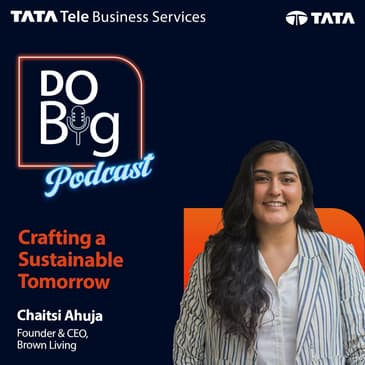
In this episode of the Do Big Podcast, we uncover the inspiring story of Chaitsi Ahuja, founder of Brown Living. Chaitsi talks about what sparked the idea for Brown Living, the market gap she aimed to bridge with sustainable, eco-friendly products, and how her business is evolving to meet new consumer and environmental needs. She also shares insightful advice for startups and SMEs looking to integrate sustainability into their operations, making this episode a must-hear for entrepreneurs committed to building a greener future.
[00:00:08] Welcome to another episode of the Do Big Podcast, where we are focusing on a critical issue facing not only India, but the world. We're speaking about sustainable consumerism. Did you know that India generates approximately 9.4 million tons of plastic waste annually? And did you know that we only recycle 60% of it? Have you ever wondered what happens to the remainder?
[00:00:35] Did you know that the fashion industry accounts for 10% of global carbon emissions? And just a small data point to leave you thinking, do you know that it takes about 2700 liters of water to produce just one t-shirt? That amount of water could sustain a person for 900 days.
[00:00:58] Next time you're shopping for a new outfit of the day because you want to be on Instagram, consider these figures. If these statistics don't prompt you, reconsider your habits, perhaps our conversation today will.
[00:01:12] I'm your host, Sheetal Choksi, founder of Unpack Research. And today we're thrilled to have with us Chaitsi Ahuja, the founder of Brown Living, India's first planet positive online marketplace.
[00:01:25] Brown Living challenges conventional shopping norms by offering products that are entirely sustainable, supporting a zero waste plastic free lifestyle.
[00:01:34] Chaitsi's commitment to ethical consumerism and her platform's rigorous Brown Lens certification process ensure that every item not only minimizes environmental impact, but also supports local artisans and eco-friendly practices.
[00:01:52] Join me as we dive into her journey of transforming the ethos of e-commerce into a force for good as she transforms us all into becoming more mindful consumers.
[00:02:06] Thank you, Chaitsi, for joining us today on the Lubic podcast. I'm super excited.
[00:02:11] Thank you, Sheetal. You've actually summed up my entire journey of being an entrepreneur.
[00:02:16] So I'm really excited to have this chat and I hope we're able to inspire a few people to choose sustainable by the end of it.
[00:02:25] I'm sure you will. I was reading about Brown Living. I went to your website and things like that, and I was totally convinced.
[00:02:32] And I've been reading up on this entire piece of fast fashion being such a terrible thing that we're doing to planet Earth.
[00:02:41] But I think it's lovely that people like you are taking these steps.
[00:02:44] But having said that, what really got you to start Brown Living?
[00:02:51] It's actually a very interesting but really long story.
[00:02:55] But because we don't have so much time, I'm going to make it short.
[00:02:58] I think growing up, I've always been, you know, somebody who's very close to nature and really gets inspired by it.
[00:03:08] So I was always trying to find ways to, you know, give back to Mother Nature in some way or like spend more time in nature as much as possible.
[00:03:17] It also had a very calming effect on me.
[00:03:20] And, you know, once I sort of finished my studies and sort of went into the corporate world, I started realizing the real impact of our consumption habits.
[00:03:30] Because I was sitting in stock rooms, I was in factories, I was looking at production at scale.
[00:03:35] And as a marketeer, it was always about growth and growing brands and doing more business.
[00:03:42] But like there came a point in my career where, you know, environmental damages that our production processes were doing were literally affecting prices of our own materials.
[00:03:55] And that's when I actually started researching on sustainable development goals.
[00:04:00] And that, you know, sort of transported me back into when I was a child.
[00:04:04] And, you know, I wanted to sort of be closer to nature.
[00:04:08] And, you know, I spent a lot of time sitting in my garden growing up and also growing up like my father used to run a factory himself.
[00:04:17] And I keep asking these curious questions about like, what is that chimney?
[00:04:21] Why is it throwing out so much smoke?
[00:04:22] And like, why does this canal smell so bad?
[00:04:25] And why are we using so many chemicals?
[00:04:27] So it just sort of reminded me that I was somebody who wanted to question these ways all along.
[00:04:35] And because it started affecting my personal, you know, health as well, beyond the point,
[00:04:43] I started looking for simpler ways to live life that wouldn't sort of harm me or the planet in the process.
[00:04:50] And so I started with simple, you know, DIY hacks at home, going back to like old ways of how my grandmother used to take care of her skin or like what food they would eat.
[00:05:01] And one part of my family were also farmers.
[00:05:04] So like really trying to understand before the fertilizer era, like how were they growing their crops and what kind of food were they eating?
[00:05:12] And all of that really made me realize that because in our times today, convenience trumps everything where okay to have substandard quality food to eat, things to wear and convenience and affordability plays a huge role in our consumption habits today.
[00:05:31] And I thought, you know, maybe it's not the best way to sort of continue living.
[00:05:38] And so I started looking for solutions saying, okay, if there was somebody else like me as well,
[00:05:43] who wanted to maybe live a minimalist or a low waste lifestyle or like look at nature inspired products, what would that look like?
[00:05:53] And very quickly discovered a lot of small businesses that were doing like really amazing work.
[00:06:02] And they were really like in-depth knowledge experts that I discovered over time.
[00:06:07] And the intention was to really, you know, help them scale because I had a forte in marketing and I wanted to put it to good use.
[00:06:16] So I started asking questions, understanding their processes, understanding their pain points.
[00:06:23] And on the other end for consumers like myself, I frequented a lot of farmers markets, local community markets, you know, DMed a lot of brands on Instagram or like wrote an email to them or found them on LinkedIn.
[00:06:37] And over time, I realized that a lot of these small businesses had very, very common issues, especially related to sustainability, how to measure your impact, how to sort of, you know, compete with brands that were doing not so sustainable things,
[00:06:56] but still being able to sell to a consumer who's sort of very price sensitive in India as a market.
[00:07:02] And even if like, especially in like urban India, it's still easier to sell sustainable products.
[00:07:07] But when you look at overall Bharat, people are getting used to cheaper products.
[00:07:13] Penetration of FMCG brands has increased over the last 20 years.
[00:07:17] So we've gotten them used to such a low price point, whether it's fashion, whether it's, you know, consumer products, whether it's technology, whether it's anything, right?
[00:07:25] So one is, of course, unlearning the art of overconsumption.
[00:07:31] And second is, how do I like figure out this sweet spot where, you know, it doesn't pinch their pocket a lot, but it also helps them, you know, find the right solution.
[00:07:41] So that's how like it was kind of a snowball where I thought maybe let me work with a few brands and see how, you know, I can help them scale and streamline processes and improve business strategy.
[00:07:52] But the more I delved into it, it sort of became clearer to me that a platform was required.
[00:08:00] And that's when Brown Living was born about five years ago.
[00:08:04] And when we started, we were purely just building something that was for people who wanted to make it their lifestyle as a to live sustainably and to live without plastic.
[00:08:17] And then a lot of layers sort of unfolded after that, the whole artisan piece where, you know, we're trying to work with communities that are producing locally.
[00:08:27] It's actually one of the second largest employer in our country after farming.
[00:08:33] There's a massive community.
[00:08:35] Like I think if I'm not wrong, it's about 220 million artisans that exist in our country.
[00:08:41] And because they're not a structured sort of industry, it's often sidelined and not considered for like even policymaking or tax purposes.
[00:08:52] It's just these old practices of, you know, making things by hand, using local materials, using age-old techniques and practices have also been really, really environmentally sustainable.
[00:09:08] So, discovered all of that and said, okay, let's make a holistic sort of platform that enables these different sort of players in the market.
[00:09:18] And also as a benefit to the consumer, all of that sort of coming together.
[00:09:23] So, the intention for Brown Living was always to make this sustainable living easy, accessible and affordable.
[00:09:30] And over time, it's evolved.
[00:09:35] So, in terms of, you know, you spoke about the fact that when you sit into large corporates, it's always about growth.
[00:09:40] It's about all of that.
[00:09:42] And as a business, I'm sure that that is also something that you have to look at.
[00:09:46] It can't be just sustainable pieces.
[00:09:51] So, how do you balance the economic objectives or how do you balance the P&L objectives with your mission to be planet positive for zero waste?
[00:10:06] It's a very interesting question.
[00:10:07] So, I think what we do is we follow a triple bottom line sort of format.
[00:10:12] Typically, all your mainstream profit-making companies follow a single bottom line, which is just profit.
[00:10:18] But we've, you know, put three layers to what success means to us as a business.
[00:10:25] And the first layer is, of course, financial sustainability.
[00:10:29] Second is social and governance overall, like having best practices, ensuring fair trade, fair wage, equal pay, etc.
[00:10:39] And the third layer is, which according to us is most important, is the environmental sustainability.
[00:10:45] So, when we switch from a single bottom line to a triple bottom line business, one thing you have to consider is that everything comes at a cost.
[00:10:54] Even for fast fashion brands today, if you see their growth is tremendous, their price tables are going lower and lower.
[00:11:02] But the quality of the product or the quality of life for the employees they sort of employ and the quality of, you know, ecosystem at large is deteriorating.
[00:11:13] And there is an eventual cost you have to pay as a business to be able to do that.
[00:11:18] So, the government is now applying like a mandatory CSR, you know, requisition for listed companies.
[00:11:30] But there's like, we also must understand that 80% of India, 80-85% is run by MSMS.
[00:11:36] So, what happens to those businesses who continue to then grow like crazy and at some point, of course, CSR and these mandates of like environmental tax and all of that, which is still in policymaking, will apply to them.
[00:11:50] But there's a lot of damage that's already been done, right?
[00:11:54] So, do we wait for governments to change policies and then implement those because somebody told us that this is mandatory?
[00:12:02] Or can we take initiative as people from the community?
[00:12:06] We all like have, you know, relatives that have fallen sick because of lifestyle disease.
[00:12:13] We've all personally had issues at, you know, our own health.
[00:12:17] So, I think there's a change in perspective that happens once you move from like a singular perspective to a triple bottom line perspective.
[00:12:25] So, what we do is like even when we are projecting numbers, let's say for the year, for the quarter, we're looking at covering all costs.
[00:12:34] Costs without discounting, costs without, you know, really like undercutting somebody or like negotiating so hard that it's not profitable for that person to sort of do business.
[00:12:46] We sort of cover realistic costs.
[00:12:49] And we also factor in costs of like for us to be able to be environmentally sustainable.
[00:12:55] So, we have this initiative where we plant trees for all our, you know, all our products travel through the country because we ship them.
[00:13:02] So, we calculate those.
[00:13:04] So, we have an estimate of like maybe 5 crores worth of sale and my carbon emission is going to be X and I will have to invest, let's say, X divided by 20 as an amount in planting trees or like doing something for the community.
[00:13:22] All of those costs are already built in.
[00:13:25] And then you look at how much profit are you actually making.
[00:13:29] It might be lesser than if I didn't do all of those 3-4 things about community, about environment, about fair trade.
[00:13:38] But in the long run, you will see that any company that follows a triple bottom line business has higher trust, has higher respect in the community, has better brand equity, has a stronger, you know, foothold in the market, has a stronger consumer base, better repeat rates, better customer lifetime value.
[00:13:59] Because we are all humans, even though you're trading in a toothpaste or like selling maybe a film, we're all in the business of emotions.
[00:14:09] So, if you're able to sort of connect with people at a larger level, then the commodity is really just, you know, something that is a transaction.
[00:14:18] But if you really want to build legacy businesses, it's very, very important to consider all aspects.
[00:14:24] So, I'm not sure if I answered your question, but I think it's really a mindset.
[00:14:31] But that's fine.
[00:14:33] I get that.
[00:14:34] What I want to understand from you is, you know, I come from the space of research and I do consumer research all the time.
[00:14:42] And every time you go to the consumer, while everybody wants to do what is right by the planet, they don't really do right by the planet when it comes to their purchase decisions, right?
[00:14:56] Because there is always this tradeoff between cost versus sustainability.
[00:15:01] How much do I pay for a sustainable product, etc.?
[00:15:05] Have you seen challenges on that front from a consumer education point of view or from a consumer acceptance point of view for brown living?
[00:15:18] I think yes and no.
[00:15:21] There are, of course, people who are sitting on the fence who will ask all sorts of questions and say, oh, this is 3x the price or it's, you know, maybe 20% more expensive than what I currently use.
[00:15:33] But the point again is about mindset.
[00:15:36] If you have bought into the idea of sustainability, you will already understand that it will cost you in the first instance.
[00:15:47] And when your mindset develops and you start implementing sustainable living in other parts of your life, you will see that it will make you consume less in terms of quantum.
[00:15:57] So over time, you will maybe per unit you're paying higher.
[00:16:02] But overall, as your overall household consumption actually reduces.
[00:16:08] So it's the less is more sort of philosophy.
[00:16:12] And there's lots of research happening, but it's not conclusive yet.
[00:16:18] But there are tremendous amounts of benefits that you get on your health, on your personal mental well-being when you sort of adopt practices that are sustainable or that are environmentally friendly.
[00:16:36] And I think another thing that we keep talking about when we say, oh, consumers are not willing to pay a premium.
[00:16:44] Consumers are willing to pay a premium.
[00:16:45] And that has been proven.
[00:16:47] There are tons of research.
[00:16:49] If you just Google it, you'll find it.
[00:16:52] The question is that can we make it convenient for those consumers to be able to pay that premium?
[00:16:58] Because just being sustainable is not enough.
[00:17:01] Your product has to be good, has to be delivered in time, has to be of great quality, has to require the consumer to do very little effort.
[00:17:12] And, you know, because there's only so much of consumers are willing to forego.
[00:17:17] And so I would say that it's probably harder to be a sustainable brand or a product because you're not just fairing on just it being a product that people can buy and sort of repeat by.
[00:17:30] But there's a lot of time and money invested in getting the right formulation, getting the right certification, being honest about it and being absolutely transparent about it.
[00:17:39] Because it's something that every consumer demands when they are willing to pay a premium.
[00:17:47] So the answer to the question, simply put, is consumers are in fact the driving force behind sustainable living becoming so popular today.
[00:18:00] It has been driving conversations at corporate levels, at policy levels.
[00:18:06] Journalism is questioning, you know, brand claims to a very large extent because we are all victims to the adulteration we've seen growing up or all the false promises that we were given.
[00:18:18] And there's, there's of course, a cost that people have paid for it.
[00:18:21] So it's, it's kind of like preventive medicine versus, you know, so, so it's really a choice that consumers have to make.
[00:18:31] And I, in my experience with Brown Living, we've actually seen a lot of awareness kicking in for consumers.
[00:18:39] People are more aware than ever.
[00:18:41] Five years ago, we had to really explain and break down the word sustainability, but today people get it.
[00:18:47] There is still a lot of greenwashing happening.
[00:18:50] So people will say, oh, recycle polyester.
[00:18:53] I'm sort of choosing that because I want to be better for the planet.
[00:18:57] But like the right applications of the right materials is something that a lot of like manufacturer level and like people who are making those procurement choices need to understand.
[00:19:09] And that in effect will give a larger base of, you know, products to consume for consumers.
[00:19:15] And there's, there's also like, because of consumer requests and consumers being so curious and they lack trust in when you say the word green or when you say the word sustainability.
[00:19:31] So it's very, very important to be truly authentic and transparent and have access to certifications.
[00:19:37] So the minute we'll, since the start of business, if I had to ask you for your three biggest challenges, what have those three biggest challenges been?
[00:19:49] First would be to convince people to not use plastic in their products.
[00:19:57] Like you would, you would see beautiful products, but they're just packaging itself was a very big challenge.
[00:20:03] And I think I spent a lot of time in like finding alternatives and looking for products.
[00:20:09] Now the ecosystem sort of adapted.
[00:20:11] So there's, there's lots of options available.
[00:20:13] But back in the day, like even looking at a replacement for a plastic tape or a bubble wrap was like a bit difficult.
[00:20:19] And it's also a very big staggering number about 68% of landfill waste is purely packaging waste, which is probably used for not more than 15, 20 minutes.
[00:20:31] Or if it's like a shipping product, then it's probably used probably slightly more, maybe a day or two.
[00:20:38] But most of that packaging ends up in landfills, if not separated properly, if not segregated properly.
[00:20:44] And in India, waste management is anyway a big problem.
[00:20:47] So packaging was one of the biggest issues.
[00:20:51] Second issue, I think, was when we were scaling.
[00:20:55] And like I said, when you, when you run a trip on bottom line business, your profitability becomes slightly delayed.
[00:21:02] And so we had to, of course, take external funding and looking for the right investors, looking for, you know, people who have patient capital,
[00:21:11] being able to, you know, being able to, you know, portray the vision that we have.
[00:21:16] And of course, like that matchmaking exercise took a while.
[00:21:19] But, you know, we're, we're now, you know, have been able to sort of maneuver around that and have found some really interesting and beautiful people who've supported us,
[00:21:31] backed us, invested in our company and also like advised us on how to scale this further.
[00:21:36] So that was number two.
[00:21:40] And I think number three, which is my recent and current challenges, growing and scaling the team that takes this to the next level.
[00:21:48] Because, you know, we've crossed five years now and there's, there's a certain MVP that's established and there's certain processes that are established.
[00:21:55] But really taking it from like India to Bharat, taking it to our next billion consumers.
[00:22:01] That's the growing pains are sort of kicking in now.
[00:22:05] And all things like from building a team to like making the right tech decisions, choosing the right partners to work with in terms of, you know, marketing and like all of those regular business pains.
[00:22:19] But I think because sustainability is a new market and there are very few people who are subject matter experts, there's a lot of time being spent on like creating that awareness, establishing that, you know, what is right and wrong.
[00:22:35] That's always been one of the key challenges too.
[00:22:39] So the Brown Lens framework really helps us like identify and like nullify a few things.
[00:22:44] And it continues to guide us.
[00:22:46] So speak to me a little bit about the Brown Lens framework that you've put together.
[00:22:52] Yeah.
[00:22:52] So I, when I started learning about sustainability, there were a bunch of frameworks, lots of different certification formats.
[00:23:01] And there was LCA, which is life cycle assessment as a method.
[00:23:05] There's cradle to cradle.
[00:23:07] There's circular economy.
[00:23:09] There's multiple of these concepts that exist.
[00:23:11] And all of them have a lot of things in common, but they also have like their own ideologies in itself.
[00:23:20] So I was trying to create something that helps us like figure out what is really sustainable.
[00:23:26] So, for example, when you look at leather as a material and you're trying to look for alternatives for leather,
[00:23:33] you end up looking at vegan leather, which is commonly known as, you know, PU, which is commonly known as vegan leather.
[00:23:41] So, which is actually made with plastic, right?
[00:23:45] And it's not compostable at all.
[00:23:47] So if you look at it from a landfill and waste generation perspective, it's not a sustainable solution.
[00:23:54] But when you look at it from animal cruelty perspective, it's a great solution because it doesn't have any, you know, animal skill in the process.
[00:24:03] But when you combine the two and say, okay, this, the waste generation and landfill problem, as well as the cruelty problem,
[00:24:12] if I had to fix both of them together, what would I do?
[00:24:15] Then we unfolded a layer of like plant-based leathers, which are made with malai, cactus, coconut, pineapple, and all of these innovations that are literally,
[00:24:27] I wouldn't say they're in lab stage, but they're, you know, in their growth phase right now.
[00:24:32] They're being tested at MBP at like multiple category levels to see how can we use them at a scale that plastic is being used today.
[00:24:42] And even like plastic as a material is beautifully created.
[00:24:47] It was actually part of, it was a zero waste ingredient in itself because it comes from the extraction of food.
[00:24:54] But the problem is the application of the material.
[00:24:58] We end up using it in like really thin films and like plastic bags.
[00:25:05] When you make plastic so thin, it becomes harder and harder to recycle.
[00:25:09] And plastic also has a quality to downgrade every time you recycle it.
[00:25:14] So from making a, you know, food container to recycling it further and further,
[00:25:20] maybe you can recycle it up to three times to be, to let it be a container.
[00:25:24] But after that, you'll have to maybe switch it to a thinner grade and make it into a lighter or smaller product.
[00:25:30] So that was a very common issue that we found with recycling as a solution.
[00:25:37] And so, you know, I sort of sat together and looked at these different frameworks and said,
[00:25:43] okay, can we, can we look at something, every product from a holistic level where it has an environmental benefit?
[00:25:51] It has a social benefit.
[00:25:52] It has a, maybe like doesn't harm other species in the process apart from humans.
[00:25:58] And it also is sort of circular in nature and regenerative in nature.
[00:26:03] So I made it like a simple Excel sheet where put down a few questions like,
[00:26:08] and then bucketed them under five parameters.
[00:26:12] So the first one is called source, which looks at the materials, ingredients of the product.
[00:26:18] Where do they come from?
[00:26:19] How are they sourced?
[00:26:20] What is the footprint of that?
[00:26:21] Is that process of extraction sort of chemically intensive or harmful in any way?
[00:26:27] The second part is method.
[00:26:31] So it looks at consumption of energy, consumption of ingredients and raw materials that go into the process of production of the product.
[00:26:39] Looking at people in this parameter as well.
[00:26:43] The third is packaging.
[00:26:45] So touched upon that already where, you know, we, we are plastic free entirely as a platform.
[00:26:50] So we don't allow any sort of single use materials.
[00:26:54] We don't allow anything that is not biodegradable.
[00:26:58] And essentially that helps us like reduce waste to another added layer because packaging is, is a large part of how a product delivers.
[00:27:07] The fourth is afterlife.
[00:27:10] So this is largely driven by LCA, the life cycle assessment framework, where you look at every product afterlife products afterlife.
[00:27:20] So basically it means that let's say you're wearing, you're wearing this kurta or a shirt right now and you're, you've used it for years and years.
[00:27:29] Let's assume firstly that you use it for years.
[00:27:31] After those years, what would it, where would it end up?
[00:27:35] Like, is it easy for you to sort of send it to like an upcycling lab or is it possible for you to probably, if it's a natural material, it can decompose.
[00:27:48] So if you put it in a compost pit, it'll probably dissolve maybe like depending on the material between 90 to 120 days.
[00:27:55] Also looking at material composition at design level, that's the fifth part.
[00:28:01] So looking at aesthetics, looking at design functionality form, how many materials are required to create one product.
[00:28:11] Can we reduce that so that disintegration becomes simpler for the product or even recycling or upcycling becomes easier.
[00:28:18] A classic example is like when you look at all the gadgets today, they're all fused with, to make the product lighter, they use plastic.
[00:28:27] And they also have graphite and some metals that are fused together, which makes it absolutely impossible to recycle because you cannot separate the materials.
[00:28:37] Even in a bamboo toothbrush versus plastic toothbrush.
[00:28:41] In a plastic toothbrush, you will see there are these different grades of plastic that are used.
[00:28:46] The bristles are different.
[00:28:47] The stick is different.
[00:28:48] There's another like cushion on it.
[00:28:50] And just to disintegrate that becomes impossible.
[00:28:53] So they almost end up in a landfill.
[00:28:56] So creating materials, creating products from the design stage to be as simple as possible and yet functional.
[00:29:05] So there's a lot of learning from sustainable design concepts, human centered design, which we've all sort of put together.
[00:29:12] So there are these attributes that we look at in every product.
[00:29:16] So whether it's biodegradable, whether it's functional, is it easy to use?
[00:29:20] And I got really inspired by this book called Change by Design by Don Norman, where he talks a lot about like,
[00:29:28] you know, when you go to a restaurant and you end up pushing a door instead of pulling it.
[00:29:33] It's not your fault.
[00:29:34] It's actually a design flaw.
[00:29:36] So really looking at finer aspects of how humans interact with certain products.
[00:29:40] And can we think of the users while they buy, while they use and after they use, what would they do with it?
[00:29:47] So having a holistic approach for every product.
[00:29:51] So each product today gets vetted through this process and like we choose basis this, like if it ticks all the boxes, then it sort of gets approved.
[00:30:01] If it ticks like three out of five, then we sort of find solutions for the two that are not missing.
[00:30:07] And again, we'll work with like collaborators and people in the industry to sort of find those solutions and then sort of take it on board.
[00:30:16] So it's a framework that is a guiding principle.
[00:30:19] It can be actually applied in multiple industries.
[00:30:23] And it's something that we've been able to use extensively and have heaps of data to sort of now build into a tech-based product that we're working on.
[00:30:35] So we're going to feed that in and see how it can maybe predict what, like if I put a random product type into it, can it tell me what I can use and make a new product out of it?
[00:30:49] So we're trying to build like a recommendation engine for sustainable products.
[00:30:55] Interesting.
[00:30:56] Two questions.
[00:30:57] One is when you have to design using sustainable products, I just want to understand, do you find enough designers who even understand sustainable products, especially when you think about it from input material, right?
[00:31:15] Because I don't know whether design schools in India or around the globe really teach you materials which are necessarily sustainable in that sense.
[00:31:26] I think it's a very interesting question.
[00:31:29] In my experience, what I've seen is that designers who are very passionate about working with their hands are mostly people who end up digging deeper into materials, what its impact would be.
[00:31:44] And of course, have more understanding of materials.
[00:31:48] And so typically those designers end up, like even if they're not taught in a college, designers are people who are eternally curious and want to understand how things work.
[00:31:59] They are glorified engineers in some way.
[00:32:02] And I think that curiosity really helps in trying to find holistic solutions because a designer's job is not to just put like an artwork or a graphic on something.
[00:32:15] It's really their job is to design for the user.
[00:32:19] But when you put an added layer of sustainability in it, I think there are a couple of schools today that are focusing on like holistic design.
[00:32:29] Especially I think there's a couple of courses in NID that I've heard of that have been focusing on like overall holistic.
[00:32:36] And I think a lot of them when they also do as part of design, they're also sent on these village visits and they spend time with artisans and they spend time in understanding processes in deeper, intricate detail.
[00:32:49] I think that exposure also gives them a holistic sense of what materials can do in its existence.
[00:32:57] So the answer is yes.
[00:33:00] It is still, of course, something that innovators are struggling with to find designers who can work with sustainable materials.
[00:33:09] But we're all learning and we're all trying to solve for it.
[00:33:14] So one thing that I've noticed is that lack of knowledge should not stop us from innovating.
[00:33:21] It's something that can be rediscovered and can be built on the fly.
[00:33:27] Like maybe 10 years ago, nobody thought of making plastic from seaweed, but it's happening today because somebody was super curious and wanted to replace something that was not solving something.
[00:33:38] So yeah, I think innovation is always about collaborative effort between somebody who's found an opportunity and somebody who's an expert at a material or a technical problem.
[00:33:50] So it's always going to be collaborative.
[00:33:53] And my last question for you is, what advice would you give other startups or SMEs for trying to incorporate sustainable practices into their business models?
[00:34:03] Because like you said, 85% of India is SMEs and MSMEs.
[00:34:09] What should they be doing when they're thinking of incorporating sustainable practices?
[00:34:15] So thumb rule is don't wait for regulation.
[00:34:18] Don't wait for other people to tell you that this is what you should be doing.
[00:34:22] I think everybody now knows that the only way to live today is to choose sustainability.
[00:34:28] And if you're able to adopt it early on, it's going to be better for you.
[00:34:35] Spend time, spend at least maybe 10% of your spends or budgets in looking for alternative materials, looking for better ways to communicate what you're already doing.
[00:34:47] And that can really go a long way.
[00:34:50] So I think growing up, my mom used to say that 10% of your money that you make, you should keep aside for savings or for like donation, donating to somebody.
[00:34:58] I would say use that 10% of your company's spend expenditure to look for innovative solutions that are sustainable.
[00:35:08] And, you know, always like don't just put profit first, like try and look at how can I impact the community in better ways?
[00:35:17] How can I make my team think about sustainability in a better way?
[00:35:21] And there's today there's tons of material, tons of like information courses, books available that you can just start with and look at your business as well as your own life.
[00:35:33] Holistically, don't do it half-heartedly because you'd rather not do it at all.
[00:35:37] Because when you do half-bake solutions, they end up being worse than your original solution.
[00:35:43] So look at sustainability in a holistic way and try to implement it at an organizational level and not just, let's say, one part of your entire offering, maybe just packaging or maybe just your material.
[00:35:59] But try to do it in a few parts and see what it does.
[00:36:03] And I'm, you know, I'm very confident that it can give you better consumer trust, better interactions and engagement at all levels.
[00:36:12] And, you know, even investors for that matter or like people who are in the financial space are tracking these metrics.
[00:36:20] There are so many investors who now like either if you are a sustainability focused business, maybe give you like better lending rates or, you know, either give you maybe they won't give you a better transaction, but will give you that visibility.
[00:36:35] That edge will support you in more ways than one.
[00:36:38] Right. So it's really like I think in my experience, when you do the right thing, you just attract a lot of goodness in life.
[00:36:47] And so when you put that goodness out of the world, you'll see lots of people sort of coming, giving in support.
[00:36:54] And I think that's priceless. So whether it's your business or your personal life, just try and try and be a little more sustainable every day.
[00:37:02] And if you need help, then we're always there.
[00:37:07] Chatsy, it was absolutely fantastic having this conversation with you.
[00:37:12] And I'm sure, I'm sure because I was inspired just looking at your website.
[00:37:17] So I'm quite sure that listening to you has, you know, is going to inspire a lot of our listeners to look at how they can get their processes.
[00:37:25] And I think what you're talking about is evaluate your end to end process and see at what stages in the process can go sustainable, especially for our NSME listeners.
[00:37:35] So thank you so much for being on the Dubik podcast.
[00:37:38] The pleasure was all ours to have you here.
[00:37:41] And we hope you continue to inspire millions and billions in the future.
[00:37:46] All the best.
[00:37:47] Thank you so much for giving me this stage to speak.
[00:37:49] And I'm really excited for what we have in the future.
[00:37:55] And I hope that we live in a time where less is more is more common than fast fashion.
[00:38:02] And I hope that we're able to make better choices as we go along.
[00:38:07] Thank you so much, Sheetal.
[00:38:08] This was epic.
[00:38:11] Thank you for tuning in to the Dubik podcast.
[00:38:13] A podcast that is dedicated to providing insights, strategies and success stories of smart digital solutions for SMS.
[00:38:21] We believe that behind every successful business, there's a strong foundation of reliable and secure technology via digital connectivity, cloud infra, cloud apps, collaboration tools or cybersecurity solutions.
[00:38:34] In a rapidly evolving digital world where technology is key to progress, Tata Tele Business Services stands at the forefront of digital transformation of SMEs.
[00:38:44] Tata Tele Business Services, with their extensive experience and commitment to empowering businesses, understands the unique needs of SMEs.
[00:38:53] Whether it's scalable connectivity, robust communication tools or tailored ICT solutions, Tata Tele Business Services is here to propel your business forward.
[00:39:03] Tata Tele Business Services is synonymous with innovation, reliability and transformative solutions.
[00:39:10] So if you're ready to take your organization to new heights of success, we encourage you to explore the transformative possibilities that Tata Tele Business Services has to offer.
[00:39:21] Our contact details are in the description below.
[00:39:24] Remember, we're available in major podcast platforms.
[00:39:27] So if you enjoyed today's conversation, subscribe to our podcast for future episodes, which we promise will be packed with equally valuable insights on questions entrepreneurs face as they digitize and scale businesses with the help of technology.
[00:39:42] Don't forget to rate and review our podcast as well as share it with peers, colleagues and other entrepreneurs like yourself who will benefit from listening to it.
[00:39:51] Thank you for listening to us.
[00:39:53] And until the next time, keep embracing technology and may your business thrive in the digital era.