
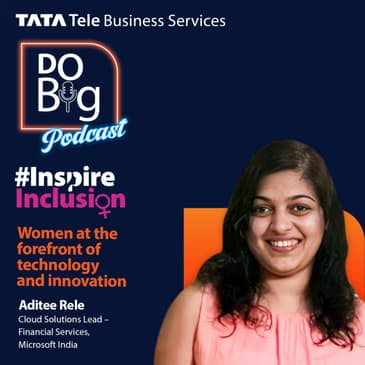

In this episode of Do Big Podcast, we are joined by Aditee Rele, Cloud Solutions Lead for Financial Services at Microsoft India. Aditee brings a wealth of knowledge and expertise in technology and innovation. She shares valuable industry insights and customer success stories that showcase the power of technology in driving business growth and innovation for SMEs.
Tune in to the "Do Big Podcast" and discover the limitless possibilities that technology and innovation hold for SMEs.
[00:00:00] Welcome to another episode of the Do Big Podcast. I hope you enjoyed all of the various conversations
[00:00:17] we've had in the past and today we have an interesting leader with us who's going to
[00:00:21] talk to us about a whole bunch of things. And I'm not going to reveal what we're going to talk
[00:00:26] about, but it's going to be interesting stuff which is going to come up ahead for all MSMEs
[00:00:33] and larger organizations. We have with us today on our podcast Aditi Rayleigh, Cloud Solutions Lead
[00:00:39] for Financial Services, Microsoft India. Welcome Aditi, how are you today? I'm very well it's an
[00:00:45] absolute honour Shita, thank you for having me. And Aditi, I'm going to jump straight into our
[00:00:51] questions because I don't want to waste us even a little bit of time because we have
[00:00:55] short episodes but we know that we can get a lot from you. So somebody who's been in the world
[00:01:01] of technology, win an industry leader, how do you see innovation playing a role in driving growth
[00:01:09] and maybe competitiveness for MSMEs? Interesting that you use the term competitive
[00:01:14] in Ashrital because to sustain in this extremely competitive world, you really need to focus
[00:01:21] on three things. In my opinion, one is increase your efficiencies, look at every little way in
[00:01:28] which you can increase your efficiencies, reduce costs and increase profits. So if you have to look at
[00:01:35] these three outcomes so to say for your business then what are your imperatives? Your imperatives
[00:01:41] start with looking at first outside in, so how do you actually engage with your own employees?
[00:01:50] How are you empowering our employees to do better? How are you empowering your
[00:01:53] employees to be more productive in the same time frame but not stressing them out? Then you also
[00:02:00] need to start looking at your own operations. What is the effort you're putting into to optimize
[00:02:07] your operations, to figure out those small chasms that exist in your operations and remove those
[00:02:16] to increase their output? Then you also want to start thinking about your customers. How are
[00:02:22] you engaging with your customers today? Are you really getting them what you want? Are you really
[00:02:26] reading about what they are talking about? Are you really aware of their asks? Then you want to
[00:02:32] look at your own products and services once you've gathered all of this information. How are you
[00:02:36] transforming your own products and your own services to be able to meet the demands of
[00:02:42] the business? Now to make all of this happen, I mean I literally refer to this as four
[00:02:47] imperatives of how you become a successful business. If you look at each one of these
[00:02:54] imperatives, technology plays an extremely important role. For example, you could look at all of the
[00:03:01] data that you've gathered about your customers, about what your customers are saying and then
[00:03:06] build insights on top of that data to engage your customers better or you could leverage
[00:03:13] the enhancements or advancements in productivity, for example Microsoft's Copilot,
[00:03:18] to give your employees the additional impetus to do more with their time. So we've said that
[00:03:26] the Copilot saves almost 75 to 80 minutes of your day, which is huge across an organization.
[00:03:34] So these are some of the things that you can leverage technology for to bring in the flavor
[00:03:40] of innovation and bring in the competitive advantage within your company to rise above competition.
[00:03:47] So one example is Microsoft's Copilot. Do you think there's other sweeter services
[00:03:54] which actually helps people become a lot more efficient? Because productivity,
[00:04:00] and there's always this debate about work from home is resulting in a certain
[00:04:06] loss of productivity if I may use the word because people are not coming together etc.
[00:04:11] Are there tools which are collaboration tools etc, which help enhance the productivity?
[00:04:18] Oh absolutely. There are so many tools and technologies that we can think about and
[00:04:23] I won't just talk about Microsoft, I'll talk at a technology level rather than getting to
[00:04:29] a product. You think about how dependent is your company on IT, right? Today whenever we want
[00:04:35] to build a solution our first run is to our IT department and say hey I want to create this
[00:04:40] application. What is preventing us from creating power users in our employee base? In the sense
[00:04:48] what is preventing us from giving the right tools in the hands of our employees so that
[00:04:53] they can build your own applications and you don't have to run to a developer or an IT person
[00:04:57] and that is what we call as robotic process automation so to say. So you have many tools,
[00:05:03] you have the likes of our own power platform, you also have the likes of the UI parts and
[00:05:08] look prisms etc which give you this power to be able to create your own applications but also
[00:05:14] lets the IT govern these applications because what you don't want is mushrooming a whole
[00:05:19] bunch of applications that you cannot control and you cannot govern. So in terms of productivity
[00:05:24] improvement there are many many such avenues tools available beyond the co-pilot with power platform
[00:05:31] that I mentioned with tools such as teams which gets you to collaborate and communicate so easily
[00:05:39] to be able to do live broadcasting, to be able to do live recording etc. But I think productivity
[00:05:45] improvement is not just about people it is also about your own processes and I think that
[00:05:52] is where the latest hype cycle if you say you know the artificial intelligence machine learning
[00:05:57] plays a huge role. If you are able to identify and everything relies on data we've heard this
[00:06:05] term data is a new oil or data is a new currency, everything depends on your data and for an MSME
[00:06:10] it shouldn't be a big challenge to gather data you would think that but there is a lot of
[00:06:15] scattered data lying around the enterprise today. So if you are able to build a strategy
[00:06:20] around identifying where your data is collecting that data and then leveraging advanced technologies
[00:06:26] like AI machine learning on top of that you would get a lot of insights and I love to use this term
[00:06:32] about how in the past we've been dependent on data always but we've looked at what has happened
[00:06:38] in the past and said why it has happened and how can we cause current. We've been very
[00:06:43] descriptive, we've been very diagnostic. We want to move towards an era where or we are
[00:06:49] moving towards an era today where data driven decisions are becoming very predictive and very
[00:06:55] prescriptive. You're looking at the data and you're saying what may happen and to prevent that may
[00:07:01] from happening what steps do I need to take to do things differently or enhance what I'm already
[00:07:07] doing. So this shift of behavior that is a huge productivity improvement in terms of how we
[00:07:14] manage our processes today. So that's very interesting because data like you said is lying
[00:07:20] in various places etc and you know you have cloud solutions and you have whatever where does the
[00:07:26] marriage of cloud data, data storage all of that problem. You know for MSMEs the promise
[00:07:36] of cloud is almost like a I'm going to say it's almost like a survival strategy okay.
[00:07:43] The reason I say this is because we were in a time frame not too long ago where
[00:07:49] everybody was asked to work from home and because companies did not have the right strategy in place
[00:07:55] I mean there were organizations who wouldn't afford laptops to people. There were organizations
[00:08:00] who would afford laptops but close all the ports and stuff like that. So it's almost like a
[00:08:05] survival strategy today the imperative to move to the cloud and I'll give you a quick example of
[00:08:10] what I'm saying. There was a time when I was asked to come down urgently to meet the marketing
[00:08:17] department of a scooter manufacturer. They had this brilliant, the marketing team had this brilliant
[00:08:22] idea on the 7th of February that they wanted to do a launch for 14th Valentine's Day
[00:08:28] for all the students of the country and the offer would you know the campaign would
[00:08:34] generate a lot of new leads and new business for them. So they were expecting the offer was
[00:08:40] just supposed to run for about four hours they were expecting about 30,000,000,000,000,000,000,000
[00:08:45] or 3 to 4 million users to sign up and they had gone to their IT on the 7th of February
[00:08:54] and I remember this because it is a Valentine's Day offer a couple years ago and they said
[00:08:59] we want this form to be it's a very simple form about 10 fails they want this form to be loaded
[00:09:05] into an application and put it up on our website and we'll run the campaign of it.
[00:09:09] The IT came back and said look we don't have any servers and we don't have any developers it's
[00:09:14] going to take two months to get to this. Here's an example where there's a direct business
[00:09:19] impact because the IT wasn't agile enough and that is really the true power of what
[00:09:25] cloud computing brings to you and the reason I was you know headedly summoned is because at
[00:09:31] the time I used to lead app innovation for the country and we were thinking what solutions
[00:09:37] to build and solution is very simple. You create a form a very simple web form you put it up on
[00:09:44] a cloud VM and you're sorted you know within 30 minutes we had the entire system up and running
[00:09:50] taking care of security considerations taking care of data leaks and taking care of their
[00:09:55] governance asks it's as simple as that. That truly is the power of you know cloud so when you think
[00:10:02] about MSMEs you have businesses that fluctuate in the way they do business for example take a retailer
[00:10:11] or shop a shop guy on the streets right his business goes to the roof during the valley
[00:10:16] times or Christmas times or you know during any festivity times but in February in March
[00:10:22] there's a slump in the business. Now if he was an online retailer he would provision for peak capacity
[00:10:29] in his data center which is wasted capacity so how do we then leverage cloud for its versatility
[00:10:35] for its flexibility for the ability to scale up and scale down as required so that is the
[00:10:39] fundamentals of why how you marry cloud to your own strategy of business and growth
[00:10:46] I'm sorry I'm going to go back to data right then it comes to data data honestly
[00:10:52] it has the ability to give you so much information that it can literally transform your business
[00:10:59] and again I will give you an example of how this sort of works and this is again
[00:11:03] I like to give examples because that kind of relates better in terms of what I'm trying to see
[00:11:09] this was a hurriedly summoned meeting by the CIO of an insurance company and he was really
[00:11:16] off his charts he said I don't understand why the innovation team is asking me this question
[00:11:21] but they want me to devise a strategy for high net worth individuals for car insurance
[00:11:26] and I really don't know I mean people drive cars period what can I do from an IT point of view
[00:11:32] so we were brainstorming and I was I was asked to come again at that time I was leading
[00:11:36] startups for the country so you know something on innovation is this something that comes out of
[00:11:41] your head and I heard him out and at the time I was working with a startup that had very interesting
[00:11:47] solution they had a device that would get into your car's OBD port and collect all the information
[00:11:54] about how how the car is running and they were struggling to find a market for it because you
[00:11:59] know they nobody was really interested in figuring out how their cars run and what is the mileage
[00:12:04] they gave and how is my tire pressure and etc and there was a ton of information they would collect
[00:12:09] but there were no takers in the market and they were really struggling to get that out in the
[00:12:13] market so I thought this is a really good opportunity where you marry a business problem
[00:12:18] to a solution and then we said why don't you meet with these guys and then devise a strategy
[00:12:23] where you offer this device to your high network network individuals and then if
[00:12:29] they drive well which you by the way you know because the data you're getting you might be able
[00:12:35] to create certain packages for them and that actually flew like a charm for them you know and
[00:12:40] they had a nice joint venture with each other and for some time it worked and then they acquired
[00:12:45] the company and so on so forth so these are simple things that you can do with your data to
[00:12:51] really transform your business if you have the right outlook and if you have the
[00:12:55] right strategy to invest in finding out what your data makes for you or brings to the table for you.
[00:13:02] So I'm going to ask you this question because it's very interesting in both cases you said
[00:13:05] you were summoned for a meeting right so that's my question to your slightly different right
[00:13:11] you know typically when you think of yourself as a small medium size entrepreneur there is always
[00:13:19] a hesitation to call larger companies you always say will they entertain me am I large enough for them
[00:13:27] will they send me the right kind of people to have these conversations and so on so forth.
[00:13:32] So I'm just trying to figure that you know when if as an MSME I want to collaborate or I want to
[00:13:39] kind of drive partnerships or for you know experiences then how do you try you know
[00:13:45] do this with larger organizations and how does one work around developing innovative solutions
[00:13:51] like this because as MSME is very often most of them don't reach out to the large organizations.
[00:13:56] Yeah they don't you're right you're absolutely right. It's quite contrary because every time I speak
[00:14:01] to a large organization basically we always have an MSME you know wing or a team who's
[00:14:07] only working with them and I keep wondering where is the lack of communication and what
[00:14:13] can be done to take that so just you know this is really interesting as and again I'll go back to my
[00:14:20] day job you know as a Microsoft salesperson my job is to go and sell our technologies
[00:14:26] to the customer. Now our technology is just a platform unless you build solutions on that
[00:14:31] on that technology that technology is meaningless to customers so there is no point in me going
[00:14:36] to an HR company HR organization the CHRO and say hey here's my platform please enjoy it
[00:14:43] they're going to say hey but what is the solution that sits on top of it is there an HR MS that is
[00:14:47] innovative is it different and so on and so forth. What I'm trying to make is that for me to be able
[00:14:51] to go to a customer to a large customer I always need to have a solution with me that actually
[00:14:58] comes from smaller medium businesses right so the way we think of partnership it's a two
[00:15:03] prong strategy for partnerships or collaboration or you know however you'd like to put it
[00:15:08] one is how do you build a technology partnership with a technology provider and for us at Microsoft
[00:15:16] and I'm sure a lot of our other technology providers there are a whole bunch of what we call
[00:15:21] as partner programs where we have the wherewithal to work with MSMEs to build their capacity
[00:15:30] in the sense do they have enough number of resources trained to build their capability
[00:15:36] in the sense do they have solutions that make sense and then give them that skill sets etc to
[00:15:44] leverage our technology to best of the solutions requirement so a lot of our you know
[00:15:51] the companies that I work with when I was doing partnerships a lot of those companies
[00:15:58] they used to push the boundaries of our technologies these to get on calls with
[00:16:01] engineering and argue with them saying oh this is not the right way of doing it
[00:16:05] that is the right way of doing it and our engineering because they got so much market
[00:16:10] in Intel in terms of how solution should be built they actually took a step back and made
[00:16:14] changes that were being requested which is not known to a lot of people outside but people who
[00:16:20] leverage the technology partnership with Microsoft have been able to change and
[00:16:25] shape our products and I'm really really proud of those people that work with us
[00:16:29] and therefore like I said one aspect of the partnership is technology partnerships if
[00:16:34] you're looking at building a solution building a service leveraging certain
[00:16:39] advanced technologies and please leverage the partner programs that we have in place they
[00:16:45] help you from everything from literally envisioning your product to shipping your product onto a
[00:16:52] marketplace or to a customer then the other part of the partnership is what we call as
[00:16:57] go to market partnership which is GTM in every parlance now I give you one example of GTM where
[00:17:04] because I knew I was working with this company that did those services on the OBD port and
[00:17:10] because I was also engaged with the customer I could marry the two that is your GTM but we
[00:17:15] have many other GTM programs so to say that you know MSMEs can leverage for example if I'm
[00:17:21] going and talking to a CHRO there are I have about seven or eight HR solutions as part of my
[00:17:29] kitty today that I can go and talk to the customer about and the customer gives us
[00:17:35] you know requirements okay this meets that doesn't meet and so on so forth so we can distill it
[00:17:39] down that is one way of doing it get the large organizations field to be aware of what your
[00:17:46] solutions are as part of your partner program that we done the other thing we do very actively
[00:17:51] is let's say I go to a particular customer and I tell them hey what is your innovation strategy
[00:17:58] what kind of solutions are you looking at and then there is a question of should I build it myself or
[00:18:03] should I buy it off the shelf and when the question comes to buy it off the shelf is where
[00:18:08] all of these MSMEs come to the play so what we do is what we call as innovation days with
[00:18:13] the customers and in those innovation days we will bring all the business decision makers
[00:18:19] and the technical decision makers from the organization and then we'll bring about seven or
[00:18:24] eight solution providers that are relevant to the organization to pitch their solution and
[00:18:31] that can range from something in HR to something in you know marketing to something absolutely core
[00:18:37] to the business like a core insure tech or a core customer onboarding solution and so on so
[00:18:42] forth so that way we're able to marry the two so do a question how should people leverage
[00:18:47] either the technology partnership or the go-to-market engagement is do not be afraid to reach out
[00:18:55] to a large organization and to the employee base because they need you it's not like you need them
[00:19:01] alone they need you as well to be able to service their customers so go out leverage our partner
[00:19:06] programs see what can be relevant to you and come on board I mean we're all open for it
[00:19:12] that's fantastic you know because one of the biggest challenges and I keep hearing this whenever I'm
[00:19:16] speaking to slightly smaller organizations like oh yeah they are too big that's always a big barrier
[00:19:23] in our lives isn't it they are too big I don't know if they will serve us something like that
[00:19:27] which is interesting to know when you and because you've played so many different roles
[00:19:34] many different roles I'm just trying to understand that if an MSME is looking to embark on their
[00:19:42] digital transformation journey right what is it that they need to do to overcome barriers
[00:19:50] embrace change I know everybody tells me it's a mindset thing but the biggest challenge
[00:19:57] is the mindset right and I just want to get a sense of how do you look at mindset and then
[00:20:02] everything else yeah very interesting so again I will rely on what is happening in our industry today
[00:20:10] there's this whole new era of artificial intelligence that is coming through
[00:20:15] and you would have seen this you know generator via iChat GPT relevance of chat GPT in an enterprise
[00:20:22] business how do we take it to I don't know use cases like underwriting fraud analytics
[00:20:28] customer onboarding or shop floor analytics and so there are many use cases that it is relevant to
[00:20:35] our initial conversations started with where we normally go to we knocked on the doors of the
[00:20:40] technologies leaders the CTO the CIO and said hey here's a fancy new technology that we've come up
[00:20:46] with we think it is going to lend a lot of value to your business let's go with it we didn't get a
[00:20:51] lot of takers because they didn't understand the technology at all and they were used to you
[00:20:57] know the fundamental way of doing working that we've been doing for the last 20 30 years even with
[00:21:02] cloud it's just moving to the cloud it's not like you've had massive shifts like we did in the journey
[00:21:08] at least so we took a reset and we said the right way to do this would be a top-down approach
[00:21:15] and that is something that is taking extremely well with customers because what we're doing is
[00:21:20] we're going to boardrooms literally we're entering boardrooms and talking to them about
[00:21:25] how this technology this little piece of technology is going to change their business
[00:21:30] significantly and once you engage the top level decision making you know it just sort of
[00:21:38] flows through the channels so within an organization as well the first thing you want to do is
[00:21:46] tell your top level any change whether it's mindset whether it's cultural whether it's
[00:21:53] technology adoption whether it is innovation is a top-down approach and you have to be able to get
[00:22:00] to the stakeholders and talk to them about things that matter you tell them why you're proposing
[00:22:07] what you're proposing more importantly what are the outcomes what is the impact it will have on
[00:22:13] business and I like to discern myself in you know in a typical conversation between what is my intent
[00:22:21] what is my activity what is my intent what are the activities I will do to bring that intent to the
[00:22:26] fore what is the outcome that we're looking for and then what is the impact of the outcome most
[00:22:32] often than not people stop at activities a few people get to the outcome phase but very very
[00:22:38] few people get to the impact phase and that is what we need convincing top-down if we are able
[00:22:43] to justify the business value of our proposals of our innovation of our technology strategy
[00:22:49] to the leaders at top who are stakeholders I think you won half the battle then it is just a question
[00:22:55] of percolating that down downwards and the reason I say this is they're simple things right for example
[00:23:03] a customer service organization today is unable to cater to somebody like me who has only time
[00:23:11] to buy let's take an example if you want to buy a you know aqua guard from Eureka folks
[00:23:17] right the only time I have to do this research is in the evening after I'm back from work and stuff
[00:23:23] and at the time there is no one take my calls and there's nobody to respond to me but what if
[00:23:28] I'm able to create a human like what who's able to respond to me like a human in the evening
[00:23:35] that is increased in business right a lot of people are talking about if you do this and
[00:23:39] you know there'll be job losses and stuff like that it's not really the job losses the jobs
[00:23:44] are going to be there they're only going to be a island but that's not the crux of this condition
[00:23:48] the crux of this conversation if you want to change something within an organization it is
[00:23:53] mindset and the mindset shift will only happen top down when driven top down so let me change
[00:24:01] this a little bit right with MSMEs the top down is the owner right it's typical MSME businesses are
[00:24:08] our owner driven in that sense and and how so there are there are challenges right if you're an MSME
[00:24:16] owner you already have so many things that you're kind of working around technology is not necessarily
[00:24:23] something you're familiar with right it's also the MSMEs are really is here right in that sense
[00:24:30] it's not always that every MSME understands and loves technology now when that is the challenge
[00:24:36] and therefore my question is that how important is it for MSMEs and owners of MSMEs to start embracing
[00:24:46] technology and changing their own mindset and how do they change their own mindset because there is a
[00:24:51] lot of what I call the unknowns of technology which is very difficult for people to understand so
[00:24:58] as an MSME let's say you were talking to an MSME owner what would you tell him just to tell
[00:25:04] him that it's you know that he should look at technology and why if that was kind of the crux
[00:25:11] of it all yeah absolutely see you know you're absolutely right in an MSME world it is always
[00:25:17] the owner okay and a couple of weeks ago on a flight back from somewhere I met the
[00:25:24] CTO of metro shoes and he was telling me we're doing this and I said wait one second again
[00:25:31] metro shoes so he said yeah you know the metro that you see and for the likes of me I would have
[00:25:36] never thought that an organization like metro has a full fledged not the CIO organization
[00:25:42] that's different right they're the ones that run the thing a CTO organization that looks at how
[00:25:49] they're going to innovate their business okay so anyway coming back to you what I would tell
[00:25:56] the owner of the MSME is goes back to what we discussed in the beginning of this podcast
[00:26:03] how are you thinking about improving your profits reducing your costs and improving your efficiencies
[00:26:10] if you keep these three pillars in mind that kind of sticks because you know whether it's an MSME
[00:26:16] or whether it's an enterprise business everybody's cost-conscious in today's world everybody
[00:26:20] wants to rise above competition and everybody's looking at these three levers to be able to
[00:26:26] sustain themselves and rise above I mean I would ground myself in these three parameters and then
[00:26:31] look at their code again one quick example there's a company that sells a lot of water
[00:26:37] distilled water to us today they sell in bottles 1 liter 2 liter 5 liter they sell to their
[00:26:45] providers you know like the grocery stores and so on so forth their ask is how do I reach the
[00:26:50] consumer directly and this came out of a discussion with them to say how do you maximize your customer
[00:26:58] engagement and then we came up with the strategy saying how should they reach out to
[00:27:02] customers directly customers like you and me directly who do buy distilled water from
[00:27:07] you know grocery stores when the water at home doesn't work and so on so forth
[00:27:12] if you ground yourself in these three principles and then ground yourself in the business of the
[00:27:18] MSME you will move them towards a technology led strategy and then I would also encourage people
[00:27:24] to say look there are a lot of technology conferences and showcases that happen please get
[00:27:32] yourselves to be a part of it you have no idea how you can drastically change your business
[00:27:37] with a small piece of technology to see even a small system like a customer relationship management
[00:27:43] in a small and medium company can change can do wonders we were working with
[00:27:49] another company who's into micro verticals okay like literally get to the lowest level of the
[00:27:54] business and I remember a discussion around there are millions and millions of salon
[00:28:00] providers in the country what are they looking for they're looking for the ability to increase
[00:28:06] their customers give have a better customer engagement more importantly they're looking at
[00:28:12] upselling to the same customer in the same amount of time the customer spends with them
[00:28:16] because the time increases then you don't have space for another customer to come in
[00:28:21] we actually put in a customer relationship management solution that would create
[00:28:26] outreaches to their customers to say hey you know this is a new thing that is coming to
[00:28:32] you would like try it on you know maybe a new hair product or a new sort of a facial or so on
[00:28:38] so forth at the same time we also provided training videos that their teams could consume on the
[00:28:46] fly well they were probably taking their coffee breaks etc and very short you know like a 30 second
[00:28:53] nuggets of videos that they could use to train themselves for upsell and that has cost
[00:28:59] such a big difference to certain salons that have adopted it so these are very very simple things you
[00:29:04] know too I'm not sure if i'm answering your question in terms of what are you going to say
[00:29:09] to their msma leader but the more you show them in terms of the direction and the directive
[00:29:15] of what technology and innovation can do for their profits I think you've made it
[00:29:22] I think you've kind of answered my question because as an MSME like you said if these
[00:29:26] are my three imperatives then I also as an owner need to go out there and figure where can I
[00:29:33] influence it with technology or where can I inject the technology to make it better for myself so I
[00:29:40] think it's a two-way process as a salesperson y'all need to go and tell them that but even
[00:29:45] they need to learn for themselves as to what technology can do and it may not be the perfect
[00:29:51] solve but at least a start it is that point see we do a lot of these what we call is envisioning
[00:29:56] workshops wherein we bring customers to our premises in uh Microsoft and then you walk through not
[00:30:03] technology but just walk through how their business could look different their own business you know
[00:30:08] how it could look different what are the measurement criteria that we would use in so on
[00:30:12] and that itself has given a lot of impetus for uh you know CEOs and owners to sit up and say
[00:30:19] I haven't thought about it let's do this sort of a thing and you're right reach out I mean if you
[00:30:24] don't go and get out of your comfort zone and attend different things that's more you're going to learn
[00:30:29] a question that you you and I have kind of discussed in in the past in other things is
[00:30:35] when you think about fostering a culture of innovation and adaptability what opportunities
[00:30:42] do you see for MSMEs to promote gender diversity and inclusion within their organizations because
[00:30:49] there's enough and more data out there saying that if you have more women in your organization
[00:30:54] there is a lot of shifts that come to the organization both financial and non-financial
[00:30:58] there's enough and more studies out there which have said that there's productivity
[00:31:02] enhancements there's more attention etc etc I just want to get a sense as a person and especially
[00:31:07] as a woman in technology and we do and I've had this conversation before where you know
[00:31:12] women in tech is such a difficult thing any which ways if yes the number of women is going up but
[00:31:18] it's not going up significantly so when you think about MSMEs and promoting gender diversity
[00:31:23] and inclusion what is it that you would topic extremely close to both our hearts I would say
[00:31:30] so you know first of all let's ground ourselves in the situation that we are in right there are
[00:31:36] more women coming out of engineering and business schools as compared to men today
[00:31:41] which is a great thing okay at least at least we're getting it right there therefore there are
[00:31:46] more women coming into the workforce at an early age but then when you start looking at
[00:31:55] approximately seven or eight years of experience you see a significant drop in the percentages
[00:32:00] so you might actually go from a 40% women in the beginning of their careers to literally somewhere
[00:32:08] like a 18 to 20 percent at approximately seven and eight years of experience at 15 years of
[00:32:15] experience that probably drops to 7% and then you know any senior leader you're looking at 2 to
[00:32:20] 3% so this is a real problem okay and that problem needs to be addressed what are ways in
[00:32:26] which you can so first of all you need to be able to bring in people that are very different from you
[00:32:32] not because of the women or not because of the diversity bit because they bring in thinking
[00:32:37] that is not like yours and again this is a learning I had with one of my senior leaders
[00:32:43] I was hiring at the time when Microsoft was going all out and talking about how much we love Linux
[00:32:51] and our whole open source strategy was coming into play I had two headcounts to hire and during a
[00:32:57] business review the India leader at that time asked me so what kind of people are you hiring
[00:33:03] and I rattled off a bunch of Microsoft technology saying this is the profile that I'm looking for
[00:33:07] and he said how will you bring about a change if you hire people like yourself
[00:33:11] and I think that was very deep you know so then we went on and hired a bunch of open
[00:33:15] source people but translating it back if you hire people like yourself who think like yourself
[00:33:21] you're not doing ourselves any favor you're not bringing anything different
[00:33:24] or you're not building a new dimension to your business at all so whether it is women or whether
[00:33:30] it is diversity in general people who think differently should be a part of your organization
[00:33:34] and that needs to be something is part of your HR accountability or your manager
[00:33:40] accountability so to say secondly I think we also need to promote an inclusive culture
[00:33:47] within an organization so that our diverse talent retains themselves and stays
[00:33:52] what does that mean so for example first are you listening are you just hearing
[00:33:59] listen with the intent to understand and solve so this is again a cultural thing that needs
[00:34:06] to come down drop down and it needs to be accountable so I'll give you again a Microsoft
[00:34:11] example on that in our end of your performances we have a couple of buckets right your core commitments
[00:34:17] your commitments and collaboration etc we also have a commitment on diversity and inclusion
[00:34:23] there is a box that needs to be filled in terms of what did you do differently from a D&I perspective
[00:34:29] this year and if you don't have anything to fill in that box then that is a moment to reflect
[00:34:34] upon and that basically gets discussed in our people discussions and our people reviews
[00:34:40] so again you know the ability to change the culture within an organization
[00:34:47] depends on how you incent the people to do more with these elements are you hiding the right people
[00:34:57] are you changing the culture to be listening to understand and solve and the reason I bring
[00:35:03] listening into the mix is typically across the table the loudest voice gains maximum attention
[00:35:10] but if you dig deeper the person who's the quietest has the most interesting things to say
[00:35:17] so how do you give that person the ability to talk the opportunity to talk and therefore get
[00:35:22] everyone else to listen so that's an important element to bring in from a cultural diversity
[00:35:27] perspective I think for us to be able to retain there are HR policies that need to change the culture
[00:35:34] needs to change the of course I said the people who are you the higher needs to change we need to
[00:35:41] also bring in incentives for women at middle level to stay in an organization so what kind
[00:35:49] of flexible policies can you afford not just to women but also to the men folk I mean
[00:35:53] there are so many people who manage homes these days you know have to sort of juggle between a whole
[00:35:59] bunch of things so what kind of impetus are we giving to the middle management to be able to
[00:36:05] stay and grow in their careers and eventually become leaders so there are a bunch of things
[00:36:10] that we do we should do as leaders to really bring up this culture of diversity and inclusion
[00:36:16] within an organization so you know as you were speaking I was thinking I start my career in the
[00:36:22] world of advertising and I was reading a book by David and he puts this example he has these Russian
[00:36:28] dolls in one of the meetings right and he's talking about whom you should hire and he says
[00:36:37] you can either hire people who will supplement your skills or you can hire people with different
[00:36:43] skills and they're complementary your weaknesses is what you should ideally build with and then
[00:36:48] therefore he uses the Russian dolls and he says either we can build a company of giants
[00:36:54] or we can build a company of midgets and it's really just that decision right it's it has
[00:37:01] stayed with me for life because it says if you're fearful you'll always hire somebody who
[00:37:06] has the same skills as you because right but if you're really in that expansive mode then
[00:37:13] you will hire people who complement and actually have the skill sets that you don't have
[00:37:17] because as a team you become bigger and I thought that was such a fascinating way of telling his
[00:37:24] people that you know let's build a company of giants and it is a company it is an agency which has
[00:37:29] really proven itself over the years. You know taking that example see one of the things that
[00:37:35] when you bring people who complement your skills right you're also creating a culture
[00:37:41] of curiosity within the org you're telling the other person next to you that go find out what
[00:37:47] makes this person different and see if there's something you can learn from there or contribute.
[00:37:53] I think all of it comes together very very nicely when you have a very diverse set of people
[00:37:59] sitting across the table and discussing an idea so many things can come out of it.
[00:38:05] Aditi as you know a lot of women entrepreneurs kind of struggle with scale there is a
[00:38:11] certain level of growth which comes in and then we've seen this I meet with a lot of women
[00:38:17] entrepreneurs and then there is a level at which I think they say okay now and that tipping point
[00:38:23] which you have to have to go to the next level doesn't often happen it could be many different
[00:38:28] challenges but if you think about it from a technological point of view what's the advice
[00:38:32] that you would tell women entrepreneurs on that level. So Sheetal I don't think it's just a
[00:38:40] technology answer to this the first thing I would say to everybody who's listening and who's a budding
[00:38:45] woman trying to do something differently is bring your authentic self to work. The reason I say that
[00:38:51] is a lot of times we try and emulate what is not expected of us and I think that is our biggest
[00:38:57] barrier if you're true to yourself and you bring your true self to your problems you'll be able
[00:39:04] to solve things much faster so it's the first thing I'd say bring your authentic selves to
[00:39:08] work. The second thing is you know there are certain things that we inherently as women stay away
[00:39:15] from we sort of take a step back I think in our world it is extremely important to have an opinion
[00:39:21] and state it I've had the pleasure or honor of being on a few uh on a women entrepreneurs
[00:39:30] accelerator where I've met a lot of women entrepreneurs and you know at a particular
[00:39:35] stage and point you would take a step back and that is something that we really need to train
[00:39:40] ourselves to say that if you have something to say just say it you know don't step back don't step
[00:39:45] back because the people around you would take offense to it or not agree with you or so on so
[00:39:49] forth. What I'm trying to say is that give yourselves wings without needing to face people
[00:39:58] you can actually be behind the scenes and run a full-fledged technology company without ever
[00:40:05] having to meet anybody or be discriminated against and so on so forth. So I would say leverage technology
[00:40:11] to your fullest advantage push your technology partners get the best out of your technologies
[00:40:16] by working with the likes of Microsoft or anybody else who's your partner and let technology give
[00:40:23] you the wings that you need to fly there is a certain amount of hesitation and I think that
[00:40:28] that culture is changing a lot in the MNC world or the larger organizations but in smaller companies
[00:40:37] there is a certain amount of hesitation in in sort of getting yourself seen in terms of
[00:40:44] in terms of you know when there's a leadership presence you would probably make the material
[00:40:49] but not present the material right and I think these are barriers that it's high time we overcame
[00:40:55] these barriers the generation of today hopefully they stay in roles and if they stay in their careers
[00:41:03] we'll change this in the next 10 20 years but we need to make effort to make sure that they stick
[00:41:07] there. Great Aditi thank you I love that bring your authentic self to the table because I think
[00:41:14] that's one of the biggest challenges we're we're so busy playing roles that we forget sometimes
[00:41:19] what our authentic self is and I think that's one piece of advice that will always stay with
[00:41:25] and thank you once again for coming on the Doobik podcast I'm sure all of our MSMEs are
[00:41:29] meeting you certainly could hear from a lot of MSMEs at Microsoft after this podcast
[00:41:35] was released thank you so much for being here and sharing all your experiences with us.
[00:41:41] Thank you it's been absolutely a pleasure Sheetal loved being here. Thank you for tuning
[00:41:48] in to the Doobik podcast a podcast that is dedicated to providing insights strategies
[00:41:54] and success stories of smart digital solutions for SMS. We believe that behind every successful
[00:42:00] business there's a strong foundation of reliable and secure technology via digital connectivity
[00:42:06] cloud infra cloud apps collaboration tools or cybersecurity solutions in a rapidly evolving
[00:42:13] digital world where technology is key to progress Tata telebusiness services stands at
[00:42:18] the forefront of digital transformation of SMS Tata telebusiness services with their
[00:42:23] extensive experience and commitment to empowering businesses understands the unique needs of SMS
[00:42:30] whether it's scalable connectivity robust communication tools or tailored ICT solutions
[00:42:36] Tata telebusiness services is here to propel your business forward
[00:42:40] Tata telebusiness services is synonymous with innovation reliability and transformative
[00:42:45] solutions so if you're ready to take your organization to new heights of success
[00:42:51] we encourage you to explore the transformative possibilities that Tata telebusiness services
[00:42:56] has to offer our contact details are in the description below remember we're available
[00:43:02] major podcast platforms so if you enjoyed today's conversation subscribe to our podcast for future
[00:43:08] episodes which we promise will be packed with equally valuable insights on questions
[00:43:12] entrepreneurs face as they digitize and scale businesses with the help of technology
[00:43:18] don't forget to rate and review our podcast as well as share it with peers colleagues and other
[00:43:23] entrepreneurs like yourself who will benefit from listening to it thank you for listening to us
[00:43:29] and until the next time keep embracing technology and may your business thrive in the digital