
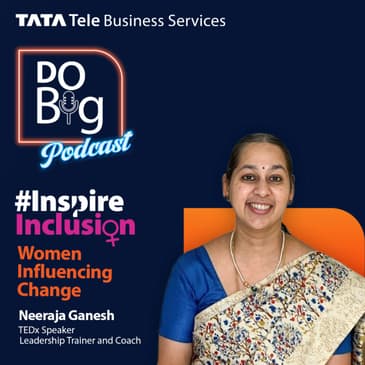
Join us in this engaging episode of Do Big Podcast featuring Neeraja Ganesh, a TEDx speaker, accomplished leadership trainer, and coach. Neeraja brings a wealth of experience as she delves into the challenges and opportunities faced by SMEs in today's dynamic business landscape.
As a beacon of inspiration, Neeraja also shares her thoughts on the role of women entrepreneurs and how they are not just navigating but leading the way, bringing a unique and invaluable contribution to the world of business. Tune in to Do Big Podcast now to gain valuable insights from Neeraja Ganesh.
#TimetoDoBig #InspireInclusion #IWD2024 #Womensday
[00:00:00] Hello everyone and welcome to another episode of the Do Big Podcast. The topic for today is Women Influencing Change. And to speak with us on this subject, we have none other than Neeraja Ganesh. Neeraja Ganesh is a TEDx and a keynote speaker at various conferences.
[00:00:28] She's been invited to various prestigious forums like Leanin and I've had the opportunity to hear Neeraja speak. So let me tell you it's absolutely amazing and fun to listen to her speak. She's been
[00:00:40] invited to many prestigious forums across the globe to deliver talks on a variety of topics. In her freelance capacity, she also conducts various training programs on leadership and behaviors, networking for results and how to tell your story are two of her
[00:00:56] signature programs. You know, I had the opportunity to attend a program that Neeraja did with her daughter on how to build your personal brand and I think I still take home some of the
[00:01:09] learnings that I had at that program. So I'm hoping that this podcast is going to be as informative for all of you and you have a lot of learnings that you can take back with you.
[00:01:19] While Neeraja has won several awards, she has also been featured as one of the 40 women who have traversed their life journeys from ordinary to extraordinary in the book Magical 40 at 40. Neeraja strongly believes that mentorship is extremely beneficial in the development
[00:01:37] and growth of individuals. She's a mentor on a variety of platforms including a spire for her and jobs for her. She switched her career to work in the space of gender diversity after a successful career in information technology industry, managing large teams, delivering
[00:01:54] large IT projects, operational excellence and customer delight for banking captives for over 25 years. Prior to a spire for her, she served as the director of relationships at National Education Society of Karnataka. Her focus in that role was to closely work with
[00:02:11] industry veterans to build the industry academia connect and to ensure the curriculum of institutions was relevant to the current and future industry needs. That's such a big, big gap today. She's also headed the jobs for her foundation, which was set up to bridge the gender gaps in
[00:02:30] India for a period of 18 months. In that role, she built a unique brand, numerous partnerships in a large community of women who experienced a variety of learning interventions through workshops, conferences, trainings and hands-on projects. Talking about change, who else but she
[00:02:49] who's done so much with individuals, with organizations, with institutions to bring about change who other than her would be better to talk to us about this today. So welcome, Nirja, to the Doovic podcast and it's our absolute pleasure to have you here today with us.
[00:03:05] Thank you, Sheetal. And I am so thrilled to be on this because I believe that impact is created when you share and I do not say no to any opportunity where I can share whatever I have done and my experiences. So glad that we are doing this today.
[00:03:24] Happy to have you here and Nirja, I'm going to jump into my very first question for you. As a thought leader, you've seen a lot of changes that have happened over the last few years. What do you see as the most significant challenges and opportunities facing the MSMEs
[00:03:42] in today's really rapidly changing and challenging landscape? You know, I believe that one can look at any situation in life as a challenge or as an opportunity. And all of us went through COVID and COVID showed and proved that for each of us.
[00:04:01] So if we deliberate that MSMEs have lots of challenges, I think the big players also have them. Some are similar, some are different but all of us have our plate full of both. Similarly, there are plenty of opportunities that MSMEs have and the fact that we're doing
[00:04:18] something like this for MSME. There's a ministry to cater for this particular business segment. I think what is the most important is that the mindset of everyone, including this
[00:04:31] particular business segment is that we can and we should do it. So now if I have to name a few challenges, we can definitely talk about their access to finance, their access to technology,
[00:04:44] adaptation, maybe do they get the right skill sets and talent? Do they have the good and the right processes? These could be seen as some bottlenecks that could keep them awake at night. As you can see, there are opportunities also when all of us have, including the government,
[00:05:00] has such a focus on this and the number of platforms that are coming in to help and showcase the work that they do. I think the founder and the team has the right mindset.
[00:05:12] These can be turned around. So I recently came across a LinkedIn post and I'm a big believer in branding and a big believer in platforms like LinkedIn. So this is a post of a founder very recent,
[00:05:24] I think a few days ago who's from this segment who said, I am trending on Discovery Network. Now, some of you may have kind of come across this post. So he had spoken about a movie that inspired
[00:05:38] him to start his business instead of taking a lucrative job opportunity from his company. And the statement that he made was, I realized that if the company where I was working could trust me
[00:05:50] to handle an international business, then I could certainly trust myself to start something new of my own. So eventually it's the mindset to keep him going. So it's self-belief, taking calculated risks and the importance of continuous learning and adaptation. These are
[00:06:08] the things that he said worked for him. But I think this is what works for everyone. Either we can keep cribbing and crying or we can take the next step to think of what needs to be done,
[00:06:19] tide over and build to the next level. So those of us who follow Sharp Tank would remember the story of Flathead's, the founder Ganesh Balakrishnan. He pitched his heart out. He walked away without a deal. But with that spotlight, the community that supported him
[00:06:36] and helped him tide over that challenge. So he says his lesson is embrace every setback. Another Sharp Tank story in this time of a woman because we're kind of focusing a lot on women
[00:06:47] in this time period. We should focus on women forever, but yeah, March coming and with women's day around. Neethi Singhal, she is the founder of a tree in one, the reversible and convertible
[00:07:00] clothing. She got a stern no from one of those investors. However, she came on Amul's topical and things just got better for her from there. So the biggest resource if I had to use that word
[00:07:13] for all of us including MSMEs is your mind and the mindset. And I believe it's our goal. And we are chasing our goal. While we can talk about competition, yeah, you have to look at
[00:07:27] your competition. But if you just focus on our goal and chase our goal and kind of think about that very focused, I think we will find creative ways to overcome the challenge. And definitely
[00:07:39] building a digital brand is very, very important today because with that, you never know who reaches out to you, who helps you. So for example, like I'm on this podcast today, I think it's all because of my digital presence and network pressure. So it's so interesting because a
[00:07:57] lot of the family businesses which are really large businesses today, I think MSMEs at some point in time, right? A couple of decades ago, maybe a couple of years ago, maybe, but we never think
[00:08:08] of it like that. We think of them as large businesses today, but they all started small and they all started as MSMEs and SMEs and today they've become who they've become. And I'm sure they've had this challenges and they've had their opportunities. And it's really
[00:08:23] the ones who've taken the opportunities, grabbed it and moved on, who've become the success stories while some of the others may not have. But you're absolutely right. It's so a mindset driven thing. It's about identifying the opportunities, grabbing onto them, making sure that you
[00:08:39] don't lose self-belief and build on your own. It's very interesting to talk about mindset. And I think that's one of the things that a lot of the senior people I speak with always talk
[00:08:52] about, which is about a positive mindset and a mindset which will get you through a lot of things. But when you think about bringing a positive mindset shift, right? In today's day and age,
[00:09:05] I'm going to focus a little bit on tech because you've also come from the world of tech. So when you think about tech, it's always challenging for people to accept tech. It could be because I
[00:09:16] don't understand it. I really don't know what's going to happen with it. I don't know the investments required are going to be all of that. How do you see that shift coming in? And
[00:09:27] what strategies do you think are best when you have to foster that kind of mindset shift in businesses? So there's no way out, right? Even the roadside, Telawala has a medium and a digital way of
[00:09:42] transacting. And it is always amusing when we have people who come from abroad, I had my uncle and aunt who came and they wanted to buy some foods before they visited us and they said,
[00:09:53] he had no money, he had no cash. He was always rendering through the digital payment and they were kind of flowergasket. So our country has done that, right? The amount of digital penetration
[00:10:03] that we have done. And how did that roadside fellow just kind of adapt to it? He may not even be literate. He may not even know the English. However, he realized this is survival
[00:10:15] for him. And this is the way to go ahead of the competition. So again, it's the mindset. So there are a couple of things that I definitely say is how do you learn that there's a different
[00:10:30] way of doing things today? How do you even learn that? That doesn't come by going to an MBA program or sitting through some entrepreneurship classes, etc. And that is why all these events and conferences and these podcast, the video interviews being on social media, following some
[00:10:46] inspiring leaders and stories do for you. You get those ideas. You get that awareness. And then you go about finding how to implement it. So first of all, we need to know that this
[00:10:59] is required. This is the way of the things today. And two, once you realize that, then you need to implement it, which is when you need to get to the right person. So I strongly believe
[00:11:12] that everyone needs to be out there and learning is perennial. We are at a stage where you need to invest in your own learning. When I started off, my company would have say 10 days mandated
[00:11:26] learning days, and it would be part of my KPI. Did you do 10 days of learning? And there would be a learning calendar and they would expect you to enroll for only those trainings, using which you could do something well in your current role. But today it's not that.
[00:11:43] You've got to learn everything. In fact, I talk a lot about being a T shaped individual. So where you have your subject matter expertise as the vertical of the T, but the horizontal of the T is a lot of other skills or competencies. So are you a problem
[00:11:58] solver? Are you curious? Are you collaborative? Are you a network? And things like that. So which means that do not ask, what's in it for me? Is it going to be a fuse? Just go.
[00:12:11] Just go all out. Read everything. Listen to every podcast. Be at every other conference that you can go to and talk to people. There is a lot of learning and awareness that you can think
[00:12:24] after that has happened when you want to embrace that within your organization is when you can seek help. But again, there are so many, so many platforms out there today to provide that
[00:12:37] it is not necessarily finance. It is more in terms of how do you adapt to it, which is more important the finance part will come later. So I think the mindset shift
[00:12:51] that every business owner needs to have is that I want to really learn. And hence, I'll be out there regardless of whether it is serving my industry or it's a different industry. And two, to seek that
[00:13:05] help or take that help when it is offered and start building in that change. Start small. Like I always refer to this platform that I'm part of. It's called Aspire for her. It's a platform for women. We've got about 18, 19 communities of women. When Madhra Das Kutrasin
[00:13:25] had the founder started this, she had six girls, college girls who built this for her because she was impacting girls in that age group, girls in the age group of 18 to 25. So she felt she
[00:13:38] needs girls in that age group who will build Aspire for her. And they did such a phenomenal job for two years in terms of building the technology, in terms of building their social
[00:13:51] media, in terms of bringing in those alliances, etc. So it's not about age. It's not about skills. It is not about the strata that you are in. It's the openness in the mind to embrace and
[00:14:07] look at the simplest ways of solving problems. You really don't have to go get the invest in a lot of cloud space or find some cloud solutions, etc. Okay, that's pertinent advice because I think one of the other piece of advice that I've got
[00:14:24] from a few others is to say you focus on the business because you know what the challenges of the business are. And then once you know what the challenges are, find the support to find the solves for it. And that's exactly what you're saying. Think that you
[00:14:36] know your business, focus on your strength and then build with people on top helping you find the solutions, the right solutions for the challenges. Because if you don't know what the problem is, the solution anyway is going to be wrong. So it doesn't matter. So I think that's
[00:14:51] very interesting. And don't think you need a 20-year expert. Well, I don't know what your 20-year expert means today because you have experts at every age group. But it is about who can help. It's the who and not necessarily the age and the experience and which institute
[00:15:10] the person studied at, etc. Correct. That's so important because today youngsters are learning on the go, right? Especially when it comes to tech. I mean, who knew that, you know, Generative AI is going to change so much of our lives. So and it's the young ones who
[00:15:26] really picked it up very quickly and moved on with it. So it's really the dynamism. Also their own agility, right? The person who's working with you also needs to be agile enough to
[00:15:38] take all of the learnings. That's fantastic. And one more point is no ego, right from our side. So what why I always come back to Madhura's story is imagine a 50-year old lady working
[00:15:52] with 18-year olds and if the 18-year old tells you your social media is crap and you need to fix it, why have they go no ego to take such a feedback and say, okay, if you think so,
[00:16:03] please tell me what needs to be done. Right? And today she is where she is. Yeah. Yeah. And how do you think leaders and because you've moved so significantly into the diversity, equity, inclusion space, how can leaders and MSME owners actively contribute to creating
[00:16:24] a more inclusive and supportive environment for women in their organizations? Sure. See, I've seen both sides of the spectrum. I've seen organizations which have all women to most women and I've seen organizations which are so male dominant. Whether it is an MSME or a big
[00:16:41] player, the way to do this is to be intentional. You have the right intent not because somebody says this is what you need to do and it's not a take-box activity but you're really intentional
[00:16:53] in building a diverse organization and be very inclusive. So what I tell people is if you think you want 50-50, so 50% of women and 50% of men, the starting point is ensuring you get 50-50
[00:17:08] resumes. If you don't get that, you get an 18-20 mix then you know everything else after that is going to be that stew and maybe it'll end up with more women. So how do you get the
[00:17:19] 50-50? You may probably get the series of men more easily but you may not get that many series of women but that doesn't mean the women are not. It's just that you need to look a little more harder.
[00:17:30] So it is then the founder's responsibility or the CHRO's responsibility to say that I'm not going to take it to the next stage of interview till I at least see an equal number of series.
[00:17:40] So then the recruiter looks a little harder and does whatever else is required to get that equal number of resumes. Then if after this looking harder, if you didn't get, then you know what you
[00:17:51] need to do. You have to then build that pipeline so then you start contributing to building that talent. So you go to those colleges, you talk to those girls, you go to those community platforms
[00:18:03] that exist and say hey the work that we do is interesting. This particular course is good for you and it can get you a good job and it can get you a good salary etc etc. So we need to do that
[00:18:17] and that comes only when you're intentional. When the intent is not there then you say okay we tried, we didn't get so now we're moving ahead with what. The other is about asking everyone in the
[00:18:28] organization what they need and not to assume. So easily we assume that a woman who's just come back from maternity leave may need some flexibility or will not be able to do this kind
[00:18:39] of late Indian jobs or something like that and it may not be the case. There may be some who may need there may be some who don't need and similarly for men too there might be some men who need
[00:18:49] that kind of flexibility. So it is very important not to assume but to ask and then build or you know provide the support that is required. So here I want to narrate two stories. One is
[00:19:02] so today of course diversity is beyond this man and the man. So there is of course LGBTQAI plus you have persons with disability and lot more. So I was moderating this panel
[00:19:11] discussion for it was at an event to celebrate the day of persons with disability and this man who didn't have you know eyesight vision he said the minute the lockdown happened the COVID lockdown happened and we all moved to online shopping is when the realization came
[00:19:31] that none of those e-commerce portals were built to help people with no vision. Now how do you get this insight without having someone like that in your organization and hence it is so important
[00:19:45] that you have if you're talking about women then you have women in India during the idea stage during the design stage and during the sales because eventually your buyers are diverse. So if you haven't catered your service or your product doesn't cater to a diverse segment and
[00:20:03] that can happen only when you have diversity in every role that you have in your organization then you're not really going to have a very diverse customer base which is going to then affect your revenues and your profits. And yeah if we have time I'll narrate this story
[00:20:20] more than diversity and inclusion equality I think it's about equity because the question that comes is oh so we are doing a favor or we have to kind of you know do something very different and hence
[00:20:32] you know I think we don't want to do it. But the story is of this girl who was studying an NII many years ago she was doing a computer course and there was this company called Sonata
[00:20:46] who were looking for programmers and they wanted contract programmers for a short term three months so they came to the institute and they said we'll take about 12 of these students for a three month
[00:20:57] contract assignment. And this was talking early 90s when you didn't have even computers you know don't have too many computers in companies forget computers at home so they were getting them to work in shifts so same computer morning one person in afternoon another person works.
[00:21:15] Now this girl had one more semester to complete so her classes were from three to five she was put in the morning shift which is from seven to three it was still doable somehow. However
[00:21:29] I'm talking about an era where you didn't have computers at home so these students used to spend more time in the institute waiting for spare PCs to practice. Now you don't know when a PC is
[00:21:39] available like somebody's absent or a faculty member didn't come you don't know whether it's going to be morning or so the girl's issue challenge was that she could work for sure she
[00:21:48] could work but can't work in shifts. So she spoke to the management and usually and I'm talking so many years ago the management would say okay you finish your course and come back then we'll
[00:21:58] see if there's a job for you but the management took two days and came back to her and said that we'll make an exception for you we'll give you a dedicated computer so that you can come
[00:22:07] and go whenever as long as you finish the work and that helped the girl so she would go you know to say the institute work for a few hours then come back here finish some work then go back
[00:22:18] you know that she had to manage but she delivered her work okay and today that girl is here sitting in front of you right so that I talk about equity why did Sonata do that for me and
[00:22:31] not because I'm a girl because I'm a student they wanted to help students start their careers and they felt the change that the difference that they could bring about is to give me an additional you know computer which will help me kind of be in the job and
[00:22:47] still perform nothing else was changed not less than number of programs or you know none of that that remained same and that is what I want organizations to look at how do you build
[00:22:57] that equity it is not favoritism it is not you know special you know allowances but that will pull playing ground for everyone and if that means something additional for that woman make that happen okay and I'm asking this question I would have normally not done this but
[00:23:16] because we're talking about this in the month of March how are women driving change in the startup and SME sectors you know maybe a case study maybe an experience that you've had with somebody
[00:23:28] how are they driving the shift because I hear enough conversations of women coming into the startups but you know then very often the conversation gets triggered over to what are the challenges that women startup founders have versus men and I'm like a startup is a startup
[00:23:45] is a startup and let's think of it as a startup issue and not a woman versus a man driven startup so I just want to understand from your perspective how do you think women
[00:23:54] are driving change in this industry in the SME sector so there are two that I want to talk about with one is a not-for-profit but let's talk about them also and both are you know serving the men
[00:24:08] so one is aspire for her with mother that's what I said right so she identified the problem as world economic forum every year puts out a gender gap report where India is you know featured or
[00:24:21] rang at the bottom every year we go down so now somebody has to fix this so she said I'm going to fix it how do I fix it which means you need to understand why these girls who are getting educated
[00:24:35] are then not getting employed or moving out of you know the workforce and her survey told her that a few things are like one is that there are no role models as well as nobody out there
[00:24:48] who talks to them about careers which are beyond engineering medicine law and management so there are so many other things that one can do but how do I do that I have an interest but I don't know
[00:24:59] how what do I study and where do I go in so which means that there has to be a showcase of all kinds of careers that are available and that's what is now aspire for her caters to it as
[00:25:11] career reviews and they have a lot of role models second is mentors and that's why I have a huge believer in mentoring and I mentor you know whoever comes to me because you have already gone
[00:25:25] through that path now why should somebody else also struggle you know you can kind of easily give them some pointers and directions to look at so these are role models and mentors three skills our colleges don't necessarily propose with what is required and that's why I was
[00:25:42] doing that role of the industry academia connector right so from where do I get those additional skills so these are the three or four things which she figured out and she built a platform
[00:25:53] and she said okay I'm going to start with these six girls who will help me build the platform today after it's going to be four years now she has 18 communities there starting with girls
[00:26:03] and colleges which was the first one to the latest one being what she calls as her sport key champion her as in Hindi her an English HER her sport key champion because you know that the women
[00:26:16] in sports most of them come from rural and uneducated backgrounds there are a few you know that we know off are possibly well educated now the sporting career is limited and you're not
[00:26:29] educated then what do you do after that so that's a community that she has built to ensure that they get some kind of mainstream skills and they are able to get themselves involved hasn't been an easy
[00:26:41] journey no because you've got to tell everyone why why you need to have women and why you need to you know serve this particular community what is work for her is that she has been able to
[00:26:55] find the right people to support her either in the organization as workforce or as networks who are carrying the word for her so she has an awesome awesome network where did she get this
[00:27:12] network one is she's kept in touch with all her school friends the college mates so you go to the IIMs in the XLR eyes of the world they are in places influential places right and then of course you
[00:27:25] know like me she's also a huge networker and she brings people along and we are willing to do what we can so I think there are many many success stories of women startups and startup
[00:27:37] founders challenges exist they'll be there for everyone but what is driving her is the fact that there is a need for this and if I don't do it then nobody else will do it so let me go and do
[00:27:50] it and let me take people who believe in this now I don't want to build another aspire for but I do want to contribute in the way that I would like so she is open to take that contribution
[00:28:01] which is my time so I ran some projects for her I'm able to mentor and you know I do a few programs for her the second story is of Jacinta Jay Chandra who started a not-for-profit
[00:28:13] organization called as Pope Works Foundation so she also was you know in infersis and then she was running her own entrepreneurship again to help women but the reason she started Pope
[00:28:27] Works was she went back to the school where she started so all of us when we turn 15 we want to do something for the world right so she went back to the school that she started and she
[00:28:37] went and met the principal and she said I want to do something for the world so principal looked at the car in which she had come she said is that your car is it yeah is this so you tell me that
[00:28:48] you studied in the school because this is a school for girls from early financially underserved backgrounds you've studied in the school and today you have that car can you teach my girls
[00:29:00] hope to be hopeful that they can have a future like this and she didn't know how do you teach hope but she figured out and today she runs Pope Works Foundation and you should look at the girls that
[00:29:13] come out from there such smart so what I'm trying to say is that there is a need these things are understood by the people who are impacted so you may have some men you know who are also
[00:29:26] running startups or you know businesses catering to women how are the women understand this best and hence you know it is important for everyone to ensure that they bring in that diversity in the organization to understand the entire landscape and to be able to be successful and
[00:29:45] create the right impact so you know I was going to ask you on mentorship and community support but I'm going to change that question of mine because you touched upon a very very important
[00:29:55] piece which is called networking right so you've covered a lot of mentorship and community support but I want to understand what is that advice you would give entrepreneurs both male and female
[00:30:08] on the need for networking the benefits of networking and maybe a few steps on how to go about networking because it's it's very easy to say network but it's very difficult to network so just a little bit on that my favorite topic
[00:30:27] so I start by saying that the definition of networking is what can you give and I think a lot of us need to change that in our minds because we always think of
[00:30:37] networks as okay fine if I'm well networked I'm able to get a few things in fact yes eventually you will but that's not the starting position because when if you start there then
[00:30:47] you're only trying to meet a sheathal thinking what can she give me maybe she can bring me as a podcast guest next time and how do I ask sheathal how can I be a guest on her podcast so that's
[00:30:57] a very difficult conversation but if I'm looking at it as okay sheathal does x y z what can I give sheathal so I say sheathal are you looking for some guests for your podcast I have a few people
[00:31:08] that I can refer can you imagine how easy that conversation is you have no issues sheathal has no issues and she's a yeah if she doesn't you should say sorry I don't need now next time
[00:31:18] I will ask or if you please introduce and introductions are the easiest way to start so today I was preparing for this and I have a meeting after this also my morning was very busy and still I've done four different kinds of introductions which all came like this
[00:31:36] so somebody said New Jersey come and speak at an event tomorrow because last minute with keynote speakers cancelled I have three sessions tomorrow so I looked at the agenda and I said no
[00:31:47] way I can accommodate it but I will refer you someone and it's a real big platform so I have to refer someone who's really powerful you know to be a keynote speaker so there I'm you know
[00:31:56] asking people and I do this by 12 because tomorrow is the end then there is someone else who put on a group women's day is coming up our organization is going to be putting up
[00:32:07] helping women entrepreneurs put up stalls like a flea market do you know of an organization who can get us these and I know of a few because I'm so well meant so I'm trying to you know patch them
[00:32:19] like this there were four different kinds of requirements that came in for me it each of them the patching up is two three minutes but in a busy day you may not prioritize that
[00:32:31] okay but I still chose to prioritize because if I don't do this today then all the four are not getting served tomorrow it's too late that's the giving part of it now every day you will not
[00:32:41] be so busy there are days when you have the time but can we just simply give and start giving introductions and then start looking at how else can I help someone and that is the basis of
[00:32:52] network and the second thing I talk about is leave your comfort zone and show up show up to any and every kind of an event that is happening in your city or virtually also it is okay
[00:33:04] don't start thinking this is not in my you know line of work I'm not a tech person I don't need to go to a tech event I'm not an HR person I don't need to go to a DNI even book clubs lit fest
[00:33:19] anything and everything you know because you need to have a very diverse network so we were part of her key we're part of she mantra there's so much of my learning about running if I can call
[00:33:29] it as a business I'm a freelancer and what I do today is has come from these communities from all you know what these communities have offered has learning resources so networking
[00:33:40] the definition is give before you receive it will come back to you in many ways leave your comfort zone and show up at events and have very genuine conversations with people it's not about collecting
[00:33:51] 100 business cards it's not about the number but even those two conversations that you have it is very genuine and you know how you can help that person that's good enough over a period of time
[00:34:03] if the network will expand people will remember you for your generosity and we'll give back to you in ways that you have not never imagined so you know entrepreneurs always have this thing they're doing everything themselves and therefore the one big constraint a lot of people think
[00:34:22] is money I think it's time right because you're everything from the strategist to the execution and everything in between is the entrepreneur and especially in the startup stage right when an entrepreneur is really busy how do you fit networking into an extremely busy it's like
[00:34:42] do I set up my business or do I network and that always becomes a question for a lot of startup entrepreneurs just any thoughts on that so I think initially you will feel that this is one
[00:34:55] added activity but over a period of time becomes a way of life okay so as I said in a busy day today I actually could do those four connections which means I'm also expanding my network and I'm
[00:35:06] helping somebody else expand their network and it took me two three minutes two three minutes right so it becomes a way of life when you start you will probably think of who is that
[00:35:16] person and then to write that introduction you will take something and you know all of that but over a period of time it becomes a way of life you have to calendarize it just like you
[00:35:27] calendarize every other meeting of yours um you have to calendarize two networking events at least every month you can do more than that it's great so which means that Google find out there's
[00:35:39] ample events happening and as I said go to diverse events don't keep going to what you know because you'll meet the same people uh meeting the same people means when you're not expanding your
[00:35:49] network too you don't get different ideas in your head because it's the same kinds of conversations right I was in tech for 25 years I don't think anybody ever knew me I quit from my corporate
[00:36:01] you know avatar as a director at captain night I don't think anybody knew me I used to only go to those tech events which the company sponsored same crowd however what made me
[00:36:12] kind of shift in my head is just a year before I quit I went to this event for women on a career I didn't have to go because I was not in a break I was not intending to take a break
[00:36:22] but I had actually done some research because my company had asked me to put out a recommendation to hire women on a career so I said okay let me go and attend that and what a transformation it
[00:36:34] was because for the first time I realized the pains that these women are going through because I have never taken a break I cannot empathize I feel of course you know life can go on
[00:36:45] um I was able to do it you should be able to do it second the kinds of people who came there to speak their thoughts were so different and I said Nidia why can't you think like this
[00:36:58] and that was because you are in a well uh so that's when I decided I need to do something one for these women and two need to really have a larger network to get different
[00:37:10] kinds of thoughts and ideas going so I used to kind of calendarize it I was in my corporate stint busy period and then I did whatever I did but I used to calendarize it and show up at those
[00:37:21] if you don't calendarize then something else will always come up okay so I would say that yeah you have to make time in the beginning but over a period of time it becomes a way of life
[00:37:31] so it doesn't then feel as a you know pick a drain on your time it doesn't and then you don't even have to go to events you can sit at home you can be on WhatsApp groups you can be on many
[00:37:43] platforms and let what just happens that is that is very good advice because I know most people don't use the WhatsApp groups and things like that for networking as effectively as it can be
[00:37:54] used um so that's really really good advice and my last words to people who listen to this is that you know people come and attend all events and they will watch every video they will listen to every
[00:38:07] podcast it'll be paisa wassul because it will be entertaining but will they implement at least one thing that they learned to implement at least one thing if not everything and you can see how that
[00:38:18] changes things thank you so much for that wonderful piece of advice thanks nidya it's always a pleasure listening to you I'm really really happy that I got this opportunity to have this conversation
[00:38:30] with you and I learned again once again I learned a lot of things which I know I'm going to implement because as an entrepreneur sometimes I struggle and um thank you so much for your wonderful
[00:38:41] insights and thank you for giving us your time so uh thank you once again from the whole dupik podcast team for being with us here today thank you thank you for tuning in to the dupik podcast a podcast that is dedicated to providing insights strategies and success stories
[00:39:00] of smart digital solutions for sms we believe that behind every successful business there's a strong foundation of reliable and secure technology via digital connectivity cloud infra cloud apps collaboration tools or cybersecurity solutions in a rapidly evolving
[00:39:18] digital world where technology is key to progress tata telebusiness services stands at the forefront of digital transformation of sms tata telebusiness services with their extensive experience and commitment to empowering businesses understands the unique needs of sms whether it's scalable
[00:39:36] connectivity robust communication tools or tailored ict solutions tata telebusiness services is here to propel your business forward tata telebusiness services is synonymous with innovation reliability and transformative solutions so if you're ready to take your organization to new heights of success
[00:39:56] we encourage you to explore the transformative possibilities that tata telebusiness services has to offer our contact details are in the description below remember we're available major podcast platforms so if you enjoyed today's conversation subscribe to our podcast for future
[00:40:13] episodes which we promise will be packed with equally valuable insights on questions entrepreneurs face as they digitize and scale businesses with the help of technology don't forget to rate and review our podcast as well as share it with peers colleagues and other
[00:40:28] entrepreneurs like yourself who will benefit from listening to it thank you for listening to us and until the next time keep embracing technology and may your business thrive in the digital