
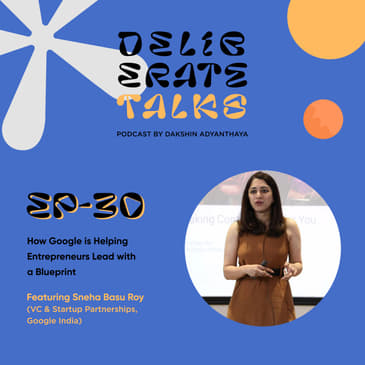

Google is shaping the future of entrepreneurship with cutting-edge technologies, resources, and insights, with the Google for Startups Program. Here's how Sneha Basu Roy is educating Soonicorns to become Unicorns.
Listen to the full episode on youtube.com/pixelatedegg
Follow Sneha Basu Roy:
LinkedIn: https://www.linkedin.com/in/sneha-basu-roy-772b5253/
Instagram: https://www.instagram.com/snehabasuroy/
Follow Dakshin Adyanthaya:
LinkedIn: https://www.linkedin.com/in/dakshin-adyanthaya/
Instagram: https://www.instagram.com/dakshinadyanthaya/
Twitter: https://twitter.com/upsidedakshin/
Follow Pixelated Egg:
LinkedIn: https://www.linkedin.com/company/pixelated-egg/
Website: www.pixelatedegg.com/
#GoogleForStartups #Startups #podcast #technology #entrepreneur #podcasting #marketing #entrepreneurship
See omnystudio.com/listener for privacy information.
[00:00:01] Welcome to the Table for Two edition of the Deliberate Talks Podcast and I am your host Dakshin Adyanthaya taking you on a journey into the heart of Startup Innovation and Entrepreneurial spirit. So get ready to break free from the conventional moulds of entrepreneurship and VC with our
[00:00:17] guest Sneha Basuroy. Sneha works on VC and startup partnerships at Google India with a focus on EdTech ecosystem. In her previous role at Google India she was leading digital capability building for the India Agency business.
[00:00:33] Having spent over 9 years at Google she has worked across policies, products, sales, strategy and now partnerships. In our conversation today with Sneha we explore how Google's initiatives are transforming the blueprint for startup success in the digital era. All this coming up right after this quick intro.
[00:00:56] This is the Deliberate Talks Weekly Podcast powered by the pixelated egg digital ventures. And we are back. Hello Sneha, welcome back to the Deliberate Talks Podcast. Thank you and thank you for inviting me back.
[00:01:15] After my absolute disaster's last rapid fire I thought you wouldn't call me back but thank you for being so generous. Not at all. I am super excited to host you again for a round of rapid fire. Of course let's start with the disaster.
[00:01:29] Well I will save that for later. Thank you. You have been doing some fabulous stuff and today we are going to talk about Before we get into this incredible discussion of the startup world, we start the show now with a Thought Starter conversation.
[00:01:44] And I want to begin with asking you if you were tasked to create a startup based on your favorite hobby what would it be on and what would you call it? Okay frankly I will tell you.
[00:01:55] I absolutely know what it will be but I also know it will not succeed. So I will tell you I have got in recently in the last year heavily into yoga.
[00:02:06] I don't know if it is a panic caused by the startup ecosystem or if it is just a realization in life but I think if I had started a startup it would just be a chain of yoga
[00:02:18] studios, shalas and connecting different like creating a community of yogis essentially. I do not know what the efficacy of this would be and I don't know if it will
[00:02:28] work but if I had to truly be really passionate about it, it would be yoga that I would start up in. And what would you call it? That is a very tough one but like the last time I am not creative at all.
[00:02:44] I would probably just call it the yoga shala. Well done. In that case let's now get straight into our conversation now that we are all prepped up. So let me begin with asking you about the Google startup.
[00:02:58] Something that you do so wonderful talking about it everywhere on your social media. It has been great watching you since the last time you were here. Again, completely different topic and owning the topic wherever you go that is wonderful to watch.
[00:03:13] I want to start with understanding what is Google startup and it caters to different categories. The campus accelerator. I want to understand more about that and what is the difference between the two and how they are helping the community respectively.
[00:03:26] So tell you what, think of Google for startups as an umbrella that does anything that Google can do for startups. Now around 2 years back when this team was really coming together for startup specifically, startup partnerships in India. We run a startup guys that is essentially a survey.
[00:03:45] And two most important things that startups say that they really need is one obviously funding because if you don't have the money, what can you do really? And the second is mentorship, right? Mentorship learning so on and so forth.
[00:04:00] So I think one thing that Google for startups does really really well is mentorship. I think that is the primary use of Google for startups. Now it has different programs under it. One is the campus.
[00:04:11] So just around five countries that really have the Google campus, but that's a physical space where we have events, you know, communities coming together or sessions, everything for free obviously.
[00:04:22] And for the rest of the world, there are a lot of global programs, whether it is the cloud program or whether it is the startup school program, right? It has a lot of these which are essentially education programs.
[00:04:34] And also we provide a lot of, let's say, you know, experiments almost of sorts with our products. So availability, we're a tech company finally. So availability of all our products, credits on our products, just ensuring that we are most simplistically understood by the startup community.
[00:04:52] And then we also have some funds, right? Like we have the Black Founders Fund, Latino Fund, we have the Ukraine Fund, the Women Founders Fund, right? So these are small funds.
[00:05:03] They're not like a Google Ventures team, but these are small funds that really ensure that we're enabling the community at scale. Right. So think of that as the Google for Startups program that's available globally. But the Accurator is one I'd probably talk about separately.
[00:05:19] I think I'm an absolute fan of the Accurator program. It's run by a separate team. It's called by our developer relations team that works with Google for Startups very closely and it has been in the organization for much longer than the team, for example, that I am with.
[00:05:35] Right. The Accurator team does a brilliant job of bringing shortlisting around 20 startups.
[00:05:40] Right. And this happens almost every quarter where they bring them down for a week in our Bangalore office and they do, you know, they literally keep them up at a, it's like a little, like it's almost like a simulated campus.
[00:05:52] There are people staying at a hotel right opposite the office and the Google Bangalore office. Actually, if you're ever in Bangalore, please visit. It's an incredible office.
[00:06:03] They come down to the office and from morning to evening we sit there and our mentors and I've been a mentor on one of the Accurator.
[00:06:11] So I thoroughly enjoyed my time because they pick these 20 startups where the founders come and they just stay with you for a week. You're literally living with them for a week. Right. We're giving them projects, we're giving them assignments. It's amazing.
[00:06:25] And they come down, you know, we fund them coming down, staying at the hotel, everything, you know, we get them mentors. And the thing is that Google fosters such a great community of mentors in the ecosystem.
[00:06:36] There are a lot of mentors even from outside Google that come in like for design strategy things that we might not have technical knowledge or expertise on. Right. So we bring the best of talent across. We get them to mentor them for that one week.
[00:06:51] Then we actually understand, you know, we do a little analysis of what are the requirements, where can we help? And then, you know, any of the mentors, they actually engage with them over the next three months. Sometimes physically, sometimes online.
[00:07:04] We get them free online mentorship, content, sessions, credits. We do all of that for three months and we get their pitch deck also ready. And at the end of three months, we have a demo day, which is actually happening.
[00:07:17] One of them, the AI first actuators having their demo day on the fifth of April right now. And we invite all our investor community. We help them with a pitch deck and then get the investor community.
[00:07:28] And Darshan, I've actually seen each of these startups get around six or seven meetings on that same day with investors in the room right away. So I think that is very, very helpful.
[00:07:39] The energy in the room, the loyalty with these startups because just imagine getting six meetings right after one quick pitch. So the AXIOTOP program is one I'm an absolute fan of. The startup school, we educated over 10,000 startups the last year.
[00:07:54] So, you know, and that's over eight weeks of sessions. And I personally was managing some of the offline sessions with my colleagues. And, you know, we were in Hyderabad with Team Hub. We went to Gujarat with IMA. We were in Delhi. In fact, we hosted the Vigyan Bhavan.
[00:08:13] So we had a lot of the startups come in offline also. So I think of Google for Startups as an overarching program for startups. And then think of it as having sessions, personal one on one mentorship to things like the AXIOTOP and also facilitating funding the entire universe.
[00:08:31] Right. Right. Wonderful. And just extending what you left behind there, how can the startups qualify for the Google for Startups program? So there are programs under Google for startups for everyone. Right. Like I said, there are funds for yes, the minority sections. But there are also these programs.
[00:08:49] So startup school is actually anyone who's a startup and certified as a startup. Right. It has to have let's say a website because frankly, if you're not a tech startup, we can't do the most for you.
[00:08:59] So as long as you're a tech, you know, like digital presence startup of any kind. We had startups from every little town and city.
[00:09:08] Right. And when we had our offline events in Hyderabad, we saw them come from small villages down to actually meet us, which was very nice. So startup school is for everyone.
[00:09:18] Our startup cloud credit program has certain requirements like you need to be basic funding, but not over series A. You know, should not have used 4K of credit before. So stuff like that.
[00:09:28] And then there's the AXIOTOP again that, you know, has some funding, some investors, some presence with you, even if it's like angel investing.
[00:09:36] So there is someone for everyone from, let's say, the absolute basic, someone who's in the ideation phase, who's got their startup registered to someone who's let's say series A.
[00:09:46] Now, for series B, frankly, our team works with them like the team that I work with because I work on priority startups that we think are going to become really big tomorrow. But once they're very developed, they go on to different teams that go.
[00:09:59] So, you know, then they don't even have to be with our team. Right.
[00:10:03] And, you know, because you've been a part of this whole ecosystem for a while now and you have worked with a lot of startups in your experience, what's the most common challenges startup face in India? And how can partnership with companies like Google help them overcome this?
[00:10:18] I think there are two, right? One, like I said, mentorship and talent. A startup founder is dealing with a million things every day. Being on top of everything and also having access to great talent is tough. Right.
[00:10:34] I was recently at the Badodara startup fest and some of them said that there are just so many mentorship programs out there. We don't know what to chase even because we don't know half the things, right?
[00:10:48] We are dealing with have my supplies or my logistics company reached me. We have not even realized when the wireframe of our tech is breaking down. We've got one protocol. We have to move on to the next protocol. How do we do that? It's very, very it is.
[00:11:02] It's it is a tough life. We know that it's a very exciting life. We know that. But having structured mentorship programs is very important for them. I think the community, whether it is, you know, us, Google or the other big tech companies have definitely ramped up.
[00:11:17] I think we've all caught onto it. Everyone has realized that talent that existed, for example, at Google, I wouldn't say that about myself, but a lot of other talent companies have definitely ramped up. I think the talent that is there, right? It's great.
[00:11:28] Just in the team that I'm working in, I had a startup founder, right? As one of my colleagues and someone who is one, a very big investor in the ecosystem. So this is great talent to learn from them is a privilege that I have.
[00:11:42] And all the other startup founders should definitely have it. Right. So that's one. I think the second piece is tech. Tech is expensive. Right. When we do even our balance sheets, it's so tricky with digital assets to really take into account for all of this tech expenditure. Right.
[00:12:02] It's not it's not cheap. It's not easy. The talent for it isn't cheap. As India still I feel like we're in a good place because with the highest export of human skill right in the world right now. So we still have a lot of tech talent.
[00:12:17] But tech is not cheap. It is expensive. And that's why I think that a lot of companies, especially like the likes of Google, are doing things like providing credit. For now, we're even providing credit for anyone who's experimenting with AI. Right. Because again, the consumption increases.
[00:12:35] So anyone would say that, hey, you know what? Everyone's talking about AI. Great. But my consumption is going to increase. How do I deal with that? So companies like Google are providing additional credit for pieces on AI. Our government is doing a lot. Right.
[00:12:49] We are also recently partnered with the government of Maharashtra on, you know, educating a lot of startup founders, a lot of institutes on what they can do with AI. Providing access to Gemini. Right.
[00:13:00] We are doing a lot of big tech is doing stuff with the government and otherwise to facilitate tech growth in the ecosystem. The only way we can all grow is if we do. So I think these two things, one is mentorship and the second is really tech costs.
[00:13:17] You mentioned AI and it's a key part of the conversation for you now. Yeah. And, you know, I want to understand where do you see this going from an ecosystem perspective for the startups? A lot of them, especially in the generative AI space has also started coming up.
[00:13:34] And where do you think this is leading to? And is it just a temporary phase where a lot of people are going to talk about AI, which is a conversation that I've had with a couple of guests previously as well to understand their POV.
[00:13:49] But you're someone who's working in and out in the innovation tech space with the startup founders. I want to understand your POV of where do you think AI is really going from here this year onwards? And where do you see this landing up?
[00:14:03] So I'll tell you what, I think is me at Google in the tech space, we're all very stoked about AI. Very, very stoked about AI. However, we know that there are limitations. One is the usage of it.
[00:14:18] Second is I actually recently was listening to a podcast this morning that spoke about how a lot of the AI, not necessarily by one platform, but across all platforms can be hallucinated. I recently heard something that said that an ability of AI is to lie.
[00:14:37] However, that's why regulations are coming in. The government came out with some AI regulations and everyone there was I think a fiasco of are we really allowing tech to grow or are we going to make it die like crypto did?
[00:14:51] I'm not saying it died, but you know, there's a lot. Because the regulation, I think it's taking its due course. I think the adoption of JNEI is inevitable. That's just the next step for tech. We'll keep growing with it, right? LLMs have come in now.
[00:15:07] The use of it is inevitable. Now, if you're going to be able to generate responses for something that you would take hours to do before, we love convenience. Who will not do it? Right? Everyone's using it.
[00:15:20] I think it's about being trained on how to use it more efficient, most efficiently where a lot of bodies will have to take responsibility. Regulatory bodies will have to take responsibility on the education of the regulation of it.
[00:15:32] And with our government and other bodies really creating regulations, it's all in the right direction. And personally, I feel that the growth of it is inevitable. The usage of JNEI is inevitable.
[00:15:44] The way I generally look at what is working, what is not, I don't think I'm an expert frankly. I'm neither an engineer, neither an investor. I work with both of them very closely, but I'm neither. So I strongly believe that learning from the experts is very important.
[00:15:59] And one of the things that I do is read a lot of reports by our VCs. Most of them have a whole life. They have partners or only working on JNEI. If people who are burning out of literally carry out of people growing, right?
[00:16:16] Are investing in AI, they must be doing something right. They must be investing money in it. They must be doing something right. In terms of tech, it is inevitable for it to grow. In terms of I think business growth, I don't see any other way.
[00:16:31] And in terms of regulations, I'm just glad they're in place because frankly everything needs regulation. Makes sense. Just coming to your VC and partnerships perspective, how does Google India's approach to VC and startup partnership differ from region to region or globally?
[00:16:48] I'll tell you what, in terms of I had spoken about Google for startups. That's an umbrella board. So there are a lot of education scaled across. Like I said, there are some funds. There are some cloud credit programs. These can be regulated.
[00:17:02] If we look at very big startup markets, right? Let's look at China, Israel, India. Each of them behave completely differently. Very, very different. So I don't even think it's about how does India work differently. In terms of specific VC and startup partnerships,
[00:17:20] we have to have a team that works differently with each of them. I would actually say I work differently on my partnership program a year ago from now. So it is very different. And I'll give you a few specifics of the India market. Our founders are very hands-on.
[00:17:37] A lot of them are the engineers that are building the product. So I think from the strategic point to the tactical piece, we have to work with them throughout. The second piece is I think for us, there's not one conversation that goes by without a funding conversation.
[00:17:56] Whether it is how are you going to cut my costs by reducing debt costs or how are you going to get me funding from Google or other investors that you know? And that is something that when we say partnerships like the US,
[00:18:10] I don't think we can talk about solely debt partnerships. We have to talk about business partners. It's just where India is, there's conversation of dhanda will come in no matter what. And the third piece, which is I think India is the only country
[00:18:22] that works on digital public infrastructure from Agha. I take huge pride in it. Like when we talk to, you know, we've got one large team that works on startups and VC partnerships and we have calls every week, bi-weekly.
[00:18:38] And when they hear of the stuff that our government is doing, they're just like, wow, like, you know, ONDC, RBI, you don't name it, right? The UPI overall, Digi Locker, they're doing a lot. And that's why working on partnerships with the government also
[00:18:54] I think becomes a key part of India. And Google is doing a lot of work with Startup India, ONDC, all of them. But it is, as a startup and VC team, we can't only work with startups and VCs. We have to work with all the regulatory bodies
[00:19:09] and the government that provides the support to the startup because they're building the country up, right? So I think that's how regionally specific to India we would be very different. One would be like I said, the first piece is funding is a very important part of the conversation.
[00:19:24] Second is our startup founders are very hands-on. So end-to-end conversation with them from strategy to execution. And the third thing is working with government also very closely. Now, just for me to understand this and in a more candid conversation
[00:19:38] and I think it would be more like me asking someone I know from Google whether it works or not kind of a thing, right? It's more like startups who are a part of this program, is it a guaranteed success for them?
[00:19:52] If not, what is really the problem that after this program also they struggle from a personal or professional level to succeed? Dakshin, you're really looking to get me fired. I'll tell you my personal take on it. I'll tell you what, when we pick startups,
[00:20:09] think of it as Google picking startups with no revenue gained right now. We're obviously going to pick startups that we think are strategically going to grow. It's as simple as that. Like it's a group of individuals who are told
[00:20:21] like who is basically told that you're not going to get revenue increment right now but pick a few startups to work on. So I will pick up startups that essentially I see are going to grow, right? Now when I say I see are going to grow,
[00:20:34] I think that essentially the business fundamentals are in the right place. They have enough funding and the right business plan. What is the next step? To see if we can help them and facilitate them growing. How can we help them if they are a hardcore tech company
[00:20:47] with the ability to grow basis or product? Now if Google Cloud can't help them grow, there's no point of me helping them. I can't help a Kirana store. I was just listening to this one startup, a blue podcast about K stores. I think they're an entrepreneur.
[00:21:08] Kirana stores, they have over 1200 stores and little towns in Andhra Pradesh. They're amazing, over 100 CR in revenue in a year. The first thought that came to my mind is that this seems so interesting. But then the second thought automatically came to my mind that can we help them?
[00:21:23] So is it a guaranteed success? Maybe not. In all probability there will be a success because we're only five people in the team looking to grow a book of just 30 of the most promising startups of tomorrow. We're putting in a lot of effort and our time into it.
[00:21:40] We are going to do everything we can to get them to succeed, whether it is cloud credits, cloud consulting. I've even gotten some engineers right now from the US working on creating APIs for one of my startups. So we do whatever we can
[00:21:57] because we are investing all our time and effort into these startups. And we have done a clear study before that of can we help them? Will our products and tech pieces really benefit them? Will my business knowledge benefit them? And so, yes, without you letting me get fired,
[00:22:15] this is what essentially, it's our efforts. Right, thank you for sharing that. And before we conclude the first round of questions, I really want to listen to a couple of success stories from the startup that's significantly benefited because of the Google Startups support.
[00:22:35] So I'll give you one first that I'm most excited about working on, but I cannot tell you the name of it, but I will start off with that one. I recently met a startup founder, they're in logistics. They acquired some companies
[00:22:50] to help the merchants that they work on logistics with in their marketing efforts. I was like, hey, that's really good. It's not just logistics that you're working with them on because when they work with logistics, think of it as any Instagram. Everyone shops on Instagram nowadays.
[00:23:04] Yes, I'm from Google, but even I shop on Instagram. Just another consumer. These merchants have to get their stuff delivered. They use these logistics providers. Now, when they use these logistics provider, essentially, they will, all their data, logistics providers have so much data and where their users are,
[00:23:21] where they're getting delivered, how many of them, what is the cash-in delivery that they get or what is the cost of it. Now these logistics providers have realized that they can use all this data for helping with MaTek content for these MSMEs. One thing is acquiring companies,
[00:23:38] but everyone's not that funded that they can keep acquiring companies. So our MaTek teams, that is our marketing teams which have tech ability and our cloud teams are coming together to do two things. One is actually creating something that I recently learned about
[00:23:52] which is a data clean room. Organizing all the data, bringing them in and making it hash data in a way that each of these MSMEs can then use, putting into their dashboards. I thought that was great. That's a whole company right there. But they are our marketing teams
[00:24:10] and our MaTek team and our cloud teams are basically coming together to create this for them. We're running a full day workshop if we're working with them, brainstorming with them on it and helping them create. So that's one way of solving for one problem. We're also helping them
[00:24:26] create wallets of sorts which they can then ensure that these MSMEs really have their money with them without the lag time of 15 days, essentially. We use this again for marketing. So these are two, three things that we're doing with them. But I thought that was
[00:24:43] really solving for their business so that was very, very exciting. Another one that we have worked very closely on is Glance. I don't know if you know, Glance InMobi is basically an Android lock screen experience. We're working with them across and we've done a lot of things
[00:25:02] with them across the whole funnel side of their business. And I think one is really, obviously we start with cloud information. I think that's where our journey also remains. But creating like an infrastructure to create product innovations and that's where our cloud comes in.
[00:25:18] We use Firebase for them, we use cloud for them to really work on content discoverability, user engagement. Then from there, if you see, we work with them on content discoverability and access with YouTube with the Play Store, Android TV to really access more content.
[00:25:35] Then we work with them on creators, right? Influential people to drive the creator ecosystem. And then we work with them on commerce and ads to ensure that they have monetization. So from really helping them create the infrastructure to partnering with the right creators to earning money,
[00:25:54] it was, you know, it's a whole full cycle. So that is essentially when we work with startups across all our products and the way we solve for them is saying it's a one Google engagement. You tell us your business problems. We will look to bring any product in.
[00:26:08] It's product agnostic. Some of the solutions that we bring are just like, which are all the products that come in? Right. And we need to bring all the products into a room for everyone to even understand. So it's like, it's basically my job to translate business requirements
[00:26:24] into what it will mean tech wise and every day is a new day. So it's exciting. And I'm sure you'll also have your share of funny stories and problems that you can't really solve. Yes. Which you probably cannot even say at times on camera,
[00:26:43] but I'm sure you have, you do face a lot of trouble there as well in terms of working with startups. I would call it excitement. But yeah, certain days are exciting and certain days are trouble and certain days are just making me an emotional wreck.
[00:27:03] But like I said that these startup founders and they are, don't get me wrong, the smartest people I know. I learn a lot from them but everyone has their days. And sometimes once I actually and yes of course, I will not name the startup but one of the,
[00:27:23] I think it was the chief of staff for basically single bed in the leadership team. The founders were dealing with basically wanted better rates from Google on certain topics. And I had a great conversation with the founders, but I think the chief of staff basically at that point
[00:27:42] was just trying to use any tactic. And it was a tech company that basically told me that Sneha, you know, to buy our product or cost. There is someone in a very tiny village, a little girl who sold a goat to buy the cost.
[00:28:02] Now I was listening to this and I'm wondering where we're getting at. And he said that, you know, Sneha, now even selling her goat that beloved goat of hers is not enough because you're not reducing the cost. And this was an auction product.
[00:28:20] This is not even above my pay grade. I don't even know how who could have done anything about it. I was like, hey, you know, we can work on making this more efficient or working on the tech spends. We can look at certain reports. When he said that,
[00:28:34] I was just like, how do I combat this conversation? Like, how? So I was just like, I do want to sympathize, empathize all of it when I'm really at a loss of words. And it took me the next two minutes to just be like,
[00:28:52] what the hell is happening? And then I was like, hey, let me just call you back. I was like, I don't know what to say to this. And then, then the other thing is when mostly an eng team messes up while uploading some content on their website.
[00:29:10] And if it doesn't show up on Google search, it's obviously Google's problem. I'm sure you faced this with the agencies and now you're facing it. Oh yes, with the agencies I face some funny problems. But frankly, problems just get funnier. I think when you tell anyone,
[00:29:25] mostly they don't even have to be the startups that I'm directly working with. It could be on LinkedIn saying that my website is not showing up. I'm a startup. My website is not showing up. And I'm just like, I don't know what to do. And yeah,
[00:29:41] there are interesting days. Like I said, I think they're dealing with so much that sometimes there's just, you know, lack of better judgment really even days and days that things are just above my pay grade or anyone in Google India's pay grade. I'm trying to do anything
[00:29:59] and everything to help them. But yeah, like I said, it's an exciting job. Sure. Exciting days. Wow, you, I'm sure there are days when you go back home and have a good laugh at it. It's not the day that I, not the same evening. Yeah.
[00:30:18] It just takes a day or two. Probably by the weekend I'm having a good laugh about it. For a few days I'm a little like zoned out, lost, questioning my existence, my knowledge, everything. Wow, great stuff there, Sneha. And I'll conclude the first round of questions with that.
[00:30:38] It's amazing that you could share all these stories and certain things without getting fired. I'm grateful for that. Wow, then let's see. Let's see. So now I'll move to a round which you would read always, which is the rapid fire round of questions. You've been there once,
[00:30:56] you slayed it. Let's see if this one is going to be in your rack. So ready for this? Yes, please. Superb. In 60 seconds, 5 startups or categories to look out for in the next two years? This one I like. One is AvriTech, I think, SpaceTech, AvriTech, SpaceTech, Clean Energy,
[00:31:19] so Clean Energy and then you can break it down into Clean Tech, I would say. And the last one is obviously Deep Tech because I work for a tech company. So these five, I think AvriTech being my absolute favorite just because I GDP relies on it. Okay then.
[00:31:40] In 50 seconds, 3 most common mistakes startups make in their pitch according to you? One is in their pitch, is it? So in their pitch, I think not talking, not talking like double-sided but starting off with numbers, I think starting off with impact is most important. Secondly, weirdly
[00:32:02] is use of emotions, use your story, that's the second one and I think the third thing is really not focusing the pitch on the VC that you're pitching to. Please read it. In 40 seconds, 3 startup trends for 2024 you're most excited about? One is AI, definitely, I'm very excited
[00:32:25] to see what companies do with it. Your second is the second is going global. The second is really going global because I think that's where the power or our economy lies. I would actually say these are the top two, I don't have a third option I'm sorry.
[00:32:40] Okay, no problem. In 30 seconds, what's one piece of advice you would give startups looking to scale globally? Analysis. Most startups get up and say I want to expand in the US, I want to expand in the Middle East, why? Ask every tech company for every report
[00:32:59] and insights they have. Analysis and insights is key for going global and essentially looking at what you're going to lose out on or the strengths that you have is most important. Superb. In 20 seconds, what's one Google tool you think every startup underestimates? Google Trends. Just use Google,
[00:33:21] it's free. Fiddle around with Google Trends. You can even look at Google, globally through Google Trends. Use Google Trends. Okay, and finally in 10 seconds, in one line, how do you describe your job profile to your loved ones? Okay, so my job profile I would like to believe
[00:33:45] is helping sunicons becoming unicorns through the power of tech. This, you should have given me more time with the option really but top of mind, yes, I'm hoping at least my vision is to help sunicons becoming unicorns with the power of tech. Lovely, lovely. Fabulous stuff there Sneha.
[00:34:04] This was fun. With that we come to the end of today's episode. See you did so well this time in the rapid fire round. I think the next time I invite you, you will be the one hosting the rapid fire round. Yeah, I think next time
[00:34:16] I should host a rapid fire round for you Dakshin because there has to be some comparison, right? I can't just keep messing up with myself. But yeah, that's a note to myself for next time. Thank you Sneha. It's always great talking to you and thank you so much
[00:34:32] for sharing all the dope about the Google for Startup program and I thoroughly enjoyed hosting you this time too. Did you have a good time again? I had a great time again. Superb Sneha. Delightful. Thank you so much and wishing you nothing but the best
[00:34:49] for your future endeavors. Thank you Dakshin. Thank you. With that we come to the end of today's episode. Don't forget to subscribe to all the audio and video channels of the Deliberate Talks and Pixelated Egg Digital Ventures. Join me for another story next week. Until then, be curious,
[00:35:03] be adventurous and never stop learning. Cheers.