
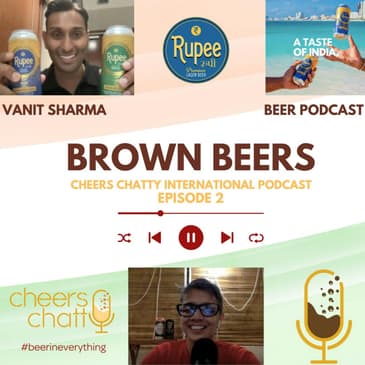
Celebrating Independence Day week with Vanit Sharma, Co-founder of Rupee Beer on Cheers Chatty ‘Brown Beers’ International Podcast edition, episode 2.
Babuussss…Rupee beer is an unforgettably smooth tribute to India.
#beerineverything
Tune into India’s first and only beer podcast.
Podcast Host: Chatty Girija
Follow us on Instagram, Facebook, YouTube, and Linkedin for regular insights and updates. And if you ever have a beer-related question, don't be afraid to DM us on our Cheers Chatty Instagram handle.
Cheers!"
[00:00:01] Hi Dear Brew Studios
[00:00:18] Hey Baboos, Welcome to Brown Beer's, Cheers Chatty's Asian Podcast Edition dedicated to international Asian brews.
[00:00:28] And this is Chatty, the host of India's first and only beer podcast, Cheers Chatty.
[00:00:36] Baboos, this is the place for Asian beers to share their love for beer here.
[00:00:41] What are you waiting for? Go grab a beer.
[00:00:49] So every time we think of rupee, we think of the Indian currency.
[00:00:54] But today I'm going to introduce to you Vanrith or he calls himself as Van Sharma,
[00:01:01] which has got a lot of vibe to his name and to his business because he's launched a beer by the name Rupee Beer.
[00:01:08] And it's a tribute to India and yes, he's everything about India.
[00:01:13] So today we're going to be chatting up with him and asking him about the rupee beer and everything associated with it.
[00:01:22] Hi Van.
[00:01:26] Good evening Chatty, how's it going?
[00:01:28] Very very well. Let me also tell our viewers and listeners that this is a revision.
[00:01:34] This is our home work and then we started this podcast again because it didn't get recorded properly.
[00:01:41] And Van has been very sweet and obliging to make the time for it too.
[00:01:45] This is a practice round.
[00:01:47] Net practice.
[00:01:50] Okay Van, thank you for being on Chayati Podcast and I'm going to ask you something very simple questions.
[00:01:56] And of course we will also have a fun round too.
[00:01:59] So my first question to you is when are you coming to India?
[00:02:04] And I'm purely asking you this because I want to have the rupee beer.
[00:02:07] Yeah, no for sure.
[00:02:09] Well, first of all thanks for having us really big fans and we're really great that we're able to see
[00:02:15] so much enthusiasm for beer in India.
[00:02:18] Love that. That's exactly the type of people we want to hang out with.
[00:02:22] And to your question coming to India hopefully soon maybe this year if possible,
[00:02:27] there's a lot of things that you want to do in India in different parts of the country.
[00:02:32] And yes, 100% I'll bring you some rupees as well.
[00:02:35] No, that's what I wanted to. Now the podcast will go well.
[00:02:38] So what have you been your initial thoughts when you thought of the rupee beer?
[00:02:44] Because your family background is in restaurants.
[00:02:47] It would have been very easy for you and your brother to enter pricing boys to stick to that.
[00:02:53] Why beer?
[00:02:55] Yeah, so I think like a lot of Indian people who come from a family business for us
[00:02:59] almost half a century in DC restaurants.
[00:03:02] So when I was growing up my friends in school, I was one of the only Indian
[00:03:07] actually only people of color in school.
[00:03:09] So my friends their parents were doctors.
[00:03:12] They were accountants.
[00:03:14] They worked in sales.
[00:03:16] They were executives and my parents were Indian restaurant tours.
[00:03:19] So I always felt a little bit ashamed because I felt as if we were not at the same level
[00:03:24] as my friends parents in the same occupation.
[00:03:26] As you get older, you definitely learn more appreciation for your family business
[00:03:31] and the trade that your family comes from.
[00:03:33] So super proud now.
[00:03:35] Yeah, but grew up when I was younger.
[00:03:37] I've seen the ins and outs of the restaurant hospitality side.
[00:03:40] So anyone that comes from that world knows it's a late night business,
[00:03:44] a lot of long hours.
[00:03:46] And yeah, when your customer facing it, there's a lot of things that you're throwing at yourself every single day.
[00:03:51] But I always took more fascination with my brother, Sumit, who's my founder on the beverage side.
[00:03:56] I don't have any pictures to show you now, but there's a lot of pictures of me behind the bar,
[00:04:01] with a Kingfisher sign or a Taj Mahal sign in the back.
[00:04:05] And I'm like five years old running around a restaurant.
[00:04:08] So you can tell I definitely had the gene for food and beverage.
[00:04:13] And we always thought that Indian beers available specifically at Indian restaurants
[00:04:18] didn't necessarily pair well with the food we grew up on.
[00:04:21] As you know, Chadi Indian food is so rich and spice, robust flavor from the north to the southeast to the west.
[00:04:29] Our food has also had so many variations, right?
[00:04:32] And we knew that we wanted to create a beverage that actually paired well with the food we grew up with.
[00:04:38] So less carbonation, very smooth, light, easy to drink, won't compete with the flavors of a desi food.
[00:04:44] And yeah, we're grateful. We teamed up with a very influential player in the world of craft beer.
[00:04:51] And what started as a project and an idea during COVID, when I had just come back to the United States from living overseas in the UK
[00:05:01] has now turned into something I'm really grateful.
[00:05:03] It's growing month on month into something a lot larger than a small little idea.
[00:05:07] So what I understand it's evident is that the Indianness is what persuaded you to launch the beer as well.
[00:05:16] And as you rightly said about the richness of Indian food, and it is so diverse across states even within the same states.
[00:05:27] So how did you strike a balance of bring a beer that will go well with all kinds of foods?
[00:05:33] Because we have the spicy ones, we have the flavorful ones and the ingredients and the topography of our country is so different.
[00:05:42] You can't match it anywhere. How did you find that exact note where this is the flavor? This is the consistency.
[00:05:49] This is the ingredients that you need that you will use to create your premium lover.
[00:05:54] Yeah, good question. So what the average consumer will never see is all the research and development that went into actually finding the perfect recipe.
[00:06:03] We're fans of beer. I'm grateful we've got to travel a lot around the world growing up.
[00:06:08] One thing we always used to do was try the local logger in every country we go to to get a sense of the country, the feel.
[00:06:15] So for us when we were creating this, we knew that we had to create a very easy to drink well liked and approachable beer.
[00:06:22] So we knew that we wanted to do a logger which goes extremely well with food.
[00:06:25] And also, yeah, a lot of taste tests along the way. A lot of different brews to get the right recipe.
[00:06:33] If anyone knows anything about brewing, a logger typically takes three to four weeks to ferment.
[00:06:38] So it also takes some time. It took almost a year to get the right recipe because if the first batch didn't brew to the expectations that we had,
[00:06:48] we have to do it again and start from scratch.
[00:06:50] So we brought in a lot of different types of food where we would test it, you know, taste testing with our chefs, but also with our brewer as well.
[00:06:58] Feedback from consumers, family, friends really figuring out, hey, we like this about this beer, but let's do this with this.
[00:07:06] If I'm having chicken tikka masala or, you know, tandoori chicken or whatever it might be, is this going to be the best flavor profile if I'm washing it down with a beer?
[00:07:14] So we were thinking about all these things and where a family of foodies, so this just made a lot of sense.
[00:07:21] And also recently, you know, we were named Best Beer for World Food.
[00:07:24] So it's not even just the Desi category anymore. It's a larger, huge international.
[00:07:30] And that's something that we didn't expect as much when we were first starting this.
[00:07:35] But now, you know, you're going to Pad Thai or if you're going from Mexican tacos, you know, it's a wide variety of different things.
[00:07:41] If you're getting chicken shawarma from a Middle Eastern restaurant, Rupee now is being sold into those types of restaurants as well.
[00:07:49] So wide variety of different types of food.
[00:07:51] Coming back to the beer itself, is this your love and tribute and heritage to India?
[00:07:57] That's why it's called Rupee.
[00:07:59] Is there, you know, you dabble with other names and finally said, no, this could be the best name that could suit a beer which is so Indian.
[00:08:06] Yeah.
[00:08:08] We knew when we were creating this brand that we wanted to do something iconic and also I'm a big believer in the universe always working out the way it needs to.
[00:08:16] Rupee was not the first name that we wanted to have for the beer.
[00:08:21] It came down to, as anyone knows, probably in anything that's regulated in the regulated business.
[00:08:27] It came down to trademarks and what was possible with our legal counsel to get a name for a beer brand.
[00:08:33] So yeah, we had looked around and tried to figure out the best ethos.
[00:08:38] But I feel really comfortable now saying that it was meant to happen.
[00:08:43] And also Rupee, we're from a family of entrepreneurs, five generations of entrepreneurship in the family.
[00:08:50] I would say it pays big homage to I think our entrepreneurial nature and also Indians in general, Indians are excellent business people.
[00:08:57] And I think it pays homage to, you know, liquid currency.
[00:09:02] Liquid currency.
[00:09:04] And which gets translated and enjoyed as cheers.
[00:09:07] Enjoyed as cheers exactly.
[00:09:10] So do you call the beer now today, you know, like we're talking about the event that yesterday happened and where beer was served and the way the brand is progressing.
[00:09:20] Do you call it an Indian brand in America or now would you call it an Indian global brand?
[00:09:26] How would you position the beer and the brand?
[00:09:29] Yeah, I think the brand is very much the story of Sumit and myself and our upbringing.
[00:09:35] The can name it sounds very Indian.
[00:09:38] My real name is Vanit.
[00:09:40] My nickname has always been Van.
[00:09:42] It was easier for Western people to pronounce that.
[00:09:44] But also my dad always called me Van as well growing up in home.
[00:09:48] So for us, you know, the can it looks it feels very desi right.
[00:09:52] We spend a lot of time on figuring out the right design with our designers to make it look Indian because we're proud of that.
[00:09:58] But also we knew that we wanted to appeal to a wider variety of different audiences.
[00:10:02] So yeah, it's a global Indian global Indian lifestyle brand is what we're hoping to branch in.
[00:10:08] We just launched our second product a few weeks ago, a new one coming out as well.
[00:10:12] So as we release more beers within the beer category of different types of styles, we want to make beer super approachable from the
[00:10:22] international audience.
[00:10:24] And we also, you know, each of our cans has a great deal of knowledge and history on them as well where people that necessarily maybe don't know anything about India can learn a little bit more about our culture, our heritage and also the story of the Indian rupee, which a lot of folks still don't know.
[00:10:39] So yeah, for us, we are looking at this looking at this also as a, you know, we're ambassadors for India.
[00:10:44] We're now available at some major US retailers all the national chains.
[00:10:48] So when someone goes in and sees that we want to be the best possible ambassador for the AC people.
[00:10:55] Okay, so what were your biggest challenges when you decided to launch a beer?
[00:11:01] Was it COVID because it was COVID or was it the name or was it just because it's an alcohol category that kind of created any kind of challenge if at all.
[00:11:12] During COVID when I had mentioned I used to live in England and my brother was in Australia.
[00:11:18] When we came back to America during COVID, especially in the United States, things took a lot of time to really get going.
[00:11:25] The whole country had slowed down.
[00:11:27] And one thing that this also the reason why rupee came to market also was during that time, no, they see beers were being available were available in the US market.
[00:11:36] International shipping containers weren't sending product to the United States because of the disruption in the supply chain during COVID.
[00:11:45] So King Fisher wasn't available.
[00:11:47] Taj Mahal, other Asian beers weren't coming to US restaurants and a lot of our customers in our network of the restaurant 30 plus year customers were saying, hey listen, I want to support this restaurant and during COVID if you're open for takeout can I have beer to go?
[00:12:03] No beer was available.
[00:12:04] So that's why also we were like, let's do something.
[00:12:07] Let's create a beer like they let's fill this void.
[00:12:10] But in that process, yeah, from finding a partner to where we're brewing the beer down to anyone that's in this business.
[00:12:17] They'll know this is a very regulated business as I had mentioned.
[00:12:21] So there's a lot of ins and outs that you have to know in the industry, especially in the United States.
[00:12:25] So there's a lot of a lot of homework you have to do and also people you have to align yourself with to really make sure that you know everything is by the book.
[00:12:34] You spoke earlier about, you know, launching new beers and stuff you want to talk a little about it what has been launched and what is expected in the crate.
[00:12:44] Yeah, so I have here this is our flagship logger.
[00:12:47] Okay, this is our first that we ever had.
[00:12:50] This was a yeah so this is a Basmati rice logger.
[00:12:52] First product that we came to market with light smooth super refreshing.
[00:12:58] This was the beer that we designed that we wanted to have when we're having our butter chicken or masala dosa or whatever you know whatever is your favorite Indian dish that you grew up with.
[00:13:09] For us that was the one product that we really wanted to hit home easy to drink light smooth refreshing and we're grateful we feel as if we were able to accomplish that.
[00:13:19] And then as the world of craft beers changed I think the consumer wanted more variations in beer.
[00:13:26] I think the times of brands that have one skew have changed, I think I think now the consumer definitely wants options.
[00:13:35] So we definitely were getting lots of feedback, which is why about two and a half weeks ago, we launched our second beer which was our mango wheat ale, and we launched icon ironically on World Mango Day.
[00:13:48] And it's paying homage to the Desi mango something that we love and grew up with.
[00:13:54] And it was just ironic how there was a connection directly with the Alfansal mango to the creator of modern day rupee so our cans both have the history of both.
[00:14:06] So we thought that was a very cool tie in where the person who founded the rupee in India or in the subcontinent also was responsible for naming the Chhosa mango in India as well.
[00:14:17] So that was very cool. And our next product coming out is our India Pale Ale.
[00:14:24] Anyone in craft beer knows that the IPA craze has been going for many years and being honest.
[00:14:32] They voted to India.
[00:14:34] Exactly. Yeah, which is why our recipe is brewed by a British brewer and excuse me and also paying homage to the original style of what an IPA used to taste like.
[00:14:48] So when the British used to ship beer to India for their, you know, their viceroy's the generals.
[00:14:54] They knew that the journey was so long from England to India.
[00:14:59] So they purposely added extra hops and preservatives into the beer.
[00:15:03] So when it got to India, it was super bitter, which is why we have these very bitter IPAs.
[00:15:08] We're doing something different.
[00:15:10] We're changing the style to go back to the original style of being less bitter and less hoppy.
[00:15:15] And a few other really cool products coming out.
[00:15:18] So you have the mango, you have the Indian name and you have the basmati.
[00:15:25] I think you have the entire, you've covered an entire India beer.
[00:15:29] Yeah. So I think it was, we're using ingredients that are, I would say very important to our family and Indians as well in South Asians and South Asians.
[00:15:39] But also, yeah, we wanted to brew beers that had a distinct flavor that are easy to drink but also can highlight, you know, South Asian ingredients.
[00:15:47] So there are two kinds of audiences I'm sure you're facing out there.
[00:15:51] One is the non-Asian audience and then the Asian audience.
[00:15:56] So what's been the kind of feedback that you've got from both of them?
[00:16:00] Because the Asians anyway are used to this kind of a palette, you know, rice, mango and it has the Indianness to it.
[00:16:07] So how did they, you know, look at it, how did they, what was their feedback and what was their, you know, non-Asians?
[00:16:13] Yeah. So we're, our customer base is very diverse from, you know, being from the Indian, from India or overseas, you know, American, whatever it looks like for us at the end of the day.
[00:16:26] The feedback is very positive. Indian people love seeing something that has a unique twist where also there hasn't been as much innovation in beer companies doing something different with beers that are made for Indian food.
[00:16:38] So they're really grateful for that, especially when they say, hey, this is so interesting. It's less gassy. There's less carbonation.
[00:16:46] And so I'm not burping as much when I'm having a chicken curry but also down to your American consumer who can buy rupee at Costco at Whole Foods at Trader Joe's.
[00:16:56] For them also it's something that I've never seen before and also easy to drink.
[00:17:01] And the feedback we get even from like, you know, Indian aunties who don't drink beer is that they're fascinated with the brand and they'll say, listen, like, you know, I don't drink beer but Uncle G, you know, Uncle does and I had a sip of his beer and I will say I thought it was non-offensive and very easy to drink.
[00:17:17] And when I hear that type of feedback, that's epic because for us, even our mom who typically her poison of choice is a pomegranate margarita.
[00:17:28] She will say, listen, like I had some of your dads at dinner and you know, it's good. I like it. The mango beer was delicious.
[00:17:34] So I think that's really cool seeing more women that don't drink and different generations as well of people that don't drink all because rupee was something that they are just really they love the brand.
[00:17:44] I think that's really nice because normally the perception is women don't drink beer. They don't prefer it. They would go for a vodka or a gin or wine and if that's you've cracked that and especially if your mother has given you a thumbs up then I think you've conquered the world.
[00:18:04] I get so many WhatsApps and texts from friends and friends that I went to university with, you know, like girlfriends as well. Like, hey, Van, I saw the beer at the grocery store and it's really cool when they see that and they're like, I don't drink beer but I had to have it because I knew that you were brewing it.
[00:18:20] But also I've heard good things. So I'm grateful. It's rupee now is getting more and more interest and you know, I think if we can convince more people to try a little bit more beer.
[00:18:31] I think that's a very cool feeling to say that you're helping bring beer into more people that normally would never drink it as a preferred alcohol of choice.
[00:18:42] I totally agree and that is going to happen, you know, just that people need to try it then the word needs to be out and you know, it's just going to get wider.
[00:18:53] Yeah, true.
[00:18:54] Just a matter of time.
[00:18:56] The first thing that people don't know about beer. Can you throw some light on what is it that people are not at all aware of and should know?
[00:19:11] Yeah, good question. The number one thing I think that I can think of is actually probably a little bit more provocative, which is interesting.
[00:19:17] The American audience, when we first launched one of the biggest questions we always got was do they drink beer in India? Do Indians like beer in India?
[00:19:26] Isn't it illegal to drink alcohol? Don't they hang people for drinking alcohol? And I was like, wow, I cannot believe that the perception out there from some a pocket of folks, you know, in North America is that they don't realize that India is the third largest alcohol market in the world now where we do drink beer.
[00:19:44] I'm Punjabi so alcohol is very much so, you know, more socially acceptable, you know, in India but also other parts here in Bombay where people are, you know, living a very progressive, you know, lifestyle.
[00:19:56] It's not the same old school India people think.
[00:19:59] So when I hear that, I think as mentioned we want to make sure our can and our product is an excellent ambassador for India, anywhere in the world it is.
[00:20:08] So when I heard those things and I heard them multiple times, I was shocked. I can't believe people think that in India they don't drink and also that it's illegal or it could be, you know, leading to something like getting hung.
[00:20:18] That was profound. I never have connected those things having, you know, having the lived experience I have.
[00:20:25] So I'm on a mission to also make sure people realize that, you know, India is not that type of a country that people think it is.
[00:20:32] I think they just like to be in denial and their thoughts need to be hanged for the ignorance.
[00:20:38] You know, somehow, you know, I guess they think we are land of snake charmers and elephants and you know, you know, they just think that all that we do is do Hare Rama, Hare Krishna, nothing else.
[00:20:51] We do that as well. And yeah, and they come back here backpacking thinking gold that they're going to find here is spirituality and yoga.
[00:21:00] But yeah, they'll be surprised.
[00:21:03] We have beer. We drink.
[00:21:05] There's a thriving scene all over the world. So I we want to make sure that we can show that because that's still it makes me so surprised and shocked when I hear those things.
[00:21:17] That's how Americans are. They're just too close. They think the world starts with them and ends with them.
[00:21:24] What about your first recipe? You at Yes, you've gone through a whole lot of a journey with this, you know, so many things with the concept itself, the the brewers, you know, the licenses, the regulations.
[00:21:39] But I'm sure you started with a particular recipe and then finally ended with something like that. So what was your experience with that the first time that you brewed your first batch?
[00:21:51] Yeah, I mentioned we did a lot of research and development, a lot of taste tests. We knew that we wanted to do a hellish logger around sort of 4.5% ABV easy drinking, crushable beer.
[00:22:04] So that was the the brief for what we were hoping for when we sat down with our brewer. As you mentioned, he's launched over 80 international breweries around the world.
[00:22:15] He's very, very famed in the industry. So when we were speaking to him also he knew exactly what we wanted to do. So yeah, the first few tests came back.
[00:22:24] The flavor profile was perhaps maybe a little bit too herbal for something myself or we thought it wasn't as neutral as it could be.
[00:22:32] So small tweaks here and there in the process of brewing. And as mentioned before, it takes about four weeks to brew a logger, right?
[00:22:40] It was annoying sometimes waiting around for the next batch that we can taste and then you know, another month. So it took a little time.
[00:22:48] But I think overall we wanted to create a just as mentioned before and I'll probably drill this point home and easy to drink beer.
[00:22:57] And the first few batches came out very smooth, very refreshing. But we knew that the taste just had to be more neutral.
[00:23:06] So the brewer is a Britain and he's proved in what you said 80 breweries.
[00:23:13] 80 plus.
[00:23:14] Did he have the experience of working with the Indian recipe?
[00:23:18] Yeah, so when he first was approached for this project being British, he obviously had a, you know, he was a fan of Indian food.
[00:23:25] Okay, then that makes sense.
[00:23:26] Masala national dish of the UK. So he very much so was waiting for and he had never done an Indian project before.
[00:23:33] So this was right up his alley. I think he was waiting for something along these lines for a while. So when he heard Heinz and Curry, let's go.
[00:23:42] And then it was very much so something he was really looking forward to. Yeah, we worked with him to really find an Indian style recipe that really paid homage to, you know, using ingredients like rice, which is a huge part of the Asian brewing format here in
[00:23:57] America people are much more familiar if they go for Japanese food with Sapporo or Kirin or Sahi, which all use what your excellent beers and some of my favorite top 10 beers, but also they use rice.
[00:24:09] And I knew that we wanted to incorporate that as part of the format. So yeah, we're pretty confident with with his expertise and also brewing is a science and I never realized how much on the brewing side, the actual brewers themselves have to follow these
[00:24:25] ornate recipes and there's a process on a process. People think I'm just going to have some beer, but they don't realize the actual science behind the brewing and these people that actually do brew beer day in and day out their artists.
[00:24:39] So it's very much I was just going to say that it's a scientific art. You know, it's something that you have to be so passionate, so close to it and you know it's the perfection is the science part of it.
[00:24:51] The passion is the art part of it, you know that you get the right kind of profile as you mentioned earlier. You know so it's the best of both worlds.
[00:24:59] It's liquid art.
[00:25:01] Yeah, absolutely.
[00:25:02] Yeah, you know, so it's a good it's a very good thing and I'm glad it all turned out well. I also feel the universe heard your brewer because he's been wanting to work on an Indian beer and there it was and you are a strong believer of the universe too.
[00:25:18] That's true.
[00:25:19] Yeah, everything.
[00:25:20] Everything came around.
[00:25:22] Yeah.
[00:25:24] So yeah, that's my the end of my trivia. It's called the cheers chatty chugging round.
[00:25:34] So my first question to you is what is that one thing most Indians like about the about the European.
[00:25:43] They have a sip and say yes, this is it. I love it because we have to just complete that sentence.
[00:25:50] Because it's super smooth.
[00:25:52] Okay, just like a tagline.
[00:25:55] Just like our tagline unforgettable smooth. It's, it's like velvet. It's like silk. It's very, it's very just the I want to keep drinking more of it.
[00:26:04] It's like the lace, you know lace chips they have this tagline saying that no one can eat just one. So it's something like that.
[00:26:14] No one can drink just one with a rupee beer.
[00:26:18] What was your first high since the time you launched the rupee brand the first compliment the first time when you heard someone say something really nice about it.
[00:26:28] Wow, I'm struggling to think because I'm grateful there's been a few cool things.
[00:26:33] I'm always grateful for all the messages we get on social media. I think for me when I was like whoa, we're getting somewhere is when we had some great emails and people calling us to say listen we want to put rupee in some really big national retail chains in the United States.
[00:26:49] That's when for me I knew whoa.
[00:26:52] What started as something as an idea slowly got somewhere faster and in larger. So I would say for me that's when I was like, okay, to my business partner my brother.
[00:27:03] We're getting somewhere this is this is this is exciting. And we're yeah we're trusting the process.
[00:27:10] You have as at this point of time to be yours.
[00:27:14] To two products exactly. If you had to relate them to two Indian personalities, who wouldn't be the first is the premium blogger who's the closest that looks like a premium of behaves in an entire persona is like a premium logo.
[00:27:32] Yeah, so I will say someone that I would want to drink the beer. I'm a big fan of. And if you don't anything know about my background. I actually originally was on track to be a diplomat.
[00:27:43] So I got my master's in politics and international relations. So I've always been very interested in that world of global affairs.
[00:27:51] And one of the reasons why I say that was when I was in school or finishing high school Barack Obama in the United States had just become the president.
[00:27:58] So I was just so fascinated with someone that had this really great charisma. I thought he was extremely well spoken. And I just loved how refreshing he was in the world of politics, also being of color, which for someone like me was like this is this is
[00:28:13] possible.
[00:28:14] So I would say yeah, I know and also Brock drinks and he smokes cigarettes as well.
[00:28:20] One very cool person that was a target that would love one day that hopefully they can try Ruby beer, and also who personifies the brand as a logger and I respect would be.
[00:28:34] Yeah, former president Barack Obama of the United States that would be really cool if he was able to do that.
[00:28:38] And your mango.
[00:28:40] Wow, the mango ale. I feel like there's a it's a little bit more exotic. It's a little bit more, you know, they see I think it definitely has a little bit more of a tropical vibe.
[00:28:51] And I guess to bring it back home to India and someone in Bollywood.
[00:28:55] Very good.
[00:28:57] Yeah, I got it. I'm not as filming as I used to be but I know what's happening usually from all the songs that come out.
[00:29:04] I think it would be really iconic to have someone and hopefully she drinks beer, but I would say someone like Deepika would be really cool if I could see her holding a green mango wheat ale can and having a sip of Ruby or maybe taking a sip of
[00:29:18] Roombaers and you know and passing it along. That would be that would be very cool.
[00:29:21] So let's make that our mission when you come to India and to Mumbai, wherever she is we will just bomb her and make sure that she has a separate anything else at least hold one hold a can.
[00:29:33] I'm yeah we'll go I would say what I also want to go see shower cons house in Bandra. Oh yeah, I'm sure they all somewhere.
[00:29:44] Okay, what is the best food pairing that you would give with your beers with your premium Lager and the mango.
[00:29:51] I would say both in general and I'm, if anyone wants to get you know upset with me for saying that my favorite Indian dish is like butter chicken.
[00:29:59] I'll take it but I'm a that's my favorite growing up. And also I think it's a really great introduction food for anyone that's never had Indian food before.
[00:30:08] I think for me. Yeah, I would say any butter chicken is a fantastic pairing with with our rice logger. They go hand in hand, very smooth just light easy to drink and also easy to pair ingredients in both.
[00:30:22] So I would say butter chicken goes extremely well with with anything in general but without with a with a logger, nothing better than a pint and a good and a good butter chicken and mango wheat ale definitely has more of a summer tropical aroma.
[00:30:36] So I would say, let's get some sort of like South Indian Tali.
[00:30:39] I was just going to ask you, is there anything in South Indian that you recommend. Yeah, so I would say definitely the flavors of South India are totally different from me being Punjabi and growing up in the Punjabi North Indian restaurant trade.
[00:30:53] So whenever I used to have South Indian food in my family did it was considered more of a treat, because we don't cook you know things like Dosa or Italy, or those types of things on a regular basis.
[00:31:05] So I would say a nice you know Tali with a banana leaf and a few options would be I can picture it already.
[00:31:13] Yeah, maybe we'll have to do a photo shoot with.
[00:31:16] It would be amazing. You know when you come to Mumbai we'll go to one of those South Indian Matunga places where there's a lot of South Indian food, of course there are a lot of many many other places too but Matunga is known primarily for this traditional South Indian food.
[00:31:32] We could actually go there and do some food and beer pairings.
[00:31:36] Well, I'm going to keep you to it Chadi so we'll 100% have to go.
[00:31:40] Yeah, completely and you know I'm also going to get my best friend also she cooks amazing food especially South Indian.
[00:31:49] You know she does this entire thing on a banana leaf especially during our festive times the Dashira and Diwali and every year I have it and more than once in a year but when you come I'm going to get you a treat from her food as well and with the bills.
[00:32:10] It's interesting how we're all from the same country and origin but even from the regions right like I when I think of a banana leaf and having like a proper South Indian experience that just sounds like almost another country right because it's so out of the
[00:32:23] up and jobby person would never do that right so it's very it's it's so exotic and it's so tropical and I think it it's completely different from something from North India so that's that's yeah for me like that gets me excited.
[00:32:36] If you look at it even within the states you know if you just look at South the four states the food is so different.
[00:32:44] So it's got to do with the region, the tropical areas and cuisine and all of those things so even there the so much of difference I mean do or keep out there North and South and East or West.
[00:32:56] And having said that you guys, you know you and your brother have cracked the exact recipe for the beer that goes with you know all kinds of foods especially Indian because you're made it from an Indian perspective and kudos to that here.
[00:33:11] It's not easy at all.
[00:33:13] True no we're yeah it's a lot of work.
[00:33:16] Thank you.
[00:33:19] So you have two beers I know you said that you would like difficult to have one of your beers that's the mango mango is but if you had to dedicate your premium lager to a Bollywood personality who would be who is like the premium lager in Bollywood.
[00:33:36] Wow, that's a tough one.
[00:33:40] There's so many big personalities.
[00:33:43] My dad would want maybe someone from the Kapoor clan.
[00:33:49] I don't know if I'll meet up drinks. Mr. Buchen.
[00:33:52] No, he doesn't.
[00:33:54] If you can just, if you could model the can for us that I would be grateful just hold it with sir can you please hold the can for one picture.
[00:34:02] I think it would be really cool. Yeah, I would say some of those legends that are famous around the world. Like even for me one thing I'll know really quickly about Bollywood connection, even just growing up Indian and being brown and having to gotten to travel so much around
[00:34:14] the world anywhere I go in the world where it's like Morocco or Serbia or Uganda. People always know Bollywood when they give a India and you know, shout out to con shout out to con we love his movies and I have a few Eastern European friends and when Eastern Europe
[00:34:31] and Russia never used to when there was a war going on with the United States the Cold War, they blocked all US entertainment. So Hollywood was never available to watch on American Russian TV, but Bollywood was.
[00:34:43] Wow. So all of these people have so much knowledge on all the old school DC Bollywood movies from the 60s and 70s.
[00:34:50] And I always find that super interesting. So I think in Bollywood there's so many celebrities that I respect and growing up with my parents I was watching them at home as well.
[00:35:00] People like you know Amitabh Bachchan or someone from the Kapoor family, you know King Khan, Shah Rukh Khan as well. I those are the types of personalities which would be amazing if they were ever enough if they're beer drinkers to have them snap a snap a pic.
[00:35:13] I'm sure they'll do that for a PPA even if they aren't make sure they do.
[00:35:18] We'll figure something out.
[00:35:20] We'll figure out something out.
[00:35:22] And what about the I guess your mango ale will be the Pica as you said earlier.
[00:35:27] Yeah.
[00:35:29] What is the best compliment that you have received for your beer still date?
[00:35:33] Usually something from someone that isn't a beer drinker.
[00:35:36] Okay.
[00:35:37] That will just give me a hey man, I don't like beer. I never have.
[00:35:41] I don't want to fear because it makes me bloated and I tried your blear out. I tried your logger out.
[00:35:47] And I was blown away that beer can taste very neutral and light and smooth and refreshing.
[00:35:53] And that just goes back to that's exactly what we were hoping to do when we started this company.
[00:35:58] So that type of feedback is usually the best that we get.
[00:36:03] This is my last question and the chugging round.
[00:36:07] If the rupee beer, it could be you could take either the premium logo, you could take the mango ale.
[00:36:13] It was a person.
[00:36:14] What kind of a personality that he or she will have? Will it be a she or a him?
[00:36:20] That's a good question. I don't know if I have an answer to that.
[00:36:22] I guess we could make the our blue can, which is our logger.
[00:36:26] We can make that a male and green can, which is our mango we fell a female.
[00:36:30] They're both men and female.
[00:36:32] I think in terms of looking at the data men are drinking rupee a little bit more than females right now in terms of the data.
[00:36:38] But I think the ultimate sort of personality or yeah just like a smooth drinker and someone who wants to enjoy the moment.
[00:36:48] Just yesterday I was at Fenway Park in Boston where rupee was sold as the first Indian beer ever and majorly baseball.
[00:36:56] And I will say I saw so many females watching baseball and drinking a green can of rupee, the mango wheat ale and that was very cool.
[00:37:04] And I think that somewhere you have incorporated in the way you have proved the beer as well.
[00:37:10] Like you've taken into account the Indianness of it, the international appeal to in terms of appealing to non-Asian palette as well.
[00:37:21] And the design which is again very striking very you know you can see from a distance you can't miss it.
[00:37:28] It's almost like you can see from the moon because it is so Indian and it is so bright and vibrant.
[00:37:33] It's just personified.
[00:37:35] Like I look at it and again give it as a happy Diwali gift.
[00:37:38] You know it's that way.
[00:37:39] Let's hope that more, yeah that's the ideal Diwali gift.
[00:37:43] Yeah actually just say you need some crackers and some betayal for all and you're set.
[00:37:51] A tie box and a four pack of rupee and you're set to go for your Diwali gifts.
[00:37:56] Yeah parties on.
[00:37:59] Okay we've almost come to the end of a podcast plan and I just have one last question to ask you is where do you see the brand going from here.
[00:38:12] And how many states of USA is going to get covered and beyond USA.
[00:38:17] Yeah so right now I'm grateful we're growing month on month and for a younger brewery for a younger brand.
[00:38:24] We are growing pretty fast from a craft beer perspective in less than two years we're in 12 US states will be adding more and more onto that roster every every few months and also internationally.
[00:38:38] I was just in Europe last week when we were connecting as well so some interesting things hopefully happening there and a few other international markets as well.
[00:38:47] So slowly our goal to bring rupee to the world is, you know, takes a little time because beer is a regulated game.
[00:38:56] But yeah well we're coming to more national retailers, more online availability as well. And as we introduce more products.
[00:39:05] I think you're going to see rupee really evolve into a really big you know in global Indian lifestyle name and brand.
[00:39:13] That's not only synonymous with South Asia, but from a global perspective Indians are everywhere now.
[00:39:19] So for us, you know the global Indian drinker, you know they live in Barcelona live in Toronto live in Miami. They're they're international so I think we're we really want to make sure that also all the in bounds that we get from people in India or in Singapore, or in Malaysia, Hong Kong, that we can get rupee to them some way.
[00:39:39] So we really want to make sure that we can do that soon. So yeah keep an eye out follow us on socials. And if there's a part of the world you want to see rupee let us know we're going to try to make it happen.
[00:39:50] Absolutely, wherever there is beer I'm sure rupee is going to be there.
[00:39:55] It won't cost a rupee as a disclaimer.
[00:39:58] Who was listening to us please remember it's not going to cost a rupee, but it's worth million bucks every every sip of it. I'm very very sure of that.
[00:40:10] Thank you.
[00:40:11] Thank you so much van for being on the cheers charity podcast and any final signing concluding lines anything that you would like to say you want to convey to a business.
[00:40:21] Just keep doing this amazing podcast I want to see more amazing cool stuff happening from South Asia, from India. So thanks for having us. And yeah I'm a listener. I just listened to your last podcast last week.
[00:40:35] Oh you did the one you wanted you did.
[00:40:38] Yeah, literally that on my flight back to from from Barcelona to Boston.
[00:40:43] I was going to ask you actually yeah.
[00:40:46] Yeah, so I listened to I was on Spotify.
[00:40:50] Yeah, so I definitely want to see more and some of the things she was also talking about our culture so rich. And I really want to go back to that point also where let's show people that in India they do drink.
[00:41:02] And you know we have a sophisticated palette and that we're you know we we we know things about beer and we know we're growing and evolving and it's very much part of the new modern format of being Indian.
[00:41:14] Absolutely and like you said that you know keep doing the podcast you know you know we are doing this brown beers series where we want to the and when I'm saying we and talking about cheers charity we want to promote the South Asian and the Asian beer companies.
[00:41:32] And all the people out there and give them a voice and since we are also an Asian brand we are here anytime you want to speak about any of your beers or anything about beer in general and as a community as well promoting beer we always there for you.
[00:41:48] Thank you so much.
[00:41:49] Thank you and cheers on that Babu's this is the end of a brown beer second episode with bandit Sharma of rupee beer I wish we could get his brother also along but I'm sure we will in the near future.
[00:42:01] Perfect cheers cheers.