
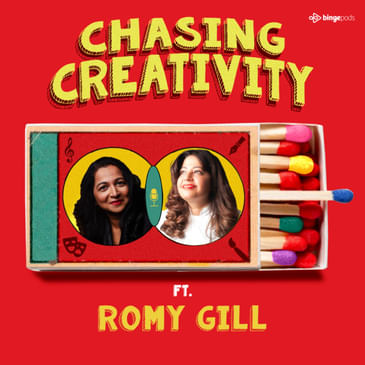
Join Kiran Manral on 'Chasing Creativity' as she explores the world of flavors with renowned chef and food writer Romy Gill. From the kitchen to the page, discover the art of culinary storytelling, the creative process behind delectable dishes, and the cultural inspirations that shape Romy's gastronomic creations
[00:00:00] Before we begin, I wanted to give a huge shout out to Amazon Music for partnering with me on this episode of Chasing Creativity. But more on this later. Let's get right into today's episode. Hi and welcome to yet another episode of Chasing Creativity.
[00:00:28] Today I have a very special guest who has come all the way down from the UK. Romy Gill, Chef Extraordinaire, Cookbook writer, traveller, restauranteer and so much more. Welcome to Chasing Creativity, Romy. Kiran, it's so lovely to meet you and thanks for having me.
[00:00:43] I was so excited to meet you because we've always chatted, right? And every time I come to Mumbai there's something you are way. So this time it just happened organically, right? It was destined to. Destined to. Like your career, for instance. Romy, you grew up in West Bengal.
[00:01:05] That's right. And you're a girl from Punjab and then you went to the UK and somehow from Punjab in West Bengal, how tell us a bit about your childhood about this entire journey of this little girl going from place to place and then to UK.
[00:01:21] So like many people, my dad migrated to West Bengal from Punjab. He didn't want to do farming. He ran away from home and went his aunties to live in West Bengal in Assam, Seoul.
[00:01:35] So he ran away and said he was 16 actually or 17 and he didn't want to study and he just ran away. He said I don't want to farming. So my grandad said you don't study. You have to do farming. He said, well, I'm not doing that.
[00:01:49] And he ran away and started as an apprenticeship in steel plant in Burnpur. And he did that like, you know, and worked really hard. But we were born three of us. We're born my sister, myself from the middle child and I'm a brother.
[00:02:05] The all three were born in born and brought up in Bengal. But all our summers summer kitchens were mostly Punjab. So what it is for Punjab? So we used to take something from Bengal. You know, I get so excited meeting a Bengali because I love speaking Bengali.
[00:02:22] And my brains when I'm bringing, I would say I'm not saying Punjabis don't have brains. I'm just saying the Punjabis are lovey ting. They are very organically in a sense that they're very, you know, open the doors and things like that.
[00:02:37] And very smart people even if they don't show they're very smart people. But with Bengalis fun one thing you have to understand education is very important. No matter what you do. Education comes first. I think food comes first. Education is there.
[00:02:52] Then the food, they will say, first, where we are going to find to eat first, then we will think about the holidays. Holiday destination don't live, but where are the places we're going to go and eat? That's my jelly. You still do so popular.
[00:03:09] Yes, but I think Bengalis have a different kind of eating hub. If you meet the eyes rolling, the eyes excitement of food, no one can be doing all this. So I have that kind of thing.
[00:03:21] And I think when we used to go to Punjab for summer holidays or even sometimes in winter, mostly summer holidays because they were longer. Those lovely train journeys, mom would pack a beautiful picnic and he would meet people. Those things not now generation won't understand everybody's flying.
[00:03:39] Everybody's fast running. I think that memories that you have is, I think there was a connection through food. And I love Bengal. I love going back to Assam Seoul where I was born and brought up. I went back for some research and I love Punjab.
[00:03:57] But if somebody tells me tomorrow to come and live in India, I think there are two places I would say is Calcutta and Mumbai would be my choice to live in India. Calcutta and Mumbai. Yeah. The busiest crowd, most crowded, noisiest cities.
[00:04:11] I think I will tell you I'd be lost, not lost. I think I will be an individual in my own way and no one will care about me. I can do what I want to. I think I can happily live in that environment and it doesn't bother me.
[00:04:28] I like Smerch Bridge especially because I live in the southwest of England. I don't live in London, which everybody thinks England is London. England is not just London. So I think I travel all the time in my car everywhere where I'm filming or recording or cooking.
[00:04:41] Like I've come to India to cook. So I think I don't mind to get lost. I'm lost in your own country, you know? A tourist in your own country is amazing because that is where you find real India. Nice.
[00:04:54] We're going to talk about you traveling through India in a bit when we come to your books. But right now tell me when you were growing up the influences, the Punjabi food influences and the Bengali food influences, how did they mash up for you?
[00:05:06] They're mash made in heaven. You take the punch for which is a whole spices, which you use ground as well. The punch for the mustard, the black mustard works really well in Bengali cuisine. Punch for and again is used as a pickling in India.
[00:05:20] Punjabi, so you know we are on kachar, hove or any kind of like if you're making lime pickle or anything like that. We use lot of punch for in that to so the connection is that if you have that,
[00:05:32] if you're going to a desert island and my desert island spice is going to be a punch for them because A, I can sit and separate them because they have five whole spices.
[00:05:42] Each and every spice works magically beautifully with their own and we are a rich country of spices and that spices work so well. I think the combination of rich cuisine of Punjab and the not just the spices, but I just think it works really well.
[00:05:58] And also you have to understand that Bengal is a place forget about Mumbai or anything. Bengal is the place where there is a small minority of Sikhs, lot of Sikhs James Marwarees, then British Anglo Indians and then Armenians where I as in Seoul and a Jewish community.
[00:06:17] So there is a community from different places, Hindus, Muslim. So the food became such a big part of Mughalai food, who are you going to British bakery or Armenian bakery on things like that is very,
[00:06:32] very different from any states of India and any I would say that people from rich to poor to middle class can really heavenly live in that part of the world because I think it's very, very different from from any states of India.
[00:06:48] Lovely. And when you move from there to the UK, that must have been quite a culture shock. It was because how old were you then? 22. Okay. So 22 you we didn't have technology then and also to phony of family from there. It was so expensive at that time.
[00:07:07] I wrote letters and emails with something that was just coming. People are starting to learn how to email or use computers and things like that. So I think that old school was quite good. I love that old school, but things have changed now.
[00:07:21] I think when I reach there or the excitement of going there is completely different. You know, nowadays this kids go, they have the iPhones, they have their any kind of technology with their laptops. I think that is the thing is very different from the generation that I went.
[00:07:38] I'm 51 now. So when you turn, you can do the maths how long it is. So I think when I went more than 30 years ago, it was completely different. After within a week, the time when I went, it was very time,
[00:07:51] which is November time is very dark, cold and damp. And then you miss the food, you miss your friends, you miss your family terribly. And you have no other choice but to make new friends, to learn the food from that part of the world.
[00:08:08] I think I make friends very quickly in a sense that you have to knock the door of somebody's. You know, I think that's how the culture in India is very different that we make.
[00:08:17] Our neighbors are kind of like now as well, where I live, all my neighbors are like, we can open door policy, you know, everyone can walk in our door and we can talk about it. I think that's how it grew up in India up to changes is different.
[00:08:29] People have to make appointments to go to somebody's house now. We're going to talk on the phone. I know. So I think that was very different to the time now. How did you adjust to the food there? Oh, I didn't adjust for a very long time.
[00:08:47] You have to understand the food scene, Indian food scene is changing now has changed lot in the recent years. People, British people now understand there is regional Indian food. We don't speak the same language. We look very different via rituals, celebrations. Everything is different.
[00:09:06] So they understand now the food of South is not just South Indian food there from Karnataka, from Madras or, you know, the Konkani food like Chetna food. Every food is very different than even if you go to Punjab, Delhi food is,
[00:09:20] you know, people think butter chicken, butter chicken is Punjabi. It's actually it started in Delhi and then it went around everywhere else, which is there is more to Indian food than butter chicken. You know, yes, I love butter chicken. Don't get me wrong.
[00:09:32] I make a good butter chicken, but we Indian food is so different. Even lentils, dals, lelo up, Ketna, cheche dals you can make for me. I think that identity of going my husband took me out to eat.
[00:09:43] And that was the point when I said to my husband that I can't eat this Indian food. This is not Indian food. Every single everything tastes the same because you have to understand we have curry houses.
[00:09:55] So the curry houses are very typically that 10 pints of lager and a curry which is like has a place. Okay. They are the people who introduced the British with the spices, you know, spicy food, but I won't be eating that food.
[00:10:10] You can eat that food because it's too sweet. It's too either it's very hot. Vindaloo. Vindaloo doesn't even mean how it's made. What is it made of? It's spicy. But if you have a real Vindaloo, it's completely different.
[00:10:23] So I think that when I my set to husband opening a restaurant and he looked at me and he said, this woman is going to do it. And it happened many years later. And you did. You did open roomies kitchen, but did you train?
[00:10:38] So the story of me, I always wanted to be a chef or a spy. These were the two things. So why a chef? Why did the spy not happen? I have to ask this. But I didn't happen for various reasons. I was a very good spy.
[00:10:52] So maybe I won't be able to come back to my country or something like that. You know, there were so many things which went around my head. And then I love, I still love reading anything which is spy detective, anything you gave me, give me I'll read it.
[00:11:06] But I was very good at cricket. My parents are like cricket, nothing can be done. Girls are cricket. I love that point. I started, at least people have started to know that women actually are good at cricket, you know?
[00:11:17] But that time you can understand that a cricket, whether you're good or not, no one wanted you to play the cricket. You couldn't do. My mom had cancer when I was doing 11th or 12th standard, I think it was. She had cancer, diagnosed with cancer.
[00:11:33] And that was the point where mom was such a good cook. Everybody's mommy is a great cook, you know? And she would put a lot of salt and things in the food that she could taste it.
[00:11:44] Her sense of tasting was very different because when you're having a radiotherapy or a chemotherapy, senses are very, very different. So that was a point of me, my whole idea of becoming a chef and cooking started from that point.
[00:11:56] And I think when you have it in you, you knock the doors of the people that I want to do this. I want to be this, whether you go to a culinary institute or not, you want to learn.
[00:12:07] I think I tell you one thing that hospitality is one of the most welcoming industry in the world. You can go without learning the skills and learn on the job and also the kitchen where I was today prepping for a dinner for tomorrow.
[00:12:25] So they're somebody from different states. They were all speaking different languages. It's a world kitchen, right? You can learn so much in that kitchen through food. The way they cook, the method, the spices same. But the food, way of technique changes.
[00:12:43] So the kitchen is an amazing place to learn and have to be very cleverly. I love learning from these young guys listening to them because how their parents would cook or I would say how your mom would make this biryani a very, very best biryani
[00:12:57] which a five-star hotel manager tell me the best biryani place in Mumbai. And I want to go there. You know, if I change some clothes and go to that place, I will go there.
[00:13:07] You tell me and she told me the right place where to go to eat the best biryani. So I'm going to try that. Lovely. So I think you have to be very open. You have to open with the challenges that you will face
[00:13:17] and also you have to understand hospitalities, restaurants. You have to work long hours. There's a wonderful story about how you started your restaurant. Yeah. And how you didn't get the loans you wanted. And how you went hammer and tongs after it. Tell us all about that.
[00:13:34] So yes, it's a support network. Okay. Fine. I got the place for great two listed buildings so people who don't know great two listed building is this is a very old building and where you have to get the permission to change a few.
[00:13:47] So there are many things that took about three and a half years. But still when I had that building is still hard to pay the loan. You know, you have to still pay the rent and things like that. We're still doing it.
[00:13:59] Even if it's less, you still have to do it took me three and a half years to get the great two listed building change to restaurant. Anybody in the right mind would have given up. But I said no, I want to open here.
[00:14:11] The reason I want to open here. If something happens to my daughters, I can run home and see them, you know, if I'm far away, I can't. So we I didn't give up neither did my husband who supported me.
[00:14:22] And then when we were working, I needed a loan. Not a big amount, very small amount. My husband and I, we put a lot of shares, a lot of our money in the building. We wanted, I didn't want an investor. It's the first time I'm opening a restaurant.
[00:14:36] I just didn't want to then invest or two kind of say things and put in put. I just needed a little bit more money. And all the banks refused. They did not want to give me money because a restaurant's fail in first year.
[00:14:49] Women of color women three three things against you. So my husband saw this something on BBC that they were looking for small businesses and how the banks don't fund the small businesses yet they get the money from the government.
[00:15:02] So they also looked, I saw my social media or something and they approached my and approached me and and they did a film news about me. And the next day the the Nat West gave me a loan.
[00:15:17] So the power of social media can be very good, negative and positive. I think that really worked in my favor. And they're still very good with me if I want anything.
[00:15:28] But also at the same time I said to my husband when no one was giving me the loans, I sold all my gold jewelry. My daughters won yellow gold. They're not going to wear it. I rang my parents. I rang my in-laws and said, I need the money.
[00:15:42] I want to sell my jewelry. I don't want money from you guys. They said, that's fine. That's how what we do, you know, if you need of money, jewelry. I said, I don't wear it. It's in the locker.
[00:15:50] So I sold all my jewelry except one thing and invested in my restaurant. Lovely. We'll take a short break and we'll be right back with Romi Gill on Chasing Creativity. And we're back with Romi Gill.
[00:16:06] Romi tell me you just told us about how you got the loan that got your restaurant started. But what was the vision behind starting the restaurant? So I really wanted to share the food I grew up in India.
[00:16:18] So my sense for me, many chefs it will be the street food. The street food is a place in India where you will be able to understand the flavors of India really well
[00:16:30] because the way it's cooked in front of you some years ago, nice things have changed, you know. And also the street food was in Bengal is very different to the street food here. Also the Hakka style of cooking, you know, the Chinese people are there.
[00:16:44] The community is completely different. So you the street food scene is very different egg rolls, the cream rolls, you know, all that kind of things you get in Bengal. I still crave for it.
[00:16:56] I recently I was there and I was like every place I have to go and I took my dad everywhere. My best friend from New York came we went there.
[00:17:03] I wanted my vision was just plain simple food, not just ghargakana because there were chefs who trained me really well to make it fine dining as well. So there was something like let's say octopus, you know, I've never eaten octopus in India when I was growing up.
[00:17:18] So I ate octopus in a really good restaurant called Saboor which Barafina it used to be now it's a bore. She moved the chef move Nevis Badan and she made this amazing she's a Spanish chef amazing poached
[00:17:33] octopus and I was like how it will work so well in the Indian spicing. So I took the punch for and then we poached the pear in the punch for and then we cooked. I have a tender I had I learned how to do the tandoor as well.
[00:17:47] So we just literally put the on the top of the tandoor we put the after poaching the the octopus tentacles. We put in the top of the tandoor so you get that smoky touch to it.
[00:17:59] And then in the tamarind you just literally cover it and the flavor I know you used to sell 100 tentacles a week. Wow. Five days. Wow. So that I think you have to be creative.
[00:18:15] So what is the process from ideation to the actual finished dish on our table being served at the table?
[00:18:23] So for me, let's say a simple Moili which is a from Saudi up cut which is a really beautiful coconut broth dish, you know with like curry leaves and different spices or so my way of Moili is what I picked from a chef I've learned and I went and did it in a little different way and I will serve it in a very different way.
[00:18:43] I'll use this sea bass make it really crispy first in oil, let's skin side down and then a lot of butter or ghee whatever you want to just nice and crispy sin on the top and my moist Moili sauce once it's cooked.
[00:18:55] I will make sure it's like I'm blended in a blender then we will serve it and then I'm going to serve it for you on the table.
[00:19:03] The fish is going to go in a bowl and then the sauce my one of my, you know, either chef or they just going to pour it on the side.
[00:19:12] If you go in my social media and know what I'm talking about, I won't play to the Moili or the fish together. Okay. Okay. So I want, I want it to look beautiful. I want you to see that how it's done.
[00:19:24] But then at the same time, the flavors in the fish are so beautiful with just salt and pepper and that curry leaf oil that you want to eat is more she want to eat more and the source. So I think that I learned the techniques of presentation.
[00:19:39] I wasn't a born like, you know, no one born with anything you learn from the process and hospitality like you said you learn you learn nonstop. Like, you know, these kids working for 12 hours.
[00:19:49] They come from so far because they have that in them and they want to cut up, you know, want to do this. There's a, because I think food is the connector for me.
[00:19:58] It's always been a connector when I moved it became a connection and through that connection I was able to feed people and what pleasure when you can earn money from that. Absolutely. You know, would you say there's a signature romigal style to the dishes you make? Samosa chat.
[00:20:15] Okay. That is Grey's Dent is one of the most famous critiques in UK. And she's very witty, very funny. She writes for Guardian. If you read her column, she's funny and she does this podcast as well, comfort eating and she's fabulous.
[00:20:32] So she came to my restaurant to eat as a food critic. We didn't know and that was a day of really awfulness. My staff didn't turn up and I was cooking for so many people. And my front of the house were like, chef, calm down. It's fine.
[00:20:50] She walked in and you should have seen my face because she's most respected food critics and I was nearly in tears because I'm like, yeah, he made it. And then boxing a very famous chef. I'm like, oh my God, this is gonna kill me.
[00:21:03] And then boxing a famous really well known politician. And I was like, this is a dead day for me. But she loved the food and Samosa chat became. I think that became my signature dish in a sense that she every time she raves about it.
[00:21:18] She said, that's her desert island dish. So my Samosa chart is Samosas you make it. Fill them up. I just make my own Samosas from scratch and then you crush it. Then it's a layer of chickpeas. So usually chart made chickpeas but then I will boil it.
[00:21:34] I'll take it. I cook my chickpeas with spices and many other methi, you know, and many other spices with tomatoes. And that goes a layer on it. Then you have sweet potatoes. That's the one. And then goes the mint and coriander chutney without garlic.
[00:21:55] Garlic need all because some lot of restaurant garlic in the mint and coriander green chutney. Don't put it. So it's a little different. Then there's a layer of tamarind. Obviously yogurt. Yogurt will be enough. Chaat masala dal cake. Then you put a little bit of sugar.
[00:22:16] Then you put tamarind and then it was the roasted human seeds crushed. Then you put then mix it with a layer and then goes the crispy Bhujia. Then goes a layer of tamarind chutney again. Then for me granites and coriander. Nine or ten layers of different things.
[00:22:35] I am so hungry right now. I'm sorry you don't have food. You should come and eat. So hungry right now. Just listening to that. We need a mop now because I'm going to be drooling all over. What is your comfort food?
[00:22:51] So my comfort food is cheese on toast with chili flakes. With a cup of chai. That's simple enough. It has to be white toast, no white bread. It cannot be brown bread. White bread, nice chad out cheese. Grated, that's not a layer, grated.
[00:23:08] Then you cook it and then you put chili flakes or rose harissa. And with a cup of chai dash is heaven. And so you don't want when you're cooking with the spices with onions. I was today and I was prepping.
[00:23:22] I said please onions, don't bring it in front of me. I will smell onions. I have to go out. They were laughing at me. When you're cooking around all the spices and onions and all that. You I think you're so full and you don't want to eat.
[00:23:34] But when you once you go home and that's what you that's heaven for me. You know, simple. Lovely. Romy's kitchen still exists? No, I closed just before COVID. My lease was up. The first case was heard around October time or something.
[00:23:51] And my lease was up and I just like it was the best time. I think somebody was sitting on my shoulders and 2019 I closed my restaurant. And I think that was the best decision I did. Are you a plan to open it again? I do consultancy loads.
[00:24:05] I do a lot of consultancy like you know, I do a lot of television and write books and travel and write for different publications. But I do a lot of pop ups all over the world. Whoever invites me obviously they have to pay me.
[00:24:17] I'd come with a fee as you should. But I will open a restaurant one day. But I just, you know what? I lost my time with my children, my daughters. Seven years I saw them barely because I was so engrossed in making that restaurant
[00:24:33] so successful and any opportunities I used to get on TV. I wanted to do it because I wanted my restaurant to be successful. So I think that seven years I lost with the children. I think I shouldn't say it.
[00:24:46] The pandemic was a good time for me with the children in a sense that I could be with them. Lovely. You have now become an author. You have two books to your credit, one on the way. What made you take the shift to writing book books?
[00:25:03] I think you know every Indians will have their authenticity in a sense that passed down from your grandma, grand-dads or families or aunts and uncles and mums and dads whatever. So I think sometimes it gets lost.
[00:25:17] So I wanted to share the stories, the recipes that I grew up eating in a Punjabi house or with my friends which were like my father. The people came from all over India, from south, from Kashmir, from Rajasthan, Gujarat, Bengalis. We were all a community you know.
[00:25:39] At any occasion the food was on the table that everybody would bring a potluck dish with them and that was their dish of that region. So I think that I wanted to share it and then when I got the opportunity
[00:25:51] actually it wasn't easy, I think never come and nothing comes easy in my life. The restaurant took four years before it opened. Then the book 10 publishers refused me for ten years. No 23 publishers refused me for ten years. Oh man. I didn't give up. There's a lesson here.
[00:26:09] So I did not give up you know and the Zika came and I wanted plant-based recipes because I was so cross with people not understanding that we eat vegetarian or plant-based food naturally without even... Jackfruit ko pulled pork banake bechna hai. Watermelon ko steak banake bechna hai. Why?
[00:26:35] You want to be vegan or want to be plant-based whatever vegetarian you need to just eat what it is in front of you right. That my publishers wrote me this is your first book. Are you sure you want to write? I said yeah, I'm very sure.
[00:26:48] So they just agreed to me thankfully did so well and then came on the Himalayan trail which I'm so proud of it which is completely different. It's a travel cookbooks and that's what I do now.
[00:27:01] Travel cookbooks I write for even if I write for New York Times or Sunday Times or telegraphs or anybody I'm writing I write travel and food. I meet the people I learn from them and then I go back and cook myself and every credit goes in that.
[00:27:14] If you open my book somebody recently you know DMS me at the rubbish sometimes I look sometimes I don't and this lady said how can you write a book about Kashmir? I said if you know anything about me then you will understand why I wrote this book.
[00:27:32] It's nothing to do with anybody. It's me as a writer, as an author, as a chef. Forget about all those other things as a chef. I want to learn. I want to learn the food from the country I grew up. I want to learn from people.
[00:27:46] I'm not giving anybody a voice or anything. I want to learn from the people. I want to just share it with the wider audience and she was quite nasty in her message and I was like my agents I don't reply to her.
[00:27:57] I said I'm going to reply to her. I said first go and do research about me and then come to me then I can explain you better. Then she apologized to me. I said I'm a travel writer.
[00:28:08] I write, I meet the people and if you open the book it says that the recipes are not mine. They're from the people I sat down. I cooked with them. I spent time with them. They taught me they opened the doors and how I learned
[00:28:23] and every recipe tells your story tells the name of the person who gave it to me and the person who cooked for me or I cooked for them and there's only couple of recipes that I made it using the ingredients that they use
[00:28:38] and I said I've made it very clear. So I think people are there. I think people that always would be people who will try to bring you down but I just think I like going around the world. I like writing.
[00:28:53] I like eating and that's what I want to share. And the next book coming up is also a travel cookbook. That's a very personal book and I'm really excited about it. It's a book from where I grew up, Back to My Roots. Lovely.
[00:29:07] So it's a book of two kitchens. So very Bengali kitchen going out with South Indian friends from I shouldn't say South Indian. I should say Andhra Pradesh. I said take Karnataka, Kerala, different places. It's a story about different friends.
[00:29:23] Even a Maggie, I picked up like how now also people will be able to relate to Maggie. A simple packet of Maggie can bring you so many memories. You know tea which comes from we all drink tea.
[00:29:35] We all drink coffee but tea is something how it was brought up how the British brought up to this country and such a sad story behind it as well. I think you have to share the good and the bad about where you grew up.
[00:29:49] You know everything is not what you see right. But also the bringing I think for me history is very important because I think then you can go back and talk about history but also cricket.
[00:30:02] Cricket was so huge in the British time in Bengal and how it went from different parts and we thrashed them now. We're good at it. So I think we learn from them and we become very good at it which is great.
[00:30:18] But I do support the, I shouldn't say that. I support the British team and then the Indians I shouldn't say it but yeah. Why not? You have that. I live there right? I live there now. My daughters are very British in a sense they're born there you know.
[00:30:32] Their roots are very different to my roots. I love coming back to my country this is my country where I grew up and I want to share my roots and everybody's story is so different from one another isn't it?
[00:30:44] I want you to write a story about me and then sell those rights. Done done it's a deal, it's a deal. But before that all the very best for the next book. Thank you so much. When is it out? Next year in September.
[00:30:59] In September looking forward to it. Thank you so much Romi for this conversation. This was lovely. We had a great chat and I'm looking forward to eating something you've cooked someday soon. Yes please do come. Thank you for tuning into this episode of Chasing Creativity.
[00:31:26] I wanted to say thank you to Amazon Music once again for partnering with me on this episode of this podcast.