
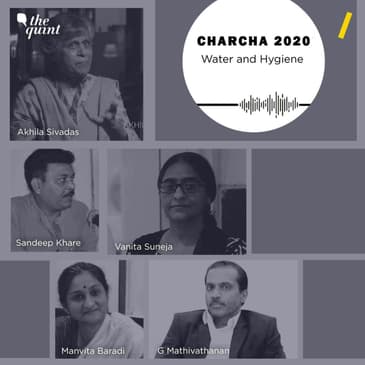

This is Vanita Suneja from WaterAid India in conversation with G Mathivathanan, Principal Secretary, of Urban Development for the Govt of Odisha, Akhila Shivadas, from the Centre for Advocacy and Research, Manvita Baradi from the Urban Management Centre in Ahmedabad, and Sandeep Khare from Vigyan Foundation.
Music: Big Bang Fuzz
Learn more about your ad choices. Visit megaphone.fm/adchoices
[00:00:00] You are listening to the Quint's podcast.
[00:00:13] The Quint and the Nudge brings to you Charcha 2020, a platform for India's development
[00:00:18] sector to come together and engage on the most pressing human development challenges
[00:00:24] on the issues of gender, policy, law, climate change, social development and much more.
[00:00:35] How will water, sanitation and hygiene look like in the post-coronavirus world and how
[00:00:40] are the governments expected to address such issues?
[00:00:44] This is Vanita Suneja from WaterAid India, in conversation with G. Mathi Vatanen, Principal
[00:00:49] Secretary of Urban Development for the Government of Odisha.
[00:00:53] Akhila Shivadas from the Centre for Advocacy and Research, Manvita Bharati from the Urban
[00:00:59] Management Centre in Ahmedabad and Sandeep Khare from Vigyan Foundation.
[00:01:13] In our urban areas, cities whether they are metropolitan or small towns, you know how
[00:01:24] the need of the vulnerable population has been met during COVID or even in the new normal
[00:01:31] where we are going to live with COVID situation for some time to come.
[00:01:35] How those needs are being met?
[00:01:39] To discuss this, we have a very esteemed set of panelists with us.
[00:01:45] We have Mr. G. Mathi Vatanen who is Principal Secretary of Urban Development of Odisha.
[00:01:52] We have Ms. Akhila Shivadas, Centre for Advocacy and Research, New Delhi.
[00:01:58] We have with us Mr. Sandeep Khare, Vigyan Foundation in Lucknow and we have Ms. Manvita
[00:02:04] Bharati from Urban Management Centre in Ahmedabad.
[00:02:09] Before we initiate, I will just put two points there.
[00:02:11] With limited resources in place in this pandemic, the need of the R is for the public and the
[00:02:16] private sector to come together to make our healthcare more robust.
[00:02:21] And while COVID-19 overwhelms the entire health system, vulnerable groups with non-COVID-19
[00:02:27] health issues also face the brunt of this overload on the health sector.
[00:02:31] How can we mitigate the impact on them and ensure access to healthcare for us?
[00:02:38] This is Dr. Shailendra Hegre from Perimalt Swastia in conversation with renowned surgeon
[00:02:43] Devi Shetty.
[00:02:48] This is Dr. Shailendra Hegre from Perimalt Swastia in conversation with renowned heart
[00:02:52] surgeon Devi Shetty and Ashoka Alexander.
[00:03:03] This is Dr. Shailendra Hegre from Perimalt Swastia in conversation with renowned heart surgeon
[00:03:11] Devi Shetty and Ashoka Alexander, founder and director of the Antara Foundation which is
[00:03:17] a non-profit organisation focused on public health delivery.
[00:03:22] So, with this, we will start.
[00:03:34] I will first ask Mr. Ji Mati Vatnand who is here with us and all our panelists are in a very
[00:03:44] nice space where they are the practitioners, they are implementing things on ground as
[00:03:50] well as they are working at the policy space also.
[00:03:54] So we are expecting to hear very good inspiring insights from each of you and first we will
[00:04:00] start with Mr. Mati Vatnand and in terms of, you know, in Orissa, I would, you know,
[00:04:09] it would be great to know that how the Orissa government has planned to ensure access
[00:04:16] to water, sanitation and hygiene in urban areas and what has been your challenges while
[00:04:23] doing that.
[00:04:25] And if you think there are some learnings for other states to pick up, you know, so it
[00:04:30] would be great.
[00:04:31] Over to you sir.
[00:04:32] Thank you.
[00:04:33] Thank you madam.
[00:04:34] As far as the strategy for the current COVID situation is concerned, I would like
[00:04:40] to mention here that providing uninterrupted water supply is highest priority for us as
[00:04:46] of now.
[00:04:47] During the current ongoing lockdown period, as most of the population is forced to remain
[00:04:52] inside the home, the domestic water demand has sharply increased beyond our expectations
[00:04:59] and along with the increased requirement of frequent hand washing, sanitation practices,
[00:05:05] it has really caused a great challenge on the water supply authority, its organizations.
[00:05:10] The government considered operation and maintenance of the water supply and sanitation as most
[00:05:16] essential services during this COVID and have given highest priority.
[00:05:22] Our workforce has been continuously mobilized 24 by 7 to ensure uninterrupted services.
[00:05:28] In fact, if you visit our towns, you can take feedback.
[00:05:32] If you would know that the city is under lockdown as far as the water supply and sanitation are
[00:05:36] concerned, we'll find absolutely no difference in the service level.
[00:05:40] Rather, we have enhanced the service level, increased the number of hours of supply, increased
[00:05:45] the quantity of supply to the public so that they don't feel they don't get the pinch
[00:05:51] of that.
[00:05:52] In fact, during this period only, the water supply and sanitation services have been
[00:05:57] notified as essential services under the ESMA Act.
[00:06:01] As a preparatory activity, we didn't want to face any eventuality.
[00:06:07] So in advance, we notified both the services, water supply as well as sanitation as essential
[00:06:11] services so that we will have the protection of ESMA Act.
[00:06:16] To provide 24 by 7 customer care, our centralized customer care is now converted to IVRS
[00:06:22] based with 24 by 7 automatic complaint login, automatic transfer of the complaint to the
[00:06:26] Voindum staff and online tracking of the redressals.
[00:06:30] We are also introducing the mobile van laboratories on wheels.
[00:06:36] It's not that you get complained and then there is a time lag between the complaint
[00:06:40] and redressal.
[00:06:41] So the moment you get a complaint, the mobile van having the laboratory will reach.
[00:06:45] We are working on that.
[00:06:47] We have also taken up a campaign called Pure for Sure and we provide the real
[00:06:54] time water quality data available for the public.
[00:06:58] We have a digital display system in all the urban local bodies where on daily basis, we
[00:07:04] display the quantity of water supply, quality of water, water parameters, number of hours
[00:07:09] of supply, all those things for the public domain.
[00:07:13] We have also every year, Odisha faces almost every year we face a cyclone threat.
[00:07:21] Disaster rates are very common to us.
[00:07:22] So power backup is very, very critical, especially in the cyclone prone areas.
[00:07:27] So we have over the period of time, we have enhanced our disaster preparedness and almost
[00:07:33] all our water supply installations are provided with alternative power supplies.
[00:07:39] The DG sets are provided and also it is not possible to cover even smaller water
[00:07:48] supply installation.
[00:07:49] So what we have done, we have now have DG sets on wheels of varying capacity.
[00:07:56] Wherever we have disaster, wherever we have problems, we can build those DG sets quickly
[00:08:02] within few hours of time and those DG sets are positioned in critical locations and
[00:08:09] migrant workers is a current huge problem for us.
[00:08:17] So we have a lot of migrant workers all over the country from abroad also.
[00:08:23] Many of the migrant workers are actually plumbers, Odisha is known for plumbers.
[00:08:29] There are few blocks and a district.
[00:08:31] The Kendrappadap district and the Patamundai block is known for providing plumbers all
[00:08:37] over the world, we can say.
[00:08:39] So many of them have now returned back.
[00:08:42] So we are actually exploring to enlist them, empanel them and then use them as our technical
[00:08:50] personnel in our ongoing water supply maintenance works as well as to provide household connection
[00:08:56] works.
[00:08:57] So community participation has been a very, very important component of our strategy for
[00:09:04] community-centric water supply service.
[00:09:06] BATCO has rolled out a reform initiative called the Jalsati.
[00:09:11] Members from the women's self-help group, Odisha is actually very strong in women's self-help
[00:09:17] group movement.
[00:09:18] It's called the Mission Sati.
[00:09:19] The members of these Mission Sati who are among the community or appointed as Jalsatis
[00:09:25] and they work with us on incentive based contract mechanism.
[00:09:28] So they are our partners at the grassroot level.
[00:09:30] This is a novel initiative we have taken up and their role is to distribute the
[00:09:34] bills to the households including meter reading.
[00:09:38] They collect the revenue from the households, facilitate complaint management and they also
[00:09:43] carry out household level on site water quality testing.
[00:09:47] This is a huge jump we have made.
[00:09:50] We are not only using as a sub staff or unskilled laborers.
[00:09:55] We are also enhancing their skill level and using them as a technical personnel.
[00:10:01] We have provided quality training and we are using them as our field quality personnel.
[00:10:08] So they undertake the quality testing.
[00:10:11] So they have been trained with the regular capacity building programs and they are
[00:10:15] provided with hand held M-PASS machine which they use for collecting the revenues from
[00:10:21] the households.
[00:10:22] They are also provided with water testing kits and other accessories.
[00:10:27] Incentives are paid based on the activity, based on revenue collection, based on new connection
[00:10:32] made, based on the number of quality tests they have performed.
[00:10:35] Based on those things incentives are paid to the self-employed group members.
[00:10:40] This actually this program has helped us now to build up the community linkage very
[00:10:44] strongly with the water supply authority.
[00:10:47] Perhaps we will hear more on those from Akhila when she will talk about also some
[00:10:56] of the work which Akhila has done and linking it to that.
[00:11:02] In terms of challenges I think it is very, you know this thing that you know water is
[00:11:07] essential sanitation is sorry sanitation and hygiene is important but at the same
[00:11:13] time the investment might drop in this sector.
[00:11:17] I think this is something which we all need to be very careful about and you know
[00:11:21] be kind of advocating for that because COVID has shown that how important it is.
[00:11:27] So while we are prioritizing different sectors, how this sector gets that new investment.
[00:11:32] So not taking much time we will again come back to Mr. Mathi Vanan in the end and now
[00:11:38] I will ask our second speaker Ms. Akhila.
[00:11:42] I will ask Akhila to come on board now.
[00:11:45] And you know Akhila in terms of like the way Mr. Mathi Vanan has talked about lots of
[00:11:53] you know government policies initiatives but I would like you and he also talked about
[00:11:58] rights and you know slums you know but I would like you to specifically focus on
[00:12:03] the equity and the whole you know inclusion bit that lens you know taking that lens
[00:12:11] for urban wash what you think you know what could be the mechanism how do we bring that
[00:12:17] and the second is also you know what role I mean we have seen what role government can
[00:12:22] play and also at the local level the capacity building of messians and you know so much
[00:12:29] and so far but at the same time what role can be played by the community based organization
[00:12:35] you know at the local governance level.
[00:12:38] So basically on these two over to you Akhila thanks.
[00:12:42] Thank you Venetan thank you Raman for you know giving us this opportunity and of course
[00:12:48] a big hello to all the co-panelists and people apart you know you have joined the webinar.
[00:12:54] I want firstly to at the outset to commend what you know Mr. Mathi Vanan has presented
[00:13:03] it really is walking the talk and you know we are all privy to what is happening and he
[00:13:11] never fails to be part of the community process even at seven in the morning is out there
[00:13:16] with us so notwithstanding that I'd like to profess my presentation with two you know
[00:13:24] sort of revolutionary remarks when it now one is that this is not about us and them
[00:13:31] a lot of this you know the kind of points that civil society makes it's not about just
[00:13:38] pointing fingers or blaming anybody or creating you know criticizing for the sake of criticizing
[00:13:47] we are all really in a difficult predicament today and we stand to lose a lot of what
[00:13:54] we have gained over the years in the months to come you know the challenge is enormous
[00:14:01] and what we are witnessing today the migrant workers something that has been steadily growing
[00:14:09] and simmering since the 70s this has not happened overnight you know it's not something
[00:14:15] that has just suddenly exploded it's been simmering and it's reflected in the wider insecurity
[00:14:23] that the urban poor has been facing but there was a time in early 2000 when they were virtually
[00:14:30] disenfranchised they were getting no rights they were running from pillar to post they were being
[00:14:36] told everywhere that your gayar kanuni that you're illegal your existence cannot be recognised
[00:14:43] you know and it is at this time in civil society networks movements and particularly
[00:14:49] state and city governments i'm not putting them out of the radar at all they played a huge role
[00:14:55] they all realised that the situation is untenable and it was in the mid 2000 that suddenly people
[00:15:01] were woke up to the huge you know shall we say crisis in the country and that you know it's
[00:15:08] not about just rural poverty there is something called urban poor and the first time in the
[00:15:13] five-year plan you got actually an acknowledgement of that that you know there's something called
[00:15:19] urban poverty and something called urban poor and not many years have gone by you know in the
[00:15:25] in the history of a nation what is 10 years and we are faced with this crippling crisis called
[00:15:30] covid-19 and so what are what were we facing at that time which is what i would like to
[00:15:38] highlight and this includes your basic services and wash services a combination of what you call
[00:15:45] administrative process very difficult to fulfil very difficult to comply in terms of schemes
[00:15:53] services and social entitlements and local dynamics with very little decentralisation
[00:15:59] happening you know and shall we say power brokers and local you know power leaders or
[00:16:06] power structures taking over and even often paralyzing the formal structures and forcing
[00:16:14] them to capitulate to what they want so you do have that kind of situation in large pockets of
[00:16:20] the country there's no getting away from it and it is in this context you know the urban poor
[00:16:27] were being squeezed they were not being given a left to do what they could do if you are a sex
[00:16:32] worker you were haunted by the police if you're a straight vendor you were thrown out of the lanes
[00:16:37] that you're not supposed to you're not licensed to be in so it was all very very ugly you know
[00:16:42] that the situation was very very grim it's in this scenario the response of many of us who stand
[00:16:50] by the rights of the workers is it's important to talk about and it is in that context that
[00:16:55] Mr. Madhi Vavinen's presentation becomes so significant you know did not just rest on a problem
[00:17:03] went about trying to solve it and address it and in the urban context is much more difficult
[00:17:09] lift cities and there are sort of you know there are what are called locked-in processes in the
[00:17:15] system you're like your land locked your system is locked you can't budge you can't move you
[00:17:21] can't converge even if you converge over a meeting it doesn't converge the heart or whatever you're
[00:17:27] intending to converge so the first thing we had to do and the government did it in its own way
[00:17:32] and we did it in our own way is to contend with those informal structures at the local level
[00:17:38] we had to strongly convert content to collective collectivize not just about expressing needs
[00:17:45] just Mr. Vavinen was saying about you know reading the meters meeting the bills collecting the dues
[00:17:52] all of that going beyond just expressing needs and demands actually aggregating the demands so that
[00:17:59] we don't get into one size fits all but everybody has a special need and here I would like to
[00:18:05] profess and you know join with Mr. Vavinen saying that it's not just about the poor within
[00:18:12] the poor there are ranges of you know what are called hidden communities communities that have never been
[00:18:18] mainstream that are struggling to make ends meet and there are innumerable of them you know so this
[00:18:26] entire collectivization to be strengthened with skills ability capacity to forge consensus gather
[00:18:35] evidence give feedback set right the grievance redress all of that on the other end there has
[00:18:43] to be equal bigger you know and they should be very close collaboration with civil society we have
[00:18:50] nothing no other intention except to help the entire process to move forward second thing we did
[00:18:57] you know a part from collectivization and it's a shall we say a co-terminus thing
[00:19:02] that is engage with the system day after day it doesn't matter if they don't respond
[00:19:09] doesn't matter if they don't listen doesn't matter if you don't get a reply they rarely reply
[00:19:15] do they do silently do they do their work but they don't necessarily reply it's important to
[00:19:21] do it every day right because you need to sensitize them they often don't take decisions
[00:19:28] because they do not know things you know it's quite amazing despite them being on the ground many
[00:19:34] things they do not see and they do not know so to help them also to take decisions they're as fragile
[00:19:40] as any of us are because they're often lonely in their jobs often get very little support the
[00:19:46] system is never a collaborator system it's highly competitive systems so nobody really helps each
[00:19:51] other they try to try and maintain the civility of help it doesn't go too far always so our role
[00:19:59] in sensitizing the system becomes very very critical and this is where in the context of
[00:20:05] covid Mr. Mati Badanand said no we are locked down how do we link what do we meet communities
[00:20:12] how do we reach out to them how do we create that kind of what we call a meaningful connect
[00:20:19] that you know actually impacts people's lives you can actually see something hitting the ground
[00:20:25] and that's where and I and it's also about hand washing in the context of wash definitely hand
[00:20:31] washing the entire sanitation value chain everything is you know making people nervous
[00:20:39] if waste is spiling they're getting nervous if you know it's not being D slash they're
[00:20:45] getting frightened so entire you know value chain and this is where now we really have to understand
[00:20:52] community empowerment we really must decentralize and we must understand however much you do from the
[00:21:00] top however much you enable from the top however much you you know create these conditions these have
[00:21:07] to be seized at the bottom things have to be you know shall we say nurtured and taken to scale from
[00:21:16] at the bottom so this is really very critical in covid context and to do both what has really stood
[00:21:24] us you know we have been able to with the community platforms across 14 cities we have been able to
[00:21:30] zoom in relief one of course is food relief but there's also what is called the dignity kit
[00:21:36] hygiene kit many things people need where is the soap where is the detergent where is the
[00:21:42] sanitary napkin where is all the stuff that you're expected to use to be able to stay healthy and
[00:21:48] prevent the virus so we've been the community platforms have just zoomed in we are working with
[00:21:54] over 25 relief agencies in the remotest part of the cities in the country reaching out to the
[00:22:00] most hidden groups right from people living with HIV transgenders sex workers denotified tribes
[00:22:07] to people living in education sites just about you can name anything we are there and the entire
[00:22:14] credit goes to the community platforms thanks thanks akhila yes so i think very you know these
[00:22:24] insights we were looking forward to in terms of the whole you know urban poor and the
[00:22:29] desegregation of those categories as such and the deeds would be very different and then the whole
[00:22:36] you know the governance at the very local level either through self-help groups or the management
[00:22:40] committees and how that that process itself helps in the overall governance of you know
[00:22:47] the government and otherwise at the community level so so and it's also great to see that
[00:22:53] the kind of collaboration which is there with the civil society and at the government level
[00:22:58] in orisa and we just hope i think these are also some of the lessons for other states as well
[00:23:04] so so with this thanks akhila and we will again come back to you later and now i will ask
[00:23:12] sandeep chet sandeep kare who is from vikyan foundation lucknow sandeep chet aap
[00:23:49] yeah
[00:24:02] uh
[00:24:19] I will share the experience of COVID-19.
[00:24:24] If we look at the preface of COVID-19 and the preface of lockdown,
[00:24:30] we see that this is the first time that the city was divided from the city.
[00:24:36] We do not see it.
[00:24:38] It has come before us in a living form.
[00:24:42] Everyone is sleeping in the care of the people of the country.
[00:24:47] So, this is a time of crisis that is taking place after the lockdown.
[00:24:54] We also have the opportunity to see ourselves in the service of the people of the city.
[00:25:03] We can think of new ways of development and models.
[00:25:09] If we look at every city where we live in Lucknow,
[00:25:14] and the rest of the cities in India,
[00:25:18] if we look at their development, then there is a centralized development.
[00:25:22] If we look at Lucknow, Delhi, Farizabad, Calcutta, Chennai,
[00:25:29] then the city around them is like a dead city.
[00:25:32] It is not a living city.
[00:25:34] The resources of the city are in one place.
[00:25:40] We see the idea of the JNNRM, which came and there are 63 cities for services,
[00:25:47] and there are 100 cities in the smart city.
[00:25:49] And the services are being developed in a very strict way.
[00:25:52] But there is a lot of attention and discussion on the services around it.
[00:25:56] So, this is the first time that we have the chance
[00:26:01] to see the model of development in a very strict way.
[00:26:05] We have to think about the services of other services.
[00:26:09] We have to think about the services we want to give.
[00:26:13] Secondly, I would like to say that this is a matter of cleanliness and water.
[00:26:22] When the crisis that took place during the lockdown
[00:26:28] was over the water, and the water spending was the biggest effect
[00:26:34] on women, then it was more than that.
[00:26:37] Because we work with those people, especially in the villages.
[00:26:40] The water is mostly used to kill women.
[00:26:45] So, this crisis was caused by the water,
[00:26:49] and the work was also increased.
[00:26:51] And the water and water supply of the work was increased.
[00:26:57] That is also related to violence.
[00:26:59] So, we should see the question of water and water.
[00:27:03] I am able to see that because of the water,
[00:27:08] and because of the water, it was not as frequently accessed.
[00:27:12] So, in some places, we see it as a matter of violence.
[00:27:15] So, we have to understand this question in the coming days
[00:27:18] that the relationship between water and poverty
[00:27:21] with the violence that was related to it
[00:27:24] is not as common as in the future.
[00:27:27] Secondly, I would like to say that this is also a time
[00:27:34] when we should think about the rights of the refugees.
[00:27:40] Because when we designed the whole development model
[00:27:44] and made huge highways,
[00:27:46] made huge cities and cities,
[00:27:50] and made huge highways,
[00:27:54] made huge cities and cities,
[00:27:56] we don't have access to water,
[00:27:58] or any facilities.
[00:28:00] And in the end, we had to pay millions of rupees.
[00:28:04] But today, without water and water supply,
[00:28:07] we had to think about the areas
[00:28:10] that we considered to be very good.
[00:28:12] So, we should look at the future
[00:28:16] and see if we can design a model
[00:28:20] that is more of an energy-based model.
[00:28:23] Because the more energy-based models we try to find,
[00:28:26] the burden will ultimately be on the society.
[00:28:29] And the burden that will be there
[00:28:32] after the public economy,
[00:28:34] there might not be enough people to support such a burden.
[00:28:37] So, we have this opportunity
[00:28:40] to see how we can get less energy-based models.
[00:28:45] We can find them in the city of Vaas.
[00:28:49] And the model of centralized development
[00:28:54] is in front of us.
[00:28:56] We are talking about decentralization,
[00:28:58] but it is not a model of decentralization.
[00:29:01] So, we should think about that.
[00:29:03] Another thing I would like to mention
[00:29:05] is that if we look at the cities
[00:29:08] and cities in the cities,
[00:29:10] we don't have any reporting
[00:29:12] with us.
[00:29:14] And that is why when the lockdown started,
[00:29:17] neither the government nor the civil society
[00:29:19] had any idea
[00:29:21] nor did anyone have any idea
[00:29:23] that so many people will leave the city
[00:29:25] and go to the houses.
[00:29:27] So, this is a good opportunity
[00:29:29] when we can map the urban parts,
[00:29:31] we can map the occupational mapping
[00:29:33] of the areas where people are going,
[00:29:35] where they are going,
[00:29:37] and then we can facilitate them
[00:29:39] by organizing them.
[00:29:42] So, this is a great opportunity.
[00:29:44] If we look at the situation as an opportunity,
[00:29:46] it is the first time
[00:29:48] when we are all talking about
[00:29:50] the issues of the development
[00:29:52] and the development.
[00:29:54] And we can see that there are some states
[00:29:56] like Satyasgarh, Bihar, Jharkhar,
[00:29:58] Uttar Pradesh,
[00:30:00] where there is a lot of development,
[00:30:02] and not only development,
[00:30:04] but also the development of the image,
[00:30:06] and the development of the image.
[00:30:08] I will give an example.
[00:30:10] There is a district of Baraban
[00:30:12] with the image where
[00:30:14] people are coming to work in the potato factory
[00:30:16] during the lockdown.
[00:30:18] This is not a good opportunity.
[00:30:20] So, this is a great opportunity
[00:30:22] when we can see that
[00:30:24] all the people who go to other cities
[00:30:26] and are looking for work,
[00:30:28] we can help them
[00:30:30] by organizing the services of the farm.
[00:30:32] So, that is the side of the people.
[00:30:34] I will also try to make another
[00:30:36] note because
[00:30:38] there are still
[00:30:40] sanitary workers
[00:30:42] who are responsible for
[00:30:44] the entire lockdown
[00:30:46] and after the lockdown,
[00:30:48] they will be responsible for it.
[00:30:50] Because COVID-19 has taught
[00:30:52] that
[00:30:54] the world will change
[00:30:56] in the future.
[00:30:58] So, according to the
[00:31:00] community,
[00:31:02] the burden on the cleaners
[00:31:04] is increasing.
[00:31:06] If we look here,
[00:31:08] in Lucknow,
[00:31:10] the cleaners are around 6,920.
[00:31:12] And their workload
[00:31:14] is so high that they take them
[00:31:16] from 6 am to 2 pm.
[00:31:18] Now, they are going
[00:31:20] for a long time
[00:31:22] and the workload is
[00:31:24] increasing.
[00:31:26] So, we should talk about
[00:31:28] how cleaners are,
[00:31:30] how they live properly,
[00:31:32] how they are safe
[00:31:34] and how they are doing.
[00:31:36] The standard
[00:31:38] of the cleaners
[00:31:40] should be at least followed
[00:31:42] by the population.
[00:31:44] This is a big source of information.
[00:31:46] There is another place
[00:31:48] where we need to understand
[00:31:50] and believe that
[00:31:52] as the minister said,
[00:31:54] the number of people in India
[00:31:56] should increase.
[00:31:58] In the nation of India,
[00:32:00] in fact, the world,
[00:32:02] as well as COVID-19 has taught us
[00:32:04] that we should not
[00:32:06] serve the people.
[00:32:08] Because wherever you look
[00:32:10] at the health sector,
[00:32:12] where the service was
[00:32:14] more important,
[00:32:16] the service is very bad.
[00:32:18] Their situation is very bad.
[00:32:20] So, this is a chance
[00:32:22] that we should
[00:32:24] think about the health sector
[00:32:26] and the health sector
[00:32:28] and think about them
[00:32:30] and the government should
[00:32:32] take responsibility to the people.
[00:32:34] Because our experience
[00:32:36] is that
[00:32:38] especially during the lockdown
[00:32:40] or even after the lockdown,
[00:32:42] the service has been
[00:32:44] reduced.
[00:32:46] They are not able to work in the areas of the people.
[00:32:48] Their society is very limited.
[00:32:50] So, the people who are working
[00:32:52] with the government
[00:32:54] and the government
[00:32:56] are able to collaborate
[00:32:58] with them.
[00:33:00] So, this is a chance
[00:33:02] that we should make our servants
[00:33:04] more self-sufficient
[00:33:06] and more worthy
[00:33:08] of working in the areas of the people.
[00:33:10] So, we need to
[00:33:12] define our citizen charters
[00:33:14] again.
[00:33:16] We need to define the services
[00:33:18] that are being given
[00:33:20] to the people.
[00:33:22] So, the water that is being
[00:33:24] provided to the people
[00:33:26] or the public toilets
[00:33:28] needs to be designed
[00:33:30] to provide a better
[00:33:32] service.
[00:33:34] We also saw
[00:33:36] that in the last few weeks
[00:33:38] we have made a
[00:33:40] contribution to the people
[00:33:42] because they are not free.
[00:33:44] So, during that time
[00:33:46] when the community toilets were
[00:33:48] being built
[00:33:50] we had to take a loan
[00:33:52] and we would be able to pay
[00:33:54] the money later.
[00:33:56] Or in some places
[00:33:58] people knew that
[00:34:00] the people who were donating
[00:34:02] the money
[00:34:04] were using the community toilets
[00:34:06] in some areas.
[00:34:08] So, we need to think
[00:34:10] that when we call them public
[00:34:12] services and we give them a lot of open
[00:34:14] defecation, the free zone
[00:34:16] because the community toilets
[00:34:18] were built around the slums
[00:34:20] and they were called open defecation
[00:34:22] areas.
[00:34:24] So, if people go
[00:34:26] to such a place
[00:34:28] to avail the service
[00:34:30] we need to talk
[00:34:32] about the
[00:34:34] resources and the
[00:34:36] resources
[00:34:38] that are being provided
[00:34:40] to the people.
[00:34:42] Thank you.
[00:34:44] I think
[00:34:46] that is the
[00:34:48] question
[00:34:50] that you said that there is no water
[00:34:52] on the highways
[00:34:54] where people are going.
[00:34:56] Similarly, public taps
[00:34:58] can be re-entered
[00:35:00] or paid attention to.
[00:35:02] Along with that
[00:35:04] sanitation workers
[00:35:06] are coming from
[00:35:08] all over the world
[00:35:10] the issue of sanitation workers
[00:35:12] is that they have to do
[00:35:14] they have to be out on the street
[00:35:16] whether they have protective workers
[00:35:18] whether they are working hours or more than required
[00:35:20] which is an essential
[00:35:22] duty.
[00:35:24] This is also a very important part
[00:35:26] of the sanitation chain
[00:35:28] as such
[00:35:30] and also the issues of gender
[00:35:32] which you raised about women
[00:35:34] the whole responsibility
[00:35:36] which comes on that.
[00:35:38] I think very interesting ideas
[00:35:40] I will take this discussion further
[00:35:42] because
[00:35:44] some of these ideas
[00:35:46] have to be
[00:35:48] urban local bodies level
[00:35:50] how the urban local bodies
[00:35:52] are responding to some of these requirements
[00:35:54] some of these contextual needs
[00:35:56] so I would ask
[00:35:58] Malvita Bharat to come
[00:36:00] and
[00:36:02] thanks Sanjeev
[00:36:04] to talk about
[00:36:06] what are the lessons
[00:36:08] from the measures taken by
[00:36:10] urban local bodies
[00:36:12] in technical situations
[00:36:14] in COVID situation
[00:36:16] and how
[00:36:18] development partners
[00:36:20] and technical agencies support urban local bodies
[00:36:22] for all these suggestions
[00:36:24] which we have been hearing.
[00:36:26] Over to Malvita.
[00:36:28] Thank you Vanita and
[00:36:30] Ramanji and all my colleagues
[00:36:32] on the panel
[00:36:34] so we could
[00:36:36] have had a situation
[00:36:38] where probably we knew
[00:36:40] how many urban poor are there
[00:36:42] how many distressed communities are there
[00:36:44] and where are the invisible
[00:36:46] people living.
[00:36:48] Mostly they live in urban slums
[00:36:50] which are the
[00:36:52] neglected areas
[00:36:54] though as we all know
[00:36:56] the 74th amendment to the constitution
[00:36:58] in 1992-93
[00:37:00] suggests that
[00:37:02] city governments role
[00:37:04] is to work with the urban poor
[00:37:06] empower them
[00:37:08] and it is
[00:37:10] inclusive cities
[00:37:12] which is mandated by the constitution
[00:37:14] cities have done
[00:37:16] some work since then
[00:37:18] I wouldn't negate
[00:37:20] what has not been happening
[00:37:22] until now
[00:37:24] but a comprehensive
[00:37:26] understanding
[00:37:28] and kind of blending them into the fabric
[00:37:30] which has not happened
[00:37:32] there are
[00:37:34] schemes and if you look at our
[00:37:36] apps and schemes they are amazing
[00:37:38] there is a possibility
[00:37:40] to have a society which is
[00:37:42] we all dream of
[00:37:44] more inclusive, equitable
[00:37:46] and just
[00:37:48] however why are we
[00:37:50] where we are
[00:37:52] what is it that we are missing out
[00:37:54] maybe the convergence point
[00:37:56] between
[00:37:58] various government departments
[00:38:00] because I am sure
[00:38:02] all of us including
[00:38:04] the parts of the government
[00:38:06] believe in what we all believe
[00:38:08] the civil society and the governments
[00:38:10] are mostly
[00:38:12] mostly on the same page
[00:38:14] they want to deliver
[00:38:16] because we believe in welfare
[00:38:18] however it has not been done
[00:38:20] the greatest
[00:38:24] blame I would put
[00:38:26] or the greatest culprit
[00:38:28] probably the intersection of that
[00:38:30] or to be able to work
[00:38:32] cohesively between civil society
[00:38:34] the government and the communities
[00:38:36] the intersection has to come out
[00:38:38] very strongly we have to work together
[00:38:40] to achieve something
[00:38:42] attempts are being made
[00:38:44] but COVID situation through this
[00:38:46] challenge in front of us and it's
[00:38:48] out and open earlier we were talking
[00:38:50] in our groups, networks
[00:38:52] no now it's people everybody
[00:38:54] knows what's happening
[00:38:56] what can be done
[00:38:58] it is high time
[00:39:00] that we look and relook
[00:39:02] at our cities
[00:39:04] and the way we integrate the functions
[00:39:06] the basic services have to be provided
[00:39:08] so some examples
[00:39:10] for instance in Ahmedabad in 1996
[00:39:12] onwards we had a SLUM
[00:39:14] networking program
[00:39:16] under which they
[00:39:18] decided very important thing
[00:39:20] is dealing
[00:39:22] the land tenure
[00:39:24] basic services
[00:39:26] you provide water
[00:39:28] and sanitation
[00:39:30] and people will construct their own houses
[00:39:32] on their own
[00:39:34] and they will invest
[00:39:36] in the formal house
[00:39:38] so that it's a better
[00:39:40] clean environment to live in
[00:39:42] why have we thrown this out of our window
[00:39:44] why is it not
[00:39:46] replicated all over the country
[00:39:48] I know Mr. Mathi sir
[00:39:50] has already worked in
[00:39:52] Orissa on similar lines and provided
[00:39:54] much more actually
[00:39:56] their scheme to Jagga mission
[00:39:58] is amazing
[00:40:00] they have in short ten year
[00:40:02] status to the SLUM dwellers
[00:40:04] that is a way forward
[00:40:06] maybe their state could do it because of the will
[00:40:08] our other states ready for it
[00:40:10] why are we not
[00:40:12] contemplating
[00:40:14] of giving cleaner environment
[00:40:16] to our residents
[00:40:18] who contribute to the GDP
[00:40:20] and we are not even capturing those numbers
[00:40:22] because it's all informal
[00:40:24] they are contributing to our GDP
[00:40:26] we have to keep them in our fold
[00:40:28] we need them as much
[00:40:30] as they need us
[00:40:32] but we need them more I would say
[00:40:34] because we need our services to be moving
[00:40:36] having them
[00:40:38] be productive citizens
[00:40:40] is very very important
[00:40:42] so how can we achieve it
[00:40:44] one example I gave
[00:40:46] is probably a way to
[00:40:48] provide for
[00:40:50] securities
[00:40:52] they will invest in their house
[00:40:54] just assure them that look
[00:40:56] nobody is going to evict you
[00:40:58] you'll be here
[00:41:00] we cannot provide
[00:41:02] affordable housing
[00:41:04] to all our citizens who require housing
[00:41:06] that's not our country
[00:41:08] it's not moving towards it
[00:41:10] what is the best possible way
[00:41:12] where you are maybe provide
[00:41:14] for them
[00:41:16] is important
[00:41:18] once that is taken care of
[00:41:20] people will invest in their own
[00:41:22] other things
[00:41:24] so what we are discussing currently
[00:41:26] we are working with four levels of the government
[00:41:28] we are also working at New Elements
[00:41:30] New Delhi with them
[00:41:32] we are working with the state government
[00:41:34] in Telangana and Orissa big time
[00:41:36] and we are working also with the
[00:41:38] communities and cities
[00:41:40] in Orissa and other parts of the country
[00:41:42] about 20 of them
[00:41:44] we have learnt
[00:41:46] that unless the community is a partner
[00:41:48] which many states now are looking at
[00:41:50] self help groups
[00:41:52] is a way forward
[00:41:54] we organise them, we provide for them
[00:41:56] and we have seen in the Covid times
[00:41:58] what response they have given
[00:42:00] making of masks
[00:42:02] making of sanitizers
[00:42:04] making of even
[00:42:06] giving little help
[00:42:08] cash help from one
[00:42:10] household to another
[00:42:12] through the Sakhibanking
[00:42:14] loops
[00:42:16] it has been possible
[00:42:18] so we have to strengthen that mechanism
[00:42:20] and what we are suggesting
[00:42:22] is let's talk about
[00:42:24] citywide
[00:42:26] and decentralised
[00:42:28] city facilitation centres
[00:42:30] what can it do
[00:42:32] it can enrol
[00:42:34] urban poor
[00:42:36] it can enrol migrants
[00:42:38] because people who come to city
[00:42:40] are looking for jobs
[00:42:42] then it's killing
[00:42:44] they need
[00:42:46] to find where the jobs are
[00:42:48] the city facilitation centres
[00:42:50] which are also embedded in some other way
[00:42:52] named as city
[00:42:54] livelihood centres in many of the
[00:42:56] in the NULM guidelines
[00:42:58] the livelihoods mission guidelines
[00:43:00] if we can strengthen that
[00:43:02] would that be a way forward
[00:43:04] we will have to enumerate
[00:43:06] people who are coming
[00:43:08] probably
[00:43:10] supported by the self-help groups
[00:43:12] the urban poor communities
[00:43:14] can take charge of it
[00:43:16] will require NGOs to
[00:43:18] skill them, to council them
[00:43:20] build their capacities
[00:43:22] and provide
[00:43:24] legal aid if they require
[00:43:26] see that they are placed
[00:43:28] in appropriate locations
[00:43:30] so as I started talking
[00:43:32] we have
[00:43:34] acts which give that
[00:43:36] that
[00:43:38] support
[00:43:40] the unorganised
[00:43:42] workers social security act
[00:43:44] of 2002
[00:43:46] provides us possibility
[00:43:48] that we work with local governments
[00:43:50] give them the power
[00:43:52] to create such
[00:43:54] maybe facilitation centres
[00:43:56] get the workers
[00:43:58] when they come back
[00:44:00] it's unfortunately
[00:44:02] it's unfortunately
[00:44:04] they have gone
[00:44:06] but when they come back
[00:44:08] they have a better
[00:44:10] life
[00:44:12] better living conditions
[00:44:14] their jobs are secure
[00:44:16] they get legal aid and they are placed
[00:44:18] properly we have to do it
[00:44:20] it's high time, thank you
[00:44:22] okay thanks Manavita
[00:44:24] I think you have already taken us
[00:44:26] in the future scenario
[00:44:28] what needs to be done
[00:44:30] so now I think
[00:44:32] in a way
[00:44:34] talked about
[00:44:36] in quite futuristic terms
[00:44:38] what should be done
[00:44:40] in those terms as well
[00:44:42] but I think
[00:44:44] this, to me
[00:44:46] these discussions were very insightful
[00:44:48] very useful and I hope
[00:44:50] people who have been hearing
[00:44:52] would also have
[00:44:54] it must have been come as very
[00:44:56] interesting for them as well
[00:44:58] and as there is a lot of work
[00:45:00] to be done and to learn from
[00:45:02] what is happening in each other state
[00:45:04] and I think that's why these
[00:45:06] platforms are very important
[00:45:08] the way we heard from Orissa what is happening
[00:45:10] or some of the ideas which are coming from
[00:45:12] other civil society members
[00:45:14] and think tanks
[00:45:16] so with this I will
[00:45:18] close the session and
[00:45:20] thanks a lot to all the people
[00:45:22] panellists as well as
[00:45:24] the NARCH team who has been supporting this
[00:45:26] as well as the WaterAid team
[00:45:28] so together
[00:45:30] thanks to all
[00:45:32] and thank you very much
[00:45:34] Namaste