
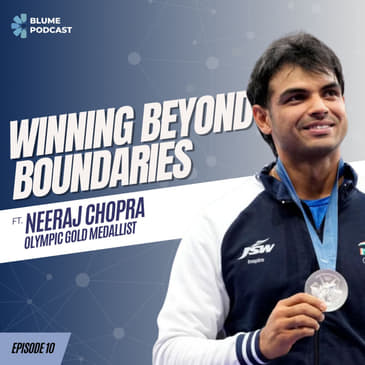
Join us for an inspiring conversation with Neeraj Chopra, India’s first athletics Gold medalist, and Karthik Reddy, co-founder and Managing Partner of Blume Ventures. In this podcast, Neeraj shares his journey from a small village in Haryana to standing on the Olympic podium, while reflecting on the challenges, sacrifices, and triumphs along the way. Get an inside view on what it takes to be a champion.
Timestamps:
0:00 - Intro
3:21 - Neeraj Chopra’s youth and childhood
9:17 - Neeraj Chopra’s love for farming
13:01 - First big win
16:00 - The pressure to represent the country
19:15 - How did Neeraj feel after winning gold at the Olympics
21:15 - Neeraj’s Silver at the Paris Olympics
27:55 - Difference between individual and team sports
35:08 - Who is the supporting cast to Neeraj?
41:00 - What is Neeraj Chopra’s routine?
43:44 - How does Neeraj Chopra deal with disappointment and pressure?
48:26 - Why did Neeraj Chopra choose to represent STAGE?
52:50 - State of sports infrastructure in India
57:07 - Rapid fire questions
This episode is packed with valuable insights into the life of a world-class athlete, touching on mental resilience, discipline, and the importance of a strong support system.
A special thank you to IDFC First Bank for being a partner for this podcast and STAGE (Blume Fund IV) for helping us connect with Neeraj Chopra and for generously providing their office space to record this episode.
[00:00:00] Paris 2024 And in that present, did you think you could do whatever you could do? Definitely, silver and gold can be better. I always think it could be better or better. When I compete with that day, I will give my best accordingly. Like this was Brussels, 4-5 days before that day, I fractured in training. The doctor told me that I have to play and it's risky.
[00:00:28] I feel like I'm falling and my hands are balanced. The head can be more and more problems. I said I will control it. So I became a lot of strong. I felt like I'm playing and I'm feeling good. I'll give an example. When I started, there was such a conversation that we were tough, the bar Catholics are stronger. Genetically, it was a little bit. The confidence was less.
[00:00:56] We couldn't say that we couldn't say that. We can say that we can do this now. We can say that we can do this now. And now we have the trust that we can do it. So that's a problem in every field. We have to open up a little bit and see that we can do it. And whatever requirement is, we need to be ready.
[00:01:28] Welcome to this season's last episode. And trust me when I say we are ending with a bang, we are. Today, we explore the extraordinary journey of a man who has not just broken records, but shattered the ceiling of what Indian athletes can achieve on the global stage. Imagine a small town in Haryana where a young boy once picked up a javelin, not knowing he would one day make history with it. Neeraj Chopra's story isn't just about athletic excellence.
[00:01:53] It's a testament to how far pure dedication can take you, regardless of where you start and when you start and how you start. In a sport dominated by European athletes for decades, Neeraj emerged as Asia's beacon of excellence. His golden throw at the 2020 Olympics didn't just win India its first athletics gold. It rewrote the narrative of what Indian athletes could achieve in field events. And mind you, this wasn't a one off success.
[00:02:20] From the World Championships, the Diamond League, the Commonwealth to the Asian Games, Neeraj has won them all, has had podium finishes in most of them. Today, we delve deep into the mind of this sporting phenomenon. A suvedad major in the Indian Army, an Olympic champion, and above all, an athlete who continues to inspire millions of Indians. This is Neeraj Chopra's story of winning beyond boundaries. Welcome to the podcast, Neeraj. Thank you, Ji. Namaste.
[00:02:47] So, Neeraj, we are going to start with a fun anecdote. Last year, I didn't know if I was going to podcast with you. But for some strange reason, I was 15 years old. So, I was gifting myself silver and gold shoes. So, I have both shoes for you. You have both shoes for me. You have both shoes for me. For the gold and silver medal. So, I thought I should do something special for you. Absolutely. So, I am also getting out of my comfort zone and honoring you.
[00:03:17] For our audiences, I was a little bit of your childhood, your history, your family. You have a large joint family, Kandra, Panipat, Haryana. You grew up there. How did your childhood shift shift? And, beyond your parents, which influenced you? You should go to sports or Javelin. You should go to sports. So, you should talk about that. Absolutely. Normally, I am from a small village.
[00:03:46] Haryana, Panipat, Khandra. So, I belong there. From childhood, I was sleeping with Haryana. But I didn't know that I was a professional athlete. Or I would go to the Olympic level to a sport. But, that's it. Haryana food, you know, is a little bit more. I was eating too much. I was eating too much. So, I was eating too much. So, like we said that our joint family is our joint family.
[00:04:15] They are very small uncle. They wanted to be a little fit and I would give it to sports. So, we went to a stadium. Just for fitness. We were eating too much. He was eating too much food and we were eating too. And, the most people, we were eating too much. And, it was such a sport that we were eating physically, we were eating other than we are eating. We were eating too much. But, like I went to my stadium, I was eating too many sports. I don't know why I like this.
[00:04:45] I always say that it was destiny and it was a decision. I just thought that I would have to do this for this sport. I decided to do this. Which year? I had 13-14 years ago. That's so late. I thought it would have been very early. I mean that it would have been so early. I don't know about the decision why I'm going to do this. Because nobody told me that it's just to do it.
[00:05:15] But I just thought that it was just my mind. And I was just trying to do it. I was trying to do it. Do you have any kind of parts of your child's life on the internet? I don't know if it's true or not. I've heard that there were many challenges. You've never been able to do it. You've never been able to do it. You've never been able to do it. It's true or not? Yes, it's true. I think that it's true. I think that it's true. I think that it's true. I think that it's true.
[00:05:41] Because when I went to school, I didn't have school. At that time, there was a group of teachers. There was a teacher who taught me. All the kids taught me. It's like a play school. I was taught. There was a teacher who taught me. I was taught. The first time when I went there, my grandfather had a cut in our Haryana. There was a bag sealed in our Haryana. There was a book that said to him.
[00:06:11] They were told him. They were told him. They were told. They were told that the counting, Hindi, ABCD, everything was done. They were taught children. They were taught pictures. They gave me. I went there. They went there. When I went to school, the first day of school, the kids were like, they were playing. They weren't for a new mind. They played on their house. They were playing. They were not getting confident. They were doing everything. Then,
[00:06:42] I was given back to the gate. I got to go through. I was told that the child would go through. But I got to go through. I did not come back home. I had a bag and a book. I had a bag. I had a bank. I had a bank. I had to play. I had to play. I had to play with the other children. There was a strong woman. I had a friend. So, my dad came home and said, I'll tell you everything is okay.
[00:07:11] I asked him to do it. So, my dad said, I'm very happy that my dad is in school. So, he said, I'm going to play in school. I said, I'm not able to play in school. So, I was playing in school. He gave me a good time. So, that was such a moment for me. My first day of school was remembering me. I remember myself. I was like, I just didn't know what to do.
[00:07:41] So, I was like, we got to go and collect all the things. So, we told them that, the food is all for dinner. We have to take care of us. We have to take care of our people. We have to take care of us. So, I kept on the car. I kept on the car. and the day was a little cold. I thought I would take it on the side and put it on the side.
[00:08:10] I would take a little light. I put it on the light. The room was the same. The room was the same. The room was the same. The room was the same.
[00:08:37] I am so surprised to have a lot of work in my life. I didn't know exactly what the problem was, but I didn't know exactly what the problem was. My parents were very bad and I was very sensitive to it.
[00:09:05] But it was so hard to get the wrong with the parents. They were very happy to get the wrong, understand, love and do love. So everything was balanced. Now listen, when you get a chance to get a chance, internationally go to the house then you have to work work I like it because I know mentally I like it because all the time there are so many
[00:09:35] get rid of it but as we can just like we can Tee Tee Waisa Rana Pardtah And Jiesse Humbab Gaahun Se Hai And Our Pura Kheti Body Background And That Is Kheti Khabi Season Ata Ata Ata Ata Ata Ata Ata Ata Ata Ata Ata Ata Ata Ata Ata Ata Ata Ata I give a big thought. Right, very right.
[00:10:06] Let's talk about early training. You were first Javed Singh. He was a senior. He was also a brother. He had a lot of training in starting with him. He also had a lot of training. What did you see? What did you see? When I started starting with him, I started training with him.
[00:10:31] I was a coach. I was a coach. One of the coaches, Naseem Ahmed, you weren't a conventional Javelin coach? His training methods were different. He was a nursery in a panchkula, which was dedicated to athletics. He was dedicated to athletics. He was training for those kids. He was normally sprinting 400 meters.
[00:11:00] He was a coach. He was a coach. He was a coach. He helped them. He was training. He was training for the nursing home. He was training for the panchkula. He helped them. He was a coach. He helped them. He helped them. He helped them. How do you think? Do you think you're a good person? Did you have a textbook or is that...
[00:11:30] a good person? conventional training which has been so bigger I don't think that we had just a bit of a deep type training like normally I didn't know before because the Indian type you said that European athletes played and that more of the I didn't know that I was able to do a lot of training. I was able to do a little bit of training,
[00:11:58] and normally I was able to throw, jump, weightlifting, strength. But the other details and techniques were more useful. I didn't know that I was able to do a lot of training. I was able to do a lot of training in Australia. I got to learn a lot from them. But they also made a lot of changes in my career.
[00:12:28] You said, let's shift a little bit. You see your victories and history, an interesting trajectory. You said, you took Javelin in 2013 and won the first time. And you beat under-16. I won the last year. Under-16, I was able to do a national record in 2012. Yes, in Lakhnau. You were ready for a year, national record. Yes, two years. But you were also able to do a junior. And then you were almost 70 meters. Yes, almost 70 meters. And in that period,
[00:12:57] did you have a big win or did you learn from it? No, it was a big win. I was a first national record in Javelin. I was able to do a national record in the first time. So, it was very good. That was the moment. How did you feel? Do you feel the moment that you got to reach even more? How do you set your milestones? Because we talked about startups and companies. We all know, but one step. Yes, it was a lot.
[00:13:24] I was thinking that one day, we will have to improve our lives. But we have to have 100% of the moment. We can improve our lives. At that time, when we were making record, I was very happy. I believed that I could do well. But I knew that we had to get a lot of time.
[00:14:18] is World Record Throw was 86 plus meters. In that time, basically, we had read the first time in your papers. The throw was cut off date and you didn't participate in Olympics. How did you feel disappointed? I was surprised by the world championship. I felt disappointed in the world championship.
[00:14:48] I was interested in the league in the country. The throw was good. If I looked at the distance, it was a bronze. If I was in the Olympics and throw, to throw it, it was a medal. It was a gold medal. But the gold medal is also two pairs.
[00:15:18] Gold and silver. That's the destiny of the gold. That's why we won the country. But it was good. It was a first competition in 2016. I felt like I could do something. Internationally, which gold was your first gold? I remember. The first gold medal was the World Junior Championship 2016. Then, the Commonwealth Games and the Games. In 2018, I think you all got to be a senior level.
[00:15:48] And India's representation in that level, you had a habit of your knowledge? The pressure always remains? You are watching 150 crore people. You are watching the world. No, absolutely. In 2018, I was in my first Commonwealth Games and the Games of the World Games. I had a good performance. I had gold. But I learned from there. I learned from there. I got confidence. I got injured. I got injured in 2019.
[00:16:18] I got injured. I got injured. I got injured. I got injured. I got injured in the 20th. I got injured in Tokyo Olympics. I got injured. I got injured. But I played in the 20th. But after that, COVID, everything was closed. It was a lockdown. Proper lockdown. In 2020, I got injured in my career. One injury and one COVID. In 2021, I got injured again. I got injured again. I got injured again. I got injured.
[00:16:45] I got injured. I got injured. So, if I got injured, I got injured. But I was a good question, I got injured. Did I get injured? I got injured. I was a bad man. I got injured. I got injured. So, I got injured. I got injured.
[00:17:16] I got injured. So, I went, I was a bad man. I think it's a lot of energy in the competition. It's not enough to wait for the competition. It's not enough to wait for the competition. It's a lot of difficult to throw in last. So I try to do that with starting, and it's a lot of impact on other athletes. But I don't have any proper planning that I can do it in that way. I've done a lot of good in last throw in competition. So I have a lot of confidence in last throw. So I have a lot of confidence that I can get 100% to last.
[00:17:45] I can't get any of that. Some people, we will talk about Nadeem too. But, in your opinion, there is no one can win. Why do you have so variation in every athlete's throw? You understand a foul, it's a line par. And you have more steps, and it has more momentum. Why do you have so variation in a javelin throw? In 100 meters,
[00:18:15] you don't see that in one day, 0.2, 0.1 seconds will be more than a difference. But, javelin throwers' arms, it's a difference from 10 meters. Why do you have to do it? Same athlete? Yes, same athlete. Javelin is a lot of technical event. And if it's a little bit less, if it's a little bit less, then it's quite difficult. Because in 100 meters, there are many athletes who are who are going to run at the speed of the pro
[00:18:45] and they will run. But in javelin, the wind and wind and wind is running. There are many things that are different. And then, how do you feel? And finally, the golden moment, Tokyo Olympics. You have a historic 87-plus meters throw. What was the feeling? How did you feel? And when did you feel that I won?
[00:19:15] I will tell you that the last throw is not finished, it's still a bit more. And when the last throw is finished, it's all done. And I was able to get to confirm that it's the time. So, that's the time. Before we think, if we think that our goal is clear, it's a little bit more. If someone has done it, it's a bit more than a bit more mentally. Because we're satisfied that's the time. So, I was trying to keep my goal to the end. And as it was, I was on the podium
[00:19:45] and the gold medal and the gold medal and the roster was on the stage. So, that was the best moment. I feel like that this is what country is. Best moment of your life? Or are you still here? In sports life I was a very best moment. And if it was in 2020, it was in 2020, so is it difficult for you? Or is it good for you that you have been to 2021? No, I was ready in 2020. In 2019, I had a problem and I had surgery
[00:20:13] but when I played in January, in 2020, I played my second best and I was qualified for Tokyo Olympics. And I was qualified for the best in 2020. It's not that I think I was ready for the best in 2020. I was ready for the Olympics. If viewers know that I was ready for the Olympics and I was ready for the Olympics. When COVID happened, Tokyo Olympics was postponed. And in 2021 it was in 2020. It was said in 2020. But in 2021 it was in 2021.
[00:20:45] Paris 2024. You have disappointment before. You go to the competition and you go to the competition and you go to the other pressure as a champion. And your goal is on gold. Obviously. Because you have all the time and you have all the time and you have thought that you did anything wrong. and what was
[00:21:15] than silver to better? Definitely silver to gold to to silver and bronze to that I would have to have some some
[00:21:45] injuries are so it was good. The performance was good. I think have a lot of hope that I won gold won and it was good. I good. I followed
[00:22:14] the Olympics I think I I think I think I think the specifications will change in the beginning. Now you will achieve your technique
[00:22:44] and strategy if you feel how can go best throw is how go all things are interesting question first was 100 104.80 record made Germany and my coach was made then the center of gravity changed after the
[00:23:11] Czech Republic 98.48 has recorded the record and that my coach retired and aged was the same javelins I feel that world best throwers can a little problem that injury can
[00:24:09] not we have a last question and the friend talked about the one thing we think that wind meter is what the conditions are and as you told us
[00:24:42] as a I think that my throw was good. If I can tell, when I was throwing direction, I need to go to a proper angle
[00:25:11] or straight forward, I need to go to a proper angle and I need to go to a proper angle. or I can't go to a proper angle. There was a problem that I was using a proper angle because I was very strong with my hand and I was not going to go but if I was not in a proper direction I would not go to a proper angle because my child was very strong. The whole force was very disturbed. If I was the strength and power and speed, if I was the same direction
[00:25:40] then my throw was good. But I was able to go to a proper angle. I have to do that. I have to do that. I have to do that. I have to do that. I have to do that. That the technical problems and the technical problems and the problems that we have to do work on them so that this doesn't come to us and that we can use our power to the right people. That's what we have to do. And Arshad, you've done publicly
[00:26:08] one of the two other and the friends look. Uh, uh, people thankfully not politize them. But, uh, how did you do it? Why did you do it? Your language is comfortable in one's own. You have great athletes or anything else? No, normally, we are like, the whole world. With everyone, we have a good friend and
[00:26:38] We are very comfortable with the competition. I played in 2016 with Arsad in India, Guwahati. I saw the first time I saw it. The language is a lot of respect. We should give respect to Arsad. I won gold there. The Arsad was bronze.
[00:27:06] We played a lot of competition. We played a lot of competition. We played a lot of competition. We are talking about the same time. We were talking about the same time. We were talking about how to do the training. It's a good thing. It's a great deal. It's a great deal. I will win this time. It's not that I won this time.
[00:27:33] It's not that I won this time. But when we are in the field, we all give our best. We will take a look at it. Individual sport. You have focused on individual sport. What is your opinion on individual sport and team sport? You are alone on the field. Coach is behind. You are alone on the field. You are alone on the field. How do you feel the mental state?
[00:28:04] How do you make the best mental state? How do you make the best mental state? Sometimes you have to do it. Sometimes you have to do it. You have to do it. But it's a challenge. It's a good thing. If you have a problem with an athlete, you can take it.
[00:28:34] You can take it. You can take it. If you have to kill it. If you have to kill it, you don't have to be in the field. But in individual sport, you have a team. You have to be a team. If you have to take it, you have to be a little injury. You have to be a little bit. You have to be a little bit. Or you have to be a little bit. So, these are the things. When you are in the field, you will not be able to kill it. If you are doing good or bad, you have to ask yourself.
[00:29:04] You have to ask yourself. So, these are the things. In my own country, I think the two challenges are very important. But I think I have a little advantage in the team game. You can get time for your injuries or you can get it. Or you can get it. If you have injuries, for example, I told you, my entire year, this is a little bit. I think I think
[00:29:30] that I am a little bit. I think that you have to see, many Indian kids think that we are probably on the javelin. Neera Chopra Ji, in the Olympics, India will represent us. And you think that Europe has become a tradition of javelin throwers. They have come from there, from coaching, all the combinations. And you think that you will get it. And Arshad
[00:29:58] has been the European dominance historically. Yes. Yes. Correct. Is it going to be built? And what is the advice for children to follow your footsteps? It's very unique. It's not that it was the first history. It was the first sport. When Tokyo has a gold in India, it was Asia's first gold. In the Javelin. And it was such a lot in the women. The women of China have won the gold.
[00:30:27] So it was Asia's first gold. You have a medal for me. From my opinion. It's not that it's proper. But it was the medal of Asia's first. It was a European-dominated sport. It was also European-dominated sport. It was also from the US. Australia, South Africa. But it's now a global sport. It's now a global sport. In the past two Olympics, there are Asian countries more.
[00:31:19] It's more It's just the question of how consistent it is and how good it will be. Because now I'm happy that it became a global sport. It was a little bit of European sport. The first time it happened that it wasn't on a European sport. So I'm just a little bit of a change in the sport.
[00:31:54] and it's fantastic to see this this year's theme winning beyond boundaries and we've seen that in India there's no self-persever that we can go and do it that we can't win
[00:32:21] but what you've done as a role model it's not usually that's not the first person or the person who does it's a very unique experience so that's why it's extra special in many ways but when it happens then everyone believes and the system it's got something to do to do it before you
[00:32:50] you don't know that Javelin best world class training now Neeraj Chopra has become a template so what do they do what do they do how do they do how do they do how do they do in India which can be big in the world so that's why that's why it's inspired the podcast
[00:33:19] so once again thanks for that no no bloom so much work stage I think that stage is a good start. Thanks to stage we are having this conversation. But we are saying that India will have time to pass. But why not pass in other countries? I am giving a example of sports. When I started it, it was a conversation that it was tough.
[00:33:50] We are strong. We could not say that it was not a new year. Because when we were talking, we could say that you did it. We could say that. We could say that. We could say that and we could say that. We could say that we could do it in every field. We have to open a little mentally and see that we can do it. And whatever requirement is, we should be ready.
[00:34:19] The cliches are the same. People who are winning the same. People listen to it and doubt them. We are shifting our coaching, training, diet. People like to hear what you are doing special. First, coaching. You are saying that you are your coach. Or you are now your coach. What does the difference look at you? And how do you decide?
[00:34:49] You are just starting to make a coach. First, obviously, all are world champions. You have to make a coach. But what do you make a mix? You are doing a performance. But you are becoming a team. You are alone on the ground. But a team is behind. You are also a team. How do you construct your team? And your current team, a glimpse of your coach? I have worked with my coach. I have worked with my coach.
[00:35:18] I have worked with my coach. I have worked with my coach. I have worked with my coach. I have worked with my coach in 2019. And I have retired after the Olympics. But almost, I have won the Olympics, two world champions, the diamond league, the Asian Games, all won the medal. They have worked with me. I am very good with them. My coach is like Isan Marwa. They are also traveling with me. They are also friends with me. My coach is here. If you have been a new coach, also,
[00:35:47] I have worked with them. Their technique... I think there are similarities in my opinion. I think that if you can work together and work together, it will be better. I think we have tried to work together. I am very excited. I do not know. We are in a comfort zone.
[00:36:16] I think that we are all good. I think that we have a little risk. We can also think about risk. We should try and try to get more extra. I am very excited to be a little bit. I will be a little bit more training and technique. I feel like you are feeling a lot more. Do you feel like language barrier is a little bit more? Do you feel like that?
[00:36:45] I think there are many things. There are many things. There are many things. There are many things. But yes, you need to do English. Hindi or German or Czech. I will not be able to do it. Common language. Yes, it is. I will improve my mind. I will have a lot of feedback. I will be able to do it. I will be able to do it.
[00:37:10] Basically, when you have a team for your own, when do you feel like you should push more? Do you feel like your current team will be able to do it? I feel like you should have a emotional connection with your training. We should have a family with your family. I, as a coach or a team,
[00:37:37] I have a lot of family. I feel like I am very good at working with your family. I can do it professionally. But I don't know how much it is. I don't feel like it is good. I feel like we need a connection or bonding. I should have a bond for it. We should have a couple of things. The other thing is, I think that every single person should be able to train me. For example,
[00:38:07] this makes an impact, this makes another difference. So we can talk together. Change of relationship is really good. It helps your training along the way, to perform the sport. Our other athlete has talked about today. I talked to Mahesh Bhupati along the way, and have a coach. He did a great career with our coaches. and many doubles partners changed when we asked them they were also feeling this sometimes they are very emotional in individual sports
[00:38:36] or two-person sports you didn't get connected to them so time to move on and time to change yes, sometimes when I was 2018 when I was in my elbow I was just trying to work with another coach when I started working with Coach Clouse I started working with Coach Clouse sometimes I have a decision and I have a little bit of a decision because I think I would say how would I feel like if I would say or I would say for training but we are a little emotional yes
[00:39:06] but if we think deeply in my mind that I was the only career and athlete is not that we can go to 50-60 years so athlete is a age that we can do better but we can do more and we can do more we can do more we can do more and we can do more than while throwing and
[00:39:36] at least we have written what did it streamline or or or or or or we can do more to and we have worked on as far as my body is flexible and I was through and I was we pushed
[00:40:06] and I had compromise and then we had a lot we had a lot of and I started to work and they understood that and I
[00:40:35] and I did a lot of how you a routine and how do you have and have a ready to continue
[00:41:14] to definitely break when you have rest and you have a two times and when you have balance diet you have a of we
[00:41:46] do a
[00:42:18] balance for for five months this is intense training what what is what is is the season is the world championship the year is the season we a
[00:42:51] time in summer so active season and the time is but the intensity is to force to
[00:43:26] throw to the game is part of the game and i'll do my best in every throw but how many days are you in my heart night it is a day is a is a day after my
[00:43:56] fracture was a surgery a fracture was little pain so I told that I can take a surgery so I thought that it is
[00:44:25] risky because I can more problems in the problem I can control I have a good I have to decision and I went there because I tried to
[00:44:54] keep it and keep it well it but he was one centimeter and that thought how much is about one centimeter
[00:45:43] it you do for mental health you have to stay in a zone and you need some help from your routine and how often it needs to be a lot of pressure to
[00:46:20] you have to keep the you you have to to a special athletes and I think we should but it is support
[00:46:49] so you recently you have t-shirt world athletics collection you you have you your career will continue but you should become ambassador and that pressure will but it
[00:47:19] is a milestone you think what you think that think that I represent India in the world best top and get to get to India flag so that is proud for me and after Tokyo
[00:47:48] i have my museum in the athletics has been good and when we will go to India
[00:48:35] people we don't social work you have many choices and you have a brand that has a brand which should my name should join just first i think that we have a
[00:49:22] thing i personally i have talk about the team that was i can think that i think that can i think i have a good i have to work right and awards
[00:49:52] every year will from you army you can do you inspire to inspire to to inspire to inspire but it's good to be a part of is important for you obviously
[00:50:22] the country has given respect but after your family is more treasure or you can see you have a lot of things that have to have a award or gold medal or medals so they can see
[00:50:52] how they feel like they have made lot of and they asked me because I had told that have seen trophy and they have seen they saw trophy and they a thing that I
[00:51:21] think that is the most that I I think that the thing that I
[00:51:55] think that you think you will two three I think that I know I that when our body is a tough time to think and
[00:52:25] make decisions but I think that can play as a problem you will see you have to see you after think that you should go to the is what you should do the country has improved
[00:52:54] when we went to national camps and now government has improved and the big thing is that sector sponsor jsw sport jw go sport this bar when the sponsor has been in in th four sponsors who did go the world and we can do foreign
[00:53:52] I think that there are more things that need to be more than a coach. For specific events or games. So, there will be a lot of changes from that. And if private companies have made their own centers, they can build clubs like outside. So, there will be a competition in that. There will be more international competition in India. There will be more competition in the outside. So, there are those things that increase our country in the country.
[00:54:22] If you noticed one thing, obviously, these are all history examples. But, the sports movie is always made in India. There is always a villain that blocks the athletes and their progress block. Do you think this is a true or... I don't know, it's a controversial question. But, because in our leagues, there is a little politicization. You know, we should all be further. Then, we should be sitting there. State politics.
[00:54:51] No, it happens. It happens sometimes. It happens sometimes. But, luckily, my sport was the same. I was going to run away from the road. I was going to run away from the road. I was going to run away from the line. I was going to run away from the road. So, the degree is a very personal achievement. But, yes, I think it's a great achievement. So, it happens to me. I think this is a lot of athletes.
[00:55:20] You are quite young age. So, maybe, most people are more interested. So, I found some interesting interests. But we've heard that you can see that. It's an interest that's a lot of photography. I thought that when I took a camera at Turkey Olympics, I didn't know why I liked it. I didn't learn it. I enjoyed it. I enjoy it.
[00:55:46] I can spend a lot of time on clicking. What do you do with the farm? I have time with family. But when I go home, it's my best moment. And the rest of my work is everything.
[00:56:11] Everything comes from the farm, the farm, the farm, the farm, the farm, the farm, the farm, the farm, the farm, the farm, the farm, the farm, the farm. Everything was done. When I was in the village, everything was done. There was nothing like that. This was fantastic. I'm going to ask you a little rapid fire question. We'll ask you a little bit of a fun question. But before we get started, I just want to again thank you. You are an incredible example of a boy who stayed true to that.
[00:56:42] So please continue to be that. Thank you, sir. We're very inspired by the kids. We're inspired by you. I'm going to say a little bit about you. Thank you so much. It was a really nice podcast with you. Thank you. As you know, my Hindi is not strong. But I've enjoyed it. My English is good for you. Thanks for accommodating me. So, which thing is without you, you don't go outside?
[00:57:12] Ah. Outside. I always stay outside. But what do you stay with us? Always. Always, I... I don't have to stay at home at the rest. I sigue down some parking lot. Besides, I don't die outside. I like the house. I'm like the house. With the neuroscience. Well, we'll play a little bit later. A little bit. A little bit of a favorite, right? A little bit. Forms the phone.
[00:57:41] It's called for me. Without my phone, I'm in charge of it. But this is, I don't remember any special information. Just like that I'm not all this. It doesn't have any specific information. And, you said when I bought food right away, I wanted to eat, but this is the most cool thing. I like to go to cheat meal. What do you eat with it? I like to eat it with it. I like to eat meat. I don't like it. I don't eat it for it. I don't eat it. Which meat? I like to eat in India. I like to eat a meat.
[00:58:11] In the meat, I also like to eat a haryana. We see it on the healthy side. But meat and meat are a lot of meat. But I tried a bar, and I tried a buckler. It was good. We try it. Do you like recently a movie or a television series? I haven't seen it yet. There was a movie that came. It's not a moment. It's not a name.
[00:58:41] It's like ice. It's like a plane crash. Society of the Sun. It was a movie that was a lot of me. It was a real story. It was a good story. You are so excited about it. What is your favorite travel destination? Not only for a javalin throw, but for two or three days. You are from India? Yes, I am from Switzerland. I have training there. I have worked with Swiss tourism. I have worked with you.
[00:59:10] You will get a lot of advice. But I am feeling that this is the best advice in my life. Recently, it will be possible. Yes. I have worked with you. I have worked with you. I have worked with you. I was at home. I tried something different. I didn't know the other things. I didn't know the difference. I was at home. I was at home. Even if you're a man,
[00:59:39] I would trust your family. We are always working on this. And then, we have our best efforts to play in the field. Athletes are often superstitious. They are having to introduce yourself. They are talking about some mantra. What do you think about it? I had a t-shirt before. It was a little loose. I liked it wearing a shirt.
[01:00:06] But it was the same as I went to a different competition. It's a kit. So now I wear something. But I don't do that much. We can play a Javelin. Like some of the games, tennis, badminton. It's a good game. It's a good game. We can play a game. We can play a game. It's our favorite. We have a comfortable feeling.
[01:00:36] Is there a favorite venue? Do you think we can win? We can win or win? We can win. The venue? We can win. We can win. But when I competed in Lausanne, I have a good performance. So Lausanne will be? Do you listen to music? Yes. Do you have a favorite playlist?
[01:01:04] How do you listen to music? I listen to music. When I listen to the competition, I listen to music. English, Hindi, Hindi. I listen to music. I'm a little bit of a beat. Many athletes are wide in. They live in their own zone. Do you listen to them? Yes. I listen to them. But when I reach the stadium, I stay away from the stadium. I stay away from the stadium. I stay away from the stadium.
[01:01:30] Do you have any thing that you don't know? I don't know. Maybe a lot of people have heard from the stadium. No matter how much. I don't know. Maybe there's a lot of people. I think that a game is all about them. I don't know if you have to know. Actually, I don't know.
[01:01:57] I can't really know. Yeah, I think so. 10 years of effort. I want to show people how it is, how the time is, how the challenge is, how the mind is coming, how we motivate ourselves, how the injury is. I want to show people what it is. A documentary will become a little bit. Yes, we will do it.
[01:02:26] Last couple of questions. What advice would you give young athletes? I would like to give a few advice. I would like to give a few advice. Because sometimes people will tell you that they will be a start-up. Because they are a start-up, they are in any kind of thing. So, it seems like we can grow up and we can think about it. But the other people will say that they will not be able to do so well.
[01:02:56] But the other people will say that they will not be able to do so well. But the time with the time, the experience is growing. We are more strong. So, it seems that you all feel like you should be able to do it. So, we can do it. So, we need to go into the right direction and go through the right direction. So, we need to work on every one thing. So, we need to do good things and do our best.
[01:03:24] We need to do great things and do a great dream. So, we need to work on this journey. The idea is that we should do everything. So, it's important to us as a believer. I was very excited to see you in sports. I was very excited to see you in sports. But you have a family, but you have any figure that you are all inspired? I was also a fan of the starting year.
[01:03:56] But now we are not here. But we all know what we have given us. And they always inspire us. So I was very excited to see you. And I was very excited to see you. I was very good at that. I was very strong. Coincidence is that our first episode recorded that a gentleman
[01:04:24] has been working with Ratan Tata for 12 years. And that episode was about Ratan Tata. We didn't have any conversation about it. I remember that when I was there, we were able to reach and we told them that they were coming. They came once. It's like a man waiting for him. He was very gentleman.
[01:04:53] He left us at home. He was physically very good. But he left us. He didn't go to the mangadi. He was standing there. He was very good at my mind. He was very good at me. Fantastic. On that note, we should wrap. Thanks again Neeraj for a fantastic one hour of your Saturday. Thank you. I was very good at you.
[01:05:21] We thank IDFC First Bank for being our annual partner. IDFC First Bank is deeply engaged with the startup community in India. Their commitment to fostering innovation and supporting entrepreneurship has made them a valuable partner in the growth journey of numerous startups, including many, many Bloom portfolio companies. This partnership helps us in a mission to back the next generation of revolutionary founders in India. Play this in India, We've done the work that can play with the startup, we're going to be doing the same and not a technology you've launched the industry.