
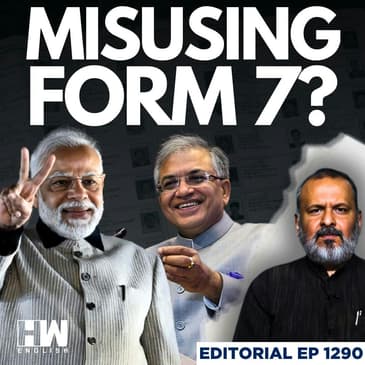
In this episode of Editorial, HW News Managing Editor Sujit Nair speaks on the glaring loopholes in the Election Commission's Special Intensive Revision. From 'misuse' of Form 7 for wrongly deleting voters by BJP agents, to mass deletion of voters in the draft roll - Mr. Nair asks whether the exercise, meant to purify our voter rolls, is actually serving its purpose.
Learn more about your ad choices. Visit megaphone.fm/adchoices
[00:00:00] And what was the intention of SIR? Now I ask, is the intention really to purify votes or purify voter list? Is the intention that? Whatever the processes are currently, I think it doesn't seem to be focusing towards purification as much as it is focusing towards deletion. That's my problem.
[00:00:24] If the BJP agent goes to a BJP-run state government and then offers the 75 forms, would the 75 forms be taken without questioning? That is the question that one needs to ask. And that is the danger we are facing. Namaskar! Welcome to another episode of Editorial.
[00:00:53] I would urge you to hear this episode of Editorial very carefully. I will urge you that. And I am going to go very slow. But my intention is to ensure that every person who is listening to my Editorial understands what I need to present.
[00:01:13] So here we go. See, all of us are going through SIR. That is the Special Intensive Revision. All of us are going through it. Some of us must have already done our processes. Some of us are still going through our processes. Now, all of this to purify the voter list. Till here, we all are in the same page.
[00:01:37] Now, today I want to talk to you about a very specific form called the Form 7 in this entire Electoral Rules. Form 7 was based on Electoral Rules 1960. In fact, let me read this out to you. Under the registration of Electoral Rules 1960, Form 7 must be used for making objections for a proposed inclusion or deletion of names in existing rules.
[00:02:07] So, what does it mean? It means that I can use a Form 7 to say that, listen, you know what, I have moved homes, I have moved my residence. So, I am no longer residing in this constituency. I have gone to another constituency. So, please, please delete my name from this constituency. I can write in Form 7. I can hand it over. Or, I can do another thing. I can say my neighbor, no, my neighbor. He, I don't think, is a citizen of India.
[00:02:35] Or, he, I think, is cheating. He has got two voting IDs. So, I can write somebody else's name, object to his right to vote and give it to the Election Commission. The Election Commission then decides whether to grant him his voting rights or not based on the form that I give him. The Election Commission has the final right. But, the fact remains that anybody can write about anybody and hand it over to the Election Commission. This is Form 7.
[00:03:06] Till now, we are clear? Okay. Now, why am I talking about Form 7? We are talking about Form 7 today because of this article from Indian Express. A 2nd September. Today's article in Indian Express. Today's article in Indian Express, their investigative team found out that Bharatiya Janata Party agent went to the BLO. BLO is a Booth Level Officer. He went to the BLO who represents, who is finally working for the Election Commission.
[00:03:36] This BLO was given 75 forms and said, He's ka naam nikaalo. You remove these people from voters list. And most of these people, incidentally, were from the minority. From the minority community. These 75 forms, Form 7, were given to the BLO. The BLO started asking questions. Why? Why?
[00:03:57] And, the moment, according to Indian Express, the agent realized that he cannot answer these questions, he burned those 75 forms. He bought 75 forms for deletion. And, then, the moment he realized, he cannot answer. He burned those 75 forms. And, like I said, most of those names were from the minority community. Now, there is a nuance.
[00:04:24] The nuance is, BLOs are state government employees. Jharkhand is a JMM Congress-run government. So, therefore, possibly, there were some checks and balances. What happens if the BJP agent goes to a BJP-run state government and then offers the 75 forms? Would these 75 forms be taken without questioning? That is the question that one needs to ask.
[00:04:54] And, that is the danger we are facing. This is Jarkhand. Now, News Laundry did another investigation. Now, let me take you through the News Laundry investigation. News Laundry investigation says that nearly half the objections of the electoral role in Haridwar's Jabrera constituency came from 35 people.
[00:05:17] All of them say their names, epic number and signatures were used in a fraudulent manner. In Uttarakhand's Jabrera constituency, 35 people listed as applicants in 1657 objections to the draft electoral role says that they never filed them and their identities were misused. Most of the voters targeted were Muslims.
[00:05:45] 35 people, 1657 objections. One constituency, Jabrera in Uttarakhand. This is the status. Now, when these 35 people were asked as to why did you fill 1657 forms? They say, bhai, it's not my name. It's not us. We didn't fill. Our names, our identities were stolen. They were used. We didn't fill. We have not raised single objection. Let alone 1657 objections.
[00:06:11] And as what I said before, year two, News Laundry also says most of the people whose names were deleted were from the minority community. Muslims. This is form 7. And this is why I said, hear this very, very carefully. Now, interestingly, one more point. 31 of these 35 people that I spoke to you about who filled all those 1650 odd forms.
[00:06:40] 31 out of these 35 peoples were BJP's, BLA, Booth Level Agents. Booth Level Agents is a grassroots representative appointed by the party for a specific polling station. And even those, they said that we didn't file all these complaints. This is where our SIR is headed to. And this is why I spoke about form 7. Let's go to a third point.
[00:07:07] In another incident, 3400 voter forms were found at a private photocopy shop. Five BLOs were suspended because of that. This happened in Maharashtra. 3400 voter forms in a private photocopy shop. Now, voter forms are not distributed in Panpatti ka Dukan or photocopy shop and all that. A voter form is between the voter and the election commission.
[00:07:35] The election commission hands the voter form to the voter. The voter takes it, fills it, gives it back to the election commission. This is the process. It is not that he can go to his nearest milk shop and get voter form. Doesn't happen. Doesn't happen that he goes to the nearest photocopy shop and says give me voter form. Doesn't happen. These are forms that are given by the election commission to the voter. Now, your guess is as good as mine. What are voter forms doing in photocopy shops?
[00:08:05] What are voter forms doing there? And where is the control? You are purifying the voter list. No. Is this how you purify voter list? By 35 people giving 1650 odd complaints? Is that how you delete? Is that how you purify voter forms? By 75 forms, form 7 being burnt when asked questions? Is this how you do it? What kind of purification are you expecting? What do you think will happen after all of this?
[00:08:35] After all this exercise is over, what do you think is going to actually happen? And what was the intention of SIR? Now I ask. Now I ask. Is the intention really to purify votes? Or purify voter list? Is the intention that? Or is there some other intentions? Now let me take you through another aspect of SIR. Another aspect of SIR. Delhi draft voter roll shrinks by 37.18% after SIR.
[00:09:04] Delhi voters shrink by 37.18%. The draft roll of Delhi after the special investment revision exercise has 97,53,577 electors. Compared to 1 crore 55,24,858 in the electoral roll used for assembly elections last February.
[00:09:28] A decline of 57,71,281 voters which translates to 37.18%. This is the case in Delhi. I will give you another story from Maharashtra. 2.07 crores out of Maharashtra voter rolls left out in SIR draft. Pune, Thane, Mumbai Sababan accounts to 40.5% of the omitted names. Voters report trouble reaching rolls online.
[00:09:57] PC says facility will be enabled from Tuesday, Wednesday. This is as far as Maharashtra is concerned. So 37.18% voters or which translates to 57,71,281 voters gone out of Delhi list and 2.07 crore voters gone out of Maharashtra list. This is how SIR purifying. But is this purifying logical?
[00:10:22] My question is, you see in West Bengal, 91% of the 82,782 names came back in the Bengal electoral rolls. So 82,782 voters out of the 90 lakh voters that was removed from West Bengal, 82,000 the first appeal, the results that came out of the first appeal, 91% were bought in. 91% was bought in.
[00:10:50] So what exactly is this exercise? What is it trying to achieve? I am a little confused because whole horde of people are taken out. Then the same people come in. Then why this exercise? Is there no checks and balances? Is there no processes in place?
[00:11:14] And whatever the processes are currently, I think it is not, it doesn't seem to be focusing towards purification as much as it is focusing towards deletion. That's my problem. And that's the point I wanted to raise. Will I see you next time? That's tomorrow at 10. Namaskar. Well, it's Sunday night. Let's go. Okay. Bye. Bye. Bye.