
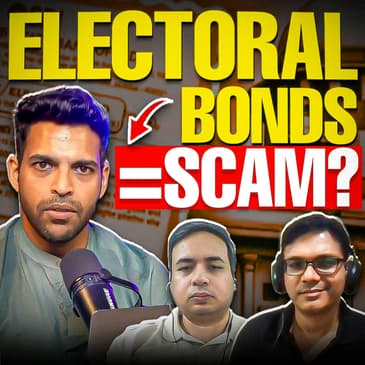
The Bharatvaarta Weekly is our reaction to the news headlines of the week that was. In this episode Roshan Cariappa, Nirav Kanodra and Abhishek Paul discuss the the latest news from the week and more!If you liked this episode, then don’t forget to subscribe to our channel and share this content. You can stay updated with everything at Bharatvaarta by following us on social media: we're @bharatvaarta on Twitter, facebook.com/bharatvaarta.in on Facebook, and @bharatvaarta on Instagram).
Topics:
00:00 Introduction
00:44 Electoral Bonds
07:13 CAA Implementation
13:42 Lok Sabha elections dates announced
19:20 Resignation of Haryana CM ML Khattar
21:47 DRDO's MIRV missile tests and Navy's fight against pirates
[00:00:00] Namaste and welcome to another episode of the Bharatvaarta Weekly. I am Roshan Karyapa. I have with me Abhishek Paul and Nirav Kanundra to run you through the week that was. We will talk about the implementation of the Citizenship Amendment Act or the CAA, the public release of the electoral bond records, election commission's announcement of the Lok Sabha poll dates, former Haryana Chief Minister ML Qatar resigning his post,
[00:00:26] and a couple of other interesting incidents that happened last week. All of this and more on the Bharatvaarta Weekly. If this is your first time on the channel, don't forget to follow or subscribe to this platform so you can get updates on politics, policy and culture. Well, let's go on with the news of the week.
[00:00:48] Last week, the State Bank of India shared records of electoral bonds bought in the country since April 2019 with the election commission. The election commission later made these records public on its website claiming transparency. According to the list, the BJP has received nearly 50% of all donations while the TMC ranks in the second place and the Congress in the third.
[00:01:10] Politicians and commentators from both sides of the aisle have accused the others of corruption by making assumptions as the list does not tie the donors to the party. Nirov, we spoke about this a few weeks back and we termed it as the perfect, as the enemy of the good. Right? Yeah, I mean, what do you make of the split in the donations and so on and so forth?
[00:01:33] Okay, so one is as you would expect the party which is winning the most is probably the most popular so should get most number. Surprising thing is TMC has gotten more versus like its electoral share. So TMC and DMK I would say punch above their weight in terms of like their wins in the Lok Sabha but also in the Vidhan Sabha they have got like a strong majority. So I think that says one thing.
[00:02:02] Second thing is see, don't let perfect be the enemy of good. Is this better than the previous system which was a lot of it was cash. Lot of it was like not traceable, etc. So probably the electoral bonds gave one thing which was give anonymity to the donor but also give clean money to the parties instead of like cash. And if there is cash involved, there are like other issues with it and there is less accountability.
[00:02:29] I think a lot of the opposition was assuming that they will nail down BJP with it but it shows like a widespread distribution. Yes, any form of electoral funding whether it is direct or indirect in a world which is functioning well, you should have access to courts in case of any unlawful or any favoritism done. Because there will be an aggrieved party which could probably file a suit and there should be other redressment mechanisms.
[00:02:57] So that is there and like finally, I think this is a thing which will gather a lot of noise right now. But if you ask me maybe a month from now before like we'll talk about the election dates, but a month or two from now this will all be kind of like forgotten with like the weekly news cycle. So there is not much to see over there. This is a data which is there on the election commission website as well.
[00:03:27] And yeah, it is and the usual suspects what people would have expected like the big conglomerates. They their name doesn't come up directly, but obviously they are also smart enough to do it via shell companies and they have the resources etc. And like to be fair, like a lot of people like to support or bet on the horse they think is winning. So that is one. If it had turned around you would have thought about who's more popular or who's got more power.
[00:03:57] And second thing is that a lot of smart businessmen or large business groups actually donate to both the parties because what they want to do is they want to be neutral and no matter who's in power have like some sort of a good relationship or curry some favors in one way or another. This happens even in like other democracies in the US in the UK in Europe etc.
[00:04:25] So there are issues you know for a fact like a lot of times there are unions which donate to certain parties even in the West there are a lot of unions which are aligned more to the Democrat Party like United Auto Workers Union which is very popular in the US the largest one. So even within India you have these all India trade union congress and like some unions affiliated to Congress some to like the Communists some to Shif Sainal.
[00:04:54] So there are people who make legitimate donations, electoral bonds in another way and let's see we don't know how this thing progresses but I think this is just going to like fly away and we won't be talking about this a month from now and this may not really be a major election issue either ways.
[00:05:14] Yeah, no I think earlier you had the case of a lack of transparency in terms of not just the identity of the donors but also whether the money was legit or not right. I mean through the electoral bonds which you know Mr. Arun Jayatli had mooted right at least the money one part of it one part of the equation was sort of legitimized right. Yeah, I mean it's a very difficult sort of proposition right I mean there are no perfect answers.
[00:05:44] What do you make of all of these people who are trying to find a correlation between the amount of money donated and perhaps some contract awarded and so on and so forth. So see most contracts that should be awarded should be in like a clean bidding process or some sort. If there's any sort of favoritism or now that this data is out there if somebody wants to go ahead and file a lawsuit or the parties which lost the bids etc.
[00:06:12] If they are aggrieved parties involved then they should go ahead and take it to the courts. I think see this is people have asked for this data someone has asked for it now that it is available any aggrieved party should make use of this data. See if it works out to their advantage or no. Yeah, I think we'll see a bunch of cases in the courts. Maybe there is something maybe there is nothing. Yes, absolutely. Absolutely. I think that will happen and there should be like a redressal mechanism. So there's no system which is perfect.
[00:06:40] That's why you might have disputes and if you have disputes that's why we need courts and judgment should be made on those things. And we'll see how it plays out. Yeah, but the interesting thing is that the bonds are open to all right. I mean clearly what this shows is all parties have received donations. And if I were to look at you know the split. I mean for the amount of elections some of these guys lose actually at the you know at the center and whatnot. I mean they seem to have a disproportionate amount of donations received right.
[00:07:08] I mean like you mentioned you know few of these parties punch way above their weight. All right. From one controversial topic to another. Last Monday the government of India announced the implementation of the much awaited Citizenship Amendment Act. This act allows persecuted minorities such as Christians, Sikhs, Hindus and others from India's neighboring countries like Pakistan, Bangladesh and Afghanistan to seek refuge in India.
[00:07:32] The implementation of this act has been met with a lot of criticism with the opposition fanning flames and spreading misinformation calling it anti-Muslim and therefore inherently Islamophobic. Abhishek there's a lot of chatter about this but you know I think in many different forums both the home minister and many of the other ministers have clarified right.
[00:07:56] In fact I mean I found Mr. Harish Salve's you know views very very clear crystal clear and sane on this right. I mean there is there's not much of a I mean there is no bias to Indian minorities as such. Yeah as you said a lot of criticism and back and forth on media and social media.
[00:08:19] I think the government via the home minister Amit Shah as well as other ministers and other let's say supporters of the government have tried their best you know to let's say put an end to all the misinformation. Or put at rest the various doubts of people.
[00:08:42] I think for example if you say the chief minister of Delhi right Mr. Arvind Kejriwal he went on quite a rant saying that you know millions and lakhs of people would stream in from the neighboring countries and cause issues of unemployment or you know violence and strife etc.
[00:09:06] throughout India conveniently missing the point that this is about providing relief to people who are already in India right. The cutoff date as of now is pretty clear that it is 2014.
[00:09:21] So I mean one of the best interviews on this has been given by Harish Salve right on India today which kind of reminded me of Jordan Peterson's interview a few years back where completely outclassed the interviewer. But if you look at the details I mean people are trying to put up one storm and after the other to sort of create various doubts. I think the points are very clear.
[00:09:50] We have a few countries in our neighborhood who are Islamic countries. And people from those countries have come to India over the years seeking refuge from their mistreatment, religious persecution etc. In those countries. These people have entered India without valid travel documents etc. Obviously because they were fleeing persecution.
[00:10:21] They remain as undocumented people within the country. And this Citizenship Amendment Act seeks to provide certain reliefs in terms of the documentation required or the period required right. To gain Indian citizenship. Normally it takes 11 years this for anyone to sort of seek Indian citizenship.
[00:10:47] This seeks to bring that down to 5 years for these people who have faced persecution. I mean that's the only thing about it. The rest of it is pretty much fear mongering. You could say maybe in terms of some valid criticism that there was some sort of linkage to the NRC process that might have happened when it was initially being discussed in 2019.
[00:11:16] Right now even the NRC process is totally on the back corner. There is no talk of that. So there is no question of linking it to that. And therefore what the government has now done is provided the rules of operating the CA amendment. They have opened website and basically as several state leaders have said that they will not allow implementation etc.
[00:11:47] Basically the government has designed the process in such a way that the states have nothing much to do in this process. There will be officers of the union government basically who will be presiding over the process. Reviewing the documentation of these people and so on and so forth in order to provide them relief and citizenship. Yeah I think it's important to reiterate some of these facts right.
[00:12:14] So the first thing is that it concerns as Abhishek said people who are already here in India right from 2014 onwards. That is the first thing. Second thing is it doesn't also prevent let's say a Muslim person from any of these neighboring countries to apply for citizenship right. I mean they are all free to apply for citizenship. There is only fast tracks. The thing is they have to firstly enter India with valid travel documents.
[00:12:43] That is they have to enter through an airport or railway station or a seaport. These people have been given the special exemption that they may not have a valid travel document because they were fleeing persecution. That's the difference. Yeah exactly right. Well in true western fashion prominent British people have called out India for its supposed Islamophobia under the pretense of holding the country to account.
[00:13:11] While the White House spokesperson as expected announced that the US will be closely monitoring the situation. Well what do you make of that? Yeah I think spokesperson of the Indian Foreign Service gave a pretty curt reply saying that this does not concern them at all. And so they should basically you know mind their own business. He said that of course in proper diplomatic language.
[00:13:39] But I think India has already responded to that. Well alright on Saturday afternoon the Electoral Commission of India announced the terms for the Lok Sabha elections. The election will be held in seven phases through April 19th to June 1st and the counting will be done on June 4th.
[00:13:57] The CEC Mr. Rajiv Kumar said that this election will be held over seven phases to accommodate security and manpower for the 96.8 crore or 968 million eligible voters across the country. Wow near almost a billion people are going to vote in these elections. And of course I mean it's going to be truly of an epic proportion for sure right. And a lot of things at stake here.
[00:14:25] Yeah I mean what are you looking forward to? Okay so one is seven phases it's the same as what it was five years ago right. What is basically people ask me a lot of people overseas asking why do Indian elections take so long? So sadly it is due to law and order and like due to moving of EVMs and earlier there used to be booth capturing and all of those things in 80s etc. So I think that is one thing.
[00:14:51] But like once the election is done the counting due to the EVMs pretty quick because each one is a calculator actually. So just a summation. I think they do a fantastic job. The election commission over the years they've done it quite well. Maybe I feel personally that seven phases might be a bit too much. We could hypothetically do it quicker. We live in the age of smartphone and video phones and if any kind of wrongdoing is there can be captured pretty quickly.
[00:15:18] So that is one thing but you see certain states they manage their state elections or even certain states have their elections only on a single day single phase. Which actually tells you something about the law and order as perceived by the election commission of that state. Right. So one which kind of comes to mind is Gujarat has it all on one day and it has 25 seats.
[00:15:38] It's fairly it's a medium sized state and with like a lot of sparsely populated areas as well many remote locations in Kach etc. as well. But I think they are managing it quite fine but maybe it's a more urban state. So that helps and I think see one is India's population of the largest the largest democracy for a while but now the largest populated countries. Our elections are always going to be bigger. Our population continues to grow. Maybe 65-67 percent will vote from this.
[00:16:07] So maybe we'll have 65 crore voters out of the 97 roughly 96.8 or 97 crore voters. So eligible voters maybe 65 percent or 70 percent might turn out to vote. Maybe if people believe as like the rumors going on or like the chatter that it's a done deal we might actually see a lower voting percentage. So let's see but I would encourage everyone to try and vote. I know my constituency in Mumbai I'm still an Indian citizen I've lived abroad for 18 years now but still an Indian citizen.
[00:16:38] And so I might actually come back and vote see if like work and all the other schedules match. But let's see and I would encourage everyone to exercise your right to vote. So hopefully that at least shows that your vote is not being misused. And it's going to be interesting. I think the news cycle as we get closer. So key dates from April there is the election dates 19th last phase is June 1st exit polls will tell you on June 1st.
[00:17:08] In India the pre-polls are not as accurate but exit polls are reasonably accurate reasonably like more accurate. And the results we know on June 4th. So that is there and not focusing on any political party I think it is like each one has their right to vote should try and exercise your franchise. And just plan everything around it right. So you know the holiday is there for people and like use it wisely.
[00:17:36] So find out your boots I think the election commission does a great job. You can find out your polling center you can find out if your name is on the electoral roll everything can be done online. I have helped like my family members and like lot of senior citizens to make sure. And so yeah it's all there help people around you. I would suggest help your neighbors your relatives people who may not be as tech savvy. A lot of India is very very tech savvy.
[00:18:01] But yeah so I think this is all my simple suggestion and make sure. Now also hopefully given that there have been so many party splits that it might be interesting to make sure you vote for the right party which you want to vote for. So do your homework as well. I am being specific about like Maharashtra Mumbai. So now there are now there used to be four parties now there are six.
[00:18:29] And there are splits in Shifsa and other splits in NCP. So vote for the candidate you want to. The worst thing is you go out and vote and end up voting for someone by mistake who you didn't want to vote for. So just do your homework. Make sure your name is on the roll. Go there and go there and vote. Yeah for sure. I mean I definitely encourage everyone to go out there and vote. And you know unlike perhaps in the US or somewhere else I mean we do get a holiday right.
[00:18:57] I mean for that one day which is pretty awesome actually. Yeah we're going to do a series of conversations leading to the elections on you know politics. More specifically on you know what are the issues going to be like and so on and so forth. So yeah do stay tuned to our channel for that. All right speaking of politics.
[00:19:19] A day after stepping down as Haryana Chief Minister, Mr. Manor Lal Kattar on Wednesday resigned as an MLA from the Karnal Assembly Constituency as well. Mr. Kattar has represented Karnal since 2014. He retained the seat in the 2019 Haryana Assembly polls. There are speculation that he may be fielded from the Karnal Lok Sabha Constituency. Abhishek, another BJP Chief Minister senior person stepping down.
[00:19:46] Right I mean Mr. Kattar has been at the helm for almost 10 years now. Right what is the significance of this? Yeah so it seems like the BJP and its ally partner in Haryana, the JJP could not sort of you know agree on seat sharing for the upcoming Lok Sabha election.
[00:20:13] I think they were asking for two seats and the BJP was like not okay with it. So basically they decided to end the current which is now the previous dispensation there with Manor Lal Kattar as the CM. And they went ahead immediately after that to install a new government there. Right under the leadership of Nayab Singh Saini.
[00:20:41] Right who is a long term BJP Karayekarta. Right and he was also an MP from Kurukshetra. So he is now the new CM from Haryana. He managed to win the vote of confidence as well on the 13th of March with the support of independence etc. There was a voice vote. The JJP I think partially abstained from it.
[00:21:10] So there are no problems in sort of restarting let's say government and there with the new CM. And as you said Mr. Kattar will probably now be getting into national politics via contesting for a Lok Sabha seat. Yeah so it's pretty amazing how the BJP can sort of reorder the old guard right.
[00:21:38] I mean whether it is in Madhya Pradesh, Karnataka or elsewhere. Yeah well we'll end on a very positive note. In a huge breakthrough Prime Minister Modi on Monday announced the development of Mission Divyastra. This also came with the announcement that DRDO had successfully completed the test flight on Agni 5 with MIRV capabilities.
[00:22:04] This is a landmark weapon system that is set to alter the country's geopolitical and strategic position and significantly change the situation in Southeast Asia. And in more positive news along the lines of security on Friday the Indian Navy intercepted and took back control of the transport ship MV Ruin.
[00:22:31] MV Ruin was captured by 35 Somali pirates and was being used as a mother ship to run their operations. The operation named Sankalp by INS Kolkata had Marines jumping off a C-17 aircraft onto the ship capturing all 35 pirates and rescuing all 17 crew members held captive. The operation was conducted nearly 3000 kilometers off the coast of India. The farthest operation by the Navy and it lasted about 40 hours.
[00:22:59] Well Nirav we seem to be gaining a foothold in the Indian Ocean as well. So very positive developments on both fronts the MIRV and this operation. Yeah so one on the MIRV right. MIRV stands for multiple independently targetable re-entry vehicle. So multiple is you can carry multiple warheads on the same missile. So once the missile goes it can shoot off one warhead and then shoot off another one etc. While it is trajectory and it's a targeted re-entry.
[00:23:29] So this missile once goes and then can come back. So I think that is a fairly advanced missile. Kind of like all of this innovation will like trickle down to the rest of the country as well. So I think it's a fantastic thing. The lady is a lady scientist within DRDO called Sheena Rani who's like headed this team. So that's also like a very big positive hopefully. Makes all young girls who are like interested in science, technology or defense.
[00:23:56] Encourages them to take it up and not be discouraged by any gender stereotype. So that's fantastic. And lastly on the recapturing of a ship by the Indian Navy. So the Somali pirates as well as the Houthis who are like in the Red Sea. They are affecting the trade and all of that in the Indian Ocean. And who does India, all of India's state has to go through Indian Ocean. So I think having a strong Navy helps our trade. This has been there since time immemorial.
[00:24:25] This is the British, the Portuguese, the Dutch, all of them are strong Navy's and then they became trading superpowers. So that is one thing. Second good thing is that this has been done 3000 kilometers off India's coast. So that's also showing our wider reach. So I think that's also another positive. So I think we need a strong economy which can support a strong defense system, Army, Navy, Air Force and a strong defense research organization.
[00:24:54] So which can develop our own weapons indigenously. We are not reliant on others. You have to be Atmanirbar. And once you have like a strong Navy, strong defense that in that sense also helps your economy grow to another level where you can go and trade around with all the international people. So I think rest of the world. So I think all of these are positive things. Each one in isolation may not sound that big.
[00:25:22] But each one is a step in the right direction and we are slowly, steadily climbing higher. So absolutely positive. Well, on that fantastic note, we come to the end of this Bharatwarta Weekly. If you stayed with us as long, do consider reviewing us on your favorite podcast platform. If you are watching this on YouTube, like, share and subscribe to this video and channel. Thank you so much for joining us. We will be back next week with more news and perspectives.
[00:25:50] Until then, do stay safe. Take care and jahin.