
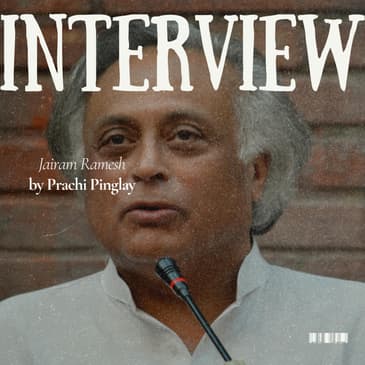
In this Environment Day special, former Environment Minister Jairam Ramesh discusses climate change, conservation, democratic decision-making, and balancing development with ecological protection in an interview with Prachi Pinglay.
Credits: This episode was edited by Aditya Srinivas, illustrated by Vernika and interview by Prachi Pinglay. Signature tune is composed by Dr Ananthu.
Learn more about your ad choices. Visit megaphone.fm/adchoices
[00:00:15] Welcome to 4C Radio. We are broadcasting from the central campus of Christ University, Bengaluru. 4C Radio is brought to you by the Department of Media Studies, Christ University. For all those who are looking for a platform that focuses on communities, commons, climate and communication, this is the place to be. What's more, this station is run by a diverse community of students and dedicated faculty members.
[00:00:42] Tune in to experience hard-hitting interviews, fact checks and myth-busting on ground stories, campus news and more. This episode marks a very special day as we celebrate one incredible year of 4C.
[00:01:04] One year of myth-busting, campus calling and meaningful conversations on diverse topics at the intersection of communication, politics and communities. This episode features an interview with Jairam Ramesh, a senior Indian politician and a member of parliament in the Rajya Subha representing Karnataka. He has previously held the position of Minister of State, independent charge at the Ministry of Environment and Forests.
[00:01:31] He spoke to Professor Praship Pinglee on his association with Dr. Madhav Gadgil, the process behind the Western Ghats Ecology Expert Panel and the need for sustainable economic growth. Thank you so much for joining us today on 4C Radio. It is indeed a great pleasure to have you on our podcast.
[00:01:58] I actually wanted to start by letting you know that in our inaugural episode one year ago, we had interviewed Dr. Madhav Gadgil and he had mentioned you when he spoke about the report that he worked on. And he very fondly remembered you as a peculiar minister in the government who let the report to be unfolded, unraveled and worked upon. So I really wanted to just start with that.
[00:02:26] How did it all go at your end when the report was being drafted or worked upon? And what was your initial reaction to it when the report came out? I recall visiting Kota Giri, you know, the Nilgiris in the early part of 2010. And this was a roundtable that had been organised on issues related to the protection of the Western Ghats.
[00:02:50] There were a lot of local people, there were a lot of activists, a lot of academics who were present. And the idea arose that there must be a systematic study on the threats that are being posed to the Western Ghats. You know, all the way from Maharashtra, Goa, Karnataka, Kerala, extending to Tamil Nadu, the entire stretch of the Western Ghats.
[00:03:17] Mining, infrastructure, road projects, urbanisation, various issues. So it had not been studied in a very systematic manner. And what are the options that are available to the government, to the central government, as well as to the various state governments? Because demographic pressures are inevitable. Developmental pressures are inevitable.
[00:03:44] So how do we manage conservation protection with demographic pressures as well as with developmental challenges? I think almost everybody said that, you know, we must set up a committee, we must set up an expert group. I thought about it and the only person that came to my mind, actually, literally, was Madhav Gargil. And I remember this meeting may have been in February of 2010. I mean, there were a lot of people who were there.
[00:04:13] And immediately I said, I think I know the right person who will head such an exercise. So I came back to Delhi and I said, look, this is the broad background. Would you agree to be head of this panel? So he immediately agreed. He suggested a few names. I talked to a couple of others. I got more names and we set up this committee. I had only one interaction with the committee. I said, look, you ought to be independent. You're professional.
[00:04:41] You're free to do what you want, how you'd want to do it. I'm not going to sit in judgment on what you say. I come in only after you have submitted your report. So they started functioning, I think, in the month of May or June of 2010. After I had demoted office, you know, I was Minister of Environment till July of 2012. Then I moved to Rural Development. So their report really came later.
[00:05:09] So I was not, I was present at the creation. I was present at the conception, but I was not present at the time of its submission. But then, of course, you know, I talked to Madhav and I had a little role in making the report public. Because the initial reaction was confidential. Why do we need to make it public? So I had a bit of a role in making sure that the report got public. Then it got shared with the state governments. And then, you know, the history. Yeah.
[00:05:38] The Kasturi Rangan panel. Yes. You know, it's still under discussion. And the protection levels afforded by the Kasturi Rangan panel were far lower than the protection levels that were recommended by the Gargill panel. But even the reduced Kasturi Rangan level was not acceptable to many of the states. Yeah. So this is the background to the Western Gargill. My instruction to them was, you are free to do what you have.
[00:06:08] You do your consultations. You do your interactions in whatever manner you can implement. And I think Gargill was really a grassroots democratic panel. You know, they did a lot of consultations with Gram Panchayats. They did a lot of consultations with people's organizations. Of course, they did consultations with state governments. The Kasturi Rangan panel was more of a satellite-based so-called...
[00:06:33] Almost it felt as if it was to somehow bring some kind of buffer to what the recommendations... The Gargill panel was truly democratic. Yeah. It was grassroots democracy. Of course, a lot of ecological science because Madhav was the most distinguished ecological scientist we have had. Kasturi Rangan, great man, very good friend of mine. Yeah. Great space scientist. But looked at it from a scientific point of view.
[00:07:02] Whereas I think Madhav looked at it from not just a scientific point of view. We also looked at it from the point of view of people, of livelihoods, of long-term sustainability. Long-term, yes. In fact, we also discussed at the time that unfortunately much later when all the ecological or natural disasters kept happening over a period of time... Especially the landslides and floods in Kerala.
[00:07:31] And then the report sort of came back as if we should have listened to this more. Yes. Actually, people thought it was an academic exercise. But the recurrence of floods in the Western Ghats, landslides, natural disasters... People still remember the Gargill panel. Yes. People still talk about it. In fact, it has remained not just as an academic exercise, but as an opportunity that we have lost, you know. Disturbing. Yeah.
[00:08:01] I mean, look at it this way. I mean, there were floods in Kurg. There were extraordinarily unprecedented floods in Kerala. Landslides in Kerala. I mean, the total unpredictability of monsoons. Yes. Mining activity, unregulated mining activity. Rail projects, you know, in the Western Ghats. So, yeah. I mean, the relevance of the report is still there.
[00:08:25] I want to bring you to current two issues that are like really occupying the environmental space these days. The Great Nicobar Project and the mining project. Over a period of time, I don't want to say just the last decade or, you know. But let's say in the past couple of decades, if you want to look at it, the debate over environment versus development has become so lopsided or polarized.
[00:08:51] And instead of and despite seeing enough of climate change related impact, in spite of seeing all of the suffering that people go through because of unregulated development, if we may call it that. The projects and the plans to deforest do not seem to stop. How do you really look at all this that's going on? I mean, because you spoke about it very recently. So I wanted to ask you about it.
[00:09:16] No, you know, I think everybody agrees that environment and development should go hand in hand. Yeah. This has become a mantra. Yeah. Everybody says we need environmental protection. Yes. But we also need faster economic growth. We need infrastructure expansion and so on. Let's start with the acceptance that everybody wants environmental protection and everybody wants faster development.
[00:09:42] Question is, what is the best way in which we can bring about this marriage between environment and development? I think it's important to recognize that there will be occasions where choices will have to be made. In some occasions, the choices will be in favor of the developmental aspect with safeguards, of course.
[00:10:02] In some cases, there will be decisions that will be taken in which you have to say, no, we will give priority to the environment because, you know, it would lead to greater deforestation or loss of livelihoods of local tribal communities. So these choices have to be made. Now, the question is, how do you make these choices? Are these choices going to be made in closed rooms by technocratic processes? Right.
[00:10:30] Or is it going to be done in a very authoritarian manner? Or is it going to be done in a participative, consultative manner with the involvement of local communities, keeping the concerns of local communities? So I've often said, look, all projects that come to the Ministry of Environment and Forests, now Ministry of Environment, Forests and Climate Change, there are three answers possible. The first answer is yes, let's do it.
[00:10:57] The second answer is yes, let's do it, but also do the safeguard. So there is a yes. But there's a third category, which we must have the courage to say, and that is no. What happened in Silent Valley 40 years ago? You know, the Prime Minister had the courage to say, yes, we need hydral power. We can have hydral power in other ways, but Silent Valley needs to be protected because it's a very sensitive rainforest ecosystem.
[00:11:24] So we must recognize that there will be some occasions in which we have to say no. In Niamgiri, for example, when, you know, bauxite mining issue came up, I took the stand that we need the bauxite. There are alternative bauxite sites that are available. But this Niamgiri is culturally very significant for Dongaria cones. It's a cultural symbol for them, and that needs to be protected.
[00:11:52] Okay, fine, we'll give you the environmental clearance for bauxite mining, but not in the Niamgiri hill. Because this is considered sacred to the Dongaria cone. I think this category, yes, but no. This mindset we must have. Right. And we must not be afraid of consulting local communities. We must not be afraid of democratizing the decision-making processes.
[00:12:16] And give confidence to the people that ultimately these decisions are being taken, not bulldozing these decisions. That's why, for example, we set up the National Green Tribunal in 2010. We passed a law in Parliament. The National Green Tribunal was set up. The National Green Tribunal was meant to involve people in environmental decision-making.
[00:12:37] People could go to the National and say, look, these are the laws which are not being followed while giving environmental clearance or forest clearance. So, in fact, the Great Nicobar Project is now under challenge. It was a challenge in the National Green Tribunal. Now it's under challenge in the Calcutta High Court, saying that due processes for environmental appraisal and for tribal rights under the Forest Rights Act have not been followed.
[00:13:05] So, I think, you know, this debate, it is a polarized debate, no doubt about it. It is a polarized debate. It shouldn't be a polarized debate because we need faster economic growth. But we also need faster economic growth that is sustainable. Because, you know, climate change has imposed extraordinary vulnerabilities for India. We have large coastline, 11,000 kilometer long coastline where mean sea levels have risen.
[00:13:34] We have the monsoon whose behavior has become more and more predictable. While the amount of rainfall has not changed in the long run. But the extreme events and, yeah. The frequency of extreme events has gone up. Deforestation in sensitive areas has certainly been now been very sharp. And that's beginning to affect microclimates. The retreat of the Himalayan glaciers can no longer be denied.
[00:14:03] There are some glaciers that are advancing. There are some glaciers that are retreating but at a decelerating rate. But by and large, the majority of the Himalayan glaciers are under retreat. So, the reality, the vulnerability of people. There is no denying of the actual, yeah, what is going on. We were in denial. Yes. And there's another very important fact. I think the most important fact. That all this is imposing a public health cause.
[00:14:33] You know, we are now seeing the morbidity and the mortality impacts of air pollution, water pollution, chemical contamination, climate change. So, 20 years ago, this was not part of the discourse. But today, we know that environmental stress causes public health stress. Public health. But it's also death. Deaths and it's also very long term is what we found. Just last week, last month, we published a four-part series from Delhi
[00:15:02] where we went to the communities and we asked them about heat and floods and all of it. And the way they were responding was that, you know, we don't go to work. When we don't go to work, we don't make money. When we don't make money, like it's a very cascading cycle which they are unable to stop. And they're constantly living with either respiratory or like digestion related issues. And because the water is not clean and like there's so many things. And it does come down to climate change and what is really happening.
[00:15:32] Look at the whole issue, phenomenon of urban heat. Yeah, urban heat. Exactly. Where the mean temperatures have gone up by a degree Celsius. One degree Celsius. That's a very significant and large increase. And that is going to affect livelihoods. Yes. It's going to affect people's, you know, economic future.
[00:15:59] And more importantly, it's going to impose a public health cost on families. Pollution. Air pollution is already imposing. You know, people are dying because of pollution. People are not just becoming sick or ill. People are dying. The mortality because of pollution and contamination is now becoming very evident. So I think, you know, that the debate which was polarized should no longer be polarized. Because the environmental impacts are here.
[00:16:28] They are visible. They are imposing a public health cost on us. So the question then is what do we do? Yeah. What we have to do is we have to make tough choices. And, you know, we have to make these tough choices in this framework that I have given you. There will be things where we have to give the go ahead, but very cautiously. And there will be occasions where we have to say, no, let's not touch this. Because this is too risky.
[00:16:55] And there's far too much uncertainty associated with its ecological impacts. According to you, which projects or which parts fall under the strict no category? Would it be the arugary? Would it be mangroves? Would it be... Mangroves would be a complete no-go for me. When I was minister, we had categorized India's forest area into go and no-go. 70% of our forest areas was go.
[00:17:24] Go means you don't... Doesn't mean you can destroy it. Go means you can apply and then there will be a due process. There will be safeguards. But we are not going to a priori close those areas for mining and for infrastructure. But there is 30% of our forest areas will be no-go, which means they will be protected under any cost. There won't be any mining. There won't be any highways. There won't be any, you know, rail links.
[00:17:54] So that's a no-go. This was done in 2011. Now we are giving clearances for projects. For example, recently, you know, there's been a project in Singarali for a power plant. It's bang in a rich no-go area in Madhya Pradesh, which also happens to be an elephant corridor. Yeah. You know, so the Nicobar project that you talked about, that's a no-go. Yeah. You know, so there are large parts of the forest area, which we did.
[00:18:24] We did a mapping exercise. It was a scientific exercise. And a lot of organizations were involved. And ultimately, we identified 70-30. Okay, now you could argue about 70-30. The government came. They said it should not be 70-30. It should be 90-10. Fine. Whatever it is. If there is a no-go area, you must keep it as a no-go area. Now, what is a no-go area? Rich forest areas. Very dense forest areas.
[00:18:53] You know, areas which fall under elephant corridors, tiger habitats. Areas which are very essential for livelihoods for local communities. Or biodiversity. Or biodiversity. So, you know, so far, we have assuaged our guilty conscience by saying we'll do compensatory airforestation. This compensatory airforestation is a totally bogus concept.
[00:19:18] I tried my best when I was minister to get out of this compensatory airforestation. But I couldn't because, you know, the Supreme Court and all other institutions. It's like buying carbon credits. Yeah, it's like buying carbon credits. You're trying to assuage your guilty conscience. So, you're going to destroy pristine, unique, biodiversity hotspot in Nicobar.
[00:19:44] And you're going to do compensatory airforestation in Haryana. I mean, it doesn't make any sense to me. Forest is more than trees. Forest is an ecosystem. It's a diverse ecosystem. If compensatory airforestation, there's nothing to do with diversity. Normally, it's a monoculture, you know, forestation that I have seen and that people have seen. So, mangroves is another good example.
[00:20:11] When the Navee Mumbai International Airport came up for clearance during my time, I was criticized very heavily for denying clearance for the original location. Because that was going to destroy very large areas of mangroves in New Bombay. And one lesson that we learned from tsunami in 2004, Dr. Swaminathan used to say that the most effective bio-shield for India are the mangroves. Is the mangroves, yes. And we're going to destroy the mangroves.
[00:20:40] So, these are examples where we have to be absolutely uncompromising. I wanted to also bring in two things that 4C stands for. Like, we stand for communities, commons, climate and communication. But I wanted to bring in communities and commons in terms of commons as ownership and usage and what we draw from commons. Whether it is forests, rivers, mountains.
[00:21:07] And you also mentioned that communities need to be involved in these decision-making processes. I wanted to ask you, what is your understanding of how we understand the idea of communities and commons and their role in decision-making process? So far as forest areas are concerned, we have a law. We have the Forest Rights Act of 2006. Now, that recognizes individual rights and that recognizes community rights.
[00:21:35] And without the settlement of individual rights, community rights, and without the written consent of the Gram Sabah, no projects should be undertaken in forest areas. This principle, by the way, has been upheld by the Supreme Court in 2013 in the Niamh Giri verdict. Yes. Where they said that the Gram Sabahs have to be totally involved and there must be prior consent for these projects. So for forest areas, we have a legal regime in place. Okay?
[00:22:05] We have this Forest Rights Act. For other areas, we have a thing called hearings, public hearings. But unfortunately, the way we do public hearings, where there is public, we don't do the hearing. And where there is hearing, there is no public. Because these are all manufactured, manipulated hearings. I've seen this time and time again in the environmental appraisal process. There's huge conflict of interest involved.
[00:22:32] There is, you know, in many ways, these are things that are rushed through without the involvement, without the consent of local communities and hearing their concerns and taking the appropriate safeguard measures. So I think, you know, a little more honest due diligence is required as part of the process of environmental appraisal. I mean, you mentioned the Nicobar project, the Great Nicobar Project.
[00:23:02] You know, the project was challenged in the National Green Tribunal. The National Green Tribunal set up a high-powered committee, you know, to examine the process of environmental approval. Had it been followed? Had all the processes been followed? Had due diligence been done? Had it been followed?
[00:23:43] Did you know the same thing? project now that's an example of clear you know conflict of interest pressure was being bought to bear uh you know on a professional an otherwise fine professional who had taken one position and four years later was forced to take another position so we have to be absolutely honest in the due diligence that we do we have laws we have very progressive laws when it comes to
[00:24:12] environmental protection coastal regulations yeah uh you know forests we have these laws there's no shortage of laws in our country we have passed these laws but unfortunately while we while we take great satisfaction in passing these laws we take greater delight in bypassing them so none of these laws really get implemented in letter and spirit and what is the debate that is taking
[00:24:42] place in many of these areas have you followed the forest rights act have you followed the environmental impact assessment have you followed the coastal regulation zone rules see if if there are laws make sure that these laws are being implemented and a lot of this probably would get sorted if they were followed properly like all the systems that were in place we have a very progressive regulatory
[00:25:09] system we have no doubt about it things evolve over time like for example in 2009 we announced and promulgated the national ambient air quality standards they were considered progressive for that time yeah but today we require to review those standards okay because you know we have had experience over the last 17 years on the public health impacts uh you know some pollutants may not be
[00:25:35] now for example i'll give you an example um the pm 2.5 standard uh today is far tougher than in what 17 years ago yes we were focused on pm 10 at that time yeah now the concern is on pm 2.5 uh and our national ambient air quality standards for pm 2.5 when you compare it with the who guidelines yeah
[00:25:58] the who safety guidelines are almost five to six times tougher tougher stricter stricter than our standards so we may have to we need to divide these standards yeah but we have standards we have regulations we have laws and we have to implement them also you know especially when it comes to environment and climate change especially nowadays there is this entire narrative that each one can make a
[00:26:24] difference sort of a thing and uh like you know you you you live a live an eco-friendly life and all of that however at the same time there are studies that show that individual way of life like whether i use a paper cup or whether i use a wooden cup has far lesser bearing on the actual impact unless it it comes from a systemic larger like you know no no it's okay individual choices do matter you know how you deal with
[00:26:53] electricity in your house right whether you use public transport private transport all those matter but you know the overall macro yeah is also very important yeah very very important so yes individual choices matter uh it's very easy for governments to say individual choices matter because then you transfer the responsibility the onus is on me suddenly too yeah no no but i am firmly of the view
[00:27:20] uh the onus is on the government of the day to set the standards to set the regulations to put the institutions in place to enforce these standards i mean we have standards for industrial effluent going into the ganga yes which have never been enforced yeah we have standards for pollutant load in the yamuna that have never been enforced so we have the standards we have the institutions but we have not
[00:27:49] enforced them so in this situation you know if i were to sort of come slowly towards our conclusion how can young people participate demand get things going and in general also like you know overall citizenry how do we sort of play a more impactful role in saving our hyper local environment and also having some role in larger decisions even global for that matter like you know well let me say that uh
[00:28:17] generational consciousness on environmental issues is far sharper today than it was 30 years or 40 years you know when i was growing up in college you know we were not environmentally all that conscious today if you go to universities you go to schools you go to colleges the awareness on climate change the awareness on pollution levels heat levels is far greater so that's one positive thing the question you're asking is how
[00:28:45] can this new sentiment be leveraged now we have institutions like the national green tribunal is an institution that was created to increase public consciousness the public can go and file cases and seek relief and in many cases i must say i disagree with the ngt on many things but in some cases they have actually provided a lot of relief you know to local communities who have gone and sought appropriate
[00:29:12] remedies that are available to the public under the law that was passed by parliament we have a very large contingent of environmental activists in this country they're not cockroaches by the way i was just this contingent of environmental activism is very healthy i mean i i i ran an open door when i was a minister
[00:29:36] i listened to the environmental activists i disagreed with them meda patkar used to do many demonstrations outside my office i let her demonstrate you know i you know that occasions in which i disagreed with the activists but the activists have a voice they represent a point of view uh so i think our processes must be
[00:29:58] we must be mature those in power must be mature and bold and sure of their position so as to enable the participation of larger people and i think you have the media today is far more environmentally conscious look at the nicobar the coverage that the alternative viewpoints it's the government is saying it is necessary uh because it's strategic you know we can deal with the threat of china but there are equally
[00:30:26] influential voices which are talking about the ecological impacts this project is having and it's all coming out in the media so the public consciousness is aware is greater public awareness is greater public sensitivity is greater i think we just uh you know just have to keep at it you know any final thoughts anything that you would like to add on the
[00:30:50] occasion of environment day well yeah i mean you know the see i have a i'm a big skeptic about all these days all the days yeah because then what happens is you know then you do it on the day and don't do it otherwise we do the mangalarti yes you know what mangalarti is yes i do so we do the mangalarti on june 5th and for the remaining you know we forget everything so the mangalarti is only on that day
[00:31:16] international women's day world environment day 100 tribal day you know indigenous communities day so i'm a bit of a skeptic on all these days because every day has to be a world environment day every day every day has to be there has to be environmental consciousness environment is you see the one of the great paradoxes uh of our lives particularly in india you know we are a civilization
[00:31:42] you know we are a culture we are a tradition in which life in harmony with nature has been made part of our consciousness you know prakriti rakshati rakshataha nature protects those who protect it we are not like a western cultural civilization which is based on man's conquest of nature the indic civilization remember i'm using word indic so indic civilization has been based on man living
[00:32:12] in harmony with nature i mean man woman people living in harmony with nature which culture venerates animals as gods which culture venerates rivers as god which culture venerates mountains as gods you know it's amazing when you look at it but which country abuses the mountains abuses the forests abuses the rivers
[00:32:35] few countries do it at the scale that we do it so you know the hypocrisy is so very very very very rampant and so very very stark i feel it's too stark yeah we don't need we don't need to be taught anything on ecology it comes to us you know we are natural environmentalists let's put it that way and yet and yet and yet we you know we this great desire i mean this is also a very important economic
[00:33:02] growth economic advance absolutely no question we have to be wealthier we have to be richer but we cannot follow the traditional grow now pay later model that you know for 20 years let's have economic growth and then we'll worry about the consequences also also i mean we need to be wealthier and richer but then who is getting wealthier and richer and who is not getting wealthier those are much larger issues
[00:33:27] but yeah you know i my life you protect nature nature protects you you protect the mangroves you will be protected against the sudan yes yes i mean in fact i mean i have been in i have lived in bombay for many many years so and i have seen the july floods when they happened i used to report for the
[00:33:49] hindu at that time yeah and and you cannot over emphasize the importance of what protects you from the sea yeah absolutely but yeah thank you so much for your time and we will be in touch with other stories and all of that thank you thank you so much
[00:34:10] thank you for listening to this podcast as always stay curious and tune in for more thanks for listening to this podcast as always stay curious and we'll see you next time in the next episode this episode was hosted by shovangi visuas with an interview by professor prachi pingle it was edited by srinivas aditya and illustrated by varnika singh signature tune composed by dr anantu please write to us and follow us on x instagram and linkedin you you you you you