
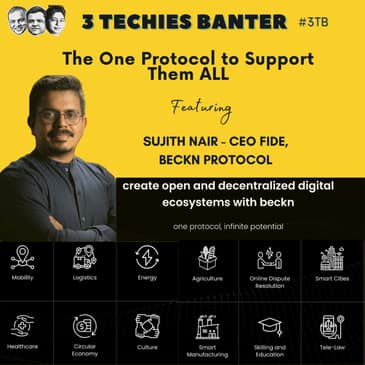



Sujith Nair, the WhatsApp-averse, badminton-loving chief mover and shaker of Beckn, gave us a peek into what the world's first e-commerce protocol is all about.
Imagine if Colgate wanted to sell a lot of toothpaste, would it open separate exclusive stores on every street? NO! Instead, it ensures its products are available in all stores where people come to shop, and not just toothpaste.
Similarly, Beckn is a way for an online business to make its products and services available on other stores (popular daily-use consumer apps) instead of setting up its own store (its own consumer app) and waiting for customers to come in droves!
In fact, we like it so much, we are carrying Beckn use cases as our episode artwork (instead of our normal groovy cover art) to spread the word in our own little way.
So, is it an app? Is it an aggregator? Is it a platform? No. It is a Super Capability - decentralised and open.
So listen, learn and use.
Learn more about your ad choices. Visit megaphone.fm/adchoices
[00:00:01] Hi, I am Samiran. Hi, I am Nilesh. Hi, I am Sheetal and you are listening to 3TV.
[00:00:08] 3 Techies Banter.
[00:00:12] So, hello everyone. Welcome to another edition of 3 Techies Banter. As you must have realized
[00:00:20] by now we do these episodes where we look at technology but we kind of give it a different
[00:00:26] view, a different lens, a different way of kind of interpreting it.
[00:00:31] We look at the fun side of it. We look at economics. We look at its impact on society and generally,
[00:00:37] you know, kind of give you another view into this world. For the, I won't say the longest time,
[00:00:42] for some time we have been super, super bullish on this whole thing around DPI, Aadhar and we've had
[00:00:49] several guests who have talked to us about it. Pramod, we had a,
[00:00:56] Chirish from ONDC, we had Shankar who talked about, you know, Teesha. So today actually we are extremely, extremely
[00:01:06] fortunate and lucky to have Sujit Nair with us. Sujit actually heads something that's called the
[00:01:14] Bekin protocol and for the people who have been in this field, you've probably heard about it.
[00:01:19] You know, it's kind of been spoken about quite a bit. If I were to describe Bekin,
[00:01:23] I would kind of really, kind of borrow from Pramod's descriptions and say, it's like literally like the SMTP protocol
[00:01:30] or you know, it's like foundational, you know, and it's having a huge impact on how we do business.
[00:01:37] And I won't kind of steal Sujit's thunder by, you know, launching into my own monologue.
[00:01:42] A little bit about Sujit before we jump in, he's been an engineer by education and like
[00:01:48] as we were just discussing before this, he went to SPJN, he started his career with EY,
[00:01:54] spent all his money in Bandra for the CVO. But I think probably like for a lot of other people,
[00:02:02] Adhar was something probably which changed his perspective on how to look at things.
[00:02:06] And since then I think he's done some very, very seminal work in this field.
[00:02:12] We did ask him to tell us some quirky things about himself.
[00:02:15] And one of the things he said is that he's been off WhatsApp for the last three years.
[00:02:19] I mean, so much so that actually I was even getting scared to ask for his number.
[00:02:22] I said, you know, maybe he doesn't even get on the mobile.
[00:02:25] But yeah, and he does play badminton for recreation.
[00:02:30] And so thank you. Thank you Sujit for joining us.
[00:02:34] Thank you for bearing up with all the fun we had trying to get you set up on this.
[00:02:41] I'm absolutely delighted to be here.
[00:02:43] I probably think it's because of me that you're going through all these problems,
[00:02:46] so much for interoperability that I keep talking about, but absolute fun and delighted to be here.
[00:02:51] And always loved your podcast and I've heard everything that Pramod had to say, Shankar had to say.
[00:02:57] So I don't know if I must add, but anyway, we're looking forward to some good conversation today.
[00:03:02] No, no, no. I have to do it.
[00:03:04] So I think maybe we'll just get this.
[00:03:06] I think we've kind of had a whole host of questions.
[00:03:08] But I think one of the things that is even before all of this is that I just kind of,
[00:03:14] I'm actually stunned where people get one great idea in their whole lifetime.
[00:03:19] Like, okay, I've done this and that's it.
[00:03:21] But how do you guys keep coming up and testing yourselves and coming up with the next great thing?
[00:03:28] You know what I said, oh no, I got a UPI right.
[00:03:32] Let's just chill now. That's it.
[00:03:34] I did Aadhaar. Let's just relax.
[00:03:36] How do you get to saying, okay, let's look at transactions.
[00:03:40] Let's look at open transactions. Let's think about it as protocol.
[00:03:43] How does that whole thing come about in your minds?
[00:03:46] I think and then I think the rest of it will probably become easier to understand.
[00:03:50] I had the same questions long ago.
[00:03:55] In fact, so one good trick is to be in the company of the likes of Pramod.
[00:04:00] You'll never be disappointed.
[00:04:02] But for me, I think it was the same question that occurred to me right from the beginning of Aadhaar
[00:04:09] because when I walked in and I've seen enough of tech business transformations and tech based,
[00:04:15] especially the government sector, I was doing enough work in the sector at that time.
[00:04:19] But Aadhaar was unlike anything.
[00:04:21] I think if I were to look back and at that time probably I didn't even have the vocabulary to articulate like this
[00:04:27] but there was something phenomenal happening and that phenomenal thinking was not something
[00:04:32] which is very chance based, a moment of euphoria or whatever.
[00:04:35] Somebody just had a Nirvana moment and like an idea fell from the sky.
[00:04:39] But I think there's something deeper which probably didn't even have a vocabulary at that time
[00:04:44] and for me, I think what Nandhan Pramod and the whole team unleashed
[00:04:49] is a completely new model of thinking, a completely new paradigm
[00:04:53] and some of it is now captured as many, I mean Sanjay Pura had called it a societal thinking
[00:04:58] but a new way of thinking about population scale design.
[00:05:01] So once we have that sense and sensibility around that design,
[00:05:05] some of these ideas if you start putting together seem like a very natural evolution
[00:05:10] and if not me somebody else would have probably thought of backend as an extension of UPI.
[00:05:16] But if you follow the same principles and thinking the way it was unearthed with Aadhaar
[00:05:22] and then the various elements of India Sack that came about,
[00:05:26] it seems like a very natural evolution. Somebody had to proudly step forward and steward it
[00:05:30] and I got to be the lucky one with backend.
[00:05:33] But I think there is an underlying essence and thinking in this way,
[00:05:39] in this manner which will open up even more.
[00:05:42] I wouldn't be surprised if there are a lot more coming in future
[00:05:46] and because of the very shift in the way of thinking,
[00:05:49] small things like normally in the tech world and this is what we have been used to
[00:05:54] and it's so in queue to Keras is this thing about scale whatever works.
[00:05:58] If it works in San Francisco, scale it for the rest of the world,
[00:06:01] it works in Bangalore, take it to the rest of India.
[00:06:03] But I think what fundamentally shifted is to think about what works at scale.
[00:06:09] Not about scaling what works but what works at scale
[00:06:11] and that for me took a while to even understand
[00:06:14] but the moment you understand it, you can't unlearn that.
[00:06:17] Now when you start thinking in with that paradigm, everything changes
[00:06:21] and the other very interesting paradigm which is essence of one of the principles of backend
[00:06:25] is to not over standardize, don't standardize but to unify
[00:06:29] because you start thinking about diversity as a feature and not a bug.
[00:06:33] How do you and you can't make everybody adopt the same thing,
[00:06:37] make everybody follow the same set of processors or standards
[00:06:41] and I'm working a little bit on energy, we have diverse set of specifications
[00:06:44] for EV charging and all that but instead of solving for them at that layer
[00:06:49] can you unify them at the layer above?
[00:06:51] Can you create a level of abstraction in unify
[00:06:53] because you need to recognize that you will not be able to overcome diversity
[00:06:58] and you should not because it makes it more exclusive and not inclusive
[00:07:03] but if you want to solve for diversity do that, do it at a level above.
[00:07:06] Unification over standardization.
[00:07:08] So just these two, three ways of thinking puts you in a different pathway
[00:07:12] and probably just a sequence of that and iteration on that as led us to backend
[00:07:16] and I'm sure many more such can emerge with this way of thinking.
[00:07:19] I think that's probably for me the fun part of the last decade
[00:07:24] of working with these ideas like Adhan and UPI.
[00:07:27] So Sajitha, everybody who comes on this podcast knows
[00:07:32] I'm not a person from the world of tech.
[00:07:34] Okay and therefore a lot of what?
[00:07:37] I'm so sorry.
[00:07:38] I'm learning all of the terms that you used I've heard
[00:07:45] and I'm reading up a lot more to be able to now confidently understand
[00:07:50] or say that I may be understand partially what interoperability is
[00:07:54] but having said that and set the context of saying that I'm not a tech person
[00:07:59] I just want to kind of understand if you had to explain this in layman terms
[00:08:03] to somebody who doesn't come from the world of technology
[00:08:06] what is it that backend does and why is it that backend does it?
[00:08:11] So I'll bring two dimensions of backend out in non-tech terms
[00:08:15] let me make an effort.
[00:08:16] Let me talk about interoperability in general as a concept
[00:08:20] maybe people think it's a very tech jargon in deep and tech
[00:08:24] and perplexing details of tech
[00:08:26] but interoperability is pretty much part of our life
[00:08:28] and let me give you the example of natural languages
[00:08:31] we are having this conversation in English
[00:08:33] the reason we are able to understand is because we have chosen to follow
[00:08:37] the common dictionary, the common grammar, the common rules that were set for English
[00:08:41] which everybody has agreed to follow
[00:08:43] I mean it's been given to us we just notionally inherited it and we follow that
[00:08:48] now imagine if I had a different dictionary for English than yours
[00:08:53] then if I say that this is not a screen that I'm looking into
[00:08:56] I'm looking into a crystal ball
[00:08:58] you'll probably start losing me in the conversation
[00:09:01] now this essence, the fact that we agreed for a common set of ways to communicate
[00:09:06] to each other is the essence of interoperability
[00:09:09] so I would say English probably in all languages where the OGs are protocols
[00:09:14] they were the first protocols
[00:09:16] that essential communication to communicate messages across to have this conversation
[00:09:20] is essentially what interoperability means
[00:09:23] but the reason why Beckham is promoting that
[00:09:27] it was in the whole last two and a half decades of
[00:09:31] commerce evolution on internet
[00:09:33] somewhere along the way we seem to have abdicated interoperability
[00:09:37] to create more closed languages or conversations
[00:09:41] which kind of create this wall gardens as we keep talking about
[00:09:44] now as part of that
[00:09:46] one of the situation that we have naturally ended up
[00:09:49] as seem like a very normal model that has been accepted all over the world
[00:09:53] in any sector is this notion that
[00:09:56] if I have something to offer as a provider
[00:09:59] whether I'm a doctor or a grocery store or a driver
[00:10:02] or somebody with a battery to offer energy or an eb charging station
[00:10:06] I have to be on the same quote unquote platform
[00:10:10] as the user is
[00:10:12] so what the consumer and provider need to be on one thing
[00:10:16] to find each other and talk to each other and do business with each other
[00:10:19] so if I'm a Uber driver I need to be an Uber app as a consumer
[00:10:23] you need to be an Uber app as a writer
[00:10:25] similarly on Amazon
[00:10:26] if you are on if you are a seller on Amazon I as a buyer need to be an Amazon
[00:10:30] and this goes on it is nothing about specific about Uber or Amazon
[00:10:34] but in general that's the underlying model
[00:10:36] with which the whole world has operated and brought economic transactions
[00:10:41] onto the internet world
[00:10:43] now there what if the question we were asking is
[00:10:47] just like the internet or emails
[00:10:50] or telecommunication which did not have this condition
[00:10:54] for example I may be using a different browser to log into this chat today
[00:10:58] and you may be using a different browser
[00:11:00] and there's nobody in between trying to say that you both have to be on the same
[00:11:03] internet always work like that
[00:11:06] mobile phones you could be on airtel I could be on waterphone
[00:11:09] I never insisted that you should get on waterphone to talk to me or me talking to you
[00:11:13] and same as both with emails as well
[00:11:15] I could be on hotmail and you can be on Gmail
[00:11:17] so all the population scale systems which are scaled up
[00:11:21] at a planetary scale had this interoperability
[00:11:24] and what do I mean by that?
[00:11:26] interoperability to give you the freedom
[00:11:28] and the choice to be on any platform
[00:11:30] and talk to whoever you want to
[00:11:33] you don't even care which platform the other person is using
[00:11:36] but yet communication, we will have to find and talk
[00:11:39] or communicate is easy
[00:11:41] and that is essentially how even UPI made
[00:11:44] the difference I could use any app
[00:11:47] connect to any bank account that I may have
[00:11:50] send money to you who you may be using a different app
[00:11:53] and a different bank account for the matter
[00:11:55] doesn't really matter I don't have to
[00:11:57] acquire knowledge or a pre-convition
[00:12:00] for me to send money to you
[00:12:02] the fact that we are all speaking the same language of UPI
[00:12:05] and the phones are speaking that language
[00:12:07] so Beckham protocol was taking the thinking to saying
[00:12:09] how do we break this sort of dual
[00:12:12] incidence of presence as a systemic risk
[00:12:15] where the consumer and provider need to be on the same app
[00:12:18] and instead unbundle that and ask
[00:12:21] what if I could be on Google map
[00:12:23] and find every driver from every platform
[00:12:25] every app whether Uber, Ola, Namae, Aatri
[00:12:28] or even a Metro
[00:12:29] why can't I find them at my app of charge
[00:12:31] it could be a WhatsApp, it could be a Google map
[00:12:34] or even a browser for that matter
[00:12:36] that freedom on one side
[00:12:39] I thought was a good way for us to sort of
[00:12:42] expand our access expand our choices
[00:12:45] and create new possibilities of what else can happen
[00:12:49] that's on the consumer side and I'll come to that
[00:12:52] what else can happen part in a bit
[00:12:54] but more importantly for the provider
[00:12:57] it kind of gives a significant force multiplier
[00:13:00] and retains the agency for the provider
[00:13:03] to be not worried about where my consumer is
[00:13:05] and how do I quote unquote acquire the consumer
[00:13:08] the fact that I am doing business on an auto-rickshaw
[00:13:11] and I've managed to find a way to go online
[00:13:13] to make myself available
[00:13:15] it doesn't matter where the consumer is
[00:13:17] or where the consumer finds without having to be
[00:13:20] onboarding him onto the same platform
[00:13:22] you know I keep saying this classic analogy
[00:13:25] if toothpaste companies were to start thinking like this
[00:13:28] with the same model of buyer and seller
[00:13:30] every toothpaste company would have probably opened
[00:13:32] an exclusive showroom
[00:13:34] and wait for customers to walk in
[00:13:36] but they didn't do that
[00:13:37] they made sure that their products are available
[00:13:39] where customers are walking in
[00:13:40] which are your Kirana stores and others
[00:13:42] okay so every provider having an exclusive app
[00:13:46] for customers to find them
[00:13:48] is like opening those exclusive showrooms
[00:13:50] where not many people are walking in
[00:13:51] we know the numbers
[00:13:52] but what if the service instead of
[00:13:54] you bringing customers to yourself
[00:13:56] why don't you take your services to where the customers are
[00:13:58] customers are using Android phones
[00:14:00] they're using browsers
[00:14:01] they're using maps
[00:14:02] they're using UPI apps in India
[00:14:04] so this nature of freedom
[00:14:06] actually force multiplies
[00:14:08] the provider's ability to do business
[00:14:10] acquire orders
[00:14:11] so shift this narrative from customer acquisition based business
[00:14:14] to simply order acquisition
[00:14:16] and to sweat your assets better and faster
[00:14:18] at lower costs
[00:14:20] and that idea
[00:14:22] seemed to be completely missing
[00:14:24] in the model in which how the transaction economy
[00:14:27] was making up
[00:14:28] so which is completely an obvious gap
[00:14:30] so we couldn't unsee it anymore
[00:14:31] especially with the evolution of UPI
[00:14:33] so the only question we asked is
[00:14:35] if this can happen for payments
[00:14:37] why can't it happen for mobility commerce
[00:14:40] and why don't we have offer choices
[00:14:42] for provider and consumer to be on any platform
[00:14:44] and talk to each other
[00:14:45] I don't know how non-tick I was in that explanation
[00:14:47] but I hope I was able to paint a picture
[00:14:49] that was brilliant
[00:14:51] that was absolutely brilliant
[00:14:53] because it triggered off a lot of things for me
[00:14:56] but absolutely brilliant
[00:14:58] thank you so much for that
[00:14:59] because it really helps understand
[00:15:02] and having been a marketer
[00:15:04] sometime in the past I was just thinking
[00:15:06] can you imagine if your customer acquisition cost
[00:15:09] drops considerably
[00:15:11] because now you're not making the effort
[00:15:13] that in itself is like
[00:15:15] such a big change
[00:15:17] for large organizations
[00:15:19] so thank you for that
[00:15:21] I know Nilesh has a very very
[00:15:23] very core tech question
[00:15:25] I'm very very non-core
[00:15:28] but Sajid, so I had a question
[00:15:31] does this thinking of
[00:15:34] at scale
[00:15:36] let's think of it as when I'm doing it
[00:15:38] at population scale
[00:15:40] it almost always makes me think that
[00:15:42] this is about doing things which are in the
[00:15:45] not profit
[00:15:47] space right because you're
[00:15:49] building
[00:15:51] like you said the infrastructure
[00:15:53] the rails right for on which others can
[00:15:55] ride
[00:15:56] but when you think about it from a
[00:15:58] corporate perspective right
[00:16:00] which is where the giants came in
[00:16:02] do you see this derailing
[00:16:04] a lot of the profiteering
[00:16:06] and the profit making
[00:16:08] and that aspect
[00:16:10] of business when
[00:16:12] you have
[00:16:14] solutions like Becken protocol
[00:16:16] or do you think that other
[00:16:18] for-profit guys will be able to ride
[00:16:20] on top of
[00:16:22] Becken protocol and because in my head
[00:16:24] it's always when it's at scale
[00:16:26] it means I have to be
[00:16:28] generous about it
[00:16:30] and there is this whole
[00:16:32] whole fund of moats right
[00:16:34] said if somebody is built something
[00:16:36] they don't want to share
[00:16:38] which is the whole issue why we have
[00:16:40] all this big tech and monopolies and all that
[00:16:42] so the guy who builds this want to protect it
[00:16:44] versus what we are saying is that this is something
[00:16:46] this is literally
[00:16:48] a uniform infrastructure
[00:16:50] for all anybody can ride on it
[00:16:52] innovate and succeed or whatever
[00:16:54] firstly and I
[00:16:56] say this as much as I can gather
[00:16:58] it does not
[00:17:00] take away competitiveness
[00:17:02] and derail
[00:17:04] the for-profit motivations in fact
[00:17:06] to the contrary it only activates and
[00:17:08] force multiplies
[00:17:10] which is what internet did
[00:17:12] internet was
[00:17:14] internet is technically a non-rival
[00:17:16] versus non-exclusive infrastructure
[00:17:18] which is largely open
[00:17:20] apart from paying for your connection
[00:17:22] internet as a way of access
[00:17:24] is kind of largely free
[00:17:26] but it sort of created a whole
[00:17:28] new paradigm of value creation which we get
[00:17:30] to see and benefit today
[00:17:32] right and for me
[00:17:34] even that infrastructure
[00:17:36] is not a for-profit
[00:17:38] is not a not for-profit in the sense
[00:17:40] that it's something out of an altruistic
[00:17:42] effort it's public spirited
[00:17:44] but it is
[00:17:46] self-sustainably economical so for example
[00:17:48] ONDC let me do just back in protocol
[00:17:50] is a set up as a section 8 company
[00:17:52] okay or NPCS is not section 8
[00:17:54] company but it doesn't make that it's
[00:17:56] not profit making it will
[00:17:58] reinvest that profit that's all in
[00:18:00] the section 8 means but it will
[00:18:02] make its own self-sustainable
[00:18:04] cash flows and way
[00:18:06] to reinvest and build that
[00:18:08] and have pay for
[00:18:10] innovation research and talent that
[00:18:12] need to run this infrastructure just like
[00:18:14] the highway authorities will do or any
[00:18:16] private investments for a public
[00:18:18] road to do that essence here
[00:18:20] is it's a public spirited infrastructure
[00:18:22] which is non rival
[00:18:24] was non explosive it does it probably
[00:18:26] does not mean the economics only
[00:18:28] work in a certain way
[00:18:30] which is not for profit that's one distinction
[00:18:32] and the example on more
[00:18:34] if I were to just expand and take this analogy
[00:18:36] and expression my mind I was using that yesterday
[00:18:38] is this whole cell tower
[00:18:40] of the telecom business
[00:18:42] but there was a time when you thought distribution
[00:18:44] is the king and if you can get as many users
[00:18:46] reach every circle as used to be called
[00:18:48] at those days and everybody said
[00:18:50] therefore my cell towers are my strategic
[00:18:52] advantage and if I can add more power
[00:18:54] and transmission and bandwidth to it
[00:18:56] get more users that's going to be my mode
[00:18:58] look where we are today all the cell towers
[00:19:00] are common shared by all the telecom
[00:19:02] companies but they realized that
[00:19:04] with common shared infrastructure like cell towers
[00:19:06] you are able to create that cost curve decline
[00:19:08] and this is a very important part
[00:19:10] expand the market
[00:19:12] UPI
[00:19:14] expanded the market
[00:19:16] from there where we were in numbers
[00:19:18] to 13.4 billion last month
[00:19:20] and that's the idea that it's a
[00:19:22] market expansion story
[00:19:24] on the mode side if I were to talk about
[00:19:26] the mode and the online economy
[00:19:28] it's great numbers but we all know
[00:19:30] for all the big companies doing commerce in India
[00:19:32] P2C in India
[00:19:34] there's still about 5%
[00:19:36] we keep hitting this 25 million 50 million
[00:19:38] wall in India so we are pretty much like
[00:19:40] a Portugal digitally
[00:19:42] an India in the physical world but
[00:19:44] 25 million 50 million with 5%
[00:19:46] penetration and mobility
[00:19:48] is like 3% penetration
[00:19:50] we're not solving for everybody's
[00:19:52] and the value creation is not happening
[00:19:54] as much as we think it can so we think
[00:19:56] that there is a possibility of creating an infrastructure
[00:19:58] like the shared cell towers like UPI
[00:20:00] to expand that
[00:20:02] but it requires a bit of
[00:20:04] a reimagination and how
[00:20:06] your modes will now be shaped
[00:20:08] relook because your modes
[00:20:10] were probably not your Mao, Dao
[00:20:12] numbers of users
[00:20:14] but it's a function of how much
[00:20:16] you can create flow of value flow of economy
[00:20:18] on your solutions on your platforms
[00:20:20] and that will require a bit of a rethinking
[00:20:22] and that's where
[00:20:24] new paradigm level and that's exactly
[00:20:26] happened when somebody started figuring out how to sell books online
[00:20:28] the business model came later
[00:20:30] but that's an emergency that we need to allow
[00:20:32] at population scale
[00:20:34] which is where I think
[00:20:36] what brought us here may not take us there
[00:20:38] it's a new way of doing new
[00:20:40] things sometimes it could be new of doing
[00:20:42] old things but it requires a little bit
[00:20:44] of an imagination to say
[00:20:46] if I get this right
[00:20:48] maybe I can expand
[00:20:50] the market access for my products
[00:20:52] and so this is possible but I just need to start
[00:20:54] thinking a little differently on this one
[00:20:56] So I think the ATM
[00:20:58] the ATM is another example
[00:21:00] like I mean
[00:21:02] so everybody started by saying
[00:21:04] it's my ATM
[00:21:06] and if you come to my ATM
[00:21:08] when you are another bank account holder
[00:21:10] I will charge you and blah blah blah
[00:21:12] but I think all of that has gone out of the way
[00:21:14] so in fact Switji I am literally thinking
[00:21:16] where the US came
[00:21:18] from this world of
[00:21:20] let the fittest
[00:21:22] survive and everything is for profit
[00:21:24] and what have you
[00:21:26] this almost while it is
[00:21:28] self sustaining
[00:21:30] and is fueling profit
[00:21:32] and commerce
[00:21:34] it is literally kind of
[00:21:36] it is another way of
[00:21:38] technology thinking but it seems to be another way
[00:21:40] of economic thinking also right because
[00:21:42] I mean somebody
[00:21:44] or some groups of people
[00:21:46] or either by policy or something
[00:21:48] have to figure out
[00:21:50] what are those
[00:21:52] base infrastructure pieces
[00:21:54] or blocks that other people can start
[00:21:56] building upon I mean
[00:21:58] we are kind of literally seeing another
[00:22:00] total shift in how
[00:22:02] classical economics
[00:22:04] also functioned literally because I mean
[00:22:06] people always said okay you know
[00:22:08] whatever it is
[00:22:10] profit is the right way and let the fittest
[00:22:12] survive and let the market decide
[00:22:14] but here we are saying let the market decide
[00:22:16] but give the market the right
[00:22:18] tools or create
[00:22:20] an environment where the right market
[00:22:22] has a choice I mean they want to follow the
[00:22:24] path time of creating their mode by
[00:22:26] exclusivity nobody stopping
[00:22:28] them nobody stopping them
[00:22:30] nobody forcing them to get on to
[00:22:32] an infrastructure like going BC the question
[00:22:34] that will be asked if O&D
[00:22:36] see where to scale and that's still an
[00:22:38] if right now if O&D see where to scale
[00:22:40] and it will I have the confidence
[00:22:42] but when it scales you have a choice
[00:22:44] I mean this is what I say you want to be
[00:22:46] an 85% market share in a 100 rupee
[00:22:48] market which is like the 5% of B2C
[00:22:50] or do you want to be a 10% in
[00:22:52] 100,000 or a bigger market
[00:22:54] the question is what would
[00:22:56] your play and you can always recalibrate
[00:22:58] calibrate your approach but the question
[00:23:00] is this infrastructure is available for everybody
[00:23:02] the big guys
[00:23:04] the small guys but it's an opportunity
[00:23:06] to deepen the access to the pie
[00:23:08] and let your imagination
[00:23:10] emerge there is a internet
[00:23:12] I think the internet's principle
[00:23:14] of moving innovation to the edges with
[00:23:16] interoperability there's no center
[00:23:18] sort of literally
[00:23:20] catapulted the imagination and the whole
[00:23:22] we are thinking I mean I keep saying this
[00:23:24] if you look at the STTP protocol
[00:23:26] if you were to read the STTP
[00:23:28] protocol there's nothing in the protocol
[00:23:30] that would have foretold you that there will
[00:23:32] be a chat GPD after 40 years
[00:23:34] so somebody has
[00:23:36] was able but without
[00:23:38] STTP I don't think you would have witnessed a chat
[00:23:40] GPD or an Amazon today
[00:23:42] so that idea that
[00:23:44] this will unfold a whole new way of
[00:23:46] thinking why are we denying ourselves
[00:23:48] as a civilization as a population
[00:23:50] from the new possibilities while
[00:23:52] also solving for some of the other important
[00:23:54] aspects which could be a policy
[00:23:56] saying that why is it exclusively
[00:23:58] available only for a few why can't
[00:24:00] we expand that access and make it more inclusive
[00:24:02] so can we be inclusive and innovative
[00:24:04] I think that if that is a possibility
[00:24:06] and that's some of the ingrained
[00:24:08] principles of how this DPI thinking
[00:24:10] has evolved and that's pretty much
[00:24:12] how Beckin intends to solve for
[00:24:14] you know to even some
[00:24:16] even's point I
[00:24:18] literally witnessed this
[00:24:20] almost a decade back
[00:24:22] I used to work on some
[00:24:24] projects of mobile money in Africa
[00:24:26] right and we were creating
[00:24:28] software and it was
[00:24:30] a very noble effort because like India
[00:24:32] African nations have very low banking
[00:24:34] penetration and banking is a luxury
[00:24:36] and not a
[00:24:38] common man's service so
[00:24:40] the telecoms
[00:24:42] who were doing this mobile money
[00:24:44] were never able to grasp
[00:24:46] I mean I even suggested it to couple of
[00:24:48] telecommunication giants that you know why don't
[00:24:50] you create interoperable mobile money right
[00:24:52] I mean this was way before UPI
[00:24:54] you have the systems
[00:24:56] and increase the pie
[00:24:58] and have a share
[00:25:00] smaller share maybe I'll beat
[00:25:02] of a bigger pie
[00:25:04] but yeah I think UPI
[00:25:06] did it in India it has
[00:25:08] it's like I think
[00:25:10] now the biggest you know we have
[00:25:12] the maximum number of transactions
[00:25:14] not even China is up there
[00:25:16] so I think that
[00:25:18] thinking was very important so
[00:25:20] it was good to have now my question
[00:25:22] Nilesh I think you're making
[00:25:24] if I can make just more, a beautiful example
[00:25:26] that you brought on even at the ATR
[00:25:28] and what is interesting in that
[00:25:30] in that whole phenomenon
[00:25:32] is that interoperability
[00:25:36] or a new way
[00:25:38] of thinking doesn't come from within
[00:25:40] the incumbents probably
[00:25:42] may not be
[00:25:44] the ones who will think of opening it up
[00:25:46] or bringing a new dimension
[00:25:48] which means it's kind of
[00:25:50] has been coming through a complete
[00:25:52] from a different direction so banks
[00:25:54] and RBI are probably not the ones who
[00:25:56] thought about UPI it probably came
[00:25:58] from I mean sometimes unfortunately
[00:26:00] they're not for profit effort as to
[00:26:02] write that or volunteering effort as to
[00:26:04] write that but it's always an
[00:26:06] externality to all the brick and mortar
[00:26:08] bookstores right so that is
[00:26:10] kind of the nature of the beast and how
[00:26:12] it evolves and that creates that forcing
[00:26:14] function it's very rare that from
[00:26:16] within the incumbents somebody just woke up
[00:26:18] and said let's do things differently but that's
[00:26:22] very very interesting you know I was
[00:26:24] recently listening to this conversations
[00:26:26] in consumer goods and
[00:26:28] they said the same thing that
[00:26:30] whether you look at ice cream
[00:26:32] you look at luggage
[00:26:34] you look at shaving blades
[00:26:36] the incumbent or the big guy
[00:26:38] is like 60 70% market
[00:26:40] say like Colgate is like 60%
[00:26:42] you know Gillette is like
[00:26:44] 80% and yet
[00:26:46] you have you know a
[00:26:48] bovin mumbasaving company and a
[00:26:50] Hoco ice cream and or what all this
[00:26:52] you know
[00:26:54] inner wear brands which are
[00:26:56] so you're right that you know the incumbents
[00:26:58] are not the people driving this it is
[00:27:00] it's the market something else
[00:27:02] or somebody else's thought of something else
[00:27:04] maybe in another industry
[00:27:06] that comes in here which kind of
[00:27:08] shifts the whole paradigm.
[00:27:10] So the follow up questions
[00:27:12] that was while you know
[00:27:14] we had Adhaar then UPI
[00:27:16] ONDC and then
[00:27:18] we are talking today of the Becken
[00:27:20] protocol right which is trying to
[00:27:22] create this abstraction
[00:27:24] layer of abstraction I got really
[00:27:26] my interest got peaked when you mentioned
[00:27:28] EVs right so
[00:27:30] which are the other
[00:27:32] areas that you're trying to kind of
[00:27:34] disrupt with this layer
[00:27:36] of abstraction. Yeah so
[00:27:38] I think we personally
[00:27:40] myself got disrupted with
[00:27:42] what we ended up creating because
[00:27:44] originally Becken protocol I don't know how many people
[00:27:46] know we were writing it for mobility
[00:27:48] you know that's why I spent
[00:27:50] a lot of time after Adhaar and I did
[00:27:52] interoperability with transit payments
[00:27:54] in that industry and mobility was something
[00:27:56] that I natively understood
[00:27:58] was my stomping ground but
[00:28:00] I still remember the call that
[00:28:02] Pramod gave me and said let's have a talk
[00:28:04] and that led to this idea was just
[00:28:06] two words unbundled mobility and I think
[00:28:08] that's sort of so when we wrote
[00:28:10] the specifications obviously specifications
[00:28:12] has to go through these layers and layers of abstraction
[00:28:14] but what we ended up creating
[00:28:16] was really we realized
[00:28:18] at this level of abstraction
[00:28:20] it doesn't really matter what the
[00:28:22] what the service or the economic
[00:28:24] resource in place is mobility
[00:28:26] we could see the adjacency with
[00:28:28] logistics retail and whole lot of things
[00:28:30] so it's come to be
[00:28:32] Becken protocol has come to be
[00:28:34] become a protocol for any
[00:28:36] consumer provider interaction
[00:28:38] transaction for any economic resource
[00:28:40] that's how universal it has become
[00:28:42] and its an economic resources up to our
[00:28:44] imagination it could be adopters
[00:28:46] calendar for teleconcentration
[00:28:48] it could be a skill it could be a
[00:28:50] learning module a learning chapter
[00:28:52] or a whole course it could be
[00:28:54] an ideal machine for manufacturing
[00:28:56] it could be a taxi or a grocery item
[00:28:58] in a piranha store it doesn't really
[00:29:00] matter how you want to think of an
[00:29:02] economic resource and then somewhere
[00:29:04] on last year February
[00:29:06] this is this call that I got into with
[00:29:08] BST department of science and technology
[00:29:10] and some of the entrepreneurs are part of the working group
[00:29:12] said can we think about energy
[00:29:14] so energy became one of those economic resources
[00:29:16] that could be overlaid
[00:29:18] on this idea
[00:29:20] this universal protocol infrastructure
[00:29:22] which is just very simple thing all the Becken protocol
[00:29:24] does within the consumer provider
[00:29:26] is solve for discovery, ordering, fulfillment
[00:29:28] post- fulfillment
[00:29:30] now irrespective of what economic resources
[00:29:32] if you do that for energy in case of a
[00:29:34] vehicle you are solving for EV charging
[00:29:36] so today in India
[00:29:38] despite what
[00:29:40] reasonably lower adoption of EV
[00:29:42] that we are going through right now I mean
[00:29:44] relative in the sense compared to Europe and US
[00:29:46] but better compared to other countries
[00:29:48] we still have
[00:29:50] 40-50 or more charging point operators
[00:29:52] with their own platforms and apps
[00:29:54] now it's not that
[00:29:56] they should not be doing that but the fact that
[00:29:58] it's so fragmented already that a consumer
[00:30:00] and the range anxiety being what it is
[00:30:02] if I have to drive my EV vehicle out
[00:30:04] I was like oh this charger
[00:30:06] I have to download this app and park some money there
[00:30:08] and do this there and register
[00:30:10] but now we have a UVI network
[00:30:12] that's somewhat like on EV charging
[00:30:14] use case to begin with where in
[00:30:16] you can pretty much and that's a demo
[00:30:18] site that we already have and it's already live
[00:30:20] pretty much from WhatsApp
[00:30:22] not just discover any EV charger
[00:30:24] in the neighborhood check the availability
[00:30:26] of energy that they have
[00:30:28] but also buy energy without
[00:30:30] getting out of WhatsApp all because of the Bekin protocol
[00:30:32] the WhatsApp
[00:30:34] what is integrated with Bekin protocol
[00:30:36] and all the underlying platforms of EV
[00:30:38] charges are connected to Bekin protocol
[00:30:40] and we are able to pull off some good
[00:30:42] 2000-3000 EV transactions
[00:30:44] but yeah I'm going to say EV transactions
[00:30:46] and find it's search, find, order
[00:30:48] even refund
[00:30:50] and cancellations and all of that happening
[00:30:52] and that's where
[00:30:54] the same thinking of
[00:30:56] a buyer and seller in an ONDC context
[00:30:58] for a retailer logist
[00:31:00] is sort of working in the energy space
[00:31:02] and that's where a fledgling new network
[00:31:04] like Unified Energy Interface
[00:31:06] is coming about and EV charging
[00:31:08] being the first use case so yeah
[00:31:10] it's something that's happening now I would see
[00:31:12] UVIs where ONDC was in 2020
[00:31:14] and I had this first composition getting pandemic
[00:31:16] but very exciting as to how
[00:31:18] that network is stepping up
[00:31:20] So in fact Sujita, I was
[00:31:22] as you were speaking
[00:31:24] I was just thinking like way back
[00:31:26] in college you know
[00:31:28] when we engineering
[00:31:30] and on a Euro basically
[00:31:32] you're learning Java, you're learning patterns
[00:31:34] I'm literally thinking people should
[00:31:36] be taught the Bekin protocol
[00:31:38] as a college syllabus because
[00:31:40] I mean you're saying this is an
[00:31:42] economic resource or a way of solving a problem
[00:31:44] so basically you're not
[00:31:46] opening up their thinking
[00:31:48] so somebody may
[00:31:50] a grocery problem, somebody may
[00:31:52] solve energy problems
[00:31:54] or telecom problems could be anything
[00:31:56] and
[00:31:58] that's how the oracles in the
[00:32:00] Microsofts of the world have kind of got
[00:32:02] adoption for their technology
[00:32:04] this could literally be
[00:32:06] a completely different way
[00:32:08] of problem solving that
[00:32:10] maybe huge number of startups
[00:32:12] entrepreneurs and people who kind of get
[00:32:14] so interesting
[00:32:16] so why do you think
[00:32:18] while you're doing this whole openness on one side
[00:32:20] what's been your experience
[00:32:22] number one with the
[00:32:24] large incumbents and what's their
[00:32:26] adoption being or their reaction
[00:32:28] I mean the classical ones
[00:32:30] of the Amazon, the Flipkarts
[00:32:32] and the big boys
[00:32:34] and number two
[00:32:36] to that is that
[00:32:38] while it's early days
[00:32:40] what are the kind of impact
[00:32:42] metrics you're seeing or at least
[00:32:44] indicative metrics you're seeing
[00:32:46] for people who are kind of jumping onto this
[00:32:48] Bekin or open transaction
[00:32:50] network bandwagon
[00:32:52] the big guy's view
[00:32:54] and the impact
[00:32:56] on the idea of protocol
[00:32:58] and the idea of interoperability
[00:33:00] and technology as to what this can do
[00:33:02] I don't think
[00:33:04] the big guys and small guys have a different opinion
[00:33:06] fundamentally because we haven't been there all and seen protocols
[00:33:08] under the recency of UPI
[00:33:10] take off I don't think people have
[00:33:12] an issue with
[00:33:14] the nuances of how what a protocol can unlock
[00:33:16] so I think the questions today
[00:33:18] and they are more than valid ones
[00:33:20] can we make it happen
[00:33:22] with this new thinking
[00:33:24] because we're talking about writing a protocol for reimagining commerce
[00:33:26] or energy
[00:33:28] or anything in 2023
[00:33:30] 2022
[00:33:32] and therefore
[00:33:34] there are many other aspects
[00:33:36] which are off-tech
[00:33:38] that needs to be solved for
[00:33:40] right for example
[00:33:42] this whole
[00:33:44] multi-platform hop of a transaction
[00:33:46] we can solve for discovery
[00:33:48] ordering
[00:33:50] but in a retail especially when you're talking about goods and not services
[00:33:52] the whole logistics of picking
[00:33:54] something and coordinating and coordinating it well
[00:33:56] and having the visibility
[00:33:58] and if the wrong order gets delivered
[00:34:00] you know how do you make that
[00:34:02] so human and an offline
[00:34:04] brick and mortar sort of an element to that
[00:34:06] which is a valid question
[00:34:08] which was a valid question but by the way
[00:34:10] this was a valid question when we started selling books
[00:34:12] online
[00:34:14] I mean as somebody told me the reason where books were picked up
[00:34:16] for commerce because
[00:34:18] they all come in the same size
[00:34:20] and it's much easy to factor
[00:34:22] ship and sell
[00:34:24] give it back
[00:34:26] because you don't have to deal with form factor or the nature of the product
[00:34:28] because it's not a perishable
[00:34:30] anything like that
[00:34:32] but when I was studying benchmarking e-commerce companies
[00:34:34] as part of MSME Ministry's work
[00:34:36] in 2010
[00:34:38] it was not that this was happening the way e-commerce
[00:34:40] was happening today I think more than 50 to 60%
[00:34:42] of the orders were cash and delivery
[00:34:44] the logistics was broken
[00:34:46] I think the likes of Unirog, Unicarmers
[00:34:48] and Shiprock were just about taking off
[00:34:50] so they were
[00:34:52] discredit components that were forced to make it work
[00:34:54] to make it go from some words
[00:34:56] up optimal to up optimal
[00:34:58] today we seem to have worked it out and of course
[00:35:00] Amazon and all of them
[00:35:02] are great companies for sure, great engineering
[00:35:04] the way they solve for physical losses
[00:35:06] are great but my sense, my suggestion
[00:35:08] my view is that
[00:35:10] even with this model
[00:35:12] those optimizations will come in
[00:35:14] and I think it will come in
[00:35:16] because now it is not
[00:35:18] for one company to solve for all the edges
[00:35:20] every edge
[00:35:22] will start optimizing in a way
[00:35:24] there will be micro warehouses coming and saying
[00:35:26] oh I can manage my part on the service level
[00:35:28] and that will be better
[00:35:30] the logistics company will say my part of the service level
[00:35:32] there has to be enough flywheel of incentives
[00:35:34] of more orders and more order flows
[00:35:36] and cheaper
[00:35:38] ways of delivering that that has to kick in
[00:35:40] to make that happen
[00:35:42] we are starting that off with O&C now
[00:35:44] but I think in good time as we can already see
[00:35:46] I mean Samaran you were asking about metrics
[00:35:48] O&C is on its ways
[00:35:50] to close 8 million or more orders this month
[00:35:52] it already closed it more than 7 million orders
[00:35:54] we were doing
[00:35:56] 1000 orders in January
[00:35:58] 2023
[00:36:00] and they were low I was there
[00:36:02] in the ward room on day 1
[00:36:04] trying to get one transaction going between the first set of participants
[00:36:06] but we have come
[00:36:08] and today we are talking about more than 200,000
[00:36:10] orders per day happening
[00:36:12] and the fill rates are
[00:36:14] I think if I have numbers
[00:36:16] if I have numbers I am very certain that it is more than 97%
[00:36:18] it will be close to 99%
[00:36:20] because it just needs a new adaptation
[00:36:22] and then a new thing
[00:36:24] and then the micro solutions
[00:36:26] and more solutions will emerge
[00:36:28] and that's how even when the automobile
[00:36:30] was invented
[00:36:32] maybe one company was trying to build all the parts
[00:36:34] of the automobile itself
[00:36:36] today every part comes from an ancillary
[00:36:38] or somebody else who is trying to make that happen
[00:36:40] and that is how interoperability
[00:36:42] makes that
[00:36:44] and I say this interoperability
[00:36:46] is a way to not concentrate
[00:36:48] cost and risk on to one person
[00:36:50] but to distribute cost and risk
[00:36:52] and create rapid cost curve
[00:36:54] and that's what OMDC will enable
[00:36:56] for logistics
[00:36:58] but it will take some time
[00:37:00] all these changes, optimizations
[00:37:02] are glacial
[00:37:04] it will take its time
[00:37:06] with UPI probably if we do it in 7 years
[00:37:08] I would be surprised if OMDC does it at the same speed
[00:37:10] because of a lot of other things
[00:37:12] that are moving parts in this in case of written on others
[00:37:14] but my sense is
[00:37:16] it is an adaptation curve
[00:37:18] that will happen
[00:37:20] and it will happen in good time once in 7 years
[00:37:22] the cost curve decline start happening
[00:37:24] where do you see the future headed
[00:37:26] with
[00:37:28] the way we are thinking
[00:37:30] around all of
[00:37:32] we're thinking differently on every issue
[00:37:34] that is around India
[00:37:36] all of our problems
[00:37:38] where are you seeing the future
[00:37:40] and what do you see coming for us
[00:37:42] OMDC we have a long way to go
[00:37:44] I mean
[00:37:46] we are still doing a few million numbers a day
[00:37:48] but that's not where it's meant to be
[00:37:50] the real value of OMDC is
[00:37:52] when I call this
[00:37:54] the forest variety of scale
[00:37:56] not the garden variety
[00:37:58] when OMDC does not have to worry
[00:38:00] about OMDC getting scale
[00:38:02] and it's like a forest which scales by itself
[00:38:04] without having a gardener
[00:38:06] so that is the
[00:38:08] OMDC moment
[00:38:10] I don't think we are there with that OMDC moment yet
[00:38:12] but it's not for OMDC
[00:38:14] it's not for scale
[00:38:16] everybody says
[00:38:18] why aren't we doing this on OMDC
[00:38:20] and they will naturally drive this conversation
[00:38:22] that's the tip over
[00:38:24] that we create this
[00:38:26] OMDC tips into that kind of a daily habit
[00:38:28] or a way of thinking
[00:38:30] between builders and users
[00:38:32] I think that's the moment that OMDC should be looking forward to
[00:38:34] and it's still far away
[00:38:36] hopefully we are able to get that closer
[00:38:38] but that's the journey we will take
[00:38:40] and I think
[00:38:42] I think
[00:38:46] if it is proven in India
[00:38:48] possibly
[00:38:50] any country in Europe or Brazil
[00:38:52] like you mentioned Amsterdam and all
[00:38:54] at least it's proven at really
[00:38:56] really large scale
[00:38:58] so I think
[00:39:00] it's something that I think
[00:39:02] will catch on I'm sure
[00:39:04] but yes, I think first we'll solve the
[00:39:06] India problems
[00:39:08] yeah absolutely
[00:39:10] what is this to Europe and
[00:39:12] some of these countries
[00:39:14] not just in Eastern Europe but also in the western Europe
[00:39:16] where there's a significant amount of
[00:39:18] economic difference
[00:39:20] I could see many restaurants, many hotels
[00:39:22] not listed on some of these online websites
[00:39:24] they are completely offline
[00:39:26] you can walk in and get a room but you won't find them online
[00:39:28] and
[00:39:30] they come up with the same concerns
[00:39:32] for the money that I pay in commission
[00:39:34] I can also shut down the hotel
[00:39:36] so I think
[00:39:38] I think it's important for everybody
[00:39:40] especially for the people who are actually carrying
[00:39:42] the inventory, carrying the business, carrying the assets
[00:39:44] taking the risk of doing the business
[00:39:46] to not find internet
[00:39:48] to be intimidating
[00:39:50] and this is why we keep saying at Beckham
[00:39:52] it's not for them businesses to become
[00:39:54] when you say discretization
[00:39:56] it kind of implies that small businesses
[00:39:58] and business needs to become internet friendly
[00:40:00] but I think it's a way to flip that question
[00:40:02] and say can we make internet
[00:40:04] and the internet economy small business friendly
[00:40:06] and that's where
[00:40:08] we have to enable
[00:40:10] where you need access to protocols
[00:40:12] as a way of multiplying that access
[00:40:14] reducing the right of passage
[00:40:16] to something that is easy
[00:40:18] retaining the agency of the provider
[00:40:20] and making it happen
[00:40:22] and I'm pretty sure
[00:40:24] even in Europe, America
[00:40:26] if you raise this conversation
[00:40:28] and talk to people and I'm visiting US
[00:40:30] recently and I know that there are
[00:40:32] fewer cases and use cases where you need it
[00:40:34] I mean the Minneapolis situation on mobility
[00:40:36] is something that the whole world is watching
[00:40:38] with the new law passing
[00:40:40] and some of the right-handing companies
[00:40:42] getting to move out or even being banned
[00:40:44] it is kind of
[00:40:46] creating this
[00:40:48] there's an opportunity to have a conversation
[00:40:50] about have we got it right
[00:40:52] or do we need to do something better
[00:40:54] so I just have one
[00:40:56] just for
[00:40:58] Siji, so Siji
[00:41:00] I mean there is
[00:41:02] the thinking obviously
[00:41:04] is progressing the way we
[00:41:06] will solve problems
[00:41:08] what about
[00:41:10] the interest in
[00:41:12] the startup
[00:41:14] or the new business or the entrepreneur
[00:41:16] community for
[00:41:18] developing back-in-plus
[00:41:20] solutions I mean
[00:41:22] I'm sure there is
[00:41:24] like you said it's a layer of abstraction
[00:41:26] maybe there'll be a couple of layers
[00:41:28] what are you seeing
[00:41:30] is there like you said
[00:41:32] you were even struggling to explain
[00:41:34] protocol versus platform 2-3 years back
[00:41:36] to a situation now
[00:41:38] that okay there is at least 2 or 3
[00:41:40] use cases out there which are
[00:41:42] looking to take off you know O&DC
[00:41:44] probably the farthest
[00:41:46] so what's the general interest in the
[00:41:48] ecosystem to
[00:41:50] build and run with back-in-plus
[00:41:52] yeah so I think
[00:41:54] last one and half year has been particularly very exciting
[00:41:56] with the likes of
[00:41:58] just based saying that
[00:42:00] with back-in as a basis
[00:42:02] can they get in there
[00:42:04] can foray into mobility
[00:42:06] so Namayathri as a peer-to-peer
[00:42:08] decent life app
[00:42:10] started as a conversation
[00:42:12] we started with this whole Kochi mobility conversation
[00:42:14] back in 2019 which was from 521
[00:42:16] and now it's part of O&DC
[00:42:18] but and then Namayathri and then Namayathri
[00:42:20] with Bangalore numbers taking off
[00:42:22] it's not just for Namayathri to now
[00:42:24] as you know that Namayathri
[00:42:26] is now an independent company
[00:42:28] for moving technologies and the fact that
[00:42:30] startups like Jaspe
[00:42:32] are betting on this
[00:42:34] paradigm and building products
[00:42:36] and say companies around it
[00:42:38] we have a spin-off
[00:42:40] I mean we are almost like a competition to Namayathri
[00:42:42] coming up in the form of Yari
[00:42:44] which is doing this Namayathri
[00:42:46] where in Hyderabad so I think
[00:42:48] there is that sort of beginning
[00:42:50] of that wheel turning
[00:42:52] in addition to this we also have
[00:42:54] solving for the plumbing aspects of protocol
[00:42:56] so the companies like Plotch
[00:42:58] and all saying I will only build
[00:43:00] the plumbing SDKs and adapters
[00:43:02] and connectors and middleware for anybody to become
[00:43:04] back in here, back in ready and get on to this
[00:43:06] so that is also happening
[00:43:08] in case of energy
[00:43:10] energy is so interesting
[00:43:12] for me O&DC and back in
[00:43:14] as a way of thinking is like
[00:43:16] it's kind of saying new way of doing
[00:43:18] whole things like commerce, retail and everything
[00:43:20] in energy given the
[00:43:22] green energy transition and the general
[00:43:24] decentralization it's going through
[00:43:26] and that's a great inflection point that we are going through
[00:43:28] with batteries being there and EV transitions happening
[00:43:30] all that it's a kind of
[00:43:32] offers UEI for example
[00:43:34] it's kind of a new way of doing new things
[00:43:36] so there is an and given that
[00:43:38] there are probably not many
[00:43:40] energy tech companies today
[00:43:42] they will probably start
[00:43:44] their amplification of business model thinking
[00:43:46] with an idea like open book
[00:43:48] and that's what I have seen so far with the early
[00:43:50] days of commerce even still very early days
[00:43:52] but there seems to be a very
[00:43:54] national intuitive way of saying
[00:43:56] can I build something up fresh
[00:43:58] and by the way as we speak
[00:44:00] there are two companies outside of India
[00:44:02] who are the private businesses
[00:44:04] their business models being
[00:44:06] based on back in
[00:44:08] so they are creating a private network
[00:44:10] with back in or a private
[00:44:12] permission network as a business model
[00:44:14] whether it's in the carbon exchange
[00:44:16] model or in the logistics space
[00:44:18] in the US there are companies
[00:44:20] we are using Beckham as a layer one
[00:44:22] of the business model
[00:44:24] and thinking of it as a
[00:44:26] think of it like a master card of a
[00:44:28] commerce, a master card for green
[00:44:30] hydrogen exchange, a master card for
[00:44:32] logistics so that imagination is
[00:44:34] of a take off but also these are all
[00:44:36] few and far in between
[00:44:38] little mushrooming of ideas
[00:44:40] has it become like a big collective
[00:44:42] thinking that everybody is jumping in?
[00:44:44] Of course not that will take some time
[00:44:46] you can see those displacements happening
[00:44:48] great, no no
[00:44:50] so
[00:44:52] I think Sujit
[00:44:54] obviously this conversation
[00:44:56] it's not like a conversation
[00:44:58] it's probably like a master class that
[00:45:00] can probably go on for hours and days
[00:45:02] probably and we can still keep on unraveling
[00:45:04] things but
[00:45:06] thank you so much for giving this
[00:45:08] perspective and I mean I'm always
[00:45:10] amazed that one tends to read
[00:45:12] and find more but every time we discover
[00:45:14] that it's kind of
[00:45:16] moves three steps ahead so
[00:45:18] I'm just
[00:45:20] I mean we all are
[00:45:22] so delighted that
[00:45:24] we are able to have these conversations
[00:45:26] with you and
[00:45:28] obviously
[00:45:30] if there is anything you think
[00:45:32] V3 can do
[00:45:34] in furthering this cause
[00:45:36] for you in our
[00:45:38] whatever way
[00:45:40] we can figure out we are very very happy
[00:45:42] to kind of you know continue
[00:45:44] to spread the word continue to kind of
[00:45:46] keep talking about it
[00:45:48] and keep
[00:45:50] evolving this thinking and break
[00:45:52] new ground so I mean
[00:45:54] thanks a lot and yeah and thanks
[00:45:56] for bearing with us
[00:45:58] No thanks Amaran, I think
[00:46:00] firstly thank you for doing this
[00:46:02] not just in terms of
[00:46:04] I'm sure there's a podcast and a lot of people listen
[00:46:06] to your podcast so thank you for sharing bringing us
[00:46:08] into this forum not just me people like Ramo
[00:46:10] and all to talk about this thank you so much for doing that
[00:46:12] it self helps because this idea
[00:46:14] needs to reach as many people because there's an opportunity
[00:46:16] to think of this idea
[00:46:18] little differently and see what can be done
[00:46:20] and if it can be small people will be great
[00:46:22] but personally even for me it's not that
[00:46:24] I these are something that I keep talking about
[00:46:26] and thinking about so when I have a conversation
[00:46:28] it also helps me to sort
[00:46:30] of distill and in articulates
[00:46:32] they always help personally as well
[00:46:34] but it's a great conversation in terms
[00:46:36] of health if you can you know like
[00:46:38] I'm going to say it in a word and make people talk
[00:46:40] because backend largely has been a community led effort
[00:46:42] because we are a very small team at Fidea
[00:46:44] we are just mostly like a steward
[00:46:46] of this protocol but we have 4,000
[00:46:48] members in the community and we want
[00:46:50] more thinkers more solvers to come
[00:46:52] and think with backend think along
[00:46:54] backend and some of the things that we are doing
[00:46:56] like open network in a box which is a rapidly deployable
[00:46:58] networks and things like that needs
[00:47:00] more thinkers to come and take it to the next level
[00:47:02] so the way you're doing this
[00:47:04] in terms of disseminating this idea
[00:47:06] this combination is super useful
[00:47:08] and I personally would like to share with the community
[00:47:10] and get their feedback
[00:47:12] perfect thank you so much for doing this
[00:47:14] thanks a lot