
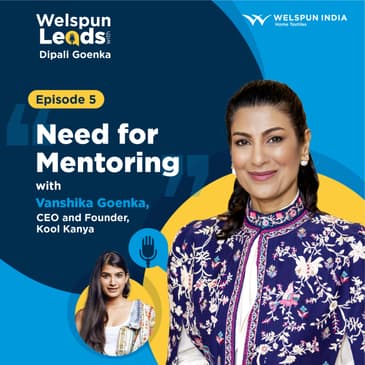
What role do mentors play in your professional development? And how do you seek out the right mentor for yourself? Host Dipali Goenka, CEO and MD of Welspun, and her daughter, Vanshika, Founder and CEO of Kool Kanya, answer these questions in this next episode of Welspun Leads. They have a candid chat on mentorship, their journeys, and the challenges they've overcome.
[00:00:00] Hello and welcome back to Welspun Leads where Diwali going to.
[00:00:04] I'm Diwali going to see you and join managing director of Welspun India.
[00:00:09] Through this podcast, I will share my thoughts across various topics that are
[00:00:15] relevant to grow the company and industry at large.
[00:00:28] Childhood heroes cast a lasting impression and somewhere throughout life.
[00:00:35] We tend to emulate them and the ways of thinking.
[00:00:39] In my life, my mother had a huge impact on me.
[00:00:42] I used to watch her with amazement at how through sheer discipline, endurance and
[00:00:48] resilience, she multitasked her way to managing herself and her work.
[00:00:56] My upbringing and the values she instilled in me stayed with me, especially with
[00:01:02] regards to how we should rise above ourselves and contribute to the society.
[00:01:10] Somewhere deep inside me that yearning to make a difference was goading me to
[00:01:16] foray into uncharted territories.
[00:01:19] And in my case, it was the big daunting male dominated world of textile
[00:01:25] manufacturing where I wanted to make my mark.
[00:01:30] So in 2002, when I expressed my desire to join the business to BK, he
[00:01:37] categorically told me that I will be treated as another Welspun employee and
[00:01:43] not his wife that I will have to learn the ropes if I have to succeed.
[00:01:49] Leaving aside my maternal guilt, I took the plunge to join the business.
[00:01:55] My older daughter Radhika was 10 and the younger one, Vanshika, was 7.
[00:02:02] Yes, there were occasions when I missed attending my daughter's school's
[00:02:07] functions and there were several moments when the guilt tore me inside.
[00:02:12] But I knew that as time passes, my daughters will realize that I looked
[00:02:18] at my work as a mission and had set out to change the paradigm of how
[00:02:23] women are treated at the workplace.
[00:02:26] Not just that, my mission was to empower women across the spectrum and
[00:02:32] help them realize their potential.
[00:02:36] Over the years at the helm at Welspun, we have managed to go closer
[00:02:41] towards that goal.
[00:02:43] Today, my daughters are 32 and 29 respectively and have their own
[00:02:48] women's centric ventures with Vanshika running a successful career
[00:02:53] counseling site for women called Koolkarnia, which has over 3 lakh
[00:02:57] active users.
[00:03:00] In this journey, the single thread that emerges is the need for good
[00:03:05] mentoring.
[00:03:06] My mother mentored me and BK and I mentored her daughters.
[00:03:10] I'm proud to say the bug that drove me to do something beyond
[00:03:14] mere business has with them too.
[00:03:17] The concept of mentoring is yet to catch up fully.
[00:03:22] Growing up, the youth today will do much better with the help of a
[00:03:26] good mentor.
[00:03:27] Today, we have good teachers, but a mentor is a teacher and more.
[00:03:34] Mentoring is often one component of a program that involves
[00:03:39] other elements such as tutoring or life skills, training and
[00:03:44] coaching.
[00:03:45] The supportive, healthy relationships formed between mentors
[00:03:50] and mentees are both immediate and long term and contribute to
[00:03:56] a host of benefits for mentors and mentees.
[00:04:00] Mentoring has also been linked in studies to social emotional
[00:04:05] developmental benefits, improvements in youth perceptions
[00:04:09] of parental relationships and better prospects for moving
[00:04:13] on to higher education.
[00:04:15] I'm curious to know how the next generation feels about this
[00:04:20] and hence I've invited one Shikha, my daughter to join me on
[00:04:25] this podcast.
[00:04:30] Hi, one Shikha.
[00:04:31] Welcome to Wellspin Leads.
[00:04:34] Hi, how are you?
[00:04:35] I'm good.
[00:04:37] So how does it feel one Shikha to start something like cool
[00:04:41] Kanya and how has it been so far for you?
[00:04:45] So it's been, we started at the end of 2019 and it's been a
[00:04:51] roller coaster to say the least.
[00:04:52] We started with a mission to help every woman out there create
[00:04:56] a career that she loves and we essentially bridge the gap between
[00:05:01] college and your first job.
[00:05:02] We teach you what you don't learn in class and we have
[00:05:05] blogs, we have a thriving community of over 300,000
[00:05:08] users and we have learning and courses as well.
[00:05:13] So in terms of how do I feel to have started cool Kanya is
[00:05:17] I was actually reflecting on this yesterday and I think I
[00:05:21] feel actually proud and also it's so interesting to see
[00:05:26] our own growth, right?
[00:05:27] When you look back and even just at old photos or even
[00:05:30] old emails and you're like, oh, I would have replied to
[00:05:32] this so differently today.
[00:05:34] And I think that is a heartening moment that, you know,
[00:05:36] oh, wow, I have grown and I've learned so much that maybe
[00:05:40] an MBA course would not have taught me by starting something
[00:05:42] on my own and made so many mistakes and that's the best
[00:05:46] part of the journey when you look back.
[00:05:48] So yeah, that's how I feel.
[00:05:51] Why did you start it?
[00:05:52] One Chika, what was the reason?
[00:05:54] What inspired you to start cool Kanya?
[00:05:57] To I think to a large extent you but like, you know,
[00:06:01] I think just growing up in this whole Marwari environment
[00:06:05] per se where your only two daughters and you know,
[00:06:08] whether it's any social function,
[00:06:09] your parents always ask that, you know,
[00:06:11] do be tea I can't concern Haliga, which is always at the
[00:06:14] background when you're growing up.
[00:06:17] I think that that somewhere maybe as a five year old,
[00:06:19] six year old affected me where, you know, I always I had
[00:06:22] decided that, you know, I'm going to prove to be better
[00:06:24] than a son would have been.
[00:06:26] And after that, I went through college and I started working
[00:06:30] with the Sanity Pat company.
[00:06:32] And when you're working with the Sanity Pat company,
[00:06:34] you expect more women in the room.
[00:06:36] But meeting to meeting and we're looking at redesigning
[00:06:39] the Sanity Pat and they're only men.
[00:06:41] Sanity Pat is never going to be won by a man.
[00:06:45] So that's when I started researching that where the women
[00:06:47] in the room, you know, why do women leave the workforce?
[00:06:50] And that's where the idea of cool Kanya came about.
[00:06:53] So tell me one thing like for me, when I when I talk
[00:06:57] about well spent India where now there are 25,
[00:06:59] 26% women but till today, I feel, you know,
[00:07:05] even the diversity sometimes gets challenged.
[00:07:09] What would be that ecosystem that you would like to create
[00:07:11] even in cool Kanya or in the corporates that would actually
[00:07:15] attract more millenials and more diversity in an organization?
[00:07:20] I think diversity or having women stick in in the
[00:07:24] workspace starts early, right?
[00:07:27] They need to be they need to have role models and mentors
[00:07:31] at the very beginning setting the example of having
[00:07:34] both a family showing that you can deal with life changes.
[00:07:39] I think so that's number one.
[00:07:41] So they need to have that aspiration that that example
[00:07:43] that okay, it's been done so I can do it as well.
[00:07:46] And when they start going through the life changes, right?
[00:07:49] Whether it's marriage, whether it's kids, they need to
[00:07:51] have a place to start talking about what they're going
[00:07:53] through.
[00:07:54] They need that sense of community and I think both
[00:07:57] of those are very important to help women stick in
[00:07:59] the workforce.
[00:08:01] And that's why I think mentorship like, you know, is key
[00:08:04] of this as well.
[00:08:06] So I think those are the two most imperative things.
[00:08:10] How would you define that mentoring?
[00:08:12] I mean, what would be that safe space for mentoring?
[00:08:16] I'm in corporates in corporates.
[00:08:19] First of all, I think you need to genuinely a respect
[00:08:21] the person you that person's journey needs to be
[00:08:24] relatable to yours.
[00:08:25] Otherwise, if it's not relatable, the advice would
[00:08:28] not be that applicable.
[00:08:30] Third is you need to be able to be yourself with that
[00:08:33] person.
[00:08:34] I strongly believe life is work and work is life.
[00:08:37] You cannot separate the two they both clean to each
[00:08:40] other.
[00:08:41] So when you're speaking to someone or, you know, having
[00:08:44] an honest conversation, you should you have to be
[00:08:46] the ability to even talk about what's going on at
[00:08:48] home.
[00:08:49] Right?
[00:08:49] Only then holistically can you sort of talk about your
[00:08:52] issues, solve your problems.
[00:08:54] I also feel when you're looking at a mentor, even
[00:08:57] when the corporate face space, your philosophies need
[00:08:59] to be aligned.
[00:09:00] If your philosophies or your value systems are not
[00:09:03] aligned, it probably won't work.
[00:09:05] So I would say these are a couple of things when you
[00:09:07] look for a mentor and one thing at least in my
[00:09:11] journey, even when starting cool gun, you're
[00:09:13] looking for a mentor.
[00:09:14] It's sort of like going and meeting multiple people.
[00:09:17] Right?
[00:09:18] Everyone and then you find one person who you
[00:09:20] connect with and that person becomes a mentor.
[00:09:22] It's a journey.
[00:09:23] You're not going to find a mentor be like, okay,
[00:09:24] I'm just gonna do that.
[00:09:25] It's a journey to meet people.
[00:09:28] You have to have conversations with people, you
[00:09:30] know, go for that coffee, go for that lunch, meet
[00:09:33] people, talk about what's going on in your life and
[00:09:35] you will see who you connect with to really find
[00:09:37] a good mentor.
[00:09:39] So you spoke about your corporate one.
[00:09:40] Chika, you know, my biggest challenge at
[00:09:42] Wellespen India where, you know, most of the
[00:09:44] population is at the factory and there we
[00:09:47] have the diversity say about now 27 28%.
[00:09:52] What do you think could be the diversity mentorship
[00:09:55] there?
[00:09:56] Because I think that's my biggest challenge here at
[00:09:59] the corporate.
[00:09:59] It's easier to mentor.
[00:10:03] I mean, from your cool, kind of experience, how
[00:10:05] do you think that could be an opportunity and what
[00:10:08] do you think we should be doing there?
[00:10:09] When you talk about smaller cities again, I would
[00:10:12] go back to that.
[00:10:13] They need to see an example.
[00:10:14] They need to see their sister or their, you
[00:10:17] know, aren't having made it then because that
[00:10:20] it needs to be relatable.
[00:10:21] That's when someone's journey inspires you, right?
[00:10:23] Because they've come from the same roots as me and
[00:10:25] they've done it.
[00:10:26] Maybe Karasakti, right?
[00:10:28] So that I think is one and number two again,
[00:10:30] community, they need to have those circles where
[00:10:33] women are talking about each other.
[00:10:34] Keenohi ghar mein yeh ho raha hai.
[00:10:36] How did you manage it?
[00:10:37] Oh, apne kaam kaisi balance kya?
[00:10:39] You know, those are the kind of conversation
[00:10:41] that plays out and will help them also
[00:10:43] grow in their career and help them also lean
[00:10:45] on each other because I think that womanhood
[00:10:47] and that friendship can actually help all of
[00:10:50] them come together and grow together.
[00:10:52] I think I agree with you because I remember
[00:10:55] one anecdote that I have is about a girl called
[00:10:58] Avni Bhadra.
[00:11:00] We did a program with Walmart and it was
[00:11:03] one of the diversity programs that we did
[00:11:05] where she was chosen out of 2000 factories
[00:11:08] to represent, you know, India and she went
[00:11:11] from Manjar to Arkansas and that created
[00:11:15] an aspiration across the communities and they
[00:11:18] all wanted to be like her.
[00:11:21] And I think that's the way it should be.
[00:11:24] And I think we have to have more and more
[00:11:25] up knees there.
[00:11:27] Yeah, one woman shatters a glass ceiling.
[00:11:29] She makes it easier for all the others to come ahead.
[00:11:32] True that.
[00:11:34] So actually now coming to mentoring,
[00:11:36] I've always wanted to ask you this.
[00:11:38] You've paved the way for so many women.
[00:11:40] Who is your mentor when you started out?
[00:11:45] No, one sugar.
[00:11:46] I think for me.
[00:11:48] It's been not an easy one though starting in
[00:11:52] Wellesbury, India, but for me, my mother has
[00:11:55] been an, you know, Nani has been somebody
[00:11:58] I took inspiration from.
[00:12:00] But gradually I do inspiration some somewhere
[00:12:05] from somebody or for myself itself.
[00:12:07] I wanted to.
[00:12:09] I think, oh, yeah.
[00:12:10] Somewhere.
[00:12:12] I think for me it was the kind of strength that I
[00:12:18] I took and kind of a determination to pave a path.
[00:12:23] And and the reason when I started off was also
[00:12:26] the reason what you said was that I wanted to
[00:12:30] open the doors for my daughters because again,
[00:12:33] it was a reason that I started working and
[00:12:35] you know that because having two daughters
[00:12:38] then would have been like and I wanted to
[00:12:41] carve a path for both of you to show you that.
[00:12:44] No, there is something beyond what everybody
[00:12:48] thinks it could be beyond what people think a woman
[00:12:50] role is.
[00:12:51] Yeah.
[00:12:52] Awesome.
[00:12:53] Today how do you mentor people?
[00:12:56] You know, again, mentoring is about a conversation.
[00:13:01] Mentoring is about sharing anecdotes out of my
[00:13:06] experiences about my journey.
[00:13:08] And I think that's the way I think I have a
[00:13:11] conversation or mentor people and also telling
[00:13:14] them that it might be looking difficult, but
[00:13:18] that's the path you need to take, but it'll get
[00:13:20] easier as you go forward.
[00:13:22] And definitely I think creating more and more
[00:13:26] communities at Wells Pineda where, you know,
[00:13:29] women can reach out amongst their peers,
[00:13:32] talk to them, relate to them.
[00:13:36] Is where, you know, I'm looking at driving West
[00:13:39] Van India too.
[00:13:40] And another question I had was, can someone who
[00:13:44] are super close to be your mentor?
[00:13:46] Like your mother or, you know, a parent?
[00:13:50] I feel the biases come in there.
[00:13:54] Like for example today, I'm looking at you with
[00:13:56] awe and pride.
[00:13:59] But I think that's not something that'll and I
[00:14:01] think mentoring has to be unbiased because you
[00:14:04] are guiding somebody for the right or the wrong
[00:14:08] or other path that she's taking.
[00:14:10] And I think it has to be something very unbiased
[00:14:13] and not somebody can give that path when they
[00:14:16] related and feel close to you.
[00:14:20] So Anshika, tell you one thing.
[00:14:23] What do you look in for a mentor?
[00:14:25] When you began as well?
[00:14:28] I think when I began, one of the first things
[00:14:32] I actually did was note down.
[00:14:34] Why do I need a mentor?
[00:14:35] So I think you need to determine your need, right?
[00:14:38] Is there a certain aspect you need helping?
[00:14:41] Are you struggling with where you are at work?
[00:14:43] What exactly is your needs?
[00:14:45] Be very clear on what your need is will help
[00:14:47] you actually find a mentor more easily.
[00:14:51] Second, like I even said earlier, is your values
[00:14:53] need to be aligned, your values, your life
[00:14:55] philosophies need to be aligned because again
[00:14:58] that is that helps in a free flowing conversation
[00:15:01] and being more honest.
[00:15:02] Third is that person needs to be able to give you feedback.
[00:15:07] You will only grow when you get feedback, both
[00:15:10] positive and negative.
[00:15:13] So I think that's the third thing and I would also
[00:15:15] say someone who challenges you.
[00:15:17] You need a mentor who you go to with the goal
[00:15:19] of okay, I want to achieve X.
[00:15:21] He'll say no, why can't you achieve Y?
[00:15:23] Right?
[00:15:23] Someone who pushes you and challenges you.
[00:15:25] So these are a couple of things that I looked for
[00:15:27] in a mentor and I think they helped me find someone.
[00:15:31] So if I take you back when you graduated or in your
[00:15:35] college days, what did you think?
[00:15:37] What, what would you do differently?
[00:15:40] I would be less afraid of failing and less
[00:15:42] afraid of what people would think.
[00:15:44] I think failure or failing mistakes are the best
[00:15:48] thing that can happen to you.
[00:15:49] They're the greatest teachers and I think
[00:15:52] they just have a bad reputation, right?
[00:15:55] Failing is not a bad thing.
[00:15:57] Failing helps you move forward.
[00:15:59] Failing helps you learn.
[00:16:01] And as long as you're failing forward, like I say,
[00:16:04] right, you're progressing.
[00:16:07] When I look back at cool Kanya, I probably should be
[00:16:10] two years ahead of where I am.
[00:16:11] Maybe if someone had more experience than me, but
[00:16:15] I have learned so much in those two and a half
[00:16:18] years where probably I would not have learned
[00:16:20] either an MBA or either working somewhere else.
[00:16:24] So failure is for me are the biggest teacher
[00:16:26] and the second point, forget what
[00:16:27] people say.
[00:16:28] You know, it doesn't matter.
[00:16:31] You have to be true to yourself.
[00:16:32] You cannot tell me people who will keep throwing
[00:16:35] stones at you along the way.
[00:16:36] You have to ignore it.
[00:16:37] If you keep barking at everyone who's barking
[00:16:39] at you and barking back at them, he'll just
[00:16:41] slow you down.
[00:16:43] So just move forward.
[00:16:44] Know what your path is, what your goal is.
[00:16:47] Focus on that.
[00:16:48] The rest is just noise.
[00:16:50] So yeah, what could you have done better
[00:16:51] at cool Kanya?
[00:16:53] I think have a stronger business model from
[00:16:55] the day one.
[00:16:57] I was always under the impression that, okay,
[00:16:58] I'll get the users and I'll figure it out.
[00:17:00] I think that I would have changed and probably had
[00:17:03] a very clear path from day one versus
[00:17:06] you know, where I'm today.
[00:17:08] Where we know where we're heading.
[00:17:11] So yeah,
[00:17:12] I hope you found this story interesting.
[00:17:16] Do like share and subscribe for more such
[00:17:19] insights in the coming months.
[00:17:22] Till then take care and stay healthy.
[00:17:25] Thanks much to go.