
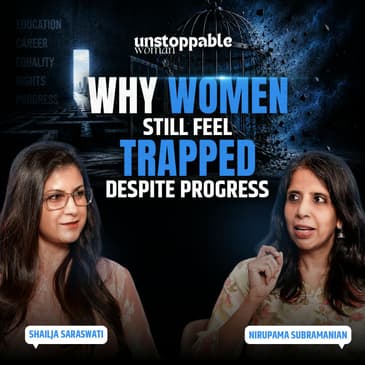

Women today have more education, more opportunity, more visibility, and more awareness than ever before.
So why do so many still feel trapped?
In this powerful conversation, Shailja Saraswati sits down with leadership coach and author Nirupama Subramanian to explore one of the most important questions facing women today:
If awareness has increased, why hasn’t transformation kept pace?
Together, they unpack the invisible forces that continue to shape women’s lives—from good girl conditioning and the burden of invisible labour to societal systems that were never designed with women in mind.
This is not a conversation about empowerment slogans.
It is a conversation about freedom, self-trust, inner authority, and the gap between knowing and becoming.
In this episode:
• Why awareness alone is not enough
• The hidden cost of being the “good girl”
• Why women often feel more relaxed at work than at home
• The difference between cognitive awareness and internalised awareness
• The invisible design problems that continue to hold women back
• Why permission remains one of the biggest barriers to change
• How women can reclaim self-trust and stop doubting themselves
• What it truly means to be an unstoppable woman
One of the most powerful insights from this episode:
“An unstoppable woman is a woman who has stopped doubting herself.”
If this conversation resonates with you, share it with a woman who needs
Chapters:
00:00 - Introduction: The Gap Between Awareness and Becoming
03:45 - The Cost of the "Good Girl" Conditioning
09:20 - Cognitive vs. Internalized Awareness
15:10 - The Sanctuary of the Workplace
21:35 - Unpacking Invisible Labor and the Second Shift
27:50 - Systemic Flaws: A World Not Designed for Women
34:15 - The Barrier of Permission
40:40 - Reclaiming Self-Trust and Overcoming Doubt
47:00 - The Leadership Journey: Coaching the Inner Self
53:15 - Concluding Thoughts: What It Means to Be Unstoppable
[00:00:00] Be very honest and tell me has the gender dynamics changed? Not significantly. And when you said that we are aware and we have more information, we are self-educating ourselves. Many women are aware of these things and there is a gap. We are not having that conversation yet. Where is the fear coming from? Thousands of years of conditioning. But there is so much awareness Nirupama.
[00:00:27] I think there is cognitive awareness but internalized awareness taking into your life, there is a big difference. But the framework and the design of the society is not serving us for what we are trying to do and bring a change. So there is research, there is data to show that the world has not been designed for women. An unstoppable woman is a woman who has stopped doubting herself.
[00:00:54] Is there ever a season for you Nirupama where you looked powerful on the outside, in the public, but you were rebuilding privately?
[00:01:22] I think that keeps happening from time to time. I can't say there has been any one situation. There have been many times in my life where because of the nature of my work and what I do, I do present a powerful persona. But there is lots happening beneath the surface.
[00:01:42] In fact, an analogy that I like to use is that of a beautiful swan gliding across a lake but people don't see the feet beneath the surface paddling furiously just to be there. Okay. And we shall deep dive further to understand the journey of this swan. That was the world I knew. That was the world I knew. But when I moved to Delhi, of course, in the 1970s, it was like moving to a different country. You don't have this exposure.
[00:02:11] You didn't know what was happening in other parts of the world. So that was quite a big change and transition that I went through as a child. Chennai to Delhi. Chennai to Delhi. Yes. And how did you adjust? Adjust is the right word, you know. And I didn't know the language, of course. I didn't know Hindi. And those days, you know, that was pretty much what was spoken in school. So I had to learn the language pretty quickly.
[00:02:41] And yeah, I remember, you know, an interesting incident when I was invited to somebody's birthday party. It was probably eight or nine. And in the South, whenever there's a special occasion, you're dressed in a particular way. You wear this long silk skirt. We call it a power dye because that's what you wear for special occasions. So my mother said, of course, you're going to a birthday. Yeah. Wear this.
[00:03:06] And when I went there, the girls looked at me and said, I remember this like this is not a fancy dress party. And I realized, oh, I'm different a little bit from everybody else. And then I was like, no, I'm going to, you know, not be different because as a child, when you're nine, ten, you don't want to adjust and assimilate. Okay. So. So did that force you to blend in that experience?
[00:03:32] Now, of course, I don't recall, but I think it was voluntary because my parents were very much like, you know, you do you. Right. So, you know, you I was having I had two long braids and I pretty much spoken Tamil at home. So there was a mix of who you are. But when you go outside to the school, you blend in. Got it. You do want to have friends. You do want to get along.
[00:03:59] And, you know, by the time I left Delhi, which is after seven, eight years, I'd made a lot of very good friends. I was a part of the gang. I had cut my hair, which is a big thing for good girls from our families. Like you grow your hair really long. You don't cut it. But my sister and I both, you know, we cut our hair and we look like anybody else. Right.
[00:04:23] So I think on the inside, of course, we're very true to who you are in terms of the food you eat, the language and the way you celebrate certain things and and the values. So but on the outside, you do blend in and you become a part. And I think for me, therefore, in the work that I do, inclusion and belonging has always been an important part of it. Okay. How do you feel included?
[00:04:52] How do you include yourself at the same time, retain certain authentic aspects of who you are without getting completely lost? Yeah. When I came back to Chennai, I went into a co-educational school. Okay. 14, 15. Okay. And and then when you're older, I used to cycle to school when I was in Chennai. And then two years later, I took public transport to school because I was old enough to take public transport.
[00:05:20] And that's when you slowly started becoming aware of the world around you. It's not very safe for women in public transport. And, you know, I spoke about this. And in fact, the memory just came back to me very recently when I was preparing for one of my talks that, yeah, you you take it for granted that you are going to get bumped and jostled. And if I can use the word molested in a public transport, and it's you learn to watch out.
[00:05:47] And you're wary when you're out into the world, you become aware of the male gaze. And it's not always friendly. Did you carry your school bags in front and back? Yeah, yeah, yeah. And a compass, like a compass out of the geometry box, like, okay, I've done that. One bag in front, one bag behind. And then you wedge yourself. But the interesting thing was I never questioned it or raged against it. I felt it. But it becomes a very lonely journey.
[00:06:14] Yes. And incumbent upon you to navigate the world without expecting the world to change. That was the time. I mean, where you where you're coming from compared to what's happening now. Right. Like everyone in their own islands. Yes. Protecting the islands. And it was a done thing. It was a done thing. It's the way you navigate the world. Yeah. And it is, you realize it is a dangerous place for women and you learn to adjust and navigate and circumscribe yourself. Hmm.
[00:06:43] I'm not going to put myself in any situation where they could be even a hint of danger. And then the parental instruction started getting, strangely enough, more strict as you grew older rather than when you were a little kid. So I started noticing those. It wasn't that I decided I wanted to work with women at that stage. But now when I look back, all those messages. Signals had started coming.
[00:07:09] Signals had started coming and I started feeling very strongly that it's not fair. Right. One of my core values is justice and equity. So I had double standards. So I started noticing that these differences existed. At that time, it's not like I wanted to do anything. I don't think I was an activist or anything in my early teenage years, but it was building up. Opened up another world. Opened up.
[00:07:38] Opened up another world. And that too, you know, it's different from moving to another world as a child. And now as a 22 year old young woman, 21, as an adult stepping into that world was very exciting. It was, it was great. It was a taste of freedom. And I remember feeling that's the word feeling free in a way. Of course, it was still campus.
[00:08:06] You were still sheltered from the outside world, but it was a co-educational campus. But what was happening in terms of your definitions changing of gender dynamics? So because you were sheltered within home and exposed to all girls environment. And then you're moved to a co-ed. Yeah. That also in another city. Yeah. Completely far away. Bihar in those days was like a little world. And, and the first thing that hit me was the gender ratio.
[00:08:36] I think we were about seven girls in a class of 57. So big difference. Hmm. And you start becoming aware. And interestingly, that's when you also realize to some extent your own power and selfhood. Right. At the same time, you also realize how you want to conduct yourself. Right.
[00:09:04] How can you be free at the same time contained? Right. Boundaries. And everybody had their own definition, but that was really great learning in terms of, I really want to enjoy this freedom. But I also want to know, you know, what are my boundaries and how do I safeguard myself in this environment without parental supervision?
[00:09:31] My nature is that I do think a lot and I like to process things. Hmm. So that is something, you know, which I, I do because it's, it's just different kinds of personalities. Let's say as a teenager, Nirupama as a teenager, right. Um, going back in time. Yeah. Something is happening and you're processing it. What was your process to process it? Was it self reflection? Was it journaling? Was it self talk?
[00:09:59] Um, yeah, I used to keep a diary as a, as a teenager. So a lot of writing. I'm, I'm an author that in word speaks a lot. So I used to journal and there were restrictions, right? As a teenager in a co-ed school, I was not allowed sleepovers, no late night parties. There were those restrictions. And as a typical teenager, when I went back, I saw, I had written that I don't like this. I want more freedom. I'm not happy. My mom is too strict. She doesn't let me do these things.
[00:10:27] And there was, uh, there was resentment. Yeah. Uh, which it took me a long time to realize and say, Hey, uh, it was done with good intent, but I felt restricted. Uh, and which is why I said freedom when I went, uh, to a hostel was very, very important for me and freedom and autonomy is another important value. So I felt the restrictions at that time, uh, where no, no sleepovers, no late night parties,
[00:10:55] uh, no going on bikes with boys. I was the good girl. So let's, let's assume, uh, we had taken those restrictions out. Hmm. Would Nirupama take and do anything else with the freedom she got? I think it's difficult to say what I would have done at that time, but I don't think so. Okay. Uh, I would have liked the freedom to make up my own decision as to whether I want to go for this is more important.
[00:11:24] That was more important, right? Maybe it was a lame party that I didn't want to go to. Uh, but I would have liked to have that decision for myself. The decision power, the decision power and autonomy over the choices that I make. Now I do understand as a 15 year old in those days, probably, you know, parents had to, you know, have those restrictions, especially because Chennai at that time, every parent pretty
[00:11:52] much had restrictions apart from a handful. So it was not abnormal either, but I felt it as a restriction, but knowing who I am, I don't think I would have broken too many rules or boundaries because I could see that when at 21, when I was given all this freedom without any supervision, I didn't suddenly go berserk and become wild party girl.
[00:12:21] By then, obviously you, you, you have been prepared for the work. Let me say, yeah, if I make mistakes, they are my mistakes. Hmm. So sense of ownership was very high. Very high. I think even now, the reason I left a corporate career and a structured system very long ago was because I realized autonomy and control over my time and the way I spend it is really important to me. Interesting. We'll come to that. Yes. So now take us through your first job.
[00:12:51] First job. Yeah. Went to XLRI, did very well. Academic excellence was, you know, something that was important for me. So I was among the top five. I had a choice of, you know, which organization what I wanted to do. I chose Citibank because in the 1990s, a foreign bank was supposed to be a very, very attractive place to be. Sought after. Sought after.
[00:13:15] I had a choice between Unilever and Citibank and I said, let's take Citibank and see what the world has. And moved to Mumbai, lived in a nice Chamri, enjoyed a lot of friends. And again, you're right free. You're living on your own. You're making good money. You're living in Pali Hill in Mumbai. The world is a very exciting place. So I think that that was good. Then a year after that, I got married to my batch mate.
[00:13:43] So that was one way I used my two years at XLRI as well. So Rajesh and I were married in 95, still stayed with the bank, moved to Kolkata. Interesting. Moved to Chennai. But I think over the period of time, I realized that I'm not, I mean, I'm not really well suited to banking specifically. And I may not be well suited to a large organization. Where did that clarity come from?
[00:14:11] That clarity came from the fact that I really didn't enjoy my job, the actual day to day job. I think of myself and I think I am a creative, independent thinking person. And even though I had done B-com and MBA in finance, I realized just because I was good at something and I could learn something, it didn't mean I enjoyed it.
[00:14:38] And if I didn't enjoy it, then I'm going to hit a lid where I'm never going to be in what I like flow. Right. It's never going to be the thing. How old were you then? 23, 24. Like you had so much clarity at 23. Not really. I know what, I knew what I didn't want to do. I had no clue about what I really wanted to do. Okay. I knew I didn't want to be in banking. Okay. And I didn't know what I wanted to do. And I knew what I had to do.
[00:15:06] What in particular in banking was the trigger that, that you, you, you stayed there, you figured out I have kind of the best organization, best brand. And it is a, this is what it is. The corporate has to offer. Then it's not for me. Yeah. That's a huge lot of clarity at 23. A lot of people have done it. So I won't say I'm there. Yeah. But I'm meeting somebody for the first time. Yeah. Clarity. I had clarity on that side.
[00:15:36] It took me 25 years. It's very fascinating for me. I'll also tell you my, I see my daughter at 24 and her friends, a lot of them have clarity about what they don't want to do. 2026. Yeah. 22, 23. Also, a lot of them have clarity about what they don't want to do, but probably not a clue about what they really want to do. Right. So it's like, yeah, I don't want to do STEM. I don't want to be a doctor. I don't want to be an engineer, but I really don't know what is that sweet spot. Not star. Not star. I really don't know.
[00:16:06] And I was in the same space and I know I took the job because of the external reasons, great brand, good money. I got it. I was good at it. Right. So that seemed like all the right reasons to take up a job. Check, check, check, check. Seen as successful by the rest of the world. Very important. I think it was important. It was very important for me at that stage. You know, in my yearbook, I was like, okay, she's the one who's going to be successful, you know, who's doing all these things.
[00:16:36] I was cultural secretary. I did a lot of things. It was important for me to be seen as successful in the conventional sense, which is association with a big brand, a position, a status, a certain amount of money that you're drawing. So that was important to me. And I went for the job that I thought gave me all of that. And I honestly don't regret it because in that moment I had clarity that I do want this. Sure. But after experiencing it, what do you do on a daily basis?
[00:17:05] You're reconciling some statements. You're signing some checks. You're trying to understand some products which don't really make sense to you. Trade, finance, deep down, I didn't really care. And I realized I'm not also going to be good at something. Right. What I did enjoy in Citibank was actually delivering two, three internal workshops. I made very good presentations. I was good with clients. I enjoyed the conversation. So it became a testing lab for you. It became a testing lab.
[00:17:34] Interesting. Because when I was in Citibank, they were really good. They sent me to all these great training programs. So I loved being a participant and learning. And I admired the people who were imparting that. I was like, wow, that sounds like something interesting. You will enjoy. And when I went to meet clients in my third job, I was what they call a product sales manager. It was client relationship. I enjoyed having those conversations.
[00:18:01] I actually enjoyed making presentations, which is standing up and communicating to a small group. And I, and it just started saying, hey, this is what I'm good at. This is what I'm enjoying. Not doing credit analysis or looking at balance sheets. Unfortunately, even today, I don't, I don't enjoy that as much. So which led me to explore, hey, what could I do? So you started thinking after how many years in the job?
[00:18:29] About two years, but it took me about five years to leave. What clarity. I'm glad you think so. But at that time, it was very confusing. I've lived half a life. Yeah. To figure this out. It was, it was, it was confusing. And I was like, hey, there are so many, you know, there's so many good things. Citibank, good money. I like the people I worked with, nice colleagues.
[00:18:55] All my good friends in those days were from the bank itself. Yeah. Some social prestige and status. Am I going to give that all up? But for what? I didn't know for what. So I got married in 95 and I continued working. It was important for me. I said, my husband and I are classmates. So I think I thought I had a legitimate right to a career just as anybody else done an MBA and you do an MBA only because you want a full fledged career.
[00:19:23] So I continued working, moved across geographies, but pretty much by that time, I'm like, I don't think I'm going to last year for long. Sure. And I also took those moves because my husband moved. Fair enough. Right? Because, and this is interesting because later on when I look at it, maybe at the back of my mind, I was also thinking this is not going to be a permanent job for me. This is not where I see myself parking. Parking.
[00:19:53] It's not like I have ambitions to move to vice president soon. So if he wants to go and pursue this career, it's okay. It's okay for me. It was very much by choice. Because what happens is the flip side is sometimes women come and they talk about that the opportunities became minimal because the husband was moving quite a bit. I would agree to a large extent. Yeah.
[00:20:20] If I was serious about making a career in the back. It would have impacted you in a different way. It would have impacted me in a different way. And I wouldn't have taken that first move from Mumbai to Kolkata. Nobody wanted to go to Kolkata in those days. Yeah. But I think by the end of the year, I was like, I don't know whether I'm going to last this long stint in not just Citibank and financial services. Financial services. And I don't know what I'm going to want to do. In the absence of that, let me go along.
[00:20:50] Sure. And I also think that this has been deep conditioning that women follow the husband. The women follow, you know, the women, the women follow men wherever they go. And I've had those examples and experiences all around me. So it was okay. It was okay, actually. It was okay for me at that point of time. Yeah. So it's like almost like a blind spot. It was a big blind spot because at that time I didn't think of it as why should I sacrifice my career.
[00:21:20] Which women won't do today. Which I think you, everybody's making choices. Yes. But you, you, you make the choices from a very informed place of what's important for you. And I think there were two reasons why I did that. One, I didn't see a long term career. I wasn't passionate about rising to the top after the year. I knew that. Sure. Second, the deeper conditioning that, hey, at some point of time, you might want to start a family in which case your career would become secondary. Sure.
[00:21:48] So I think that thought was there. Sure. At that point of time as well. Okay. And then you left City. Yeah. That was, that was interesting. And you didn't have the North Star yet. No, I didn't. Okay. So I just hit upon it. And I would say I would. Just when you left. Just when I left. So I was like, okay, I have to leave City Bank.
[00:22:12] Also because my husband moved to Delhi, we were in Chennai and either I hang around because I love my job and I continue to work with City Bank in Chennai, or I hang around, wait for them to give me something appropriate in Delhi, or I leave. So I was in that stage. And then I went to Delhi to visit. And it was just sheer coincidence that I met this person who was to become my future boss,
[00:22:40] who was setting up a training company in India. Okay. And their first clients were the, you know, the company that my husband was working for, Rekit at that point of time. Okay. So I just happened to meet, you know, Rajesh's boss who said, why don't you meet somebody? I know you're looking for something in Delhi and have a conversation. So it just happened. I honestly had no idea what I was getting into, but it sounded interesting. So.
[00:23:09] So I'm cutting it short. I'm sorry. I'm also interjecting. You've been in this space for like good 30, 35 years. Yeah. I would say about, yeah, 25. Yes. Be very honest and tell me, has the gender dynamics changed? You, because you're in the thick of things. Yeah. Yes. Yes. Not significantly. Okay.
[00:23:31] In fact, as more and more women enter the workforce, I have a feeling today it's become a little bit more complex. Why? And I'll tell you why. You know, when you have, when you don't have an awareness about something, like when you don't know a thing, let's take anything unconscious bias. Yeah. Yeah. Yeah. For you, it's the norm. Understood. It's the way of life.
[00:24:00] Like I would assume our great grandmothers did not think of diversity, equity and inclusion. It was a way of life. Right. Today, I see young women, older women, including myself, we are more aware. We feel strongly. We, we see this around the world because our eyes are more open to double standards, to patriarchy.
[00:24:25] And we have now reached that very interesting stage where we have freedom and restrictions. So it becomes more complex to figure out your own balance and nuance around this. Let's hear. We are transitioning. We are transitioning.
[00:24:45] And when you said that we are aware and we have more information, we are self-educating ourselves, but not enough in action is visible for us to then take the full plunge. That's why it's in transition. I think it's in transition. And also remember, it's not just the women, it's the men. It's the other, other half also who need to be together. Yeah. Yeah. In, in I, the way I use it is more empowered. Right.
[00:25:16] We have to, and you know, it's even today. Now I'll give you a very life current example. Sure. Right. Now I don't have, my daughter's grown up. It's just me and my husband. And my cook has gone off to Bengal because of elections. So, you know, a few years ago, I think it would have been out of the question. I'm responsible for, I'm the food provider. Right. Now we are like, we'll figure it out. You take care of this. I'll take care of this.
[00:25:46] Or we'll just go to, we just going to take a holiday and go off somewhere else. I am not taking on the. Replicating the person who's not there. Exactly. I am not replicating the person. Which is still a done deal. Hence in transition. Exactly. Hence in transition. Right. I'm having this conversation. Just hold on to the thought. Just hold on to this. Now you are having that conversation with your partner. Yeah. Yes. Many women are aware of these things and there's a gap. Yeah. You're not having that conversation yet. Yes.
[00:26:16] Where is the fear coming from? Thousands of years of conditioning. And if I may, I mean, that's, that's why I wrote powerful because even as we try to get power in the external world, the thousands of years of conditioning are also equally powerful, inserting pressure and a pull from the other side.
[00:26:39] It is my desire to be seen as a good girl, good wife, good housekeeper that is making me naturally gravitate towards that particular way of being, which is, of course, I handle all of that. And, you know, this is my gendered role. So I need to accept it. But there is also a pull. Now I'm awakened. I have all these ads. I have everybody saying, no, you don't have to do it. You're worth it. You're worth it. Share the load and all of that.
[00:27:08] And then I'm confused as, am I not progressive enough? Or, but if I do this, then I'm going to lose out on domestic harmony. And there is a tension. But there's no provocation happening beyond the tension because the woman is not going to take the lead. There's fear. And in households where it is happening, it might be going either north or south. It could go any which way depending upon your environment. So it's not a given. Right.
[00:27:35] It's not a given that this is how it is. There are choices and options. And therefore, there is tension. And you have to navigate your own way depending upon your specific ecosystem. You know what? COVID in a way did good. Because a lot of these, the balance in the gender roles started happening because there was no other choice. But after COVID, everything has gone back.
[00:28:03] I would say I've had, you know, I do a lot of workshops with women. So we hear really a mixed bunch of stories from COVID. For some women, it was like, hey, that's really opened up and, you know, equal partnering. For some, the load just increased. Because it's all fluid now. It's hybrid. It's hybrid. It's fluid. You're at home. So I remember this, you know, example that one of my participants gave that she and her husband would both be taking calls in two different rooms.
[00:28:32] In-laws were in the house. But when it was time for lunch, she was the one who had to heat the food and put it on the table. And he would not be disturbed during the day. And he would be allowed to be in, you know, in that room and take care. But she had to step out from time to time to take care of the domestic and there was no domestic help also available. Yeah. So while she was able to work. Yeah. She also had to manage the double load.
[00:29:01] And yes, her husband would step in from time to time when he could to check in. But the core responsibility of running the household was on her shoulder. She said, I was very happy that I could escape to the office once COVID got over. It's unfair, you know. It's so unfair. Life is unfair. And what you just said, women feel more relaxed when they go to office. I've heard this so many times, Nirupama. It's not even funny.
[00:29:31] Escape. Right. And, you know, escape, but hopefully you don't escape into another prison. Because if you are in a job that you love and you enjoy in a great work environment, good for you. But I see a lot of women managing very stressful work come back to managing a household, which is also stressful.
[00:29:54] You mentioned something very interesting in connection to what you're just talking is that women in corporate are ending up picking up a lot of executional and operational jobs versus strategy, strategic. Right. Right. So when you said one prison to the other. Yeah. Literally. Yes. What was coming in my mind was visuals that the work is same. One is much more profile on the desk. Yeah.
[00:30:23] And the other is a little more messier at home. Yeah. So if I can share, you know, we just did some research with 1600 women in corporate India based on the six feminine powers model. And we found that two most dominant powers of frequently used archetypes are the Rani and the Ma, which is the executor and the caregiver. Okay.
[00:30:44] So women across career stages do very well or sometimes maybe even over indexing on being the executor organizer, the planner, and the one who is responsible for taking care of the people around her. The two archetypes which scored among the lowest, I would say are the seeker and the influencer, the Dishika and the Apsara, which is really the self orientation.
[00:31:14] So women, and this is not just the 1600 women, but we have data for about 4000 women. And it shows that women spend a lot of energy on getting things done and taking care of people and less on their own needs, wants and desires. So less of self. Less of self, whether it's learning something for myself or expressing myself or indulging in myself.
[00:31:38] And interestingly, a lot of takeaways that I have from women who attended the workshop are self love, self care, putting boundaries, self respect, self respect, because it doesn't exist. I need to take I it's not selfish to take care of myself. So they need permission. They need permission. Usually from themselves. Also, first to begin with, to begin with. But they are feeling that it's from the outside.
[00:32:07] They're waiting for permission from the outside, whereas you're saying it's more of the inner dialogue. Yes. And you might have to have some tough conversations. You may not be ready for that. Or you might need to give up certain things which have been important for you, which is the tag of the nice, good girl. And there is a risk that you will now be the selfish girl.
[00:32:37] But there is a taboo of a conflict at home. Exactly. So are you willing to wade through that? Either it could be an easy way to influence or it could be a minefield that you have to go to get some of this for yourself. Okay, so just hang on. We are clearly talking about gaps. And we are talking about it is what it is. And it's nothing to do with it's just not happened now.
[00:33:05] It's patriarchal disposition, which has been carried forward and subconscious mind is carrying it. Yes. But just to help women, whether it's coaching or training, there's a lot of work which is still left in terms of at least women to start self-reflecting, taking action, and then start talking about it outside. Yeah. And hence, only awareness has come, but no action has been taken.
[00:33:33] So I think you can't have action without awareness. So it's a necessary first step. But there's so much awareness, Nirupama. Look, it's been like this entire thing about women empowerment has been going on for 10 years now. I think there is cognitive awareness. Hmm. But internalized awareness taking into your life. It's, there's a big difference. It is. There's a big difference. Agreed. Yeah. Right? There's a big difference where everybody says, oh, women have to be confident and bold. Yeah.
[00:34:00] Everybody's telling me women have to be confident and bold 10 times. Resilient. Resilient. Oh, amazing. It's all there and outside. But for me to take it and say, what does it mean? What does it mean for me? What does confidence look like for me? Is it quiet perseverance? Is it holding my ground? Is it being bold and outspoken? And what is, to use the language, limiting belief that is holding me back from being confident and showing up the way I want to show up?
[00:34:31] So I would say, cognitive awareness, we have an abundance of it. And I'm doing scrolling. There's all, all of these things. I just, I just want to do like a really bad plug in for all the award platforms out there and forums. They're doing a great job, but it's so incomplete. Just to give that valid validation is really not enough. Yeah. Because I agree with you. It's much deeper work. Yeah, it is much deeper work.
[00:35:00] It's just not surface level. Yeah. And you know, and then I'm just smiling at that because the last one year, most of these awards are paid for awards. In any case, I've got emails saying, well, congratulations, you're nominated. This is, this is how much you have to pay. This is the amount you have to pay. And I think we have to be, you know, careful that we're not just showcasing women as a marketing ploy and a gimmick. Yeah.
[00:35:23] But are we really helping people make changes that suit them at the ground level and also honoring their context? Hmm. Right. Without, you know, without having judgments, there's also intersectionality. Even, you know, two women are not the same. Yeah. A woman, a rural woman who has a lot of autonomy in the way she manages her house. Yeah.
[00:35:48] Could actually be more free and emancipated compared to a woman in the city who has got all the financial stability and the luxuries, but does not have freedom of choice at home. Hmm. Right. So we, I think every woman's context is slightly different. There are common factors. Yeah. So you have to see what are the battles which are important for me.
[00:36:14] And this is what I've realized after working with thousands and thousands of women over the last few years is it's very easy to preach. Uh, but every woman's context is different. Very different. It's very different. Yeah. You know, as a coach. Yeah. And I strongly believe in coaching because it speaks to your context and allows you to make decisions that hopefully serve you. You. Yeah. Yeah. There is, there is no formula. There is no formula. You have to just go.
[00:36:42] I mean, as a coach, we can only be the thinking partner. Only be the thinking partner. For them to go deep. Absolutely. And even when we do women leadership programs. Yeah. Yeah. Usually the ask we get is, oh, women need to be more assertive. Uh, women need better work life balance. Hey, that might be true for 50%, but not for the other 50%. They are grappling with something else.
[00:37:03] There, there are women who have become, uh, so tuned to a masculine way of being, which is I have to be a man in a man's world to get my way. Otherwise I'm not going to be respected. We've seen many prototypes out there. Absolutely. Absolutely. And I'm this tough, you know, hardcore, don't mess with me leader. And what I need to do is maybe to develop my ma more or my kanya more. So that's Veera. That is the Veera. Warriors. I'm the warrior.
[00:37:33] I'm the warrior all the time. It's very exhausting. I want to put down my weapons, but who would I be if I put down my weapons? Yeah. I'll be judged as weak. I'll be judged as weak. But what I'm really longing for is some rest and lightheartedness in my life. So the solution for me is very different from some other woman who has not, uh, evoked the Veera in her at all, or who feels, you know, I can't speak up. I am shy. I understand.
[00:37:59] So I would say, you know, a lot of people do and including myself, we do tend to stereotype saying I'm a Veera, I'm a Dishika. But I always say archetypes are tools. Okay. Imagine you have six tools in your toolkit. You're used to using one or two because that's what your circumstance calls for. But we're doing it unconsciously. But we're doing it unconsciously. Right? Like you're right. Ma and Rani are the top two. Because we've seen in serials. Always.
[00:38:28] We've seen in soap operas. And these two characters are always there. The ones which are rewarded for it. The Kanya and all are not rewarded that much. A certain version of the Kanya is rewarded, which is the obedient, good girl. Yes. The extreme, what I call the extreme Kanya. And this is so interesting. Every time I get a woman in the corporate who's got a high Kanya score, she's actually feeling sad. Why? Why is my Kanya so high? I shouldn't be. Right?
[00:38:55] Because there's a certain extreme version of the Kanya which is socially rewarded, which is the good, sweet, sub-Serviate girl. But the Kanya is much more than that. The aspect of the Kanya which I feel we don't bring out is the light-hearted, easy-going, optimistic Kanya. Right? You know, it's like that movie Chandni. There were two characters, two Shri Devis. Yeah, yeah, yeah. One was the sweet Kanya. Yeah, yeah, yeah. And the other one was Veera. And the Veera all kept saying, come on, you have to become Veera.
[00:39:25] Exactly. Yeah. You know, so it's almost like they say women is Shakti. Yeah. Right? So just going back to your cultural context now, you come from a very powerful one. Yes. Tambram. So Shakti has manifestation. All, right? So there is Saraswati. Correct. Right? There is Parvati. Lakshmi. There is Lakshmi. And we have thousand other goddesses. There is Durga, the fierce warrior. Kali.
[00:39:52] There is Kali, like the fierce, fierce destructive warrior. Yeah. Which is an extreme of the Durga is you can become Kali and really destructive. Yeah. So we have N number of goddesses, but they are all manifestations, I would say, of one source. Right? So which is now if I were to bring that to psychology, that is the self. Yeah. That is me who contains multitudes. Right? I contain multitudes.
[00:40:19] I have all the tools within me, but because of years of conditioning in my context. I've got disconnected with my own power. I've got disconnected with some of my powers, which are the latent powers. I may not pick up and use them. So as a coach you come in their life to say like Krishna, come on, wake up. I'm riding the chariot for you. Exactly. Yeah. So I was actually, last Sunday I was attending this Gita class. It was very interesting. And I was making the connection between, you know, one of the verses and coaching.
[00:40:49] And the teacher there, he said, Krishna was the first and ultimate coach. Right? Who is able to show you. Yeah. And finally you make a decision. Yeah. And finally you come to certain actions when you've exhausted other options. Right? When I'm not able to make the changes and do what I know needs to be done, I come to a coach who can help to point out some of these things and awaken the powers I need. At the same time, remove the blocks and the blinkers. Sure.
[00:41:19] From my eyes. So specifically for you, where did the inspiration come from? Is it the spiritual, the religious context behind the energies or the Shakti in women? Because now we have gone in that tangent. Yes. Is it connected to that somewhere in your mind when you started? Not so much the spiritual part of it.
[00:41:44] But I like seeing connections patterns and connecting the dots. So it was partly from history and mythology. Sure. And you know, one of the inspirations was the book I had finished reading, Chitra Banerjee's Forest of Enchantments, where the Ramayana is told in the voice of Sita.
[00:42:09] But I could also see distinct characteristics of, in fact, I would use the word female leaders among the other characters in the Ramayana. Like Kaushalya as the Maa or Kaikeyi as the Veera, who's also made out to be the villain of the piece. Yeah. And there's the Shurpanaka as the Apsara. There's Mandurjari as more of the Rishika. Yeah. And I said, how interesting, because I can connect that to the leadership work that I do, where I see most archetypes as male.
[00:42:37] But I can't relate to the male language, right? If you say, you see yourself as king. Though we say everybody's ruling a kingdom, irrespective of whether it's a king or queen, it's a kingdom. It's mankind. And I said, why does the default language for self-awareness itself have to be male? You know, you touched upon something very important right now.
[00:42:58] In my head, I'm thinking that if the CEO or the CXO positions are all defined by the male sort of terminology and the fabric, women have never understood the value of all of that because it just doesn't resonate. What is the point? Could be. Right. Because now when you sort of bifurcate into six powers, I can then say, oh, okay, Veera,
[00:43:24] Rani, decision making, kingdom protection, then allies and attack happening. I have a role to play. Yes. And perhaps out of this, maybe there's no role to play there. That's why archetypes are so powerful. Right. Right. So even though man and a woman are both parents, the image I have of a mother is very different from the image I have of a father, the role of a mother and the role of the father.
[00:43:54] They are not parents in the same way. Yeah. Certain things are allowed for the father, which are not allowed for the mother. And certain things are expected from the mother, which are not expected from the father. So when I use the word parent, it's difficult for me to connect. When I say mother, I say, ah, I know what a mother has to do. Right. Ah, father. I know what a father has to do. And these have been in our psyches for such a long time. When I say warrior, who do you think of? Invariably, it's a man with a weapon. Yeah. Right.
[00:44:24] When I say carer. Right now, Dhurundar. Okay. Hyper masculine. Hyper masculine. Yeah. Yeah. Man with multiple weapons. Not a single woman in the movie. Yeah. I've seen only part one. Oh, you know. Yeah. Okay. We can absolutely go into also the... They were wives for all. They were wives. Yeah. They were wives. They were... Because, yeah, that is the hyper masculine things we celebrate. That is why movies, and I've, I've watched a lot of movies and also there was,
[00:44:52] you know, in my book, Powerful as well. But movies that have fierce female protagonists as a warrior don't really do that well. That's true. Statistic supports it. Exactly. Right? Yeah. And even, I mean, I have like people in the industry who are dear friends and I know producers stop putting money behind certain female, very strong female characters. Strong female characters if they're not adequately female also. Right? Yeah. But it's so interesting.
[00:45:21] And I don't know, I could, you know, I just, this is very, this is recency. So I, I'm learning French now. Okay. And one of the ways I decided to learn is by watching French movies. Okay. And I just saw this very interesting movie. It's called I'm Not an Easy Man. Je suis pas non facile. And it's about a male chauvinist who hits his head on a pole and wakes up in a world where roles are totally reversed. Okay. Right. And I think it's come out in English as well.
[00:45:49] And it was fascinating to see how gender roles play out so subconsciously that when I see a man taking care of a child or spending time in front of the mirror, taking care of how he looks, it's so incongruous. Yes. And when you call a plumber and a woman shows up as a plumber, it's again unsettling. Yes.
[00:46:16] And it just made me see there are so many things that are just taken as this is the way the world is. This is the way the patriarchal world is. Women are supposed to do certain things. Men are supposed to do certain things. If one does a thing they are not supposed to do, it's very difficult for both parties to be okay with it and accept it.
[00:46:43] I think what's happening now is women have started embracing male roles much more. Yeah. But men have not started embracing female roles. They are overloaded. Women are overloaded. There's no share the load happening. There's no share the load. That's because it is still seen as very incongruous for a man to stay at home. Yeah. The stay at home dad. But that's a social stigma. It is. It is a social stigma. Right.
[00:47:12] And as long as that is going to be there, we would not have to call equality. How many more, you know, even if we have many, many women CEOs, if that part doesn't change, women are going to get overloaded and we will have burnout. And you see that happening to a lot of women in their forties. They've reached a certain stage in their career. Yeah. And I see so many of them and I'm coaching some of them. They're like, it's not worth it for me to go and become CEO. Yeah. It's just too exhausting.
[00:47:42] And with the perimenopause and menopause. All of that, right? The usual biological clock is not serving me as usual. Yeah. They give up. They give up. Yeah. Because I, and it's not just me. There's research, there's data to show that the world has not been designed for women. Just hold on to this thought. And that's exactly what I was trying to say. Like, you know, we have so much talk and we have so many forums, so many bought awards and so many acquired awards. Yeah.
[00:48:10] But the frameworks and the design of the society is not serving us for what we're trying to do. Yeah. And bring a change. So who's going to change that? Yeah. We can change the human. We can build the inner mastery, the personal mastery, which both of us are working towards. But who's going to change the design of the society? That's beyond both of us, Nirupama. Shalja, I think you need to have enough number of people. You need to have a certain group.
[00:48:37] I don't know what that number is, but you need to have momentum built around a certain number of people for it to shift. Right? So shift hasn't happened yet. A significant shift hasn't happened. We are seeing movements like this. Right? And when you have movements like this, there is also going to be backlash. Yeah. You had the Me Too movement and now you see diversity and equity efforts across the world are just dying down. There's been a backlash. There's been a pullback.
[00:49:06] More crimes against women are being reported. It simply could be also because they are being reported, but there are more crimes because whenever anybody who has not been in power traditionally tries to take power, those who hold the power don't want to give it off.
[00:49:22] They don't want to give it off. So it has to be visible to both. It has to be visible, tangible, and I do a lot of change management. So you also have to make a person feel there is no loss. Ah, okay.
[00:49:51] Of something of power, of ego, of prestige, of status as you move to this world where we both can share power. Hmm. Right? And here we are talking about two genders. We have a long list where a lot of others are also asking for their rights. So I don't know where they are on the waiting list. Right? Across, right?
[00:50:15] So all the, you know, any structure you see, capitalism, racism, colonialism, you take any ism, it's always around one group of people who believe a certain way and they believe that they are the right ones. And if by chance they are in power, they're not going to let anybody else take power. Hmm. Right? But it will maybe take a long time, but it will take some time.
[00:50:39] But with gender, it's even more difficult because the other is not somebody far away. It's not somebody who's different. It's somebody who's living with you. It's your half. It's your half. It's your son. It's your brother. So my son, my son started pointing it out in the season two of the show. Why don't you have men? Wow. I'm like, okay. Yeah. And that's a valid point. Yes. And this season we said, okay, let's get men on the show. Yes. And we made it gender agnostic. We said, okay, we won't polarize.
[00:51:09] We will get everyone's point of view because we need to move together if we have to bring a shift. Completely. Precisely to the point that the conversations which are happening right now, Nirupama, you're saying these are bursts. The shift is yet to happen. But prior to this, the bursts were also not happening. Not happening. Exactly. Right? I don't think we're going to see something magical overnight. The feminist movement has been there for many years. Right?
[00:51:37] Let's say if you start with the suffragette movement to get voting rights for women. Right? That is at least about maybe 60, 70 years old. Women got voting rights. We made progress like this. Right? Not allowed to work. Okay. You can go and work. You can now vote. You can study science. You can study gender. You can become a doctor. Oh, excellent. So we have made progress. I won't say that we are still stuck in the dark ages.
[00:52:07] We've made progress. You can go up. You can become an astronaut. You can do a lot of things. So we've made changes along the way. Yeah. But that has not resulted in a major shift in the way of thinking. Okay. I would say in the entire societal mindset. Give me an example. Like how big an impact is required for that shift to happen?
[00:52:36] The UN and World Economic Forum says it will take about 136 years to have what is called complete gender. All right. Nerukama, there you go. You are in my lifetime. It's going to go in this. The good news is we have work to do. Yes, we have. And that's the reason I do the work that I do is because I don't think it's a women's issue anymore. It's a societal issue. Yes. Right.
[00:53:02] I would say no parent wants her daughter or son to feel disempowered or, you know, go down a path that doesn't serve them. So, but I think it's going to take a longer time to change the mindset. Right. This is saying, you know, one swallow doesn't make a summer. So you see a handful of swallows and you can't say, ah, summer is here. You have to do the work. Any message out there?
[00:53:29] How do we join the dots of the ones who are doing, the ones who are only talking, the ones who are only celebrating? Shouldn't be there something which all comes together. I see pockets where there's a lot of buzz. Yeah. And they're in the silos and they've commercialized each of these pockets and that's okay. Which is fine. Absolutely. I mean, what we do now is of course, there is the book. Yeah. There is the assessment tool, which anybody can take. You get your scores for the six powers.
[00:53:59] I do seminars and sessions. We do women leadership journeys. We have about 20 women who are also certified on this tool who can amplify it and take it to other women. So it's sort of a pass the baton. Absolutely. Which is what I, you know, I really want to do to take this to more and more people and not just keep it within me. Okay. Talking about women. What are women praised for early that later becomes a prison? Yeah. Being small and silent.
[00:54:31] And later they are praised because it serves someone else. It serves the world around them. Right. They're praised for being quiet, being nice, for being obedient, for conforming to the expected norms. Right. And they get praised for it. So which is the devious strategy I call decorate. Because who doesn't want to get praised?
[00:55:01] I don't want to get scolded. I'd rather be told, oh, such a sweet, nice girl. And the more I'm told such a sweet, nice girl for doing all the things that a sweet, nice girl does, the more I myself get drawn and I will lean in to that. And the more I get scolded for why are you always talking back? Why aren't you telling me what I do? Why are you jumping up and down on the sofa? Why do you want to climb trees and go and play in the sun and become dark? This is what one girl shared with me.
[00:55:29] I realized that's not a good thing to do and I don't do it. And it's very difficult later on to change. So this conditioning would probably start at home. A hundred percent. Where else it starts? Girls are to be seen and not heard. Yeah. And sometimes not seen also. Just be quiet in the background. Somewhere. Tweet, tweet. Yeah. And you know, let the food magically appear in front of me and then you magically appear in front of me when I summon you.
[00:55:58] So, yeah. And even, it's very interesting, of course, a lot of changes now. Yeah. And you know, of course we are stepping away. But when you see some of these, when you see content, when you see some of the content which is there and you know, which may not be consumed by me, but it's consumed by a lot of people. Yeah. A lot of them are still around. It is. The old accepted. It hasn't changed much. Norms.
[00:56:28] It has not changed much. Yeah. And yeah, I was listening to something my mother was watching on Facebook and some Hindi thing. And it was the same thing in 2026. The mother-in-law is telling the daughter-in-law, you've come back from office. Why not make food? Like, okay. Pepsi. Indra Nooi. Also. Yeah. Exactly. Yeah. Right. So, and we've internalized, and I must say women also have internalized this so much that we pass it on unknowingly.
[00:56:58] Hmm. Right. So, yeah. Yeah. A lot of work left. Yes. Let's put it that way. Yeah. Okay. So what part of the feminine power is still quietly punished in the society? I would say the Apsara. Hmm. Right. So we want a certain, the Apsara is actually the charming influencer. Yeah.
[00:57:25] It's, this is the fully self-expressed woman who is present, fully there, doesn't care what people think about her. And she's a dangerous soul. So. But the Apsara sometimes becomes Veera in social occasions. If, yeah, there's a, there's a distinction. There is. Yeah. The Apsara might come across like a Veera, but she's really throwing a tantrum and asking for attention.
[00:57:55] The Veera is more about winning. Just showing impact and winning. Exactly. So there is a thing that only women face. It's called the beauty penalty. You can, if you look very beautiful and attractive, you won't be taken seriously. If you suffered from this all my corporate life, but tell me about it. Yeah. And if you want to be taken seriously, you better not come across as too attractive. I see that changing.
[00:58:23] So when you say women are quietly punished, sometimes they're quietly punished. Sometimes they are openly vilified trolled. Now. Now everything is out there in the open. But they are also vocally and vehemently punished. If they, you know, move away from certain norms that have been laid out. Hmm. Right. And women are supposed to be good toward the line.
[00:58:52] So a woman leader who organization has, let's say, indulged in certain corrupt practices. Yeah. Is made out to be, if I can call the whipping girl that look at her woman leader and terrible, terrible. But 20 men could have done the same thing in their organization. And it's like, it's, it's par for the course. Right. Come on. Yeah. So, yeah. Women politicians are trolled seven times more than male politicians. And this is statistics.
[00:59:21] Statistics. And State International shows that women who dare to speak up face a lot of abuse online. So, yeah. So if you move away from the norms we've set out for you, you will be punished. And at the same time, which is why today it is, I said, it's more complex. You can't be too much also.
[00:59:48] So you cannot be quiet or you cannot take the full plunge. So you are managing these two. Yeah. And see, if you decide, I don't want anything. Women are also blamed for not being ambitious enough. Yeah. Or being confident enough. Because opportunities are there. Opportunities are there. Yeah. Who's to blame? You're the one to blame. Yeah. Because you're not availing of this opportunity. Correct. Right? Nobody is chaining you and forcing you and whipping you or burning you.
[01:00:15] So you should go out, conquer, be the CEO, be this bold, unstoppable Uber man. But if you cross even that magical boundary, and we don't know what that boundary looks like, it's a shape-shifting boundary. If you cross that shape-shifting boundary, then we will punish you for it. It's up to you to find out that perfect proportion and ratio which will be acceptable to the entire world. It's exhausting. It's exhausting.
[01:00:44] And coming to unstoppable, I think we came up with something very interesting in one of the guests spoke about it. And then I reacted and I said, you stop to become more abled is unstoppable. Interesting. Right? Yeah. An entire space of self-care, inner authority, wait, pause, reflect. Yes. Get that power back. Absolutely. Yeah. And that's a great way of looking at it.
[01:01:09] It's not that unstoppable woman is this heavy force of nature, blunt instrument force of nature. I mean, I see it as continuing to do the work. Continuing to do the work, but inner work is required. An enablement is required outside. Happens together. Together. So when we do leadership, it is always nurturing self, nurturing others. So my last book, The Nurturing Quotient was exactly about this. Okay.
[01:01:36] That you can't serve from an empty vessel, whether you're a man or a woman, you have to take care of yourself. So we actually talk about the four domains, physical, mental, emotional, spiritual pathways to sustaining yourself. And from that space where you feel healthy, where you feel happy, where you feel sharp and fit, and you're connected to a greater purpose, you're in a better position to have an impact on the ecosystem around you. Whether personal or professional. Absolutely. Or societal. Right.
[01:02:05] And it's as much for a parent, a homemaker, as it is for a CEO of a large corporate. Yes. Fair. So what loneliness have you seen in powerful women that nobody names? Yeah. So one of the participants who was an entrepreneur in one of my programs, she said, I'm a lonely planet. Right. Orbiting in my own, you know, little orbit. It gets tougher. It gets tougher. In the CXO level. It does. It gets tougher.
[01:02:34] And you know, one of the big takeaways in all the women leadership programs I do is this line that women say, I'm not alone. Hmm. And now I'm seeing a lot more acceptability as well as spaces where women can get together and share stories. You know, I do a lot of work with women's communities. And I think that is, that is great. And that's a way to, you know, manage this loneliness.
[01:02:59] Yet, I have found that women in very senior roles don't always make it a priority to actively reach out, connect, share stories. What is the fear? I don't think it's a fear. They don't want to come out in the open. I think it's more of lack of prioritization. So it's not just me, right?
[01:03:22] Indra Nooyi, whom we all like to quote in her book, said she tried to get all these women CEOs to come together and exchange, share notes. She said after two, three times, I found it didn't work. There's too much effort. I did that, you know, a couple of years back. Yeah. Tried to get an online meeting of these, you know, women who were, you know, and it was very organic. One woman came and said, I love that. Another woman came and said, I want that. I said, okay, excellent.
[01:03:51] Let's put together something. Let's put together something where even if we don't do anything, let's just connect online. Just aligning to a date that worked for everyone was very difficult. See, because the frame and the design is not supporting this action to happen. Exactly what we discussed a while back. Exactly. The conversations can happen. Trainings can happen. The willingness to do that self care can happen. But the design is not going to because she has, again, she has to lay the table. Absolutely. A lot of other things. She has to go to office.
[01:04:21] She has a presentation. Board exams of the child. Yeah, exactly. Yeah. The vacations are coming up. She has to plan the child's. It is. Yeah. In the middle of all this, Nirupama is calling for her. Exactly. Exactly. And that was a call where you enthusiastically put your hand up and said, I want this. But the need is there. The need is definitely there. Right. So when, you know, I just did a women's retreat. Yeah. Where we got women from diverse backgrounds to come together. So retreats work. I love retreats.
[01:04:51] Because it just takes you away from the design for a while. Absolutely. It is great. But interestingly, it's also been a challenge. Must be. It's a challenge for. Corporates or individuals? Corporate leadership programs are the easiest because there is a holding container. But to get individual women to pay up and show up has not been easy. Whenever I do it, it's been a wonderful experience. And I've said every year I'll offer a retreat.
[01:05:21] I really, you know, at cost. Because I just, that space is so important. But I think, you know, that's again what the research shows. Yeah. Taking time out for yourself. Unless there's a compelling reason. Or, you know, it falls in place nicely with all your other priorities.
[01:05:43] So it's not sharp enough and impact enough for them to tell their families that we are doing this for self-education. And training. Unless it's like a degree or something. Which will enhance. Exactly. Yeah. Exactly. Right? Which is what I've found. Or it is like fun and relaxation. Girls' trips. Right? Which is... No, which is great.
[01:06:09] I think all women need to take girls' trips and go, I look forward to mine so I have these friends and you know, we spend a whole year planning. Just to coordinate our schedules and get those three days. Which is great. No, I think that really meets the kanya needs as well. Okay, this is very good what you're saying and please talk about it. So girls' trip is not only about just having fun. It's also the space where a lot of healing can happen. A hundred percent.
[01:06:38] A lot of sharing. Community. Yeah. Bonding. Deepening. Rest. Away from the design. The matrix. I call it the matrix now. Away from the matrix. Yeah. Uh... Not judged. Uh... Not having to do things on a daily basis. It's... It's a huge self-care mechanism. Mm-hmm. Or solo trips. Or girls' trips. Strongly... I'm signing up for one.
[01:07:08] Absolutely. Okay. Yeah. Have you ever mistaken performance for inner authority in your own life? Integrated. Uh... What does it wound first? Relationship, body, joy or self-worth? At some point of time, all of them. Mm-hmm. But I think, um... It starts with the self. Right? And the word ambition is again an interesting one. Mm-hmm. Right? Um... I think... I would...
[01:07:38] Always say that... Ambition has a connotation of reaching for something beyond. Outside. Outside. More. Correct. Right? More than what would come to you by default. Yeah. Right? So by its very definition, ambition causes stretch. Hmm. And anytime anybody sets an ambitious goal, there is going to be stretch.
[01:08:06] So I would say it's important to prepare yourself, your body and the ecosystem around you, which includes your relationships, to be aligned with your ambition. Ambition. Ambition. And if you're not able to do that, irrespective of gender, it will create wounds on all. Hmm. Right? So if I have an ambition of going... I'm just saying... Going for a trek. Yeah. Right?
[01:08:36] I've never done before in my life. I've never done before in my life. And I... And I did this. So that's why I can, you know, speak from... Experience. That my identity is not that of an athlete or a physically fit person or even a trekker. So when I set an ambition that I want to go for a trek, I have to prepare my body first. Of course. Yeah. But to prepare myself and start embracing the identity of a trekker and leave aside certain fears like, oh, I won't be able to breathe. I won't be able to take the next step.
[01:09:06] What if I fall and break my leg? I need to get the ecosystem. So I was lucky my, you know, I went with my husband and a group of friends. So I didn't suddenly disappear and go off on a solo trek on my own. Yeah. I wanted to go with a supportive ecosystem to enjoy the entire experience. So if I hadn't done the alignment, it would have shown up on any one of these. You know, it would have ruined my body.
[01:09:34] Probably I would have felt only unhappy or had terrible relationships. Yeah. Or I would have had self doubt or I would have stopped at some point of time. Yeah. So, you know, rather than look at it as an afterthought. I think. So alignments are important. Alignments are important. And preparation, of course. And then process. And then, of course, the process. So mentally prepare yourself. And I was, and let me extend that to coaching. Hmm. Right.
[01:10:02] I was coaching this lady who had a fairly senior role in one of these large GCCs, multinational. But one of the ways she started off by saying, you know, describing herself as I'm not a very ambitious person. Okay. Right. But deep down, there was a feeling I can do more. I can do better. I can have a bigger role. Oh, that's the shadow. That's the shadow. Right.
[01:10:30] So the first step was actually to own your ambition and, and start saying, I want. So I asked her simply, do you want the next promotion? I said, yeah, of course I want the next promotion. Why? Who does not want the next promotion? But what will that next promotion help you to do? Yeah. It will help me to have impact at scale. I can do so much more.
[01:10:58] And I believe I'm capable and I have the potential. So the ambition for me is not just a goal there, but it is a pathway for me to use all my capabilities and gifts. And there's nothing bad in being ambitious or even being seen as ambitious. So first start saying, I want. So you recognize it. Recognize it. It's like almost like in a very base level language. It's putting the energy out there. Putting the energy out there.
[01:11:28] I believe I'm a big believer in that. Absolutely. So you, you sort of set it out. It's a purpose. You put the energy, park it. Put the energy. And then you start doing the actions towards it. And then you start moving the action. Yeah. Right? But for me. But you're not really recognizing it. You're not recognizing it. It's very easy. So there's no validation. And you don't have your own validation. Your own validation. Because I would say at an individual level and at a gendered level. Gendered level. See, the design is restricting now probably. The design restricts you.
[01:11:57] Because when a man enters the workforce, he does so with the intention of becoming a CEO one day. Of course. A woman is glad just to enter the workforce. And it's like, let me see how long I last. We'll figure it out. We'll figure it out. And then one woman goes on to become a large, you know, head of a large organization. And we are like, wow. But it's not 10. It's not 20. It's not everyone who enters doesn't think, ah, one day, of course, I will rise to the highest level. So it's self-validation. It is self-validation.
[01:12:27] So I think you start by saying, I want to play a bigger game. Hmm. And there's nothing wrong with saying. So the canvas opens up then. The canvas opens up. Conversations will be different. Absolutely. And, but you can decide what the bigger game is for you. So for me, early on, I decided it's not being the CEO of a large organization. But does that mean I'm playing a smaller game? Maybe at some part of my life, I was quite, you know, content with that saying this much.
[01:12:55] But I realized later, and that's been my transition, that I do want to play a bigger game in my own way. And I want to expand my canvas. If earlier it was like this, I think it can be bigger. Bigger. And that is my way of being ambitious. And integrated at the same time. And integrated into who I am. Got it. Which is why this, you know, the role of all women should aspire for being the CEO may not always work.
[01:13:22] Just as all men who enter the workforce don't automatically become. But they have an internal expectation and a societal validation for that path. Fair enough. Fair enough. I mean, their pressure could be different. Their pressure could be different. Actually, we don't talk. This is not the, I mean, today's episode won't be for that. Maybe next time we can talk about all pressures coming together. Yeah. Men also have pressure. And I think it's very important to recognize that because a man who is not employed is seen as a loser. Right? Like, oh, you don't even have a job.
[01:13:53] You're jobless. Or a man competing with another woman for the same profile. Yeah. So how that's perceived by others. How that's perceived. Oh, you're reporting into a woman? Yeah. Oh, you're showing some emotional vulnerability out here. They have different kinds of pressures. But I think the price that women pay is much higher. Yeah. Because the rewards are different. The rewards are different. The punishment and the rewards are in the favor of one gender. Absolutely. It is different.
[01:14:23] And the male ambitions and pressures conform to the design. Yeah. Because it's by design. If you're in this game, right? If you're playing a rough game, you're going to get hurt. Yeah. That's the game. But the game has been decided for you. You're in that game. That game has not been created for women who are now entering that game. Yeah.
[01:14:47] I mean, this is a very deep conversation because I know that I've read enough and heard enough that it is not restricted to only corporate world. Yeah. It goes beyond the kind of how cars are manufactured, for example, how seatbelts are created. Yes. Everything. Research on, you know, the drug research. If you read Invisible, there's a book called Invisible Women, which is really about how data does not serve women.
[01:15:13] You think everything is data driven, but, you know, certain drugs are not tested on women. So when women take it, it doesn't work. Heart attack symptoms are different for men and women. So the same protocol will not work for a woman who's suffering from a heart attack. Hmm. So, yeah. So talking about the design, but we can do our bit what we can. Maybe we do our bit. Your work evolved from power of nurturing, right?
[01:15:41] And what did life teach you that achievement did not? I think life and let me put it that way. Your journey through life is often your biggest teacher. Absolutely. And for me, it has been an integration. Right? By not doing a nine to five job for the last 20 years. I've just integrated life, work, life, work.
[01:16:07] I won't say always seamlessly, but definitely integrated for me. Right. So Nirupam, you've been working with people and on people. Right? And I've had like pranic healers and people who've spoken about this, that healers don't get time to heal. And within wellness industry or even coaches, coaches are the most not so fit just because of whatever pressure they are taking.
[01:16:36] So it's not only managing one's own life, but it's also making sure the clients are happy. So how do you sort of do the self healing or do the self care and self love which you talk about? Yeah. You know, very, and I'll put it this way. And it's very close to, you know, my last book also, which Rajesh and I wrote, Nurturing Quotient. Yeah. I have distinct practices for physical, mental, emotional and spiritual.
[01:17:06] Um, yoga five days a week, non negotiable, have a fabulous yoga teacher. So we do online classes. Okay. Been doing yoga for the last 15 years. Very, very helpful at all levels. Uh, I love, uh, walking by myself without even listening to music or a podcast. So you go out in nature? In nature, very often it's in my building in a Gurgaon, you know, it's a Gurgaon condominium, but a little bit of nature there.
[01:17:34] But I like being that there's a, you know, the movement and not cluttered. That's a decluttering space. So, you know, I do that, uh, workout at least twice a week over the weekend when I'm in town. So, you know, take care of the physical very intentionally till a few years ago is to run. Then my knees are a bit dodgy now, unfortunately. So, and I have a mental practice, which is, I am learning French, as I told you. I do a little wordle. I'm a big reader.
[01:18:04] Every flight, uh, is an opportunity for me to pick up a book. So you do 52 books a year? Well, last year I did 36. Wow. And I wrote about that. My goal was to read 36 books and also write about them. So I started doing these posts initially about, uh, you know, a book, a post. Then I realized, uh, I don't have time. So I cheated by putting five books in one post, but yeah, little snippet. But yeah, I do read. I read a lot. So you have an inner authority tool. I have. Box.
[01:18:34] Toolbox or practices. Where you sort of lean in. I lean in. I pick up. Like I do a gratitude meditation every day. You know, really centering and saying, this is what I am grateful for. A little prayer for myself. And that's the way of connecting to my soul. And luckily my work, every time I do the work, it gives me a lot of space for my own reflection. Like when I do my river of life, every time in front of a group, I get these very interesting insights.
[01:19:03] So a lot of self work is happening in you through your work anyway. Through my work in any way. So your growth is happening. My growth is happening. So the growth mode, move on. Exactly. A conversation like this. Like this. Yes. And you know, I make it a point to connect with some friends on a regular basis and have deeper conversations. I can do better on the emotional part of it. But I, you know, do that in conversations with my daughter.
[01:19:31] She's overseas, but find that very engaging and uplifting or just a random when I'm walking, just walking with somebody. I don't need a lot of social interaction. I think that's my Rishika personality. But when I do, I enjoy those connections as well. Sure. But they've all been conscious practices. So over a period of time, you kept adding to your toolbox. I kept adding to my.
[01:20:01] So obviously I choose things that are relatively easy for me to do. Yeah. Like I sign up for one new learning every year. Okay. Ideally two. Right. Attending something. That's become very important now. Yeah. I think the way the world is changing and that's exciting for me as well. So I know this year I'm going to do these two things. And then last year I went for a two week Ayurveda retreat to take. Panch karma. Panch karma. I love it. Yeah.
[01:20:30] I did the panch karma very intentionally. Yes. Yeah. So. So you are walking the talk. I absolutely. Right. So whatever we spoke about before this. There is a person who's, I mean, the Rishika in you is through going through the transformation herself and then bringing that all to the world and enjoying the expression of that with the world. Yes. It's beautiful. I mean, you know, that you figure this out in two years of your corporate life, which took me 25 years.
[01:21:00] But yeah. And nonetheless. Let me say it's figuring, right? Figuring. You're constantly figuring. I don't think there's been a day where I can say I have figured it all out, but I'm figuring, figuring. Still on the journey. Work in progress. Work in progress. And now you have your partner in crime. Yes. Yes. Exactly. And we have to figure it out together. Yeah. That's all I say. Okay. Yeah. That's your husband joined a coaching couple of years ago. Yes. Yes.
[01:21:31] And we co-authored the book together. That's what the coaching coaching. Yes. So what truth did age give you that success never could? Yeah. I actually see, I think the fifties so far have been a really great decade for me.
[01:21:48] And what it gave me is more freedom and permission to be more of who you are. More of who I am. That's what I'm feeling that butterfly just more out now. Yeah. Yeah. Right. So I can decide. Not, I can't say I decide. I can choose to channel my Apsara more.
[01:22:17] So interestingly, I did a lot more of interesting things after I turned 50 compared to many years before that. But you could have done that earlier? I don't know. But I didn't. Could I have done it? I could have done it. Was the design restricting you? The design and maybe myself. So all the self coaching. I think it was myself. Could I? Should I? Would I?
[01:22:45] Like trying your hand at something which you may not be good at or become mastery at. Like golf. Just signed up, went for a golf class. Salsa dancing. Now I've joined Bollywood dancing. I'm not very regular because I travel a lot, but I go for that not for mastery, but for fun. Yeah. For enjoyment. Running, running 10 kilometers. Never been an athlete. Did it. Marathon. Not even. Yeah.
[01:23:14] I can call it a mini marathon, but 10 kilometers for me is equal to a marathon because I've not been athletic for a large part of my life. Right. So doing a lot more of these smaller things. Why now to why not? Exactly. Hmm. So 50s should be why not? Absolutely. Yeah. And you know, and I guess everybody has their own journey. And for me, in a way it also kind of coincided.
[01:23:44] My daughter went off to college and you do find a certain part of you is available. Hmm. I won't say I was a very motherly mother because my mom, not that high, but you know, I think the design also said this is priority. Not just the design. I myself felt this, this is important and I enjoyed all of those years.
[01:24:12] I had no regrets, but now I have space. I have a larger canvas has just got opened up. Sure. So how do I use it? Well, plus a lot of the older insecurities, the fears, it's like you're shedding as you're growing, right? As you're growing, you are shedding as well.
[01:24:33] Powerful coming out was a big trigger because as I was doing the work on myself, as I was a lot of the work itself was very much liberating process of understanding who I am. What are my powers? Where am I coming from? So you've grown as a person with your work. A lot. Literally. Like your inner journey transformation has been in parallel to. It has been in parallel with my work.
[01:25:02] And since my work is all about that, I think I should always be the first guinea pig or the first person to role model that. Beautiful. What is the emotional tax of being nice for too long? I think that what you pay is loss of self-worth. What should women stop apologizing for immediately? I think it's just stop apologizing. That's enough.
[01:25:29] What does real authority feel like internally? I think waking up each day with a feeling of power and joy. Finish this sentence, an unstoppable woman is a woman who has stopped doubting herself. Lovely. You want to say anything about unstoppable in your own words?
[01:25:56] Yeah, I think unstoppable for me is about being there and doing the work constantly and consistently. I think it's unstoppable is not about not falling, but rising up when you fall and then continue.
[01:26:22] Carry on on whichever path that you choose. Lovely. Thank you. Thank you. Thank you so much. Thank you so much. Thank you so much, Anurubomam. Thank you.аний.