
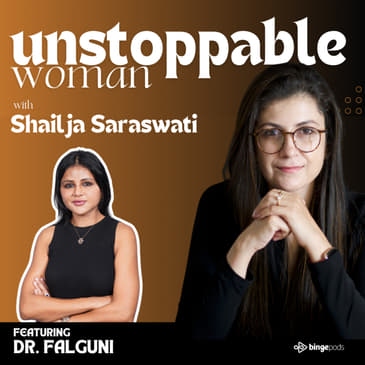
Join us in this empowering episode as Dr. Falguni Shah, a celebrated dermatologist, enlightens us on the intricate links between mental health and physical well-being. Explore her personal voyage into medicine, influenced by her parents, and the balancing act of a thriving career and motherhood. Dr. Shah shares transformative skincare strategies, addresses societal misconceptions on treatments like Botox, and illustrates real-life patient success stories that showcase life-changing impacts on self-esteem. Get inspired by discussions on self-care, professional dermatology, and the essence of being unstoppable through holistic skin health and personal empowerment.
[00:00:00] And this largest organ needs to look good and it's completely linked to your mental health. Something like a woman, right? She has to lift the heavy weight, look like a woman, act like a woman, be the moral torch bearer of the society while doing her stuff. Her skin has to do the same thing. How do you quantify emotions? I wish we could. Eventually it will happen. Somebody is going to pick up on this conversation and do something about it. I hope so.
[00:00:26] Those paparazzi, paps sort of pick up that piece of information and they blow it up and it's amplified all over. That this person has got this done, this person has got this done and it's gone wrong. That's the catch. Paparazzi has only picked up things when it has gone wrong. Almost everybody is doing it. But when it is right, nobody knows it. And that's the right job.
[00:00:46] What I feel bad about is celebrities doing it don't come out in the open and say they're doing it. In fact, don't say it just if you're doing it.
[00:00:53] There's a few. Few have.
[00:00:54] The ones who are not saying it, I'm okay. Don't say it. Don't run it down after having done it. It is tough to have a celeb because you have to be very careful because it faces on screen.
[00:01:03] If somebody says something wrong about them, it is finally hitting your heart. So you need to be careful.
[00:01:09] Hi everyone. Welcome back. You're watching Unstoppable Woman. Today we have a very famous dermatologist, Dr. Falgunit Shah with us.
[00:01:17] And today we are going to go very skin deep but also spirit deep with her.
[00:01:22] Yes.
[00:01:22] Welcome doctor. Welcome on the show.
[00:01:24] Thank you so much. Thank you so much. It's a pleasure.
[00:01:26] Yeah, so we are going to go a little deep like I said and go behind the person which we see.
[00:01:33] Who is the real Dr. Falgunit Shah?
[00:01:36] You want to talk about something about your childhood, where it all started?
[00:01:42] It's very normal. Sometimes I feel way too normal and straightforward a life that there are friends of mine who actually feel that
[00:01:49] maybe you are not telling us everything but that's all that there is.
[00:01:53] Born a good student, born to parents who were both professionals.
[00:01:57] My mother is a scientist and she used to be working with GIFR, that is Tata Institute of Fundamental Research.
[00:02:04] My father was a businessman whose dream was that the child becomes a doctor and me a complete fan of the father.
[00:02:12] So I think I didn't know of any other way but to grow up to be a doctor.
[00:02:15] So I tell most of my friends that the easiest thing in my life is to study.
[00:02:21] Studying has come very naturally to me.
[00:02:23] Any siblings?
[00:02:24] I have a brother and he's an engineer as well and he lives in America.
[00:02:30] But yes, it was a family where we were told that there is no other way but education.
[00:02:37] So when you get into that stream, it's a very simple, educated, middle class upbringing.
[00:02:43] And all in Mumbai?
[00:02:45] All in Mumbai and I didn't really have any pitfalls out there.
[00:02:50] That means you finish your school and you do well in your class 12, you get into MBBS, you sail through that, you get into MD.
[00:02:58] So I didn't have a break where education was concerned.
[00:03:01] But you were very clear that you will get into medicine, right?
[00:03:03] I was very clear I would get into medicine and I think I didn't know, there was no plan B.
[00:03:08] So after my class 12, I took medicine admissions, like you see what's happening even today with NEET and everything, medicine admissions happen last.
[00:03:21] As in the seats are declared last.
[00:03:23] But you can't keep waiting so you have to take some admission somewhere so that you don't stay 12th pass.
[00:03:29] Yes.
[00:03:30] Okay.
[00:03:31] But I was good in education so I got in engineering as well because we used to do PCBM, that is physics, chemistry, bio and math.
[00:03:39] So till I got into medicine which was a month later, I took up engineering.
[00:03:42] Okay.
[00:03:42] So pretty focused.
[00:03:44] Pretty focused.
[00:03:44] You had clear idea.
[00:03:46] Medicine hai, medicine mein jana hai.
[00:03:48] So there was like a straight trajectory towards that goal.
[00:03:51] Yes.
[00:03:51] Any hobbies around it which you developed?
[00:03:54] So as a child, I used to dance a lot.
[00:03:57] I have also done my Arangetram which is we do Bharatanatyam and after that you do Arangetram.
[00:04:03] So I have done that and I used to paint some but I don't know where it all went.
[00:04:09] But if someone asked me what were your hobbies then they were that.
[00:04:12] And now?
[00:04:13] And now I think it is mostly fitness.
[00:04:15] I got into the zone of fitness to keep the mind fit.
[00:04:20] How many years ago?
[00:04:22] So there's a story there when I was doing my MBBS and my final year MBBS.
[00:04:27] I was very overwhelmed with the education as such.
[00:04:30] And by final year MBBS we had started seeing patients in the hospital.
[00:04:35] Yeah.
[00:04:35] And I think I was very, very weak to see.
[00:04:38] Because as you know or I don't know if you don't know but in government hospitals maximum people getting admitted are those who don't really come for an illness.
[00:04:48] But they also come because they have no place to live.
[00:04:50] They come and the government provides them food.
[00:04:53] So seeing that much pain and illness around wasn't easy on me.
[00:04:58] And it was getting very difficult to study.
[00:05:00] So my father one day, everything that I'm in my life is thankfully because of my father or gratefully because of him.
[00:05:06] And he took me to the beach one day and said just why don't you run?
[00:05:11] Okay.
[00:05:12] And I did jump.
[00:05:12] So he noticed something in you?
[00:05:14] Yeah.
[00:05:14] Because I was unable to study.
[00:05:16] So that was very rare to me.
[00:05:18] So he made me run and I realized that the mind got way easier.
[00:05:22] So then I held on to it because it was the easiest way to make me concentrate more.
[00:05:28] Right.
[00:05:28] Right.
[00:05:28] But there's a lot of science supporting it now.
[00:05:30] Oh yes.
[00:05:31] That time it was just my father supported it.
[00:05:33] Now yes, it is science supporting it as well.
[00:05:36] All the good hormones and serotonin.
[00:05:39] And then you learn about it.
[00:05:40] But yes, I think your age old remedies have a lot of science in it if you dissect them well.
[00:05:47] So running was?
[00:05:47] I started running because there was no concept of a gym then.
[00:05:50] Gym at that time.
[00:05:51] Yeah.
[00:05:51] And then eventually I realized that it was not possible to run because we are not as safe as two in the night and three in the night especially.
[00:06:04] When you're an intern and you're doing your residency.
[00:06:07] Right.
[00:06:07] You don't really finish on time.
[00:06:09] Right.
[00:06:09] So that's when the concept of gym came up.
[00:06:11] And I joined the gym I think when I was in my 30s.
[00:06:15] Okay.
[00:06:16] And since then it's been no looking back.
[00:06:18] Yeah.
[00:06:18] Yeah.
[00:06:19] I've recently taken up a sport because call it midlife crisis.
[00:06:22] Which is?
[00:06:23] Squash.
[00:06:23] Not bad.
[00:06:24] Yeah.
[00:06:25] So that's happening now.
[00:06:27] So very interesting.
[00:06:28] I mean as a doctor you got on to health and fitness very early on.
[00:06:33] I think it's not only just talking about something.
[00:06:35] It's also you are walking the talk.
[00:06:36] I feel that there is no other way.
[00:06:38] There's no other way.
[00:06:39] There is no other way to heal the body if you don't heal the mind.
[00:06:43] And both are linked.
[00:06:44] Absolutely.
[00:06:45] Absolutely.
[00:06:46] I mean a patient who walks into my clinic or office with faith that this doctor will treat me always gets treated.
[00:06:54] And a patient who walks in with Google achieved five differential diagnosis will always take longer to heal or will go doctor shopping.
[00:07:03] Yeah.
[00:07:03] And will try to take different opinions.
[00:07:05] Yeah.
[00:07:05] And in that they only harm themselves.
[00:07:07] And can you make out the moment they walk in which category they belong to?
[00:07:11] Absolutely.
[00:07:12] I think one thing about medicine is I may be wrong but it is something which I have realized over a period of time.
[00:07:18] That touching someone is a lot of exchange of energies.
[00:07:23] And I touch so many people every single day that I think somewhere down the line I started adapting their energy.
[00:07:31] So we know it when the patient enters your room that this is good news or bad news.
[00:07:36] We know it when they enter.
[00:07:38] And the exchange of energy is just apparent.
[00:07:42] And I also have learned one thing which my teacher had taught me while I was doing my internship.
[00:07:49] That any patient who comes to you, touch the patient.
[00:07:53] Because when you touch, you not just take their energy, you also give their energy.
[00:07:57] Yeah.
[00:07:58] So if you are even looking at an acne, touch the face.
[00:08:01] Yeah.
[00:08:01] Because you may use a sterilizer and disinfect yourself.
[00:08:05] But touch the face, that healing will be a little bit of there.
[00:08:08] Correct.
[00:08:09] Because touching is giving warmth.
[00:08:11] Absolutely.
[00:08:12] I mean now obviously there are studies and techniques of Reiki and passing on the energy.
[00:08:19] Right.
[00:08:19] And we do have that energy aura which all of us carry.
[00:08:22] Absolutely.
[00:08:22] Absolutely.
[00:08:23] So if you are charging your energy aura every day or if you are exercising or you have any other hacks.
[00:08:31] I think that also sort of is a transmission of that energy.
[00:08:35] Yes.
[00:08:35] I so agree.
[00:08:36] Yeah.
[00:08:37] So do you combine it with anything else besides exercise like mindfulness or meditation, breathing?
[00:08:44] It's on my list.
[00:08:45] It's on your list.
[00:08:45] It's on my list.
[00:08:46] Yes.
[00:08:46] And I really want to get to a calmer version of myself.
[00:08:52] But it is not coming very easy.
[00:08:54] You look very calm.
[00:08:55] Well, I know how to act.
[00:08:58] But yeah, I would like to really practice this in my day-to-day life.
[00:09:03] I want to meditate.
[00:09:04] It's on my list.
[00:09:05] Okay.
[00:09:06] It's interesting, you know, because I meet many people and they always start with physical first.
[00:09:13] Right?
[00:09:14] Easier, no?
[00:09:14] It's, I guess.
[00:09:16] But for me, when I was young, it started with meditation first.
[00:09:20] And you were more evolved than most of us.
[00:09:22] I don't want to label anybody.
[00:09:24] Seriously?
[00:09:25] It's just now, off late, the last one decade, it's been the physical now.
[00:09:29] I'll give you an instance on this or it is just an anecdote kind of thing.
[00:09:35] Most people want to feel good and every book you read says that if you feel good, you look good.
[00:09:40] Yes.
[00:09:41] But the easier way to also achieve is when you look good, you feel good as well.
[00:09:44] Yes.
[00:09:44] And I have seen this so often in my practice, so often that it's not funny.
[00:09:48] Yeah.
[00:09:49] I have seen people change the minute they start looking the best versions of themselves.
[00:09:53] I was coming to that.
[00:09:54] Yeah.
[00:09:55] And it is apparent.
[00:09:56] Yeah.
[00:09:57] I'll give you an example.
[00:09:58] We had a patient, a young couple, not very happy in the marriage.
[00:10:04] Yeah.
[00:10:04] Or rather not compatible in the marriage.
[00:10:06] Happiness is a larger word.
[00:10:08] Yeah.
[00:10:08] Compatibility comes first.
[00:10:11] And we decided to work on her.
[00:10:14] And she had some pigmentation issues.
[00:10:16] And she was premature aging kind of phase.
[00:10:20] And it worked.
[00:10:23] And I can see her so much happier in the marriage.
[00:10:26] And now when they come as a couple, there's so much they talk about.
[00:10:30] Because I could feel that her confidence in self has so much more.
[00:10:34] Her irritability on other aspects was lesser.
[00:10:38] She was dedicating good three minutes a day on skincare, which is also very meditative.
[00:10:44] Yeah.
[00:10:45] Because any kind of routine is meditative.
[00:10:46] You have to be in the moment.
[00:10:47] So she's in the moment.
[00:10:49] Yeah.
[00:10:49] I feel her relationship is better.
[00:10:51] And you're connecting with your physical self, right?
[00:10:53] And you're spending time on yourself, which is all about that me time we've been talking about.
[00:10:58] Very true.
[00:10:59] The relationship of hers with everyone else.
[00:11:02] And I'm not even going by what she's saying.
[00:11:05] When she enters my room today, her energies are so much different.
[00:11:08] So I'm so much more comfortable with her.
[00:11:10] I mean, where I would dread to ask her for a cup of coffee.
[00:11:13] Now I can sit and chat with her on coffee and toast.
[00:11:16] Yeah.
[00:11:16] Don't know.
[00:11:17] Very interesting.
[00:11:18] Yeah.
[00:11:18] You know, interesting point you made.
[00:11:22] When we think of skincare, dermatology or cosmetology, it's always about products, right?
[00:11:28] Yeah.
[00:11:29] Because the brands have completely made it very commercial.
[00:11:32] But what you're saying is a very different language.
[00:11:37] You're saying it in a language which is very human-like.
[00:11:40] It's very human.
[00:11:41] It's about my relation with my skin and my body and my time at that time when I'm spending very in close contact.
[00:11:49] Yes.
[00:11:49] And it can be a meditative process.
[00:11:51] It is.
[00:11:52] It can be a process of self-healing or self-love.
[00:11:55] And it really makes a difference when you go home.
[00:11:58] Try it out someday.
[00:12:00] If you've had a horrible, horrible day and you don't want to meet anyone.
[00:12:03] But you go and spend that 15 minutes in the bathroom.
[00:12:06] You go, you wash your face.
[00:12:08] You pat your face dry.
[00:12:10] Not completely dry.
[00:12:11] Leave some water there.
[00:12:12] See, I'm just giving tips on skincare also.
[00:12:14] Apply that moisturizer nicely.
[00:12:17] Comb your hair.
[00:12:18] Oil it.
[00:12:19] Braid it up.
[00:12:20] Do whatever you need with your hair.
[00:12:21] Yeah.
[00:12:22] Go back to your bed.
[00:12:23] Take a little bit of Vaseline.
[00:12:24] Put it on your hand.
[00:12:25] Put it on your feet.
[00:12:26] Watch the TV.
[00:12:27] You will see that you're much calmer.
[00:12:29] Yes.
[00:12:30] Pampered.
[00:12:31] Yeah.
[00:12:31] Self-pampered.
[00:12:31] If you wanted to pick up a fight with someone, you will fight less after those three minutes
[00:12:36] of therapy that you've done.
[00:12:38] And it works.
[00:12:39] There should be some research quantifying this.
[00:12:43] How do you quantify emotions?
[00:12:45] I wish we could.
[00:12:47] Eventually it'll happen.
[00:12:49] Somebody's going to pick up on this conversation and do something about it.
[00:12:52] I hope so.
[00:12:52] That'll be nice.
[00:12:53] Okay.
[00:12:54] So coming to your education, which you were very clear where you're heading towards,
[00:12:58] right?
[00:12:59] And then you started your clinic also very early part of your practice.
[00:13:04] How did that happen?
[00:13:05] So after I finished, all the bad part is I've got no breaks in life or rather I'm like that
[00:13:13] and I didn't take breaks.
[00:13:14] I don't know which comes first.
[00:13:15] But when I was giving my postgraduate Viva, you know, Viva is the external examiner.
[00:13:21] My external examiner then had a friend who I could say was my mentor because she's no
[00:13:29] more and she passed.
[00:13:30] So I would say my mentor, Dr. Rekha Seta.
[00:13:32] And she was there in the college when the Viva was going on.
[00:13:37] Yeah.
[00:13:37] So when I finished my Viva, I had not even got my results.
[00:13:40] I didn't get, I didn't know whether I cleared my MD.
[00:13:43] So when she came out and she told me, would you want to work as my assistant?
[00:13:47] And I was like, yeah, why not?
[00:13:49] And you know, this is called manifesting because I used to stay in this suburb, Ville Pala.
[00:13:55] Yeah.
[00:13:56] And I used to walk from my home to the, to school every day.
[00:13:59] Okay.
[00:14:00] And when I used to walk, there was a building there which had a board which said Dr. Rekha
[00:14:04] Seta because that's where her clinic was.
[00:14:06] And every time I used to walk and I used to say, wow, someday I'll have Dr. Vala Masha.
[00:14:11] What are you saying?
[00:14:12] And she was, she was in the college and she said, would you like to work with me?
[00:14:16] And I was like, oh my God, this couldn't be happening.
[00:14:19] And you know, I was, I didn't even bother where, how.
[00:14:22] So it would just hit you every day when you walked on that road?
[00:14:24] Every day I have read that name.
[00:14:26] Every single day till my class 10th, I have read that name when I've passed.
[00:14:30] Reading and there was something, feeling you were having while you were reading it, right?
[00:14:34] I had heard about her and I'd heard that they were a very famous doctor couple.
[00:14:38] Husband is a psychiatrist and she was a dermatologist.
[00:14:42] Dermatology was never my dream.
[00:14:44] I always wanted to be a gynec.
[00:14:46] Okay.
[00:14:46] And fate had it that I didn't get into gynecology but I got into dermatology.
[00:14:53] Okay.
[00:14:53] So while I was giving my viva when Dr. Rekha Seit was there, I already knew about her.
[00:14:59] And she asked me to work with her and I was like, I am not a dermatologist as yet.
[00:15:05] Yeah.
[00:15:06] And those times were purer.
[00:15:07] A dermatologist would employ a dermatologist.
[00:15:10] Nowadays it is, you could have homeopaths, MBBS, everybody practicing that science.
[00:15:14] We'll come to that later.
[00:15:15] Okay.
[00:15:16] So I said, but ma'am, my results are not out.
[00:15:18] She says, she was a Gujarati.
[00:15:20] She said, come on.
[00:15:21] You come on.
[00:15:22] You come on.
[00:15:23] And I was like, okay.
[00:15:24] And I thought she would say next week.
[00:15:25] I said, okay, when do I try?
[00:15:26] I said, I plan to take a holiday.
[00:15:28] She says, come on.
[00:15:29] You come on.
[00:15:33] You come on.
[00:15:43] I learned a lot, not just medicine, but how to conduct yourself and how I learned a very,
[00:15:53] very important thing in life because she has two sons that if you're a working successful
[00:15:59] woman, there is no work-life balance.
[00:16:02] Okay.
[00:16:02] It is always a juggle.
[00:16:04] Okay.
[00:16:04] You will be juggling two ends.
[00:16:06] You will never balance.
[00:16:07] And I learned it.
[00:16:09] I was prepared for it.
[00:16:10] Yeah.
[00:16:10] So I was a very hands-on mother.
[00:16:12] Yeah.
[00:16:13] But I have juggled.
[00:16:13] Well, hold on to that thought because that's interesting, right?
[00:16:16] And that's where women generally find it challenging when work-life balance, juggling.
[00:16:22] There is no balance.
[00:16:23] There is no balance.
[00:16:24] Explain.
[00:16:26] Work-life balance, what I understand is that you are giving quality time to your kids and
[00:16:32] you're giving quality time to work.
[00:16:34] It cannot happen.
[00:16:35] You will be giving time to work and time to kids.
[00:16:38] Both.
[00:16:39] Let's take the word quality and the compromise will be you yourself.
[00:16:43] So for example, in my daughter's school, when she was young and they had said someday that
[00:16:52] everybody had to get something from home.
[00:16:54] Yeah.
[00:16:54] Yeah.
[00:16:54] And you get a snack from home.
[00:16:56] Yeah.
[00:16:58] And the importance of home-cooked food.
[00:17:00] Yeah.
[00:17:01] I realized it in the morning that we have to do this and had to rush to work.
[00:17:05] So there is no concept of home-cooked food.
[00:17:08] I just had my associate who was a very, very sweet dear friend of mine now who also runs
[00:17:14] a practice but in Goa.
[00:17:16] Yeah.
[00:17:16] And I told her, Jai Shri, kya karein?
[00:17:19] He says, doesn't matter.
[00:17:21] She quickly ordered idlis from one of the udipis.
[00:17:26] Okay.
[00:17:26] We put it in a foil as it looks like it's homemade.
[00:17:29] Yeah.
[00:17:30] And we took it to school.
[00:17:31] Yeah.
[00:17:31] And people loved those idlis.
[00:17:33] Yeah.
[00:17:33] And we said they were homemade.
[00:17:35] Right.
[00:17:35] That's called juggling.
[00:17:36] So you don't balance.
[00:17:38] You show up.
[00:17:40] But you show up.
[00:17:41] You show up.
[00:17:42] That's more important.
[00:17:43] So you show up.
[00:17:43] So it's also not about that typical 100%.
[00:17:46] Yeah.
[00:17:47] It's never 100%.
[00:17:47] Or what other people of society wants from you.
[00:17:49] It's your 100%.
[00:17:51] And the other thing was to be seen at school, at pick-up times.
[00:17:56] Yeah.
[00:17:56] Because it was considered that mothers who come to pick up their kids, they are much more
[00:18:03] hands-on.
[00:18:03] Hands-on.
[00:18:04] All mothers are around because if I'm not accepted, my child is not accepted.
[00:18:09] You see how it is in schools nowadays that the mothers become friends and that's how
[00:18:13] the kids become friends.
[00:18:14] Yes.
[00:18:15] Yes.
[00:18:15] But you learn.
[00:18:16] Yeah.
[00:18:16] So you juggle, you learn.
[00:18:18] Okay.
[00:18:18] Now you've touched upon an interesting topic.
[00:18:23] And also where I think women are doing most of the heavy lifting.
[00:18:26] Oh, yes.
[00:18:27] Yeah.
[00:18:27] And there are men sitting in the room.
[00:18:29] But I still want to bring this topic up.
[00:18:31] Okay.
[00:18:32] In terms of, you know, when you're saying that I'm juggling between school and my clinic
[00:18:38] and then home and there's lots going on.
[00:18:40] And then you have these false things in your head that have been built up that I don't want
[00:18:46] my daughter to go for tuitions.
[00:18:47] I'm going to teach her.
[00:18:48] Yeah.
[00:18:48] So you come back at 7.30 p.m.
[00:18:50] You don't even keep your bag down and you straight rush to her room and say, show me your homework.
[00:18:55] Show me your homework.
[00:18:56] Yeah.
[00:18:56] So you do all that.
[00:18:58] Yeah.
[00:18:59] You juggle.
[00:18:59] You compromise on self.
[00:19:01] Yeah.
[00:19:01] And your mental health.
[00:19:03] Yeah.
[00:19:03] We have this idea that you need to succeed and you need to succeed purely.
[00:19:11] But is it about a lot of heavy lifting women are doing?
[00:19:14] Yes.
[00:19:15] Yeah.
[00:19:16] And there is somewhere, there are certain roles which are self-assigned because generations
[00:19:23] and generations have been doing, call it generational trauma or whatever you want to call it.
[00:19:27] But it's also what we are doing ourselves.
[00:19:30] Knowing that it's seeding into our mental health or me time.
[00:19:33] Absolutely.
[00:19:34] It's burning us down.
[00:19:35] But we are bringing it on ourselves.
[00:19:37] Yeah.
[00:19:38] But I'll tell you one thing, Shailaja, because I have a girl at home and she's 18.
[00:19:44] So it's time we change a little bit because one thing I've learned in my journey with my child
[00:19:52] is that kids don't listen to you.
[00:19:55] They watch you.
[00:19:56] They observe.
[00:19:57] They observe.
[00:19:58] So you may tell them 100 times a day, eat healthy, eat healthy.
[00:20:02] They're not going to listen to if they see you not eating healthy.
[00:20:06] You keep saying exercise, exercise, go and be fit.
[00:20:09] They're not going to see that.
[00:20:11] And if you are going to sit at home and make importance out of things which are not important,
[00:20:18] like instead of buying five fruits, you bought ten fruits,
[00:20:21] you are going to spend one hour on deciding which those ten fruits are.
[00:20:25] Yeah.
[00:20:54] They're watching you.
[00:20:56] Boys at home are watching their mothers.
[00:20:57] Absolutely.
[00:20:58] So if boys at home see mothers who don't really have an identity of their own,
[00:21:04] they're okay with getting a wife like that.
[00:21:09] And they're okay with not giving the wife equal status.
[00:21:14] Yeah.
[00:21:15] So I think it's very important that we watch ourselves.
[00:21:20] Yeah.
[00:21:20] Make a change.
[00:21:21] Like my father used to say that get married to someone whose mother is evolved and educated.
[00:21:27] I don't care about the son.
[00:21:28] Interesting.
[00:21:29] Interesting.
[00:21:30] And it made so much sense.
[00:21:31] It made sense.
[00:21:32] It made.
[00:21:32] Very interesting.
[00:21:34] But tell me why dermatology, of course, you told me how it happened.
[00:21:39] But opening a clinic very early on, right?
[00:21:43] Yeah.
[00:21:43] So it so happened that my father fell ill and chronically so.
[00:21:49] He went through a renal failure.
[00:21:51] And he had to be taken for dialysis like two, three times a week.
[00:21:55] Okay.
[00:21:55] And my brother had only shifted to America.
[00:21:58] And the clinic where I was assisting Dr. Vekha Seyd was in South Bombay.
[00:22:02] Okay.
[00:22:02] And it was getting very difficult for me to take him because he was a stubborn man.
[00:22:08] It was not about just taking him to the dialysis.
[00:22:11] It was about convincing him to come for the dialysis.
[00:22:14] So it was a task.
[00:22:16] And so I decided to start a clinic close to his home.
[00:22:21] Okay.
[00:22:22] Which when I was not even mentally ready or financially ready.
[00:22:25] But somehow the money sense is not too great in me.
[00:22:30] So I didn't worry about how it will go.
[00:22:33] Okay.
[00:22:34] I just found a place.
[00:22:35] And thankfully money has the financial burden never happened.
[00:22:41] Okay.
[00:22:41] And things fell in place.
[00:22:42] But I started a clinic close to home to be able to take my dad for his dialysis.
[00:22:48] Okay.
[00:22:48] That's how I started my practice.
[00:22:50] Okay.
[00:22:50] And then it was just the rest is history.
[00:22:52] And it's called?
[00:22:53] The Radiance Skin Clinic.
[00:22:55] Okay.
[00:22:55] I started it in 2004.
[00:22:57] Okay.
[00:22:57] Before that I was, as I said, I was working with Rekha Seyd.
[00:23:00] And until I could have just enough money to pay up the deposit or something else, I also
[00:23:05] started small time in these polyclinics.
[00:23:09] Yeah.
[00:23:09] Where you take a two, two hour slot.
[00:23:11] Yeah.
[00:23:11] And I realized, but that was not my game.
[00:23:13] I also realized that I needed the space.
[00:23:15] Yeah.
[00:23:15] Because I wanted to do procedures in a certain way.
[00:23:18] So that's how I...
[00:23:20] Okay.
[00:23:20] So you started your clinic 20 years ago.
[00:23:23] Yes.
[00:23:24] Like you said, right?
[00:23:25] To make life comfortable for your father.
[00:23:27] Yes.
[00:23:28] Why the name Radiance?
[00:23:30] I have no clue.
[00:23:31] It's intuitive.
[00:23:32] It has no relevance, no nothing.
[00:23:35] I was just...
[00:23:36] So I was working in a polyclinic where I used to have a two, two hour slot.
[00:23:41] Yeah.
[00:23:41] And I had this very old gentleman who used to run that place.
[00:23:46] And one fine day he just came over and he said that he wants to shut the place because
[00:23:50] they wanted to give it to a bank.
[00:23:52] Okay.
[00:23:52] And no intimation was given to me.
[00:23:54] And by that time I had thankfully, gracefully started doing well in my practice.
[00:23:58] I had enough number of patients that it was difficult for me to leave from that place.
[00:24:02] Yeah.
[00:24:03] But he said, I'll give you a one month notice.
[00:24:05] And I was like, oh, what am I supposed to do?
[00:24:07] And I had a small Sancho car comes from the fact that huge Shah Rukh Khan fan.
[00:24:13] Oh, yeah.
[00:24:14] So I remember, I don't know if everybody remembers, he was the ambassador for Sancho.
[00:24:18] So I'd seen him touch the...
[00:24:21] There was an ad where he was touching the road and he could hear the car and they had
[00:24:25] Unle coming.
[00:24:26] I said, okay, that's the car I'm going to buy.
[00:24:28] Yeah.
[00:24:29] That was my first car.
[00:24:30] And I bought that.
[00:24:31] And so I got into the car and I said, what's the point?
[00:24:35] Just let's survey the area.
[00:24:36] I didn't even know it had a name called Reiki.
[00:24:39] Yeah.
[00:24:39] So I just went for a drive and I saw one building which had a ground floor and they did it in
[00:24:44] two late.
[00:24:45] Okay.
[00:24:45] So I went and asked and they told me, okay, this is 26,000 rent.
[00:24:50] I was like, whatever is, it will be.
[00:24:52] So I took the place and with hardly any money and a lot of support from friends.
[00:24:59] We just put some chairs, we put something and we started and I was able to pay the rent the
[00:25:05] first month.
[00:25:06] And after that, there was no looking back.
[00:25:08] Yeah.
[00:25:08] And why the name Radiance?
[00:25:10] Because while I was going, I was thinking, naam kya rakhenge, naam kya rakhenge, naam kya
[00:25:14] rakhenge.
[00:25:15] And while I was going, I saw this word radar written somewhere.
[00:25:21] Okay.
[00:25:21] Radar, radar, radar.
[00:25:23] Say Radiance.
[00:25:24] Ah, okay.
[00:25:25] And I didn't even really think that Radiance.
[00:25:27] So Universe has been talking back to you.
[00:25:29] Yeah.
[00:25:29] It seems like.
[00:25:30] And there was nobody to consult.
[00:25:32] There was nobody to talk to because when you have someone ill, so like I tell everyone,
[00:25:40] you have a lot of problems till you have a health problem.
[00:25:43] Yes.
[00:25:43] The minute you have a health problem, that is the only problem.
[00:25:46] So in my house at times, the only problem was the health of my dad.
[00:25:52] So there was nobody to consult.
[00:25:54] And you were close to him.
[00:25:55] Very close.
[00:25:56] Oh, I was obsessed with him.
[00:25:59] So there was nobody to ask.
[00:26:01] And I just started it.
[00:26:03] And it was nice.
[00:26:04] It's been very kind to me.
[00:26:07] Universe has been very kind.
[00:26:08] The clinic has been very kind.
[00:26:10] Yeah.
[00:26:10] I've had the best staff.
[00:26:12] Touch wood.
[00:26:13] I always have my eyes.
[00:26:14] But the best staff, the most...
[00:26:18] I mean, if I'm ill, I would rather go to the clinic.
[00:26:21] To your own clinic.
[00:26:22] No, if I'm ill at home and somebody says,
[00:26:25] I said, let me go rest in the clinic.
[00:26:27] So that is more peaceful for you?
[00:26:29] That's more peaceful for me.
[00:26:29] Amazing.
[00:26:30] What an environment you've created.
[00:26:31] Yes.
[00:26:32] And I think I can say that about every single person who's working in my office.
[00:26:36] Lovely.
[00:26:37] Is there a routine you guys follow?
[00:26:39] Like in the morning or you come together and do something?
[00:26:42] Yeah, we have a chai together.
[00:26:43] We have two cups of chai together.
[00:26:45] Very nice.
[00:26:46] To the fact that a girl went into labor in my clinic at 7 p.m.
[00:26:51] She was full nine months pregnant.
[00:26:53] She went into labor and delivered within two hours.
[00:26:55] She wouldn't sit at home even for a day.
[00:26:58] Wow.
[00:26:58] She would say, I would rather deliver here than go back home.
[00:27:00] Wow.
[00:27:00] Wow.
[00:27:01] So we love the place.
[00:27:03] And again, like I'm saying, that place has been built not by people, but by their energies
[00:27:08] and what they get to the table.
[00:27:11] And the staff has been around for all these years?
[00:27:13] Yes.
[00:27:14] I have my assistant doctors have been with me for almost 10 years.
[00:27:18] I have had girls who are assisting me who have been with me for 12 years.
[00:27:22] So the only time people have moved on is when they've moved on to a marriage in a different city.
[00:27:27] Yeah.
[00:27:28] And thankfully, we've lived as a family.
[00:27:31] We are super proud of that.
[00:27:33] Lovely.
[00:27:34] Lovely.
[00:27:35] Okay.
[00:27:35] So talking about, you know, skin care and skin care routines, and there's a lot which
[00:27:40] you speak about on a, you know, I would say you are the OG Insta creator now.
[00:27:47] Thank you.
[00:27:47] We see you a lot more.
[00:27:48] And it's very interesting, the kind of reels which you create.
[00:27:51] You talk a lot about skin care for all age groups.
[00:27:55] Yes.
[00:27:55] So it's not only youngsters.
[00:27:57] It's also older people, menopausal, pregnancy, you know, you're covering all sort of issues.
[00:28:03] But is there any skin care which you follow, which is favorite for you and favorite for
[00:28:10] yourself and which has worked?
[00:28:11] I think over the years just using a sunscreen regularly has worked for me.
[00:28:17] And I started using sunscreen even before I got into dermatology because I had a very
[00:28:22] allergy prone skin.
[00:28:23] There is a term called atopic dermatitis in skin, which is an autoimmune disorder.
[00:28:29] And I've been a highly sensitive person.
[00:28:32] And every exam that I've given is, I've cried and given exam because I'm always nervous.
[00:28:37] And so I used to get these skin rashes associated with it.
[00:28:41] Very easily.
[00:28:41] Very easily.
[00:28:42] And they used to get worst in the sun.
[00:28:44] So in those days sunscreen concept was not so good.
[00:28:46] But sunscreen quality was not so good.
[00:28:48] I remember that it was greasy.
[00:28:50] Like I stopped using it for a long time.
[00:28:53] And then I realized, oh, sunscreen to hain hi?
[00:28:55] Routine mein?
[00:28:55] So I used to get that sunscreen.
[00:28:58] There was something in the US which was called Water Babies by Coppertone.
[00:29:03] And there was another one which was available in Crawford Market called Banana Boat.
[00:29:06] These were all spurious ones.
[00:29:09] But the US one, I had a mama who would send it to me.
[00:29:12] And I would lather myself with sunscreen, however sticky.
[00:29:16] And brown.
[00:29:17] I used to look browner over there because of too much sunblock.
[00:29:21] But I think it worked for me.
[00:29:22] It worked for you.
[00:29:22] It worked how in maintaining the collagen.
[00:29:26] Okay.
[00:29:26] I'm not a big sucker for fair skin.
[00:29:29] Okay.
[00:29:30] Nobody should be.
[00:29:31] But they are.
[00:29:32] That's the truth.
[00:29:33] But yes, it preserves the collagen.
[00:29:36] So it somewhere leaves your skin a little bit more youthful.
[00:29:40] And I think that worked for me.
[00:29:42] Okay.
[00:29:42] And I would say that everyone must use a sunblock.
[00:29:44] So cleansing and sunscreen.
[00:29:46] See the routine needs to go is cleansing, sun protection and moisturizing.
[00:29:53] This is basic.
[00:29:54] Three things if you want to do.
[00:29:56] Use a detergent free cleanser.
[00:29:58] Use a sunscreen which is broad spectrum.
[00:30:02] Yeah.
[00:30:02] And broad spectrum which also now has something called a blue light or a blue shield.
[00:30:08] Okay.
[00:30:08] Which also helps you, helps protect you from infrared.
[00:30:11] Which is your mobile.
[00:30:12] Just like what you have in your spectacles.
[00:30:14] Yes.
[00:30:15] Amazing.
[00:30:15] Same thing in the sunscreen.
[00:30:16] Yeah.
[00:30:17] And you use that daily.
[00:30:18] Okay.
[00:30:19] Cleanse it with a detergent free which is a non-foaming face wash and use a moisturizer as per your skin type.
[00:30:25] Okay.
[00:30:26] Okay.
[00:30:26] So these three things you must follow.
[00:30:28] Yeah.
[00:30:28] These are for healthy skin.
[00:30:31] Yeah.
[00:30:31] Then we can discuss on what you need for a good looking skin as a person.
[00:30:35] Okay.
[00:30:35] So this is basically hygiene.
[00:30:37] This is your base level.
[00:30:39] Yeah.
[00:30:39] Now let's go to the second level.
[00:30:41] If somebody is in media or in front of the camera or they are conscious or influencers or somebody who is just more aware about skin and skin care.
[00:30:51] What is the next level?
[00:30:52] Okay.
[00:30:53] So I think once your this level is sorted, once you know that you want to go a step further, you need to start something which are called skin actives.
[00:31:01] Okay.
[00:31:01] Skin actives are those which are made in a serum form.
[00:31:06] Okay.
[00:31:06] Why a serum form is because that is easily absorbed by the skin.
[00:31:10] It absorbs better.
[00:31:10] When you make it in a cream or a moisturizer form, you will have to add a lot of other agents in that which dilutes what you want to give to the skin.
[00:31:19] So a vitamin C serum I think is recommended for everyone.
[00:31:23] At night?
[00:31:24] It's always during the day.
[00:31:26] Always.
[00:31:26] Vitamin C is an antioxidant.
[00:31:28] Okay.
[00:31:28] So what you need to do is you cleanse your skin, apply your vitamin C serum and then put a sunblock on top of that.
[00:31:34] Okay.
[00:31:34] A mistake which you will make is if you apply the vitamin C and you don't apply a sunblock on that.
[00:31:39] Ah.
[00:31:40] Because if you apply a vitamin C, it oxidizes on your skin.
[00:31:44] Okay.
[00:31:44] And that will make you look darker.
[00:31:46] Oh, okay.
[00:31:47] So use a vitamin C and then don't forget to use a sunscreen.
[00:31:50] Okay.
[00:31:50] Got it.
[00:31:51] Because a vitamin C will protect your skin.
[00:31:53] Yeah.
[00:31:53] During the day from all the excess damage.
[00:31:56] Yeah.
[00:31:57] Then at night, depending upon your skin type, what I think most people should use is a hydrodonic acid.
[00:32:03] Okay.
[00:32:04] Again, in a serum form, that is giving hydration to the skin.
[00:32:08] Okay.
[00:32:08] So if there is one thing which I would say that what is, one thing that you would want to do for skin is I would say maintain the epidermal barrier function.
[00:32:18] What is that?
[00:32:18] It means maintain the hydration capacity of the skin.
[00:32:22] So your epidermis, that is the first layer of the skin, has 10% water content in it.
[00:32:28] Hmm.
[00:32:28] That is your natural hydration and that is the layer which protects you from everything from outside.
[00:32:34] Okay.
[00:32:34] Which is the pollution, the harmful sun effects, everything else.
[00:32:38] Okay.
[00:32:38] So your skin is covered.
[00:32:39] So basically the first layer is blocking everything out.
[00:32:43] Yes.
[00:32:43] Which is protecting.
[00:32:44] Which is hydration.
[00:32:45] Which is hydration but not moisture.
[00:32:48] Not moisture.
[00:32:48] What I mean by that is hydration is in the gel form which absorbs moisture.
[00:32:52] I understood.
[00:32:53] So it is hyaluronic acid is in tiny gels which eventually over a period of time starts capturing the moisture.
[00:33:03] Okay.
[00:33:03] And that is how it builds up on the barrier.
[00:33:05] And these are also serums?
[00:33:07] These are serums and hyaluronic acid naturally present in your body.
[00:33:10] Are?
[00:33:10] Are.
[00:33:11] So what we are doing is replicating.
[00:33:13] Yes.
[00:33:15] Okay.
[00:33:15] So your hydration is, hyaluronic acid, it starts depleting with age, second with stress, lifestyle and the sun.
[00:33:27] Okay.
[00:33:27] So these are four things which will deplete it.
[00:33:30] So age?
[00:33:31] Age, lifestyle means if you are into too much makeup, not taking the makeup.
[00:33:35] Smoking, not handling enough water.
[00:33:40] Too much polluted area if you are working.
[00:33:42] Yeah, and you don't wash your face very regularly and you are okay with sleeping with makeup.
[00:33:46] Yeah.
[00:33:46] Stuff like that.
[00:33:47] Yeah.
[00:33:47] And then the sun because the sun anyways will evaporate your moisture.
[00:33:54] Now as this hyaluronic acid starts depleting, the signs of aging, discoloration, pigmentation, everything starts.
[00:34:02] So if you are replacing the hyaluronic acid in a serum form, you are helping maintain the barrier function.
[00:34:08] Okay.
[00:34:09] So I think hyaluronic acid is good.
[00:34:12] And then after these two actives, then you can choose an active depending on your repair thing.
[00:34:19] Okay.
[00:34:19] Like what you want to repair.
[00:34:20] Okay.
[00:34:20] If you are 30 plus, start a retinol.
[00:34:23] Okay.
[00:34:23] If you have patchiness, then there are other combinations like niacinamide along with glutathione in the topical form which can be available.
[00:34:32] Okay.
[00:34:32] So then you treat the concerns.
[00:34:34] Okay.
[00:34:34] Okay.
[00:34:35] So that's a third level.
[00:34:36] That's a third level.
[00:34:37] Which is basically pertinent to certain issues.
[00:34:40] And I would like to say that almost every individual thinks they have a skin problem.
[00:34:46] Yeah.
[00:34:46] Some sort of the other.
[00:34:48] Yeah.
[00:34:48] Because Instagram uses so much filter that everybody looks chakachon.
[00:34:52] Stunning.
[00:34:52] I feel something is wrong with me.
[00:34:54] Correct.
[00:34:55] But not everybody needs to use a lot.
[00:34:57] So we make our own products.
[00:34:59] Okay.
[00:34:59] Also.
[00:35:00] At Radiance.
[00:35:01] At Radiance.
[00:35:01] And this thing started.
[00:35:02] And they're available only in your clinic?
[00:35:04] And now on Instagram as well.
[00:35:06] Instagram as well.
[00:35:07] And this started during lockdown because in COVID when patients couldn't come to us and still wanted.
[00:35:13] So there were two things.
[00:35:14] They had time and they wanted to do something about themselves.
[00:35:18] Right.
[00:35:19] So we would, that time I used to, you know, put salicylic acid or hyaluronic acid.
[00:35:23] I have a pharmacist in Chennai.
[00:35:25] And we would send it to their homes.
[00:35:27] Dharpekaro in bottles, bottle forms.
[00:35:30] And the bottles started having a label on it.
[00:35:32] Okay.
[00:35:33] So it grew organically.
[00:35:34] It grew organically.
[00:35:35] And then the label had a name.
[00:35:38] And then the name became a brand.
[00:35:39] So it's been, we're going to.
[00:35:42] And this year we've done exceptionally well with the products is what I came to know from my CA now.
[00:35:48] And we know that we are now raring to just go all out and go online.
[00:35:54] Very nice.
[00:35:54] Very nice.
[00:35:55] We'll take it by that.
[00:35:56] So three levels, right?
[00:35:57] Level one is base, which is just hygiene, maintenance.
[00:36:00] Level two is essentially to do with your routine, which is morning, evening.
[00:36:04] And third is, which is pertinent to certain issues which you have.
[00:36:07] Certain issues that you have.
[00:36:08] And then fourth is the one which we've been talking about of late.
[00:36:12] Fourth is overdoing it.
[00:36:13] Overdoing it.
[00:36:13] There's no third.
[00:36:14] There's no fourth.
[00:36:15] So your skin is a multiplying organ throughout life.
[00:36:18] If you need help after three, then you must visit a skin specialist.
[00:36:22] Got it.
[00:36:23] Because that is a time when you need to intervene.
[00:36:25] Got it.
[00:36:26] And intervention can't be done by topical applications.
[00:36:29] Okay.
[00:36:30] When you say topical applications, what happens in beauty parlors?
[00:36:33] Or, yeah?
[00:36:36] No comments.
[00:36:38] No comments.
[00:37:03] Okay.
[00:37:09] So when you're going to these salons and beauty parlors and spending a lot of money there,
[00:37:16] you're saying that it's temporary.
[00:37:19] It's feel good.
[00:37:20] Feel good.
[00:37:21] It's temporary.
[00:37:22] So, for example, I can have a candy also.
[00:37:25] I don't have to go and bust my...
[00:37:27] Just wear your shoes and go for a run.
[00:37:29] Go for a run.
[00:37:29] You've come back feeling the best.
[00:37:32] Not just good.
[00:37:34] Okay.
[00:37:34] Okay.
[00:37:34] So let's talk about the fourth level, which is what you're saying is,
[00:37:39] it's not going to be at home.
[00:37:40] It's not going to be at home.
[00:37:41] Now, beyond, you want to enhance something.
[00:37:43] Yeah.
[00:37:43] Now, let's go to that level.
[00:37:44] Now, let's go to a doctor.
[00:37:45] Yeah.
[00:37:45] Let's analyze our skin.
[00:37:47] Yeah.
[00:37:47] Let's understand what can be done, what should be done, and how much I want to do.
[00:37:51] Okay.
[00:37:51] Because there are three levels.
[00:37:53] A lot can be done.
[00:37:55] Little can be done.
[00:37:57] Or we can maintain what you have.
[00:37:59] In a healthy way.
[00:38:00] So, you discuss that with your doctor.
[00:38:02] Okay.
[00:38:02] You make a plan.
[00:38:04] Okay.
[00:38:04] Dermatology is a treatment where you should follow a plan.
[00:38:08] Okay.
[00:38:08] It is not a four-day prescription.
[00:38:10] Okay.
[00:38:13] I'll get a prescription for four days.
[00:38:14] I'll be all right on the fifth day.
[00:38:16] It is something that will have to grow.
[00:38:18] You do this and you move from strength to strength.
[00:38:21] So, make your plan and then follow it.
[00:38:23] Okay.
[00:38:24] Do you complement this with some other sort of techniques?
[00:38:29] Do you tell your patients to do now calming exercises?
[00:38:33] I always tell my patients to...
[00:38:34] Or just relax.
[00:38:34] Because it's not skin, right?
[00:38:36] Oh, yes.
[00:38:36] They're getting a treatment done.
[00:38:37] So, I'm assuming it's going to play on their mind.
[00:38:39] So, you're going to focus on your metabolism because you are going with...
[00:38:43] For example, if you're going with an anti-aging goal, what is aging?
[00:38:47] Aging is not limited to the skin.
[00:38:50] Yeah.
[00:38:50] Aging is a body mechanism.
[00:38:51] Your skin is aging because you are aging.
[00:38:54] It's not the other way around.
[00:38:55] So, if you're aging and you're only going to do something on your skin, how far is it
[00:39:00] going to take you?
[00:39:00] Yeah.
[00:39:01] Build up your metabolism.
[00:39:03] Overall.
[00:39:03] Overall.
[00:39:04] So, exercise.
[00:39:06] Eat right.
[00:39:06] Eat right.
[00:39:08] Calm down.
[00:39:10] Calm down, calm down.
[00:39:12] Very important.
[00:39:13] So, all that is very important.
[00:39:16] And I tell my patients that my skincare will only make you look youthful if your body is responding.
[00:39:24] And I also want to wipe out the word young and young.
[00:39:28] Let's be youthful.
[00:39:29] And that's all we should aim at.
[00:39:31] Because young to cattle bhi hota hai.
[00:39:35] Doesn't make them look good.
[00:39:36] But the thing is, our focus, our industry is such that the only way to look good is to look young.
[00:39:46] Yeah.
[00:39:46] I think there are gracefully aging women who are beautiful.
[00:39:49] So, if you're talking about looking good, age has nothing to do with it.
[00:39:52] Okay.
[00:39:53] Yeah.
[00:39:53] So, if anybody who is youthful and doing the right thing can look good.
[00:39:57] Yeah.
[00:39:57] So, we can stick to that.
[00:39:58] Okay.
[00:39:59] So, tell me, you've been talking about holistic approach.
[00:40:03] Right?
[00:40:03] If somebody is coming to you and you will look at their history.
[00:40:07] Yeah.
[00:40:07] And where they are heading towards also.
[00:40:10] Right?
[00:40:10] How much should they really do?
[00:40:11] And I would love to see somebody who is coming to me carry a picture of their mom or their dad.
[00:40:16] You know, I'd like to see where the genetic aging is also going.
[00:40:19] It makes a big difference.
[00:40:20] It makes a big difference.
[00:40:22] Because I understand the genes and it's easier to take it forward.
[00:40:25] Yeah.
[00:40:25] Even when you're talking about obesity.
[00:40:27] Yeah.
[00:40:28] If you know the gene, you're able to treat it better.
[00:40:31] Yeah.
[00:40:32] And then, at your end, you're not overdoing something.
[00:40:35] Yes.
[00:40:35] And you know where to stop because you know the genes will take over.
[00:40:40] Okay.
[00:40:41] So, talking about a little more invasive sculpting beauty products or techniques which are fillers and Botox.
[00:40:51] Right?
[00:40:51] I mean, they've come into the limelight because of all the celebrities using it.
[00:40:56] Honestly, I think that's where it caught everyone's attention because pap radzi, paps sort of pick up that piece of information.
[00:41:03] And they blow it up and it's amplified all over.
[00:41:06] That this person has got this done, this person has got this done and it's gone wrong.
[00:41:11] That's the catch.
[00:41:12] That's the catch.
[00:41:12] Pap radzi has only picked up things when it has gone wrong.
[00:41:17] Almost everybody's doing it.
[00:41:18] But when it is right, nobody knows it.
[00:41:21] And that's the right job.
[00:41:22] When you say everybody's doing it and it's as good as going to a salon, getting your hair straightened.
[00:41:28] Yes.
[00:41:29] Right?
[00:41:29] It's not a big deal.
[00:41:30] Yes.
[00:41:30] And you know where this is coming from.
[00:41:32] There are two, three things to this.
[00:41:34] It's okay to do it.
[00:41:35] Okay.
[00:41:36] It's okay to do it because if it gives you confidence, why not?
[00:41:40] It is scientific.
[00:41:41] It is, if in the right hands, it is beautiful.
[00:41:45] Yeah.
[00:41:46] And if it is giving you what you're looking for.
[00:41:50] Yeah.
[00:41:50] What's wrong in that?
[00:41:51] I mean, people go and buy new clothes.
[00:41:53] Yeah.
[00:41:54] To feel good.
[00:41:55] What's wrong in getting something done if it's making you feel good?
[00:41:58] Second, there are certain professions today.
[00:42:00] And I will not stop at saying it is only the film industry or the media.
[00:42:05] Yeah.
[00:42:06] Professions require or value the young.
[00:42:09] Yeah.
[00:42:09] Youthfully.
[00:42:10] Youth.
[00:42:11] Yeah.
[00:42:11] Now, there are so many people who have so much knowledge.
[00:42:15] Sometimes you want to continue to feel relevant.
[00:42:18] Yeah.
[00:42:18] And you kind of start feeling irrelevant.
[00:42:20] Irrelevant.
[00:42:20] If you're among the young and you're taking as, he's too old for the job.
[00:42:25] Just because of the looks.
[00:42:26] Just because of the looks.
[00:42:27] The intellect is there.
[00:42:29] Yes, the intellect is there.
[00:42:30] The experience is backing you.
[00:42:30] But just because of the looks, you feel left out.
[00:42:32] I mean, a 40-year-old can do a marathon as quickly as a 20-year-old.
[00:42:36] Yeah.
[00:42:36] But just because he's looking 40, they will say, he's a little good.
[00:42:39] Yeah.
[00:42:40] Now, so if your relevance is going down because of the age factor, there's nothing wrong in
[00:42:45] looking youthful.
[00:42:46] You can still tell people, I'm 40.
[00:42:48] And they will say, oh, you're damn good for 40.
[00:42:50] Yeah.
[00:42:50] Don't lie about the age.
[00:42:51] Yeah.
[00:42:51] Just defy it.
[00:42:52] Yeah.
[00:42:53] Because that's the right thing to do.
[00:42:55] So, there are all kind of people coming to you, right?
[00:42:57] Yes.
[00:42:57] There are people who have issues, who don't have issues, who are young, who are old.
[00:43:02] Yeah.
[00:43:03] And the reasons could be multiple.
[00:43:05] And they're accepted.
[00:43:06] They're accepted.
[00:43:06] In the sense, when they go back home, they're telling their family, you know, I went.
[00:43:09] No, no, no.
[00:43:10] That's what I want to talk about.
[00:43:11] I don't think we are still in the community or the country where we are accepting it.
[00:43:17] And that's what is creating the trouble.
[00:43:19] Now, what is happening is, we have actors coming on screen and saying, we look this good
[00:43:25] because of olive oil and beetroot.
[00:43:28] Bichara, beetroot khaa khaa ke mar jata hai ho, insan.
[00:43:31] And depression, that's a different one.
[00:43:33] And weight increases, that's a different one.
[00:43:36] And if they're eating olive oil and beacne, that's a different one.
[00:43:41] That's a different one.
[00:43:42] That's a different one.
[00:43:43] That's a different one.
[00:43:43] But when you accept it, you don't misguide people.
[00:43:47] And in an attempt to hide it, you always blotch up.
[00:43:50] Like, I see it all the time.
[00:43:52] I have people coming.
[00:43:53] They want to do jobs done.
[00:43:54] And they'll say, I want to go home.
[00:43:56] Nobody should come to know.
[00:43:57] Yeah, this is the first line.
[00:43:59] Now, if we're intervening something, then where's redness, swelling, something will happen.
[00:44:04] Something will happen.
[00:44:05] Unless you go underground for like a week.
[00:44:07] And they'll put makeup on countering it.
[00:44:09] And they'll put makeup on that same time.
[00:44:11] So, you are inviting an infection.
[00:44:14] So, let's accept it.
[00:44:15] If you can talk about going to the salon and covering your grays.
[00:44:20] What is that?
[00:44:21] Yeah.
[00:44:21] But that's accepted for ages now, doctor.
[00:44:24] That is what?
[00:44:24] It's about acceptance.
[00:44:26] Yes.
[00:44:26] There's a big taboo about this.
[00:44:28] Exactly.
[00:44:28] And I'm glad we're talking because while there's lots happening there in terms of creating content on this.
[00:44:35] That this is good, that is good, that is good.
[00:44:37] You know, this product, that product.
[00:44:39] But there's still not acceptance.
[00:44:40] And the first person to object would be your family members.
[00:44:45] And what I feel bad about is celebrities doing it don't come out in the open and say they're doing it.
[00:44:51] In fact, don't say that you're doing it.
[00:44:53] Few have.
[00:44:54] The ones who are not saying it, I'm okay.
[00:44:56] Don't say it.
[00:44:56] Okay.
[00:44:57] Don't run it down after having done it.
[00:44:59] Ah, okay.
[00:45:00] You know, I don't do Botox on my own.
[00:45:02] Babes, you've been all over.
[00:45:03] But let's not, let's say we don't, let's not say we don't do it.
[00:45:08] Let's not deny it.
[00:45:09] Yeah, you say there is exercise, there is everything.
[00:45:11] Yeah.
[00:45:12] Don't deny it.
[00:45:13] Say no comments and move on.
[00:45:15] Yeah.
[00:45:15] But the minute you deny it, you're making it a taboo.
[00:45:19] That means who hides something?
[00:45:22] Yeah.
[00:45:22] Extramarital affairs are hidden wide.
[00:45:24] Yeah.
[00:45:25] You know, you can say, he's love.
[00:45:27] Is it safe to say this is the best kept secret of Bollywood?
[00:45:31] One of them.
[00:45:32] It is the, no, it is the most open secret of Bollywood.
[00:45:36] Why best kept?
[00:45:37] But not really picked up in the right light.
[00:45:39] Not accepted.
[00:45:40] Not accepted.
[00:45:41] Not by them.
[00:45:42] Known by all.
[00:45:43] Known by all.
[00:45:44] And when all know it without the right thing, it becomes wrong.
[00:45:48] Like for example, they will say,
[00:45:51] Hmm.
[00:45:52] If someone has Botox done, they think, plastic surgery.
[00:45:56] Huh.
[00:45:56] That is misinformation.
[00:45:58] There is no plastic surgery.
[00:45:59] It's Botox.
[00:46:00] It's something that you've injected, which is a protein, which has relaxed those muscles.
[00:46:06] And the activity of the muscle will come back to normal in four to six weeks.
[00:46:09] That's not surgery.
[00:46:10] And that's very different from plastic surgery.
[00:46:12] That's very different from plastic surgery.
[00:46:13] Plastic surgery, yes.
[00:46:14] Plastic surgery is when you go under the knife, you give anesthesia, there's a recovery period.
[00:46:19] And you're doing a lot more than some tweaking here and there.
[00:46:22] So you're saying in Botox and fillers, there is no anesthesia.
[00:46:26] There is no anesthesia.
[00:46:27] It is back to work.
[00:46:29] And it is something which is done on a chair by the doctor.
[00:46:35] When you go back home.
[00:46:35] So it's less painful than a dental treatment.
[00:46:38] Much less painful than a dental treatment if done rightly.
[00:46:41] If done rightly.
[00:46:42] So that's what I'm saying.
[00:46:43] When you don't talk openly, there is a lot of misinformation which goes out.
[00:46:48] It's okay.
[00:46:49] Like some people say, lip surgery.
[00:46:51] Lip surgery, what is it?
[00:46:53] There's nothing like that.
[00:46:54] People just put a filler in your lip.
[00:46:55] Yeah.
[00:46:57] When you say filler also, you know, that also is like sort of misleading.
[00:47:02] Filler means that you put silicone in your lip.
[00:47:04] It's surgical.
[00:47:05] See, normal person.
[00:47:08] Like if I interview 100 people today and I'll ask them, what is your knowledge on Botox,
[00:47:13] plastic surgery and this.
[00:47:14] They will not know.
[00:47:15] They say that silicone is different.
[00:47:17] Botox or filler are different.
[00:47:19] Botox or filler are different.
[00:47:19] They don't know.
[00:47:20] They don't know.
[00:47:21] Everything is called Botox.
[00:47:22] Correct.
[00:47:22] They will come and say, doctor, I don't want Botox.
[00:47:25] But I'm not giving you Botox.
[00:47:27] Yeah.
[00:47:27] But I want my lip bigger.
[00:47:29] But that's not Botox and that's fillers.
[00:47:30] We have to start with educating.
[00:47:33] Also, these tools, I will call them tools.
[00:47:36] Like Botox.
[00:47:37] Again, again, let's be more clinical now that we're talking.
[00:47:39] There is not.
[00:47:40] Botox is a brand name.
[00:47:41] Yeah.
[00:47:41] The name of the drug is Botulinum Toxin.
[00:47:43] Yeah.
[00:47:44] And we have various brands.
[00:47:46] Botox is a brand by a company called Allergan.
[00:47:48] We have something called Disport, which is the brand by a company called Galderma.
[00:47:54] We have Xeomin, which is a brand by a company called MERS.
[00:47:58] Okay.
[00:47:58] And so on.
[00:47:59] Yeah.
[00:47:59] And there are multiple other brands.
[00:48:00] Sure.
[00:48:00] So these are the multinationals and these are their brand names.
[00:48:04] Okay.
[00:48:05] It is a protein which works on the neuromuscular junction.
[00:48:09] Neuromuscular junction is the nerves when they enter the muscle.
[00:48:12] Nerves when they enter the muscle.
[00:48:13] Enter the muscle.
[00:48:14] Okay.
[00:48:14] It relaxes that junction which relaxes the muscle which was hyperactive.
[00:48:21] Ah.
[00:48:21] That's the science of Botulinum Toxin.
[00:48:24] It can be done to relieve or reduce the lines of expression.
[00:48:28] Okay.
[00:48:29] Which are your wrinkles.
[00:48:30] Okay.
[00:48:31] So called.
[00:48:31] Okay.
[00:48:31] It can be used.
[00:48:32] It's around the eyes or the forehead.
[00:48:34] Around the eyes or the forehead.
[00:48:35] The lips and all.
[00:48:35] Yeah.
[00:48:36] It can be used to restructure your face.
[00:48:39] Okay.
[00:48:40] In a medical way as well.
[00:48:41] Okay.
[00:48:41] Because you may have.
[00:48:44] Like I have a problem of clenching my jaw.
[00:48:46] Okay.
[00:48:47] People who work out a lot clench their jaw also.
[00:48:49] And when you're stressed you do.
[00:48:51] Yeah.
[00:48:51] And that's when you wear a mouth guard.
[00:48:53] Yeah.
[00:48:53] But sometimes you will need to Botox this muscle because it is so painful otherwise.
[00:48:58] You're unable to open your mouth.
[00:48:59] You're unable to.
[00:49:00] So you relax the muscle then.
[00:49:01] Yes.
[00:49:01] You relax the muscle which kind of structures your face as well.
[00:49:04] Okay.
[00:49:05] Which makes your face look a little bit leaner.
[00:49:07] Okay.
[00:49:08] Now on camera actors as little as you are with that kind of close up their faces look very
[00:49:16] big on camera.
[00:49:16] Yes they do.
[00:49:17] So sometimes you have to Botox to be looking leaner.
[00:49:21] Interesting.
[00:49:22] That's not called plastic surgery.
[00:49:22] Because let's say you look 8 pound heavier on camera.
[00:49:26] Yeah.
[00:49:26] Okay.
[00:49:27] So itne se ho to itne dekhoge.
[00:49:30] But how do you make your face itna sa?
[00:49:32] You're toh genetic.
[00:49:33] You got it.
[00:49:34] So then you make your face leaner by doing that.
[00:49:36] Nothing wrong in that.
[00:49:38] Okay.
[00:49:38] The problem is acceptance.
[00:49:40] Yeah.
[00:49:40] If makeup can be accepted.
[00:49:42] If straightening can be accepted.
[00:49:43] If going for a clean up can be accepted.
[00:49:46] If concealer is accepted to hide something.
[00:49:50] Why not these tools which are more scientific.
[00:49:53] More medical.
[00:49:53] Yeah.
[00:49:54] And these are temporary right?
[00:49:55] I mean everything is going under the skin.
[00:49:58] It's not going to stay there forever.
[00:50:00] And coming back to the wrong results.
[00:50:01] Yes.
[00:50:02] That so many wrong results we see.
[00:50:04] Let's talk a little bit on that.
[00:50:06] Since it is temporary it is safe and it is reversible.
[00:50:10] So for example if somebody is roaming about with a lip.
[00:50:13] Which is too big as per you.
[00:50:16] But maybe not too big as per her.
[00:50:17] Because if it was she would have dissolved it.
[00:50:20] Yeah.
[00:50:20] Because a filler can be dissolved the very next day.
[00:50:24] Oh okay.
[00:50:24] It can be reversed the very next day.
[00:50:26] Within 24 hours.
[00:50:27] Within 24 hours.
[00:50:28] Okay.
[00:50:28] Yeah.
[00:50:29] Similarly a Botox will go away.
[00:50:32] Botulinum will go away after 4 months.
[00:50:34] Yeah.
[00:50:34] So if something is permanent and not going.
[00:50:38] Maybe that person likes it.
[00:50:39] Yeah.
[00:50:40] Let's not blame the doctor or the product anymore.
[00:50:42] You know the similes which I can draw from this.
[00:50:44] This is like back in those days when they were.
[00:50:47] There was an entire thing about having curly hair.
[00:50:50] Yeah.
[00:50:50] And people wanted to go for straightening.
[00:50:52] And straightening chemicals were very primitive.
[00:50:54] Yeah.
[00:50:55] Now obviously they've evolved.
[00:50:57] And you had to stay in those for 4 days.
[00:50:59] And not let the water touch the hair.
[00:51:01] And all of that used to happen.
[00:51:02] And there was a taboo.
[00:51:04] There was a big taboo regarding that as well at that time.
[00:51:06] And now I think it's very normal.
[00:51:07] No it's normal.
[00:51:08] It's normal.
[00:51:09] It's super normal.
[00:51:10] Because even the products have evolved.
[00:51:12] It's become easier.
[00:51:13] You know the time.
[00:51:13] Everyone's doing it.
[00:51:15] The time to normalize a phenomenon is the day you realize that it is medically safe.
[00:51:20] That's all that is required.
[00:51:21] But that knowledge is not out there.
[00:51:23] It should be out there.
[00:51:25] But let's take away the taboo of looking young.
[00:51:28] It is not.
[00:51:29] Now I'll give you another thing.
[00:51:30] I tell all my friends this.
[00:51:32] There was a time when your average life expectancy was 56 to 60.
[00:51:36] Correct.
[00:51:37] That means you married in 25 years.
[00:51:42] You will grow your children.
[00:51:44] You will grow your children.
[00:51:44] You will grow your children.
[00:51:46] And you will grow your children.
[00:51:47] And you will grow your children.
[00:51:48] You will grow your children.
[00:51:48] So you have to look old only for 10 years.
[00:51:50] Correct.
[00:51:51] Now the thing is the average life expectancy is 86.
[00:51:55] Dude.
[00:51:56] Very good point.
[00:51:57] Are you ready to look old from 50 to 86?
[00:52:00] Wow.
[00:52:00] That's a lot of old age to carry on.
[00:52:01] That's a lot of.
[00:52:02] And I think old age is the only age which doesn't have an end point.
[00:52:05] There's nothing called old to grow age gracefully.
[00:52:10] You know.
[00:52:10] There is.
[00:52:11] Beautifully also.
[00:52:12] Gracefully also needs help.
[00:52:15] Now what help you want to give yourself is up to you.
[00:52:19] Correct.
[00:52:20] Like teenage age ends at 19.
[00:52:23] Adult age ends at 40.
[00:52:26] Correct.
[00:52:27] Middle age ends at 50.
[00:52:28] When does old age end?
[00:52:30] When you die.
[00:52:30] When you die.
[00:52:31] That's not in your head.
[00:52:32] So today if I want to feel relevant.
[00:52:35] Yeah.
[00:52:35] Then I want to work till I am 85.
[00:52:38] Yeah.
[00:52:39] But I have the energy and the brain to do that.
[00:52:43] But somebody seems to have become a bad person.
[00:52:45] Correct.
[00:52:45] So maybe I'll change their perception.
[00:52:47] Yeah.
[00:52:47] And they say you know the mind doesn't grow old.
[00:52:49] Right?
[00:52:49] It's just the body.
[00:52:50] Yeah.
[00:52:50] So my mind wants to work.
[00:52:52] Yeah.
[00:52:52] I'm going to be in touch with technology.
[00:52:54] I'm going to see to it that I don't become redundant.
[00:52:56] Because I'll keep reading.
[00:52:57] Yes.
[00:52:58] But I don't want you to feel that I'm redundant.
[00:53:00] Medical advancement has made the old age like the longest phase of life.
[00:53:05] Yes.
[00:53:05] And we want to keep living.
[00:53:07] But do we want to keep living without being relevant anymore?
[00:53:12] Is your dream only to travel to places?
[00:53:15] To go to a nightclub?
[00:53:16] To meet friends?
[00:53:17] Is that what life is going to be about?
[00:53:19] No.
[00:53:20] It has to end somewhere.
[00:53:22] Yeah.
[00:53:22] It has that relevance to do something with your life.
[00:53:25] Yeah.
[00:53:26] Needs to go on.
[00:53:27] And this is a very normal outside India right?
[00:53:30] In many countries now.
[00:53:32] Yes.
[00:53:32] Because people are taking their old age as a gift.
[00:53:38] People are taking their ageing as a gift.
[00:53:40] Because how beautiful it would be.
[00:53:42] Like I talk about myself.
[00:53:43] There was a time when I was working and seeing patients.
[00:53:47] But there was a lot of financial burden as well.
[00:53:49] Because I wanted to educate my daughter.
[00:53:51] I wanted to pay up all the EMIs and the loans.
[00:53:54] And now finally I have come to a stage where I am done and I want to work peacefully without the financial stress.
[00:54:00] I am going to work better.
[00:54:01] And still enjoy more.
[00:54:02] I am going to enjoy more.
[00:54:03] I am going to do the studying.
[00:54:05] So I want to be more relevant.
[00:54:06] Yeah.
[00:54:07] With less pressure.
[00:54:08] Yeah.
[00:54:08] It is a second youth.
[00:54:09] Second youth.
[00:54:10] So why not just live it properly?
[00:54:13] So basically what you are saying is all these beauty enhancement procedures bring your second youth back.
[00:54:19] So you live more.
[00:54:20] You live more and the quality of your life is better.
[00:54:23] Yeah.
[00:54:23] And forget old age.
[00:54:24] Let me give you another example.
[00:54:25] When I was doing medicine.
[00:54:27] So like I said I come from a pretty middle class set up for the time.
[00:54:32] In my building I was the only one who was studying to be a doctor.
[00:54:36] When I came from.
[00:54:37] In my building my mother was the only educated lady.
[00:54:40] Okay.
[00:54:40] In my building my mother was the only lady going to work.
[00:54:43] Okay.
[00:54:43] Everybody else was at home looking after kids.
[00:54:47] And the kids were busy playing while I was giving entrance exams.
[00:54:51] So just the fact that I was a doctor put me on a pedestal higher than most.
[00:54:56] Now in that same building today.
[00:54:58] Yeah.
[00:54:59] There are four girls who are doing MABS.
[00:55:02] And one boy also.
[00:55:04] So five people in that same building.
[00:55:06] Now when I stepped out in society it was considered.
[00:55:09] And I go for an interview.
[00:55:11] They would say.
[00:55:11] Okay doctor.
[00:55:12] Pass.
[00:55:14] Today five doctors come for the same job.
[00:55:16] Then how are you going to choose?
[00:55:18] Yeah.
[00:55:19] You're going to look at who.
[00:55:20] The times have changed now.
[00:55:22] Who is a smarter doctor.
[00:55:24] Yeah.
[00:55:24] Or pehle nazar mein.
[00:55:25] How will you know who is a smarter doctor?
[00:55:27] Yeah.
[00:55:28] Some amount of physical appearance.
[00:55:30] Correct.
[00:55:31] Is going to.
[00:55:31] Because now it is about overall development.
[00:55:35] Yeah.
[00:55:35] Just being educated.
[00:55:37] Is not enough.
[00:55:37] Is not enough.
[00:55:37] It's your personality.
[00:55:39] How you apply that knowledge.
[00:55:41] Yeah.
[00:55:41] So how does Samne wala know that you're going to do it?
[00:55:44] You take care of yourself.
[00:55:46] First impression is.
[00:55:47] Maybe.
[00:55:48] This one is a little bit more disciplined.
[00:55:49] Correct.
[00:55:50] So I think physical appearance.
[00:55:54] And physical fitness.
[00:55:56] Is mattering.
[00:55:58] It is.
[00:55:58] It matters.
[00:55:59] It completely matters.
[00:56:00] Whether it's profession.
[00:56:02] Whether it's your social circle.
[00:56:04] Community.
[00:56:05] Any interaction which you're doing with outside world.
[00:56:08] Forget outside.
[00:56:08] It's also the connection with yourself.
[00:56:10] Yourself.
[00:56:11] Like I totally agree that being vain.
[00:56:13] Without matter.
[00:56:15] Is not required.
[00:56:16] Like you cannot want to just look good.
[00:56:19] Yeah.
[00:56:20] So it's a balance.
[00:56:21] It's a balance.
[00:56:22] You have to have the matter.
[00:56:23] And let the looks assist.
[00:56:24] Yeah.
[00:56:25] That matter.
[00:56:25] Yeah.
[00:56:26] And let the matter shine.
[00:56:28] Yeah.
[00:56:28] By you shining.
[00:56:29] Yeah.
[00:56:29] So there is nothing wrong in that.
[00:56:31] And let's accept it.
[00:56:32] Yeah.
[00:56:32] Do you think in the coming times.
[00:56:34] Maybe two three years down the line.
[00:56:35] It will become more acceptable.
[00:56:37] I'm not sure about two three years.
[00:56:38] But let me tell you.
[00:56:39] Or lesser.
[00:56:40] The next generation.
[00:56:41] When I look at my daughters.
[00:56:42] They are very open to talk about it.
[00:56:45] They don't judge people.
[00:56:46] Okay.
[00:56:47] Like the way our generation does.
[00:56:49] I've seen the gen next.
[00:56:51] They are not judging.
[00:56:52] In fact they get very upset if you judge someone.
[00:56:55] Yeah.
[00:56:55] So I'm hopeful that people are henceforth going to be judged by their matter.
[00:57:00] Yeah.
[00:57:00] And not what they do to get that matter.
[00:57:03] Lovely.
[00:57:04] It's very important.
[00:57:06] Lovely.
[00:57:07] Talking about the mental which goes with the physical.
[00:57:11] There is something called neurocosmetics also.
[00:57:14] Yes.
[00:57:14] There is.
[00:57:15] It's a new trend.
[00:57:16] Okay.
[00:57:17] These neurocosmetics are those which kind of work by making your mind sounder as well.
[00:57:26] That means some shardaks have fragrances which will calm you.
[00:57:30] And thereby also work on the skin.
[00:57:33] Like lavender.
[00:57:33] Like lavender.
[00:57:34] Like jasmine.
[00:57:35] Yeah.
[00:57:36] Then there are certain products which have.
[00:57:40] There are adaptive essential oils.
[00:57:43] Okay.
[00:57:43] Which you could.
[00:57:44] Which calm the body down.
[00:57:46] The nervous system.
[00:57:47] Like nervous system down by making it as a body moisturizer.
[00:57:50] Okay.
[00:57:50] Okay.
[00:57:50] There are.
[00:57:51] Radiance also has these.
[00:57:52] Right now we are not into neurocosmetics or neuro skincare.
[00:57:56] I am making sunscreens.
[00:57:58] Okay.
[00:57:58] And I am very very fond of mineral sunscreen because I feel physical sunscreen is the way to go.
[00:58:04] Okay.
[00:58:04] And which are fragrance freeze.
[00:58:06] And we have serums.
[00:58:07] Mm-hmm.
[00:58:08] Which are corrective serums.
[00:58:09] And for regular skin nourishment.
[00:58:12] Like we have a vitamin C.
[00:58:13] We have hyaluronic acid.
[00:58:15] We have a brightening serum.
[00:58:17] Okay.
[00:58:17] Which is a combination of two actives.
[00:58:19] And we have a game changer which is a retinol.
[00:58:22] Okay.
[00:58:23] The best way to know whether someone is making the right product is when they make the right retinol.
[00:58:28] Okay.
[00:58:29] Because retinol could be a game changer but the problem is does your skin adapt to it.
[00:58:33] I like to have them in the purest form.
[00:58:36] So not in combination.
[00:58:37] I don't like to mix.
[00:58:38] Why is that so?
[00:58:39] I feel one can take away the potency of the other.
[00:58:44] Of course there are products which can increase the potency of the other as well which act as a catalyst.
[00:58:49] But then I feel that if somebody's skin is reacting you will never know what you are reacting to.
[00:58:54] Oh because of which one?
[00:58:55] Because which one.
[00:58:56] And then you will have to stop both.
[00:58:57] I understand.
[00:58:57] So all my serums are single.
[00:58:59] Okay.
[00:58:59] They do the job.
[00:59:00] Okay.
[00:59:01] And when it's vitamin C it's pure vitamin C.
[00:59:04] If it's hyaluronic acid it's pure hyaluronic acid.
[00:59:06] If it's salicylic acid it's pure salicylic acid.
[00:59:09] Okay.
[00:59:09] So yeah.
[00:59:10] Okay.
[00:59:10] Can you give us some examples of some breakthroughs which happened in your treatment?
[00:59:15] Somebody who has really got magical results.
[00:59:19] And helped them to enhance their confidence.
[00:59:23] Some change happening.
[00:59:25] Drastic change happening.
[00:59:26] This is a very interesting girl who still my patient for many many years.
[00:59:31] She was based in a different city.
[00:59:34] And for the longest time she used to itch herself out.
[00:59:39] Why?
[00:59:40] In stress.
[00:59:41] You know you itch yourself itching.
[00:59:42] She would like keep itching.
[00:59:44] Yeah.
[00:59:44] Scarring herself.
[00:59:45] And they come from a Marwadi family.
[00:59:48] And the...
[00:59:49] It's real stuff right?
[00:59:50] It's real stuff.
[00:59:51] I've heard people have that issue.
[00:59:52] People pull their hair and they cause scars.
[00:59:54] Or biting nails I've heard like pull their...
[00:59:56] Yeah.
[00:59:56] Okay.
[00:59:57] Yes.
[00:59:57] So this girl.
[00:59:58] And since the goal in the life of a family tree was marriage.
[01:00:04] Hmm.
[01:00:04] So she had scars and she wouldn't...
[01:00:09] Was not able to get married and not able to get a suitable thing.
[01:00:13] Okay.
[01:00:13] So we started her on treatment.
[01:00:15] It was a...
[01:00:15] She would come to Mumbai.
[01:00:16] She started looking nice.
[01:00:19] The treatment started helping.
[01:00:20] It took a year.
[01:00:21] And I had said we would take a year and more.
[01:00:23] She started looking nice.
[01:00:25] And then she...
[01:00:27] Also...
[01:00:27] Then boys were okay in seeing her.
[01:00:30] But then she realized...
[01:00:32] Why do I do a wedding?
[01:00:34] So she did the job.
[01:00:37] She went and did a course on interior design.
[01:00:38] Amazing.
[01:00:39] And then she said...
[01:00:41] And then she became...
[01:00:41] She's a very popular interior designer.
[01:00:43] And then she got married much later than when it started.
[01:00:47] She'd come to me when she was in her mid-twenties.
[01:00:49] She got married in mid-thirties.
[01:00:51] Took a time.
[01:00:52] A decade later.
[01:00:53] Yeah.
[01:00:53] Because then she says...
[01:00:55] She got the confidence back.
[01:00:56] Oh my God.
[01:00:56] She made her own career.
[01:00:57] And we are in touch and...
[01:00:59] It's beautiful.
[01:01:00] Amazing, yeah?
[01:01:01] Yeah.
[01:01:01] So it can happen.
[01:01:03] Yeah.
[01:01:03] And it can really change the way you are.
[01:01:05] So just that...
[01:01:07] That was sort of a trigger.
[01:01:08] Trigger, yeah.
[01:01:09] Which sort of settled a major part of her life.
[01:01:12] Which...
[01:01:13] She realized that I don't have to go down this path.
[01:01:16] This is not the only way I can redeem myself.
[01:01:19] So you changed the direction of your life.
[01:01:20] Yes.
[01:01:20] And I didn't change it.
[01:01:21] I mean she...
[01:01:22] She changed it.
[01:01:23] She changed it.
[01:01:23] And what was required was just the mirror.
[01:01:27] You don't know how much your mirror helps.
[01:01:29] And I have realized this now.
[01:01:33] Any more examples like this?
[01:01:35] Oh, there are plenty.
[01:01:36] You know, our clinic is full of these examples.
[01:01:38] Because...
[01:01:39] Let me give you the example of...
[01:01:43] My assistant doctor.
[01:01:45] I mean I will not name.
[01:01:46] My assistant doctor went through a bad relationship.
[01:01:50] And a real...
[01:01:52] If I may say...
[01:01:53] Asshole of a guy.
[01:01:54] Okay.
[01:01:55] You can edit that.
[01:01:56] Okay.
[01:01:56] But really made her go through bad stuff.
[01:01:59] And then we said...
[01:02:00] I said let's do something with you.
[01:02:01] So we...
[01:02:02] We...
[01:02:03] You know...
[01:02:03] Shaved her lip up a little bit.
[01:02:05] And we got her skin care going.
[01:02:07] You can't recognize that girl now.
[01:02:09] No?
[01:02:09] She's confident.
[01:02:11] As hell.
[01:02:12] She doesn't care.
[01:02:13] That ex-boyfriend got married.
[01:02:15] And he's saying...
[01:02:16] And now she's dating a fabulous guy.
[01:02:19] And not in a rush to get married.
[01:02:21] Lovely.
[01:02:21] That is one.
[01:02:22] Then we had another girl.
[01:02:24] A Catholic girl.
[01:02:26] Who was...
[01:02:27] Adopted by someone.
[01:02:29] And she had a lot of scars.
[01:02:30] And the parents...
[01:02:32] Were thinking...
[01:02:33] And the parents were really really in love with the child.
[01:02:35] But the child kept thinking that...
[01:02:38] I am adopted.
[01:02:39] Because never looked as good as the parents.
[01:02:42] And the parents always wanted to do something about it.
[01:02:44] Because they didn't want her to feel like that.
[01:02:46] Yeah.
[01:02:47] So we started working on her.
[01:02:48] She started looking fabulous.
[01:02:50] With cleaner skin and all.
[01:02:51] And then she says...
[01:02:52] Now I feel that they are my parents.
[01:02:54] Nothing changed.
[01:02:55] She always knew she was adopted.
[01:02:57] But when they started going out for lunches and dinner.
[01:03:00] She said...
[01:03:01] Now I feel...
[01:03:01] Amazing.
[01:03:02] That I am the child.
[01:03:03] I feel now I have a family.
[01:03:04] Complete impact on mental health.
[01:03:06] Yes.
[01:03:07] It is...
[01:03:07] How much it impacts your mental health is not funny.
[01:03:10] It's not funny.
[01:03:11] You also reverse tattoos, right?
[01:03:14] Yes.
[01:03:14] Like if somebody is not interested in doing...
[01:03:16] Yeah, yeah, yeah.
[01:03:16] Living with it anymore.
[01:03:18] And also self-abuse scars.
[01:03:20] Self-abuse scars can be reduced up to a point.
[01:03:23] Not completely.
[01:03:24] What stage of scarring you are in.
[01:03:26] If you are really deep, we can...
[01:03:30] Make them a little bit more superficial.
[01:03:32] But we can't request them.
[01:03:33] Yeah.
[01:03:34] Because that's gone skin deep.
[01:03:35] That's gone...
[01:03:35] That's beyond the skin.
[01:03:37] That's probably you...
[01:03:39] Okay.
[01:03:39] Skin deep, we can do it.
[01:03:40] But beyond that...
[01:03:41] But it's not the bottom of the skin.
[01:03:42] But it's not the bottom of the skin.
[01:03:44] So that's nothing.
[01:03:45] And the tattoos would take how many settings?
[01:03:47] Yes.
[01:03:48] So it's easier to get a tattoo than remove a tattoo blanket statement.
[01:03:51] So please think hundred times before...
[01:03:53] After you've fallen in love, is she the one?
[01:03:55] But...
[01:03:56] Or is he the one?
[01:03:57] Because removing takes at least six to eight...
[01:03:59] That'll be more painful.
[01:04:00] Oh, painful?
[01:04:01] More expensive.
[01:04:02] And every time you're getting it removed, going for the session, you'll be reminded of
[01:04:05] the person.
[01:04:05] And it hurts.
[01:04:06] And it hurts.
[01:04:06] It hurts here.
[01:04:08] The pocket is later.
[01:04:11] So you don't care about the money you'll make, but you're saying, guys...
[01:04:15] Yes, yes.
[01:04:16] Oh, no, no.
[01:04:16] Please be careful.
[01:04:17] Please be careful of what you eat.
[01:04:19] Okay.
[01:04:19] And I also strongly believe in one thing that anything to do with your body, it affects your
[01:04:27] body.
[01:04:28] And the mind.
[01:04:29] You absorb those energies.
[01:04:34] So be careful.
[01:04:35] Any wish.
[01:04:36] Let a tattoo not be a flower.
[01:04:38] Because you like the flower.
[01:04:41] Wow.
[01:04:41] Let a tattoo be the flower you want to be, rather than what you liked.
[01:04:45] Wow.
[01:04:45] So yeah.
[01:04:46] Okay.
[01:04:46] Very important.
[01:04:47] Okay.
[01:04:48] Interesting.
[01:04:49] Yeah, it works.
[01:04:50] Very interesting.
[01:04:51] Yeah?
[01:04:51] It works for and it works against.
[01:04:53] Do you have tattoos?
[01:04:54] Yes.
[01:04:55] How many?
[01:04:56] One.
[01:04:58] Okay.
[01:04:58] Can I ask?
[01:04:59] What is it?
[01:04:59] Yeah, it's my daughter's name.
[01:05:02] Okay.
[01:05:03] But we had...
[01:05:04] We have an OM written.
[01:05:06] So me and my husband got it together.
[01:05:08] Wow.
[01:05:08] We have the name and an OM written on it.
[01:05:11] Same tattoo.
[01:05:12] Same tattoo.
[01:05:12] Because I wanted her to be peaceful as a person.
[01:05:19] And I always tell everybody that whatever mistakes your parents make while they are raising you,
[01:05:25] you're careful to not make those mistakes when you're raising your child.
[01:05:29] But what happens is in that whole journey, you end up making some brand new ones.
[01:05:33] Yeah.
[01:05:34] So those I think she will look into.
[01:05:36] But the aim was for her to have peace.
[01:05:39] Okay.
[01:05:40] And for me to be peaceful about her.
[01:05:42] Okay.
[01:05:43] So we had OM and her name.
[01:05:45] Very nice.
[01:05:46] Beautiful.
[01:05:46] Yeah.
[01:05:47] Okay.
[01:05:48] When celebs take appointment?
[01:05:50] Yeah.
[01:05:51] Nightmare.
[01:05:52] And do you carry your equipment to their residence or they come to your clinic?
[01:05:57] So as a rule, I don't go for house visits.
[01:06:00] As a rule.
[01:06:00] So I've lost on a lot of...
[01:06:03] And the celebs who know it, know it.
[01:06:05] They prefer it.
[01:06:06] The first question is...
[01:06:07] I'm a girl.
[01:06:08] It means if the first of all, they get taken aback when you say, I don't.
[01:06:11] So it takes some time for it to settle in.
[01:06:15] But out of 50...
[01:06:17] Say out of 100% of celebs who've called me to come to their house and I've refused all,
[01:06:22] 75% have finally turned up.
[01:06:25] As a ratio.
[01:06:26] And when they're there, the other normal people are there?
[01:06:29] I think the celeb culture is also changing.
[01:06:31] There was a time, like if you ask me this 10 years ago,
[01:06:34] even TV actors came and they wanted a clean room.
[01:06:37] But now it is not like that.
[01:06:39] That's not.
[01:06:39] I think they are more human.
[01:06:42] I think they are...
[01:06:44] They are very normal.
[01:06:47] They come...
[01:06:47] I have not seen them throwing that much tantrum.
[01:06:50] Okay.
[01:06:50] That you can't do it.
[01:06:51] Yes.
[01:06:52] Sometimes we do it because...
[01:06:54] Just to make it comfortable for them.
[01:06:55] We can see it.
[01:06:55] Because there have been times when people have...
[01:06:57] You know, they're filming and the next thing is they are...
[01:07:02] Yeah.
[01:07:03] You also don't like it.
[01:07:04] So, yeah.
[01:07:05] Tabs are really crazy these days.
[01:07:07] Yeah.
[01:07:08] It's like...
[01:07:09] It's blown out of proportion sometimes.
[01:07:11] It's really bad.
[01:07:12] So, but yeah.
[01:07:13] It is tough to have a celeb because...
[01:07:17] A.
[01:07:18] You have to be very careful.
[01:07:21] Because it faces on screen.
[01:07:23] If somebody says something wrong about them,
[01:07:26] it is finally hitting your art.
[01:07:28] So, you need to be careful, A.
[01:07:30] Yeah.
[01:07:31] Secondly, you have...
[01:07:33] You give them more time because...
[01:07:35] I don't blame them because they are criticized way more than an average person.
[01:07:41] Yeah.
[01:07:41] So, you have to be extremely, extremely careful.
[01:07:43] Do you take pressure?
[01:07:44] A lot of it.
[01:07:45] Okay.
[01:07:46] Because I know what pressure they're going through.
[01:07:49] I can feel it.
[01:07:51] Nobody wants...
[01:07:51] Again, the energy exchange that you were talking about.
[01:07:53] You can see that they...
[01:07:55] There's a lot at stake.
[01:07:56] There's a lot at stake.
[01:07:57] And it's not fun to have people criticizing you.
[01:08:01] As much stonewalled as you are,
[01:08:04] it's not fun to people calling you plastic.
[01:08:07] It's not fun.
[01:08:08] Yeah.
[01:08:08] So, I see that in them.
[01:08:11] So, I'm more careful.
[01:08:11] I am out there all the time.
[01:08:14] Plus, of course, they don't cross-refer.
[01:08:17] They don't tell anybody that they've done something.
[01:08:19] Yeah.
[01:08:20] So, it's not that...
[01:08:22] Word of mouth is never a thing with celebs.
[01:08:25] Yeah.
[01:08:25] They're not going to talk about you to anybody else.
[01:08:27] Yeah.
[01:08:28] But, I don't blame them again for that.
[01:08:31] Yeah.
[01:08:31] I'm sure they are human.
[01:08:32] They would also want to tell their friends.
[01:08:34] Yeah.
[01:08:34] But the world is such that they're going to be looked down upon.
[01:08:37] Yeah.
[01:08:37] If they do, so...
[01:08:39] Well, some of the celebs have gone through this
[01:08:41] and things have gone wrong, right?
[01:08:43] Whether international or in India.
[01:08:45] But then that is medicine.
[01:08:46] That is medicine.
[01:08:47] It is going to go wrong.
[01:08:48] We are not gods.
[01:08:50] It goes wrong in a heart surgery.
[01:08:53] It goes wrong in any surgery.
[01:08:55] That is the law of averages.
[01:08:56] But when you're saying it's non-invasive,
[01:08:58] you're not going through anesthesia,
[01:09:01] then...
[01:09:02] You don't die.
[01:09:03] You don't die?
[01:09:04] You'll get a bad result.
[01:09:05] But how bad can that be?
[01:09:08] Now, your expertise comes into picture
[01:09:11] because our field is so diluted now
[01:09:15] that we have people who have done courses
[01:09:18] and come and start injecting
[01:09:20] because there's no regulation.
[01:09:21] We have non-dermatologists injecting.
[01:09:25] We have people who are just MBBS injecting.
[01:09:27] Why would people let them touch their face?
[01:09:30] I want to ask them the same question.
[01:09:33] Cost?
[01:09:34] Cost, yes.
[01:09:35] Where are these people sitting?
[01:09:36] They don't have clinics.
[01:09:37] All over.
[01:09:38] They don't have clinics.
[01:09:39] They have clinics.
[01:09:39] They have clinics all over.
[01:09:41] And they're doing IVs as well.
[01:09:43] They're doing everything.
[01:09:44] IVs are the smallest of the things they're doing.
[01:09:45] They're injecting.
[01:09:46] They're doing thread lifts.
[01:09:47] They're doing everything.
[01:09:49] Cost is one.
[01:09:50] Second is overall misinformation.
[01:09:52] Overall lack of awareness.
[01:09:55] And we don't talk about it much.
[01:09:56] So that's where it all starts, right?
[01:09:58] Because people don't talk about the procedures.
[01:10:01] They don't talk about where they're doing it.
[01:10:03] So even if they're going wrong,
[01:10:05] who's pulling anyone up?
[01:10:07] So not enough is being spoken or written about this.
[01:10:10] Yes.
[01:10:10] Sometimes when things are hidden for too long,
[01:10:12] it gives rise to an entirely different industry
[01:10:16] which is detrimental to the science.
[01:10:19] So does dermatologist or dermatology...
[01:10:22] They have gotten together now.
[01:10:23] You have gotten together.
[01:10:24] And you have a sort of a council or association.
[01:10:27] We have an IADBL,
[01:10:28] which is the Indian Association of Dermatologists
[01:10:31] and Vinerologists.
[01:10:32] Okay.
[01:10:32] And we are campaigning heavily to wear out things.
[01:10:37] But let's see.
[01:10:38] Wait till we watch.
[01:10:39] And is media supporting it?
[01:10:42] Not as yet.
[01:10:44] Not as yet.
[01:10:44] But this is what we are doing.
[01:10:46] Through arbit,
[01:10:47] through letting the awareness,
[01:10:49] spread that least people can do
[01:10:52] is check on the credentials of the doctor
[01:10:54] before getting in.
[01:10:55] Because I understand that money plays a role.
[01:10:59] Yeah.
[01:10:59] But a bad job is going to cost you way more
[01:11:03] than an expensive good job.
[01:11:04] More damage.
[01:11:05] Yeah.
[01:11:06] And what about this entire culture of influencer now, right?
[01:11:09] There's a lot of influencers post-COVID
[01:11:11] which are out there creating content on skin care.
[01:11:15] How do I address them?
[01:11:17] How about you telling me?
[01:11:19] Because I don't know how to address them.
[01:11:21] You know, honestly,
[01:11:22] I'm in content and branded content, right?
[01:11:25] For the longest time.
[01:11:26] And when I talk to a beauty brand, for example,
[01:11:30] and they'll tell me,
[01:11:31] get us a dermatologist.
[01:11:33] Get us like credential doctors talk about our products.
[01:11:38] And that's top of their influencer bucket.
[01:11:41] And second would be beauty influencers
[01:11:43] or lifestyle influencers and so on and so forth.
[01:11:46] But for them, doctors are the top bucket.
[01:11:49] So any more case studies would you like to share with us?
[01:11:51] Since there is so much of a taboo on botulinum or Botox,
[01:11:55] let's talk some goodness about it as well.
[01:11:57] So we had this girl who was overweight
[01:12:01] and a little bulky on the shoulder.
[01:12:03] So she was heavy chested.
[01:12:04] So when you're heavy chested,
[01:12:05] what happens is a lot of weight comes on your back.
[01:12:09] Yeah.
[01:12:10] So automatically you develop a hunch kind of thing.
[01:12:14] So she used to walk with that hunch also.
[01:12:16] And it used to make her upper body look very bulky.
[01:12:19] Okay.
[01:12:19] And she was always in pain, always irritable.
[01:12:22] Because it's heaviness.
[01:12:23] It's not something that you can tell people.
[01:12:25] Because you yourself don't know.
[01:12:26] It is an anatomical thing.
[01:12:29] So spine pain?
[01:12:31] The muscle becomes,
[01:12:33] any muscle which is overused becomes bulky, right?
[01:12:35] Like you go to the gym,
[01:12:36] you work out on your biceps.
[01:12:38] Your biceps become big.
[01:12:39] All your life,
[01:12:41] your back muscle,
[01:12:42] which is a trapezius,
[01:12:43] it's a diamond shaped muscle there,
[01:12:45] carries,
[01:12:45] has been carrying the weight of your chest.
[01:12:47] Yes.
[01:12:48] So it has now become bulky.
[01:12:50] So overall,
[01:12:51] when you wear blouses and all,
[01:12:52] it looks like a huge bulk behind you.
[01:12:54] It's not very pleasant to look at.
[01:12:57] But this is something that people don't understand.
[01:12:59] So when she came,
[01:12:59] she was always very upset.
[01:13:01] And she would say,
[01:13:01] my hair is falling.
[01:13:02] I've never seen her smiling.
[01:13:04] Because most of the clothes don't fit you well.
[01:13:06] You know,
[01:13:07] you have a bulge over there.
[01:13:09] So I told her that,
[01:13:11] so one day when she was just sitting,
[01:13:13] I was just checking her face.
[01:13:15] And like I said,
[01:13:16] that I like touching the patient.
[01:13:18] I was checking her face.
[01:13:19] And I just said,
[01:13:20] let me check your neck.
[01:13:21] And I did this.
[01:13:21] And she's like,
[01:13:21] oh my God,
[01:13:22] that feels so good.
[01:13:23] So I said,
[01:13:25] do you have stiffness of the neck?
[01:13:26] She says,
[01:13:27] yeah.
[01:13:27] So I pressed on this side
[01:13:29] and I pressed on this side.
[01:13:30] And I could actually see her relaxing.
[01:13:32] I said,
[01:13:33] your trapezius is so bulky.
[01:13:36] It must be causing a lot of stiffness.
[01:13:38] She says,
[01:13:38] I wake up with stiffness.
[01:13:39] I sleep with stiffness.
[01:13:41] And my husband and the in-laws feel she's fat.
[01:13:44] You know,
[01:13:45] because she looks bigger.
[01:13:48] So I said,
[01:13:50] let's use the Botox for what it was made for initially.
[01:13:54] Botox was made to relax the hypertensive muscle.
[01:13:58] So we injected Botox into the trapezius.
[01:14:00] Muscle and the scaphoid out here.
[01:14:03] Okay.
[01:14:04] How far I wish I could show the pictures.
[01:14:06] Her posture changed completely.
[01:14:08] The bulk went away.
[01:14:10] Okay.
[01:14:10] She started looking leaner.
[01:14:13] She started running.
[01:14:14] She started working on better.
[01:14:17] Wow.
[01:14:18] She was a happier person.
[01:14:19] Then she started caring about her skin and her hair.
[01:14:23] And today she comes to the clinic.
[01:14:25] I cannot believe it.
[01:14:27] She comes on a bike,
[01:14:29] on a cycle.
[01:14:29] Wow.
[01:14:30] Wow.
[01:14:31] So,
[01:14:32] somebody who would not,
[01:14:33] means it was,
[01:14:34] I couldn't believe this change.
[01:14:35] Complete transformation.
[01:14:36] Complete transformation.
[01:14:37] And,
[01:14:38] it was all because then she started wearing those
[01:14:41] tank tops.
[01:14:42] How old was she?
[01:14:45] She was 39.
[01:14:45] 39.
[01:14:46] Okay.
[01:14:46] You know,
[01:14:46] when your shoulders show,
[01:14:47] she was slender.
[01:14:49] So it made so much difference.
[01:14:51] Amazing.
[01:14:51] So,
[01:14:52] that's one very important thing.
[01:14:54] And then I have this other patient whom I've been seeing for a very,
[01:14:57] very long time,
[01:14:59] under too much depression,
[01:15:01] because of pigmentation issues.
[01:15:03] Okay.
[01:15:04] So,
[01:15:05] she has a,
[01:15:05] she has very,
[01:15:06] so basically it's a cycle.
[01:15:08] She has pigmentation,
[01:15:10] and because her skin is dry,
[01:15:12] and because the skin is dry,
[01:15:13] she has more pigment.
[01:15:14] Okay.
[01:15:14] Because,
[01:15:15] when I,
[01:15:15] remember when it's dry.
[01:15:17] It's a cycle now.
[01:15:18] Yeah.
[01:15:18] It's like,
[01:15:18] it's dry because the barrier function is not there.
[01:15:21] Because the barrier function is not there,
[01:15:22] it becomes drier,
[01:15:23] it becomes more damaged.
[01:15:25] So,
[01:15:25] it's a cycle.
[01:15:26] Very difficult to break this cycle.
[01:15:28] And somewhere,
[01:15:30] at one point,
[01:15:31] we need to tell patients,
[01:15:33] that some things you need to accept.
[01:15:34] Okay.
[01:15:35] Like today,
[01:15:35] if the color of your eye is black,
[01:15:38] you want blue,
[01:15:39] at best you can wear a lens.
[01:15:40] Lens.
[01:15:41] You can't change it.
[01:15:42] Correct.
[01:15:42] So,
[01:15:42] we said,
[01:15:43] we will need to work on you accepting it.
[01:15:47] Yeah.
[01:15:48] Now,
[01:15:48] how do we do that?
[01:15:49] Yeah.
[01:15:49] It's very easy to tell somebody,
[01:15:51] that accept it.
[01:15:52] Yeah.
[01:15:52] So,
[01:15:52] we said,
[01:15:52] let's work on things,
[01:15:55] which can be changed.
[01:15:57] Okay.
[01:15:57] Let's not work on things,
[01:15:58] which can't be changed.
[01:15:59] Okay.
[01:15:59] So,
[01:16:01] her,
[01:16:01] I put her on,
[01:16:02] a little bit of filler,
[01:16:03] to sculpt the face.
[01:16:05] Okay.
[01:16:05] So,
[01:16:05] we got her cheekbone a little enhanced,
[01:16:07] we got her jawline a little.
[01:16:09] And that hyaluronic acid,
[01:16:11] which is a part of the filler,
[01:16:12] also indirectly,
[01:16:13] over a period of time,
[01:16:14] started hydrating her skin.
[01:16:16] Oh.
[01:16:16] Because,
[01:16:17] hyaluronic acid,
[01:16:18] absorbs water,
[01:16:19] which is,
[01:16:19] which absorbs,
[01:16:21] thousand X,
[01:16:22] the water of the molecule.
[01:16:24] Okay.
[01:16:24] Over a period of time.
[01:16:25] Okay.
[01:16:25] And she was young,
[01:16:26] she's 26.
[01:16:27] Yeah.
[01:16:28] It changed her,
[01:16:30] it didn't change her color,
[01:16:31] but it changed her skin type,
[01:16:33] it became,
[01:16:33] became glossier,
[01:16:34] became hydrated.
[01:16:36] Radiant.
[01:16:37] It started reflecting light.
[01:16:38] Because,
[01:16:39] if you have seen the swimming pool,
[01:16:40] when light falls on the pool,
[01:16:42] it shines.
[01:16:43] Hmm.
[01:16:43] Because,
[01:16:44] the water is reflecting the light.
[01:16:45] Yeah.
[01:16:46] So,
[01:16:46] the hyaluronic acid under the skin,
[01:16:47] started reflecting light.
[01:16:49] Amazing.
[01:16:50] She went off,
[01:16:51] anti-depressants.
[01:16:52] She went off,
[01:16:54] all,
[01:16:55] the other things,
[01:16:56] she was doing,
[01:16:57] which was,
[01:16:58] smoking,
[01:16:59] and,
[01:16:59] it's why that she went,
[01:17:00] off,
[01:17:00] all of it.
[01:17:02] She started,
[01:17:03] cycling.
[01:17:04] And,
[01:17:05] of course,
[01:17:05] there's no boyfriend,
[01:17:06] at least not that I know of.
[01:17:07] But,
[01:17:08] the biggest thing,
[01:17:10] that I heard,
[01:17:10] was when her mother came and said,
[01:17:12] the doctor,
[01:17:12] we've stopped the anti-depressants.
[01:17:14] And she stopped anti-depressants,
[01:17:15] after 11 years.
[01:17:16] What a breakthrough,
[01:17:17] yeah.
[01:17:18] Yeah.
[01:17:18] This is amazing.
[01:17:19] So,
[01:17:19] sometimes we don't know,
[01:17:20] how much that is,
[01:17:21] yeah,
[01:17:22] bringing in her.
[01:17:23] Because,
[01:17:24] but yeah,
[01:17:24] it was very,
[01:17:25] very,
[01:17:26] you know,
[01:17:26] I came back home,
[01:17:27] and,
[01:17:28] I was feeling,
[01:17:29] so good about it.
[01:17:30] Yeah.
[01:17:31] I was feeling,
[01:17:32] really good about it.
[01:17:33] Yeah.
[01:17:33] When I spoke this,
[01:17:34] you know,
[01:17:34] these messages,
[01:17:35] when I show my husband,
[01:17:36] and I show my daughter,
[01:17:38] it used to just make me feel,
[01:17:39] it was worth it all.
[01:17:41] Absolutely.
[01:17:41] And I,
[01:17:42] you know,
[01:17:42] when you keep getting these messages,
[01:17:43] all the time,
[01:17:44] because,
[01:17:45] people,
[01:17:46] in our country,
[01:17:47] don't,
[01:17:49] applaud good results,
[01:17:50] as much as,
[01:17:51] they run down bad results.
[01:17:52] Mm.
[01:17:53] It's a thing.
[01:17:54] Yeah.
[01:17:54] Yeah.
[01:17:55] If it's wrong,
[01:17:55] if it's wrong,
[01:17:56] if it's good,
[01:17:56] it's good,
[01:17:57] it's good.
[01:17:57] Correct.
[01:17:58] But,
[01:17:58] there are sensitive people,
[01:18:00] who also believe,
[01:18:01] that we are in here,
[01:18:02] for a larger picture,
[01:18:03] which is not money.
[01:18:04] Correct.
[01:18:05] Absolutely.
[01:18:06] It really makes you feel good.
[01:18:07] You know,
[01:18:07] like the human body,
[01:18:08] like you say,
[01:18:09] the largest organ is the skin.
[01:18:11] Skin.
[01:18:11] For a reason.
[01:18:12] Yeah.
[01:18:12] And,
[01:18:13] there are a lot of other organs,
[01:18:14] who are doing their work,
[01:18:15] we don't see them.
[01:18:16] Yeah.
[01:18:17] Because they're all inside the body.
[01:18:18] So,
[01:18:18] they don't need to look good.
[01:18:19] They don't need to look good.
[01:18:20] Exactly.
[01:18:20] And this largest organ,
[01:18:21] needs to look good.
[01:18:22] Needs to look good.
[01:18:22] And it's completely linked,
[01:18:24] to your mental health.
[01:18:25] And like how?
[01:18:26] Something like,
[01:18:27] a woman,
[01:18:28] right?
[01:18:28] Yeah.
[01:18:28] She has to lift the heavy weights,
[01:18:30] look like a woman,
[01:18:31] act like a woman,
[01:18:32] be the moral,
[01:18:34] torch bearer of the society.
[01:18:35] Yeah.
[01:18:36] While,
[01:18:37] doing her stuff.
[01:18:38] Yeah.
[01:18:38] Her skin.
[01:18:39] Has to do the same thing.
[01:18:41] It has to protect,
[01:18:42] and it has to look good.
[01:18:43] Very nice.
[01:18:44] Nice analogy.
[01:18:45] Yeah.
[01:18:46] Coming to this,
[01:18:47] I wanted to ask you,
[01:18:48] what is your definition,
[01:18:49] of unstoppable woman?
[01:18:51] Can I read this?
[01:18:52] Yes,
[01:18:53] please.
[01:18:53] Because it is something,
[01:18:54] that I have often quoted.
[01:18:57] I know it by heart.
[01:18:58] Yeah.
[01:18:59] But,
[01:19:00] since it is the media,
[01:19:01] and you are not beautiful girls,
[01:19:03] I get nervous.
[01:19:04] So,
[01:19:04] I am going to read it.
[01:19:07] Yes,
[01:19:07] please.
[01:19:09] Okay.
[01:19:09] I had also said it,
[01:19:11] in one of my talks,
[01:19:13] which I was invited for,
[01:19:16] and this is a very popular,
[01:19:18] Nazam,
[01:19:19] or shared by,
[01:19:21] Faiz.
[01:19:22] Okay.
[01:19:22] And it says,
[01:19:23] and it really holds true for me.
[01:19:25] Okay.
[01:19:25] Kuch log tumhe samjhaenghe,
[01:19:28] wo tumko khauf dilayenge,
[01:19:30] jo hai,
[01:19:31] wo bhi khou sakta hai,
[01:19:33] jo hai,
[01:19:34] wo bhi khou sakta hai,
[01:19:35] is raam mein rahi guzar hai kitne.
[01:19:37] Rahi guzar means,
[01:19:38] there are these enemies,
[01:19:40] and there are robbers,
[01:19:41] on the highways.
[01:19:43] Kuch aur yaha ho sakta hai,
[01:19:45] kuch aur yaha ho sakta hai,
[01:19:48] arre,
[01:19:48] kuch aur toh vaisi hi hota hai,
[01:19:51] kuch aur toh aksar ho jata hai,
[01:19:54] par tum jis lamhe mein zinda ho,
[01:19:57] wo lamha tumse zinda hai,
[01:19:59] ye vakt nahi phir aayega,
[01:20:01] tum apni karni kar guzro jo hoga dekha jayega.
[01:20:05] So it is something which I hold very close to my heart,
[01:20:08] and I think that an unstoppable woman
[01:20:11] is someone who accepts
[01:20:14] there is never going to be a balance,
[01:20:15] girls.
[01:20:16] You're always going to be a juggler.
[01:20:18] But there is a reason why you are a juggler.
[01:20:21] You have two ovaries and uterus,
[01:20:23] which the other one doesn't have.
[01:20:25] So just go for it.
[01:20:27] Really.
[01:20:28] Thank you so much.
[01:20:29] Thank you.
[01:20:29] Thank you.
[01:20:30] Thanks for coming on the show,
[01:20:31] and I think you've shared so much about skin
[01:20:33] and skincare in a very different way,
[01:20:37] in a very different light.
[01:20:38] And our audience, our viewers,
[01:20:39] are going to love it.
[01:20:40] Does it come from the fact that I wanted to do Gainek
[01:20:41] and I ended up doing skin?
[01:20:43] I have no idea.
[01:20:44] But I think you've come from a very holistic perspective,
[01:20:47] which viewers will love.
[01:20:48] Thank you so much.
[01:20:49] And thank you so much for sharing your presence
[01:20:50] on the show today.