
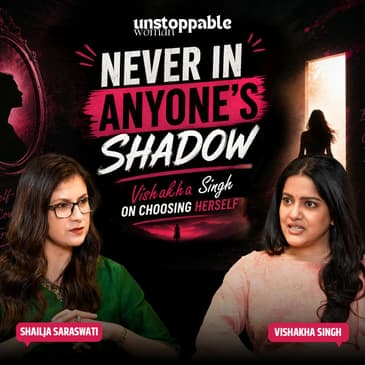

They wanted her to change.
Her name.
Her smile.
Her skin.
Her definition of success.
Vishakha Singh chose something far more difficult.
She chose herself.
In this episode of Unstoppable Woman, Shailja Saraswati sits down with actor, producer, entrepreneur, investor and storyteller Vishakha Singh for a powerful conversation about identity, rejection, reinvention, emotional resilience and the courage to stay true to yourself when the world keeps asking you to become someone else.
From navigating beauty standards in the entertainment industry to walking away from opportunities that no longer aligned, creating opportunities instead of waiting for them, championing underdogs, embracing therapy and discovering the power of emotional regulation, Vishakha shares the lessons that shaped her life beyond fame, visibility and achievement.
This is not a conversation about success. It is a conversation about self-definition.
In this episode:
• Why Vishakha refused to change her name
• The pressure to fit beauty standards
• The audition moment that changed everything
• Why she stopped waiting to be chosen
• Moving from performer to opportunity creator
• Championing underdogs and untold stories
• Entrepreneurship, reinvention and purpose
• Therapy, emotional regulation and self-awareness
• Why a calm nervous system may be the ultimate advantage today
• What it means to build a life on your own terms
A line that stayed with us: "I decided long ago never to walk in anyone's shadow. If I fail, if I succeed, at least I did as I believed."
Chapters
01:24 - Introduction: Radical Reinvention vs. Tenacity
03:51 - A Protected Childhood & The Anchor of Family
08:16 - The Modeling Grind: Defying Industry Beauty Standards
12:28 - The Breaking Point: Setting Boundaries and Walking Out
18:44 - Shifting Roles: From Performer to System Provider
24:47 - The Critical Path Method: Reverse Engineering Success
30:06 - The North Star: Empowering the Underdog
35:28 - Embracing Technology: Taming the AI Horse
39:28 - Mental Health, Therapy, and Emotional Regulation
46:22 - Unlearning Success & The Unstoppable Spirit Final Reflections
#UnstoppableWoman #VishakaSingh #ShailjaSaraswati #InnerAuthority #WomenWhoLead #Leadership #EmotionalResilience #SelfWorth #PersonalGrowth #Entrepreneurship #MentalHealth #Storytelling
[00:00:00] When you pushed back and you said, hey, you know, my name is okay, my look is okay, I'm okay under the skin. And I hold all this very tightly. I don't want to change. You have given the name. If you give it, it will be Vishaka. It will not be double A, it will be single A. I said, I'm sorry, this is the way it's gonna be. I love my Tera Daant. Enough means enough. I will have that walk on the beach.
[00:00:26] I love my tan. I love my brown skin. Something snapped. I said, I can't do this anymore. And I just got up. I said, never again. Never again. I am not going to stand in a line and waste three hours of my life for somebody to give me a chance. What will happen to Vishaka? I feel that would be a life wasted. The only thing to control is to be yourself. The human in you has to be taken care of. If somebody can rattle you that easily, you've lost.
[00:00:51] You have invested a lot in the person inside. It's also about the inner work. I decided long ago, never to walk in anyone's shadow. If I fail, if I succeed, at least I did as I believed.
[00:01:23] Welcome Vishaka. Thank you so much. You know, some journeys look like reinvention from the outside. But your journey looks like alignment towards a bigger purpose. Yes. And we are going to decode this today, like I told you earlier. And we have a small ritual. Okay. Okay. We call it the unstoppable keys. Mm-hmm. So all I'll do is I'll ask you a few questions. Okay. And you have to answer them briefly. Okay. To get to this.
[00:01:53] All right. All right. What do people see when they look at your journey? And what do they completely miss? I think they see a journey of radical invention or radical reinvention. What they perhaps miss is the... Oh God, I really don't know how to answer that. I think they probably miss seeing the tenacity behind all of this.
[00:02:23] Beautiful. And that's your first key. Thank you. I'm going to keep it up. Thank you. Thank you. Second, which chapter of your life changed you the most, but is least understood from the outside? I think it's my latest chapter about four years ago in 2022 that changed me the most when I exited from my last startup that I'd co-founded, Vazeer X NFT marketplace.
[00:02:47] That really, really changed the core of who I was and my own understanding of myself. Okay. Thanks for sharing that. And this is your second key. I think you're sitting a little far off. Yes, I'll take it in a bit. I'm going to keep your key on the table. Thank you. What is the one inner compass that has stayed constant through every reinvention? Ashutosh Gavarkar once told me that I'm a very sorted person. And I think it's that sortedness that has been very, very consistent.
[00:03:17] So we're going to decode this sortedness, but this is your key. Thank you. Again, what's striking about your journey is that from the surface, everything seems to be in place. Right. And you have held it very nicely and graciously. But if you allow, we're going to start with somewhere where maybe you didn't have all the learnings and the wisdom and we'll go back in your childhood and start there.
[00:03:45] So just share something about that period. What comes to your mind right now? So my childhood was primarily spent in Abu Dhabi and then of all the places, Ghaziabad. And it was a very beautiful childhood. Very happy. I'm the youngest in my family and very loved. My parents have always allowed us, and I say the word allowed because as children, you're allowed freedom because you're still learning who you are.
[00:04:14] They allowed us to make so many mistakes. It's not even funny. Most of my friends, you know, today when I see them and with their children and I see the kind of pressures they put on their children for learning and for studying during exams. I go back to my childhood thinking, my God, I never had to face that. I mean, I remember in class 12 when I was studying before my boards, I was doing an all nighter and my father woke up at night and he said, What are you doing? I'm studying. He said, What is the first time to be a professor?
[00:04:43] I said, No. So he said, Why are you studying so much? I'm studying so much? And to me, that sums it up. Wow. You know, so I have never understood the concept of taking undue pressure. Sure. And yeah, so it's been a very happy childhood. I was very protected by my siblings. And it's also, I mean, some people would be surprised to say that I, surprised to know that I say that my childhood was very, very happy.
[00:05:10] Because while my childhood was very happy, I also remember times when in Abu Dhabi, my father, who was a chemical engineer, went through nine eye surgeries, you know, and my mother had to leave us in Abu Dhabi, come to, sorry, come to Chennai with my father for his eye surgeries. And, you know, we were left with various families and friends. So that was a tough phase. And I was, I was a very small kid. My sister had probably had to bear the brunt of all of it or the responsibility of all of it.
[00:05:38] But I still remember a lot of happy times. Okay. So while that was going on, the travel to and fro, how was the child in you processing it? So again, you know, because I'm the youngest, I was always very shielded, very, very shielded. I mean, the travel was, my parents, my mother especially, had to do a lot of travel between visiting my father in the hospital, staying, you know, for months with him, and then coming back to Abu Dhabi and looking after us.
[00:06:09] And, but I think we were very blessed to have good friends as well. And I always feel that you can take a lot of life, anything that comes your way, if your core is strong. And I always say my family is my core. Okay. Okay. So you, you had that shelter. Yes. And your parents had given that larger infrastructure ecosystem to you. Yes.
[00:06:37] So that you didn't feel that need or that pain at that time. You would have felt and processed it, perhaps. Absolutely. I mean, I, looking back even now, you know, when I, when I go back to those very vulnerable moments in our family's life. And I was very young back then, but I still get emotional thinking of those times. So, but I just remember how happy we all were. Together. Together. Yes.
[00:07:06] So, you know, there's a story from childhood that one stick and four sticks together. When four sticks stay together, it's stronger. You can't break them all together. So that visual is coming to my mind right now. True, true. True, true. So I come from also like three siblings household and we, like every family, we've also gone through our own shades. Yes. Right. All colors and shades and sizes and seasons.
[00:07:28] But you're so right that, you know, as long as you're together, whatever storms or seasons come, you feel it's okay. Yeah, absolutely. Right. So that's a sense I'm getting. Yeah. While you're talking about the past. Yeah. And yes, so what one value you remember from that phase, which is with you till date? I think it has to be family and strength.
[00:07:58] I mean, I don't know if those are values, but family and strength. Core. That's my core. Okay. Okay. And that has stayed. That has stayed. That is, I always say that's my compass, I'd say. Yes. That's your compass. That's my compass. Okay. I remember, again, you know, today when kids are born, they already have camera in their hands. Yeah. In our time, there was no camera. You had to go, you had to look into the camera.
[00:08:25] And I remember I would be at home and I would prepare myself by keeping a bottle and pretending that's the camera. So that I could just look into it and talk. Wow. You know? Okay. So yeah. I mean, it took me almost, I think, four to five months of nonstop auditions until I landed my first ad. Four to five months of nonstop auditions. So this is, you know, this is the time I really want you to talk a little bit more. Yeah.
[00:08:47] And let's look at Vishaka back in that time, getting up every day and going for those auditions. Auditions. And what's really happening in the back of your mind? What is the self-talk going on? So at the back of my mind, so the initial four or five months, you know, I was still like, okay. You know, I was living with my friend and my dad had told me, okay, take your time.
[00:09:13] You know, and he was, he was again, he was very, very supportive in the sense. He told me the day you feel uncomfortable of any situation or any set you are on, you just walk out. Okay. You know, and I'll be there. And you're the first generation. I'm the first generation, you know. And there was no hiccups from home. So initially they were, they were very worried. They were. How did you face that storm? So my now husband, back then boyfriend, he told my dad that, you know, uncle, let her do this.
[00:09:42] We need to be supportive and I can guarantee you she'll be the first one to walk out of it. Which is what happened 10 years ago. But anyway, that aside. Okay. So I remember Bombay mein, we used to go, you know, like we would be, we'd get calls from casting directors and three, four of them would call us for different auditions. Aj, is ka hai, is ka hai. As models, we would literally take out, carry with us four to five different looks of costumes. Suit for a sweet gharelu ladki, you know, a kurti and a jeans for,
[00:10:13] for office look or, or maybe, you know. So you'll have, you have, have a suitcase with you. Like a little bag. Yes. And all of that. And you're going to two, three different places every day. Absolutely. Absolutely. And this went on for four, five months. Four, five months. Non-stop. What is the kind of resilience you need at that time? What is the self-talk? What is the self-reflection going on in the back of your mind? Did you ever feel, ya ho gya, bas? No.
[00:10:35] So I think, you know, anybody who decides to come to Bombay should know that you have to learn to... Ye hai. Ye hai kar nah hai. And I was told early on ki, the beauty of Bombay is ki, you give it your best. And the city will give you back. It'll give you multifold, you know. So, and that's what happened because I gave auditions non-stop.
[00:11:02] And it wasn't always comfortable, you know, because you would, you are always thinking you're not good enough, you know. Sometimes you're too dark for the role. Sometimes you've, I've been told you've got a teda daat. Can you get it corrected? Oh, you've got baby hair. Can you get that removed? You know, can you correct your, not the smile. The smile was a good asset though. You know, little things here and there. And somebody said, why don't you add an extra S in your name, an extra A. So you're constantly being pushed to doubt yourself.
[00:11:32] And I remember telling people ki, bhai, dekho, naam to ma baap ne diya hai. If you give a vishakha, it'll be vishakha, double A not a, single A not a, you know. Daat, I said, I'm sorry. This is the way it's going to be. I love my teda daat. I love my baby hair on my forehead. So four months, six months down the line, then I started getting work. And I remember my first ad was for some catalog for which I got 5,000 rupees, which was nice. And, you know, and also when you're young, somehow you just have that fire to fight it out.
[00:12:02] Fight it out, yeah. Right? So you're just constantly on the roll and you just turn up every day. It's only when you do it for year one, year two, year three, year four, year five, year six, year seven. So for me, it was 2011 when I said, bus, enough. I am no longer going to stand in a line for auditions. Okay. That was a very, very conscious decision. Okay. So that's the time in the ad world you decided that this is it.
[00:12:30] Yes, because I had also, by then, I had done almost 150 commercials. TV commercials, catalogs, prints, all of that. So I'd had my fill. And, you know, with ads, there is no, for a model, I'd say there's no growth trajectory. Because the more ads you do, the more exposed you are. You know, and I don't think brands necessarily like that. So that was one thing. The second thing is I had already done on the side, like by 2007 and 8 and 9, I had already started doing films in South.
[00:12:59] And all of them had flopped. And then I'd already done Khele Hamji Janse with Ashu Sar finally. Right. That also didn't do well. So that's when I took a call in 2011 saying, I don't understand what gives, what really works. And I need to pause and just pull back from what I'm doing. So you did pause at that time. I did. You know, before we go ahead and look at what happened to you in the pause. Yeah. You said something about them telling you to fix your teeth. Yeah.
[00:13:24] And I had like a few celebrity dermatologists on my show last season. And I know like celebrity dentists as well. Yeah. They are not on the show yet. But, and I know the extent to which film industry pushes you about modifications. And some are talking about it. Some are not talking about it. But it's just a lot of pressure on the mental health end of the day. Right.
[00:13:51] So when you pushed back and you said, hey, you know, I'm, my name is okay. My look is okay. I'm, I'm okay under the skin. Yeah. And I, I hold all this very tightly. I don't want to change. Yeah. Did you have self doubts ever? So. And that sigh also says something. Yes. I'll tell you why. Because I grew up.
[00:14:15] So when I was born, the whole, you know, all my relatives were like, oh my God. I'm a girl. I'm a girl. I'm a girl. But I'm a girl. I'm a girl. I don't like to say. I think makeup or light. But, right. So I was quite dark. Now my father, I mean, he and I have the same skin too. And my siblings are lighter skin. Okay. So it was like, my brother is going to be dark. I had a crush in school who once told me that I'm an ulta tawa. Okay.
[00:14:45] Now, until class 10th, I used to use fair and lovely. Okay. And then I remember class 10th when this guy said to me, I was like, yeah, there is no winning. Because when I go to school, I would have all my juniors say, hi Vishaka didi, good morning. Teachers say, hi beta, how are you? You know, you're doing so well. And I was like, what is this switch? And I remember very distinctly throwing fair and lovely. Saying, no.
[00:15:12] Now, in the industry, when I started, you know, when people would point out, I would literally look at all these pretty lighter skin models getting a lot of ads. And they would get more ads than me. And it would always break you. It would always break you. You know, there were days when I'd be like, yeah, okay, I'm not using fair and lovely. But I'm avoiding going for a walk on the beach. Because of? Because I don't want to tan.
[00:15:40] So it was a very, very conscious decision until, like by 2011 when I said, enough means enough. I will have that walk on the beach. So when I, you know, when you go to a salon, they're like, madam, you'll get this pack and detan it. And I'm like, enough. I love my tan. I love my brown skin. I don't want detan product. So I don't know what the question was. No, that's okay. I was talking about the entire modification pressure in the film industry.
[00:16:10] And what role it plays in the mental havoc. The mental hair. So it does. It does. And you're sharing your journey. How you. Yeah. So because, you know, when you've all your life, you've heard that you are not fair enough. And then you get the validation because now you're modeling and you are on. And I've done a lot of ads, a lot of popular ads. So you defied. I defied it, right? And I said, now that I've defied it and all those relatives who said, oh my God, they would literally say, iski shadi kaise hogi. You know, all that stuff.
[00:16:41] And of course, my parents have been always very, very loving. I mean, I think my parents actually gave me a sense of superiority or a superiority complex saying humare bache toho itane sharp hain, itane smart hain. So in my head, very subconsciously, I always felt I was smarter than the rest, which is not, I feel, looking back, I'm like, okay, it worked then, but now you need to be a little more grounded, you know.
[00:17:02] And as destiny would have it, two and a half years later, after Khale flops, I get all these directors reach out to me. After two and a half years? Yes. Just by themselves. By themselves. I didn't have to lift a single finger because I did have that thing in 2011 when I said, so okay, I'll probably backtrack a little. After Khale had flopped and before I had left for Dubai, sorry, for London, I was called in for an audition for a skin brand.
[00:17:33] I went and I was, in my head, I was thinking, you're Abhita, I've done Khale, I'm an actor now and I've been called for an audition. Okay. So I go and there are like 150 girls standing. And some of the top names that you know today in the industry, in the OTTs, were in that line. Okay. Okay. So I went in and I said, how much time will I take? So they said, two hours later. I went back after two years and those girls were still there. Two hours? Yes. Two hours.
[00:18:03] After two hours, sorry. And I said, two hours later. I sat for 10 minutes, 15 minutes and I don't know what happened. Something snapped. I said, I can't do this anymore. And I just got up. I said, never again. Never again. I am not going to stand in a line and waste three hours of my life for somebody to give me a chance. That's it. And I walked off. And I also had a benchmark. Even as a model, I had a benchmark that if there was a certain figure that was offered
[00:18:32] to me, I would act. Else I will, I literally used to say, I'll not leave my house for a number below this. So you had boundaries and you were clear about it. I always, always had boundaries. So now after this, when I took the pause, I think that pause really helped me reflect because at that time. So that plus then you went down south. Yes. You had three languages? Four languages. I did Telugu. I did Tamil and Canada. Okay. Yeah. Nice.
[00:19:04] You've spoken about not feeling satisfied, right? What was happening in all those years when you got the fame, you got the media, limelight, you got everything. What was going on? What was missing? I think somewhere I knew that I wanted to do something bigger. I also knew that I wanted to take charge of my own narrative. I think I always was in charge of what I was doing, but I was just... Control. You wanted control. Control.
[00:19:34] I wanted control. I didn't want to look for opportunity. I didn't want to ask for opportunities. You know, I didn't want somebody to give it to me. Give me a role. Give me an ad. Give me this. You know? So you wanted to create that opportunity for yourself. I wanted to create my own opportunity. And not just for myself, because even the films that I've produced, co-produced, like for instance, Peddlers and Haram Khor. I didn't cast myself in those, right? I produced an Assamese film called Onata that won the National Award. I didn't cast myself in that.
[00:20:03] I didn't cast myself in the Marathi remake of that same film. I produced a film called Atkan Chatkan, which A.R. Heman sir presented, that released in COVID on Z5. I didn't cast myself in that. So you moved from a performer to a system provider somewhere. Yeah, somewhere. So you were looking at a shift of role or identity you were creating for yourself. Yes. And you said, well, let's go beyond this. Let's create a system for myself. Let's go beyond that. For us. For us. Not for myself. For us.
[00:20:36] Besides the lines of the cues, of course. And the modifications. Besides the lines of the cues, you know, I felt that there were not enough stories of the underdogs. Okay? My friends, I think I've said it in another interview, is that my friends would actually joke saying, why are you making a strange picture? Yeah. You know, now filmmaking is not a strange process. It's an expensive process. And every film that I have produced, co-produced, invested, I mean, I have put in
[00:21:06] my own monies. I always put my skin in the game. So, I think the difference is what I do do is I tell stories of protagonists who have roughed it out, who are underdogs. Why is it exciting for you? Or relevant for you? I think it's perhaps my story. It's also my parents' story as well. So you want to keep reliving it? I don't know about reliving it, but I love it when people win. I love it when people win.
[00:21:32] I'm a huge cheerleader for anybody who's worked up their way, who has not been supported by the system. Okay. Yeah. Okay. So let's say that's your North Star in the entertainment industry. And that sort of being the North Star, then from a performer, you became the system provider. And then you were looking for investments and looking for scripts which are in this to satisfy the North Star. Yeah. Then what happened after that?
[00:22:02] So, after I got all these films for Kray and all of these films, I remember why 2015, so 2012, 13, 14, I'd done something like nine films back to back. As an investor? No, as an actor. As an actor completely. Okay. And I had co-produced Peddlers and Haramkhor with Gunita Nandrag. But again, I was very insulated there because I didn't really have to do anything apart from putting my monies.
[00:22:27] But I remember 2015, January, I asked myself what I really wanted to do because I realized I didn't enjoy acting. Okay. You know, I... Because system exposure had started happening, you realized that something is shifting inside. You know, more than the acting part, it was the dressing up for media interviews that really, really sucked my energy. I want to act. I want to do my job. I want to come back. I'm very happy with that.
[00:22:56] When the film releases, this entire... Promotion. People are... Oh my God. It sucks the energy out of you. I remember for one particular film, for Bajati Rho, we had 10 days of non-stop publicity. Right? And you're constantly changing costumes. Constantly changing hairstyles. Constantly giving interviews. Constantly answering the same questions. And I was like, I can't do this. And city to city. Yeah. And it is just taxing.
[00:23:25] And now I think... So you know, the schedule, the constant working, you know, jumping from one set to another, working for like 72 hours at a stretch, going for promotional rounds, all of that resulted in me having hypothyroid, PCOD. It's impacted with... Absolutely. You know, so I was like, if this is going to come on my health and my mental peace, this is not serving me well. It's simply not serving me well. And that's when I said, again, I took a pause and I said, I need to know what I want to do.
[00:23:55] And I went with my husband, now husband, back then boyfriend again. So I went to Rome with him and we were there for some time. And that gave me a macro view of the industry. I understood cinema better. I then produced this Assamese film called Onata. And similar? Similar space? It is a story of a rape survivor. Okay. There you go. So because you found a North Star. Absolutely.
[00:24:20] And also, you know, when you have filmmakers who are passionate about filmmaking, who also do not come from a film industry background, but have the talent, and they want to tell stories of underdogs. Then... Somebody's got to. Somebody's got to. Somebody's got to, right? You know, so you try and chip in. And that's when we all win. We all change the system together. So Pishaka, almost the feeling I'm getting is that your North Star is clear.
[00:24:50] You are collecting your tribe, right? And somewhere underdog, achieving, finding the success is a similar theme. Now, after doing all those movies and bringing your tribe together, what did you do with the tribe? When a filmmaker comes to me with an IP or a script writer comes to me with their script,
[00:25:16] I, first of all, think, especially if I like the project, my mind starts working towards the release date. Okay. Okay. And I work backwards. I do a backward integration. Yeah. Okay. It's a default. So you would not think of step A, but you'll think of Z and Z. And you'll say, this is the cast in stone. Now, let's go. Let's go. Let's go. Right?
[00:25:43] So I am a huge believer and user of the critical path method, which is if you have to reach from point A to B, you map down all the steps. And you identify that one critical path that simply cannot be compromised on. And the timestamps attach to that. So he just says that. He says, I will put it. I will go backwards. Now you've spoken, so you're still a strong commitment. So you have to do it.
[00:26:11] So you know, Roshan and I have somebody in common. He has a very dear friend called Paran Thakur. Okay. He's a voice coach. And Paran Thakur is a dear friend of mine. He's almost like a brother to me because his father was my school principal. Okay. And his mother was my English teacher. And Thakur sir and Thakur ma'am have been my mentors. They have shaped me immensely in this life. Okay. So there is something in common. There's something. Maybe it's Thakur sir's or ma'am's teaching that is probably passed down to Paran and Roshan and me. Who knows? Amazing. Amazing. Amazing. Yeah.
[00:26:41] But this is very interesting because what happens, you know, half the time as founders and newbie founders like myself, because I've just started this venture, somewhere we get lost in the, let's say in the strategy and in the planning so much that the prototypes never come out. Yeah. And that's what I started thinking that, you know, now is the time that I have to start focusing on prototypes, which means that you put the timeline out there. Yeah. And you just test it. Yeah. Nothing.
[00:27:09] The architecture can not be ready overnight. Yeah. But you have to keep testing the prototypes. Otherwise, you'll never know what's working. It's like you start walking and the path will appear. Exactly. Exactly. So tell us like when your path started appearing and enriching you, enriching your tribe. Now there's a rhythm. Yeah. You know the rhythm. You are sort of replicating that magic from one project to the other. How is it looking now and how do you want to take it ahead in future?
[00:27:36] Considering the macro environment is changing very fast. I know the complexities in the macro environment, right? Yeah. Entertainment as a pie has reduced and what's happening on OTTs, television, theater is going through a complete shift. Absolutely. So how is your, this, which you've created a beautiful world, fitting into the macro changing environment?
[00:28:00] I, so you know, when I take on any task or any project or any story that I want to tell, I don't really think of fitting in. Okay. I've realized that my biggest USP is that I do do very different projects. When I produced Real Kashmir Football Club, nobody would have thought of telling a story of Kashmir and that football club because that itself is a very radical idea. It is. Right? And it's a true story. It's a very heartwarming story.
[00:28:30] You were a producer and you acted in it. Yes. I acted in it because we wanted to save on the actors money. Sure. And I was the only non-Kashmiri character in the storyline. Okay. Okay. And I auditioned for it. Okay. Because as a rule, I had told myself that I would never cast myself in any of these, on my own productions at least. Okay. Because I'm not acting actively and I think actors should get a chance. If I'm not acting, I mean, why should I take some other actors role, so to say? Sure. But anyway, it was a producer's decision to act.
[00:28:58] But that aside, so what was the question again? So how do you fit in? Yes. Because the macro environment is changing. Yes. So the whole, so I've realized that I have a knack of identifying stories that are very, that are compassionate and they are about the triumph of the human spirit. Okay. And if I continue following my own North Star and I do things to the best of my ability with integrity and honesty, I don't think I'm going to have a problem because I also have a knack of remaining within budgets.
[00:29:29] Okay. And delivering on time. When you said you have a knack of picking up the right projects, are you depending on data or it's just instinctive? Both. A lot of times I will read about something and I kid you not, I read about a story say in South India and it could be one of those better India stories, you know, that has come. And my mind just goes into visuals. I have an entire story already ready within a minute in my head. So what I do in those cases, I just quickly write a concept and register it on Script Writers
[00:29:58] Association immediately. Very nice. Yeah. Tell me what mission are you on, Vishaka? What is your purpose? Because see, I, there is an underdog story. There is a North Star. You're building your tribe. Yeah. But I believe every human, every leader especially who has walked the talk has transformed their lives and they're trying to transform other people's lives. And I've interviewed maybe 70, 80 of such leaders. They always have this mission, right?
[00:30:27] Which they might be aware and they might not be aware. And I can sense that mission which you have. What, what is it? I just want to, and I, it sounds like one of those, you know, so years ago I used to mock at those beauty queen answers. What do you want? World peace. I used to mock them. And now I'm like, my God, they were right. We were silly to mock them. You know? So what I really... That was a cosmetic answer though.
[00:30:56] It was a cosmetic answer, but that is still what the world needs. So what is your substance under it? All I know is that I just want people to be more empowered. And I genuinely want that. And I want it perhaps even for myself. Because I would probably go deeper and say the difference between the haves and the haves-not is what creates all these complications in society. What if we all had it?
[00:31:26] So through your filming, you're trying to bridge that gap. I'm trying to bridge that gap. I don't know about that, but I'm definitely trying to motivate people and tell them that you can do it. There's nothing holding you back. So you and I are on the same mission. So let's say unstoppable, anchoring human spirit. Yeah. An unstoppable spirit. Yeah. And you're doing it through filmmaking. I'm doing it through conversations and coaching. Absolutely. Fair world. Fair world. It's like a more peaceful world which we're trying to build together in our own ways. In our own ways. Absolutely.
[00:31:52] So that's your North Star which is pulling you. Yeah. But let's just go a little deeper. Right? Like a 12th failed sort of a story which... Oh, beautiful. Beautiful. I love underdog stories. I love this conversation. And thank you for investing your life and professional and personal in pursuing this. But let's just go a little deeper. There is still something more. Right?
[00:32:19] There are roots to our mission and roots which you have nurtured. Roots which have made you resilient. They are somewhere in your system. Yeah. So where is it when you go deeper and deeper? When you dig this root of... I have to stop with underdog. I have to stop with the have-nots. I have to stop with the have-nots. What will happen to Vishaka? I feel that would be a life wasted. Why?
[00:32:48] Because I now come from a background of privilege. Okay. Okay. I have chosen to be child free. Okay. I don't have the responsibilities of most people. I have the time. I have the means to support people. Okay. Right? Having said that, I'm not a socialist. You know, maybe I am, but perhaps I think I'm the right balance of a socialist and a capitalist. Okay.
[00:33:18] And I think if you can empower people by telling stories of the underdogs that a normal Bollywood wouldn't touch and still make monies, you can literally scale up a new system. Hmm. You know? And also, you know, when I say supporting people, it's not just cinema.
[00:33:44] Every director I work with, I am hoping the director, the DOP, the actors get to work more after that. Okay. And everybody wins across the chain. So you're saying that if this formula is successful, not the formula, if this space is successful, it's everyone's win. It's a win-win for everybody. And then the success will replicate more success. Absolutely. And that you're building a system around it. Yeah. And you know, like when I talk about haves and haves not, today, why do so many people want to go?
[00:34:12] Why do, I mean, of course, right now there's a war situation in Dubai, but why do we say Dubai is the most safest and happening Indian city? Because there's so many Indians there. And why do people aspire to go out of India? Right. Because of safety. And I think maybe we're digressing from our regular conversation right now. But the whole idea is to ensure that people are able to basically just grow in life, right?
[00:34:37] Tomorrow, an auto-wala ka beta or a beti can also become an actor, can also become a filmmaker. So you're creating a life of possibilities. Yeah, absolutely. Because the world is your oyster today. And I think that's the way when a chaiwala can become the PM of the country. Anybody can. Anything is possible. Anything is possible. And people just need to, they need to see these aspirational stories. They need to see that this is out there. And the medium is storytelling. Yes. So world of possibilities. Yeah. And the medium is storytelling.
[00:35:07] And you're combining it with commercial and craft. Yeah. And because you have a balance of the two. Is what you see. Is my understanding of myself. Understanding of yourself. And that's the axis on which you're standing with confidence. And you're repeating that success. What next now? Where is this taking you next? Because again, I'm saying the macro environment is, it's moving fast. I will not say it's difficult. It's moving fast. It's full of opportunities.
[00:35:34] But it's also sort of saying that we don't know what's going to work. Audiences, tastes are evolving. No formulas are working anymore anyway. So how do creative people like yourself, while you created this entire system for yourself, how do you stay centered and still continue to do the work which you're doing and keep this noise out? So again, you know, I've realized you, when I was in the NFT space, we have a term called hodl. I'm a hodler.
[00:36:04] Hold on for dear life. Which is basically a long term investor. Okay. Nothing phases you. I don't know. You're a debt fund. You're not in debt fund. You're not in debt. You're not in debt. So you're going to go. You're going to go. You're going to go. I think the whole idea is, you should know, first rule of life is there's nothing certain. Okay. Right? It's never the machine. It's always the man. In this case, it's the woman. So there was a very funny ad that I saw. I can't remember the brand of Paresh Rawalji. Okay.
[00:36:32] Where he's sitting and this guy comes. Saab, saab, aag lagi. Toh mera kya jata hai. He said, saab, saab. Aap ke ghar mein aag lagi. Toh tera kya jata hai. I think it's the funniest ad. But the character was just so centered. I was like, God, grant me this centeredness. This centeredness. This calm. Right? So you're saying ki abhi jo ye AI ka influx hua wa hai,
[00:37:03] isme aap continue to do what you are doing. So I will continue to tell stories. I will explore mediums for sure. Sure. Right? AI is not a threat to us. AI is like a horse that you need to tame. You need to master it. Simple as that. And I've also realized when I... So I have had five tech startups and my last one being the most successful one. Okay? And I'm not a techie. I'm not a person from a STEM background. Okay. So I'm an actor. I'm a producer.
[00:37:32] I've been a tech startup co-founder as well. I've dealt with technologies like blockchain. So now when people talk about AI, I'm just like, why are you scared of technology? Okay? Let's just master it. If you can't master it, let's play with it. But play with it. You cannot say that I'm scared of it and I don't want to get into it. Scared for what? Like you know, Ram came, Ram Madhwani came on the show and he's like, ki technology ka matlab tekne hai. I don't know which language he said. And tekne means art. Yeah.
[00:38:01] And basically it's a technique to use to make your craft better. Absolutely. So move, you know... Let AI assist you. Exactly. Just let it assist you. And that's exactly what it is doing. Absolutely. So I will continue to tell stories. Now it... See, I have produced films for OTTs. I've produced a web series for OTT. I will perhaps produce a film for a theatrical release. I'll probably do an international co-production. I'll produce something for YouTube. But you'll stick to your mission. Definitely. I'm a storyteller.
[00:38:31] I will continue telling stories. Of the underdog. Absolutely. Which is beneficial for your tribe and it's beneficial for... Absolutely. ...people and they get to see a possibility of possibilities, right? Absolutely. What are your next projects here? Now I'm excited. Not yet decided. I'm working on something. But when the time is right. How do you go about figuring out your storylines and... So like do you have like people on field...
[00:38:59] ...who have their ear to the ground and they keep telling you... ...hey this is happening, that's happening. And also another connecting question to this is... ...there was a time when there were stories about hinterland, right? You've spoken a lot about the mental pressure. How mental health and the physical health gets impacted. Yeah. But do you feel that people are not talking enough... ...and they're holding back? There's a lot which we as an audience still don't see... ...is being covered, it's not being said enough.
[00:39:27] I think in the film industry... ...a lot of actors have started talking about... ...mental health pressures, etc. But there is still a... It's still a taboo topic, right? The other day I mentioned... ...me, you know, talking about my therapist to somebody... ...and they were just like... ...are you alright? Do you need help? And it was suddenly an act of concern as if... It should be a normal conversation.
[00:39:57] Having a therapist is like having a dermatologist. Absolutely. Or a dentist. Yeah. Right? Or your own GP. Yeah. But I'm still glad that people are talking about it. Talking about it. Like today when you go on Instagram... Like for instance, I've been part of a pocket full of happiness... ...community which is by Anushri Dindolkar. She's into art therapy. Okay. And I've been attending her workshops for the last two years. Okay. They have helped me immensely. Hmm. Immensely. And even prior to that... I remember in 2022 after I left my... I exited from the ZRX NFT marketplace.
[00:40:27] And I would say that was perhaps the lowest point of my career. Hmm. Because I had built something so beautifully... ...in a space that was not mine. And I was validated not by my peers... ...but by intelligent journalists from business standard, financial times, economic times. I mean, you know, from being featured from Bombay times to suddenly business standard and economic times. I mean, that's quite a high. Yeah. To have the intelligentia applaud you... Yeah. ...was another high. And then to...
[00:40:56] To walk away from a startup... Yeah. ...that was doing well because there was... There was... You know, there was no clarity around regulations around NFTs. It was a very tough phase. Yeah. But what that phase gave me also was a lot of mental clarity because I hit my lowest. I started researching on, you know, how do I find my North Star? What's my Ikigai? I started understanding the emotion wheel.
[00:41:23] So every time I had any sort of cognitive dissonance, I would immediately start labeling my feelings. Sure. And understanding what do I need to do about it. And I remember my therapist once told me, Vishaka, you tend to apply logic to a lot of your emotions. Why don't you sit with it? Hmm. And I tried it one day and I was like, what do you mean sit with it? Like, kya karo, coffee peering? I'm still thinking about it. I'm like, what do I do? For me, action is the antidote for everything. You know? So... So sit and then let it process, let it surface up.
[00:41:53] I mean, even in meditation, what we do is... Yeah. I mean, I'm just taking a segue from this. Is that you sit with it so that it dissolves and the fire of the meditation sort of burns the thoughts automatically. Yeah. So in the subconscious mind, they say the awareness erases the thoughts. It burns the thoughts down. Nice. So that's a sit with it phenomena in meditation.
[00:42:22] So what you're doing, you must have done art, you must have done writing, you must have done observation. I do a lot of journaling. But the more you stay journaling, so the more you stay with the thoughts and the emotion and be aware, it burns. Yes. But we don't, na? We run away from it. Absolutely. Exactly. So I've tried that and of course, and I like to expend energy also. Like, you remember when Meryl Streep said, I think in one of her, I don't know, one of the award functions, she said,
[00:42:48] take your broken little heart and convert it into art or make a piece of art. Yeah. Which is so true because every time you've hit low, either you... And I mean, I'm not talking about grief. I'm just talking of low moments. Yeah. You have to, for me especially, and I need to time it because I don't like to sit with it for unnecessarily. It's just unproductive for me.
[00:43:15] And of course, there are different labelings of what you're feeling emotions, right? Is it an emotion or a pain caused by your core group? I'll perhaps take longer to heal. Is it by an external group? That doesn't really... Then it doesn't really matter. Then I'm really going to time it. It's like, I have this... I keep telling my family because we are from the Pradesh and we are Rajputs. So, our people are angry at the people. Right? So, this is something that I've heard across my family and relatives. That we are angry at the people.
[00:43:45] Now, I say in very Mumbai language, I'm like, Why? Because I said, if you are losing your cool, you are weak. It's as simple as that. You cannot lose your cool. You use that energy elsewhere. If somebody can rattle you that easily, you've lost. Yeah. So, regulation is effective. So, I think one of my biggest learnings, you know, when we talk of the various industries that I have transitioned into and from, has been, especially in the last few years,
[00:44:15] is my emotional regulation. I am able to emotionally regulate. So, that's the biggest investment in your self-care which you've made. 100%. I think that's the most relevant one in the times we are in right now. Because I keep saying, the only thing to control is to be yourself. Absolutely. Be yourself. Because the human in you is what is with you now. Yeah. Technology toh sara le jayegi. Woh sab kar leegi. Aapko kar nahi kya hai. You know, aapko. The human in you has to be taken care of. Absolutely. Yeah.
[00:44:43] And if you don't invest enough time, anyway, it's too late. Like, you've already, you've walked this path, Vishakha. But, there are many people who have not invested time with themselves. Yeah. Right? So, and you know, with the macro environment moving so fast and if you have not rested within. So, you can imagine the coming times, the mental health is going to be even more messier. Absolutely. And that's why I say, I tell so many youngsters who reach out to me for investments and all
[00:45:13] of that. And, you know, especially when you're investing in early stage startups, it's always the founder you bet on. Right? And, aaj ke zamanemein, if the founders are very young, I usually look for emotional resilience. And that's something you can gauge. At this age, at least you can gauge when you talk to people. So, for me, I always look for self-awareness. And, of course, the new term point for self-awareness is metacognition. Right? So, metacognition is basically, I'm sure you know it better. It's when you're able to observe yourself. Yes.
[00:45:42] Going through. It's the highest form of thinking or self-awareness. So, I mean, I am trying to now. When you can watch your own thoughts. When you can watch. When you can watch your own thoughts and actions. Okay. So, what does real emotional resilience look like beyond the surface advice? Ah, a calm nervous system. Yeah. So, the more regulated it is, the more resilience it will. Absolutely.
[00:46:08] And, that seems to be a work which you are doing along with the mission in the North Star is defined. But, that's a self-work which you are invested in. I have been very, very actively for the last three and a half years. So, what is one illusion about success you had to unlearn? That success does not mean financial security. Especially in the film industry because success is measured by your likes, your follow account.
[00:46:34] It's measured by the number of parties you've attended and the number of times you've appeared on various publications. What do people overestimate about visibility? I think, again, similar. Visibility does not necessarily mean you've got work. What kind of success quietly drains you? What kind of success quietly drains you? Oh, God. I think when you follow the herd.
[00:47:03] Like, when you're doing formula films that don't really align with you. But, you're doing it because everybody else is doing it. I mean, if I had to do that, I know I'd be very drained. What is harder? Being seen by everyone or being understood by no one? Honestly, I really don't care for being seen or heard by anybody. I really don't. I don't care. As long as you're connected with them. Yeah. I mean, I know my core people, right? My family and friends know me and I really don't care if somebody misunderstands me. And I don't really care if I'm not famous and if people are not seeing me.
[00:47:33] I don't know if I've got the context of the question correctly. That's your answer. Yeah. What is one decision that changed your trajectory the most? To walk away from acting in 2015. I think that's when I started investing in startups and I co-founded tech startups. So, Nishaka. One, you have a very beautiful smile. Oh, thank you. And you were right. Please don't do anything. To the teda daad. This is adding to your beauty. Thank you.
[00:48:03] And whoever told you that, please, guys, you don't know what beauty is. If I may just add, after all of these episodes, in 2017 or 18, I ended up doing Himalaya toothpaste ad with Gajraj sir. And Gajraj Rao, I've done my most number of ads and commercials with him over my modeling career. Ended up doing that. And I also won the Elle Most Beautiful Smile Award. So, I'm like, whoever said that to me, you were wrong. Okay.
[00:48:31] You know what stays with me more when I look at you, when I reflect on the conversation we had for the last one hour is that you have invested a lot in the person inside. Right? So, it's not really Vishaka, the actor, the producer, the entrepreneur, but it's also about the inner work which you've been on. And you have clarity. You have invested in yourself.
[00:48:59] And whatever is visible outside is exactly, you know, because of the inner work. And that is a very nice alignment, right, to have. And once that is aligned, then whatever you do feels very satisfied at a soul level. At a, your mind, body, soul are all aligned then. You know, you don't feel out of sync. Right. And that's a feeling I get when I'm sitting and I'm talking to you that that was your mission also.
[00:49:27] That to feel much more aligned, to feel like much more centered and calm. And that could be a mission you're on. But at the same time, it's reflecting in the kind of work which you're doing, you know, because that's the feeling you want to, that feeling should stay back with the audiences as well. Right. That they feel more aligned. They feel that, okay, there's no gap. There's a world of possibilities out there. So all I can say is that we wish you all the best, Vishaka. Thank you. It was a pleasure hosting you today. Thank you.
[00:49:55] And your journey is unstoppable. Before we go, I want you to answer this question for us. It could be a dialogue or it could be anything which you wish to say. What does unstoppable spirit mean to you? There's a song by Whitney Houston, which is the greatest love of all. Okay. And my favorite lines from that song are, I decided long ago never to walk in anyone's shadow.
[00:50:25] If I fail, if I succeed, at least I did as I believed. No matter what they take from me, they cannot take my dignity. Wow. So the greatest love of all is happening to me. And I think that's the unstoppable spirit. Thank you so much. You want to sing that? Oh no, I'm not a good singer at all. Sure. Very sure. Okay. All right. Guys, can you give the journal? You've got a journal? Yes. You know, so this is the fourth season. And this season, it's also the launch of my venture. So I thought I'll just take it up a little.
[00:50:55] Like this is a labor of love. Nice. We have our past guests. There are quotes on the right. Aha. And then I have a coaching question on the left. So if you like to self-reflect, this might help you. Lovely. Thank you so much. It's, I think, perhaps one of my favorite gifts then. Because I do a lot of journaling. Yeah, you do? A lot of journaling. Like this is my favorite gift that I keep gifting to people as well. Oh, lovely. You know, all my friends, they know that I'll give them some journal or the other. Lovely. Fantastic. Thank you so much.
[00:51:24] And a butterfly because I have a film called The Butterfly coming up. Oh! Thank you, Unstoppable Woman Podcast for this amazing journal. I love journaling. And I think this really is very, very significant because it's got the butterfly on it, which I think signifies my metamorphosis as well. So thank you so much for this.