
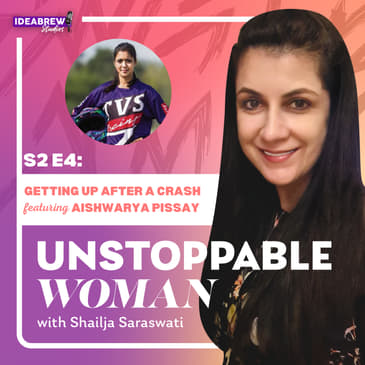

It's not easy to get up and try again after a crash, whether in life or in motorsport. This episode, Shailja meets Aishwarya Pissay, a multiple world title-wining circuit and off-road motorcycle racer as she displays the determination and perseverance that makes her unstoppable in a sport that's considered a man's domain.
[00:00:00] This week we have another outstanding women athlete who has made her country proud. My guest,
[00:00:16] Aishwarya Pise is an Indian circuit and off-road motorcycle racer. She holds the distinction
[00:00:23] of being the first ever Indian athlete to win a world title in motorsport on motorcycles,
[00:00:29] along with being the first Indian woman to win six national titles in circuit racing
[00:00:34] and rally championship combined. Truly an astounding person who proves that women can do anything.
[00:00:42] Welcome to the show, Aishwarya. It's really a pleasure to have you here.
[00:00:47] Thank you, Shailja. It's an honour to be a part of the show.
[00:00:50] So tell us, where did your passion for motorsport come from?
[00:00:55] I started riding motorcycles at the age of 18. Motorcycles came into my life at a point where
[00:01:02] I failed my 12th and I was figuring out what I would like to do with life, studying, working.
[00:01:10] That's when motorcycles came into my life. I started going on weekend road trips with my
[00:01:14] girlfriends and I really liked the thrill of riding a motorcycle, going fast and the wind
[00:01:19] blowing through my hair. So I think I started riding more and more and then I knew I had
[00:01:25] a buck for speed. Started training at a school called Apex Racing Academy. That's where I
[00:01:30] found out about racing, learned more about racing and that's how I got into racing.
[00:01:35] You've also mentioned in interviews how you didn't particularly take to academics and
[00:01:41] you had some pushback from your family in context to that, right? And your choice of your
[00:01:46] hobbies or your career is also very unconventional. So would you like to tell us a bit about that?
[00:01:52] Was it a struggle? Definitely. Coming from our Indian conservative family,
[00:01:59] everybody even today in my family does a nine to five job where anything apart from that is unheard of.
[00:02:06] So when I wanted to pursue motorsports as a career, not only had no one in the industry
[00:02:14] of motorsports had seen a woman make a career out of racing, neither had my family seen anybody
[00:02:21] who'd made a career out of racing. So definitely I did have a lot of pushback from them,
[00:02:27] especially from my family, expecting for me to have a regular nine to five job and do racing as a hobby.
[00:02:34] However, also peers in racing also suggested that I do this just as a hobby and not take it up seriously.
[00:02:42] But from listening and reading and seeing a lot of stories of successful athletes,
[00:02:50] I cannot do two things half and half. Like I will have to give my 100% in the sport. So when I started
[00:02:57] giving my 100% to the sport, it wasn't easy. But when the results started coming and when
[00:03:03] TVS Racing signed me on as one of the factory racing athletes in 2017, things really changed.
[00:03:10] It became my career. Racing was not just a hobby anymore. It became my career. So
[00:03:16] yes, I did face a lot of pushback in the beginning. But as I started doing very well,
[00:03:22] today everybody really supports me to do what I do.
[00:03:26] So for a champion, it's always always the hard work behind the scenes,
[00:03:31] right? Till the time you reach the podium, it's all fine whether journey is a real journey,
[00:03:36] one goes through and I think it's mostly all alone.
[00:03:39] Yes, definitely. I think the journey to the top is definitely a lot more
[00:03:44] the higher we go, the more and more hard work it requires. And it's just reaching to the top
[00:03:52] and doing the struggle all over again. And I think it's just made me stronger and
[00:03:57] given me a skill set and a toolkit to make it easier and better every single time I need to do the process.
[00:04:04] But do you think there are any women specific barriers in motorsport tell us about them?
[00:04:09] Motorsports has been a very male dominated sport. Even today, the ratio of women who participate in motorsport
[00:04:17] is a lot lower than the male participation globally or only in India.
[00:04:23] Globally, the participation of women is a lot lesser. The ratio is a lot lesser than the men.
[00:04:30] It has been picking up but still not at a par of one is to one. It's still a lot lesser.
[00:04:36] And when I did start racing, I was the only girl racing on the grid with the men.
[00:04:42] Like there were 42 men and I was the only girl racing because there was nothing for women.
[00:04:47] But I was never training to race with women. I wanted to be the best racer out there.
[00:04:51] So I mean, when and when I want to be the best racer out there, it's the same struggle as
[00:04:57] any other athlete out there. I am fighting with the boys, the struggle to find sponsors,
[00:05:02] the struggle to be able to have the infrastructure to train in India, or the support to be able to
[00:05:09] find the right team, the right manager or the coach or all of the best bike, the best gear.
[00:05:16] All of these are the struggle that initially any athlete goes through and it's the same process
[00:05:22] that I went through too. And I think as a woman, yes, like it's a little difficult to be able
[00:05:29] to find sponsors and things like that until you prove yourself. And which I did face as well.
[00:05:35] But I think it was important for me to participate and bring in performance by borrowing a bike from
[00:05:41] someone gears from someone else, and not letting the next day stop me and like just be focused
[00:05:46] on my goal and get the results that's required. And as the results started showing up, things
[00:05:52] started getting more and more easier. Like my coach once told me that I need to invest in
[00:05:57] my education first before anybody else does. So and I feel like that really stuck to me and
[00:06:05] the first few years, yes, it's a struggle for all athletes including myself.
[00:06:10] Is age also a factor in career in motorsport? Or is there any idle time to start? I think
[00:06:15] you started in 2017 or before that if I'm not wrong? Yes, I started at 18 because that was the
[00:06:23] age that I could begin with. But definitely starting younger would give us a higher advantage because
[00:06:29] even today when I race with athletes, they are they started training and racing at the age of 3
[00:06:33] and 4. Whereas I started at 18. But at the same time, that bridge of performance has to be
[00:06:41] gap. And it's possible by a lot more training and hard work, but would definitely be easier
[00:06:47] if I would have started a lot more earlier. However, even today there are a lot of brands
[00:06:53] that manufacturers like TDS run like the one makeup where a lot of women have started coming in.
[00:06:59] Like we see a participation of 15 women that come in year on year from the year 2016.
[00:07:06] So and also there is this one makeup for men and young people who want to get into it.
[00:07:13] And I think like now there's an amateur category like under, I think it's the kids from the age of
[00:07:21] seven and eight are racing in India now up to 13, 14, 15. We're seeing more and more younger
[00:07:28] participants. Absolutely amazing. I mean, to have that focus, I have a toddler at home.
[00:07:35] Yeah, I mean, if you're saying three to five years is when they start.
[00:07:38] So I think no wonder the parents focus is a lot different than what it was 10,
[00:07:43] 15 years ago. I so agree with you. But tell me, I have seen very intense videos of yours
[00:07:51] where you are training and your training seems to be very holistic in approach.
[00:07:56] Right? So it's not really focused only on the physicality of sports, but also you've
[00:08:02] been talking about mental health, your diet, your regime, your sleep and how you balance the
[00:08:09] entire thing between a weekend and your weekday regime. Right? You want to talk about it because
[00:08:14] that was the most fascinating part when I was doing research on you.
[00:08:20] Yes, I think especially athletes in India, we just focus on the skills set of the game
[00:08:26] or just the physical fitness. But to be an athlete, there's more aspects to it.
[00:08:31] In my regime, I do have mental conditioning, physical conditioning, skill training as well
[00:08:36] as nutrition. These are things that I am focusing on. And these were things that
[00:08:44] I figured that were very important at probably somewhere midway in the career like 2017,
[00:08:51] the same year that we were facing signed me on. I think that's when I started working with
[00:08:57] my coach, Shuman, who is my mental psychologist, sports psychologist, where we work on a regular
[00:09:04] basis to simulate race situations, to be able to focus on multitasking where I'm connected to
[00:09:11] something called the EZoom, where the heart rate, the breadth of the skin conduction,
[00:09:18] brain waves, all of these things are captured on the laptop and we're doing tasks.
[00:09:24] To be able to stay at a flow state of mind and to be able to grow these skill sets to use at
[00:09:32] a race situation. So that's one thing that I work with my sports psychologist, then the physical
[00:09:38] conditioning is a part of it where we work on strength and conditioning, endurance,
[00:09:42] and that's one part. And then skill training like especially in India, I get to train four
[00:09:48] days a week, whereas when I'm in Europe, I train five to six days a week, where I train
[00:09:53] in the afternoon to go ride and in the morning I'm training on my physical fitness. Nutrition
[00:10:00] plays a very important role as well because it's very important to fuel a lot of athletes,
[00:10:05] including myself, have been underfueling a lot because of the amount of calories and our metabolic
[00:10:13] rate being very, very high. And in the recent times, I'm using something called as
[00:10:17] the ultra human cyborg, which is monitoring everything that I eat. And it's technically
[00:10:24] giving real time data of how the food is affecting my body when my energy levels are low and my
[00:10:29] fueling right and all of these things. So these are few things that I really focused on and to
[00:10:36] bring my performance to the elite level. But is there any aha moments on your journey in terms
[00:10:43] of holistic training? Were there any self discoveries besides what your coaches and your
[00:10:48] trainers have told you? Was there anything something which came from really inside, right?
[00:10:52] As an intuitive process that okay, you should do this or you should add this
[00:10:58] to the mix of training which you're going through.
[00:11:02] Today my career wherever it is I think is because very early in life I believed
[00:11:09] that this is what I wanted to do. I believed in the goal, believed in law of attraction and
[00:11:15] since I started working at 17 I never took a penny from home. So I'm a very self-made person
[00:11:22] to where I have gotten today. And I didn't really think when I failed my 12 that I would really
[00:11:27] be here like being a world champion at 22 and to be aiming to go out to darker is definitely
[00:11:34] not something that I really thought I could but very early in life this thing of the law of attraction
[00:11:39] really taught me that if I have a goal and if I am and let the naysayers stop me and you know
[00:11:46] if I put in the hard work no matter what that goal is I can achieve it. And that's something
[00:11:52] that came from within from all the experiences that I had. So this was the driving force
[00:12:00] which you were aware of as a kid maybe or as a teenage. Yeah I mean this I think came into me
[00:12:06] only after I had the biggest failure of my life at least the first biggest failure of my life that
[00:12:11] was failing my 12. Yeah I mean that's an adversity which you know kind of released that entire energy
[00:12:18] for you to realize that's all within. I saw one of your TEDx speech where you spoke a lot
[00:12:23] about self-confidence, passion, determination and it was coming straight from the heart
[00:12:29] you know and for a such a young person as you to talk about self-confidence with so much of confidence
[00:12:36] it's really you know it just kind of makes me believe that you have kind of decoded or understood
[00:12:41] what really self-confidence really means. It's not really English words but okay on a completely
[00:12:47] unrelated note Ashwarya tell us about your dog. The names Alaya and Teddy both are female
[00:12:56] dress use. I became into my life at a I mean I found them on one way side to a pole and the other
[00:13:04] one I found her on the shoot and they're full of love and they're my partners in crime to go hiking,
[00:13:11] to go cycling they're just wonderful. And they go with you everywhere right? I've seen a lot of
[00:13:18] your reels on Insta where they are almost in every frame every still of yours. Yeah they're
[00:13:25] always around me if I am home so yes they're a very important part of my life to keep me calm
[00:13:31] and for me to be stressed. Lovely yeah. Ashwarya tell me you know I think just about a year ago
[00:13:40] in round two of Paja's World Cup you suffered a crash and wrist injuries right? And also in
[00:13:47] 2018 you ruptured your pancreas I mean ouch that sounds like really really painful and
[00:13:52] I've had like a wrist injury which took six months to recover from but what was the recovery
[00:13:58] process for you like and how did you get back informed? Well injuries are a part and parcel
[00:14:04] of being an athlete and being a racer being an athlete has given me a way of life. When I say
[00:14:12] that what I mean is that every time I've crashed my only focus has been towards the recovery
[00:14:22] has been towards what baby steps I could take each single day. It wasn't easy either.
[00:14:30] The first accident that I had was the clavicle where I broke my collarbone just one week before
[00:14:37] the championship of the national road racing where I was already leading for three races into
[00:14:42] this season and I had that accident and the fourth race was like the defining race where I would
[00:14:47] single the championship and I went and had an accident and that I was really I wasn't sure
[00:14:55] you know how long the doctor was saying it took three months but we consulted a few other
[00:15:00] people and they suggested that it would be all right to go race and when I started my physio two
[00:15:07] days later after the surgery and I was back racing the weekend and I sealed the championship
[00:15:13] I think that really showed me what more I could do and that just didn't come from me alone.
[00:15:20] Him with the team work like my coach and the ecosystem that I had around me who really focused
[00:15:27] on every step that was very essential to be back on the bike. That was just the clavicle but in 2018
[00:15:34] after I was featuring my pancreas was definitely a life-threatening incident accident that I had
[00:15:41] which I mean I was in the ICU for 10 days I wasn't sure I mean they I couldn't eat any food for a
[00:15:48] long time orally so they were feeding me through the intravenous but all of these experiences
[00:15:55] have only made me stronger have only shown me how quickly I could bounce back from each one of these
[00:16:02] accidents. Was there any fear of getting back on the bike? I understand the support system you had
[00:16:09] around you right and the period which you spent in the hospital I mean what what I'm listening
[00:16:14] to is our stories where probably you know for people life comes to a standstill and I see you
[00:16:21] even stronger when you come out of it. Did you go through any fear to conquering this fear journey?
[00:16:27] Was there any inner journey going on at that time? Definitely I think it wasn't easy for me though yes
[00:16:34] life did come to a standstill every single time I had these accidents at least the 2018
[00:16:40] accident and the risk fracture that I had last year these two things really put me at a pause
[00:16:47] for at least the minimum of two to three months. Yes fear I mean I may be an athlete and like I said
[00:16:55] being an athlete is a way of life and I think fear is very common as a human being I dealt with it
[00:17:00] as well even I mean even like just of being sitting in the car as a co-pilot would freak me
[00:17:07] out after coming back from my wrist accident but I think it was very important for me to
[00:17:13] talk about this to my sports psychologist and work on it with him to be able to overcome my fears to
[00:17:20] be able to conquer the goals that I had set for myself each single day even moving the wrist
[00:17:26] like last year at Jordan at the World Cup I had an accident where I broke both my wrists so
[00:17:34] and coming back from that I've never like been so I'm a very independent person having to
[00:17:41] depend on someone for pretty much everything was not easy for me and even after when I had to slowly
[00:17:49] start getting into doing physical for the wrist it's definitely very painful but it's about
[00:17:56] reminding myself what the goal is reminding myself what this process is all about reminding
[00:18:01] myself that it's baby steps and consistency it's about putting in that one percent every day
[00:18:08] and conquering those fears conquering all of the all the hurdles that come along the way are a part
[00:18:15] of the process that I face as anybody else does so speaking of recovery you strongly support
[00:18:23] Hyper-Ice even posting about using the Hyper-Vol2 to recover from training tell us more about that
[00:18:29] Hyper-Vol came into my life in the year 2019 when I started using it as my recovery partner in terms
[00:18:39] of like using it for my warm-up before races and recovery right after races and I could really see
[00:18:45] better performance especially with how my body would behave in these situations and
[00:18:52] and this was before I had the wrist accident and 2020-21 when I did have the wrist accident I think
[00:19:02] it really helped with the recovery a lot because I think with all the muscles being sore and tight
[00:19:08] I think it was so important for me to release them and even my coach insisted that I use it
[00:19:14] and I could really see the difference in terms of how I would recover or like you know how it really
[00:19:21] played like a very important role in in my recovery of the injury not just recovering from the sport
[00:19:27] or a training session but also with the recovery of my injuries so definitely the Hyper-Vol just
[00:19:35] played a very essential part in my motorsport career so would you recommend Hyper-Ice for non-athletes
[00:19:45] too because I've been hearing a lot of information about Hyper-Ice that it's not only for athletes or
[00:19:51] sports teams though the information is only amongst that fraternity but it's also valid for anybody
[00:19:57] right I mean whoever wants to use it yes definitely like Hyper-Ice is what you definitely
[00:20:04] see a lot of athletes use it because it is really helping them stay at the top of their game but
[00:20:11] not only does this help athletes but also a lot of regular people who have desk jobs who have a
[00:20:18] lot of sore muscles it really is a holistic approach to using this product to be able to
[00:20:25] be to take care of our muscles and so on of the body like to give a personal anecdote is that
[00:20:33] my family uses it as well my mother has a desk job but she's pretty much in front of the computer
[00:20:38] and after after a long day of work she she uses the Hyper-Vol that I have to help with you know
[00:20:46] feeling better with her muscles and back and you know hands and everything and so does my dad
[00:20:53] use it he he runs around for work and you know it really helps them as well and from my personal
[00:20:59] experience of my own family using it I could really see how it really helps them and I think
[00:21:04] that's what I'd like to also say with the listeners is that it's very I think
[00:21:09] experiencing the product will really show how one could take care of their body
[00:21:14] and how it will really help them feel better. Game changer absolutely I've been hearing a lot of
[00:21:22] a lot of news about this off late from a lot of athletes and non-athletes
[00:21:27] so there is the stereotype that motorsport is a man's world isn't it and it's not a sphere of
[00:21:33] interest or aptitude for women and what is your take on it Aishwarya? Well motorsports has been
[00:21:40] male dominated for a very long time because you see a lot more male participation than female
[00:21:45] participation but I believe that motorsports is a game of skill sets it's about being the
[00:21:50] best racer out there and even for me it's not about being the best woman out there but as
[00:21:55] opposed to being the best racer out there and that's what I'm working towards year on year
[00:22:01] and with my participation as well. So yes I mean I think it's about who could put in the hard work
[00:22:10] who could be the best racer and with the best skill set and I think that's what matters the
[00:22:17] most. But it does take a certain kind of audacity doesn't it to do what you did and how did you
[00:22:23] build that confidence to take that plunge and forge your own path and I can imagine there weren't
[00:22:29] many footsteps for you to follow either? Yeah definitely it's not easy to be the first one
[00:22:36] to find a way to do things I mean there's no set way in motorsports that I could follow
[00:22:42] there is still none it's about getting out there finding ways finding different things that could
[00:22:50] work for me I think it was more about the goal that I set for myself and I knew that that's what
[00:22:57] I wanted to achieve and I didn't let no matter what people's opinions were or what anybody had
[00:23:03] to say about it affected and I think year on year the goals or the milestones that I set
[00:23:08] for myself are definitely you know things that a lot of people haven't been able to achieve and
[00:23:16] and I hope to pave paths for more youngsters and women to you know follow set a way to follow.
[00:23:26] Who inspires you Eshwarya? I mean you've done so much so much you achieved any mentors or
[00:23:32] inspirational figures in your life maybe from inside or outside motorsports?
[00:23:37] I look up to Laya Sanz she is one of the women who race at a race called Dakar. Dakar is the
[00:23:46] Olympic of motorsports it's a 15 day race that happens every January and she finishes top 15
[00:23:54] out of close to 200 boys and girls you know like the women participation is definitely lower but
[00:24:01] like out of 200 bar spent she finishes top 15 so Laya Sanz then there's Toby Price then there are a
[00:24:09] few other athletes that I follow from different genres that's Haley Deegan, Lindsay Won these are
[00:24:14] a few people I regularly look up to. What does it take to succeed in motorsport and keep at it
[00:24:20] because obviously success is very infectious isn't it and you want to be in that spot again on that
[00:24:27] podium again and again so Eshwarya essentially what I'm asking you is that you have you gone through
[00:24:34] a performance anxiety because you've succeeded so much so many times in life right you've been on
[00:24:38] the podium and you've achieved all the accolades but does it put you under performance anxiety?
[00:24:45] Performance anxiety or being on the top yeah I definitely did face these challenges at the
[00:24:51] early stages of my career but I think over the years I've realized that success is a by-product
[00:24:57] of doing all the steps right in terms of in a race in the training all of this put together is when
[00:25:05] I get to win a race but also I have failed a lot more than I have won so the goal is to be able
[00:25:15] to get that each corner right each straight right to be able to do every stage right so
[00:25:23] and the end product of that is winning so I mean that's how I focus in terms of succeeding as
[00:25:30] supposed to thinking about I won the last race what if I don't win the next race
[00:25:36] so I think it's more about focusing on
[00:25:39] the goal in hand and the process that needs to be done to achieve it. That completely makes you
[00:25:47] truly unstoppable the way you've articulated it and you have one nine championships right both
[00:25:53] nationally and internationally five national rally championships in a row and in a sport with
[00:26:00] very few men let alone women so participating from India what was that victory feeling you know what
[00:26:09] was the taste of victory when you got the first medal for India what was that feeling like
[00:26:14] Eshwarya? It was a feeling of putting the flag of India on the map of motor sports it was
[00:26:23] something that I aspired for it's something that I put the work into and it was the best
[00:26:29] feeling that I ever had it was about putting in a plan doing all the races putting in all the hard
[00:26:38] work and the end product was winning the World Cup and it was an amazing feeling. But what are the
[00:26:45] challenges that women face in the field of motorsport you've mentioned a bit earlier in
[00:26:51] in the show about a few but are there any personal challenges which one would go through because you've
[00:26:59] been repeatedly talking about that's completely male dominated right whether it is global or India.
[00:27:06] Challenges that women face in motor sports is definitely one is the acceptance of the family
[00:27:11] for them to get into this sport especially us coming from the Indian conservative families
[00:27:18] where you know they're very protective of their girl children especially and I think that's that's
[00:27:25] one hurdle and then I think second would be finding the right place to train finding the right
[00:27:32] finding sponsors finding the right bike finding the right gear these are the few challenges
[00:27:37] that I think every athlete faces in motor sports and especially women. Okay specifically
[00:27:47] in context to your life Ashwarya you are a role model for all the youngsters out there any message
[00:27:54] you want to give to the parents through this show who are listening to us right now. Don't let the
[00:28:00] naysayers stop you and if you have a goal in mind put a plan in place start actioning it out
[00:28:06] put in the hard work and just keep going and you'll achieve your goals. Wonderful yeah and
[00:28:12] you know so with the history making women like Pt Usha, Sanya Mirza do you think India has come a
[00:28:18] long way in representation of women in sports? Yes definitely it has come a long way and all these
[00:28:24] successful inspiring women have just shown us what women can achieve and how unstoppable they are
[00:28:31] and what more each one of us could do. But what do you think still needs to be done in that
[00:28:35] sphere Ashwarya while we know we have taken long strides but there's still a gap especially when
[00:28:43] it comes to our nation within sports. I think the grassroots level of educating more and more
[00:28:51] people about the sport or the kind of spots that are available for people to take up and
[00:28:58] definitely more and more participation of women and acceptance of the families to let them go
[00:29:05] forward and participate in sports these few things will definitely help with more and more people
[00:29:11] of women to come into the sport. But according to you what makes a person unstoppable in their
[00:29:16] life because the journey is lonely right I mean especially what you've told us you walked
[00:29:22] 100 miles to reach that fifth mile where you got all the accolades but those 100 miles are
[00:29:29] your personal journey but what makes a person unstoppable in their life according to you?
[00:29:36] I think facing every challenge is a small bump in the road and not letting anyone of these obstacles
[00:29:44] deter your determination and your focus and keep moving towards your goal is what makes it
[00:29:50] unstoppable. But that also requires a lot of passion, determination, drive right what if you
[00:29:56] kind of lose that drive somewhere you kind of get mixed up with your passion because
[00:30:01] as a woman who's playing multiple roles after getting married you have kids you have
[00:30:06] various other responsibilities what if you just kind of detours you take a detour and you kind
[00:30:11] of stop you know instilling enthusiasm into your passions? I believe that all these obstacles
[00:30:19] are definitely difficult on everybody and every athlete goes through it but I think
[00:30:24] what sets the unstoppable athletes apart from the rest is that everybody faces challenges so do I
[00:30:31] so so do every athlete but not letting any of these obstacles come in our way and not forgetting
[00:30:38] the bigger picture and focusing on what that is and manoeuvring through all these challenges
[00:30:46] as just a small bump in the road and I think that's what makes the unstoppable
[00:30:51] athletes set apart. Thanks for sharing your insights on that Eshwarya any advice for our
[00:30:58] young athletes especially women who are listening to the show right now? Being number one is an easy
[00:31:06] it requires a lot of hard work a lot of sacrifices a lot of focus, determination and I think
[00:31:13] to all the listeners that's what I'd like to say as well that if you have a goal in mind
[00:31:18] put in the hard work invest in yourself don't let the naysayers stop you and you'll achieve your goal
[00:31:24] tell us about the next race you have coming up what are you training for right now?
[00:31:30] I am training to the European Championship as well as the national championship that's coming up
[00:31:35] this year that's what I'm trepping for and what is the next for you in your career or in your
[00:31:40] life anything special anything as a goal you have in your personal life also which is coming up?
[00:31:47] On a larger scale of things in terms of my career I'm really looking forward to being at Dakar
[00:31:52] in a few years that's what I'm working towards and the short term goals are definitely the European
[00:31:57] Championship, Dakar qualifiers these are the short term goals and Dakar's my long term goal.
[00:32:04] We wish you all the best for all your endeavors Eshwarya you will excel we thoroughly
[00:32:11] enjoyed talking to you and thank you again for being on the show but before we let you go I would
[00:32:18] want to ask you five quick questions are you ready? Yes. How has racing impacted your life?
[00:32:28] It has changed the way I look at life and challenges and being an athlete is the way of
[00:32:33] life and that's what it has brought into my life. Are you an extrovert or a private person?
[00:32:41] I believe I'm an ambivert. Okay if not an athlete is there anything else you might have been?
[00:32:49] I think I wanted to be a fighter plane pilot and at the time that I wanted to be that we really
[00:32:56] didn't have the provision of women to do that so I instead decided to fly motorbikes so yeah.
[00:33:05] Okay quote an instance where you broke a bias or were inspired by someone who did it?
[00:33:12] 2017 I went on to winning both road racing and rally championship where when I wanted to do it at
[00:33:20] the beginning people said it's not possible nobody has done it and all is that and I think
[00:33:24] when I did break that bias that you know an athlete could do both and especially a woman
[00:33:28] went ahead and did that I think that moment was definitely something that I am inspired by
[00:33:36] in terms of what more I could do it's not impossible to do both if I put in the hard work anything's
[00:33:41] achievable. What does spirit of unstoppable mean to you in a word or a line? The spirit of unstoppable
[00:33:49] is not giving up no matter what the situation and making sure you rise back from every challenge
[00:33:57] stronger and keep going at your goal. Thank you Aishwarya, thank you for coming on the show
[00:34:03] and we wish you all the very best. Thank you for listening to the riveting conversation as always
[00:34:10] remember to subscribe and follow us on your favorite podcast app. If you like the show
[00:34:16] remember to rate us on Apple, podcast and Spotify. It helps us to improve.